As I’m stumbling through a bad cold, I got a reminder that you can find good stuff in bad situations.
Let me see if I can string this together somewhat coherently…
The cold I have came with an eye infection (relax, not posting pics!) that makes me light-sensitive enough that I need to be chauffeured around. Went to the doc last week, got a prescription for eye drops, then swung by to do some shopping, which I needed to wear sunglasses for.
And as I’m picking my way through a busy Costco, I’m holding onto a phone that I just bought–has a case but no screen protector yet–and I’m really worried that I’m going to drop it or lose it if I get distracted.
And why do I get distracted? Because anxiety and a touch of chemo brain (aka Cancer-Related Cognitive Impairment (CRCI)) have a summative effect that makes me loopy. Not a “scare-your-children” kind of loopy, but a constant “what-was-I-just-doing” kind of loopy. Over and over and over again.
I’ve been dealing with this over the past couple of months while juggling stressors. My eye infection introduced a new wrinkle–I am very much a visual person and use visual cues to manage the anxiety/CRCI problem.
But the good news? The Memory and Attention Adaptation Training (MAAT) classes I took for managing CRCI focused on mindfulness as a way of dealing with the lapses in memory.
And when I was in a Costco bathroom stall, I realized that I was acutely aware of where all my things were–purse on the door hook, phone on top of the toilet paper dispenser. I was ALL THERE and 100% present. I couldn’t afford not to be.
Not an earth-shaking revelation, but it was another reminder that there are all sorts ways to ground ourselves in the present. If I hadn’t taken the MAAT class I don’t think I would have felt so confident that what I was doing (being mindful) would work so well to help me stay focused and aware.
So, yes, I can be grateful for chemo brain for that.
~~~~~~~~~~~~~~~~~~~~~~~~~~~~
Today my vision has improved to the point where I can tell that the kitchen floor is really dirty, and that is most unfortunate indeed.
Warmest wishes to everyone for a joyous start to 2024! I hope you had a wonderful holiday season with your loved ones and are ready to launch into the new year!
I…learned a few things about myself in 2023.
My family and I had our share of misfortunes, bumps and hiccups and stumbles that started piling on. An apartment flood, two sizable rent increases, physical pains, emotional turmoils, family illnesses.
It’s easy to focus on the negatives (and *ahem* trust me, I did many times). But there were also some significant positives this year, not the least of which is that my cancer has not returned and I am still alive. Those are two biggies.
But I also found myself somehow managing, even in the midst of the worst stressors. I didn’t respond the way I had in the past, which would have been with a bought of nausea, racing thoughts and tortured nights.
So I know that something has changed: there is actual space between me and the things that suck. Now, there’s not always a lot of space–occasionally it’s a teeny gap that you could only slide a credit card through. And at those times, I might not even remember to take three deep breaths. But when I come to my senses I can breathe more space into that gap.
You need to stop and reflect on how far you’ve come to understand the benefits of what you’ve been doing. (Photo by Alexander Milo on Unsplash)
That, my friends, is called progress.
And as frustrating as it is that anxiety sometimes gets the best of me, my reaction is still so much better than it used to be and that provides motivation to stay consistent with a meditation practice.
So, if I learned anything, it’s that you don’t know how far you’ve come until you look back at the road you’ve been on and reflect on where you started.
But I also learned something else this year: sometimes you need to back off in order to go forward. I dealt with body pains that affected both my strength and conditioning exercise and yoga practice. I fought against taking it easy because I was so afraid of “falling behind”.
Well, nothing good comes of that. If anything, it prolongs recovery.
I was pushing myself to train harder and not respecting my changing limits. At the same time, I was juggling several online classes because I was also afraid of falling behind career-wise, on top of which I was concerned about finding a new apartment.
This was a classic case of spreading myself thin.
Constant striving made it impossible to my body to heal and rest and for my mind to assimilate information and construct useful goals and plans.
It was not until late December that I was forced to prioritize my well being because it hurt too much not to. Stressful events that came in the last quarter of the year gave me no choice. But in doing so, pain in my hip improved significantly and in backing off my expectations, I opted to focus on a single class, while at the same time continuing to sort through our belongings and get rid of things that we no longer need.
I slowed down and made more progress than if I had continued beating myself silly.
Look at all the beautiful positives that show themselves when you focus on the good stuff. (Photo by Kim Stewart on Unsplash)
All in all, as frightening as 2023 was at times, I can see all the good that took place, and that’s the third thing that was a major revelation for me. I’d describe my view of the world as being like a picket fence. Sure, if I only look at the pickets I see the negatives that have taken place. But adjusting my focus on the the world that is visible between the pickets, it becomes clear that there’s so much more that hasn’t gone wrong.
Even when it seems that you’ve suffered so many setbacks–and it felt like I really stumbled during the second half of the year–when you review what DID work out, the sense of gratitude and relief is uplifting.
So even in the midst of everything that stressed me out, 2023 doesn’t seem so bad afterall. And that little burst of positivity is what I’m taking into 2024 with me.
One of the striking benefits of mindfulness is that it amplifies the richness of our world. On a personal level, it’s revealed to me how tightly my mind and body are connected.
I truly believe that when you calm the mind, you calm the body and vice versa. This is particularly important for me because 1) I am prone to anxiety and 2) some of the breast cancer drugs I was given were cardiotoxic. Therefore, I have an inherent interest in keeping calm and avoiding stress.
Avoiding stress. HA!
After several anxious weeks that included trying to secure a new apartment and the possibility of serving as a juror on a 4-week criminal trial (for better or worse, neither one has happened), I found myself drained and unbalanced.
So for my Advent commitment, I’m working on getting my sense of balance back. And while I realize that yoga is much more than just one aspect of the physical practice, in my case, I believe that being able to calm my body, find a point of focus (drishti) and work on my balance go hand in hand with balancing my mind .
The moves that I’m using are uncomplicated and unimpressive, but I’m getting back to basics and rebuilding my balance foundation from there, even though I’ve found that there are more advanced balance moves that I can do that don’t seem to give me as much trouble. Go figure.
My daily practice has incorporated the following poses (asanas) with the intention of holding each for a prolonged period of time:
Standing wind-release pose (Tadasana Pavanmuktasana): This is a classic beginner pose that I chose as a starting point. From Mountain Pose (Tadasana), shifting weight into supporting leg, float the other leg up forward, knee bent with options to draw it into your chest or, which I find more comfortable, have my hands in prayer or support the raised leg under the knee.
Tree pose (Vrksasana): This is the classic tree pose, weight on supporting leg, other leg bent with knee pointing to the side, but with the sole of foot on the inside of the supporting calf instead of the inner thigh, as we usually see it portrayed. I chose this because of the hip opening aspect and by keeping the foot on the lower leg, all my focus is on balance, without having flexibility become an issue, because that is also affected by stress–I found that certain muscles tighten up and throw things out of whack.
Warrior Three (Virabhadrasana III): This is an intermediate level pose in which body weight is in the supporting leg with the upper body bent forward parallel to the floor in line with the hips, and the non supporting leg stretched out back, also in line with the hips. I play around with arm positioning, alternating between arms stretched forward past my head, out to the side or behind me.
Has this been a humbling experience? Yes, it has.
My balance practice is not a competition, it is a gentle smoothing of my nervous system. I’m not trying out for Cirque du Soleil. Ever. (Photo by GMB Fitness on Unsplash)
Balance poses are not my “thing”. They used to be no big deal, but that was in my pre-cancer life. Physical balance took a huge hit during cancer treatment and I found myself strangely off-kilter afterwards. Aromatase inhibitors’ effects on my joints certainly didn’t help either. It was exhausting to fight this deterioration when I already felt spent. Years later, I had been avoiding balance asanas in my practice, which means that what was suboptimal has become worse.
Starting out this time around I was terrible. And I mean embarrassingly terrible. When I moved into the first asana, it felt as though I’d been plugged into a light socket with nervous energy coursing through me, making it so difficult to be still. I couldn’t hold any poses for very long and Warrior Three felt like a constant struggle.
But even in the space of a week’s practice, I am getting better. These asanas were chosen with ease of progress in mind and I’ve decided to keep going with this well into the New Year. I can definitely use the work.
While it’s frustrating feeling like I’ve regressed so much, I guess that means my progress will seem even better, right?
The Advent season is a perfect time for introspection and mindfulness. For me, 2023 has had challenges and as a result has served as a proving ground for different calming techniques.
One of the things I’ve grappled with, usually in the wee hours of morning, is the persistence of uncomfortable memories from the past.
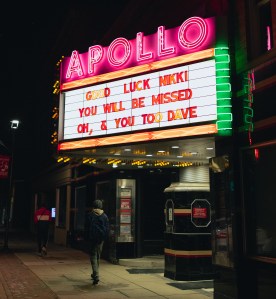
It reminds me of a one-panel comic that I saw some time ago: a person lying in bed, eyes wide, a theater marquis over their head that reads in bright lights: PLAYING AT 3AM! EVERYTHING YOU SAID AT THE PARTY LAST NIGHT! [A cartoon in the same general vein by Hilary Fitzgerald Campbell appeared in The New Yorker on Jan 21, 2019 (#11 of 15), but I’m not posting it here because they might be touchy about copyright infringement.]
In the middle of the night, being hit with an glaring memory of something that sends your stress levels rocketing…goodbye sleep. (Photo by Gregory Brainard on Unsplash)
How many of us have had a similar experience? I occasionally find myself tortured by things I said or did even decades ago. DECADES! Or they could have happened yesterday. A simple image can trigger shame, embarrassment or regret that feels real and vivid and, yes, while this generally happens at night for me, it’s certainly not limited to that time.
How odd that we give the past so much power over us when it’s not even real anymore. While we’re shaped by our experiences, allowing ourselves to be haunted by them serves no purpose, especially not once we’ve learned whatever we needed to from them.
Soooo, one early morning in the darkness I found a way to add some perspective to the memories that bully me: I started thinking of them as echoes, wispy harmless reminders of what happened.
And there in bed at 3am, I am safe. My body is not in the imagined situation, it’s under the covers, lying on my mattress. Here is where mindfulness is so helpful because it brings me back to the present. The past is echoing, trying to get my attention. But the more aware I am of where I am in space currently, the easier it is to step back and simply observe the echoes, watching them fade away.
I’m making this sound simple, I know–as with all the things that bounce around inside our heads, taming a stressful memory is not necessarily easy. But identifying it as just an echo has been remarkably helpful for me. It has provided a different viewing angle that enabled my perspective to shift.
Echo…echo…echo…
Thinking of thoughts as echoes can dispell them, but simultaneously focusing on a sense helps ground us in reality. (Photo by Mariana Rascão on Unsplash)
I’m not there now, those other people are not there now, that event is not happening now–just because I remember it so vividly doesn’t mean that anyone else does. And most of the time, I don’t remember it either. Only during the limited, wee-morning-hour viewing window during which it appears because I’m susceptible to the tickle of anxiety.
The senses can bring me back to reality. Opening the eyes, feeling where my body contacts the surface that it’s on, hearing the hum of a fan or sound machine. Anything occuring in the present anchors me to what’s going on now.
And in the present, that echo cannot hurt me because it’s just an airy thought.
Of course, this all comes back to the basic idea that the more we practice presence, the easier it will be to minimize the impact of thoughts that unsettle us. It may take some exploration to find what works best for you, but in the end, being patient and consistent will be the best way to calm your mind and bring you back to what is real at the moment.
So, something occurred to me as I was dealing with stress about a work project…and then got news of changes that may require us to quickly move from the place in which we’ve lived for over ten years.
I am experiencing two different textures of anxieties. I’ve heard people discuss chronic and acute anxiety, but I would characterize the way I experience anxiety differently.
The first anxiety may wear you down but won’t require a complete change in your life. Photo by Aiony Haust on Unsplash
The first is anxiety about what may happen or anxiety about what has taken place in the past and I can’t change. That encompasses stressful events that you need to work through, like a job-related project, which requires holding on and managing. It’s more of a chronic type of stress even though it might be time-limited. There are things out of my control or, in the case or what has already taken place, there’s no going back. It doesn’t qualify as life-changing as it may intensify and relax depending on conditions.
The second, however, is anxiety about something that *is* life changing. Those of us who have been handed a cancer diagnosis know what it feels like. It means that the future will look dramatically different from what we expected it be. Other examples are a death of a loved one or losing everything in a natural disaster. A sudden involuntary change in your living situation. This requires letting go and radically recalculating what you’ve become very used to. It can be very difficult to do, especially for those of us who like stability in our lives.
The first anxiety is exhausting. The second is terrifying. Having experienced both, I can definitively state that the first anxiety pales in comparison to the second. In fact, in the face of the second anxiety we may actually let go of the first completely and wonder why it ever bothered us.
The second anxiety is more intense and will alter life as you currently know it. Photo by Ann on Unsplash
At the same time, as terrible as it may be, the second anxiety offers us a perspective and clarity that we would be hard pressed to accept as quickly any other way.
I do not wish either of these anxieties on anyone, but if there’s a bright side to them it’s that the same type of mindfulness practice that helps us deal with the anxiety of the first kind will also help when the expectation-smashing heaviness of the second anxiety hits.
Although you may still wake in the middle of the night, heart racing and wishing things had not changed, a consistent mindfulness meditation practice will provide you with the tools to smooth the jagged edges of rumination and fear, slowing the breathing and with it the heart rate, even in the presence of frightening thoughts.
~~~~~~~~~~~~~~~~~~~~~~~
Of course, since this is a mindfulness blog in addition to being cancer-related, I cannot resist talking about one of the most effective techniques that I’ve found for calming myself: belly breathing.
Start by simply breathing deeply into the belly, as anxiety often results in shallow breaths. The deeper the inhale, the more air you will have for the exhale – try matching inhales and exhales in length. It won’t happen immediately. Give it time.
Create a breathing cycle and keep going. Establish a breathing practice and stick with it. Photo by Brett Jordan on Unsplash
Keep breathing into the belly, fully engaging the diaphragm, allowing it to drop and make space for your lungs.
As you do this, focus on the breath. The uncalm thoughts can still be there, but gently allow them to sit on the sidelines for now. I used to try to completely push them away, but they would bob back up to the surface like a balloon pulled under water, bringing the intensity of my anxiety back with it.
So let them be there…keep one eye on them if necessary but give your breath the main stage.
Once the inhales and exhales have evened out in length, insert a short pause between them. Breathe in … pause … breathe out … pause. Just a little stop to elongate the cycle. Consistently breathing into your belly.
Transition to full box breathing, where the inhales, exhales and pauses are all equal in length. If you get very comfortable doing this, for a little extra, try to make the exhales just a touch longer than the inhales.
Or if it gets tiring, simply try to make your exhales a little bit longer than your inhales and dispense with the pauses altogether.
Maintain this type of soothing, intentional breathing for a few minutes or longer, depending on how your body is responding or what your nervous system needs today.
Truly, you don’t have to do this perfectly or adhere to a specific count. Simply focusing on your breath and slowing your breathing will help immeasureably in making space for your thoughts so that you can back away a bit and survey the scene without feeling claustrophobic, no matter which anxiety you’re dealing with at the moment.
About a year or so before I felt a cancerous lump in my breast, I was tasked with planning an academic conference, which I’d never done before. The project was running behind schedule, procedures had changed and I felt panicky and lost.
As a result, I was working seven days a week with most workdays lasting into the night. This was in addition to having to break in the early afternoon to pick up my children from school, then continuing work from home.
Everything was a rush and I had a constant lightheaded feeling.
When you have the least time to move is when you need to move the most! Photo by niu niu on Unsplash
Most non-work activities fell by the wayside (Cooking? Cleaning? What’s that?). But the most pivotal of these was exercise. I’d been through highly stressful situations before but always had the opportunity to work off my anxiety. This time there was none of that.
Anxiety sat like a boulder in my stomach. I could feel my brain buzzing from the stress but couldn’t do anything about it. There was SO MUCH to take care of that my work-life balance was non-existent. There was only work, and this went on for weeks. My mental well-being plummeted, sleep was filled with night sweats…and the agony of not having the time to work out magnified my anxiety.
We know how bad sitting is for you physically, but not everyone is aware of the psychological ramifications of being sedentary, especially when it comes to managing stress. I found it so ironic that after my tumor was confirmed, the doctors estimated that it had started developing a year or so prior…during the time that I felt my life falling apart.
Stress did not cause my tumor. But it didn’t help my body counter it either.
~~~~~~~~~~~~~~~~
I personally am convinced that there’s no healthier, more positive way to tame anxiety than exercise. COVID’s remote work situation demonstrated to me that I feel much saner when I can stick a workout into the middle of my day, even if it lengthens my workday a bit, and the increased blood flow helps with my mood and productivity.
There is a Zen saying: “If you don’t have time to meditate for an hour everyday, you should meditate for two hours.” I believe that this saying also holds true if you substitute the word “exercise” for “meditate”.
Find movement that you enjoy and then stick it into your day. Photo by Ahmad Odeh on Unsplash
Obviously, I’m not suggesting that you do either for two hours. The idea is that when you are overwhelmed with responsibilities and stress, that is an indication that you need meditation AND exercise all the more.
Frankly, it’s also time to reevaluate your life priorities, but that can be difficult.
How to get more movement into your day? Based on the research* that I’ve seen, it’s best to take breaks about every half hour. That might seem impossible for some people and some work situations, but do the best you can. The last thing you need is more pressure on yourself.
Even just standing up and stretching is better than sitting glued to your seat. If you can walk around, take the long way to the bathroom. Hike up and down the stairs. Breathe deeply. Start there and you can add more later, keeping in mind that energy begets energy: the less you move, the harder it will be to get started; the more you move, the easier.
If you have time for a considerably longer break and don’t yet have an established training program, start by picking a rhythmic movement like walking, running, cycling or swimming and lose yourself in the rocking motion. Not only does that give you exercise, but the gentle back-and-forth is soothing for the nervous system.
Most importantly, make the experience a positive one.
My personal recipe for mind-happy exercise is: (1) indoor rowing (for the rhythm and cardio load), (2) strength training (with a focus on each repetition) and of course (3) yoga (for deep breathing and unwinding the stressed-out body). But these recipes will vary for every individual. What’s yours?
*I had a choice between getting my workout and meditation in or digging up these references. Guess which I chose? 😉 I’ll be back with the science in another post.
A little over a week ago, I had another oncological appointment. This one marked my six years since completing chemo for triple positive breast cancer.
Honestly, at this point, the conversation between my doctor and myself has turned much more social. There are not as many pressing matters to discuss. My bloodwork is normal and boring. I don’t have side effects to speak of, at least not any that I can attribute solely to cancer treatment (hello, menopause, ugh). And even my oncologist is openly positive about my future.
Wow, have things changed.
Six years ago I was dealing with the effects of a nasty fingernail infection that landed me in the ER (be forewarned before clicking that link: it was pretty gross!). But for this appointment, I was asking my doc how HE was feeling.
Our conversations have become pleasantly mundane and I enjoy catching up with him. Also, I am panicking less.
As a cancer survivor, I do not like surprises. When my doc says to schedule an exam, I’m going to do it fast!
Much less. Even when I do lapse into micro-panic, I have accompanying moments of calm. That is a definite improvement. At the same time, cancer is cancer. So when my oncologist noticed that I hadn’t had a pelvic exam this year, he told me I needed it. And then before our appointment ended, he repeated that I should get one.
For a brief instant, my emergency alarms went off.
Maybe it was the fact that he repeated himself and seemed very serious about it. After six years of hypervigilance, I still get unnerved by slight shifts in tone of voice. I think that’s hard-wired in me, seared in via anxiety, even though my days of being a hot stress-mess are behind me.
It’s so tempting to wipe my hands off and pretend that everything is normal, but cancer teaches us that some nasty stuff might be lurking under the surface of, “I’m sure it’s nothing”. My days of innocent ignorance are gone.
So, yeah, I’m fine. Still no recurrence of a cancer in my breasts. Probably not anywhere else either. I’ll remain optimistic and look forward to seeing my oncologist in six months and chatting again.
As I sit at home waiting for the stormy remnants of what used to be Hurricane Hilary to pass by, a bit of reflecting…
There is a saying attributed to Buddha: “The root of all suffering is attachment.”
While there is much that can be and has been written about this, I’d like to bring it down to something very concrete in my life.
It seems so simple, this letting go of our expectations. But we humans are hard-wired not to do that!
One of the wonderful attributes that we as humans have is the ability to plan. Yes, that’s been evidenced in very clever animals, but humans take it to a whole new level.
Where that incredible gift fails us is that in the process of planning, our goals and expectations become very real in our minds, and if they don’t play out as we had anticipated…well, sometimes we don’t deal with the disappointment well.
For instance, in such situations I experience stress and anxiety. Others may react with anger and frustration.
Regardless of the outlet (whether handwringing or yelling), it’s safe to say that the outcome is not pleasant for anyone. And yet letting go is hard when we are really counting on the expectation being realized. Or perhaps even worse, when we get lost in thoughts of how things could have been.
Consider this scenario: let’s say that following a leak in our apartment and subsequent slow repair process, two months later our water-damaged kitchen cabinets haven’t yet been replaced.
But wait, I get word that the cabinets are coming finally coming in this Friday, August 25th and will be installed the following Monday (28th)! Expectation established! And it’s not a small one because most of our kitchen and the entire dining room have been sitting in the living room area for over eight weeks.
Oh, how difficult it is to sit with what’s happening in the present moment — we’re always looking to see what’s up ahead or somewhere in the past. The greatest peace I’ve ever felt is to simply be here.
WOW, do I want this to get fixed! We have a house guest arriving on Wednesday the 30th who is supposed to sleep in the living room. Weeks ago, when she arranged to visit, I was sure that all the repairs to our apartment would have been done long ago. But now, between the cabinet installation and her arrival, I don’t have a lot of time to clear out the mess and get everything back in its place.
I cannot let go of the need for everything to go smoothly. But while I’m struggling with the burden of that need, I’m simultaneously living through the stress of, “oh no, what if it doesn’t work out that way???”
So there you go, a double-whammy. All this because although I know better, I latch on to how I want/need things to be. Either expecting perfect success or total disaster.
Letting go will never be as easy to do as it is to talk about. But in my brightest moments, I am able to step outside the confines of my thinking, move out of myself and get perspective on the present situation, accepting that I cannot predict and shouldn’t expect too deeply. That’s when I experience the highest level of calmness.
And then, as will happen, I forget and sink back into my small, highly personal mind, where I once again cling to having things be a certain way.
It’s hard to believe that six years ago I was a week and a half away from my final chemo infusion, in the thick of being a cancer patient with no idea of what tomorrow would bring.
Cancer survivorship used to be a whole lotta “looking over your shoulder” for the next thing to hit.
I also thought that I’d live the rest of my life, however much or little of it there was left, in fear, always looking over my shoulder to see if cancer was close behind. In fact, after my active treatment was over, I expected that my anxiety would increase because I imagined that whatever had triggered my tumor growth would again be unleashed and ready to attack my again.
And when I had to stop aromatase inhibitors early due to side effects, I envisioned even more terror because I wouldn’t have the medication’s protection anymore.
None of this suggested that I would have a very pleasant future. Either I would get cancer again…or I’d be consumed by worry over getting cancer again.
Reality turned out to be quite different.
The more (1) I practiced being present, coupled with the (2) increasing distance between my last dose and today, the easier it has become. Now, that might sound like a no-brainer, but it was news to me.
And I don’t know exactly when I turned the corner on my fear but it was probably after the worst letrozole side effects ceased and I was able to reflect on and accept that cancer happened and now I was moving past it.
It took years to get to that point, but it would have probably come sooner if I hadn’t convinced myself that I’d never get there.
And how are things different now? I don’t think of cancer every minute of every day. And when I do think about it, it doesn’t seem as daunting.
So far, so good.
I realized this after meeting a cancer survivor who works at a store that I frequent. She revealed that she’d just received her three-year “all-clear”. The relief on her face was unmistakable.
And it struck me that I used to have that incredible sense of gratitude too. And I still kind of do for a short bit, but it fades quickly as I turn my focus to the rest of my daily responsibilities.
Yes, I am still seeing my oncologist twice a year, having annual 3D mammograms AND the occasional MRI, so it’s less likely that something’s going to sneak up on me. But the concern is no longer as all-encompassing because it doesn’t feel as likely.
Of course, I could be kidding myself. Even after six-plus years I know that every set of scan results is a door to either “no evidence of disease (NED)” or “we’ll get you in to see the oncologist ASAP”. So far I keep going through the NED door…and it keeps opening onto a bright day.
In the midst of taking things for granted, it’s nice to stop and think about that.
As the saga of our building’s leaky pipes continues, this experience reminds me of some of the best advice I received for getting through my cancer treatment.
How could cancer relate to a plumbing emergency? In how I perceived the news and possible outcomes. My cancer diagnosis was terrifying because I had grown up understanding that the disease meant difficult treatment and a real possibility of death. Now that I was dealing with cancer, I was jumping to conclusions, driven by FEAR.
And the leak in our unit? That meant a huge disruption in our lives as workmen enter and our belongings are piled together. But even more so, FEAR of the future, as we didn’t know the extent of the damage and whether we’d be able to to keep living here.
Getting a first glimpse of restoration. Lost some ceiling, light fixtures and a lot of kitchen cabinets.
The thought of moving brought anxiety about higher rental rates, dealing with belongings after nine years in the same apartment, even simply fear of change and uncertainty.
But that best bit of advice that I mentioned above? I found that it applied well to this situation also. And it goes like this: don’t try to tackle everything at once; take it bit by bit.
When I was diagnosed with cancer, the experience was nothing if not overwhelming. So many new terms, treatment options, possible outcomes. It was too much to handle. Someone I worked with suggested that I deal with things on a day to day basis. Not obsessing about the future, only what I needed to get through for today.
This was not easy for me, as being FEARful came naturally to me. But I understood what he was saying, even if I struggled to actually follow this advice at the time.
As with cancer, so with plumbing. My mind had already “gone there”, struggling to afford another unit (this is an older unit with rent lower than other places around us), staying up day and night to pack. Ending up in an even worse situation with inconsiderate neighbors…
But reality was not like that.
Behold, the FORCE AIR 2000EC! This monstrosity is the heart of the asbestos abatement operation. The workmen couldn’t fit it back in their truck so we’re babysitting it for a couple of days. Also, it looks like it was built by orks, but that has nothing to do with anything.
Within a weekend we had moved much of the kitchen and dining area. And really overhauled our possessions — even something as complicated as draining our 20-gallon fishtank and relocating its inhabitants to my husband’s office was not as difficult as anticipated.
I had time. I had time to move things, I had time to reorganize, to declutter, to stop and think about what was next. I had time because it wasn’t all happening at once. Stopping and breathing and noticing all the space around gave me space inside my head.
Discussions with our landlady suggested that we would take it one day at a time. No one was throwing in the towel yet…
…and even if the worst case scenario happened and we had to move, there were other places that were available (all with air conditioning, which we don’t currently have), and the rental cost would have been similar to what we pay now. In some cases the places were newer and most allowed pets (!), which I’ve been longing for.
All of a sudden, things didn’t look that bad. The options seemed promising.
Taking it bit by bit gave back a sense of control. All those fears slowly fell away.
And now, I find myself hovering with acceptance. Not landing on an expectation that THIS or THAT will happen. I don’t know what will happen and I’m finding a comfortable place to simply hang here, not gripping or holding on or needing for anything to be different.