Stress…is not my favorite thing. In fact, when it results in anxiety it is absolutely horrible.
But what if you were to take a stressful episode and view it as an alert to interrupt the cascade of reactions that you are in the middle of.
Instead of allowing stress to take on the runaway locomotive feel, it would serve as a time-out flag, a warning of sorts that right *now* is the time to take a short break, reshift your focus, resettle your body and release some tension.
In order for this to be more effective, it helps to actually notice the stress building. That can be a task in itself as we can get swept up and carried away with intense feelings and not realize what’s happened until we’re in the middle of it. But no matter, wherever you are when you become aware that you are in desperate need of a calming break, just take it.
If you know that the effect that stress has on you is unsettling, don’t tell yourself you don’t have time. Don’t say that you’ll do it later. Don’t try to convince yourself that what your body is telling you is “not that bad” and that you can “work through it”. Just do it.
Use that opportunity as a reward to immediately focus on your hands or feet, notice where they are at that moment and then take a deep breath with an extended exhale. Maybe you have time for only one breath, that’s okay. Focus on it as if it’s the only thing in the world. This doesn’t have to be a ten-minute meditation session. It’s just a break from the craziness of the day to show your frazzled nerves some much-needed love.
Looking at stress this way takes the teeth out of the effects that it has on you. Yes, it may take a while to re-learn your reaction to the heart-pounding and stomach-churning, and while the relief might not be 100%, it’s definitely an improvement.
The best thing is, the more often that you do it, the more you will re-wire your brain to accept stress merely as a signal that your nervous system is asking you to help it release some steam, and not anything scarier than that.
Seems like a big thing in hair these days is the concept of “embracing your gray”. You can see it adopted by both celebrities and the average woman on the street. And I respect that, as accepting your gray hair is a positive change from the mindset that we should erase all signs of aging as if older people don’t exist and older women have no value.
You might be surprised to learn, therefore, that some months ago, I started coloring my hair blonde, my original color.
Why would I do that?
Because some of the collateral damage from going through cancer treatment was that I was pushed through sudden physical changes to the point that I could not recognize myself in the mirror.
It literally felt like I lost my sense of self.
Let me back up a bit: chemotherapy obviously brings on hair loss, but it’s not just the hair on your head. It’s also eyelashes and eyebrows, and surprise surprise, due to their relative slow growth as compared to your head hair, these last two might continue falling out after you’ve finished treatment. Just when you think you might be on the road to getting back to “normal”, your face may become even more foreign-looking.
And then there’s the speed with which your hair grows back. I kind of thought my follicles would resume functioning after the side effects from my last chemo faded away. Maybe that happens to other people, but for me, it took about three months before I started to even notice regrowth. This was in part due to the fact that my hair came back white even thought I was only 51 years old (thanks, genetics), so the new hairs were harder to spot.
Pastel pink hair was very pretty and I got into it for a while. But it was not the real me. (Photo by laura adai on Unsplash)
It took a long time to grow my hair out because I kept cutting it to maintain a pixie cut…and then a longer pixie. Cute cuts for sure, but all the different iterations that my hairstyles went through were SO different from what I had worn pre-cancer.
As a result, even though I was years out from chemo, I was still struggling to recognize myself. During COVID lockdown, I dyed my hair pastel pink a number of times, even tried pastel purple (which I hated). After a couple of years of this I stopped with the wild colors because as fun as they were, they were so different and so far away from the real “me” that had been wrenched from normal life and thrust into cancer treatment.
It wasn’t until about 7 years out of chemo, I decided to try growing out my hair. Just a bit, into a bob. And FINALLY, when I shook my head, I felt movement at the back of my head! Up until that point, I hadn’t realized what a difference it would make psychologically. I was shocked to walk by a mirror and actually see a familiar face! And with some very gentle semi-permanent color, I found myself again.
After 9 years of stumbling around, lamenting the loss of my self to cancer treatment, I got her back. Coloring my hair is less about what age I am and more about getting myself back on even footing after feeling off-kilter for almost a decade.
It also doesn’t help that my hair turned white before its time.
I admit that when I let my hair stay white, people automatically identify me as way older than I am. One gentleman assumed that I was my husband’s mother. His MOTHER! No matter who you are, I cannot imagine any woman not caring that she has been mistaken for her spouse’s parent!
For me, that mislabeling was particularly difficult. It came at a point that I felt very distant from my husband and children. Dealing with a lot of tiredness, often the first in the family to go to bed while every one else was still up. I felt like I was being erased from their lives, watching them engage in activities that I should have participated in. A heavy loneliness set in.
It hurt a lot. For a long while, I thought that this was going to be what the rest of my life would look like.
I am delighted that this has not been the case. Time marches on and brings changes, once again. My body has continued to strengthen. Familial bonds have been revitalized. Attitude has improved. And while it’s not the greatest factor in this turnaround, enjoying a head full of blonde hair again has helped.
Following up on last week’s post where I wrote about the gradual effects of practicing mindfulness and meditation, I wanted to briefly focus on one aspect of this.
It has to do with the process of insulating yourself from situational stressors and the anxiety that accompanies them. These types of stressors have plagued me for a large part of my life.
I’m talking about dealing with, say, bad news that could affect my future. It used to be that an uneasy feeing would overtake me, starting in my gut. Nausea was the most prominent symptom and it would wash over me, with anxiety bulding a nest in my head. From there, my brain would promptly resuscitate the anxiety if it started to fade, like some maniacal defibrillator.
It was an uncomfortably electric feeling, like getting zapped over and over again.
Now, it’s a little different, and it has to do with the practice I’ve had staying present. Yes, I experience the initial jolt of anxiety, as one would expect. But as the day passes, the absolute intensity of these feelings fades more quickly. And they’re less likely to recur as strongly.
Focusing on the present moment means that your thoughts stay here. And in doing so, it’s easier to compartmentalize the feelings, keeping them further away from your face. They are still around—we are not going to make them suddenly disappear—but they are manageable and somewhat muted.
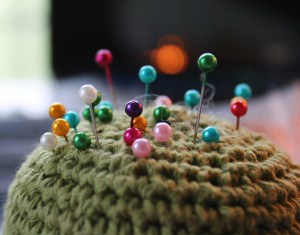
This presence in the now helps you realize that where you are in this very moment is safe. This one point in time keeps you up and out of potential future and past fears that you might otherwise get lost in. You can perch on this point like you would on the head of a pin (admittedly, this might take some imagination). And so you can hop, moment to moment, noting that things are still okay.
Again, those worries continue to circulate in the background, but they are there and not here now. And all of this gives you space to breathe.
Staying in the present is like perching on the head of a pin, a single moment in time. (Photo by Sarah Dao on Unsplash)
Interestingly enough, one suggestion for people who are habitual ruminators is setting aside about 10 minutes every day for “worry time”. This is time that you allow yourself to go through all the concerns that you have with the understanding that once your time is up, you set aside the worries until the next day’s session.
I have personally never tried it as I’m not sure it would work with my tendencies, but it is considered an effective strategy for many.
For now, I am consistently returning to the present and compartmentalizing effectively, even bringing in some soothing stories when I need a more dramatic focus shift. Of course, this is not meant to “fool” me into thinking everything is peachy. I’m simply allowing the space I need to keep anxious thoughts from taking over.