What I Learned By Feeding Virtual Fish

I wrote my previous post about Zen Koi 2 so that I could write you this one.

You’d think that with a lovely mindful smartphone game where there’s limited stress and little competition, I’d be able to sink into peaceful bliss every time I played. Oh, but no. After I fell in love with Zen Koi 2, I found myself engaging in rather unmindful behaviors.

No stress? I’ll create it! All I needed to do was swim my delightfully colorful koi around and nab a little morsel here and there. It wasn’t long before that turned into frantic darting around the pond, frustrated by the prey I wasn’t fast enough to easily catch, annoyed by lack of maneuverability (these abilities improve as you level up), incensed when a spiny pufferfish blocked my path or spikey plants slowed me down. Instead of creating space between myself and the game, I was sucked into it and treading virtual water frantically.

Mind you, there’s no time limit on playing this game, no detriment to your koi if you spend a lot of time in one area. The prey items never run out. All you need is patience…and a little perspective.
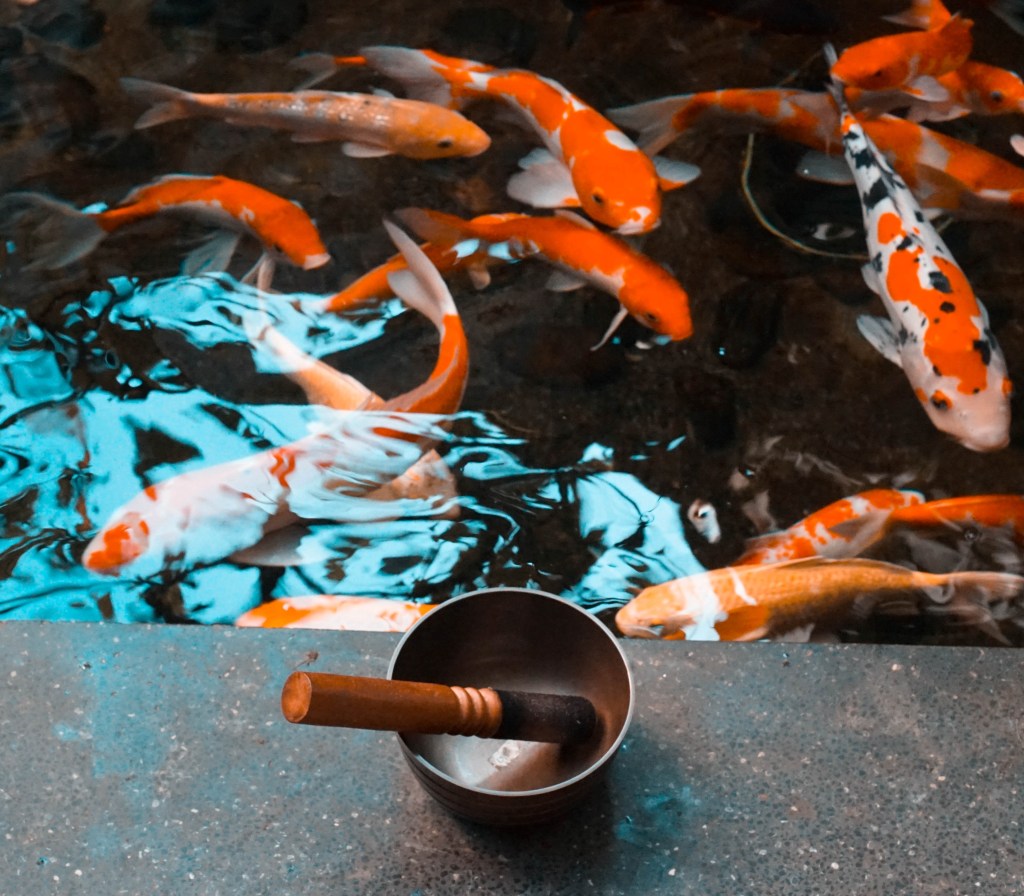
I needed more zen in my Zen Koi 2.

I had trouble releasing newly hatched koi, wanting to keep them in my separate, personal pond (which has very limited space), so that I could play with them again. All this, even though once a koi is hatched is it in your collection permanently, and if you release it, you can easily clone it and swim with it once more. So there’s absolutely no need to hold on. But I was grasping, unable to let go. My behavior didn’t make sense.

It really wasn’t until I found myself clenching my jaws and gripping my phone that I dawned on me that I wasn’t enjoying this. I was striving for the next level. What I had at the moment wasn’t good enough, I was always trying to increase my koi’s abilities or get to the next sigil. I wasn’t enjoying the beauty of the little fish I had now. As soon as a mating fish appeared, I started drawing Punnett squares in my head, calculating what color combinations would result, and whether I potentially needed the hatchling to complete a collection.

Clearly, this sort of behavior is *not* what I’m going for when practicing mindfulness. In fact, it is completely antithetical to it. The striving, grasping, inability to focus on “now” was very telling. These are, of course, digital creatures, color pixels on the screen. It was my mind that made them real, my mind that created the anxiety around the game. It was my mind that gave the game so much emotional power over me.

So much grasping. I can’t get back what I lost by holding on to things that can’t be.

So I was thinking. Isn’t that kind of like my relationship with my fears? They too are not real, and it’s likely that a majority of them will never be real. And yet I attach to them and let them drag me around, frustrating me, agitating me, and in general, making me miserable.

For me, my cancer “story” was about loss. Loss of hair, loss of energy, loss of hope, loss of time to do more in my life. And the more I had felt I lost, the more I clung to how I wanted things to be. But they couldn’t be like that. I had already realized that, but it wasn’t until I played that innocent little smartphone game that I saw how powerful my attachment was to the things I really needed to release.

So, the next time I played with my fish, I gave myself distance. When I found myself clinging, I took a deep breath and let go. I let go of the newly hatched koi, I let go of the need to be more than I already am, I let go of the fears about tomorrow. And nothing bad happened. My koi was still peacefully traversing its little pond. I was still sitting on the couch, phone in hand, just like before. It was a pleasantly grounding realization.

Spiny pufferfish be damned. I think I can do this.

~~~~~~~~~~~~~~~~

My need to hold on is like my cancer journey: still a work in progress. I don’t know what the future holds. But if I can make this moment a little more pleasant instead of mourning all my losses, then I will consider that a victory.
Breast Changes, Revisted

One of the most popular posts on this site has been, “I Didn’t Expect THAT: Breast Changes“, so I thought it might be useful to revisit the subject now after a few years have passed since my initial lumpectomy for breast cancer.

Before my surgery, I had been frustrated by the lack of information about how much tissue would be removed along with my tumor. Or maybe I was just too afraid to search. In either case, I had prepared myself to lose a good chunk of my left breast. All the “after” photos of lumpectomies that I found on the internet were not pretty.

However, my tumor was only 1.6cm at its longest, and was on the outer upper quadrant of breast, and this turned out to offer me the best of all possibilities. There was amazingly little breast size lost. I was impressed. So was my surgeon.

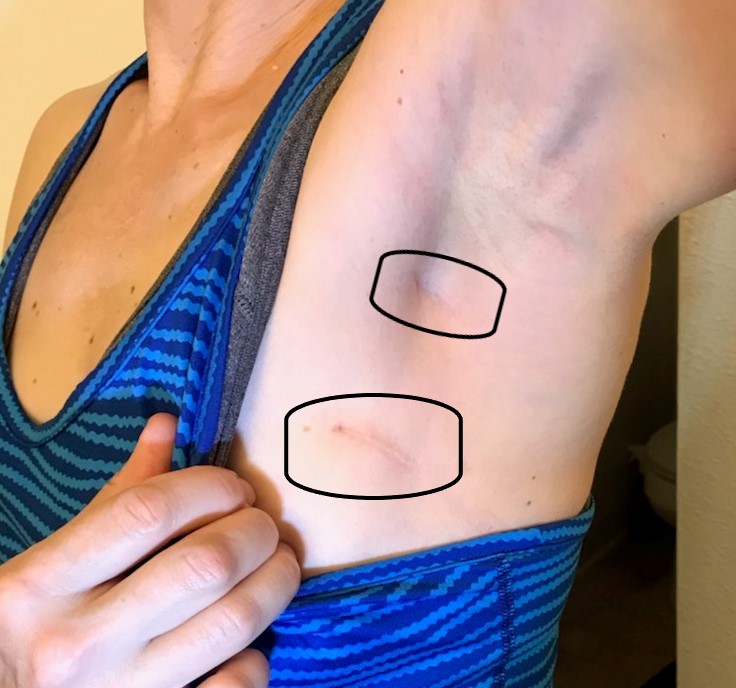
So, fast forward to now, three and a half years down the road. The scars, one for the lumpectomy and the other for lymph node excision, remain very uninteresting in a good way. Only three sentinel lymph nodes were removed, and the scar for that sits up in my armpit. The lumpectomy scar is situated a bit further down and into the side of my breast. But it’s not obvious.

This is the original photo from my post on Nov 1, 2018, already over a year and a half since my surgery.
Three and a half years after surgery, today: the top scar is the lymph node excision, the bottom one is the lumpectomy.

The biggest issue I have had with the lumpectomy scar is that the scar tissue there feels like a biggish lump itself. Not frightening for me anymore, but when I went to a new gynecologist who, I suspect, forgot that I had had breast cancer (HOW? That’s the main thing I talked about!), she felt that area and said, “Oh, there’s something here” in that ‘I’m-going-to-say-something-scary-in-a-calm-voice’ kind of way.

Yes, it was just my scar tissue, but for a split-second I wanted to let myself freak out. Didn’t, but wanted to.

Sorry about the headlights…I just wanted to show how “normal” the shape of my breasts is. The weird thing is that it’s actually my left breast that is a bit BIGGER now. Who would have expected that? (NOTE: my left breast is also turned towards the camera slightly, accentuating its size.)

But the bottom line is, as time has gone by, the scars remain inconspicuous, and if not for the fact that my affected breast is actually a touch firmer and larger than the healthy one, something attributable to radiation treatment, there’s no obvious sign that I had breast cancer.

Not a bad deal considering what could have happened.

Hey Doctors! Before You Give a Cancer Diagnosis…

From time to time, I think back on my cancer experience (who am I kidding, I think about it every single day!) and wonder how things might have gone differently. Generally, I write for the cancer patient, but this post is directed at the doctor who delivers the diagnosis.

So…dear doctors:

Think very carefully about what else you want to tell a new cancer patient right after you tell them that they have cancer. It better not be important, because they’re not going to hear it. Once you deliver the diagnosis, a cancer patient’s executive level cognitive processes freeze, making comprehension difficult. Any further speech sounds like the “wah-wah-wah” talk of the adults in Charlie Brown cartoons.

For example, I was told two things by my radiologist, when he came into the room after he looked at my diagnostic ultrasound: (1) you have cancer, and (2) you’re going to be alright. Guess which one of those points I didn’t remember. I’m sure my doctor was trying to be cheery and supportive, but I can guarantee you it didn’t work.

Let’s face it, no matter how gently a doctor tries to break it to you, being told that you have cancer is devastating. It’s perfectly normal to be blown back by the news because your life is going to change drastically for at least a while, and maybe permanently. But, geez, doc, you should be prepared to repeat the same info at least several times and cut out the unnecessary bits. Your newly-designated cancer patient is going to have to need time to process the news!

Tip to the patient: bring someone with you to your subsequent visits who’s good at taking notes and is on an even keel. I brought my husband but he barely wrote anything down. Turns out, he was just as shocked as I was and wasn’t taking the news any better.

Hey, doc, I get that this is hard on you too. So please don’t think I don’t appreciate what you do (especially these days!). But please consider some of these things before you deliver your next cancer diagnosis. Thanks. 🙂

Following up on that, doc, the next thing that I would suggest is that you not give overly specific responses to questions based on assumptions you’re making. I asked about the recovery time from surgery, since I was terrified by the thought of going under the knife. Mine was early stage breast cancer, and ultimately I had a lumpectomy, but that same radiologist had warned me that recovery would take 4-6 weeks. Up to a month and a half?!? I whimpered something along the lines of, “But I have to work,” at which point he reminded me that my health was more important than my job.

I don’t know where he pulled out such a long recovery time, but being given that sort of time frame compounded my anxiety. Maybe he also said that some people have a shorter recovery time, but of course, I wasn’t processing info well and all I could remember was “4-6 weeks”.

So I would recommend to doctors, (1) if you really don’t know specifics, don’t offer estimates–I was back to work the week after my surgery, btw–and (2) please don’t blow off a patient’s concern about the importance of other aspects of their lives, like going to work. Yes, ultimately, as the saying goes, “if you don’t have your health, you don’t have anything.” But for many of us, if you don’t have a job, you don’t have health insurance! Everything in our lives is interconnected. It’s all important. Please keep that in mind.

Hey, nobody likes to deliver bad news and I know you’re trying your best. But the only thing worse than telling someone they have cancer is being the one it’s being told to. So please, be gentle. You will go home that evening possibly bummed that another one of your patients has cancer.

The patient is going home that evening embarking on one of the most frightening journeys of their life.

Regaining Control Through Mindful Living

As I mentioned in a previous post, I’ve really enjoyed the Coursera course, “Engineering Health: Introduction to Yoga and Physiology“, which I highly recommend. One of the recurring themes of the class that I’ve found particularly relevant is that of effecting incremental and meaningful epigenetic change through yoga and meditation.

The class lectures went through the physiological mechanisms by which this happens, and this information would be reason enough to incorporate mindfulness and breath-to-movement in one’s life. But for someone who’s experienced cancer, there’s something even more important: a sense of control.

For me, the most terrifying part of my cancer diagnosis was the lack of control over what was happening to me. First, my body had turned on me by cultivating a tumor, the ultimate goal of which was to take over my organs and kill me. Then, my doctors were giving me drugs that by design would kill certain parts of me, with the intention of taking out the tumor before it spread to really important parts of me (brain? liver? heart?).

My body was a battleground in the war between my rogue cells and modern medicine. I had to sit there and take collateral damage if I wanted a chance at survival.

Disclaimer: So I feel the need to stress here that we do not yet know how to reliably prevent the formation of cancerous tumors, but there are things that we can do to greatly lessen the risk. I’m willing to bet that managing stress would have a powerful impact on prevention.

While I did begin meditation at that time, had I started learning to deal with my anxiety and accompanying physiological responses years ago, I might have been able to sidestep the disease. There is science to this which I will cover in a later post, but my doctors *hate* it when I postulate possible causes of my tumor since if we could truly pinpoint the cause, we’d be able to cure the disease. However, given what we do know about stress and inflammation, I can guarantee that my stress response did not help in keeping me cancer-free!

In the Coursera class, Dr. Ali Seidenstein (NYU) explains, among other things, how the small positive changes that arise from learning to control the stress response by applying yoga and meditation affect your genetics. And this is key. While you’re born with a certain set of genes, the science of epigenetics describes how you can affect gene activity (think, turning a gene on or off) and thereby have a different outcome from someone else with the same gene.

Finally! Something that *I* can do that provides a rare sense of control in an uncontrollable situation! For a cancer survivor, this offers a nugget of hope to hold on to in the face of continuing medications that may or may not help your survival. Medicine is tested on a variety of individuals but there’s no guarantee that their success will translate into your own (news flash: cancer = no guarantees, period). But knowing that you can engage in behaviors that, when applied over time, will actually benefit you on a genetic level…that, my friends, is priceless.

Making Space for Cancer Emotions

While I myself am celebrating three years since the summer of my chemo for breast cancer, I was shocked to hear of actor Kelly Preston’s death from the disease. It’s a reminder that in an egalitarian way, cancer doesn’t care how famous you are.

I’ve been reading about those who are dealing with late-stage cancer. Most notable for me is actor Shannen Doherty, whom those of my generation remember from “Beverly Hills 90210” (although, admittedly, I didn’t watch the series).

Shannen, along with well-known names like Alex Trebek, Olivia Newton-John, Congressman John Lewis and others have been interviewed by the press. We hear about daunting odds and their strength of character. Anyone battling the late-stages of cancer shows a lot of bravery.

They speak of gratitude, perseverance, patience, a forward-thinking mentality. But as anyone with cancer can tell you, they would rather not be fighting this fight. Yes, there are “bright moments” (and I use that term loosely) that come with learning you have a “serious” cancer diagnosis, but that’s because you find those breaks in the darkness.

Cancer brings powerful emotions, often negative ones. And that’s perfectly okay.

However, I think it’s critical that cancer patients be given the uninterrupted space to talk about the fear and anxiety associated with this situation. It’s not all happy trips to the infusion room as everyone cheers you on. Shannen is quoted as saying, “The unknown is always the scariest part…Is the chemo going to work? Is the radiation going to work? You know, am I going to have to go through this again, or am I going to get secondary cancer? Everything else is manageable. Pain is manageable, you know living without a breast is manageable, it’s the worry of your future and how your future is going to affect the people that you love.”

This is something that must be addressed. When others call you a warrior, they need to understand that you’ve not been given a choice in the matter. And you yourself have a right to feel all the emotions that you feel, whether it’s anger, fear, helplessness or numbness. That must be allowed because it’s real.

Most importantly, no one should tell a patient that they need to only think positive. That is telling them that they shouldn’t feel what they feel. And that’s never a good thing.

So just as Shannen has done and others continue to do, we must accept the weight of the emotions felt by cancer patients, not diminish it. We should hold space for them to express everything they’re feeling. And then actively offer all the support and love that they need.

Revisiting Yoga After Cancer: Finally Coming Around

Decades ago, my introduction to yoga took place in my parents’ library, a small paneled room with wall-to-wall, floor-to-ceiling books. There I found an illustrated guide, replete with black and white photographs of odd contortions and strange nasal flossing. It seemed weird.

Oh, the moves I could do!

I had barely begun elementary school, and at that age was a natural-born yogi, as many young children are. Lotus pose? I could get my legs into position without using my hands. King Pigeon was no big deal, and nothing hurt when I folded myself up. I didn’t have a regular yoga practice at that age, but I would get occasional exposure to yoga moves at school, and I imagined all yogis wore diaper-like pants and lived on mountaintops.

High school provided an opportunity to do more. One of our French teachers practiced yoga, and I took a season of classes with her. Really, I remember little from that time. At that point, I was still limber but not as lanky, and yoga wasn’t particularly exciting. Volleyball was my game and I had no appreciation for how yoga could improve my playing. Had I practiced it properly, yoga could have helped immeasurably and prevented many a lost serve. But I lacked introspection and so barreled on as before.

Yoga resurfaced in my life now and again, but obsessed with more active ways of sweating, I steered away from it. I swam, ran and eventually strength-trained my body into shape. Yoga didn’t have a place in my view of what fitness should be.

Holding poses for a prolonged time? Not for me. Sweating through hot yoga? You’ve got to be kidding. A friend sustained a serious back injury from a yoga teacher who tried to force her into a pose. That was it; I was done with the idea of incorporating yoga into my already packed fitness routine.

Then I got cancer.

And I realized that my mind was victim to free-ranging anxiety. Desperate, I immersed myself in learning to meditate. I know they say that you need to find calm in the midst of chaos, but being thrown into chaos is not the best place to learn to be calm. I limped through cancer treatment and clung to the hope of peace. The only relief came from my love of fitness and drive to exercise as soon as the worst side effects of each infusion had passed.

Still, I pushed yoga away. Not interested. I needed to get my body back to where I’d been pre-cancer, not do slow movements that might tweak something and burned too few calories.

But the more meditation I did, the more mindfully I moved, yoga kept coming up, like a refrain in a song. Movements paired with breath.

I have made space in my life for yoga.

And then, it hit me. Movements paired with breath. I was all about the breath by then. Yoga provided the movements. And I found bliss.

When I opened myself up to yoga and invited it into my workout routine, something magical happened: my body started stretching out. All that tension that I’d carried for decades that had gradually tightened me up started releasing. My fingers found the floor in a forward bend again, and gently brought my palms with them. My heels easily pressed against the ground in a downward dog, with little peddling required. Moves that I could once do became available to me again.

So here’s the thing about breast cancer: after surgery, you lose some mobility in the affected side. Even now, side bends stretching my left side “pull” uncomfortably compared to my right side. Anyone who’s had lymph nodes plucked out of their armpits knows that that area stays tender for a good long time. Often, this brings an imbalance to the body.

My workouts had consisted of pounding myself through rowing, conditioning intervals, strength training with heavy weights and swinging kettlebells around. But without yoga, something critical was missing. Initially, I was afraid that “sacrificing” exercise sessions to yoga would result in faster decline of my physical ability and a push towards a more sedentary existence. Oh, how wrong I was! If anything, yoga has moved me towards vitality, flexibility and a sense of youthfulness that straight strength training had never allowed. Yoga opened up my whole body and allowed it to breathe freely.

What this has offered me is another way to look at how my cancer journey is progressing. After the aches and pains associated with never-ending adjuvant therapies, I admit I felt it was all going to be downhill, and that all I could do was desperately cling to my workout routines as my abilities gradually slipped away. Yoga brought back an element of fitness that I’d forgotten, and now, even though I know that I will be lifting less and rowing slower as time goes on, there is a new, perhaps more gentle world of fitness that I have yet to fully discover.

Finding A Path Through It

There are few things more terrifying than the unknown.

I experienced this with my cancer diagnosis, although it would be the same with any catastrophe that significantly alters your life, such as losing a job when you’re already financially strapped. You’re hit with the news and then…everything stops. It doesn’t matter who else is talking or what other information is relayed, because the gravity of the situation stops up your ears and you hear nothing else.

A powerfully negative event throws up a wall that you cannot see around. When the future is undefined, it can take any form. This is a positive and liberating concept when you’re embarking on a new venture — “the sky’s the limit!” But in the case of something that’s painfully life-changing, our minds race to frightening prospects, often culminating in a terrifying extreme that we can’t see our way out of.

This is where you pause and breathe. Get your facts together and see what your options are. Things get easier when the darkness in front of you parts and you see a path to follow. After my cancer diagnosis, it was when I met with the oncologist who explained the possible variations of my condition, what the treatments would be for each, and yes, even what the potential outcomes were.

Once you get a grip, the climb gets easier.

Sitting there, digesting the information, I finally felt like I had something to hold on to. If the diagnosis was a hulking monolith, smooth and slippery, blocking my way, my doctor’s words gave me handholds with which to climb.

Right then, the future looked more manageable. I still desperately wished that it had been different, but I saw the path through the ordeal and it gave me something to follow as I strode forward.

~~~~~~~~~~~~~~~~~~~~~~~

April 27, 2017 was a Thursday. It was also the day of my first chemo infusion. If you’ve ever gone through chemotherapy, you’ve sat through the full disclosure of all potential side effects. There’s so much that it can be disorienting.

But on that Thursday when my husband and I went to the infusion room, I learned that there was a process. Everything doesn’t hit you at once, you take it in steps as you make your way down the path.

I’m still walking. But at least I’m still walking.

Musings from a Lockdown State

If there’s one thing that the COVID-19 pandemic has illustrated, it’s that all of us on this planet are inextricably interconnected.

In times of disease spread, this may seem like a bad thing, but it’s also an opportunity to pause and reflect that no matter where we live, we all belong to the same species. We are all vulnerable to the coronavirus, no matter whether someone is a high-profile lawmaker, a movie star, a famous athlete or the custodian at an elementary school.

So this is similarly a good time to think about the importance of sharing resources and considering the common good. I’m looking at you, Ms. “I’m-cramming-three-packs-of-toilet-paper-into-my-cart-even-though-the-limit-is-one.” C’mon, don’t be like that. Leave the stampeding to cattle herds. And the rebellious college students who feel the right to crowd beaches for Spring Break celebrations? Time to grow up.

We should be above that. And I believe we are.

As many hiccups as there have been, communities are adjusting to the changing situations at a breakneck pace. My university has ordered all “non-essential” personnel to work from home, within a week, we scrambled to move meetings online and eke out a research plan. Likewise, university courses are transitioning to an online platform, as is my kids’ high school. Restaurants have switched to take-out wherever possible. And my daughter joined her fellow fencers for a ZOOM training session with their coach last night.

This is not to say that this has been effortless. My daughter will probably lose her restaurant job, which means that she won’t have the income to continue fencing, as the classes are a financial burden on our family. But she has a place to live, food to eat and incoming college acceptance letters. Others are losing their livelihood and looking at a far bleaker future. Many of our favorite small businesses are suffering. Therefore, as much gratitude as I have for the ability to work from home and not face immediate financial consequences, I have great compassion for those who are struggling through what could be a long and difficult situation.

Blink and the numbers increase…

And this isn’t even counting the number of infected individuals, some with severe complications. These days, “hot spots” are less about internet connections and more about loss of life. Few saw this coming and we won’t see the end of it for some time to come. My heart goes out to COVID-19 patients, their loved ones and the uncertainties they all face.

At the same time, I’m concerned about a group with which I’m more familiar: newly-diagnosed cancer patients. Getting a cancer diagnosis is frightening enough; getting that diagnosis when the treatment for the disease puts you at significantly higher risk for succumbing to a global pandemic is unimaginably unfair.

This is painful, so I look for the bright spots in the world: the clothing designers distributing patterns for people to make their own masks so they don’t compete with hospitals for supplies, and the designers making gowns, scrubs and face mask covers for doctors; the local seamstresses who are firing up their sewing machines and using their skills in the same way; the alcohol distilleries and perfume producers who are switching to making hand sanitizer; the millions of dollars raised to support intensive care units. All this gives me hope that we are bigger than the virus and we’ll pull ourselves out of this.

Emergency Preparedness, Inside-Out

We have spent the last couple of weeks in various hunting-gathering trips in preparation for a possible coronavirus lockdown. Yes, we got enough toilet paper, but not multiple mega packs, as there is no place to store them. We bought a little extra frozen food, but space is limited in the freezer, just as it is in the fridge.

When in doubt, bidet!

Being a mainly vegetarian family, we consume a lot of fresh fruits and vegetables, and those have to be procured on a frequent basis. Hoarding is not a real possibility at our place: we have no garage, basement or pantry. And I don’t consider a 30-roll pack of TP to be proper living room furniture.

Luckily, we have ample soap and I have the large bottle of hand sanitizer that I kept at work when I was going through chemo (think: it’s been a few years). Also thanks to cancer: a generously-sized box of surgical face masks that we will be dipping into, should one of us start feeling ill.

Finally, in a “clouds parted and a ray of light shone down”-type of serendipitous luck, we found a bag of N95 respirators in the back of our coat closet. Usually one finds old tennis rackets or worn shoes. We find items that someone might strangle us for.

One of my brothers had stocked up on the respirators during the devastating fires in Northern California, only to unload them on us during a visit here. I always complain when he leaves stuff at our place, but I’m feeling much more accepting of it now. My kids are planning to sell them to finance their college educations. (kidding!)

So we’ve prepped as much as we can, for the amount of space that we have. And while it’s not a lot, I believe it’s enough for several weeks.

But where I’m engaging in some serious “hoarding” is greedily protecting my daily meditation time. If there were ever a time to practice mindfulness, it’s now.

This is not the end.

Consider this: during a trip to Costco a week ago, people were going nuts with toilet paper, as if it were a finite commodity and if we didn’t get it now, we’d be wiping our butts with tree leaves and old homework assignments for the rest of our lives.

It’s easy to laugh, but I myself felt a sudden bolt of urgency watching people squeeze nine months’ worth of toilet paper into their cars. It was difficult to resist.

Many people were operating as if with blinders on. At that same Costco, the check-out line for one cashier stretched all the way back to the bakery section. If you’re familiar with these enormous warehouse stores, you know that baked goods are way in the back. That is a crazy-long line!

What those shoppers didn’t realize was that the lines for the other cashiers were only one or two people long. But few people looked through the aisles enough to realize that. They simply saw a line and got in it, assuming that everyone else knew what they were doing.

Clearly, they didn’t

This is a perfect example of the need to slow down, take a deep breath and spend the time to understand what’s going on. In the face of unprecedented events, panic seems like a decent option. But just doing something–ANYTHING–isn’t the same as doing something useful.

Relax. You’ll use less toilet paper that way.

Look, I get it. This is scary. As a cancer survivor, my white blood cell count remains depressed, and although my oncologist doesn’t think I’m in danger of dying from COVID-19, that doesn’t mean I can’t contract it. If I did, maybe it would tax my system more and send me to the hospital. There are so many uncertainties that I have to live with. The best thing I can do is to be mindful of what’s going on, accepting of what I can’t change, and rational about the rest.

So my wish for all of us going through surreal times for which we have no operating instructions is to listen to reputable sources, drop the conspiracy theories, pause and think. Don’t rush simply because everyone else is. Breathe. When this pandemic has subsided, there will be more toilet paper. I promise.

I Didn’t Expect THAT: Chemo Nails

I’ll be honest, I’ve been putting off writing about what chemotherapy did to my fingernails. While I’ve wanted to provide frank accounts of my cancer treatment experience, this particular side effect was nasty, miserable and completely unexpected.

Given that I ultimately decided to post this, there are three points I need to make: (1) be forewarned, there are a number of ugly images on this page; (2) just because it happened to me doesn’t mean that it’s going to happen to you; and (3) I suspect that I could have avoided ending up in the ER, and I’ll explain how at the end.

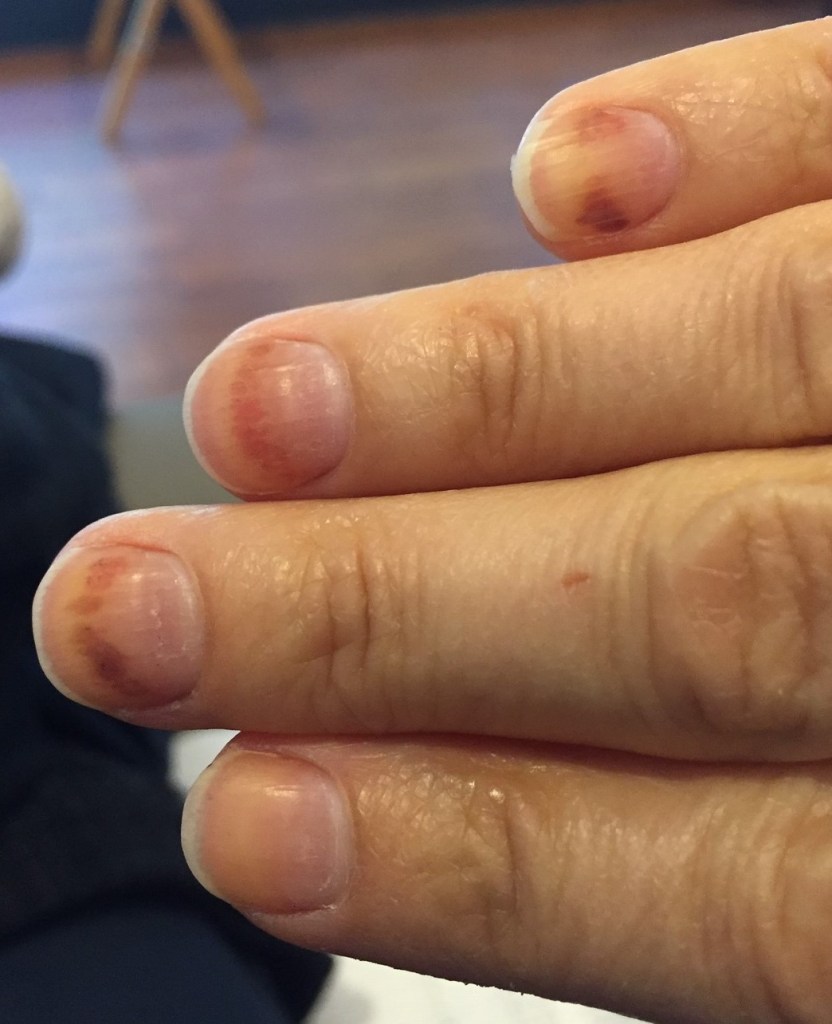
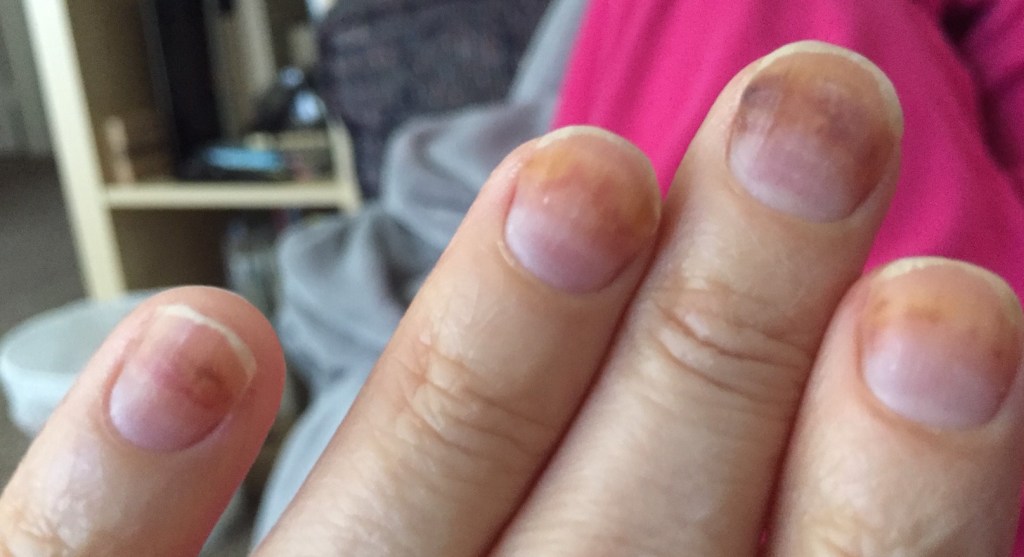
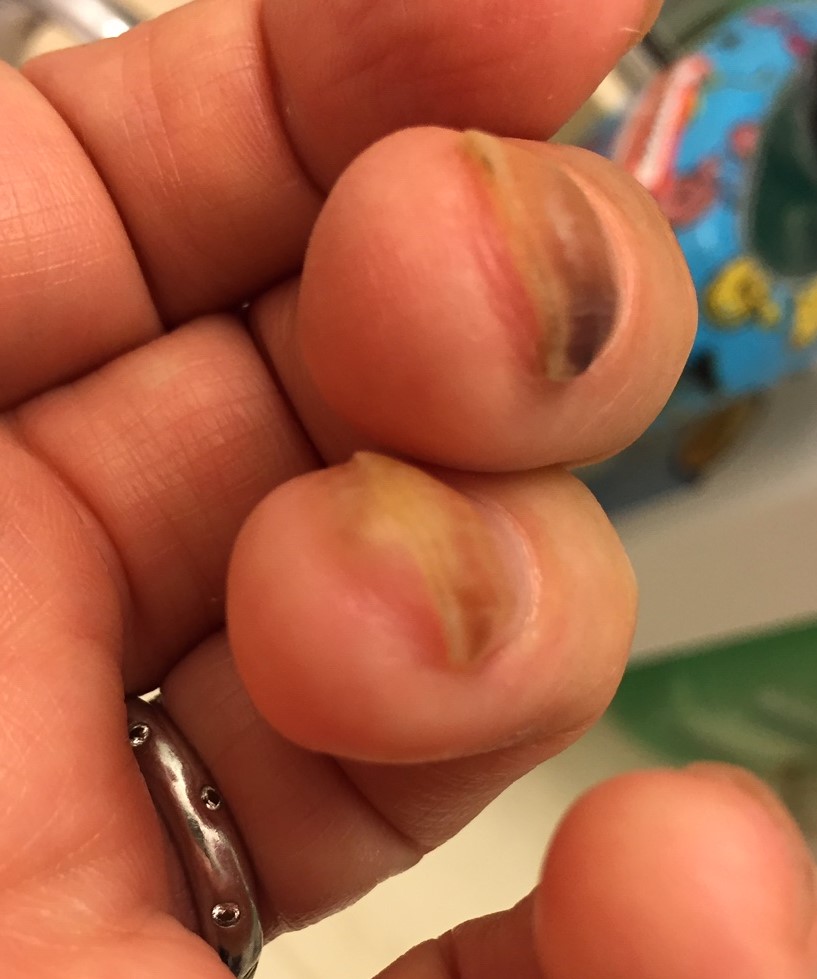
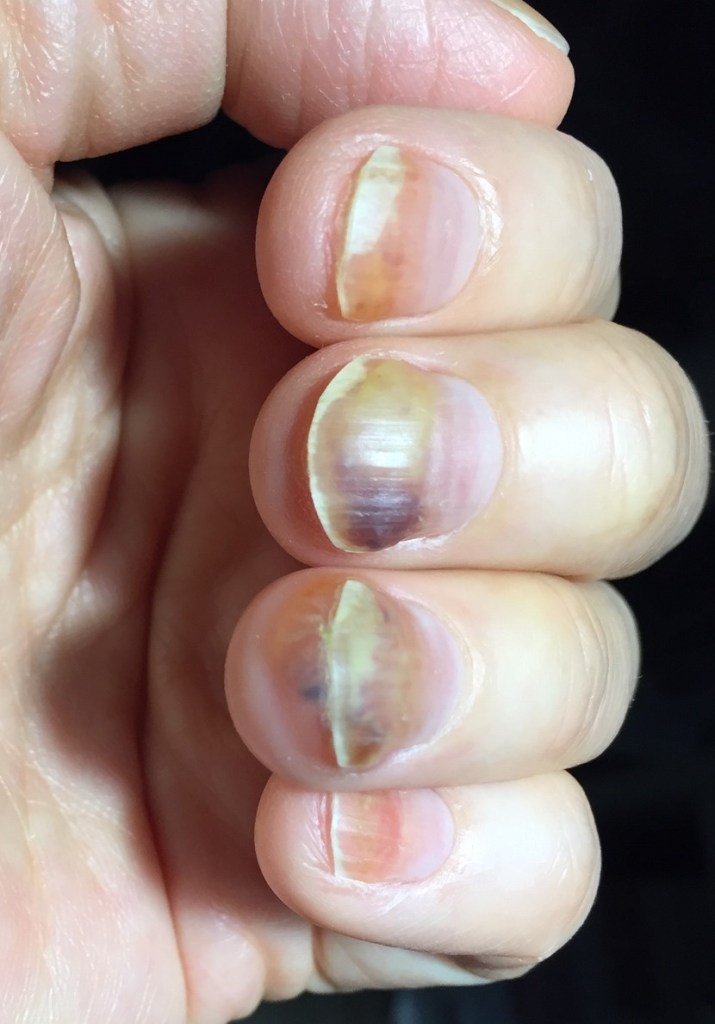
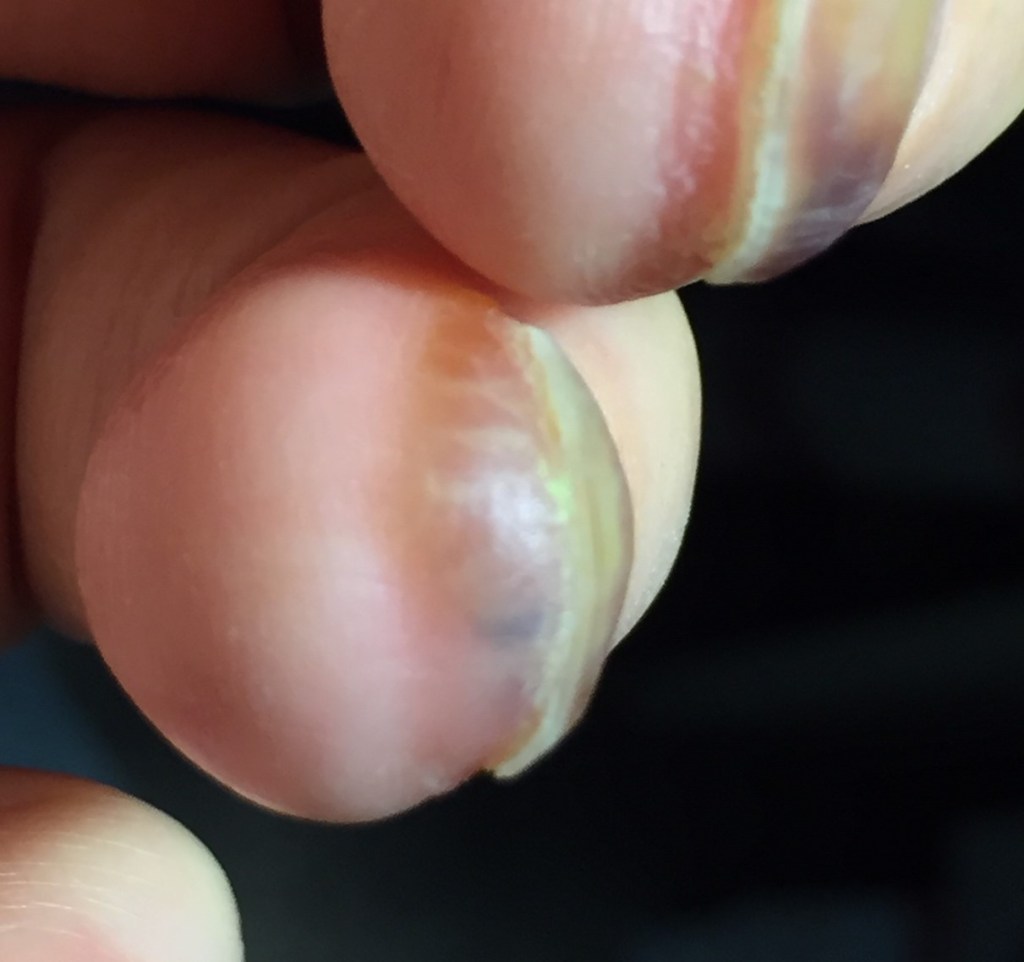
So here it is: the most painful experience associated with my chemotherapy actually came after I was done with chemo, and it deserves a bit of an introduction. You may be aware that how chemo works is by killing off rapidly dividing cells, which is why people lose their hair and the lining of their GI tract. Fingernails are also affected, often turning black, and for some patients, falling off altogether.

July 30, 2017: My left hand’s fingernails at the time of my fourth infusion.
Same day, right hand. The chemo drugs were beginning to leave their mark on my nails.
August 13, 2017: a few days after my sixth and final course of chemo, the nails were looking worse.

My nails didn’t fall off but they really took a beating and ached a lot, almost as if they’d been slammed in a door (not the actual “slam” experience, but the aftermath). Many of them, particularly on the left hand looked like they were starting to detach, retreating into the nail bed.

August 23, 2017: the nails are looking progressively worse.
Same day, right hand.

Several weeks after my last infusion I noticed a little something under the nail of my left ring finger, like a bit of swelling. It didn’t look like much of anything to me, nor to my oncologist during a Friday, August 25 appointment, although he lamented that I might lose that nail.

August 23, 2017: I noticed some swelling under my left ring finger’s nail and figured that it was starting to lift off and that I’d eventually lose it.
Another view of that “bubble” under the nail.
August 25, 2017: HOW could I have possibly NOT been worried about this?
These photos were taken in the evening after my August 25th oncologist’s appointment, and because he hadn’t been immediately alarmed, neither was I. Just my luck, the 25th was a Friday, and good old “I-don’t-want-to-be-a-bother” me figured this type of thing was normal and I’d wait to see how things looked on Monday.

Saturday, August 26, the increased swelling looked like a good-sized bubble under that nail. Sunday was worse, with far more pain. By that night I was in serious agony and even though I had already dubbed one of the nights after my first chemo infusion as the worst of my life, Sunday night definitively stole that title.

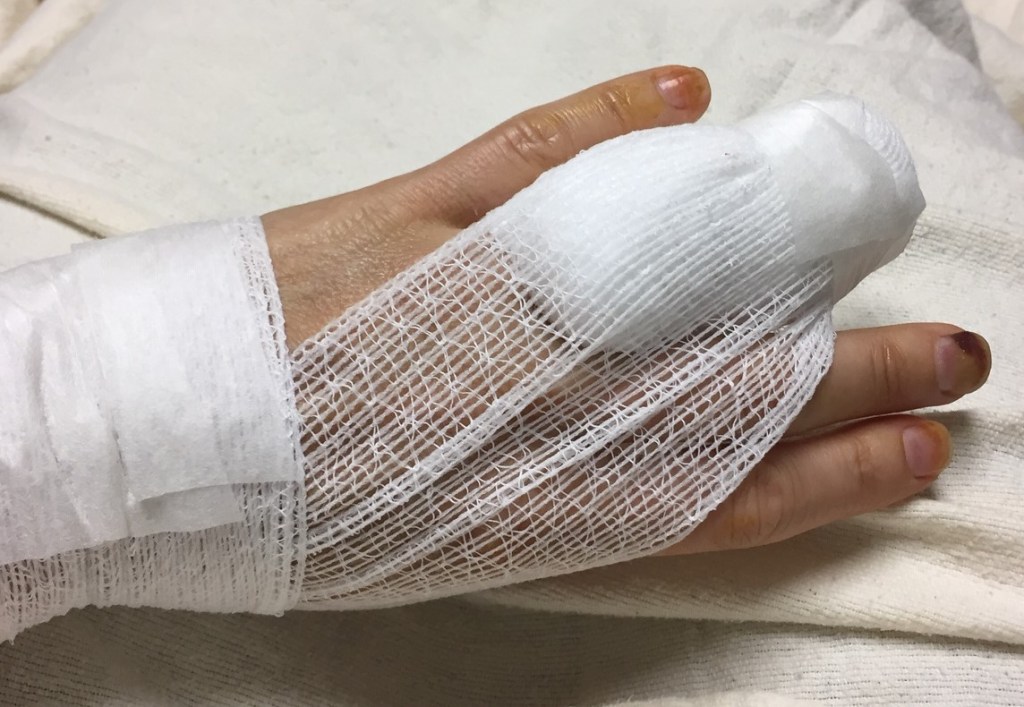
By early Monday morning I was in excruciating pain and paging my oncologist who exclaimed, “Hie thee to the ER!” I had a full-blown infected finger and there was a red line traveling down my hand and into my arm, meaning it was on its way to becoming systemic. I have no idea what I was thinking, not contacting my oncologist over the weekend, but the infection evolved very quickly. Had I known…

August 28, 2017: need I say more? In the space of a couple of days, everything turned nasty. And I do mean, nasty. My nails may have looked ugly before, but nothing compared to this. This was a bad situation getting worse. The pace of deterioration was accelerating and waiting in the ER was excruciatingly painful.

At the ER, healthcare workers winced when they saw my finger. I was miserable by the time they took me in, gave me IV antibiotics and (against my better judgment) morphine, the latter of which did nothing other than make me nauseated by the end of the day. I don’t understand how people get addicted to that stuff.

True relief arrived in the form of three lidocaine shots to the affected area. With the pain gone and the antibiotics at work, the ER doc lanced my poor finger and drained all the pus (no, I did not watch).

August 28, 2017: the worst part is over. And I’m not dead!
This is one week’s worth of antibiotics. Since the doc didn’t know whether the bacteria were gram+ or gram- he decided to err on the side of caution. I was popping pills every few hours.

Once that was done, I was bandaged up, got a couple of prescriptions for 7 days of heavy duty antibiotics and sent on my way.

With all this going on, my right hand wasn’t experiencing the same agony. It was a classic case of “one hand didn’t know what the other hand was doing”. My right was living in blissful ignorance.

So here are two interesting points: (1) even after all this, I did not lose that nail; (2) of my ten fingers, only one nail became infected. For this second point, I have a theory: since I’m mainly vegetarian and was eating copious amounts of veggies during chemo, I had been instructed to clean all the raw stuff with a vinegar and water solution. I did that mainly with my right hand.

Interestingly, the fingernails on my right hand hurt less and had fewer issues than the ones on my left.

I wouldn’t be surprised if the acidity of the vinegar and its antimicrobial properties were the reasons for this. Obviously, I can’t guarantee that this made a difference, but were I to go through chemo again, I’d be spending more time dipping both hands into vinegar and water.

While being diagnosed with cancer was terrifying and going through chemo was miserable, the strange reality is that this fingernail episode probably posed the most immediate risk to my life. My husband recently admitted to me that he was afraid that after enduring six rounds of chemo, I’d fall victim to sepsis. So ironic that a cancer patient would almost be done in by an infected nail!

Most amazing is how my body healed all those insults to my hands, and within a number of weeks, the signs of that infection had faded. See photos of the healing process here.