What No One Told Me About Cancer and Hair Regrowth

More than two years after finishing chemo, after being afraid my hair would not grow back, and after being delighted with the way it did…I’m experiencing follicular drama, once again.

Once chemo was over, my sleepy follicles took their time getting roused into action. To say that I worried would be an understatement. I was still caught up in the unfairness of being smacked down by breast cancer. Confronting the possibility that after enduring the nastiness of cancer treatment, I might not get my hair back? That was too much.

Well, if you’ve read my posts on hair, you’ll know that my hair finally did come back. And there was much rejoicing.

And that’s where my hair posts stopped. But as happens with these kinds of things, that wasn’t the end of the story.

While still bald, I had been fed reassuring anecdotes by well-meaning supporters about hair coming back even better than before, lush locks that served as well-deserved rewards for undergoing the anxiety and strain of cancer diagnosis and treatment.

But as much as cancer patients feel like they don’t know what’s going on, those around them have even less of an idea. They want you to “stay positive” at all costs, so they overload you with lots of good news.
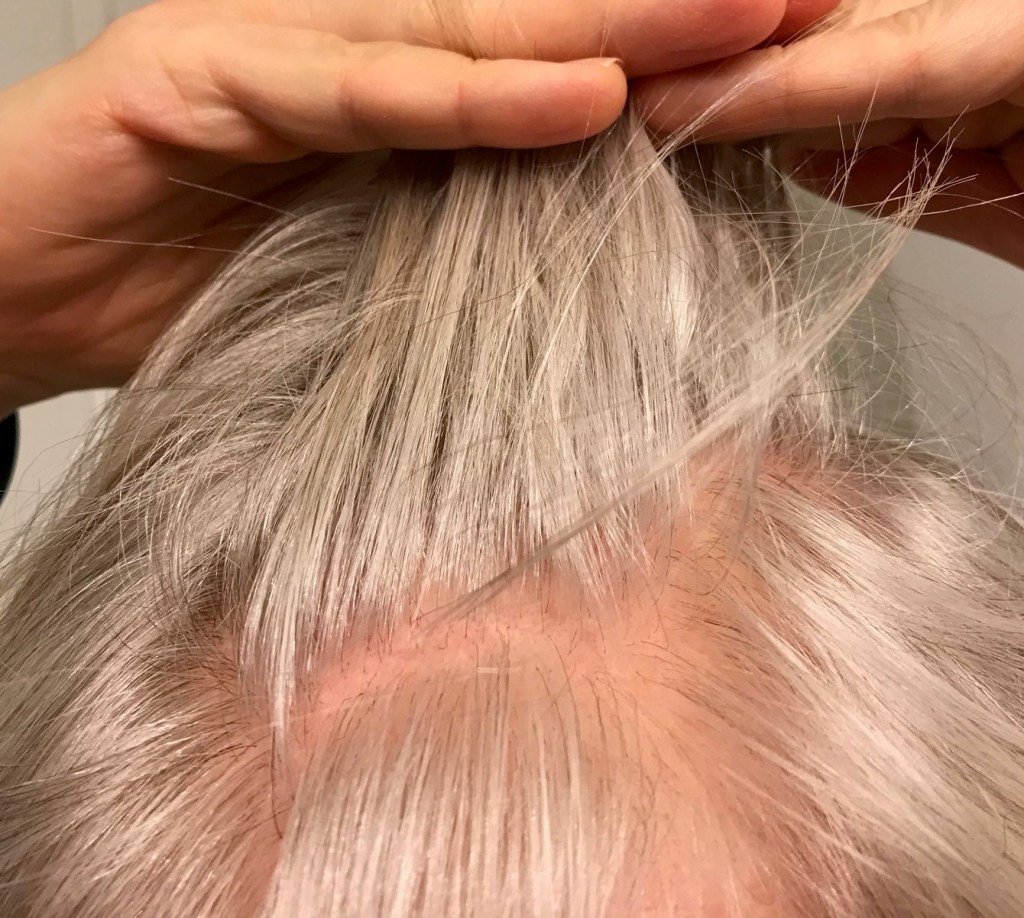
The forest isn’t as dense as it used to be.

By now you can probably guess where I’m going with this. Because in Spring 2019, things started changing. Within a few months, my uber-cool spikey rockstar hair lost fullness as my strands thinned. Then, I saw “bald spots”.

So, let me explain how I define “bald spots”: these areas have hair, but due to the color (um, WHITE) and thinness, the hair seems translucent, even transparent. And along the part? You can’t see the roots well at all.

My reward for enduring cancer is invisible hair.

My hairstylist confirmed that the hair that comes back in after chemo is different from the hair that eventually settles in. And mine had settled.

Tamoxifen also played a role, since choking off estradiol and moving into menopause will age both you and your hair, particularly if you are premenopausal going into treatment, as I was. So this should have been expected, but in the hustle and bustle of all the other little things, like, oh, wondering if you’re going to survive the ordeal, no one really talks about the fact that there will be other changes that take place.

And now, I’ve been off tamoxifen for almost six weeks, but can’t tell whether there’s been any regrowth, not that I expect any. I meet with my oncologist this Tuesday and you can bet your panties he’s going to prescribe an aromatase inhibitor for me, so the pharmaceutical depression of estrogen will continue.

I am dealing. Mostly. Am I happy about this? Of course not. The last few years have felt like running a gauntlet of misery, but one where I’m only hobbled and not completely taken out. Given that, I’m ashamed of complaining, as there are many others doing so much worse. But not ashamed enough to stop writing about it, as this is my reality and it affects me. If I’m going through this, there’s a good chance that many others are too.

I’m supposed to be moving on and leaving cancer behind me, right? But like an annoyingly nosy neighbor, it keeps waving at me through my kitchen window, reminding me that it’s living next door.

“Don’t Drink the Water and Don’t Breathe the Air”: A List of Breast Cancer Risk Factors

After some intense research on the risk of developing breast cancer, I’ve come to the conclusion that the factor with the greatest causal relationship to the disease is, quite frankly, life. In fact, I sometimes wonder how people manage to NOT get cancer.

For your reading pleasure, I surveyed a number of reputable sites to compile a list of commonly accepted breast cancer risk factors (links to the info): American Cancer Society, Mayo Clinic, Memorial Sloan Kettering Cancer Center, Dana Farber Cancer Institute, Centers for Disease Control, National Breast Cancer Foundation, World Cancer Research Fund and WebMD. There are some emerging risks that most sites didn’t list and although I have seen the research studies in support of those factors, I opted to exclude specifics for now. Perhaps that’s for a future post.

Here you go, not in exact order of importance:

  1. Being born female (well that covers about 50% of us)
  2. Getting older (um, inevitable…)
  3. Drinking alcohol (even moderate drinking has been shown to be harmful – find a different hobby)
  4. BRCA1 and BRCA2 gene mutations, which everyone talks about, but certain mutations in the following may also increase cancer risk, although to a lesser extent: ATM, TP53, CHEK2, PTEN, CDH1, STK11, PALB2
  5. Personal history of breast cancer (get it once and you’re a moving target)
  6. Family history of breast cancer (including both close and distant relatives)
  7. Personal history of breast lesions (even stuff that seemed benign-ish)
  8. Radiation exposure, specifically to the face and chest, before the age of 30
  9. Obesity (but mainly for postmenopausal women, see here; it’s complicated)
  10. Having dense breasts (sometimes this is considered a top risk factor)
  11. Beginning your period before age 12
  12. Going through menopause after age 55
  13. Having your first child after age 30
  14. Never having kids (remember that when you’re paying for their college)
  15. Taking hormone replacement therapy (HRT)
  16. Certain hormonal birth control methods
  17. Family history of ovarian cancer, especially before age 50.
  18. Being white (at least in the U.S., although the rates of African-American women are catching up, often with a worse prognosis)
  19. Having received diethylstilbestrol (DES) to prevent miscarriage, given either to you or your mother
  20. Being inactive (honestly, exercise is critical – don’t overthink it – MOVE!)
  21. Not breastfeeding (not only does nursing lower your risk, if you do get breast cancer, you’re less likely to get the aggressive triple-negative type)
  22. Being taller (this may have to do with faster growth at an early age)
  23. Doing night shift work (this may affect your hormone patterns, not to mention make you cranky during the day)
  24. Smoking (the evidence for this has been deemed “suggestive, but not sufficient”, but inhaling smoke sounds like a bad idea regardless)
  25. Exposure to cancer-causing chemicals (that’s, like, just about everything out there, and the connection remains unclear)
  26. Diet choices (this is unclear, although there have been some links drawn to both macronutrient proportions and some vitamins, but more research must be done)
Oh, for the day when we can be guaranteed that what we’re doing is helping (or hurting) us!

In a word, we really don’t know, but living a healthy lifestyle gives you the best chance for survival.

Finally, the things that seem to have no reasonable link (per WebMD and echoed on other sites):

  1. Antiperspirant (no need to stink)
  2. Bras, underwire and regular (feel free to support yourself)
  3. Abortion or miscarriage
  4. Fibrocystic breast changes
  5. Multiple pregnancies
  6. Coffee/caffeine (raise your mug in celebration!)
  7. Hair dye (unless it’s really radioactive, but come on, that would be silly)

Judging from the above info, it can feel like cancer is waiting around the corner to pounce on the next unsuspecting victim that wanders by. I thought I had ZERO risk factors, but I can easily pick out several there. At the same time, I know people who seem like they’d have a gazillion risk factors and they never get zapped. So.not.fair. But that’s cancer for you.

And the more we find out about the disease, the more we see how complex it is. We are all different, reflected by our DNA, so it’s not out of the question that we might be affected in unique ways by these risk factors. Research is uncovering new connections all the time, and it may be that in order to find a cure for cancer, we’re going to have to look at the disease in ways that we never have.

What Do We Really Know About Cancer?

Some of the recurring themes in my conversations with my oncologist have been that there’s so much we still don’t know about cancer and that the truth will likely be much more complex than we realize.

The recommendations offered as ways to reduce the risk of cancer should not be misconstrued as sure ways of preventing the disease. Thinking we can prevent something gives us a sense of security, which is what we crave. With cancer, we don’t yet have a clear view of how the processes that initiate a DNA mutation translate into our everyday world behaviors or environmental influences, if they even do. What we know is mostly correlational, which means that there seems to be a connection between two things, that they occur together. But that does not mean that one causes the other.

Consider this example: the growth of grass that comes in spring is correlated with the appearance of robins searching for worms. But it would be incorrect to say that the appearance of robins causes the grass to grow. That’s confusing correlation with causation.

In the case of cancer, we don’t have significant causal information when it comes to providing guidelines to humans about what to do and what not to do to prevent the disease. We can offer suggestions, although as in the case of the robins, we can be way off in terms of the way that one thing might affect the other.

Perhaps most unsettling is that as humans, we’re used to being the top predator. What we don’t have as protection inherently (claws, fur, huge teeth), we can use our big brains to manufacture. Cancer, however, still exerts its dominance over us.

We are trying, of course, and learning more all the time. Witness how far we’ve come with treatments, and how we’ve affected the survival rates. That’s a significant and positive step – as a breast cancer survivor, I can attest to that.

But not being able to effectively address the cause means that the treatments, as effective as they may be, take a huge toll on the patient both physically and psychologically. Many of us struggle in recovering from treatments that are considered highly effective, while others succumb to either the disease or the treatment itself.

So as the Breast Cancer Awareness Month of October comes to a close, it’s a good time to celebrate all the positives associated with our medical advances, but also keep an open heart for those who continue to suffer from any type of cancer.

And many of those do not have the benefit of being highlighted in pink.

Letting Go, Painfully

I try to avoid “stream-of-consciousness”posts, but occasionally I’ll let one through. This one stings a bit…

I am tired. Physical fatigue is easy for me; getting emotionally wrung out is exhausting.

Events that have taken place over the past several years have demanded a release of expectations, a relinquishing of normality, how I think life “should” be.

Cancer was the big one. I used to wake in the morning, hoping that my diagnosis had been a bad dream. That I could laugh and shake my head, thinking, “Phew! Glad THAT wasn’t real!” And then go about my day, forgetting the fear and immersing myself in blissfully boring everyday life.

But that’s not what happened. I would wake in the pre-dawn hours after sleep had left me to the darkness, coldness spreading through my belly as I remembered that I had cancer. And in the midst of the fear of dying was that wrenching feeling of having to let go of wanting things to be different. Still desperately holding on when it was too late to do so.

Attachment leads to suffering. I know this, but I cling nonetheless, stubbornly refusing to accept change.

I was given a bit of news several days ago, too disorienting for me to even define in this post. Like cancer, it caught me off guard, and I cling to wanting things to be different. To be “normal” and uninteresting. I’m compelled by my need to fix it, make it comfortable and easy to accept.

I need to get.a.grip…

Yet another thing I wish I could control. But I can only paw at it from the outside.

Now I’m engaging in emotional calisthenics, to try to find a notch on this slick surface that I can stick my finger into and get some sort of grip.

I wish this wasn’t the case. I’m disappointed that I feel the way I do. I tell myself, I should be more tolerant of what happens. But it’s the hope that things will stay the same that makes change so difficult.

I twist my thoughts into origami, trying to find a comfortable shape. It takes a lot of massaging to smooth out the edges and make this morsel easier to swallow. Every time I mull it over, it cuts me again.

At some point it is no longer the matter itself that causes pain. It’s all the emotion layered on top of it.

So I’m tired. Letting go, yes, but so slowly. You’d think that it would get easier with practice but even the process hurts.

Of course, holding on hurts more.

Two Assumptions I Wish Doctors Didn’t Make About Cancer

Cancer can turn you into a stress-ball on its own, thankyouverymuch, but there are things that healthcare workers do that may worsen matters.

While there is always room for improvement in the many subtleties of physician-patient interactions (with subtleties being the operative term here, as anxious patients may be zeroing in on the “feel” of interactions and not just the spoken words), there are two big assumptions that I wish doctors would realize that they’re making:

Eat your vegetables and you won’t get cancer? I wish it were that simple.

The first assumption I’ve experienced has been made by non-oncologist physicians. They seem to be just as likely as the rest of the population to confuse correlations with causations. One doctor had been surprised that I had gotten cancer (hey, join the club) because my lifestyle “should” have been protective.

This physician, you could argue, was justified in saying what he did, as the messages we are bombarded with suggest that we have some control over our risk for cancer. However, read the fine print and you’ll see that in a great number of cases the risk factors that a cancer patient has don’t differ from those of someone who doesn’t develop cancer. But even doctors miss the fine print…

I brought this up to my oncology team which was quick to point out that as long as we don’t definitively know what causes cancer, we can’t make assumptions about whether or not someone will get the disease. So, yeah.

The other major assumption is one that I’ve gotten from the oncological community, and that is that on some level, most patients with a given cancer have the same health profile. Ironically, this concept is often mixed in with the conflicting assertion that everyone’s cancer experience is different. Granted, when you’ve seen a gazillion cancer patients, similarities emerge, and consciously or not there’s probably a tendency to pigeonhole people. Still it’s frustrating to be treated like I fit into a slot when I really don’t.

Effective communication is a critical part of quality physician-patient interactions.

My own oncologist has realized that, thankfully, but he has done a good job of listening and I do a (*cough cough*) good job of talking. Perhaps a bit too good, since he’s mentioned that it would be best if I scheduled my appointment to be his last of the day, so that we don’t face as many time restrictions. But therein lies my point: oncologists need to ask and patients need to share, otherwise, the patient remains a two-dimensional entity and it’s more likely that assumptions will be made about them.

So if there’s a take-home message from any of this, it’s that good communication is an essential part of effective treatment. This is not an easy feat, as physicians have a limited amount of time with each patient, and patients might not think that a given aspect of their experience is relevant. Believe me, it is, and the more that we talk about this and get into the nitty gritty of it, the easier it will be for everyone involved.

“The Human Side of Cancer”

I first learned of Dr. Jimmie Holland’s work through her obituary in the New York Times, following her passing on December 24, 2017. As a psychiatrist at Memorial Sloan-Kettering Cancer Center, she was credited with pioneering the field of psycho-oncology, which addresses the stuff that goes on in your noggin while you’re making your way through cancer treatment.

Years ago, Dr. Holland became frustrated by the fact that cancer patients were questioned about how every inch of their bodies felt, but oncologists neglected to ask about the state of their emotions. I’m grateful for her recognition of this fact and I completely agree with her. The psychological experience of cancer is a critically important element in treatment, one that is too easily overlooked by hospitals and physicians in their rush to address physical symptoms.

The late Jimmie Holland, a psychiatrist who happened to be married to an oncologist, understood the many psychological pressures affecting cancer patients.

I highly recommend Dr. Holland’s book, The Human Side of Cancer: Living With Hope, Coping with Uncertainty, which still sits by my bedside even though I finished reading it well over a year ago. While I read it cover-to-cover, it works just as well as a reference text, set up so that you can go to the section most relevant to you.

For me, with a background in psychology, this book was exactly what I was looking for, but certainly psychology degrees are not necessary to utilize what’s on these pages. The book was written for both patients and caregivers, for those undergoing treatment and those on the path of survivorship, dealing with a poor prognosis or experiencing a recurrence. There is information appropriate for all these varied situations and all types of cancers.

The book is divided into 16 chapters, followed by a listing of resources. The chapters are as follows:

  1. What Is the Human Side of Cancer?
  2. The Tyranny of Positive Thinking
  3. The Mind-Body Connections and Cancer
  4. The Diagnosis: “I Could Die of This”
  5. Working Together
  6. Coping
  7. The Human Side of Cancer Treatments
  8. The Human Side of Specific Cancers
  9. All Medicine Doesn’t Come in a Bottle: Psychological Treatment
  10. Alternative and Complementary Therapies
  11. “I’m a Survivor–Now What?”
  12. Staying Healthy
  13. The Goal is Control
  14. The Last Taboo
  15. The Family and Cancer
  16. How Do I Go On?
At some point, I had to stop tagging pages because, honestly, I wanted to tag everything.

I enthusiastically plowed through this book because Dr. Holland was writing exactly about the things I’d been thinking about. Most of the parts that I tagged for future reference were in the center (chapters 7-11), but in its entirety, the book is invaluable. Dr. Holland provided numerous examples of situations that her patients experienced in addition to offering practical advice on a variety of topics. So many sections spoke directly to questions that I’d had, such as, “Did Stress Alter My Immune System and Cause My Cancer?, “Are All These Problems [from treatment] Worth the Long Term Gain?” and “Am I a Cancer Patient or a Cancer Survivor?”, to name several. I was surprised by how many issues that had been bothering me showed up in the pages of this book.

Cancer is never an easy topic, but thoughts about potential outcomes and treatment consequences are the reality that cancer patients live every day. This book addressed everything about that reality, and it was perfect for where my head was at the time I was reading it: having had surgery, chemo and radiation, still undergoing monoclonal antibody infusions. My hair had just begun to grow back in and I was happy that the “worst” of my treatment was over, but I was facing the uncertainty of the future.

I remember reading The Human Side of Cancer and being excited by how relevant the material was to my life, and simultaneously wondering why this wasn’t required reading for anyone receiving a cancer diagnosis. Or every oncologist on the face of this planet.

If you are a cancer survivor, current patient or caring for someone who is, I encourage you to get a copy of this book. You might not realize how much you need it.

Gratitude, Every Night

One of the most intense emotions that I felt after being diagnosed with cancer was anger. I felt betrayed by my body and the medical community. I’d done everything that I had been told I was supposed to do to bring my breast cancer risk down to as close to zero as I could, and still cancer found me.

In reality, until we discover what causes cancer, we can never eliminate our risk of the disease. Of course, I wasn’t thinking like that. I had been completely blindsighted (as, I’ve learned, so many are) and was furious about it.

So when I read a suggestion about finding things to be grateful for, I scoffed at it. Until I actually thought about what I could potentially be grateful for.

The result was overwhelming. In the midst of what had gone wrong, there was so much that had gone right! So many things that could have been worse, so many lucky coincidences that improved my situation. So much to be grateful for! Where my way had been obstructed by brambles and thorns, now lay a welcoming path.

I sat slack-jawed, humbled by my many blessings, as if they had been planned out to benefit me. If I had to develop invasive breast cancer, then so many things were working together to make my journey easier.

I kept a gratitude list and continually added to it. Invariably when I sat down to write my mood would gently soften. Even so, I struggled. There was a perpetual tug of war between hot emotions and the soothing breeze of gratitude. Many times the heat would overtake me.

Gratitude returns the beauty that anger steals away.

Time has passed and distance offers perspective, and while I am not perfect in making space for all the frustration associated with repercussions of my treatment, I understand the importance of working on it.

Every night, therefore, right before bed, I make a list of five things that I am grateful for. They don’t need to be big and they don’t even need to have taken place that day (although often they have). If they’ve evoked gratitude, they qualify.

I can always find at least five things and that is a heartening thought.

Settling into bed, thoughts of wonderful things fill my head and put a smile on my face, shepherding me to sleep. There is no better way to end the day.

Balancing Side Effects vs. Quality of Life

“Remember that your doctor has prescribed this medication because he or she has judged that the benefit to you is greater than the risk of side effects.”

I can’t tell you how many times I’ve read that statement on the informational leaflets from various bottles prescribed for me. When it comes to a disease like cancer, it might as well say, “You think these side effects are bad? Hohoho, just try not taking your meds!”

This does not give warm, fuzzy feelings of hope. Then again, there’s not much about cancer that’s warm and fuzzy.

It can feel like the treatment is as bad as the disease.

I, admittedly, am generally accepting of the advice given by knowledgeable professionals. When my oncologist laid out a treatment plan, I didn’t argue, although when offered a choice between an effective targeted therapy versus an even more effective but also more toxic one, I opted for lower toxicity.

For me, it was a quality of life issue. If I’m “cured” of cancer but end up with severe heart problems…well, I’d rather take my chances with a less damaging option.

Cancer still remains life-threatening, now as it did decades ago. The difference is that patients are living longer and some go completely into remission. Survivorship should be considered a factor when designing a treatment plan, as should long-lasting repercussions of side effects.

So if I had one request of oncological health teams, it would be that they look beyond simply bombarding the cancer and consider the physical and mental condition in which they leave the patient, being sensitive to the possibility of ‘overtreatment’ in their exuberance to squash as much of the disease as possible.

Should you use a sledgehammer when a rubber mallet might be sufficient? Is “just to be sure” a justification for side effects than can compromise your quality of life, however long that is?

It’s not always easy to find that sweet spot between acceptable risk and tolerable side effects.

There is no “right” answer to this as everyone’s situation and risk tolerances are different. So if I could have a second request of the medical community, family and friends of the patient, it would be that they respect the limits and decisions of the one who’s going through this.

To be able to weigh the risks and decide what’s acceptable and where to draw the line — that might offer at least a semblance of control in the crazy roller-coaster ride that is cancer.

“Fly the Friendly Skies”?

What if the skies aren’t guaranteed to be friendly?

While I’ve not been a nervous flyer in the past, I’ve haven’t flown since 2005 (!) and I’m starting to feel unsettled about our upcoming trip. It’s going to be a cross-continental red-eye during which I’ll be Tetris-ing myself into a plane seat (I’m 5’11”) and trying to sleep upright. Then there’s that plane change in the wee hours of the morning, at a time when any sane person would be fast asleep.

After writing a post on the importance of sleep, I’m going to go against my own advice and really screw up my family’s sleep cycle. So there’s that. But I’m also feeling prickly about making it through security, finding storage room in the overhead compartments, making our connection on time, picking up the rental car and remembering how to get to my parents’ home on a few hours’ sleep.

Oh yeah, and hoping that the plane doesn’t drop from the sky. That’s a biggie.

Life: enjoy the flight.

For a cancer patient, plane flight is one of those things you’re supposed to avoid. While I’m well past “patient” stage, my white blood cell count remains abnormally low, so breathing recycled air in cramped quarters is a bit of a concern. Taking Tamoxifen brings with it a risk of deep vein thrombosis, which is associated with long plane rides, and I’ve been warned about breast cancer survivors developing lymphedema due to the changes in air pressure during airflight.

Okay, okay, okay, realistically none of that will cause me problems. And all those other worries about the trip? They only matter if I’m thinking about them. When I’m not thinking about them, they don’t exist (*crossing fingers*).

Of course, the risk remains. I can sleep calmly on the flight with 99.99% confidence that we’ll get to where we need to go without mishaps, but there is that 0.01% that hangs in the back of my mind. Whether or not I give it attention depends on me. My life is not going to be any better if I’m fretting about it.

Cancer is the same way. There is no guarantee that I’ll stay cancer-free and I have to live with the possibility of recurrence for the rest of my life. That is disconcerting, particularly to a card-carrying worrier like me, but when I detach from that and simply appreciate where I am, I find that my days are a lot brighter. So for both air travel and life, the best course of action is to sit back, relax and just enjoy the flight.