I hold sleep as one of the most critical elements of self-care in our lives. Get enough sleep and the whole world looks brighter. But ignore the call of the mattress and dire consequences await.
This is especially true for me, as I slog through the ever-changing side effects of my current anti-cancer therapy (Tamoxifen). The amount and quality of sleep I get sets the tone of my day and determines my resilience to work and life stress. In addition, sufficient sleep has a significant positive effect on my cognitive functioning, which took a hit from cancer treatment.
But this is not limited to my personal experience. The more we learn about the science of sleep, the more we understand how our electronics-driven lifestyles disrupt sleep patterns and affect us as a society.
Dr. Matt Walker (UC Berkeley) is a strong proponent of sleep, and for good reason. He outlines in his TED talk (19:19) below some of the latest research on the repercussions of not getting enough shut-eye, and it’s not pretty. As a cancer survivor, I find this information particularly sobering. While I’ve written about the downside of placing superhuman expectations on ourselves, having THIS kind of superpower, getting sufficient sleep, is literally life-preserving.
Let’s start with “testicles”…
Dr. Walker’s two main suggestions for good sleep? (14:16 in the video) 1) Keeping a regular sleep schedule, retiring and rising at the same time regardless of day of the week. 2) Keeping your bedroom temperature at about 65°F (no mean feat without A/C in the summer months!).
For many of us, improving the amount and quality of our sleep will take concerted planning and possibly sacrifices. We live in a 24-hour-a-day world and sometimes we try to keep up with that ’round-the-clock pace; ultimately, however, we pay the price for it. There should be no question that sleep is critical to our well-being and it’s time that we give it the priority that it deserves.
“…and a shoutout to Sharon in Accounting for submitting her financial report on time from her hospital bed, even with spotty WiFi. Way to show that losing both arms in a car accident doesn’t mean you can’t type with your nose! Everyone else, what’s your excuse?”
We in the US seem to take particular pride in demonstrating our inability to maintain a sane balance in our lives, viewing those who don’t exhibit an indomitable will as not trying hard enough.
Persevering in the face of adversity is laudable. But then, is experiencing difficulty doing so a weakness? Or just confirmation that we can be vulnerable and have limitations, and that’s perfectly acceptable?
It’s not always possible to rise to the occasion. Cancer patients experience this. They are told to “be strong, you can beat this!” “Never give up!” They are supposed to be warriors with limitless energy for the fight.
Lemme tell ya, sometimes you don’t feel like a fighter. Sometimes all you can do is just show up, and that’s a victory.
It’s okay to be just human.
But there’s always that one person who manages a quasi-superhuman feat while undergoing a particularly grueling treatment. We’ve all heard about their inspiring story because they’ve been held up as a shining example of what can be accomplished even in the darkest of times and most difficult of situations. So if they can do it and you can’t, what’s wrong with you?
Maybe there’s nothing wrong, maybe it just means that the most important thing in your life is to focus inwardly on your healing in whatever way you need to. Why should relentless productivity overshadow self-care?
Every being has limits, and where exactly they lie will vary between individuals and depend upon their circumstances. Not having the energy to push on where someone else did does not make you a lazy or unmotivated or selfish person. It just means that, yep, you’re still human.
A wise man once said to me, “There is no special place in heaven for people who don’t take care of themselves.” It’s time to stop acting like there is — so go home and get some rest.
I lost my Costco card today. Somewhere between the entrance and the check-out line. It’s not the end of the world since I was promptly issued a new one, but the old one had a photo of the pre-cancer me on it.
Reminders of that “old me” are disappearing as I redefine who I am. Yes, life is constantly in flux and change is inevitable but I’d be lying if I said it doesn’t hurt.
Cancer has been about loss for me. Loss of weight, loss of hair, loss of concentration, loss of physical fitness, loss of over a year spent in treatment. Loss of a friend to the disease. Out of nowhere, losing that one seemingly insignificant warehouse card brought this all back.
There have been gains too, and much to be grateful for. I could draw up a long list. But today I can’t write about them.
Today I longed for what was gone. Tomorrow will be better.
~~~~~~~~~~~~~~~~~~~~~~~~~~~~~~~~~~~~~~
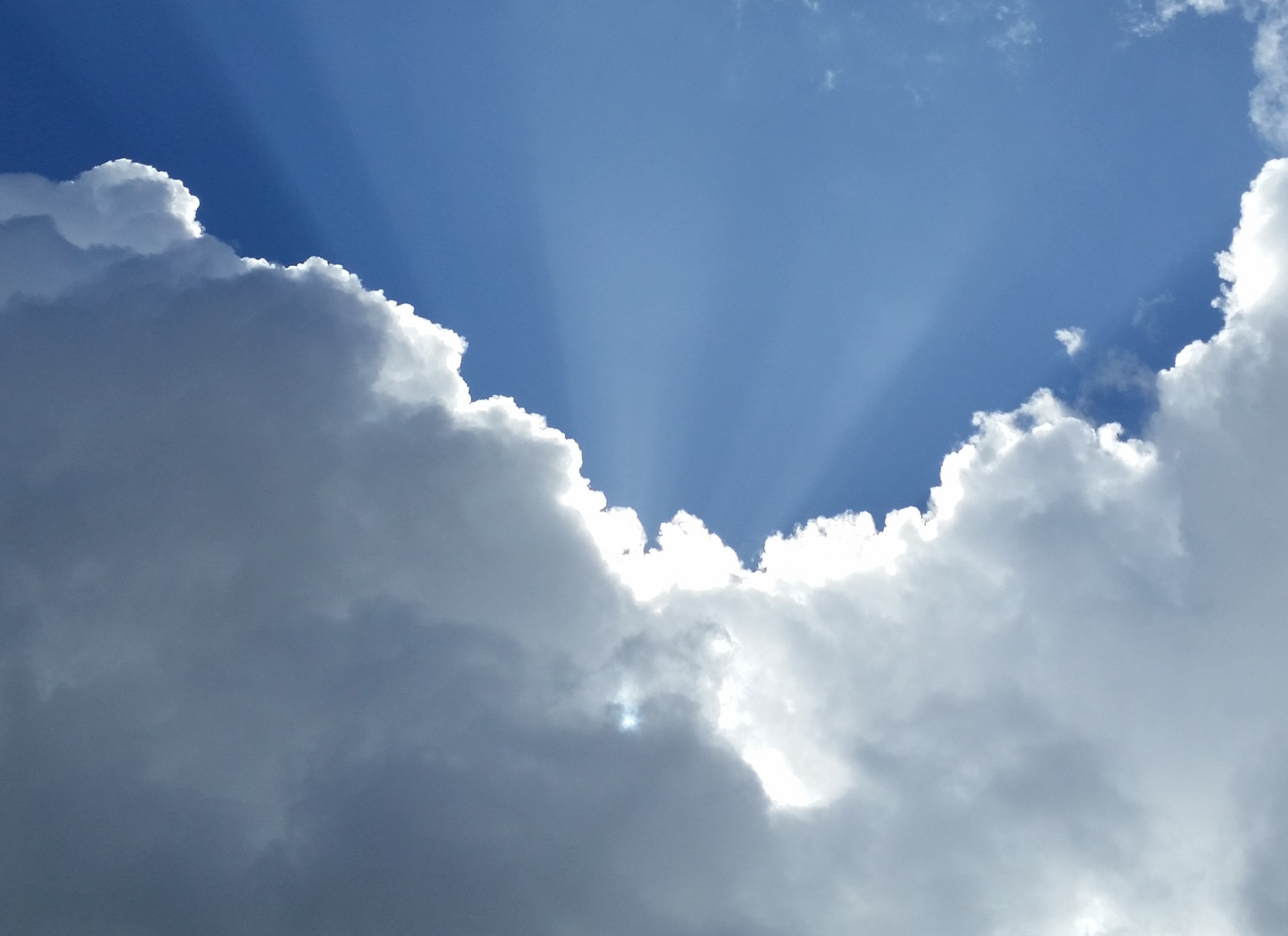
The clouds parted, the sun shone forth and nothing really changed but my attitude.
So, after all that angsty serious talk, I got home and realized that my old Costco card was in my back pocket all this time. D’oh! I’d forgotten that I’d stuck it there!
Wow, I felt silly. They say hindsight is 20/20…well, looking back at how darkly I’d taken this, it did seem a bit ridiculous that I’d packed so much meaning into a piece of plastic.
And in a swoosh, the clouds cleared out, the sun peeked through and the world looked different. I still have that new post-cancer photo on my Costco card, but I’m laughing at myself and it doesn’t seem that bad.
Same situation, new perspective.
And then, if we realize that we can change our perspective…?
Several nights ago I woke at 3am, my brain abuzz with images of what had taken place that day. In an effort to divert my attention and fall back to sleep I focused on my breath, but I was so groggy that I couldn’t concentrate effectively.
So instead I imagined a beautiful sunny field with chirping birds and various animals coming by to snuggle with me. It was the epitome of placidity and contentment. A darling fawn nuzzled me. Then a purring lion tenderly rubbed up against me. And attacked me.
Seriously??? This is my self-created fantasy and I can’t manage to keep it positive???
But perhaps I shouldn’t be surprised. I’m a few days out from a 3-D mammogram that I’ve managed not to think about because I’ve had such a busy week at work. It will be the first mammogram since completing all my cancer treatments, so it’s kind of a big deal. Somewhere in the back of my mind fears and what-ifs are simmering. It’s scanxiety rearing its ugly head.
People tell me that everything is going to be okay. But how can they say that? This is cancer. There is never a guarantee that everything will be okay. For others to say that to someone who’s been through the full spate of treatments sounds like a brush off. Even when everything is “okay”, it may still not be okay! And sometimes it’s worse.
Sure, Mr. Expectations, you look so cute and peaceful, but if I get too close, you’ll take my head off.
I wrote a letter to myself the evening before my original diagnostic mammogram way back in early 2017, trying to calm myself down because I was an anxious mess. And in that letter I told myself that I’d be able to go back and re-read it after the mammogram and chuckle about how worried I’d been and how everything actually worked out. I tried to reason myself into calm, noting how unlikely it was that I had cancer. That tenuous serenity was blown the next morning by the radiologist who read my scan.
I remember that crushing feeling — it’s what colors my experience right now. I want to believe that everything will be okay, and yet the spectre of possibilities hovers over me ready to potentially ruin my day (and life!). I don’t think that the cancer is back, but I’ve put off making summer travel plan. Just in case.
Gah, is this what the rest of my life will be like? Being fearful of making plans? That’s not a good use of the time I have left on this planet.
Mindfulness as espoused by Jon Kabat-Zinn (drawing heavily on the Buddhist wisdom of Thich Nhat Hanh) speaks of non-attachment. Having expectations and being attached to their outcome causes suffering. I can attest to that.
Trying to reason through to an “answer” only increases agony. So I will take deep breaths and stop thinking.
Throughout my cancer treatment, it was the smiles, gentle hugs, kind words and unexpected “going-out-of-their-way” little extras from those around me that made a huge difference and left a lasting impression on me.
Now, as I gradually wind my way through survivorship, memories of those acts smooth over the physical and emotional pain associated with cancer. Those soothing feelings are too powerful to keep to myself. Given the general vibe in the world today, the hyperpolarization of people’s opinions and the resistance to leaning over and trying to empathize with others, we need more kindness everywhere.
“But what if the person doesn’t deserve it?”
Then that is a person truly in need of it.
It won’t hurt a bit, I promise.
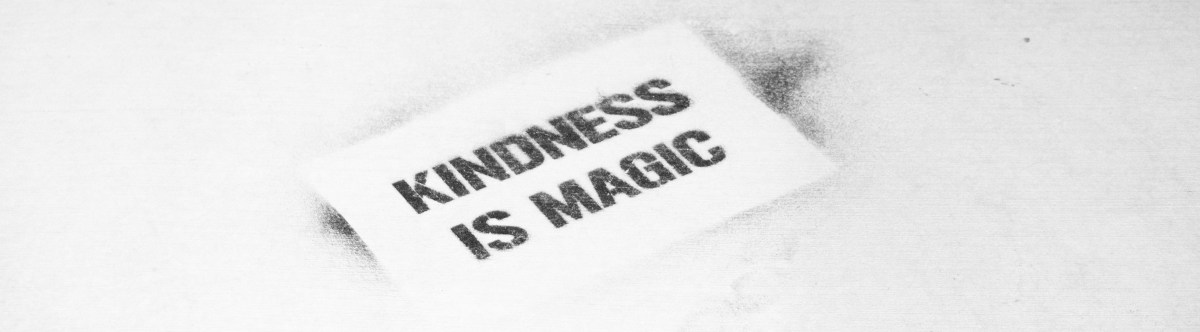
There is no limit on how many smiles you can dispense, doors you can open and kind deeds you can do. It doesn’t have to cost anything. And if there’s one thing that I’ve found, it’s that random acts of kindness have a two-fold benefit: for the person receiving the kindness and for the person giving it. It’s the ultimate win-win.
There are only so many hours left in this day of kindness. Take advantage of them. And then make every day a “Random Acts of Kindness” Day.
Yes, “scanxiety” is a thing. And I’m already regretting writing about it because it’s bringing home the fact that in a week and a half I have a mammogram coming up. It’ll be the first one since completely finishing my treatment almost a year ago.
You can google the definition of scanxiety, but any cancer survivor can offer their version. Mine is the unease that increases as I get closer to THE scan, the one that will pronounce me cancer-free for another year. Mercifully, I will have an unusually busy week at work which will keep my mind equally busy, and the rest I will have to power through with mindfulness and focus.
The unsettling thing about this is that for a short while, it’s a Schroedinger’s cat kind of situation. Around scan time, I am simultaneously a cancer patient and a cancer survivor. Prepare for the worst, hope for the best. It’s altogether unsatisfying.
This mammogram opens the door to the potential of letting cancer back into my life. And I am so.done.with.it. that having to consider what would happen if I had to go through treatment again evokes feelings of hopelessness and frustration. I don’t want to re-experience the steep let down that came with my initial diagnosis, after trying to reason myself into optimism.
Sometimes I play games with myself. Things like, “If I make it to the intersection before the light turns yellow, I don’t have cancer.” This is ridiculous, of course, but I can guarantee you that if I DON’T make it before the light turns, I’m going to be yelling, “Two out of three!”
Scanxiety differs from most life stressors, like a horrible job situation. I’ve had tough jobs with miserable bosses before. I also had the option of quitting. But I can’t say, “Screw this, I’m going to a different universe with better benefits.” I’m here and stuck living out some potentially nasty stuff, and possibly not making it through. That is simply reality and I have to be comfortable with it.
It’s all in how you look at it…
I struggle with the uncertainty that arrives hand-in-hand with scanxiety. Mindfulness teaches us to release expectations, and that is exactly what I’m trying to do. For me, the next week and a half will be a proving ground for how far I’ve come in my mindfulness practice. Perhaps looking at it as a challenge will put a neutral spin on the process of waiting.
No expectations means no anxiety, no let-downs, no shattered hopes and no “dying a thousand deaths” before I’ve even made it to the radiology department. I am not good at this, but I am light-years ahead of where I was two years ago, and I’m going to have to be content in that for the time being.
One of the inevitable parts of being a cancer patient is that you get to know other patients. Equally inevitable, however, is the fact that not everyone has a positive outcome. This week, one of my friends with whom I went through my cancer journey entered into hospice.
We had received our breast cancer diagnoses within several months of each other and occasionally met for coffee as we discussed our treatments. It was a safe conversation, as we were sharing similar experiences with similar fears that only someone in the same situation would “get”. We both enjoyed these opportunities to compare notes and allay anxieties. I had been publicly open about my cancer, but she was more private and circumspect about whom she told, so I was one of the few people who knew her condition.
But as our treatments came to a close, our paths began to diverge. My cancer treatment had been more straightforward because the drugs I was given were well-targeted to my type of tumor. Hers was a more complex situation – a more aggressive tumor with no clear targets, complicated by an existing chronic health condition. While I was declared cancer-free, diagnostic scans found “spots” in other parts of her body, tiny ones that had caused suspicion early on but had been too small to biopsy.
These sports grew larger and a biopsy confirmed her fears. Her cancer had spread. Due to her other health issue, she had not been able to tolerate the most prescribed and effective chemotherapy given to patients with her type of cancer tumor. Therefore, her best option was not available. Immunotherapy was attempted but that failed to produce positive results.
At this point, I was hearing about her disease progression second-hand as she wasn’t open to having coffee. I respect her reluctance to meet with me, because if the tables were turned, I don’t think I would have wanted to be discussing my worsening situation with someone who had been in a more fortunate position. Consider this analogy: you’re on a highway. The cars all drive at similar speeds and travel is pleasant. But if you need to pull over — perhaps there is car trouble — you suddenly feel like the world is passing you by. Every whoosh of an automobile is a reminder that you are not moving. You feel frustratingly stuck and left behind, wondering whether you’ll be able to re-join everyone else on the road again.
Her decline has come abruptly. She’d been living on her own all along, but then came dizziness and aches and pains. It started at the beginning of this past week. By Wednesday, her parents were setting up hospice in their home and had ‘round-the-clock care secured. So fast, so fast. It feels like we need to catch our breaths. No one is prepared for this.
I was told yesterday that she had only days left. I am in shock. I had originally planned to bring over bright gerbera daisies this morning, but decided against it, as she is not able to take visitors.
It’s raining hard today and for the next several days. The weather is uncharacteristically gloomy and foreboding for this part of the country. When she passes, I pray that her transition is gentle and the sun is shining.
Since my breast cancer diagnosis, I’ve kept a close eye on both the popular and scientific literature regarding potential causes of breast cancer. There’s a lot of new information coming out now, but the core recommendations for lowering one’s risk of breast cancer remain the same.
In fact, current research is reinforcing them: keep a lower weight, eat more fruits and veggies, exercise, don’t smoke, don’t drink. While I’m oversimplifying, that’s the gist of the message that’s being disseminated. Some articles go a step further and make bold statements. One in particular stressed that cancer was preventable through lifestyle changes. Anand et al., 2008 claims: “cancer prevention requires smoking cessation, increased ingestion of fruits and vegetables, moderate use of alcohol, caloric restriction, exercise, avoidance of direct exposure to sunlight, minimal meat consumption, use of whole grains, use of vaccinations, and regular check-ups. …[W]e provide evidence that cancer is a preventable disease that requires major lifestyle changes.”
Of course, when I read these recommendations, all I absorb is, “You irresponsible ass, you’re not doing enough to protect yourself!” The fact is, I was doing all that and more, and I still got breast cancer. If you’ve read some of my other posts, you’re probably sick of hearing me say it. I shouldn’t have gotten breast cancer according to all the guidelines out there.
So here’s the issue that I have with all these helpful suggestions. They keep repeating lifestyle changes that should be implemented to lower your cancer risk. Let’s face it, it doesn’t matter WHAT disease you’re trying to avoid, you should maintain a healthy weight, exercise regularly, not smoke and so forth.
We can’t automatically assume that if someone has cancer, they must have been engaging in unhealthy behaviors.
The stigma of cancer comes in when we start making assumptions about WHY someone gets the disease. Given all the purported connections with lifestyle for breast cancer, that assumption may be that the woman (or man) brought it upon themselves. The more that we stress lifestyle changes, the stronger the connection becomes in the mind of society: if you get cancer, you were clearly doing something wrong and it’s all your own fault.
I will be the first to stress the importance of doing everything you can to improve your health. But we have to accept that given our current lack of understanding regarding the exact agents that bring on cancers, we cannot put the “blame” squarely on the shoulders of the patient.
While smoking does account for 80% of lung cancer deaths, that’s only a general statistic. Statistics work well for populations, but they can be strikingly inaccurate when it comes to pinpointing causes for an individual. For example, one of the youngest known cases of lung cancer was in an 8-year-old girl in Jiangsu Province in China due to some of the worst air pollution on the planet, not to a pack-a-day habit. So we need to be careful about the assumptions that we make.
Back to breast cancer, if you were to construct a picture of what a “typical” breast cancer patient would look like based on the recommendations for what to avoid, you’d come up with an overweight, sedentary, smoker/drinker with a bad diet. But if you start picking this apart, you find that these predictions don’t hold up. For example, the connection between breast cancer and weight is complicated. In fact, many of the women I know with breast cancer had healthy habits, and most did not look like the picture that we constructed at the top of this paragraph. In contrast, there are numerous women with unhealthy habits who remain cancer-free.
Statistics work well for populations but are lousy predictors of what actually happens to a given individual.
This message that we send about how to lower your risk of cancer raises the possibility of stigmatizing the patient. It suggests that we have control over our outcome, and this is simply not the case. Currently, we don’t know enough about what causes cancer and what to do to truly avoid it. And if we do what we can to lower our risk of it, that only means statistically lower our risk. That doesn’t guarantee that we won’t get the disease.
My painful personal lesson was to not assume that I could avoid cancer by following health guidelines to a “T”. At the same time, I had to shake the notion that I had done something wrong to willfully bring cancer upon myself. Ultimately, I had to let go of both control and responsibility because neither one had a role in this disease for me.
The best we can do is live as healthfully as possible, accept the uncertainty that comes with a situation this complex, and not judge those who have been unfortunate enough to fall prey to the disease.
Part 1 of this series chronicled the loss of my hair to chemo and subsequent gradual regrowth through the end of 2017. Part 2 is the “beyond” part of “chemo and beyond”. These photos are somewhat self-indulgent because, well, hair does grow and so whether I’ve got short bangs or spikey hair doesn’t really have anything to do with chemo. Nonetheless, I wanted to provide some perspective regarding how long it takes until a cancer survivor’s head doesn’t look like a cancer survivor’s head.
I need to stress that these photos were originally taken so that I could monitor my progress, not with the intention of posting them for all to see, so the quality may be lacking.
February 6, 2018: I didn’t take photos for a number of weeks — probably because once I was convinced that my hair was growing in properly, I mellowed out about scrutinizing my scalp. This was my general look into the early part of 2018, a hat that showed the longer growth (around the back) but hid the painfully short hair on top. I had my very first post-chemo haircut in February.
February 17, 2018: This is after that first haircut. I got a trim around the ears and back, but the hairstylist left the top alone — good thing since it was still really short. I started venturing out without a hat. It was amazing to feel the breeze in my hair!
March 29, 2018: I loved this stage and got a lot of compliments about this look, in part because the hair on top was incredibly soft (all new growth!) and touchable.
April 24, 2018: A view from above showing how full the regrowth was.
April 24, 2018: A front view of the same stage.
May 19, 2018: Now we’re getting somewhere! The hair is noticeably longer and showing more weight.
June 27, 2018: The hair is getting unruly. Need a haircut soon!
August 17, 2018: This marks a little over a year after my last chemo. I got my second haircut in July, and this was the first trim on top. This was another stage that I really liked even though it had a mullet-y feel. I was channeling Rod Stewart here.
August 17, 2018: A view from the top. There was more color creeping back into my hair and it was feeling very substantial.
November 19, 2018: Fast-forward a couple of months. After some more growth, I went for my third haircut. The hairstylist was distracted and did a major chop job on my hair. A bad cut always sucks, but when you’ve gone through chemo, it’s even worse.
January 11, 2019: Almost two months after that last cut, the lack of symmetry was obvious (combed out for effect here); she had chopped off more hair from one side than the other. I waited to let it grow more so that the new stylist (not going back to the old place!) would have more to work with.
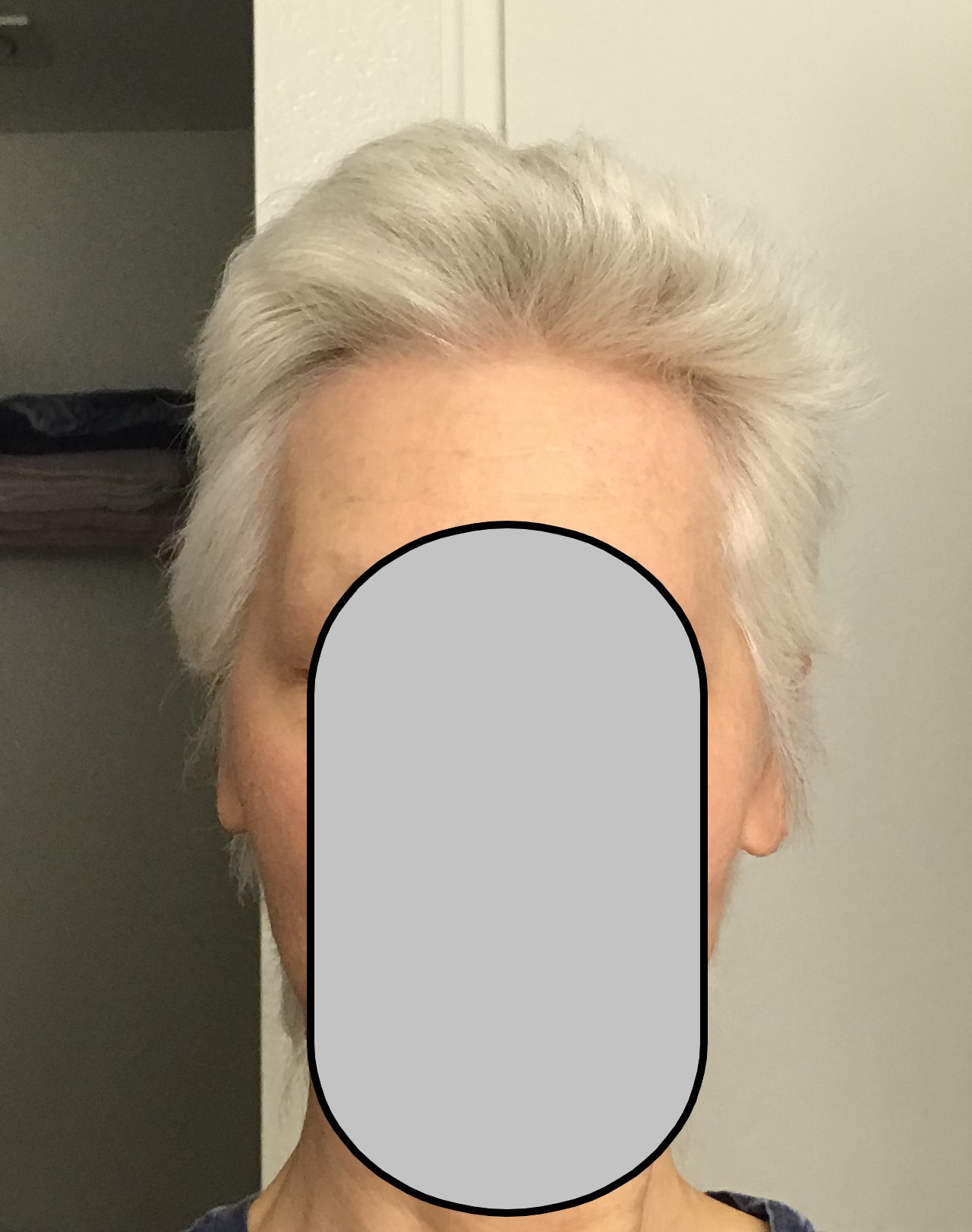
January 16, 2019: Finally, went to a highly-rated salon (should have gone there in the first place, but…) and got a cut I love!
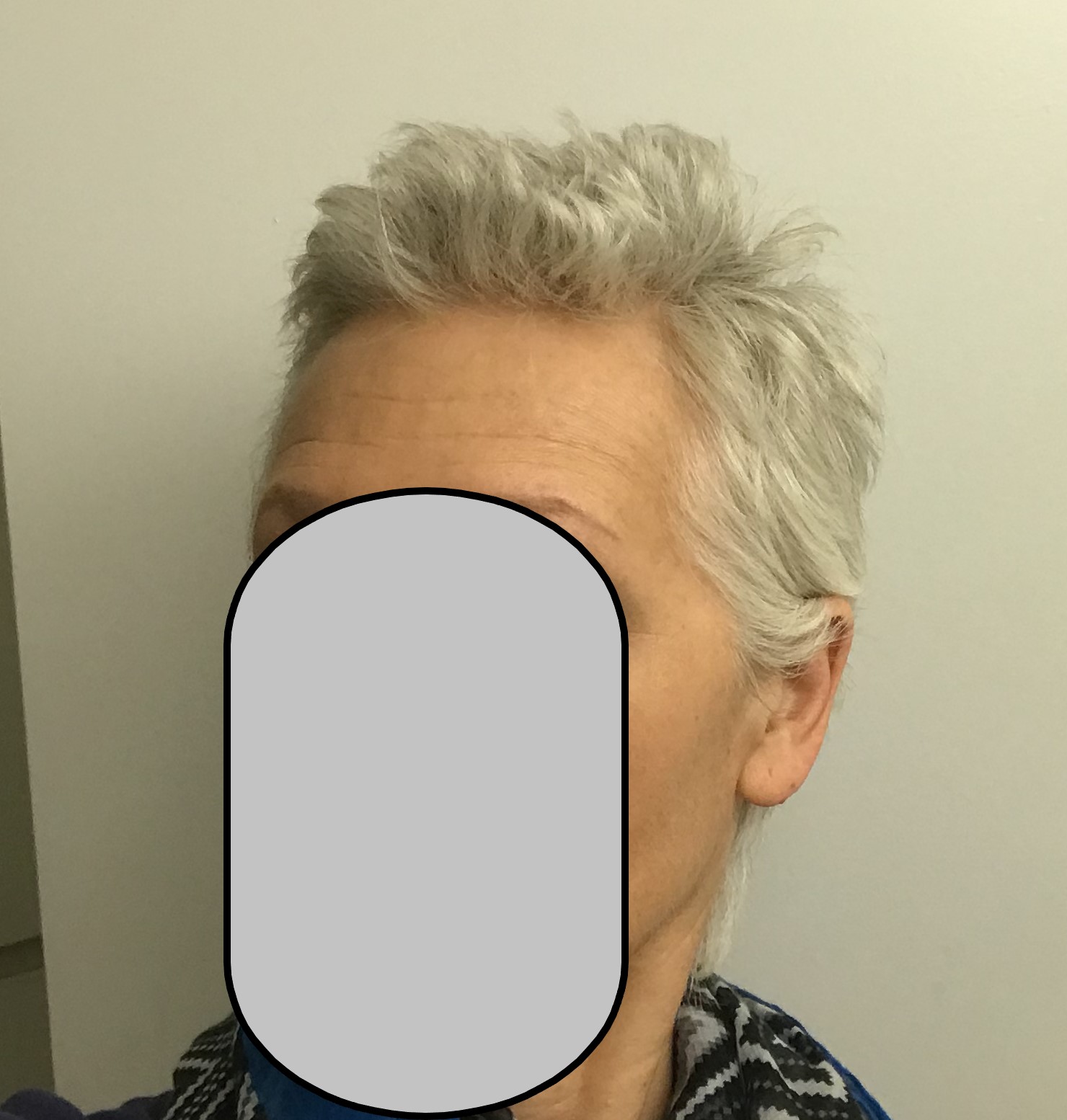
January 17, 2019: I can spike it for a seriously edgy look, or keep it tamer so that I don’t freak out everyone at work.
And so ends this journey. What my hair looks like now is vastly different from when I began with my cancer diagnosis, but as I’ve said previously, I am not the person inside that I was before, and now my outside reflects that. After a year of treatment followed by a year of regaining my footing, I’m edgier and willing to push my boundaries. Cancer didn’t give me a choice but to move forward, and that’s what I’m doing.
It’s been almost a year and a half since my last chemo infusion. This past week, I treated myself to a chic haircut at a real salon (instead of going to a cheaper chain hair-cuttery) and I’m so delighted with the result. I reflected on what it took to get here, hair-wise, by going through the photos I took of this whole experience. This post series chronicles my cancer journey as witnessed by my scalp.
Please note that these photos were taken for my own records, without the expectation that I’d be posting them online, so I apologize for the quality.
May 13, 2017: My first chemo treatment was April 27th and just over two weeks later, my hair started coming out in handfuls. I had long hair so the loss was noticeable and very distressing. Time for it to come off!
My husband started by taking off the bulk of my ponytail first.
I got to live out all my punk hair dreams…
…and even spent a few minutes channeling Riff-Raff from “The Rocky Horror Picture Show.”
Finally it was done. No looking back! As miserable as it was losing my hair and crying through most of the head-shaving process, I now felt like I had a modicum of control over this whole crazy situation.
June 8, 2017: This was the day of my third chemo session. Oddly, my hair had actually grown but then seemed to freeze. If I pulled on individual hairs, they would come out easily.
Needless to say, I didn’t mess with them! While it’s not readily apparent in the photos, there’s way more bald scalp than hair there, with significant loss at the front.
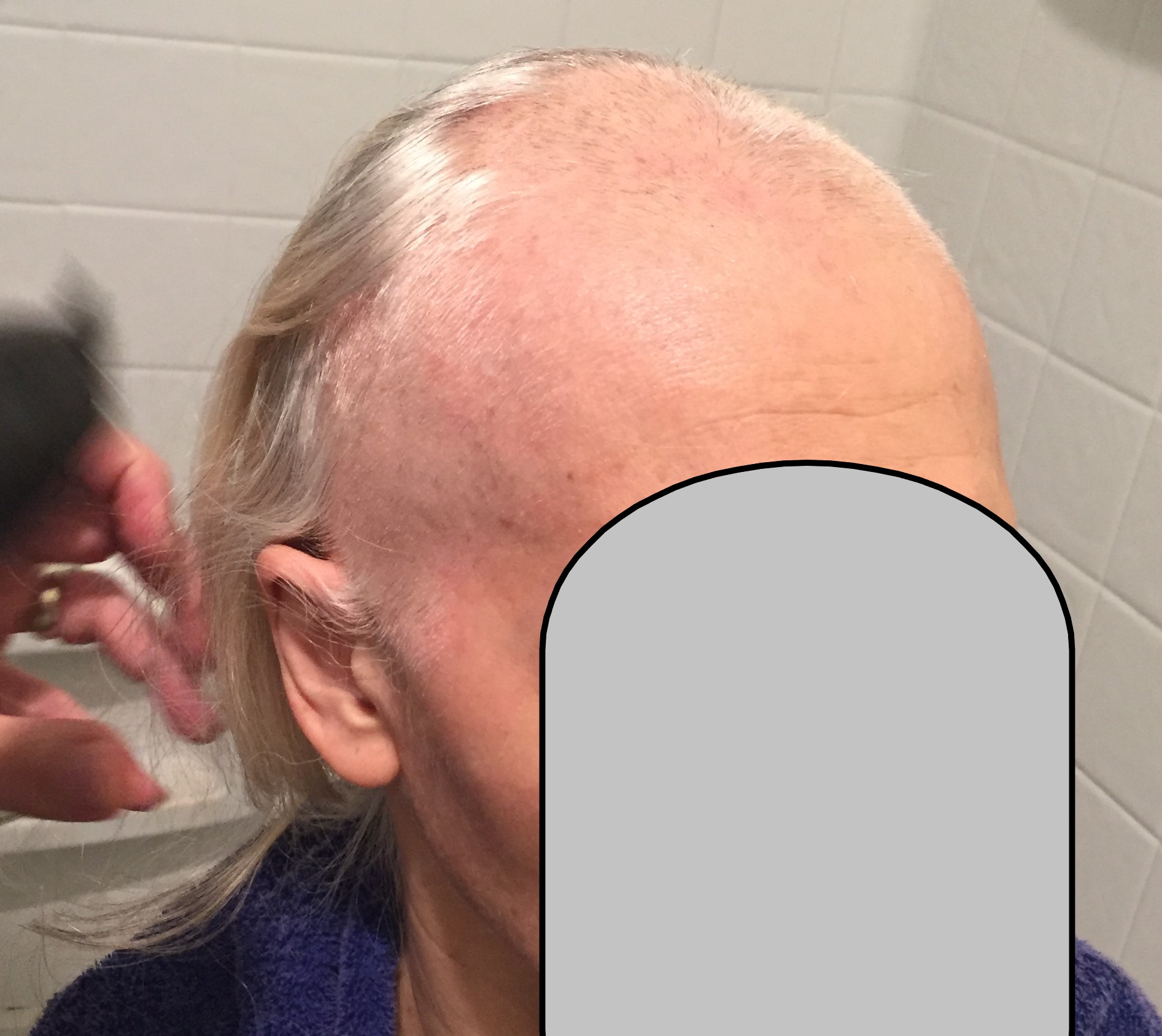
July 3, 2017: Yeah, not looking so healthy here. Loads of the tiny hairs had given up and dropped out, and I was having issues with a dry, flaky scalp. Honestly, I hadn’t realized that it looked this bad until I saw the photo.
July 20, 2017: My scalp was confused. Some obstinate hairs continued to grow, but most hadn’t, giving me a great view of the horrible moles on my head!
August 18, 2017: My last chemo had been August 10th. There were only enough of these longer hairs on my head to make me look like Yoda, but without the big ears. You can see the rough shape that my nails are in (but that’s a story for another post).
September 6, 2017: There were hairs on my head, but they were not really growing in. It had been a month since my last chemo and I was hoping to see significant signs of life. But, nope.
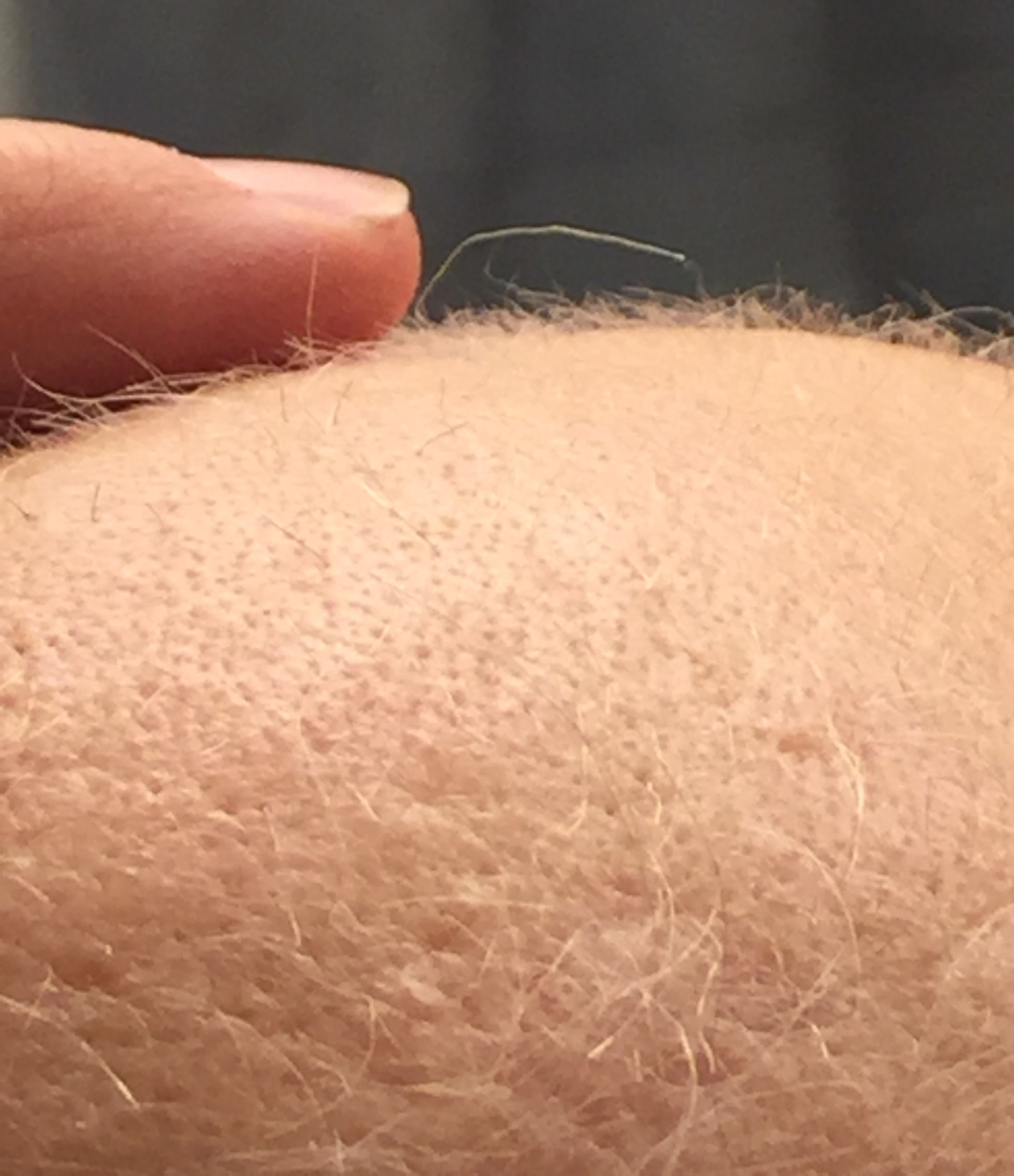
September 16, 2017: Here’s one of those never-say-die hairs. I was also noticing downy, baby-chick hairs but no appreciable coverage. Wow, I have huge pores!
October 6, 2017: It had been almost two months since my last chemo, and I was convinced that I should be getting more growth. My hairs were super-fine and my scalp squeaked when I tried to run my fingers through them. See the light shining off my head? I could blind someone with that!
October 11, 2017: Yes, this photo was taken only 5 days after the one above it, but I was starting to get desperate and taking loads of photos. I was convinced that I should be getting more growth than I was, and had spent too much time on cancer forums reading posts by women whose hair hadn’t come back at all (bad idea!). I was experiencing growth but their fine texture made it seem like there was very little there.
October 17, 2017: At this point, there was a mixture of sparse longer hairs and the super-soft fuzz, but the overall view still screamed, “BALD!” Family members enjoyed patting my head and cooing.
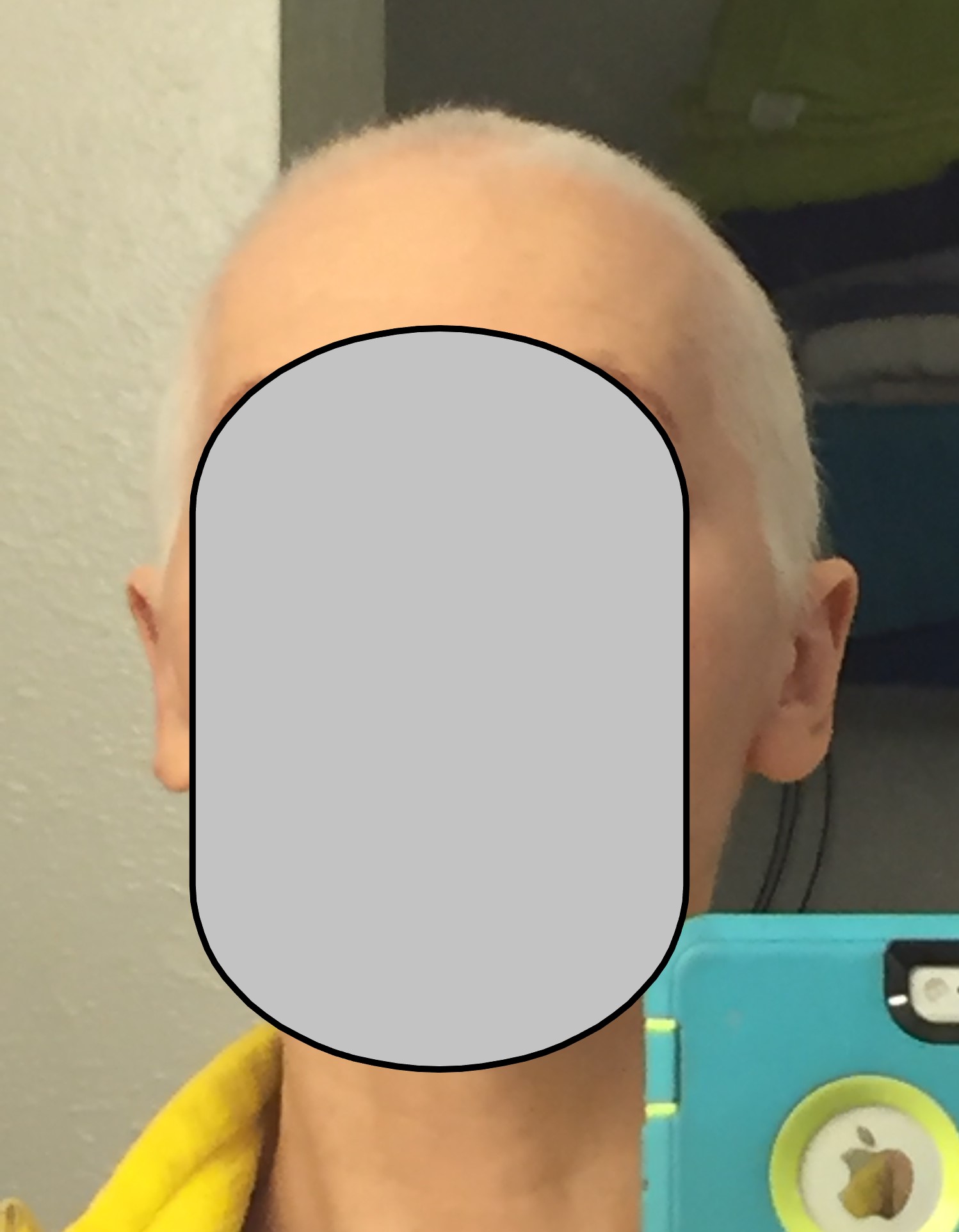
November 2, 2017: Almost three months after finishing chemo, I still saw light glinting off the front of my scalp. I could wear hats because the back of my head had more hair coverage. Regrowth was happening in a sort of reverse male pattern baldness. There WERE little sprouts on the front of my head, but they were taking their own sweet time.
November 11, 2017: Finally! The hairs in front were definitely coming in. All the growth was soft and fine, but it seemed like the follicles had woken up. I found it easier to be patient now that there was definite promise of a full head of hair in my future.