The Problem With Pink

The breast cancer awareness movement has done a good job of bringing cancer awareness to the forefront. Especially in October, which is Breast Cancer Awareness Month, it’s hard to see pink without thinking of breast cancer. This is particularly true for someone who has gone through cancer treatment, but I expect that many who haven’t strongly equate the color with the cancer too.

Certainly, it doesn’t hurt to distribute pink “Save the Boobies”-esque stickers, t-shirts and wrist bands. It’s acceptable to say “boobies” in polite company, to broach the subject of women’s health, and this push to pink-out everything has resulted in more funding for cancer research. People probably think it’s cooler to have “boobies” on your wrist band than something like “Save the Pancreas”, the cancer of which has a much higher mortality rate. But a pancreas doesn’t look as good in a bikini top.

There is a darker side to this, and it has nothing to do with the usual arguments against pinking everything out, which tend to be about companies making profits at the expense of women. This is about what it feels like to be diagnosed with breast cancer.

At some point, awareness hits a saturation point. I’m willing to bet that many women who have been diagnosed with breast cancer dislike the color pink on some level. The diagnosis is life-disrupting if not traumatic, and the constant reminder from all the pink ribbons and other paraphernalia can get nauseating. And I do mean that in a physical sense. For me, diagnosis = anxiety; anxiety = nausea; pink = breast cancer…well, math was never my strong suit, but this all adds up to pink = nausea.

As I sat alone waiting for my surgery, feeling very nauseated, my Nurse Navigator paid me a visit. Incidentally, these nurses are the greatest thing since sliced bread (probably even better!), as they are a knowledgeable liaison between the patient and everything medical. In any case, my nurse brought me a goodie bag. Yes, it was pink and it contained various useful items relevant to my surgery and future treatments. And yes, most of these items were pink too. I guess these days it’s hard to justify using any other color if you’re talking breast.

But there was one thing that was not pink, and it’s because it wasn’t pink that I realized right then and there what sort of a visceral response I’d been having to all the pink stuff. It was a soft and springy heart-shaped pillow to be placed in the armpit to comfortably support the affected arm after surgery, and it was purple. Okay, with pink accents, but close enough. It was PURPLE!

PurpleHeart

This is a good place to mention that I make strong associations between emotions and my environment. This is a form of contextual conditioning. I’m sure I’ll write more about that in the future, but for now, I can tell you that having something not-pink that I used daily until my incisions healed, and having it be completely relevant to breast cancer treatment…but again, not-pink…actually took the edge off my anxiety. I was more likely to reach for it because at a time when I needed to relax and recover, the color didn’t remind me of my cancer.

That may sound unbelievable, but contextual conditioning is like that. I love that pillow and I love that it’s purple. And it’s really pretty amazing how my brain perceives that squishy little purple pillow as being so nice to have around. Don’t think I would have had the same response had it been pink.

A Year With Tamoxifen

One of the most distressing parts of going through cancer treatment was that I thought it would “ruin everything”, even if it saved my life. Physically, I was really enjoying my 50s and hadn’t noticed much of a drop in endurance and strength, and certainly wasn’t experiencing menopausal symptoms. But with my diagnosis came the news that, because I had an estrogen receptor positive tumor, I’d need to be taking estrogen-blocking Tamoxifen (or an aromatase inhibitor) for a decade.

A decade is a long time! Chemo was only six courses over about four months and radiation lasted only six weeks — all time-limited and psychologically doable. But Tamoxifen would be with me for ten years, and presumably, so would the troublesome side effects, according to just about every woman who was taking it. They spoke about how difficult it was to stick to the daily regimen, knowing that it was responsible for horrible hot flashes and night sweats — one woman even said that she couldn’t exercise due to the severity of her symptoms.

Not exercise?!?! My version of hell: a sedentary existence.

At this point, I was busy dying a thousand deaths. I started to question whether death by cancer was a preferable alternative to a decade of misery. Mind you, I hadn’t even begun taking Tamoxifen yet; all of this was fear-driven. I feared having no control over my own existence and the things that really mattered to me. Basically, this was an end to life as I knew it.

So, fast forward to today. I have been on Tamoxifen for a year. I’m still waiting for the misery. Please note, I do not, for a second, doubt that women struggle with Tamoxifen’s side effects and I have the utmost sympathy for them. I also realize that I’ve been very fortunate so far to not have those types of symptoms. Sometimes I feel a little warm and have to roll up my sleeves or take off a sweater. Being in stuffy rooms can feel uncomfortable. But these don’t constitute what has been described to me as a hot flash, and I cannot recall whether I had those same sensations prior to treatment. Before my diagnosis, I’d had some sweaty nights from stress; I haven’t had a single night like that since starting Tamoxifen.

I do have some memory issues, particularly distractibility and loss of focus. Sticking to one thing at a time is an absolute necessity or else I’ll get sidetracked. My libido took a hit too. But is that Tamoxifen, effects of chemo…or just the onset of menopause?

The bottom line is, I had beaten myself up over potential effects of a medication way before I’d experienced it. I’d ignored the number one rule of cancer: everyone’s experience is different. Oddly enough, that had been the mantra I repeated to everyone else, but I’m the one who needed the reminder. For me, Tamoxifen has not turned out to be the torture that I’d expected.

If there’s a take-home message from this, it’s that cancer is a complex disease and its treatment is equally complex. Just as there is personalized medicine, there are individual reactions to that medicine. I, for one, have convinced myself that I need to stay off the Internet, take a deep breath and have my own experience.

Gratitude for Community

My teenage daughter had her eyebrows threaded for the first time (her decision). The threading salon came highly recommended and it was bright and inviting with a peaceful vibe. On the wall by the entrance was a sign next to photos of the owner’s lovely children: “I am not lucky, I am blessed.”

Ok, you probably see where I’m going with this and it has nothing to do with eyebrows. As I waited for my daughter I read the sign over and over again and felt a rush of warm fuzzies. I feel the same way, not simply lucky, but blessed. And in that comfy little shop, I thought about where I was a year and a half ago, scared and disoriented after my diagnosis, feeling like my world was crashing in on me. That seems so far away now.

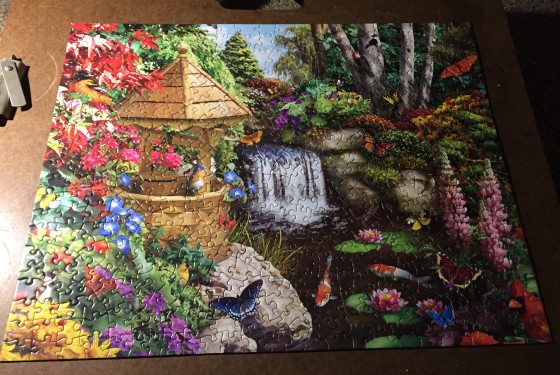
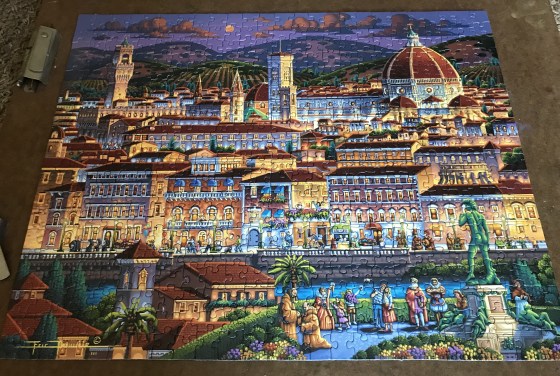
Later, I was less frantic and lost, but saw a future only as far out as my hand, living treatment to treatment, riding a roller coaster as I went from one new medical experience to the next. But even in the midst of treatment, when I took a moment to stop and look around, I knew that I had so much to be grateful for. Not the least of this were the people who cared for me: brilliant doctors, nurses, therapists and administrative personnel. When I pause to consider my treatment experience, the warmth of these people is what leaves me with such a positive feeling. It was the community of care that made a huge difference: the attending nurses in the infusion room, the radiation therapists that I saw daily for weeks, the other cancer patients, most of whom I never met, but with whom I shared the work of putting together a jigsaw puzzle in the waiting room as we all came for treatments throughout the day. That sense of community, of never feeling alone and always being supported, that’s what makes me feel so blessed right now.

Yes, when I finished my infusions, when I finished radiation, I jokingly told these wonderful people that I hoped I’d never see them again (they get that a lot), but every time I think of them, I am overwhelmed with gratitude.

Lifting My Spirits

I received an unexpected but incredibly satisfying compliment today. It was from a worker at Trader Joe’s who made a flattering comment about my arms. A little background here: I like to work out, and even obtained a personal trainer certification when I was a stay-at-home-mom. While I’ve never trained people as a profession, I have maintained my certification over the years — in addition to a vigorous training schedule. I’ve been told that this is unusual for “a woman of my age”.

When I received my cancer diagnosis, I was shocked largely because in my mind my lifestyle didn’t seem to fit the profile of someone at high risk. One of my greatest fears as far as cancer was concerned was that it would affect my ability to train regularly. While so many people engage in eye-rolling when it comes to exercise — it’s popular to equate exercise with misery — having to take time off from working out was one of the most horrible outcomes I could imagine. My version of hell involves a sedentary existence. I train hard to enjoy my life, to be able to move and lift and not feel pain. I work out to live and that energizes me like nothing else. And anything that jeopardizes that is a death sentence to me.

Okay, maybe a little dramatic? But you get my point. I.Love.Exercise.

Today’s compliment was particularly poignant. During my 2017 doctor’s appointment to check out that suspicious lump in my breast, the doctor’s assistant commented that she wished she had my arms. I remembered that as I went through diagnostic tests and oncology visits and surgery. I followed my surgeon’s orders regarding not lifting heavy things (well, mostly, because “heavy” is negotiable), but as soon as that time limit passed, I was off and running. Exercise meant normality, and I craved feeling normal, as in “not sickly and dying from cancer”. There was mention of this nasty impediment to my life called lymphedema. I didn’t really think about it much until I was discussing lifting weights with my oncologist, who said, “Exactly HOW MUCH weight are we talking about here?” and sent me to the lymphedema specialists so that I wouldn’t go full-Schwartzenegger without knowing whether I was risking having my arm blow up. (It hasn’t so far.)

But my point: the compliment I received today made me feel like I’d come full circle. While, yeah, fear of death from cancer is a biggie, drastic changes to one’s lifestyle are also anxiety-provoking.

Today, I felt, I’m back.