Year 8 Mammogram: Can’t Shake This Feeling

(Title image: Photo by 🐣 Luca Iaconelli 🦊 on Unsplash)

A couple of weeks ago, I had my 8-year 3-D mammogram. To be clear, this is eight years following the original diagnostic 2-D mammogram and ultrasound that identified my breast cancer tumor.

This far down the road, the situation seems much less dire. The mammogram takes place shortly after one of my visits to the oncologist, who does a manual breast exam. So if anything should show up on the 3-D mammogram, it would still be quite early stage.

And at this point in my life, my greatest fear is not something showing up on a mammogram, it’s something showing up on another scan elsewhere in my body, because that would mean metastasis.

I’m busy, busy, busy. Too busy to worry, right? RIGHT?
(Photo by Dan Freeman on Unsplash)

But that was not the case this year. I was preoccupied with other concerns including a car purchase, the upcoming practicum for my yoga4cancer training and an NIH grant renewal for the lab I work in. The main thing that I was thinking of regarding the mammogram was how badly my ribs might hurt as I was pulled closer into the scanner and smushed up against the machine.

And also, how sleep deprived my husband and I would be since we had an early morning appointment. Following which I needed to get to the office, while catching a webinar on the way. Lots of stuff to juggle.

So that’s the mindset with which I arrived at the imaging center. And that’s what was going through my head as I made small-talk with the friendly technician and went through the scanning process.

But then she left the room to bring the scans to the attending radiologist’s attention. Note: at our imagining center, if you are a cancer survivor, the radiologist reads your scans while you’re in the imaging room so that you don’t have to wait for results via phone call, through an online notification or—even worse—via the mail. You get them then and there.

Before the tech left she offered me use of the bathroom. I didn’t need it, but I realized that while waiting for the results I needed to keep my mind busy. Off to the bathroom I went, feeling into my feet as I walked like a good little mindful girl.

My big burning ball of cancer experience has quite a long memory tail!
(Photo by Jacob Dyer on Unsplash)

So again, it’s been eight years. I’ve had quite a few mammograms and other scans in that time. I’ve gotten a lot better about dealing with them and I certainly don’t experience severe “scanxiety” with mammograms.

But when I was done with the bathroom and sat back down in the imagining room with the monolithic mammography machine quietly staring back at me, I wanted to be done with it. I wanted to be dressing and leaving and on my way to the next thing.

Again, it’s been eight years, but I had to grab my phone and distract myself with work emails so that I wouldn’t think about anything else.

EIGHT YEARS, people! Cancer is like a fiery comet with a long tail that is visible for years after the thing itself passes.

~~~~~~~~~~~~~~~~~~~~

Oh! I got a clean bill of health. Good to go for another year!

Even When There’s Nothing to be Grateful for…There’s Something to be Grateful for

(Title image: Photo by Nathan Dumlao on Unsplash)

With the Thanksgiving holiday coming up in the United States this week, I wanted to offer you a funny little story to think about when you feel there’s little to be grateful for.

Although I work from home a lot these days, I had gone in to the office a few days ago to get some things done onsite. It was a hectic day and I ended up leaving later than I expect, and as I walked to the busstop, I was carrying more items than usual, including an umbrella for the sun, a large zippered bag for my water bottle and food I hadn’t had time to eat and held my cell phone connected to a charger in one hand. I was loaded up!

Luckily my purse is backpack-style so I didn’t need to carry it in my hands. And my office keys were on my ID badge, which hung around my neck.

All packed up and ready to go, right?
(Photo by Alexandra Tran on Unsplash)

On the way to the bus, I was preoccupied with things that I still needed to do and concerns about issues at home.

The bus arrived, I got on and put my belongings on the floor at my feet, burying myself in a game on my phone.

NOTHING seemed out of the ordinary, save for someone who sat down beside me and seemed to press against me a bit. But, hey, it’s the bus and there were a lot of people on so it isn’t a completely comfortable ride. That’s okay.

Besides, the guy moved to another seat as people got off on their stops.

By the time we got to my stop, I prepared to get off by collecting my items. And my heart missed a beat: my purse was not there.

I did a double-take. I looked all around my seat. Nope, no purse.

My head started to swim because it seemed obvious that someone had taken it. I rushed over to the driver and told him that I thought my purse had been stolen. He listen to my story, called the dispatch and marked the security video, explaining that I should fill out a police report and let them know the time and bus number…

My mind was a blur as I tried to remember everything that I had in my purse.
(Photo by Nick Noel on Unsplash)

I dutifully wrote down his instructions but I was already thinking of the hours of work that getting my cards cancelled, obtaining a new drivers license, getting new car, apartment and mailbox keys, and everything else would require.

“And now THIS on top of everything else!” I thought to myself as I got off the bus and walked home, feeling dejected and spent.

Before calling the police department I decided to call my co-worker to check my office in case I’d somehow left my purse there.

But I knew that was hopeless. There is no way that I would have walked out of the office without putting on my backpack purse, no way that I would have not felt it on my back as I stood waiting for the bus and absolutely no way that I would not have noticed that it wasn’t there when I put all my belongings by my feet on the bus.

I was wrong.

My co-worker told me that it was on the floor under my desk.

Behold the power of mindlessness! I have no idea how I could have missed all those cues that alert me to presence or absence of my purse, especially when it’s the most important item that I carry. But I did.

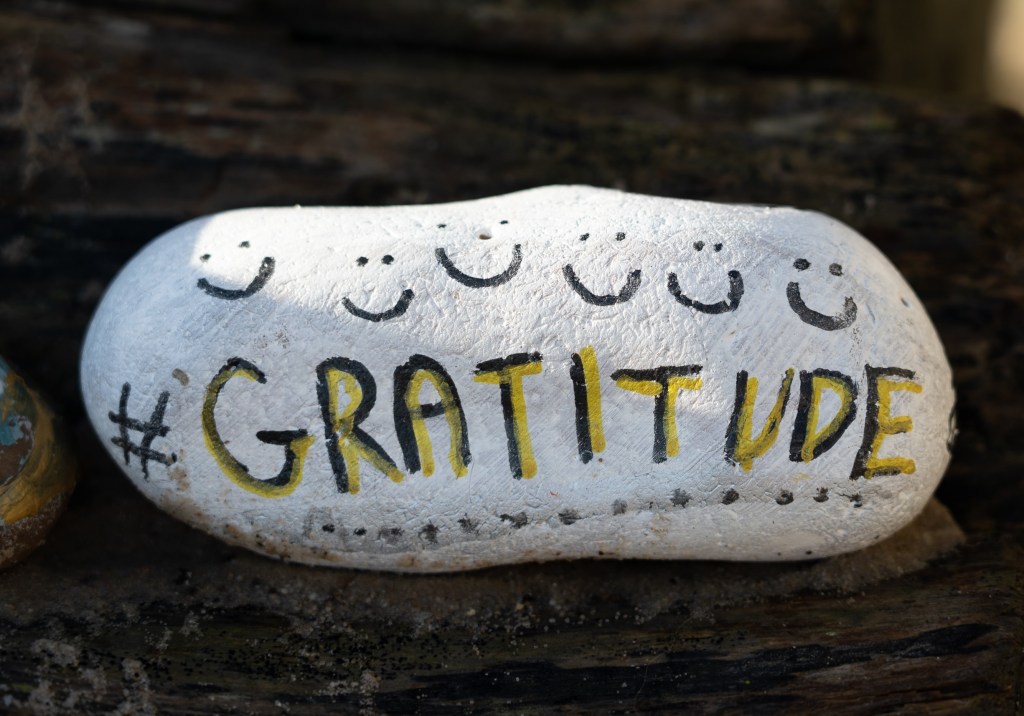
Gratitude hides out in the unlikeliest of places.
(Photo by Nick Fewings on Unsplash)

However, that’s not the point of this post. The point of this post is, suddenly I did not need to call the police department, cancel my credit and debit cards, stand in line to get a new driver’s license, sit and recall everything that I had in my purse and wallet and anything else that I would have spent hours doing.

And I felt a tidal wave of gratitude wash over me, one that would have not experienced if I hadn’t spent the last 20 minutes convinced that someone had stolen one of my most important belongings.

That gratitude came out of nowhere. And it made me think.

If I could muster such a powerful feeling of thankfulness when I realized that something bad that I was sure happened actually hadn’t happened, maybe I could find a way to generate that same feeling without needing to experience the sense of doom beforehand?

In other words, I can be thankful for all the bad things that don’t happen even if there aren’t great things going on at the time.

So this Thanksgiving, my wish for you is to be able to experience sincere gratitude without having to lose your wallet and then find it.

Happy Thanksgiving!

Sinking into the Depths, but in a Good Way: A Meditation Visualization

As I return to really sinking down into my meditation practice, I am reminded of what I’ve been missing out over the past few months when my practice gradually changed and “shallowed”.

Due to pressures and stressors the start of this year, I had been skittering over the surface of my meditations, much as you would imagine barefoot skiing over the surface of a large body of water, and I use this as a visualization of my experience.

It is not fun trying to keep my head up and focused through my distractions.

Up on the surface, you have wind and waves to contend with. The more time that you spend up on top of the water, the more tumultuous distractions you find there and it becomes more difficult to find a sense of calm. The more you do that, the more it becomes habitual.

But when you stop charging across the surface — resisting the enticing attraction of thoughts — then you find yourself slowly sinking…but in a good way. Thrashing winds disappear, sounds become muffled and fade into the distance, movement slows. The deeper you descend, the more quiet you find there.

There are times that I think I’ve been meditating, only to realize that I’ve floated up to the surface and am actually bobbing around in the choppy waves of my thoughts. That realization comes more quickly the more time I’ve spent in the depths, and when I return to the process of sinking, it feels like such a relief.

The deeper I allow myself to descend, the quieter I become. It becomes less of a struggle to stay down.

I can learn to sit with frightening creatures the way I can learn to sit with unsettling thoughts…and vice versa.

And as I get progressively deeper, light dims. Initially, the darkness felt a little intimidating (I’m not a fan of dark water). But then I remembered, this is my ocean. I decide what dwells in the darkness. I can fill my ocean with fearsome, aggressive creatures — and sometimes I do this — but then because I realize that they are mine, they don’t hurt me and I am able to sit with them peacefully.

What an accurate analogy for our thoughts, no?

In this way I feel my own inner strength and power. The darkness does not have to be frightening — it is a gentle darkness that signals rest, allowing my mind to slow and focus inwards.

If that darkness is too disconcerting to you, imagine that there is a soft blue brightness in the water, illuminating your entire area of vision, and perhaps even an underwater staircase you can use to control your descent. Tweak it however you like so that it fits with your level of comfort.

This visualization is the perfect reminder of how good meditation feels when I don’t get in my way about it. Nothing to do but relax and let myself sink down…

Memory and Attention Adaptation Training (MAAT): Finding a Way to Deal with Chemo Brain

So, as I’ve written about in previous posts (here and here) there’s this thing called ‘chemo brain’, and contrary to what you might find when you google it, it doesn’t necessarily go away after you finish cancer treatment. It also has a longer name: Cancer-Related Cognitive Impairment (CRCI).

This can be particularly frustrating for those of us who are expected to perform “as before” (meaning, prior to getting cancer) and yet increasingly fall victim to distractions, searching for words, forgetting things as soon as we’re told them, and in general, wondering whether we’ve now come down with a mix of dementia and ADHD.

You’ll need more than a bouquet of forget-me-nots to navigate post-cancer issues like CRCI. Classes like MAAT can help.

There is help, however, and it’s arrived in the form of a class called Memory and Attention Adaptation Training (MAAT). I had the opportunity to take this 8-week class in Fall 2022 and it recently concluded.

The class is intelligently put together, first showing students the science about what they are experiencing (and that it’s not early-onset dementia!), and then over the next two months, teaching tricks and techniques for helping navigate the new landscape of CRCI.

This includes learning stress management techniques, improving sleep and pacing oneself, making self-care a high priority. But the majority of the class was devoted to learning how to use methods such as rehearsal/repetition, situational awareness, scheduling, distraction reduction, active listening and imagery. These help us maintain focus and retain information while reducing overwhelm.

It takes more than littering your desk with post-it notes. We need to create an environment that supports memory storage and distraction reduction.

I took the class through SHARP Hospital in the San Diego, CA area as part of their second cohort. It was taught by a clinical oncology social worker (herself a breast cancer survivor) and a speech pathologist, and their expertise made the class even more worthwhile. While the first cohort was in person, we in the second cohort had the benefit of taking the class via Zoom, which helped with accessibility, especially for those of us who are still working.

And a number of us there were already about 3-5 years out of treatment, which dispells the notion that chemo brain only lasts during treatment. Our cohort members’ ages ran the gamut from early 30s to well into retirement, illustrating that CRCI can show up in any cancer survivors regardless of age.

Realizing that this is affecting many more people that have been reporting symptoms, the SHARP Health Care system has opened the classes to individuals in other health systems in the San Diego area.

No matter where you live, if you are a cancer survivor experiencing some form of cognitive impairment, I urge you to 1) tell your oncological team (They need to know this is happening!) and 2) ask them about the availability of MAAT classes in your region. MAAT is not currently being offered widely, so please make your needs known so that this service can be expanded to those who need it.

~~~~~~~~~~~~~~~~~~~~~~~~~~~~~~~~~~~~

Curiously enough, one of the first assignments we had in the MAAT class was to work with gratitude – yes, it really does help! Such a perfect practice to begin at this time of the year! Happy Holidays to all! ❤

Another Dual Focus Meditation: Engaging the Ears

In my ever-continuing quest to maintain my concentration during meditation, I’m constantly exploring different points of focus. My go-to still remains the breath, but I’ve written about sharing that spotlight with focus on sensations in the hands as part of a dual focus meditation.

More recently, however, I’ve incorporated more of the senses into my meditation practice (I mean, we have five so why not?).

Urban sounds can provide a constant din that can be used with the breath as a dual focus sensory practice.

In between the inhales and exhales, there’s space during which I’m notoriously susceptible to distractions. Lately, I’ve been working with sounds. I live in the city on a busy street and there’s rarely a lack of noise, so in the lulls between my breaths, my ears turn on and absorb the sounds transpiring outside my window.

The trick with sounds, however, is to allow them to simply be interpreted as tones and refrain from being drawn into naming them. A siren runs the risk of eliciting thoughts of “where’s the fire?” or similar scenarios. For this to work, it’s important to engage our “beginner’s mind” — our brains are quick to match familiar sounds with a story — and divorce the sounds from associations that we’ve made over the years.

If simply shuttling between breath and sound provides enough fodder for concentration, this might not be an issue.

In that case, street noise can be an effective anchor for its variability, its high tones and low tones, as the passing of cars may morph into ocean wave-like sounds.

Meditation music and meditative sounds abound on the internet. Hunt around and you will find a plethora of offerings to use as a focal point.

However, if urban noises are either too intermittent or too difficult to resist spinning tales around, there are many other options for ambient sounds that will work for purposes of meditation. It’s no surprise that platforms like YouTube have a gazillion listings under “meditation music” that may fit the bill. In addition, apps like “myNoise” (and website myNoise.net) provide customizable background sounds to help mask outside noise and maximize ability to stay focused longer.

As the body moves with the breath, sound will remain in the background allowing attention to organically cycle between the two. From personal experience, I’ve learned that juggling between feeling into sensations in the body (breath) and being aware of sounds coming through my ears results in really turning down the dial on my Monkey Mind, which seems to fade to the distance. This dual focus can close the gap through which mind chatter might otherwise intrude.

If you feel inspired, give it a try and let me know how it goes!

I Am An Imperfect Meditator

I meditate. It is a daily habit that I engage in with the best intentions, but I am a victim of my wandering mind. Some days are better than others, most days I struggle with distractions.

Often, I can be halfway through a sit before I realize that I’ve been clenching my jaw or tensing my brow or gripping some other part of my body, thinking I’ve been relaxed but I’ve been kidding myself.

There are times that I’ve managed to stay with my breath, and then start getting excited that I’ve stayed with it that long, and then start imagining how I might look, staying with my breath…and of course, then I’m no longer meditating.

Yep. Welcome to the noise in my noggin’.

So it goes, day in, day out. Everyday, once or twice a day, or maybe even more. Some days feel like a complete waste, like I’ve got a freeway running through my head and have no idea what I’m doing.

But once in a while, I get a few moments of golden light. They may just flicker in and out, but when I look back at those moments I know everything flowed.

And those mindful sessions make all the other ones worth the effort. Every time I pause before reacting. Each time I recognize my body’s physiological response to a stressor. When I remember that I don’t have to respond with anxious energy. That I get to chose what happens inside my head. That I can just say, “Sh-h-h-h.”

That I can stand back and observe the storm without getting sucked into the whirlwind.

I meditate and often don’t do it well. But I still meditate. As of this posting, 1,380 days in a row, originating with the most frantic breaths shortly after my cancer diagnosis. Even through chemo, when I thought I wouldn’t make it through the night. Sloppy meditation sessions that seemed to be going nowhere.

Change doesn’t require force, it requires consistency.

Those imperfect meditation sessions have changed over time, imperceptable on a daily basis. Perhaps they have worn away a few rough edges the way constant drops of water oh-so-gradually wear away a stone. And just as an indentation forms where the drops hit, so meditation has molded a little basin for me, a bit of extra space in my mind that provides just that much more breathing room.

I am still at the very start of my mindfulness journey, so imperfect and stumbling. But even with the little that I have achieved, I am light-years ahead of who I was before I started, wide-eyed with fear and not knowing how to stop the rush of emotions.

It was terrifying then because I didn’t realize what was happening. Now I know, and that makes all the difference.

Mindfulness Apps I Love: “Zen Koi 2”

Note: I do not receive compensation for writing about apps. I highlight these products because I personally use them and have found them to be helpful. Hope you do too!

Zen Koi 2 works for me like a mindfulness/meditation app.

I admit that I would have never though of calling a smartphone game a “mindfulness app”, but as far as I’m concerned, Zen Koi 2 qualifies.

The concept is simple: lead your koi through a pond as it catches prey that it uses to magically craft into gems, which in turn are used to expand the size of the pond. The koi increases in abilities (speed, agility and rarity) and has the opportunity to mate with other koi (in a stylized, family-friendly kind of way).

The egg that’s produced has the possibility of hatching into one of several different koi, which you can gather into collections. The pond increases eight times, each one marked by a certain sigil (symbol), and at the last one, your koi ascends to a beautiful dragon by jumping over the dragon gate and establishing its place in the heavens, harkening back to the Chinese legend of the hero Dayu.

The koi is supercute, swimming around the pond and gulping the prey you select for it.

That’s the gist of the game. But what makes it a mindfulness app? The way it allows you to stay in the moment. There is no competition, and while, if you prefer, you can focus on completing the collections of different koi “sub-species”, or collecting dragons, the game is not lessened if you chose not to do so.

Both koi and prey are colorful and pleasingly cute. The pond looks peaceful and inviting. Catching the prey is easy, even though they get more evasive as the pond expands. Select a prey item and the koi swims up to it and gulps it.

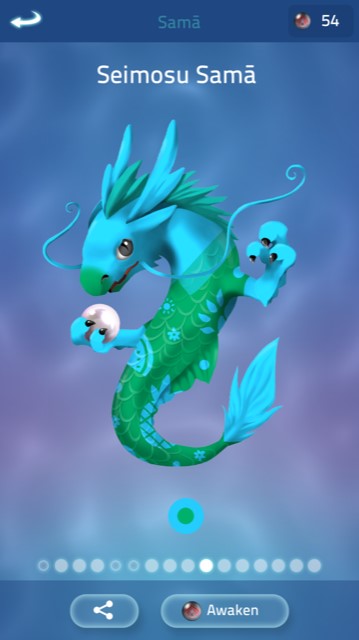
At the last expansion of the pond, the koi jumps over the dragon gate and transforms into a colorful dragon.

Once you hatch an egg into a koi, you can release the fish if you don’t want to keep it. The koi remains in your collection, able to be cloned and played with again, “paid for” with easily-obtainable pearls that appear in pond flowers, as rewards, or, if you prefer, by watching ads. There is no time limit and your koi is never in danger. You don’t suffer any penalties by taking it slow. This is all about living in the moment, playfully chasing the prey needed for that given sigil level and enjoying the surroundings.

You also get a personal pond outside of gameplay to showcase several koi and decorate with plants and rocks as you wish.

What was my most definitive test of whether this worked as a mindfulness app for me? I woke in the wee hours of the morning with too many worries on my mind. Usually I meditate when this happens and I can fall back asleep, but last night my thoughts raced too much to allow that sort of calm. I popped open this app and after about 15 minutes of helping my koi meander through the pond, I found distance from my worries and was able to sleep a few more hours.

Zen Koi 2 is worth looking into if you’re interested in soothing, mindful distraction.

“Dropping Down”: A Meditation Analogy

One of my greatest obstacles to meditation is distraction. I’m particularly susceptible to having my mind wander off because of the drug tamoxifen that I’m taking for breast cancer, the side effects of which include difficulty with concentration and focus.

A wandering mind, however, is not limited to those with cancer medication side effects. If you meditate, you’re pretty much guaranteed to struggle with focus at some point. I use the analogy of a cave to describe what this feels like and how to deal with it.

I sit in a darkened cave, warm and comforting, the only light coming from a hole far up above, where the noisy world buzzes. There’s nothing wrong with that, but right now is the time to devote to my meditation cushion. I focus on my breath. As I sit, a thought emerges and I notice a rope hanging down from above. Before I realize it, I’ve grabbed hold of it and start climbing.

These thought-ropes are so tempting to grab onto, pulling us up and away from the meditation cushion.

The further I climb, the easier it is and the louder the world gets. My surroundings brighten, but I’m no longer meditating. I’m actively engaged in what’s going on up above, perhaps agitated, perhaps excited. I’ve lost track of my breath.

“Drop down,” I tell myself gently. And I slide down the rope, into the welcoming darkness below, until I find my place back on my cushion in this womb of Earth. One deep breath and I’m grounded again, calm and rooted.

I can’t stop what’s going on in the world above, but I can choose whether or not to climb a rope.

This experience repeats itself, like a flowing dance between the meditative breath and wandering attention. Another thought catches me and I reach for its rope, making my way back up swiftly.

“Drop down,” I tell myself again patiently. I let go and return to my place in the cave, surrounded by the supportive darkness. Another deep breath and I’m calm again.

So many thoughts, so many tempting opportunities to climb out of my cave too soon. Some days, I swing from rope to rope, only hovering over my cushion, never quite managing to ground myself. On other days, it’s easier and the path to a peaceful meditation session is straightforward. The darkness of the cave soothes me and reminds me that I am safe, and that I can choose whether or not to cling to a thought.

My distraction is a constant, but that doesn’t matter as long as I can drop back down. And I can always drop back down.

Invisible Effects: Helplessness

Suffice it to say, simply having cancer can leave you feeling helpless. Ignorance of the cause, uncertainty about the future, fear of treatment effects — that lack of control is frightening. But that’s not the helplessness that I’m writing about here.

In my last post on chemo brain, I alluded to the disorientation that comes from distractedness, brought on by lasting effects of chemotherapy on brain function. Here, I want to drill down and describe the feelings of helplessness that arise. 

In WHY Did I Just Do That?, I wrote about a humorous dream in which I couldn’t understand the reasons for my weird behaviors. But the more sobering side of this is that I often feel that same way during my waking hours. There are things that I’ve done — treating a red light like a stop sign, as mentioned in my previous post — that make absolutely no sense to me and make me feel like I’m not in control of my own behaviors.

To make matters worse, I am not aware that I’m doing anything wrong (or dangerous or illegal!) at the time. When I realize what I’ve done, I’m horrified. Want to feel helpless? Not being able to trust yourself is a pretty good way.

I’ve been told that the main issue is loss of focus. Mindfulness helps immensely in these types of situations, but as anyone who has practiced mindfulness can tell you, you can’t be mindful 100% of the time. In my case, I’m fearful that this distractedness can put others or myself at risk.

This.

Want a few more examples? Some are rather benign, like almost flooding the bathroom because I left the water running in the sink. Or writing an important email and leaving it unsent. Most of us have done something like that at one time or another, likely due to juggling too many tasks at once.

But the things that leave me feeling desperate are the ones that are not easily remedied. Having to learn things over and over again because I’m not retaining information. Having trouble expressing myself and not being able to retrieve words. After working as an editor at one point, this is unbelievably disheartening.

However, one event topped them all: I fell for a (well-designed, admittedly) bank scam where I gave out my Social Security Number despite having taken my work’s cybersecurity training course the previous week, and having received constant reminders from my bank that they will never ask for my SSN over the phone. Besides making me feel unimaginably STUPID, it cost me a good deal of money, time and nerves. 

“Helpless” is not even the best word to describe how I feel. “Hopeless” is a more apt term. “Exposed” and “vulnerable” work too. This begs the question: how much more damage will I do to myself before things start improving? I should be working full-time instead of part-time, given the cost of living in my area. But how can I even think of looking for another job when I’m on such shaky ground? Cancer knocked me down in ways that I never anticipated. Yes, I’m grateful for being alive, but YEESH!

Building new neuronal connections, identifying what aspects of my memory issues are most severe, practicing mindfulness as much as humanly possible — it will take all that, along with a healthy dose of patience, to start seeing improvement. Hope I don’t get distracted and drive off a cliff before then.

Invisible Effects: Chemo Brain

Ah, chemo brain: the eater of thoughts. I should note that what I’m experiencing might not just be the effects of chemotherapy messing with my brain cells. This could also be influenced by the estradiol-blocking drug Tamoxifen that is forcing me into menopause before my natural time, or it could simply be the menopause “fog” that women complain about. So I don’t know exactly what it is, besides being infuriating.

I lose thoughts in an instant. Sometimes I actually “see” them disappear in the distance. It’s such a weirdly tangible sensation. I can try to grasp at their coattails and occasionally I’m successful in latching onto the thoughts and pulling them back. Other times I need to stop and walk back through my thought processes to retrieve them. And then sometimes they’re just gone. My desk at work is covered with post-it notes as a testament to what’s going on in my noggin. If there’s something I need to do I need to write it down NOW, and it’s not unusual for me to lose the thought as I’m in the process of getting something to write it down on!

This is what a walk down my memory lane looks like.

I can juggle up to three things in my mind at a time if I keep repeating them over and over again and work to maintain focus. Any more than that and it quickly crosses into the realm of hopelessness — it’s like knowing how to juggle three balls but if someone tosses a fourth at you, they all crash to the ground.

Then there are those chunks of awareness that disappear. It may simply be distraction and losing focus, but it feels like a hiccup in time that I don’t notice until it’s happened. It’s that “huh?” feeling as I return to present time when I realize that I’ve been gone for a second or two.

More disconcerting is a strange myopia that prevents me from reacting normally in a familiar situation. For instance, several months ago I treated a red light like a stop sign, and this was a familiar traffic light in my neighborhood that I’d been through many times. I briefly stopped at it, then drove through it. It was a “T” intersection that’s not terribly busy, but I did get shocked back to reality by the angry honk of a car that had the green and was probably wondering WTF I was doing. 

The bottom line is that I’m distractable beyond belief. My train of thought gets derailed before it even leaves the station. The first time I noticed this, my oncologist ordered a brain MRI, way back in February. Nope, couldn’t blame it on a brain tumor — it’s just chemo brain.

This feels demoralizing, especially since my memory used to be so good. I lament losing all those awesome thoughts and ideas. And I know they were awesome because I remember having them — I just can’t recall exactly what they were. Yeah, there will be more, but I better have a notepad nearby to write them down. I even had a better ending for this post, but, you know…