Throughout my cancer treatment, it was the smiles, gentle hugs, kind words and unexpected “going-out-of-their-way” little extras from those around me that made a huge difference and left a lasting impression on me.
Now, as I gradually wind my way through survivorship, memories of those acts smooth over the physical and emotional pain associated with cancer. Those soothing feelings are too powerful to keep to myself. Given the general vibe in the world today, the hyperpolarization of people’s opinions and the resistance to leaning over and trying to empathize with others, we need more kindness everywhere.
“But what if the person doesn’t deserve it?”
Then that is a person truly in need of it.
It won’t hurt a bit, I promise.
There is no limit on how many smiles you can dispense, doors you can open and kind deeds you can do. It doesn’t have to cost anything. And if there’s one thing that I’ve found, it’s that random acts of kindness have a two-fold benefit: for the person receiving the kindness and for the person giving it. It’s the ultimate win-win.
There are only so many hours left in this day of kindness. Take advantage of them. And then make every day a “Random Acts of Kindness” Day.
Yes, “scanxiety” is a thing. And I’m already regretting writing about it because it’s bringing home the fact that in a week and a half I have a mammogram coming up. It’ll be the first one since completely finishing my treatment almost a year ago.
You can google the definition of scanxiety, but any cancer survivor can offer their version. Mine is the unease that increases as I get closer to THE scan, the one that will pronounce me cancer-free for another year. Mercifully, I will have an unusually busy week at work which will keep my mind equally busy, and the rest I will have to power through with mindfulness and focus.
The unsettling thing about this is that for a short while, it’s a Schroedinger’s cat kind of situation. Around scan time, I am simultaneously a cancer patient and a cancer survivor. Prepare for the worst, hope for the best. It’s altogether unsatisfying.
This mammogram opens the door to the potential of letting cancer back into my life. And I am so.done.with.it. that having to consider what would happen if I had to go through treatment again evokes feelings of hopelessness and frustration. I don’t want to re-experience the steep let down that came with my initial diagnosis, after trying to reason myself into optimism.
Sometimes I play games with myself. Things like, “If I make it to the intersection before the light turns yellow, I don’t have cancer.” This is ridiculous, of course, but I can guarantee you that if I DON’T make it before the light turns, I’m going to be yelling, “Two out of three!”
Scanxiety differs from most life stressors, like a horrible job situation. I’ve had tough jobs with miserable bosses before. I also had the option of quitting. But I can’t say, “Screw this, I’m going to a different universe with better benefits.” I’m here and stuck living out some potentially nasty stuff, and possibly not making it through. That is simply reality and I have to be comfortable with it.
It’s all in how you look at it…
I struggle with the uncertainty that arrives hand-in-hand with scanxiety. Mindfulness teaches us to release expectations, and that is exactly what I’m trying to do. For me, the next week and a half will be a proving ground for how far I’ve come in my mindfulness practice. Perhaps looking at it as a challenge will put a neutral spin on the process of waiting.
No expectations means no anxiety, no let-downs, no shattered hopes and no “dying a thousand deaths” before I’ve even made it to the radiology department. I am not good at this, but I am light-years ahead of where I was two years ago, and I’m going to have to be content in that for the time being.
Okay, maybe this post’s title is a lie, since I keep bringing this topic up. But I admit that I need to stop whining about getting breast cancer when I didn’t have risk factors, so I’m officially giving myself one last time to vent. And then it’s time to let it go.
First, what is a risk factor? The NIH National Cancer Institute dictionary defines a risk factor as “something that increases the chance of developing a disease”. However, that does not mean that it’s necessarily a cause of that disease. And that’s where the potential confusion (and in my case, irritation) arises.
While breast cancer has a number of risk factors, none of them are 100%-for-sure causal in nature. Even having the BRCA gene does not guarantee that you’ll get breast cancer, although your risk is quite high.
So why does this matter? Turn this around and look at someone with breast cancer. Based on risk factors, you’d expect them to be overweight, sedentary, a smoker, a drinker, an unhealthy eater…and you might be completely wrong. Ascribing unhealthy behaviors to an individual just because they are a cancer patient is potentially stigmatizing (it suggests that they are responsible for bringing on their disease) and ignores the fact that we still don’t know why cancer develops. And what of all those making poor health choices who do not get cancer?
Engaging in the opposite behaviors — being a lean, active, non-smoker, non-drinker with a plant-based diet — likewise is not guaranteed to protect you from breast cancer. And yet, that’s exactly the feeling you get from reading all the recommendations, which leads to a potentially dangerous false sense of security.
Risk factor, schmisk factor! Putting in the effort to live as healthfully as possible is well worth it, no matter what.
Certainly, no matter what disease you have, the more healthy behaviors you engage in, the better your outcome. However, even being a paragon of healthy living is not the “get out of cancer jail free” card that we are led to believe it is. So get yourself checked out and don’t take your health for granted!
What brought all of this up? At a recent gathering, I had an interesting conversation with another former cancer patient who also happens to be a medical psychologist. She felt as frustrated as I did about the way cancer risk factors are presented, so I felt a vindication of sorts. We both agreed that it is critical to highlight the difference between cancer risk factors and causes. And of course, no matter what your perceived cancer risk, to live as healthfully as possible.
Now that I’ve gotten that off my chest, I will do my best to shut up and move on.
Unbeknownst to me, the friend whom I wrote about in “Waiting To Say Goodbye” had already passed by the time I posted last Saturday. The end came very rapidly but peacefully Friday at sundown, allowing just enough time to enable her to be surrounded by everyone in her immediate family.
This is sudden and painful. She and I had spent a good chunk of 2017 sharing breast cancer treatment experiences. We knew that there were no guarantees with cancer, but we both had hope. Neither one of us imagined that this would be one of the outcomes.
After she knew her cancer had spread, she continued living as she always had, toughing through the hard parts. She didn’t want people asking her how she was feeling, she wanted to keep on going until she couldn’t go anymore, and that’s what she did. Her decline was so swift that she had felt well enough to do everything normally until the last few days before her passing. That was a beautiful gift that she genuinely deserved.
Understanding that nothing in this life is permanent doesn’t make her death any easier to accept, although it does underscore how things change no matter how desperately we cling to them. I strive to practice non-attachment, but who am I kidding? I am too attached to people and expectations. Yes, it does cause suffering, but right now suffering is just what I do.
Eventually I may transcend this. Eventually.
I end this post with a quote from Claire Wineland, the 21-year-old cystic fibrosis activist who passed away from complications from lung transplant surgery on September 2, 2018. She had spent most of her days knowing that her time on this Earth was short and urged people to live life to the fullest: “Go enjoy it, ’cause there are people fighting like hell for it.”
One of the inevitable parts of being a cancer patient is that you get to know other patients. Equally inevitable, however, is the fact that not everyone has a positive outcome. This week, one of my friends with whom I went through my cancer journey entered into hospice.
We had received our breast cancer diagnoses within several months of each other and occasionally met for coffee as we discussed our treatments. It was a safe conversation, as we were sharing similar experiences with similar fears that only someone in the same situation would “get”. We both enjoyed these opportunities to compare notes and allay anxieties. I had been publicly open about my cancer, but she was more private and circumspect about whom she told, so I was one of the few people who knew her condition.
But as our treatments came to a close, our paths began to diverge. My cancer treatment had been more straightforward because the drugs I was given were well-targeted to my type of tumor. Hers was a more complex situation – a more aggressive tumor with no clear targets, complicated by an existing chronic health condition. While I was declared cancer-free, diagnostic scans found “spots” in other parts of her body, tiny ones that had caused suspicion early on but had been too small to biopsy.
These sports grew larger and a biopsy confirmed her fears. Her cancer had spread. Due to her other health issue, she had not been able to tolerate the most prescribed and effective chemotherapy given to patients with her type of cancer tumor. Therefore, her best option was not available. Immunotherapy was attempted but that failed to produce positive results.
At this point, I was hearing about her disease progression second-hand as she wasn’t open to having coffee. I respect her reluctance to meet with me, because if the tables were turned, I don’t think I would have wanted to be discussing my worsening situation with someone who had been in a more fortunate position. Consider this analogy: you’re on a highway. The cars all drive at similar speeds and travel is pleasant. But if you need to pull over — perhaps there is car trouble — you suddenly feel like the world is passing you by. Every whoosh of an automobile is a reminder that you are not moving. You feel frustratingly stuck and left behind, wondering whether you’ll be able to re-join everyone else on the road again.
Her decline has come abruptly. She’d been living on her own all along, but then came dizziness and aches and pains. It started at the beginning of this past week. By Wednesday, her parents were setting up hospice in their home and had ‘round-the-clock care secured. So fast, so fast. It feels like we need to catch our breaths. No one is prepared for this.
I was told yesterday that she had only days left. I am in shock. I had originally planned to bring over bright gerbera daisies this morning, but decided against it, as she is not able to take visitors.
It’s raining hard today and for the next several days. The weather is uncharacteristically gloomy and foreboding for this part of the country. When she passes, I pray that her transition is gentle and the sun is shining.
According to a recent Time article, Zen Master Thich Nhat Hanh, who is considered the father of mindfulness, is close to death, never having fully recovered from the stroke he suffered in 2014.
Although that report has been disputed by Plum Village (the school of Buddhism coming out of the Plum Village Monastery, which Thich Nhat Hanh founded in France), at 92, the monk is certainly frail. He has returned to the temple where he was ordained decades ago, Tu Hieu Pagoda in Hue, Vietnam, to live out the remainder of his time on Earth.
Due to his condition, Thay (“teacher”, as he is affectionately called) is unable to speak, but he still manages to serve as an example of living in the “now” and appreciating every day. Thay is considered one of the greatest teachers of Buddhism and his influence has reaches countless millions.
Mindfulness has played a significant role in my life and emotional well-being since my breast cancer diagnosis in early 2017; however, my first exposure to Thich Nhat Hanh was in the early 2000s, during a program called Speaking Of Faith, hosted by Krista Tippett on NPR. I was transfixed as I listened to the story of his life, his anti-war activism during the Vietnam War and his interpretation of Buddhism. We purchased several of his books, specifically the ones he wrote for children: Each Breath A Smile and Under The Rose Apple Tree.
Thich Nhat Hanh at Hue City, Vietnam (2007) (in dark vestments). Photo: Lưu Ly
It wasn’t until my cancer experience that Thich Nhat Hanh’s teachings resurfaced in my life. I am deeply indebted to mindfulness for taking me through cancer treatment into recovery and survivorship. And yet, even now, I understand mindfulness in only the most superficial way. Every day of my meditation practice brings me more deeply into it. It has been invaluable not only in dealing with anxiety, but also in cultivating compassion for myself, something that has not come easily.
Most recently, I’ve been utilizing mindfulness to help deal with chemo brain, which continues to plague me. When I feel stupid, can’t remember things or lose concentration, mindfulness provides the way to be more patient and understanding with myself. By staying present, I’m better able to focus. Am I good at it? No, not at all. But I do my best. It’s a process. And if I weren’t practicing mindfulness, I would be in a much worse place.
While I am Roman Catholic, I’ve found that Thich Nhat Hanh’s Buddhism resonates with me, particularly as I watch Christianity struggle with hypocrisy. The practice of mindfulness was the most important gift that I received with my cancer diagnosis, and it allowed me to find even a sliver of peace in what was a dismal situation. I am coming to accept where I am now, not holding on too tightly, but appreciating what I have.
Since my breast cancer diagnosis, I’ve kept a close eye on both the popular and scientific literature regarding potential causes of breast cancer. There’s a lot of new information coming out now, but the core recommendations for lowering one’s risk of breast cancer remain the same.
In fact, current research is reinforcing them: keep a lower weight, eat more fruits and veggies, exercise, don’t smoke, don’t drink. While I’m oversimplifying, that’s the gist of the message that’s being disseminated. Some articles go a step further and make bold statements. One in particular stressed that cancer was preventable through lifestyle changes. Anand et al., 2008 claims: “cancer prevention requires smoking cessation, increased ingestion of fruits and vegetables, moderate use of alcohol, caloric restriction, exercise, avoidance of direct exposure to sunlight, minimal meat consumption, use of whole grains, use of vaccinations, and regular check-ups. …[W]e provide evidence that cancer is a preventable disease that requires major lifestyle changes.”
Of course, when I read these recommendations, all I absorb is, “You irresponsible ass, you’re not doing enough to protect yourself!” The fact is, I was doing all that and more, and I still got breast cancer. If you’ve read some of my other posts, you’re probably sick of hearing me say it. I shouldn’t have gotten breast cancer according to all the guidelines out there.
So here’s the issue that I have with all these helpful suggestions. They keep repeating lifestyle changes that should be implemented to lower your cancer risk. Let’s face it, it doesn’t matter WHAT disease you’re trying to avoid, you should maintain a healthy weight, exercise regularly, not smoke and so forth.
We can’t automatically assume that if someone has cancer, they must have been engaging in unhealthy behaviors.
The stigma of cancer comes in when we start making assumptions about WHY someone gets the disease. Given all the purported connections with lifestyle for breast cancer, that assumption may be that the woman (or man) brought it upon themselves. The more that we stress lifestyle changes, the stronger the connection becomes in the mind of society: if you get cancer, you were clearly doing something wrong and it’s all your own fault.
I will be the first to stress the importance of doing everything you can to improve your health. But we have to accept that given our current lack of understanding regarding the exact agents that bring on cancers, we cannot put the “blame” squarely on the shoulders of the patient.
While smoking does account for 80% of lung cancer deaths, that’s only a general statistic. Statistics work well for populations, but they can be strikingly inaccurate when it comes to pinpointing causes for an individual. For example, one of the youngest known cases of lung cancer was in an 8-year-old girl in Jiangsu Province in China due to some of the worst air pollution on the planet, not to a pack-a-day habit. So we need to be careful about the assumptions that we make.
Back to breast cancer, if you were to construct a picture of what a “typical” breast cancer patient would look like based on the recommendations for what to avoid, you’d come up with an overweight, sedentary, smoker/drinker with a bad diet. But if you start picking this apart, you find that these predictions don’t hold up. For example, the connection between breast cancer and weight is complicated. In fact, many of the women I know with breast cancer had healthy habits, and most did not look like the picture that we constructed at the top of this paragraph. In contrast, there are numerous women with unhealthy habits who remain cancer-free.
Statistics work well for populations but are lousy predictors of what actually happens to a given individual.
This message that we send about how to lower your risk of cancer raises the possibility of stigmatizing the patient. It suggests that we have control over our outcome, and this is simply not the case. Currently, we don’t know enough about what causes cancer and what to do to truly avoid it. And if we do what we can to lower our risk of it, that only means statistically lower our risk. That doesn’t guarantee that we won’t get the disease.
My painful personal lesson was to not assume that I could avoid cancer by following health guidelines to a “T”. At the same time, I had to shake the notion that I had done something wrong to willfully bring cancer upon myself. Ultimately, I had to let go of both control and responsibility because neither one had a role in this disease for me.
The best we can do is live as healthfully as possible, accept the uncertainty that comes with a situation this complex, and not judge those who have been unfortunate enough to fall prey to the disease.
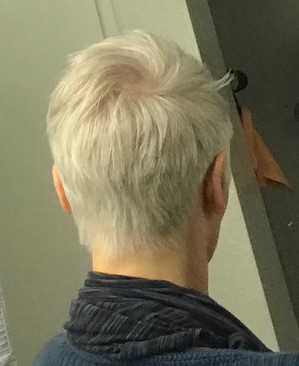
I am getting my hair cut today, but this is no ordinary trim. After losing all my hair to chemotherapy in 2017, I find myself in a completely foreign realm: short hair after a lifetime of long locks.
Losing my hair was like losing part of my identity. We’re used to bald men — it’s even hip to shave your head as a man. But bald women are seen as oddities, because our hair is tied to our perception of beauty. A woman with no hair is perceived as an oddity — something is wrong. You’re sick.
So hair regrowth took on a particularly important meaning for me after chemo. It wasn’t simply that I finished treatment — I was reclaiming myself. My first haircut, in February 2018, when my ends were getting unruly, was terrifying. I hated the thought of cutting what I’d “worked” so hard to regrow. When you’re a cancer patient and hear horror stories about permanent baldness, getting hair back is not taken for granted. I didn’t finally exhale until I saw little sprouts at the front, and that didn’t happen until about November 2017, three months after my last chemo. I had no idea that it would take so long for my entire scalp to wake back up.
I feel so…different. Maybe a new haircut will help?
Now, almost a year and a half after chemo, I still look so different from the pre-cancer me, and I get a shocking jolt every time I see my reflection. It’s me, but it’s not me — I guess it’s the “new” me. I’m different and there’s no going back to who I was before. Sometimes that leaves me feeling lost and disoriented.
My husband feels similarly. Cancer affects those we love too, and as I struggle to define myself, he works to understand how I’ve changed. As I’m not familiar to myself, I am also unfamiliar to him. While it’s true we all change as we age and are not the same people we were when we met, normally those changes are slower and we have some control over them. But cancer is the hurtling locomotive that plows through your life and tosses everything you’ve known to the sides. Cancer forces you to pay attention.
So I’ll march into the salon to delve into new-short-hairstyle territory and put on a brave face to make cancer recovery into a positive experience — one that I didn’t ask for, but here I am anyway.
It won’t come as a shock that I’m so grateful to have cancer treatments behind me. While it’s true that the ‘me’ in the mirror still looks so different from the person I used to be, memories of cancer slowly fade into the background as concerns about current life take precedence. The more time that passes, the more likely I am to think that treatment wasn’t that bad. Hey, maybe parts of it were pretty good?
Nothing shocks me back to the frigid reality of cancer like an unexpected flash of pain in my breast. I don’t mean those post-surgery “zingers” that I was warned about. Those I’ve gotten used to and consider familiar. The ones I’m talking about feel different. I stop breathing for a second, trying to define the sensation.
I feel stupid forgetting how nasty a beast cancer is. These pains throw me into high alert. It’s an unpleasant sensation, because it transports me back to an uncontrollably dark point in my life. I’m so mindful and present in the “now” that it’s almost too intense.
Then the pain stops. Um, okaaaaay?
These are sensations that someone who’s never gone through cancer would consider to be weird annoyances. But to a former patient, they mean something else. I’m primed to worry about anything new, no matter where it is.
Twice so far, I’ve experienced a sudden weakness in my arms. Both times it was in the morning not long after rising. My arms felt heavy and uncomfortable. This is not normal. It’s worst for about a minute and then gradually disappears, but my focus on it is so sharp that I’m not sure if it’s really gone even after a half hour, most of which I’ve spent googling “sudden temporary weakness in both arms” and getting unsatisfying results.
“Relax, it’s only Ebola.”
Incidentally, not a single one of those search results mentions cancer.
That echoes what my oncologist said: “You know, it doesn’t have to be cancer.” Yeah, I know, but in my mind the Big “C” still seems like the scariest bully on the block. I shudder at the thought of another round of treatment.
Clearly, things have gotten weird when you read that your symptoms might be due to ischemic stroke — and breathe a sigh of relief.
The funny thing about telling people that you have breast cancer: their eyes always seem to glance down at your chest, as if they’re thinking, “Wait, are those real?”
Our society puts a lot of value on breasts, way more than just as vehicles for nourishing our young. As a dedicated breastfeeder of two children, I was surprised by how many women admitted to me that they wouldn’t breastfeed because they didn’t want their breasts to sag.
There’s also this weird assumption that a woman will jump at the chance to “improve” her breasts; in the case of a breast cancer patient, hey, congratulations, you get “free” implants! YAY! After I related my diagnosis to a male friend, he noted that finally my husband would get the C-cups that he’s always dreamed of.
Stop. Go back and re-read that last sentence. It was my breast cancer, but my husband would “benefit” from it too. Yay.
“Bummer about your cancer diagnosis, but at least you’ll get a nice pair out of it.”
If you’ve read about my breast cancer experience, you’ll know that a mastectomy was unnecessary because my tumor was small enough to require only a lumpectomy. My recovery from surgery was short — I was back to work the following week.
However, my insurance would have covered removing far more breast along with reconstruction. None of this, as far as I’m concerned, would have been medically justifiable, but there was the expectation that breast cancer equals boob job, even when studies have shown that survival outcomes are not improved by complete removal of the breast when only a lumpectomy is indicated (for example, Fisher et al., 2002), and there are far more complications that can arise from the multiple surgeries necessary for reconstruction.
This, of course, was my personal preference. To be fair, I know a number of breast cancer survivors who had no other option than a radical mastectomy. That in itself is traumatic, so it’s perfectly understandable why they would want reconstruction in an effort to regain whatever normality they could. As I wrote in Body Image, Part 1, like it or not, breasts do define us as women. You can argue whether or not that sets women’s rights back (“I am not my breasts”) but I feel that when it comes to cancer, all bets are off. Breast cancer survivors deserve a lot of leeway in making decisions about whether or not to reconstruct.
I didn’t need a complete mastectomy and thereby did not augment my tiny breasts even though I could have. For me, this was not a matter of “looking better” or “taking advantage” of the situation the way others suggested I should. It was about maintaining the greatest degree of normality, getting though the experience and trying to get on with life.