Benefits of Mind-Body Fitness Classes for Cancer Patients: A Preliminary Research Study

If you needed yet another reason to turn to meditative exercise practices in the course of cancer treatment, here it is.

A recent, unpublished study that was presented at the 2023 ASCO (American Society of Clinical Oncology) Quality Care Symposium, entitled “Virtual Mind–Body Fitness Classes Show Unexpected Benefit in People with Cancer” (Mao et al., 2023), examined the effects of virtual mind-body fitness classes on visits to urgent care or unplanned hospitalizations for cancer patients who were in active treatment and were dealing with moderate or greater fatigue.

While mind-body practices are already recommended for cancer patients to help deal with the symptoms of treatment and its emotional fallout, the results of this study illuminated specific benefits. Those patients who had been assigned to the group given access to virtual live mind-body and fitness classes (called Intergrative Medicine at Home, or IM@Home) had fewer hospitalizations and shorter hospital stays, in addition to fewer visits to urgent care, compared to those subjects who were only given access to pre-recorded online meditation resources (Enhanced Usual Care, or EUC).

It’s not surprising that mindfulness benefits cancer patients, although it’s striking how those benefits manifest themselves.

This study was run at the renown Memorial Sloan Kettering Cancer Center (MSKCC) with 200 cancer patients randomized into the two groups (IM@Home and the stan, which makes the design more solid and increases confidence in the results. Nonetheless, as the lead author Dr. Jun Mao (Chief of Integrative Medicine at MSKCC) stated in the National Cancer Institute’s Cancer Currents blog, “I do want to caution that the current trial was designed as an early-phase trial, so we would like to do a larger study with longer follow-up to confirm our results before we are completely confident in the findings.

A larger study is currently in the works. Dr. Mao would like to explore whether these classes help patients follow through on their treatment plans, and if so, whether these patients also live longer.

The IM@Home group’s classes included a variety of classes (again, quoted from Cancer Currents blog): “Some of the classes taught participants movement-based activities such as yoga, tai chi, and dance therapy; other classes taught meditation-based practices, such as music therapy and mindfulness.” It is already known that exercise during cancer treatment can reduce fatigue, but the researchers felt that part of the success of this study was due to the participants’ ability to choose the level of exertion based on how they were feeling at the time of the class.

Looking forward to further research on the ways that we can support cancer patients physically, emotionally and spiritually!

As Dr. Mao pointed out, more directed research on this must be done before drawing specific conclusion, but this was a very valuable pilot program, the results of which would not surprise those of us who have made use of various exercise modalities, particularly those with a mind-body angle, for calming ourselves during our cancer journeys.

The more this subject is studied, the greater the chance that cancer centers focusing on whole-patient treatment will be offering such classes to their patients. COVID taught us that there are ways to make classes accessible to people with limited mobility or conditions that may prevent physical travel to classes.

While I believe that attending mind-body oriented classes in person is ideal, this study illustrated that even virtual opportunities can have significant benefits for the patient.

It’s worth pointing out that of the 200 study participants, 91% were female and 77% were white. That is not a diverse spread and reflects the typical clientele at your average yoga studio (based mainly on my personal observations), with the exception being that the average age of these study participants was 60 years. I would be willing to bet that less-represented groups would benefit greatly from the stress relievers offered here and I hope that the researchers expand their subject pool to balance out the participants in their future study.

Regardless, these are intriguing results that underscore the important of mind-body focused classes, and exercise in general, in the well-being and improvement of cancer patients. This study joins a growing list of research that is changing the way that we look at managing cancer treatment side effects.

~~~~~~~~~~~~~~~~~~~~~~~~~~

REFERENCES:

Reader-Friendly
Windstead, E, Virtual Mind–Body Fitness Classes Show Unexpected Benefit in People with Cancer, Cancer Currents, December 15, 2023:
https://www.cancer.gov/news-events/cancer-currents-blog/2023/mind-body-fitness-cancer-side-effects

Research Study Abstract
Mao, JJ et al., Effect of virtual mind-body fitness program on reduction in unplanned hospitalizations among patients undergoing active cancer treatments: A pragmatic randomized clinical trial, presented at 2023 ASCO Quality Care Symposium, October 28, 2023:
https://meetings.asco.org/2023-asco-quality-care-symposium/15514?presentation=227485#227485 (note: click on “Abstract 473” on right side panel for abstract text)
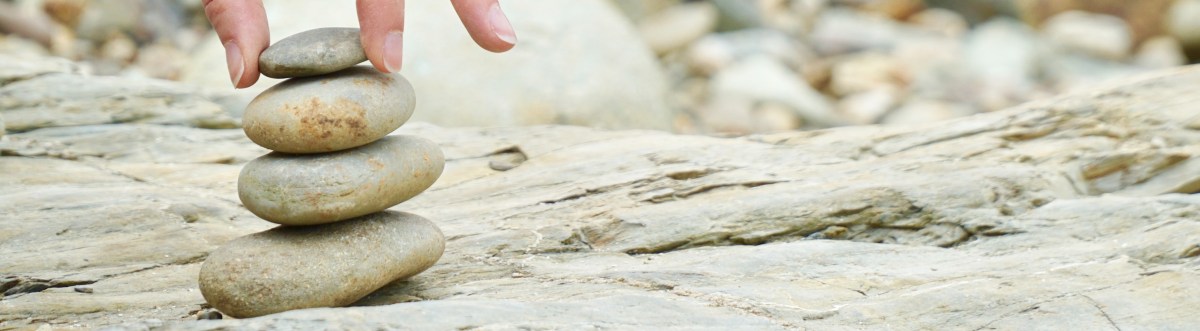
Finding Balance, Literally

(Title Image: Photo by Martin Dawson on Unsplash)

One of the striking benefits of mindfulness is that it amplifies the richness of our world. On a personal level, it’s revealed to me how tightly my mind and body are connected.

I truly believe that when you calm the mind, you calm the body and vice versa. This is particularly important for me because 1) I am prone to anxiety and 2) some of the breast cancer drugs I was given were cardiotoxic. Therefore, I have an inherent interest in keeping calm and avoiding stress.

Avoiding stress. HA!

After several anxious weeks that included trying to secure a new apartment and the possibility of serving as a juror on a 4-week criminal trial (for better or worse, neither one has happened), I found myself drained and unbalanced.

So for my Advent commitment, I’m working on getting my sense of balance back. And while I realize that yoga is much more than just one aspect of the physical practice, in my case, I believe that being able to calm my body, find a point of focus (drishti) and work on my balance go hand in hand with balancing my mind .

The moves that I’m using are uncomplicated and unimpressive, but I’m getting back to basics and rebuilding my balance foundation from there, even though I’ve found that there are more advanced balance moves that I can do that don’t seem to give me as much trouble. Go figure.

My daily practice has incorporated the following poses (asanas) with the intention of holding each for a prolonged period of time:


Standing wind-release pose (Tadasana Pavanmuktasana): This is a classic beginner pose that I chose as a starting point. From Mountain Pose (Tadasana), shifting weight into supporting leg, float the other leg up forward, knee bent with options to draw it into your chest or, which I find more comfortable, have my hands in prayer or support the raised leg under the knee.

Tree pose (Vrksasana): This is the classic tree pose, weight on supporting leg, other leg bent with knee pointing to the side, but with the sole of foot on the inside of the supporting calf instead of the inner thigh, as we usually see it portrayed. I chose this because of the hip opening aspect and by keeping the foot on the lower leg, all my focus is on balance, without having flexibility become an issue, because that is also affected by stress–I found that certain muscles tighten up and throw things out of whack.

Warrior Three (Virabhadrasana III): This is an intermediate level pose in which body weight is in the supporting leg with the upper body bent forward parallel to the floor in line with the hips, and the non supporting leg stretched out back, also in line with the hips. I play around with arm positioning, alternating between arms stretched forward past my head, out to the side or behind me.

Has this been a humbling experience? Yes, it has.

My balance practice is not a competition, it is a gentle smoothing of my nervous system. I’m not trying out for Cirque du Soleil. Ever.
(Photo by GMB Fitness on Unsplash)

Balance poses are not my “thing”. They used to be no big deal, but that was in my pre-cancer life. Physical balance took a huge hit during cancer treatment and I found myself strangely off-kilter afterwards. Aromatase inhibitors’ effects on my joints certainly didn’t help either. It was exhausting to fight this deterioration when I already felt spent. Years later, I had been avoiding balance asanas in my practice, which means that what was suboptimal has become worse.

Starting out this time around I was terrible. And I mean embarrassingly terrible. When I moved into the first asana, it felt as though I’d been plugged into a light socket with nervous energy coursing through me, making it so difficult to be still. I couldn’t hold any poses for very long and Warrior Three felt like a constant struggle.

But even in the space of a week’s practice, I am getting better. These asanas were chosen with ease of progress in mind and I’ve decided to keep going with this well into the New Year. I can definitely use the work.

While it’s frustrating feeling like I’ve regressed so much, I guess that means my progress will seem even better, right?

Dampening the Echoes of the Past

(Title image: Photo by Anastasiya Badun on Unsplash)

The Advent season is a perfect time for introspection and mindfulness. For me, 2023 has had challenges and as a result has served as a proving ground for different calming techniques.

One of the things I’ve grappled with, usually in the wee hours of morning, is the persistence of uncomfortable memories from the past.

It reminds me of a one-panel comic that I saw some time ago: a person lying in bed, eyes wide, a theater marquis over their head that reads in bright lights: PLAYING AT 3AM! EVERYTHING YOU SAID AT THE PARTY LAST NIGHT! [A cartoon in the same general vein by Hilary Fitzgerald Campbell appeared in The New Yorker on Jan 21, 2019 (#11 of 15), but I’m not posting it here because they might be touchy about copyright infringement.]

In the middle of the night, being hit with an glaring memory of something that sends your stress levels rocketing…goodbye sleep.
(Photo by Gregory Brainard on Unsplash)

How many of us have had a similar experience? I occasionally find myself tortured by things I said or did even decades ago. DECADES! Or they could have happened yesterday. A simple image can trigger shame, embarrassment or regret that feels real and vivid and, yes, while this generally happens at night for me, it’s certainly not limited to that time.

How odd that we give the past so much power over us when it’s not even real anymore. While we’re shaped by our experiences, allowing ourselves to be haunted by them serves no purpose, especially not once we’ve learned whatever we needed to from them.

Soooo, one early morning in the darkness I found a way to add some perspective to the memories that bully me: I started thinking of them as echoes, wispy harmless reminders of what happened.

And there in bed at 3am, I am safe. My body is not in the imagined situation, it’s under the covers, lying on my mattress. Here is where mindfulness is so helpful because it brings me back to the present. The past is echoing, trying to get my attention. But the more aware I am of where I am in space currently, the easier it is to step back and simply observe the echoes, watching them fade away.

I’m making this sound simple, I know–as with all the things that bounce around inside our heads, taming a stressful memory is not necessarily easy. But identifying it as just an echo has been remarkably helpful for me. It has provided a different viewing angle that enabled my perspective to shift.

Echo…echo…echo…

Thinking of thoughts as echoes can dispell them, but simultaneously focusing on a sense helps ground us in reality.
(Photo by Mariana Rascão on Unsplash)

I’m not there now, those other people are not there now, that event is not happening now–just because I remember it so vividly doesn’t mean that anyone else does. And most of the time, I don’t remember it either. Only during the limited, wee-morning-hour viewing window during which it appears because I’m susceptible to the tickle of anxiety.

The senses can bring me back to reality. Opening the eyes, feeling where my body contacts the surface that it’s on, hearing the hum of a fan or sound machine. Anything occuring in the present anchors me to what’s going on now.

And in the present, that echo cannot hurt me because it’s just an airy thought.

Of course, this all comes back to the basic idea that the more we practice presence, the easier it will be to minimize the impact of thoughts that unsettle us. It may take some exploration to find what works best for you, but in the end, being patient and consistent will be the best way to calm your mind and bring you back to what is real at the moment.

A Different Take on Advent

(Title image: Photo by Niklas Ohlrogge on Unsplash)

For anyone here who has celebrated Advent, you know it as the period of time comprised of the four Sundays (and the weekdays in between) leading up to Christmas in preparation for the arrival of the Messiah. The 2023 season of Advent starts this coming Sunday, December 3rd. [Edit: Many consider Advent to run from Dec 1 – Dec 24, and that suits the purpose of this post also.]

Advent has historically been observed by Christian religious dominations and is marked by the lighting of four candles, one for each Sunday. But it is most famously known by everyone as the four or so weeks before Christmas when you “give up” something.

Advent wreath with four colored candles representing hope, peace, joy and love, one lit every Sunday of Advent. The white candle can be lit on Christmas Eve or Christmas.
(Photo by KaLisa Veer on Unsplash)

Growing up, we’d usually give up sweets during this time, only being allowed a little something each Sunday, with the idea that we would appreciate the candies and cakes at Christmas all the more.

But you know what? I don’t really think it had that effect. That was something geared more towards our stomachs than our souls. Sure, we’d look forward to finally indulging in holiday goodies…but that was about it.

And as the years went on and treats played an ever-decreasing role in my life, I flailed around looking for something else to deny myself. Let’s face it, I was missing the point.

More recently, I’ve turned Advent into a different kind of spiritual opportunity.

So I’d like to offer a most positive way of observing those last weeks of the year for everyone, regardless of religious affiliation. And it has nothing to do with depriving yourself of anything.

Rather, it’s a blissful gift for yourself…and your soul, if you will.

Not everyone lives where the winter weather is warm enough to pick up trash on the beach…but I’m willing to bet that most of us live in a place where we can lend a hand to a charitable organization.
(Photo by Brian Yurasits on Unsplash)

For this Advent, I invite you to commit to several weeks of establishing a new thoughtful behavior. This can look different for everyone:

Perhaps, it’s time to set aside a few minutes in prayer and contemplation, as it suits your own spiritual tradition.

Perhaps it’s an opportunity to commit to volunteering for a charity, giving to others without expecting anything in return.

Perhaps it’s a time to establish a simple meditation practice, a few minutes a day at a specified time.

Perhaps it’s an opportunity to practice daily mindfulness, say, when you make your morning coffee or tea, truly focusing on the process and what the items feel like in your hands.

Perhaps, it’s time to think before reacting, pausing before getting angry and saying something hurtful.

This Advent might be the perfect opportunity to establish a practice of mindful contemplation.
(Photo by Ümit Bulut on Unsplash)

Perhaps this is the time to go through your belongings, a little every day, and gather up what you can give to others in need, or discard if the item is no longer of use to anyone.

Perhaps this is time to think about all the things for which you’re grateful, starting or ending your day in this way. And if there’s nothing that you can be grateful about, then consider what you’re grateful that is *not* happening.

Choosing what to focus on for Advent can be a very mindful process in itself. And after about a month of this practice, you will emerge with a beautiful new habit.

Give it a try and I wish you a beautiful Advent season!

~~~~~~~~~~~~~~~~~~~~

Please note: I realize that there is a much deeper religious meaning of Advent for Christians, and I’m not trying to minimize that. However, in this time of hyperpolarization when we’re so focused on what sets us apart from those around us, this is a thoughtful way to share the Advent tradition with everyone, with love. And isn’t that the spirit of Christmas?

5-Minute Meditation: Lovingkindness with Jon Kabat-Zinn [VIDEO]

(Title image: Photo by Mei-Ling Mirow on Unsplash)

Since we’re in the season of gratitude and mindfulness, it’s a great time to post about Dr. Jon Kabat-Zinn, Professor Emeritus of Medicine of the UMass Medical School. Among other things, he is the founder of the Mindfulness-Based Stress Reduction (MBSR) program, which I had the privilege of taking in early 2018.

For this week’s post, I’m including a short, 5-minute guided video meditation by Dr. Kabat-Zinn that was presented as part of his class on MasterClass.com (I was fortunate enough to take this class also). While the subscription to MasterClass is somewhat pricey, the meditation below is free.

The video requires little time investment and will pay back rewards in spades. I hope you enjoy!

This is a beautiful mindfulness meditation for right now.

There are a number of other meditations and talks by him available on YouTube. If you currently don’t have a mindfulness meditation practice, I encourage you to give yourself a gift by looking him up. His videos are the perfect place to start.

Two Anxieties but One Breath

So, something occurred to me as I was dealing with stress about a work project…and then got news of changes that may require us to quickly move from the place in which we’ve lived for over ten years.

I am experiencing two different textures of anxieties. I’ve heard people discuss chronic and acute anxiety, but I would characterize the way I experience anxiety differently.

The first anxiety may wear you down but won’t require a complete change in your life.
Photo by Aiony Haust on Unsplash

The first is anxiety about what may happen or anxiety about what has taken place in the past and I can’t change. That encompasses stressful events that you need to work through, like a job-related project, which requires holding on and managing. It’s more of a chronic type of stress even though it might be time-limited. There are things out of my control or, in the case or what has already taken place, there’s no going back. It doesn’t qualify as life-changing as it may intensify and relax depending on conditions.

The second, however, is anxiety about something that *is* life changing. Those of us who have been handed a cancer diagnosis know what it feels like. It means that the future will look dramatically different from what we expected it be. Other examples are a death of a loved one or losing everything in a natural disaster. A sudden involuntary change in your living situation. This requires letting go and radically recalculating what you’ve become very used to. It can be very difficult to do, especially for those of us who like stability in our lives.

The first anxiety is exhausting. The second is terrifying. Having experienced both, I can definitively state that the first anxiety pales in comparison to the second. In fact, in the face of the second anxiety we may actually let go of the first completely and wonder why it ever bothered us.

The second anxiety is more intense and will alter life as you currently know it.
Photo by Ann on Unsplash

At the same time, as terrible as it may be, the second anxiety offers us a perspective and clarity that we would be hard pressed to accept as quickly any other way.

I do not wish either of these anxieties on anyone, but if there’s a bright side to them it’s that the same type of mindfulness practice that helps us deal with the anxiety of the first kind will also help when the expectation-smashing heaviness of the second anxiety hits.

Although you may still wake in the middle of the night, heart racing and wishing things had not changed, a consistent mindfulness meditation practice will provide you with the tools to smooth the jagged edges of rumination and fear, slowing the breathing and with it the heart rate, even in the presence of frightening thoughts.

~~~~~~~~~~~~~~~~~~~~~~~

Of course, since this is a mindfulness blog in addition to being cancer-related, I cannot resist talking about one of the most effective techniques that I’ve found for calming myself: belly breathing.

Start by simply breathing deeply into the belly, as anxiety often results in shallow breaths. The deeper the inhale, the more air you will have for the exhale – try matching inhales and exhales in length. It won’t happen immediately. Give it time.

Create a breathing cycle and keep going. Establish a breathing practice and stick with it.
Photo by Brett Jordan on Unsplash

Keep breathing into the belly, fully engaging the diaphragm, allowing it to drop and make space for your lungs.

As you do this, focus on the breath. The uncalm thoughts can still be there, but gently allow them to sit on the sidelines for now. I used to try to completely push them away, but they would bob back up to the surface like a balloon pulled under water, bringing the intensity of my anxiety back with it.

So let them be there…keep one eye on them if necessary but give your breath the main stage.

Once the inhales and exhales have evened out in length, insert a short pause between them. Breathe in … pause … breathe out … pause. Just a little stop to elongate the cycle. Consistently breathing into your belly.

Transition to full box breathing, where the inhales, exhales and pauses are all equal in length. If you get very comfortable doing this, for a little extra, try to make the exhales just a touch longer than the inhales.

Or if it gets tiring, simply try to make your exhales a little bit longer than your inhales and dispense with the pauses altogether.

Maintain this type of soothing, intentional breathing for a few minutes or longer, depending on how your body is responding or what your nervous system needs today.

Truly, you don’t have to do this perfectly or adhere to a specific count. Simply focusing on your breath and slowing your breathing will help immeasureably in making space for your thoughts so that you can back away a bit and survey the scene without feeling claustrophobic, no matter which anxiety you’re dealing with at the moment.

In the Midst of “Breast Cancer Pink”, Finding Stillness: A Meditation

As you’re probably aware by now, October is Breast Cancer Awareness Month. For breast cancer patients and recent survivors, seeing all that pink around can be a little stressful.

Yes, it’s important to maintain awareness that 1 out of 8 women in the United States will be diagnosed with breast cancer at some point in their lives. Those of us who have already been…well, it would be nice to forget about it once in a while.

One out of 8 is a lot of pink!
(Photo by Pawel Czerwinski on Unsplash)

So for this post, I want to offer you a very simple meditation. No prep needed.

Pause where you are right now and become still. Right where you are.

Notice how your body feels in the space that you’re inhabiting. What sensations do you feel most strongly?

The expansion and contraction of your ribcage with your breath?

The contact points of your body on the surface where it rests?

Perhaps a pesky little ache somewhere, in your joints, muscles or around an incision?

Tingling in your fingers or toes?

Are you gripping anywhere? If you notice tension somewhere in your body, very very slowly see if you can soften it. It’s okay if it doesn’t release completely – imagine that part becoming heavy and pliable.

And then see what other physical sensations make themselves known to you.

Stay with your body. There might be a lot going on in your mind right now, but that’s “up there” in your head.

Here. Stay down here.
(Photo by Tim Mossholder on Unsplash)

We are down here in your physical being. Feel the stillness that exists here, not agitated by your thoughts. It’s okay if there’s noise in your mind, like if you lived on the floor below a bustling office. All those workers up there, getting their stuff done.

You can hear them, moving about, speaking in muffled tones, keeping busy. That’s all okay. They can be there.

But we’re all hanging out in stillness down below, with distance between what’s going on here and what’s happening elsewhere. We have space.

How does it feel knowing that you have permission to be still? That you don’t need to drop everything and dash upstairs? The thoughts can wait. They’re not going anywhere. You have time.

Eventually, you’ll return to the hustle and bustle up there. But know that you can always take a break, come down into your body and sit in the stillness that is here.

~~~~~~~~~~~~~~~~~~~~~~~~~~~~

This October in particular is very busy for me. A big project at work, the holidays around the corner, prepping for guests while our apartment STILL awaits repairs. And then strange guilt that I’m not doing more yoga teaching. It’s a lot to manage in my head, all this piling on of responsibilities.

So that meditation up ^^^ there? Yeah, I needed that. ❤

Mindfulness 101: You’ve Got Options!

It’s been a long work day so this post has a simple message: you have options in practicing mindfulness meditation. And then for good measure, at the end I toss in an article about other meditation practices you can try.

In a nutshell, mindfulness meditation is the process of noticing your thoughts (“awareness”) and observing them without judgment (“acceptance”). It often involves an anchor, such as the sensation of the breath or a constant sound in the background, that the meditator focuses on for the purpose of grounding and staying present. The anchor is what we return to after we realize we’ve been pulled away by thoughts.

The anchor to presence is what we return to after we find ourselves carried away by thoughts.

This way we explore the concept of impermanence as it relates to life and our own situation. Everything is in flux. Negative experiences pass, positive experiences pass and we move through it all. The more we practice, the more we are able to notice the ups and downs without being as affected by them.

In the same way, I consider mindfulness meditation to be fluid without rigid rules. For example, you do *not* have to be seated in Lotus pose with your hand on your heart. You do not need a special cushion, outfit or music. There are no specific words to recite or candles to light. However, you are welcome to do all of these.

Lying down, seated on a chair, leaning against a tree or riding a crowded bus holding on to a strap are all viable positions. Eyes open, closed or half-shut. Paying attention to bird songs, a light rain, a washing machine or cars whooshing down the road, all good. In the early morning, during a work break, when the kids are napping or when you’re settling in for the evening are all ideal opportunites.

You don’t have to be in a specific location in order to practice mindfulness meditation, although admittedly some places come with a better view than others.

Even carelessly sprawled out on your bed, noticing how it feels to do that, no matter how dorky you think you look. Mindfulness doesn’t judge.

All of these are good conditions under which to practice mindfulness meditation and that is one of the things that I feel makes it an ideal meditation starting point.

As you continue to practice, you develop a tool with which to nurture a sense of peace and calm down a busy mind. It is a tool that you can take with you no matter where you go, like a little gift for yourself that you keep in your pocket, bringing it out whenever there is a need.

And since we’re talking “meditation options”…

I’ll finish up by noting that just as there are different ways to engage in mindfulness meditation, there are a number of other meditations that you can try if you want some variety.

For that, I’m going to punt you over to an article on the website Healthline, written by Holly J. Bertone, CNHP, PMP, and Crystal Hoshaw, entitled, “Which Type of Meditation Is Right for Me?” I really liked the information mentioned here, including the nine types of meditation that they describe:

  • mindfulness meditation
  • spiritual meditation
  • focused meditation
  • movement meditation
  • mantra meditation
  • transcendental meditation
  • progressive relaxation
  • loving-kindness meditation
  • visualization meditation

See the Healthline article for more information.

I do not believe that the above is an exhaustive list by any means, although it is a wonderful place to start if you want to explore other meditative practices. While I feel that mindfulness is one of the most accessible meditations for beginners, if you feel inspired to try something new, there are many options to choose from.

The only thing you “should” do is begin. 🙂

Mindfulness 101: Avoiding Avoidance

There is, unfortunately, a trap that some people may fall into when practicing mindfulness meditation.

In the context of selecting a point of focus that anchors you into the present, there is that teensy possibility that someone just starting out with meditation might focus without equanimity.

Equanimity is the ability to maintain balance and a sense of calm in both good and bad situations. It is the acceptance that impermanence and suffering are a part of life, and it is the state of allowing all feelings to pass through you, observing them without judgement or expectations brought on by previous experiences.

Equanimity is being able to allow in both the good and the bad without getting dragged through it.

Allowing emotions in when you’re trying to stay calm and collected might seem a little counter-intuitive, but in fact, I consider it to be to goal of mindfulness meditation. That’s because the most important time to maintain a sense of inner peace is exactly when the proverbial sh!t hits the proverbial fan. Mindfulness meditation provides us with a safe space within which to practice just that.

The tendency, however, is to try to keep difficult emotions out. I myself encounter a lot of resistance when doing guided meditations that focus on bringing up uncomfortable thoughts, particularly in the evening, when I’m most susceptible to anything that might perturb my sleep.

However, not allowing those thoughts in can set up a pattern of avoidance, depriving us of the opportunity to learn to deal with them. And this avoidance can imbue difficult thoughts with even more power, as if they become the boogeyman lurking behind a door that we’re terrified to open. That’s not a good thing.

So how do we get around this?

Pick a good time to explore the stickier side of things; I would caution against the evening, when, as I mentioned above, bringing up tough feelings can agitate you and make it more difficult to fall asleep. Keep the environment quiet, comforting and safe, with gentle music in the background, if that suits you. I like mid-morning time and natural light, with a cup of tea or cacao or anything else that feels soothing.

Choose your anchor: your breath, a bodily sensation like tingling in your hands, a constant sound in the the background…even lofi music from YouTube.

If you feel too drifty, keep your eyes open to help ground you. Perhaps focus them on an object that brings you peace, such as the photograph of a loved one or an image of a peaceful place.

Give yourself a calm opportunity to explore complicated emotions.

Breathe deeply and pay attention to gripping or tightness in your body, especially forehead, jaw, neck, shoulders and belly. Consciously release any areas that seem to clench as you go along.

And then allow whatever comes up to come up. Observe them…and then let them go. No need to analyze or justify. Imagine that you’re made of Teflon and those uncomfortable images slide off you.

If needed, sit further away from them. When the intensity gets too high, you might need space, so imagine that they are flowing past as if you’re on the bank of a river and they are the leaves that float by on the surface of the water. They come and they go and you breathe deeply through it all.

As you practice, maintain your focus the best that you can. The point of your focus is not the thoughts, it’s the breath or whatever other anchor you might have chosen. This way, the thoughts move independently and subside as smoothly as they appeared. If you find yourself getting stuck, return to your anchor and remind yourself that in this moment, you are safe.

IMPORTANT: If your thoughts are tied to trauma or the intensity seems unbearable, please seek out the help of someone professionally qualified to help you deal with them. Mindfulness meditation is a wonderful tool, but sometimes it’s not enough.

The Satisfying Pleasure of Letting Go

If you’ve read my last couple of posts (here and here), you’ll know that I’ve been dealing with the frustrations of water leaks, never-ending renovations and unfortunate coincidences.

Hopefully, this will be the third and last installment of the trials and tribulations concerning this situation. But just to catch you up, the cabinets which were supposed to be installed Thursday, not in time for our houseguest’s arrival on Wednesday, but just a day late…were not.

Yet again, there were dashed expectations: one of the cabinets arrived with a crushed side and was unable to be used. So the innards of these cabinets are still piled up on and under the dining table and the place looks disheveled.

When things start blowing up, sometimes all you can do is sit back and enjoy the show.

And due to the completely unrelated construction taking place outside, which will prevent daytime access to our unit for several days, there will be no cabinet installation for at least another week, regardless of when the new cabinets come in.

But you know what? It’s okay.

I had wanted to have everything put together for our guest. That was not possible, so–admittedly after much jaw clenching–I completely let go. The crushed cabinet, the disruptive construction, I’m simply accepting it and that feels so good.

It really doesn’t matter when the cabinets are put up or what other monkey wrenches are thrown into the mix. We’ll get to closure when we get there.

Which is a good thing because on Saturday evening, I discovered another leak in the walls that soaked the new (still unpainted) drywall and flooded out the unit below us. And I’m totally serious. The inside of our hall closet sounded like a rainstorm.

Well, we needed rain…

I guess I could have been more stressed about it, but with everything that had already taken place, I shrugged. We notified out unit owner, we called the plumber, we waited for the leak to be fixed.

Another day, another leak, another disruption, another hole in the drywall. Still okay.

These are still problems that need to be dealt with. But whether it’s skillful mindfulness (probably not) or simply emotional exhaustion (more likely), it’s not getting to me and it feels amazing to stay calm under such circumstances.

I know I cannot avoid stressors in my life. So I’m trying to remember what this feels like. If I can draw on this experience the next time an upheaval occurs, perhaps I can slip into gentle acceptance and let reactive anxiety pass me by?