As I mentioned in a previous post, I’ve really enjoyed the Coursera course, “Engineering Health: Introduction to Yoga and Physiology“, which I highly recommend. One of the recurring themes of the class that I’ve found particularly relevant is that of effecting incremental and meaningful epigenetic change through yoga and meditation.
The class lectures went through the physiological mechanisms by which this happens, and this information would be reason enough to incorporate mindfulness and breath-to-movement in one’s life. But for someone who’s experienced cancer, there’s something even more important: a sense of control.
For me, the most terrifying part of my cancer diagnosis was the lack of control over what was happening to me. First, my body had turned on me by cultivating a tumor, the ultimate goal of which was to take over my organs and kill me. Then, my doctors were giving me drugs that by design would kill certain parts of me, with the intention of taking out the tumor before it spread to really important parts of me (brain? liver? heart?).
My body was a battleground in the war between my rogue cells and modern medicine. I had to sit there and take collateral damage if I wanted a chance at survival.
Disclaimer: So I feel the need to stress here that we do not yet know how to reliably prevent the formation of cancerous tumors, but there are things that we can do to greatly lessen the risk. I’m willing to bet that managing stress would have a powerful impact on prevention.
While I did begin meditation at that time, had I started learning to deal with my anxiety and accompanying physiological responses years ago, I might have been able to sidestep the disease. There is science to this which I will cover in a later post, but my doctors *hate* it when I postulate possible causes of my tumor since if we could truly pinpoint the cause, we’d be able to cure the disease. However, given what we do know about stress and inflammation, I can guarantee that my stress response did not help in keeping me cancer-free!
In the Coursera class, Dr. Ali Seidenstein (NYU) explains, among other things, how the small positive changes that arise from learning to control the stress response by applying yoga and meditation affect your genetics. And this is key. While you’re born with a certain set of genes, the science of epigenetics describes how you can affect gene activity (think, turning a gene on or off) and thereby have a different outcome from someone else with the same gene.
Finally! Something that *I* can do that provides a rare sense of control in an uncontrollable situation! For a cancer survivor, this offers a nugget of hope to hold on to in the face of continuing medications that may or may not help your survival. Medicine is tested on a variety of individuals but there’s no guarantee that their success will translate into your own (news flash: cancer = no guarantees, period). But knowing that you can engage in behaviors that, when applied over time, will actually benefit you on a genetic level…that, my friends, is priceless.
Oak is among the simplest meditation apps that I’ve tried. While it’s not as stripped down as The Breathing App, it really covers all one would need for a meditation practice.
The home tab – simple!
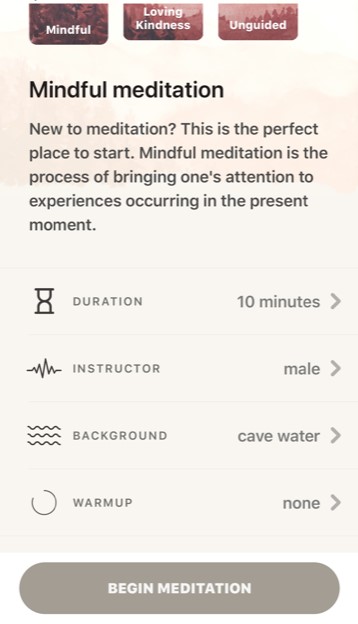
I love the aesthetics — the app has a soothing watercolor-like look to it that reminds me of a quiet, overcast morning, before the rest of the world has awoken. Navigation is very simple as there are only three basic elements to choose from: meditate, breathe and sleep. However, they’re quite enough.
Meditate offers three meditation options, all customizable in duration, instructor voice (male/female), background sounds and warm up (for those wanting to settle in before meditating). The three types of meditations are (1) Mindful, learning to focus on the breath; (2) Loving Kindness, cultivating compassion and empathy both for yourself and others; and (3) Unguided, with the choice of interval bells instead of spoken cues.
Choose your meditation and then customize it to your liking.
Again, very uncomplicated and accessible. Both the male and female voices have that certain “something” that makes them soothing and easy on the ears. While Oak doesn’t have the expansive meditation libraries that some apps provide, for many meditators what Oak offers will be quite enough, and the ability to customize the meditations creates far more permutations than one might expect.
Breathe is the section of this app that I personally use the most. It consists of three types of breathing exercises: (1) Deep Calm, which has been advocated by Dr. Andrew Weil and has a 4-second inhale, 7-second hold and 8-second exhale; (2) Box breathing, which is a square “box” of inhale-hold-exhale-hold, each segment being 4 seconds long; and (3) Awake, which is a 6-second inhale followed by a brief 2-second exhale.
The number of breaths per “set” for each of these exercises differs, and you are limited to the number of totals sets you can do at a given time. However, this is probably a good idea because it’s important to take breaks when doing prescribed breathing in these ways. Think of it as insurance against passing out.
Not just for sleep! I can choose from a variety of sounds to fill the empty voids in my workday.
Sleep offers (1) Relaxing Sounds and (2) Guided Breath. Again, there are options for the background sounds and duration. I enjoy using the sound “elevate” at work, not for sleep (!) but to offer gentle music to even out the frustrations that may complicate my day.
There is also a 10-session course on Mantra Meditation. While I was able to unlock it for free, this may be a temporary benefit (perhaps due to COVID-19?) because the App Store makes mention of the course being available for a small fee. Keep that in mind for the future.
I had not been using a mantra for meditation, but this class helped me choose one and added another dimension to my meditation practice. The narrator’s voice was perfect for this type of lesson. The class is downloadable which leaves you no excuse not to meditate on your next plane flight. Note that I haven’t completed the entire course yet, so I cannot yet comment on its benefits as a whole.
Finally, Oak tracks your progress, including minutes meditated and number of breaths taken. It also shows the number of people meditating and breathing with you. And of course, it shows you your streaks. So, if there were something that I felt I need to gripe about with this app, it would be that it encourages me to focus on streaks. I can get pretty obsessive and competitive about these things, and unfortunately, Oak doesn’t let me turn them off.
On the other hand, tracking your progress is what allows you to gather badges while developing your meditation and breathing practice, so for anyone who’s interested in seeing visual reminders of their progress, this is a plus.
All things considered, this is a lovely app that you’re not likely to outgrow quickly. With the exception of possibly being charged for the course, everything else is absolutely FREE, which evokes the spirit of mindfulness being accessible to all. It also makes it completely risk-free to download and try for yourself. While I haven’t used Oak quite as much as I have other apps, I really do enjoy it and highly recommend it.
In my last post, I mentioned yogi Eddie Stern’s breathing app. If there were ever an app that exemplified the beautiful simplicity of mindfulness, this is is!
There are several things that make this mobile app perfect: (1) it does one thing and does it well, (2) it is uncomplicated, and (3) it’s absolutely free, with no in-app purchases.
This app is designed to help guide you in breathing. It is based on the concept of resonance frequency breathing, which is deep, slow, diaphragmatic breathing, between about 4-7 breaths a minute, depending on the individual — true resonance is considered to be six breaths a minute. Resonance breathing, “where oscillations in heart rate (HR) and breathing synchronize” (Pagaduan et al., 2019), has been shown to improve heart rate variability (HRV), which is “a key marker of health, mood, and adaptation” (Steffen et al., 2017). You may be familiar with HRV if you’re in training for a sport.
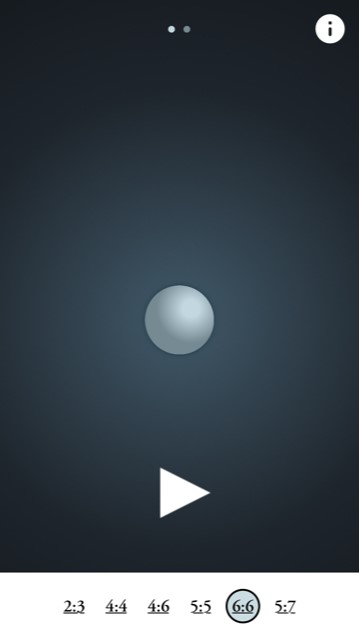
Set the timer, choose your breath intervals…
As Eddie Stern describes in his app and on his website, “by breathing at resonance, we enter into an even balance between the two branches of our autonomic nervous system, the sympathetic…and the parasympathetic…” The sympathetic is known as “fight-or-flight” and parasympathetic as “rest-and-digest”, and in our everyday lives, we tend to spend too much time with the sympathetic nervous system in charge.
…and inhale.
The Breathing App helps us balance out the two systems via resonance breathing. There are several elements to this app: (1) an informational page, with instructions on setting up and using the app, including info on the science and creators; (2) the breathing ball, which helps you visualize the breath; and (3) the sound breath guide, which provides a tone that guides your inhales and exhales.
You set the timer from 1 to 30 minutes, choose your inhale:exhale ratio (2:3 or 4:4 [for kids]; 4:6, 5:5, 6:6 [true resonance] or 5:7), and decide whether you’ll watch the ball or look at a starry sky, with or without the sound.
And that’s it.
There’s nothing to buy and practicing with it is simple. Of all the mindfulness/meditation apps that I use, this is one of my favorites and I use it to augment my yoga practice. Give it a try!
~~~~~~~~~~~~~~~~~~~~~~~~~~~
Fun fact: some well-known names are credited as participating in the development of this app, including Deepak Chopra and musician Moby!
WARNING: IF YOU ARE STARTING ON AN AROMATASE INHIBITOR, I highly recommend that you not read this and instead give yourself the chance to gauge the medication’s effects without being influenced by someone else’s experiences. Note that I started letrozole just out of menopause, so my side effects from this drug have been more dramatic than they might be for a women who’s been postmenopausal for longer.
When it was time to start letrozole, I took a different tack than when I began tamoxifen. For the latter drug, I did all the research I could, researching relevant studies, digging into possible side effects and visiting lots of forums to learn about what other women were experiencing.
I wish I hadn’t. I think all the negatives affected my perception and made me anxious about taking the medication.
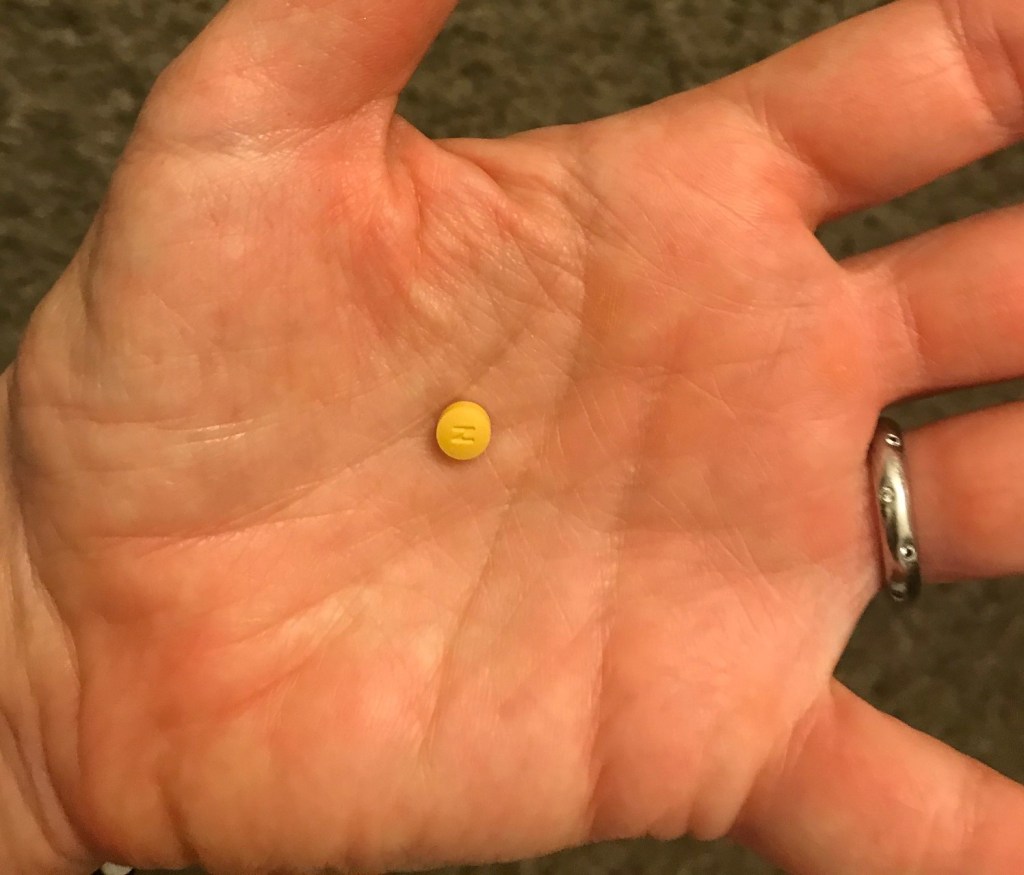
The letrozole pill looks so teeny and cute – how bad could the side effects be?
So after two years of tamoxifen, when my hormone levels suggested that I was postmenopausal and it was time to switch to an aromatase inhibitor, I stayed away from clinical literature about letrozole. I decided to give it a chance, since my oncologist felt that I had confused the effects of anxiety about taking tamoxifen with the actual effects of tamoxifen.
Okay, then. As I was leaving my oncologist’s office, letrozole prescription in hand, he added that some women complain of “joint pain”. I think he felt it was his duty to warn me.
My experience? I’m finding it harder to recover from workouts. I train with free weights and am a rower (currently, indoor) and the change in my resilience and stamina is striking. In 2018, a year after finishing up chemo, I was able to power through tough workouts and felt like I’d gotten most of my pre-cancer strength back.
Fast-forward to now, just two years later, I feel old. My joints are creakier and I’m having increased muscle pain and overall stiffness. I’m experiencing bone pain in the leg that I broke skateboarding when I was 12. Yeah, I push through workouts, but they’re taking their toll on me.
I’m fortunate to have a full complement of gym equipment at home, so the COVID-19 lockdown didn’t hinder my workouts. To get some fresh air, I incorporated more hiking into my routine, in addition to my regular workouts.
It was too much and left me with hip pain that made it difficult to fall asleep. So I took a rare break from vigorous workouts and for two weeks incorporated more gentle movements and focused on yoga, which I had been doing intermittently.
When I started ramping back up, I didn’t feel rested, I felt weak! Weights that had been easy to lift a couple of weeks before felt challenging. I had to restart the process of building my strength. You could pass it off as simply “age”, but I’m only 54, and the drop in strength and energy has felt precipitous, even demoralizing. While it’s true that I went through menopause during the last two years, it was a medication-induced menopause and I was literally shoved through the change.
Letrozole has been shown to be very effective in preventing cancer recurrence, presumably because it works to keep estrogen levels low. However, most women on letrozole are in their 60s and have been postmenopausal for a number of years. For a woman in her 50s, the aging effect of estrogen suppression has felt dramatic.
My libido dipped even lower than I’d experienced with tamoxifen, something I was warned about by my GP and gynocologist (both females). My male oncologist didn’t talk about it. I believe this is a seriously underreported side effect of aromatase inhibitors and one that many women suffer from in silence, because they don’t feel comfortable bringing it up.
Likewise, I feel my appearance changed. Now, this may simply be my perception of myself, as my post-chemo hair transitioned from super-cool and spikey to thin and limp (and, now, untrimmed!), and my eyebrows never recovered. But it’s not just in my head: A bus driver recently tried to offer me a senior citizen discount, whereas four years ago someone had told me they thought I was in my late 30s! That’s a big difference. The fact that the lack of estrogen is making me look like I’m older than I really am has become distressing:
And that difference is felt in my relationship with my family. There have been times that I’ve looked at my husband (four years my junior) and my high school-aged kids, and I feel like don’t belong with them. I feel like a stranger, an old lady that’s just hanging around. That hurts a lot.
And on my worst days, I feel dark clouds rolling in, bringing with them frustration and hopelessness. Is it letrozole or menopause? Does it even matter? Take a woman, throw her in a bag, tie it to a tree branch and then beat it with a stick. That is how I feel when I have to take a pill that does these things to me. No control, no future, lots of pain. The longer that I continue with medications like this, the more I feel that they are pointless, since I’m starting to not care whether or not the cancer comes back. And that’s the worst side effect of all.
~~~~~~~~~~~~~~~~~~~~~~~~~~~
So, this blog is about being honest about the cancer experience. But it’s also about mindfulness. I have to open the door and let the negative feelings into the room so that I can offer them compassion and a kind ear. I sit with them for a while, and eventually, I feel better.
If there were ever a time to open yourself up to being more mindful, it’s in the midst of a global pandemic. We are in foreign territory, in an unsettled state where we’ve lost our footing. Mindfulness can help us find a path through this.
Stay Healthy
Being mindful is critical now that we’ve got to remain more aware of how we move through space.
Stop. Where are your hands now?
There are things that we do automatically. Consider how often you touch your face. Don’t do that! It’s important to notice where your hands are. Are you wearing a face mask? Don’t touch the front of it. When you inhale, you’re creating suction around the mouth and nose, and if you’ve come into contact with viruses, it is more likely that the cloth covering those areas will be contaminated. Remove the mask only using the ties on the back of your head or elastics around your ears.
Going to the store? Be aware of which hand you’re using to do what, even if you’re wearing gloves. Touching door knobs or packages with one hand? Use the other to get your wallet out of your pocket or purse.
What hand are you holding your phone with? Which finger are you touching the screen with? The COVID-19 situation necessitates a focus on what you’re doing. Take a deep breath…and then disinfect everything when you get home.
Lessen Anxiety
Living mindfully, in the present, helps us let go of fears surrounding what may happen, and in the midst of unprecedented uncertainty when , most of us have those thoughts. But you don’t have to let them take you over.
Stay grounded in the moment. No one knows exactly what the future will bring, but the possibilities can be scary. Right now, however, you are safe. Feel what part of your body is in contact with the seat or floor. Come down from the frightening thoughts and listen to your breaths. Those imaginings of the future are not happening now. At this moment you are standing or sitting, breathing. Feel into your hands and feet. Can you feel the blood pulsing through them? Feel yourself being supported by the earth. Breathe.
You can meditate without twisting yourself into a pretzel.
If you don’t yet meditate, this is a chance to start, and it’s a habit that will benefit you for years to come. The good news is that you don’t have to get it “right” the first time. In fact, there is no “right”. There is just consistent practice.
What does meditation look like for you? It doesn’t have to be sitting in lotus position and chanting mantras. There are other ways to meditate. Stay in the moment. Keep your attention on your breath, noticing the quality of the inhales and exhales. When your mind wanders, as soon as you notice your loss of focus, bring yourself back to the breath. Resist jumping down rabbit holes of tempting thoughts. Just stay with your breath. That’s all.
If you need to bring yourself down to a more peaceful state, you can try a more structured breathing technique, such as the 4-7-8 “relaxing breath” espoused by Dr. Andrew Weil: inhale for 4 counts, hold for 7, exhale for 8. It is more important to maintain that ratio rather than to have a count last for a specific amount of time. Do several cycles of this, then return to natural breaths.
Does this feel too forced for you? Your meditation might be listening to a complex piece of music — truly listening to how the instruments blend together, gliding through the different layers of sound — and feeling into the sensations that it invokes in your body.
Perhaps it’s looking at nature through a window, holding a cup of warm tea, immersing yourself in the subtleties and complexities of the world.
Or constructing a jigsaw puzzle, diligently looking for pieces to match a color or pattern. Focusing on the satisfying click when they snap into place. Apparently, this is a stress reducer for many, many people, given how quickly puzzles disappeared from Amazon!
Find your own meditation. Let go of what you think it “should” be and focus on what works for you. There will not be a quiz.
Calm Stress Eating
For those prone to emotional or stress eating, a stay-at-home order can result in weight gain. This is the time to practice awareness of what goes in your mouth. Do you respect yourself with nutritious food or treat your body carelessly? Are you truly hungry or do you eat out of habit or boredom? Are mealtimes a mechanical process for you?
Slow down and savor your food.
Allow yourself the opportunity to halt other distractions and focus on what you’re eating. In a busy household, this can be difficult, but as with all mindful things, there is no “perfection”. There is simply practice: doing, and doing again.
Look at your food. Savor the aromas. Listen to yourself chew. Taste the flavors. Feel the textures. Close your eyes. Slow everything down. See if you can sense when your hunger has subsided, instead of stopping simply when you’ve eaten everything on your plate.
Create a Calming Space
Now that we’re sheltering in place, it’s not as easy to overlook cluttered spaces. Living in the midst of disorder can be very stressful, but trying to balance remote work and childcare, or beating back concerns about no longer having a job, while trying to maintain a cleaning routine is also anxiety-provoking. There is nothing normal about the situation we are in, so allow yourself the latitude to prioritize.
Mindfulness takes the drudgery out of cleaning. Stop and look. Breathe. Decide what you can take on and then go for it. Focus on one spot and stay present as you work on it. Set a timer for ten or fifteen or thirty minutes and see what you can get done within that time. I guarantee you that you will find yourself in a better place than if you hadn’t done anything at all.
Ha! I WISH my kitchen were this big. But even a small kitchen, clean and organized, can feel spacious.
This is not a punishment. It’s an opportunity to create a positive environment in which to ride out the pandemic. I spent Easter Sunday bleaching my kitchen, which seems so antithetical to what we expect to do on a holiday. But for me it was a gift, being present and scrubbing counters and appliances bit by bit, no expectations. Yes, there are still many loose papers on the dining room table, but when I enter the kitchen, I breathe a sigh.
I could say, “it’s not enough,” but you know what? It is more than enough. It’s a semblance of order in a situation that felt out of control, just as the COVID-19 situation is out of our control. We all need some grounding, and I promise you, a clean, uncluttered room lowers stress levels. When I went into the kitchen to get coffee this morning, I thought I was in heaven.
This sense of calm is still with me, even as my son has decided to bake cookies…
We have spent the last couple of weeks in various hunting-gathering trips in preparation for a possible coronavirus lockdown. Yes, we got enough toilet paper, but not multiple mega packs, as there is no place to store them. We bought a little extra frozen food, but space is limited in the freezer, just as it is in the fridge.
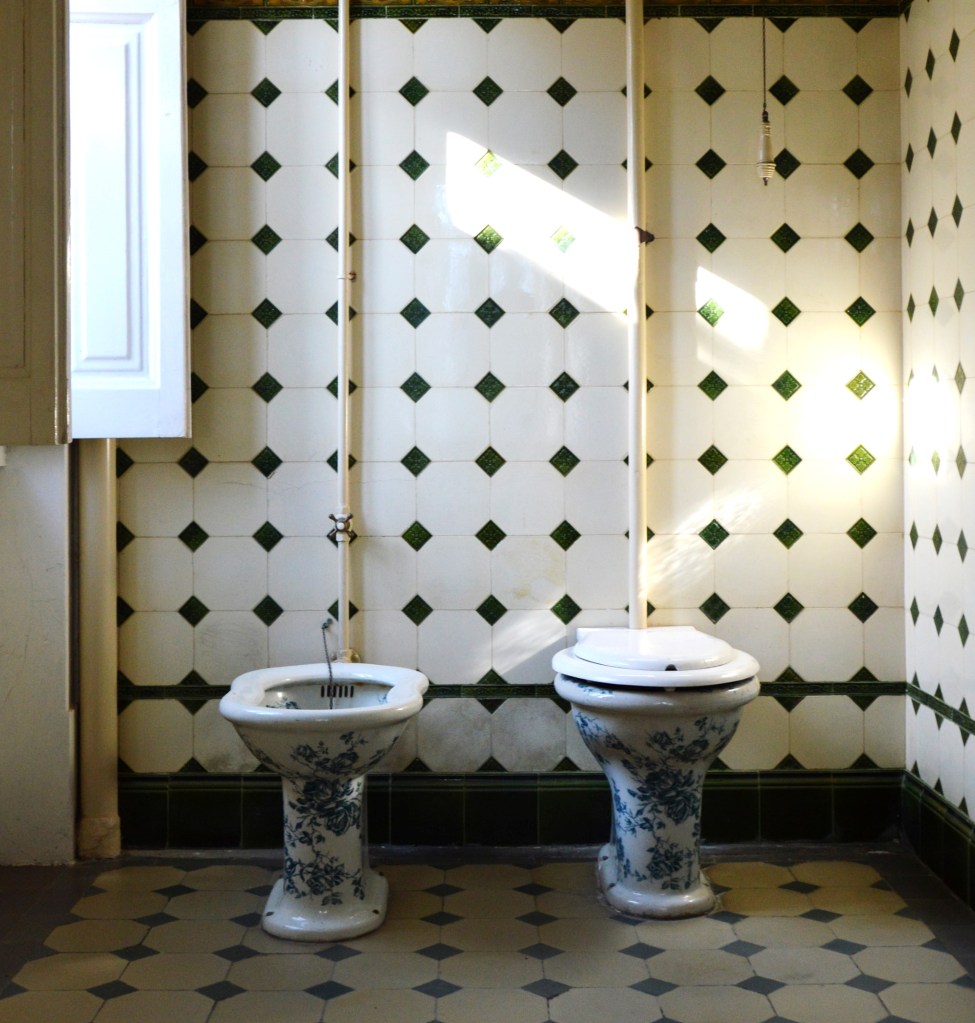
When in doubt, bidet!
Being a mainly vegetarian family, we consume a lot of fresh fruits and vegetables, and those have to be procured on a frequent basis. Hoarding is not a real possibility at our place: we have no garage, basement or pantry. And I don’t consider a 30-roll pack of TP to be proper living room furniture.
Luckily, we have ample soap and I have the large bottle of hand sanitizer that I kept at work when I was going through chemo (think: it’s been a few years). Also thanks to cancer: a generously-sized box of surgical face masks that we will be dipping into, should one of us start feeling ill.
Finally, in a “clouds parted and a ray of light shone down”-type of serendipitous luck, we found a bag of N95 respirators in the back of our coat closet. Usually one finds old tennis rackets or worn shoes. We find items that someone might strangle us for.
One of my brothers had stocked up on the respirators during the devastating fires in Northern California, only to unload them on us during a visit here. I always complain when he leaves stuff at our place, but I’m feeling much more accepting of it now. My kids are planning to sell them to finance their college educations. (kidding!)
So we’ve prepped as much as we can, for the amount of space that we have. And while it’s not a lot, I believe it’s enough for several weeks.
But where I’m engaging in some serious “hoarding” is greedily protecting my daily meditation time. If there were ever a time to practice mindfulness, it’s now.
This is not the end.
Consider this: during a trip to Costco a week ago, people were going nuts with toilet paper, as if it were a finite commodity and if we didn’t get it now, we’d be wiping our butts with tree leaves and old homework assignments for the rest of our lives.
It’s easy to laugh, but I myself felt a sudden bolt of urgency watching people squeeze nine months’ worth of toilet paper into their cars. It was difficult to resist.
Many people were operating as if with blinders on. At that same Costco, the check-out line for one cashier stretched all the way back to the bakery section. If you’re familiar with these enormous warehouse stores, you know that baked goods are way in the back. That is a crazy-long line!
What those shoppers didn’t realize was that the lines for the other cashiers were only one or two people long. But few people looked through the aisles enough to realize that. They simply saw a line and got in it, assuming that everyone else knew what they were doing.
Clearly, they didn’t
This is a perfect example of the need to slow down, take a deep breath and spend the time to understand what’s going on. In the face of unprecedented events, panic seems like a decent option. But just doing something–ANYTHING–isn’t the same as doing something useful.
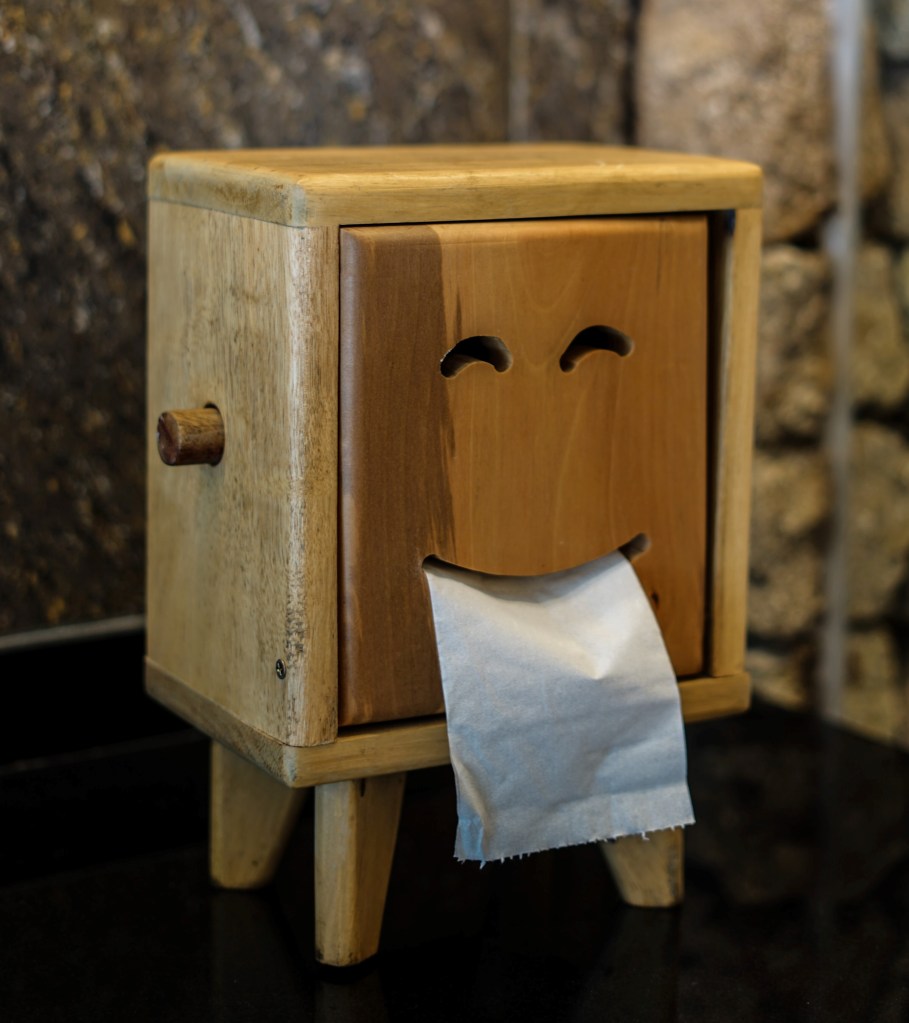
Relax. You’ll use less toilet paper that way.
Look, I get it. This is scary. As a cancer survivor, my white blood cell count remains depressed, and although my oncologist doesn’t think I’m in danger of dying from COVID-19, that doesn’t mean I can’t contract it. If I did, maybe it would tax my system more and send me to the hospital. There are so many uncertainties that I have to live with. The best thing I can do is to be mindful of what’s going on, accepting of what I can’t change, and rational about the rest.
So my wish for all of us going through surreal times for which we have no operating instructions is to listen to reputable sources, drop the conspiracy theories, pause and think. Don’t rush simply because everyone else is. Breathe. When this pandemic has subsided, there will be more toilet paper. I promise.
Of course, maybe not funny at the time. File this under, even the best laid plans can be undone.
I had been preparing mentally for my mammogram over the past weeks, and everything was going smoothly. I had a nice mammographer, not overly chatty, very matter of fact. There were video screens on the walls of the mammography room projecting peaceful nature scenes for me to watch as I got squooshed, as if ocean waves would make me forget that my breasts were being clamped in a mechanical vice.
Then, finally, I was done and back in the intimate waiting room. There were only two of us women there (along with my husband, who, since my breast cancer diagnosis, no longer lets me get scans alone). The other woman’s mammographer came out and told her that everything looked good and she was free to go; they’d see her in a year. She happily left.
Several minutes later, my mammographer came out and said something along the lines of, “The doctor is looking at your scans. I’ll bring you to the consultation room so that we don’t have to talk out here.”
Had I not just heard the exchange between the other woman and her technician, I would have been fine. But since I’d heard it, my heart started to pound. My husband and I were led to a cozy little room…with an array of informational pamphlets about biopsies and breast surgeries on a side table, and you can imagine where my mind went.
Forget mindfulness, forget non-attachment, forget letting go of expectations. Forget three years of daily meditation. I was terrified. I tried slowing down my breathing, but it only made me feel like I was being starved of oxygen.
I unloaded all my fears on my husband, who up to that time, was not experiencing the same level of concern.
“I don’t feel good about this. Why did they bring us into this room?”
“They always bring us into a separate room.” He was right, we always went to a consultation room for the results. But the other woman hadn’t.
“Why are all those pamphlets there?” I motioned to the biopsy pamphlets on the table.
“They’re always there.”
“Why did they tell the other woman out in the hall?”
“Maybe because you’re having a 3-D mammogram so there’s more to look at, or maybe because you’re a cancer survivor, and they probably bring all the former cancer patients in…”
Yup, I was having flashbacks.
Yes, he was giving me solid, rational explanations, but I would have none of it. I was in the middle of a “fight or flight” moment and struggling to regain composure, but it was too much.
I simply could not let go of intense feelings. They were too much like what I’d experienced three years earlier, at a time when I so desperately feared bad news. And then got it. It’s difficult to articulate what that feels like to someone who hasn’t experienced it, but if you’ve been there, you know exactly what I mean.
Throughout all of this, however, there was a small, reasonable piece of my brain that was collecting data. I had noted the time when the other woman had received her news (1:20pm), so I would have a better idea of how long this was taking. I sensed the tightening in my muscles and attempted, with difficulty, to release them. I’d been frozen into a block of ice and was trying to chip my way out with a butter knife.
Then at 1:27pm, the radiologist knocked and came in.
In that first fraction of a second that I saw her face, my brain ran a scan of it, and it told me…nothing. I’m betting that doctors are honing their “stone-face” look, so as not to give a clue one way or the other. My radiologist said hi and stretched out her hand, I shook it, and she told me everything looked good.
Just like that.
The rational part of my brain exhaled, but it took hours for my body to shake off the hype. By the evening, I felt like I’d gotten a year’s-long extension on a tenuous lease. So, I thought, I have another twelve months do something useful with my life. Go!
A week later, when I told my oncologist about this mammogram episode, he explained that as a cancer survivor, I get diagnostic mammograms from now on, and those always involve a consultation with the radiologist afterwards.
As calm as I may be during the waking hours, nightfall poses a unique challenge. How many of us have struggled in the darkness, surrounded by those scary thoughts that we thought we had dealt with during the day?
The darkness seems to make us more vulnerable to flying thought-gremlins. They creep in at night when our brains can’t reason them away. I’ve fought those little buggers for much of my life and they’ve been responsible for many hours of lost sleep. It wasn’t until I got serious about meditation that I developed means of protecting myself against them.
These are my best recommendations for returning to dreamland:
Drop into your bed. After waking to Dementor-esque anxieties circling you, realize that they’re flying, ephemeral creatures. And if you’re up there with them, it’s time to come back to Earth and settle into your bed. That is where you really are and you are safe. Focus on how it feels to have your body contact the bed, how the bedclothes feel against your skin. Rustle the sheets and listen to the sound. Take three deep breaths and listen to the exhales. You’re not “up there” with the swirling thoughts. You’re down here where it’s calm.
At times when there’s too much noise in my head, I will put a soothing voice in there from a meditation app like Calm, Plum Village or Insight Timer. Sometimes a guided meditation is enough to quiet the negative clamor.
Practicing stress release during the day will make it easier to do the same at night.
To support nighttime attempts at falling asleep, establish a sense of calm during the day. Practice being present — as opposed to chasing thoughts down rabbit holes. Pay attention to your reaction to various stimuli. Take conscious breaths, meditate, and use whatever tools work for you.
For instance, I have associated certain images with a calm state and I use them as anchors during the day (e.g., setting up a safe space). I have them pinned up by my bed and at work so that as I work to release stress I look at them, and as I look at them I release stress. The more I do this, the more powerful the association. I draw upon those images and feelings at times when things seem out of control. Practice during the day and you will have more peace at night.
Appreciate the nighttime wakening. Odd as it may seem, this can be a positive opportunity. Each such interruption allows you the chance to ground yourself and learn how to gently drop off to sleep. Stressing about being awake does you no favors and only adds to your wakefulness.
This doesn’t mean that there aren’t bad or frightening things actually happening in your life — sometimes there are and they can be very serious. I struggled with this when I got my cancer diagnosis. But at that moment in the middle of the night, lying in your bed, you have a temporary reprieve. Your only responsibility then and there is to go back to sleep. There’s nothing on fire.
Unless there really IS a fire, in which case, RUN. But most of the time, it’s just our fiery thoughts. And we can learn to douse those flames.
This will take practice – it’s not a one-time pill. But once you have done this enough times, you’ll find that not only is the relief wonderful, so is the knowledge that you are capable of determining how you react to things. That provides a satisfying sense of strength and a peaceful sense of control over what may seem like an out-of-control situation.
Is it possible to re-imagine annoying city noises?
At the least, living in an urban area with a high level of noise pollution is annoying. At worst, being subjected to car alarms and emergency vehicle sirens at any time of the day and night is very jarring and stressful. And I’m speaking from personal experience here, as following our last move, we ended up with a bedroom overlooking a very busy Southern California street.
The stretch of road outside our apartment unit is one of those that give cars enough distance between traffic lights to really accelerate as they blast by. It also leads to one of the major hospitals in the area (hello, ambulance traffic), and this being a big city with big city issues, there’s no shortage of opportunities for the police to be called out, sirens blaring.
There are many days that I wish I weren’t where I am. But wishing doesn’t change anything.
Drawing on mindfulness helps, however, and this is how:
Re-interpreting noise as different sound elements turns an “idiot street racer” into a thunder-like rumble. Much less annoying.
Much of the stress I experience from these various car noises is due in part because I know what they mean. I know that the sounds are the constant stream of cars going down the street or a high-pitched siren wail. But what if I were to accept that I’m living in a noisy city and to define the street noises as simply various sounds?
What if I were to break down the sounds into their characteristics? Would it be easier to handle the noise if I stopped judging and explored each sound as if I were hearing it for the first time?
This is far more doable than one might imagine. Yes, alarms and loud tail pipes are decidedly unpleasant, but they don’t punctuate my soundscape nearly as frequently as do the regular cars driving by. The cars speed through with whooshes of different pitches depending on the vehicle and how quickly it passes.
Sounds of passing cars transform into soothing waves – with the occasional jarring reminder that things are not entirely pleasant.
These sounds rise up and pass away like waves on the ocean – in fact, that whoosh can be soothing, just like the sounds of the ocean can lull you to sleep. Even noisier cars and motorcycles take on a rumbling quality, like thunder. Allowing oneself to re-interpret these sounds, to let go of annoyance, makes even the more jarring noises easier to handle.
When you can’t run away from the noise, make space for it, invite it in and accept that this is what’s happening now. Inevitably, it will pass, to be replaced by another noise and another opportunity to re-imagine it.
Exercise has been an integral and indispensable part of my cancer recovery and my life as a whole. I’ve maintained a personal trainer certification (ACSM-CPT) for over a decade and even though I don’t train professionally, I keep abreast of new research and love a challenging workout.
Still, there are days that even I find myself dreading the session I have planned. For those times, I engage in mental calisthenics and rely on a mindful attitude. If you’re struggling to find motivation to exercise, this may help you too.
Note, motivation is something you generate yourself. It is inside you, but you have to coax it out. Be gentle. Hiring a personal trainer to beat you with a stick when you’re not up to a workout is not going to make you look forward to exercising more. But the following concepts might help:
Consider that a workout is made up of a series of movements.
Stop looking at a workout as a massive monolithic thing. Doing so can be overwhelming and make it more likely that you’ll talk yourself out of it before you even begin. Instead, consider that it’s made up of distinct parts, steps that you take one at a time.
Stay in the moment and keep each movement fresh.
Stay present and focus on the part of the movement that you’re doing at the moment, truly feeling into it. If you’re on a rowing machine, concentrate on each individual stroke making sure that you’re using proper form as you reach, push with your legs, and pull the handle. If you’re lifting weights, focus on where your body is in space, on contracting the muscle as you lift, on exhaling as you do so, keeping your body properly aligned. If your exercise is a brisk walk, be aware of how you’re stepping, pushing forward, swinging your arms. These movements become a meditation in and of themselves.
What matters is the here and now.
Release thoughts of how much longer you have until you’re done. Focus on the stroke, step or rep that you’re taking at this very moment. And then when you’ve completed it, consider the next movement with the same fresh attitude. Just as you would if you were focusing on each breath during meditation.
If you can’t finish your workout, that okay. You can try again tomorrow.
Practice self-care.
Do not force yourself to finish an entire workout if you *really* don’t have the energy to–but that means truly listening to your body’s limitations, not discouraging voices in your head. You are better off making a concerted effort at doing, say, half your distance or only one set per weight lifting exercise and doing it well, instead of making yourself so miserable that you don’t exercise again for another week and a half.
If you’re thinking, “I’m not up to doing the entire workout”, ask yourself, “Well, how much can I do?” and at least start. Consistency is key.
Let go of expectations.
Release preconceived notions of how your workout will go and how tired, miserable or sore you’ve already decided that you will feel. Look at each movement with fresh eyes. Employ a beginner’s mind. Get curious about how everything feels.
While it’s true that you’re exercising your body, your mind has a lot of influence on what will happen. The kind of exercise session you have is up to you. Decide to use your best form, draw on as much energy as you have in the moment, and exercise as much as you have planned. And if you cannot go as long you anticipated and have to stop earlier, let that be okay. No matter how much exercise you do, you are still better off than having done nothing. No one can take that accomplishment away from you.