Memories of Blood, Sweat and Tears

There are some odd memories from my chemo experience that stick in my head. It was such a jumbled, frantic time when I was struggling to get a handle on what I was dealing with. I was going through my first few courses of chemo when my daughter was diligently learning the dance steps to K-Pop group BTS’ song, Blood, Sweat and Tears. Lying on the couch in the living room as she followed the dance practice video, I became involuntarily familiar with the song and its accompanying dance moves. Because of the frequency with which I heard the music, I was convinced that either I was going to love it — or would get nauseated and anxious whenever I heard the opening bars.

I never developed an aversion to it. In fact, it remains one of my favorite music videos. Any associations that I have with the song also include knowledge of having endured the chemotherapy medications and emerged on the other side of treatment. That positive perspective gives me a feeling of accomplishment. I can watch the video without any “baggage”, which is a feat for things cancer-related. The surreal nature of the video, coupled with the fact that most of it isn’t even in English, reflects my disoriented state during treatment: colorfully dreamy, occasionally inexplicable and an escape when reality became “too real” to handle.

Peace In Puzzle Pieces

One unexpected thing that had a big influence on me in terms of feeling support from others was a jigsaw puzzle in the oncological radiology’s waiting room. It was a large puzzle with a lot of pieces. Every day for six weeks, as I received radiation treatment, I saw that puzzle in various stages of progress. Eventually, I started poking around at it, and often I would be able to add a piece or two. The next day I came, more would have been completed — seems like a lot of us were poking!

This served as a lovely metaphor for what we, as patients, were going through: cancer is a puzzle, and treatment offers pieces that we put together in hope of finding our way through. All of us were working on this jigsaw puzzle at different levels of ability. Some were stronger than others, some had better support networks, but everyone was shuffling along at their own pace, completing their treatment puzzle, piece by piece, day by day. On days when treatment seemed never-ending, there was gratification to be found in the progress of the jigsaw puzzle.

I had never realized that working on jigsaw puzzles was so soothing. Just as in mindfulness meditation where you focus on the breath, the puzzle offers an opportunity to focus on a particular pattern, color or shape of a piece. It requires concentration, but this concentration comes easily. You don’t have to make yourself focus, it simply happens as you search for a piece.

Eventually, my radiation treatment ended and I left a partially completed puzzle in that cozy waiting room for others to finish, but I longed for that familiar feeling of comfort and quiet. That waiting room had been an inviting sanctuary where my only responsibility was to practice self-care. I wanted that to continue. It wasn’t long before I’d found puzzles to work on at home. I chose the images for how they made me feel, and for quite a few months afterwards, working on puzzles was a meditation. My family played the role of other patients, and together we enjoyed the satisfaction of putting the pieces together.

~~~~~~~~~~~~~~~~~~~~~~~~~~~~~

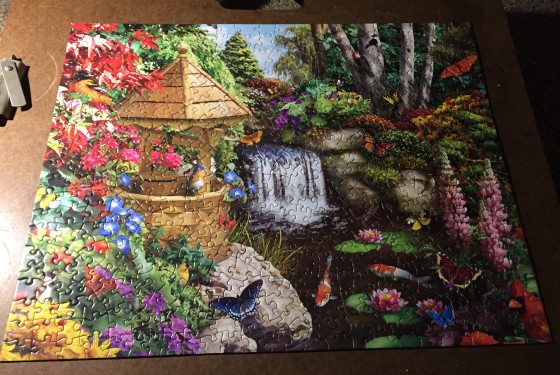
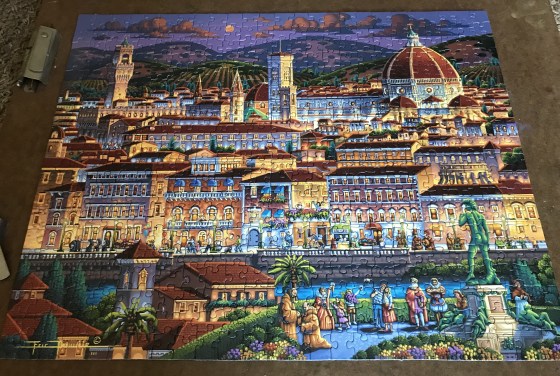
Here are several of the puzzles I/we finished at home. Apologies again: as with most other photos in this blog, I never intended to post these online, so the photo quality is lacking. I’ve added info on where these puzzles can be found in case anyone is interested, especially if you’d like to see what the pictures look like under ideal conditions.

“Secret Garden” by Alan Giana (Bits & Pieces, 500 pcs, Amazon.com): I was looking for a peaceful oasis and this image fit the bill. I loved the flowers and flying creatures, but particularly the koi, which brought a special zen to the picture. (Bad lighting – doesn’t do it justice!)

Summer_Puzzle

“Marvelous Garden” by Oleg Gavrilov (Bits & Pieces, 500 pcs, Amazon.com): I love peacock blue, the architecture smacked of Tuscanny and the flowers (yes, pink ones) completed the scene. This remains my favorite puzzle to date.

Peacock_Puzzle

“Autumn Oasis II” by Alan Giana (Bits & Pieces, 500 pcs, Amazon.com): Autumn means that Halloween/Thanksgiving/Christmas are coming up soon, and after such a miserable year of fear and cancer treatments, I was so looking forward to a joyous holiday season.

Autumn_Puzzle

“Florence” by Eric Dowdle (Dowdle Puzzles, 500 pcs, dowdlefolkart.com but purchased at Costco): I missed visiting Florence during a European trip due to scheduling conflicts, but it remains one of my most-wanted cities to tour. Seeing Michelangelo’s David in person is on my bucket list! I particularly liked that this puzzle came with a little poster of the image that made putting it together a serene pleasure. The last thing you want is to get headache trying to match up teeny windows!

Florence_Puzzle

The Problem With Pink

The breast cancer awareness movement has done a good job of bringing cancer awareness to the forefront. Especially in October, which is Breast Cancer Awareness Month, it’s hard to see pink without thinking of breast cancer. This is particularly true for someone who has gone through cancer treatment, but I expect that many who haven’t strongly equate the color with the cancer too.

Certainly, it doesn’t hurt to distribute pink “Save the Boobies”-esque stickers, t-shirts and wrist bands. It’s acceptable to say “boobies” in polite company, to broach the subject of women’s health, and this push to pink-out everything has resulted in more funding for cancer research. People probably think it’s cooler to have “boobies” on your wrist band than something like “Save the Pancreas”, the cancer of which has a much higher mortality rate. But a pancreas doesn’t look as good in a bikini top.

There is a darker side to this, and it has nothing to do with the usual arguments against pinking everything out, which tend to be about companies making profits at the expense of women. This is about what it feels like to be diagnosed with breast cancer.

At some point, awareness hits a saturation point. I’m willing to bet that many women who have been diagnosed with breast cancer dislike the color pink on some level. The diagnosis is life-disrupting if not traumatic, and the constant reminder from all the pink ribbons and other paraphernalia can get nauseating. And I do mean that in a physical sense. For me, diagnosis = anxiety; anxiety = nausea; pink = breast cancer…well, math was never my strong suit, but this all adds up to pink = nausea.

As I sat alone waiting for my surgery, feeling very nauseated, my Nurse Navigator paid me a visit. Incidentally, these nurses are the greatest thing since sliced bread (probably even better!), as they are a knowledgeable liaison between the patient and everything medical. In any case, my nurse brought me a goodie bag. Yes, it was pink and it contained various useful items relevant to my surgery and future treatments. And yes, most of these items were pink too. I guess these days it’s hard to justify using any other color if you’re talking breast.

But there was one thing that was not pink, and it’s because it wasn’t pink that I realized right then and there what sort of a visceral response I’d been having to all the pink stuff. It was a soft and springy heart-shaped pillow to be placed in the armpit to comfortably support the affected arm after surgery, and it was purple. Okay, with pink accents, but close enough. It was PURPLE!

PurpleHeart

This is a good place to mention that I make strong associations between emotions and my environment. This is a form of contextual conditioning. I’m sure I’ll write more about that in the future, but for now, I can tell you that having something not-pink that I used daily until my incisions healed, and having it be completely relevant to breast cancer treatment…but again, not-pink…actually took the edge off my anxiety. I was more likely to reach for it because at a time when I needed to relax and recover, the color didn’t remind me of my cancer.

That may sound unbelievable, but contextual conditioning is like that. I love that pillow and I love that it’s purple. And it’s really pretty amazing how my brain perceives that squishy little purple pillow as being so nice to have around. Don’t think I would have had the same response had it been pink.

A Year With Tamoxifen

One of the most distressing parts of going through cancer treatment was that I thought it would “ruin everything”, even if it saved my life. Physically, I was really enjoying my 50s and hadn’t noticed much of a drop in endurance and strength, and certainly wasn’t experiencing menopausal symptoms. But with my diagnosis came the news that, because I had an estrogen receptor positive tumor, I’d need to be taking estrogen-blocking Tamoxifen (or an aromatase inhibitor) for a decade.

A decade is a long time! Chemo was only six courses over about four months and radiation lasted only six weeks — all time-limited and psychologically doable. But Tamoxifen would be with me for ten years, and presumably, so would the troublesome side effects, according to just about every woman who was taking it. They spoke about how difficult it was to stick to the daily regimen, knowing that it was responsible for horrible hot flashes and night sweats — one woman even said that she couldn’t exercise due to the severity of her symptoms.

Not exercise?!?! My version of hell: a sedentary existence.

At this point, I was busy dying a thousand deaths. I started to question whether death by cancer was a preferable alternative to a decade of misery. Mind you, I hadn’t even begun taking Tamoxifen yet; all of this was fear-driven. I feared having no control over my own existence and the things that really mattered to me. Basically, this was an end to life as I knew it.

So, fast forward to today. I have been on Tamoxifen for a year. I’m still waiting for the misery. Please note, I do not, for a second, doubt that women struggle with Tamoxifen’s side effects and I have the utmost sympathy for them. I also realize that I’ve been very fortunate so far to not have those types of symptoms. Sometimes I feel a little warm and have to roll up my sleeves or take off a sweater. Being in stuffy rooms can feel uncomfortable. But these don’t constitute what has been described to me as a hot flash, and I cannot recall whether I had those same sensations prior to treatment. Before my diagnosis, I’d had some sweaty nights from stress; I haven’t had a single night like that since starting Tamoxifen.

I do have some memory issues, particularly distractibility and loss of focus. Sticking to one thing at a time is an absolute necessity or else I’ll get sidetracked. My libido took a hit too. But is that Tamoxifen, effects of chemo…or just the onset of menopause?

The bottom line is, I had beaten myself up over potential effects of a medication way before I’d experienced it. I’d ignored the number one rule of cancer: everyone’s experience is different. Oddly enough, that had been the mantra I repeated to everyone else, but I’m the one who needed the reminder. For me, Tamoxifen has not turned out to be the torture that I’d expected.

If there’s a take-home message from this, it’s that cancer is a complex disease and its treatment is equally complex. Just as there is personalized medicine, there are individual reactions to that medicine. I, for one, have convinced myself that I need to stay off the Internet, take a deep breath and have my own experience.

Gratitude for Community

My teenage daughter had her eyebrows threaded for the first time (her decision). The threading salon came highly recommended and it was bright and inviting with a peaceful vibe. On the wall by the entrance was a sign next to photos of the owner’s lovely children: “I am not lucky, I am blessed.”

Ok, you probably see where I’m going with this and it has nothing to do with eyebrows. As I waited for my daughter I read the sign over and over again and felt a rush of warm fuzzies. I feel the same way, not simply lucky, but blessed. And in that comfy little shop, I thought about where I was a year and a half ago, scared and disoriented after my diagnosis, feeling like my world was crashing in on me. That seems so far away now.

Later, I was less frantic and lost, but saw a future only as far out as my hand, living treatment to treatment, riding a roller coaster as I went from one new medical experience to the next. But even in the midst of treatment, when I took a moment to stop and look around, I knew that I had so much to be grateful for. Not the least of this were the people who cared for me: brilliant doctors, nurses, therapists and administrative personnel. When I pause to consider my treatment experience, the warmth of these people is what leaves me with such a positive feeling. It was the community of care that made a huge difference: the attending nurses in the infusion room, the radiation therapists that I saw daily for weeks, the other cancer patients, most of whom I never met, but with whom I shared the work of putting together a jigsaw puzzle in the waiting room as we all came for treatments throughout the day. That sense of community, of never feeling alone and always being supported, that’s what makes me feel so blessed right now.

Yes, when I finished my infusions, when I finished radiation, I jokingly told these wonderful people that I hoped I’d never see them again (they get that a lot), but every time I think of them, I am overwhelmed with gratitude.

When Deep Breaths Don’t Calm

It’s an obvious understatement to say that getting cancer is stressful.

My treatment plan involved a lumpectomy first, then chemo and radiation, but just getting to the surgery wore me out emotionally. I’ve written before that I’d never experienced anesthesia before, certainly never had major surgery…and add to that, the surgery would confirm how far my cancer had spread so I was apprehensive about the whole thing.

Suffice it to say, I didn’t handle this process well. Two weeks prior to surgery, I had begun a mindfulness meditation practice at the suggestion of my radiation oncologist. This was a life-changing step for me, but I hadn’t had enough experience with meditation for it to truly benefit me as I was sitting in the “ready room”, waiting for my surgeon. I knew I had to breathe, but it was hard to focus when I was terrified.

The “breathe deeply” mantra was repeated by a number of nurses, probably because I looked like a wreck. I can honestly say that breathing deeply, as hard as I tried, didn’t work. Months later, I came across an article (and unfortunately, I cannot recall whom to credit for this) addressing this issue. The problem with focusing on the breath during periods of extreme anxiety is that the breath is most obvious in the center of the body. You know, right where your racing heart is. I couldn’t separate out the two, and as I was trying to slow my breathing, I was acutely aware of the pounding in my chest.

So, here’s the advice that I would give now: find a comfortable position and focus on your hands. Feel into them and focus on any sensations present in them. Fingers are sensitive, so it’s likely that you’ll feel something. Is there tingling there? Are they numb?What’s the texture of the material that they’re resting against? If you feel nothing, rub your hands together and focus on those sensations.While this type of meditation (essentially a body scan) is often done with eyes closed, depending on the individual and how frightening the surroundings are, it might even work better to keep the eyes open and look at the hands. But really look, so that you draw your attention away from the beating heart, and then gradually try to slow your breathing.

The idea is to keep your attention away from parts of the body that remind you of how anxious you are.

I can’t say that I would have completely relaxed had I known to do this. I had been dealing with runaway anxiety for the past weeks that my rudimentary meditation had only begun to chip away at. But it’s possible that I would have gotten myself into a more comfortable state as I waited for surgery. Definitely worth trying the next time you find that a breath focus doesn’t help with anxiety.

Lifting My Spirits

I received an unexpected but incredibly satisfying compliment today. It was from a worker at Trader Joe’s who made a flattering comment about my arms. A little background here: I like to work out, and even obtained a personal trainer certification when I was a stay-at-home-mom. While I’ve never trained people as a profession, I have maintained my certification over the years — in addition to a vigorous training schedule. I’ve been told that this is unusual for “a woman of my age”.

When I received my cancer diagnosis, I was shocked largely because in my mind my lifestyle didn’t seem to fit the profile of someone at high risk. One of my greatest fears as far as cancer was concerned was that it would affect my ability to train regularly. While so many people engage in eye-rolling when it comes to exercise — it’s popular to equate exercise with misery — having to take time off from working out was one of the most horrible outcomes I could imagine. My version of hell involves a sedentary existence. I train hard to enjoy my life, to be able to move and lift and not feel pain. I work out to live and that energizes me like nothing else. And anything that jeopardizes that is a death sentence to me.

Okay, maybe a little dramatic? But you get my point. I.Love.Exercise.

Today’s compliment was particularly poignant. During my 2017 doctor’s appointment to check out that suspicious lump in my breast, the doctor’s assistant commented that she wished she had my arms. I remembered that as I went through diagnostic tests and oncology visits and surgery. I followed my surgeon’s orders regarding not lifting heavy things (well, mostly, because “heavy” is negotiable), but as soon as that time limit passed, I was off and running. Exercise meant normality, and I craved feeling normal, as in “not sickly and dying from cancer”. There was mention of this nasty impediment to my life called lymphedema. I didn’t really think about it much until I was discussing lifting weights with my oncologist, who said, “Exactly HOW MUCH weight are we talking about here?” and sent me to the lymphedema specialists so that I wouldn’t go full-Schwartzenegger without knowing whether I was risking having my arm blow up. (It hasn’t so far.)

But my point: the compliment I received today made me feel like I’d come full circle. While, yeah, fear of death from cancer is a biggie, drastic changes to one’s lifestyle are also anxiety-provoking.

Today, I felt, I’m back.

Cancer As Divine Justice?

It’s disappointing that I feel the need to post this disclaimer, but I would be heartbroken if someone misinterpreted this post to suggest that people with cancer are being punished by God, the Universe or whomever, for something that they’ve done. THIS IS NOT THE CASE and this post is not to be twisted into a perverted view of divine justice. I hope that’s clear.


One thing that I’ve grappled with throughout my cancer experience has been the WHY of it. I don’t like uncertainty and when I looked at the risk factors associated with getting cancer, there was no reason why I should have been saddled with this disease. Yes, I realize that life is not fair, and that these things happen for reasons that we don’t understand. But when you’re in the thick of diagnostics and treatment plans and all that good stuff, you don’t think clearly. Ultimately, there is a reason, but science has not progressed enough yet to provide a definitive explanation.

So, when science can’t answer, we turn to more primal explanations. Being a Catholic, I couldn’t help but think that this was some sort of divine justice. You’ve heard of Catholic guilt? On some level, I carry around a lot of it, more than my share. It’s propelled me to be as exact as possible in all things. When a police car drives by, I fear that I’m doing something wrong. I follow rules. I don’t lie. I keep my promises and hold secrets close. I care, perhaps a touch too much. In effect, I drive myself up a freakin’ wall.

Things had been going well, physically. At 50, I was strong, fit, remarkably healthy and free from a lot of the ailments that many women my age complain of. I had no weight issues, no food issues, loved to exercise and was so happy about that. My lifestyle supported good health and longevity. But then – WHAM! – cancer diagnosis. Maybe I was too happy? Perhaps I was smug? Catholicism makes a big deal of intention, as in not thinking bad things. Whether or not this is actually practiced by members of the faith is a different issue altogether, but that’s the idea. So I immediately thought that perhaps I wasn’t humble enough about my physical state? Despite the fact that I had truly worked for it, avoided indulgences like sugar and alcohol, pushed through discomfort to exercise, maybe my thoughts had brought on some sort of divine anger, and cancer was going to put me in my place.

That’s what I thought. And YES, I am a well-educated individual who understands that mutations in the DNA occur frequently, and the body takes care of them. But mine didn’t, so any reason that seemed to make “sense”…

Even then, I am not so arrogant to garner the attention of a deity. These days, there’s quite a bit of that going around, and I couldn’t hope to compete with the obvious examples that we see in political and entertainment spheres. So it really doesn’t make sense that I would get cancer for that reason. In that case, was my confidence in my good health particularly egregious and insulting to a divine power that I would get singled out?

These are the kinds of thoughts one has in the middle of the night when one has mixed up the order of their anti-nausea medications while that the body is fighting the effects of being slammed by an elephant-sized dose of chemotherapy.

Regardless, the thought processes continue…

Maybe this went so much further than some kindergarten-style retribution? Another cancer survivor had related that the disease was the best thing to ever happen to him. In the middle of chemo, I had a hard time appreciating that. But as the end of treatment started coming into view, I began to grasp what he meant.

Of course, being Catholic, my head went to…maybe this is some sort of odd divine blessing? I have no doubt that God has a sense of humor. I imagined him being bored and seeing me through a break in the puffy white clouds and – ZAP! – I get cancer while he runs and hides behind St. Peter, giggling. So maybe I was being pranked, but in a loving, benevolent kind of way?

Truly, this cancer experience has given me a lot of direction, a sense of purpose that I had lacked. Admittedly, this is imbuing an unchecked genetic blip with a whole lot of divine power. But take the God-figure out of the equation and look at it again. Choose your interpretation. Some random mutation? Or an opportunity to redirect my life in a positive way that benefits others?

Isn’t the latter a far better choice?

What Is Up With My Hair?

But let me back up a bit. My hair has been an issue throughout all of cancer treatment. As everyone knows, the hallmark of a cancer patient is a bald head. That’s pretty unmistakable. Being told you have cancer and waiting for test results is anxiety-provoking because — besides the obvious fact that you have freakin’ cancer — you don’t know the extent of your treatment. Being told you don’t need chemo is a huge plus. For me, this was because then I wouldn’t be a “full Monty” cancer patient, and my perception was that my condition would not be quite as serious as if I were going all in and having to undergo the full spate of treatments (surgery, chemo, radiation). The reality of this is debatable, of course, but for me, finding out that I needed chemo meant giving up hope of all normality. This wasn’t going to be like taking a prescribed medication. This was going to change me physically, and everyone would know.

I didn’t shy away from telling people of my diagnosis, particularly those who were going to see me on a frequent basis. I mean, who was I kidding?

I’d always had long-ish hair, but when it started coming out by the handful, the thought of leaving a hairy trail in my wake was unbearable. I entreated my husband to get the clippers and off everything went. My daughter was supposed to film the entire thing (I was bound and determined to record my experiences for posterity) but this whole episode was a little overwhelming and I started crying…and my sweet kid didn’t want to film a breakdown so she only took stills. I really wanted the video, but whatever. At least I had photos. My husband had fun leading me through an evolution of punk haircuts that allowed me to relive the 80s, but when it was all said and done, I felt better and promptly sent out the photos to close relatives. I got compliments on my headshape and was told that I had dainty elf-like ears. The world of cool Halloween costumes opened up for me.

And man, did I look weird.

So, for the next however-many months I was all about scarves and hats. I got used to always having something on my head because my dream of being the “cool bald chick” didn’t materialize. With my hair gone, I had a very good view of my scalp, and it looked terrible. I guess being a Northern European in a city on the same latitude as Morocco was not kind to my skin, and my scalp displayed the abuse it had suffered all those sunny, hatless days. I had some pretty incredible moles, and, look, I already had breast cancer – I didn’t want to have to deal with skin cancer too. My lid stayed capped.

Now, everything-hair was in a holding pattern until the end of my chemo. First of all, when you google “Taxotere” (one of my chemo drugs) and “hair”, the first entry that comes up is for a law firm that is planning a class action suit against the makers of Taxotere on behalf of all the women who suffered permanent alopecia after taking the drug. This is NOT what you want to see.

After all that, I was pretty impatient about hair regrowth. There is a small percentage of women who do not get their hair back, but it doesn’t matter how small that percentage is. When you’re holding your breath and waiting for your hair to return, you’re convinced that you’re part of it. To make matters worse, my hair had gone all white/gray so it was even harder to see. I gave in to the folly of reading about other women’s experiences with regrowth, and they all seemed to grow hair more quickly. Or not at all.

By this point, I looked like a cross between Yoda and Gollum, since a few crazy hairs had apparently not gotten the memo and decided to keep growing throughout my treatment. Not a lot, just enough to make my scalp look like it was undergoing an identity crisis. My eyelashes were still clinging for dear life, and I had high hopes of being able to emerge on the other side of this journey with some fringe around my eyes…but no. A few weeks after chemo ended, all but a couple of my lashes went the way of my eyebrows. Gone. Nothing quite like being hairless to make you look like an alien from a 70s sci-fi flick.

So I waited. I whined in my oncologist’s office, and cried in my counselor’s. I don’t have much faith when it comes to being patient and seeing how things turn out. My impatience was driven by fear. Every trip to the bathroom was another opportunity to stare in the mirror, trying to determine was that a shadow or a new hair? This was complicated by the fact that my previously excellent eyesight is changing and I’m not adjusting well to that. I forget to bring reading glasses and think that the world has just gone fuzzy, like that’s perfectly normal. To my glassless eyes, I still looked bald.

But at one point I was examining my forehead, where the hairs reeeeeally took their time coming in (what’s up with that???), and saw teeny translucent sprouts. Finally? Trip after trip to the bathroom mirror, squinting from every angle, the hairs were unmistakable. Yes, foreheads are great things, but I didn’t need so much of mine. And finally it was getting coverage.

Let’s fast-forward to now. I have hair. It’s white and I look like my kids’ grandma. But regardless, I have hair and that makes me so happy. Let me say it a few times: hair, hair, hair! And not only do I have hair, I have gravity-defying hair. It’s a few inches long and reaching for the stars. I use hair styling products with names like “taffy” and “putty” to keep it in place, but when I wake up in the morning I look like a Pomeranian. I didn’t even realize my hair could do that.

Note that I am not complaining. My eyelashes came back. My eyebrows didn’t, but that pulled me into the creative world of brow design. Once I got past the “my-brows-were-drawn-by-a-five-year-old” stage, I got into the look and expanded the rest of my make-up to balance my face out. In the end, I look more put together. At the same time, I don’t look like my old self. But perhaps that’s not so bad – I am not my old self inside, and that’s being reflected on the outside. Yes, sometimes I walk past a mirror and shock myself, but this journey has been transformative and I’m going to have to get used to that. As with everything, deep breaths.

What’s All This, Then?

“If you want a happy ending, that depends, of course, on where you stop your story.”

Orson Welles
director, actor and producer


Honestly, this blog is supposed to be funny, but sometimes it’s hard to get there.

I am a cancer survivor. You cannot imagine how good it feels to write that. This blog was established to help me document my journey, process my experiences and, ultimately, inch away from thinking of myself as a cancer patient and towards being a mindful, peaceful and accepting (that’s a tough one!) creature on this Earth. Be warned, some of my posts are self-indulgent and unnecessarily wordy; I have much respect for anyone willing to slog through them.

Right now, this blog is anonymous: I need to stumble through my feelings, complain when I feel like it and be blunt when necessary — and I need a safe space to do it without fear of judgmental glances. While my goal is to keep this light-hearted, I realize that I have the pleasure of being a survivor and chuckling about my cancer experience; there are many who are not granted that opportunity. Writing this blog is a privilege.

Cancer sucks. It’s an indiscriminate spectre that has haunted the lives of practically everyone at some point, whether relatives, friends or ourselves. For me, cancer cannot pass into faded memory quickly enough, but at the same time, I am infernally curious about the disease and how it has changed me.

So here are my facts:

In early 2017, I was diagnosed with triple-positive (estrogen+, progesterone+ and HER2+) breast cancer. The lump was 1.6cm in diameter, removed at the end of March, along with three sentinel lymph nodes that were revealed to be unaffected. Chemotherapy (Taxotere & carboplatin) started a month later and lasted the entire summer, 6 hefty courses, one every three weeks; adjuvant therapy (Herceptin, a monoclonal antibody) also started at this time, but went for 17 courses, ending in April 2018. Daily radiation treatment lasted six weeks through autumn of 2017. A 3-D mammogram in February 2018 showed nothing, in a good way. That marked my first year without the tumor.

I wish I’d been able to write in 2017, but my head wasn’t there. I was not processing, I was existing and enduring. After my final Herceptin infusion, my port was removed and I turned around to see what had happened. It took several months of writing before I tossed out my first post in September 2018, privately at first, and then, “Hello, world!”

It’s going to be a bumpy, unpolished ride. Bear with me.