It’s Not a Crisis, It’s an Opportunity

(Title image: Photo by Nick Fewings on Unsplash)

So I’ve been playing with another mental challenge.

For the past month, it feels like I’ve been dealing with a lot.

So many things weighing upon me: obligations, deadlines, upcoming responsibilities, health woes. At least I think there are many things.

Lately, I’ve been getting overwhelmed by what needs to be done. I manage to trudge through everything but procrasination becomes harder to resist and a good night’s rest is harder to get. I’m more susceptible to distractions, which end up resulting in more stress because now, of course, I’m getting even less done.

Life can look scarier than it actually is. Awareness illuminates reality.
(Photo by Razvan Sassu on Unsplash)

It is a self-fulfilling prophecy of sorts.

But when I pause and identify the sources of stress, there aren’t that many. The ones that are there expand around their edges, looking bigger than they really are and that creates a crisis in my brain.

If I were a purely mindful creature, I’d be able to notice this immediately and gently put a stop to it. But, alas, I am clumsy human being. Even with all my practice, mindfulness can easily evade me at times when I need it the most.

So for this round of dancing with anxiety, I’m reframing what I’m experiencing as a fortuitous learning opportunity. And it’s a very “safe” one because quite honestly nothing that I’m going through now is life-threatening.

I am not currently dealing with a cancer diagnosis. I am not about to be kicked out onto the street with my life in peril. I am not dodging bombs or searching for missing loved ones.

Instead, I only need to de-escalate what my brain is blowing out of proportion. This is in fact an ideal situation to be in because I can’t get it wrong. The only question is how long this process is going to take. Everything else is time-limited. Sooner or later it will work itself out and I know I’m going to be okay.

Every challenge is another chance to practice mindful awareness.
(Photo by Gantas Vaičiulėnas on Unsplash)

This is a chance for me to practice shortening the time it takes to notice that no true calamity has befallen me. The more I sit with the things that I’m grateful for, the more I reinforce the realization that not everything that I experience is a stressor and there are so many awesome things that perfuse my day.

And once that realization lands, once I see that my feet are planted on the ground and the din of fears in my head fades, everything feels clearer and calmer.

Why didn’t I do this earlier?

I Thought I Was Doing Better

(Title image: Photo by Merch HÜSEY on Unsplash)

Last week, I met with a friend that I don’t see often. We were talking about what was going on in our lives and he related how he loved where he lived right now, and put a positive spin on everything in his life, even when talking about negative happenings.

He sounded sunny and was handling the tough stuff that came his way.

But then it was my turn to tell him about what I’d been up to. I started describing what I’d been dealing with: my father’s decline and death last year, worries about my mother’s well-being, concerns about the increasing cost-of-living…

My friend smiled at me. The last time he had talked to me, he said, I was stressed about something else. In fact, every time he calls me, there’s some new thing that I’m stressed about.

And of course he’s right. As much as I’ve improved in handling anxiety using all the tools I’ve developed to calm myself down—and, yes, I’ve found success with that—the overarching feeling that I have is that I’m playing whack-a-mole with my worries.

It’s as if I’m trying to regain my footing, but something new comes up and knocks me off balance again.

I admit it. I’m feeling worn out.
(Photo by Anca Gabriela Zosin on Unsplash)

After getting past cancer treatments like chemotherapy and radiation, you’d think that the skies would look brighter and my outlook would be more positive. And for quite some time that was completely true.

But as endocrine therapy wore on and I went through menopause, my spirit suffered. The luster of surviving cancer started wearing off. That’s embarrasing to admit, especially when I have lost friends and family to the disease and know of many others desperately fighting it.

But even being aware of that, my day-to-day seems to have become darker overall. I start the day with energy to get things done but by evening I’m exhausted and sometimes overwhelmed by what’s in front of me.

I know some of this is my own doing. In fact, one of the big, scary changes that I was faced with this year just sorted itself out. It was simpler than I expected (note my previous post). And then my son was admitted to the college he wanted to attend. All these are refreshing successes that I should have spent time basking in. But it didn’t take long for the clouds to gather again.

After hearing my friend’s assessment of me, I am trying to figure out whether what I’m going through is really getting harder? Or have I gradually been losing my ability to pull myself out of a funk? And once the uncertainties are settled, will I bounce back?

I feel disappointed in myself, which is exactly part of the problem. Lack of self-compassion simply compounds the stress. You know the carrot-and-stick analogy? Well, I’ve tossed the carrot and am just beating myself with the stick.

Back to the drawing board.

But What If Everything Goes Right?

(Title image: Photo by Aaron Burden on Unsplash)

Friends, I am a worrier. You’d be hard-pressed to find something that I wouldn’t worry about.

I know better. And I’ve actually gotten better.

But even with practicing mindful self-awareness, those foreboding thoughts of “what if everything goes wrong” creep in, particularly at night.

Because 2025 is a year of big changes for me, there have been many opportunities to awaken in the darkness, worrying about how this and that can go totally downhill.

A few days ago I was on the same train ride, hurtling through fears, when it hit me that, in the same way that I can imagine everything crashing and burning and my life being miserable and terrifying, I didn’t have to fear the worst. Things could work out.

Call that the “Schrodinger’s Box” philosophy of life. At the same time that things could be awful, they can simultaneously be fabulous—or somewhere along that spectrum. No matter what you’re anticipating, it won’t be until you finish the exam, give the speech, get the biopsy results or have the conversation that you will really know how things turn out.

Fear and avoidance are not the way to go through life.
(Photo by Alexander Grey on Unsplash)

So if you don’t know, you might as well think positively, tempered with a healthy dose of realism. Things are rarely black or white. Just as we shouldn’t be “all negative”, we shouldn’t be “all positive” either.

Ok, so right here I need to backtrack and say a word about “positivity” and “negativity”. When we practice mindfulness, we strive to release expectations, to not attach ourselves to an outcome. Yes, I get that.

That is an ideal. Our minds don’t always allow us this.

But if there is a choice between being morose or upbeat, you are still better off being upbeat. Realistic and upbeat.

I’ve heard people justify constantly being negative by saying that at least they will be “prepared for bad news” so that it’s not a shock. I used to think that too, fearing the precipitous drop in spirit when you’re expecting something good and get something bad instead. But I’m no longer convinced that doom-and-gloom saves you from anything.

Consider the “coward dies a thousand deaths” adage. Perpetual pessimism can lead to all sorts of health issues, mental and otherwise. For example, living in constant fear may result in anxiety, depression and high blood pressure,among other things. And with enough time, those can turn into something worse.

Again, the ‘ideal’ is non-attachment. But if you cannot completely disengage from imagining an outcome, your mind and body will be better served by considering that everything will work out in the end. At least you’ll be able to sleep better at night.

~~~~~~~~~~~~~~~~~~~~

And what is recognized as the optimal way of thinking? There exists the concept of “short-term realism, long-term optimism”. This means that you take care of the tough stuff in the present, facing challenges head on, but keep your chin up and not lose hope for the future.

“It’s Not a Toomah”: My Aura Theory

(Title image: Photo by Daniele Levis Pelusi on Unsplash)

I’ve written in my blog that I was experiencing strange visual disturbances, most likely visual migraine auras. Note: I’ve never experienced migraine pain.

This is particularly worrisome for me as a survivor of triple-positive breast cancer, as there is a greater chance of that type of cancer metastasizing to the brain. Presumably, a growing tumor could restrict blood flow to areas of the brain that could result in me seeing strange things.

This was of great concern to my ophthalmologist. However, there was no pain associated with the auras, and pain would have been expected (but not necessarily required) if the auras were caused by a tumor.

There were other confounding variables, too. Since the summer of 2024, shortly before my father’s death, I had noticed that I was doing a lot of involuntary “sighing”. I’d experienced this type of sighing before, but this time it kept going for months, sometimes occurring a number of times an hour.

Naturally I googled it, and Dr. Google pointed out that excessive sighing was potentially associated with undiagnosed anxiety and depression. When I finally started writing out all my stressors, it because obvious to me that I had been far more deeply affected by what was going on in my life than I imagined.

So, after my appointments on Nov 22, I took time to grieve my father’s death, which I hadn’t done up to then. I thought I had accepted his passing and moved on, but clearly I hadn’t. I sought hugs and solace from family members and expressed what I was feeling.

My last aura was on Nov 29th. After that, along with allowing space for grief, I expanded my time in meditation, added up to an hour of breathwork a day and even included a daily cup of ceremonial-grade cacao (for the theobromine).

Mindfulness took a front seat. I paused at various points of the day to simply take deep breaths. I paid attention to what my body was doing and what thoughts were running through my mind. I made a concerted effort to show compassion to myself, more than I had in a long time.

The auras did not come back. As of this writing, it has been 45 days since the last aura. I had been having them once a week, and at their worst, a couple a week and even two on one evening.

I am well aware of the power of the mind. My educational background is in graduate-level psychology and I myself have experienced psychosomatic pain before. But honestly, I never expected to have such a striking response to anxiety/depression/grief.

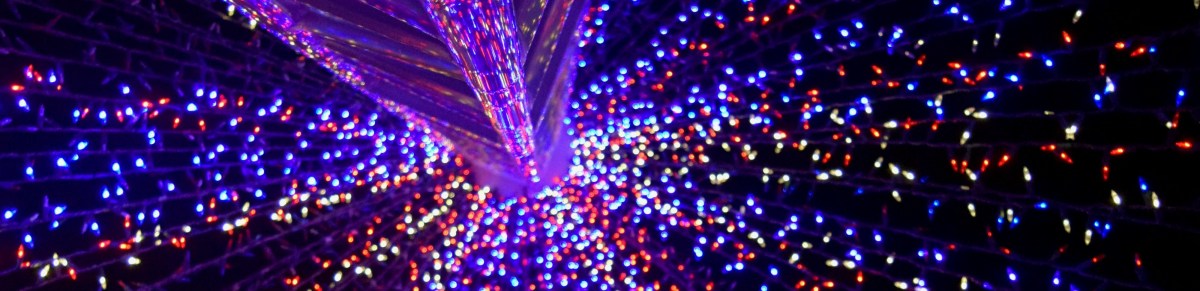
I have searched for a good visual representation of an aura and it’s hard to find one that actually reflects what I was experiencing. It was something like this:

This is not exactly what it looks like for me, as some of my auras have been “thicker” and more “stained glass-like” in color, looking more zigzagged (as if the entire half-circle is made up of triangular pieces of vividly bright LED-like colors). Also, mine were gone within about 20 minutes.

That’s not an insignificant reaction to something that is going on in my head. My brain created those auras. That is amazing.

I should mention, I never had an MRI so technically a tumor cannot be ruled out. And neither can some other cause that I have not considered. However, the fact that my auras stopped after I put concerted effort into exploring my anxiety, acknowledging depression and recognizing that I was not okay with the pressures I was under suggests that it’s probably not a tumor.

Cancer Took the Magic Away, Mindfulness Brought It Back

(Title image: Photo by Ethan Hoover on Unsplash)

And, no, I’m not talking about casting spells.

But I remember “life before cancer” and it felt different. There was a feeling that there was so much life left to live, so many plans still to execute.

I felt bulletproof. My own primary care doctor was impressed that I’d made it through so many years without ever having a major surgery (or any surgery, for that matter). I was looking foward to my future. My workouts were still tough and vigorous and I felt like I was going to age well.

Most importantly, life had a certain magic to it. It felt multidimensional and filled with possibilities, and even with the challenges that I’d had to face, I had hope that things would always get better.

Then I got hit by the locomotive that is cancer and everything ground to a halt. My world went gray and all those plans that I had for “the rest of my life” fell away as all my energy was focused on surviving the diagnosis, surviving chemo…and I didn’t see much past that.

For quite a while after diagnosis, I’d felt like I’d been tossed out by the side of the road.
(Photo by Sven Brandsma on Unsplash)

Emotionally, my life felt like a void. I was too afraid to even let hope in because of the fear of having it dashed to pieces.

It was like being out in the wilderness and calling for help but receiving none, not even an echo. Spiritually, it was the loneliest that I’d ever been.

I was no longer on the highway of life. I was sitting in the breakdown lane.

Forgive me if this sounds melodramatic. All my ‘anxiety chickens’ had come home to roost, so to speak. And I wasn’t handling it well.

I dragged myself around treatment like this…although about two weeks before my cancer surgery, I had started mindfulness meditation, encouraged by my radiation oncologist who suggested it as a non-pharmaceutical way of dealing with anxiety.

It was that little ‘peep’ of mindfulness that had I clung to, terrified, in the beginning, not really sure whether or not it was helping. But at least it was something warm at a point when I felt cold and abandoned.

I can honestly say that mindfulness and meditation were what gave me back the strength to persevere through tough times.
(Photo by Robin van Holst on Unsplash)

As time went on and I stubbornly refused to miss a day of meditation, that little break in the clouds became bigger. In this case, my obstinance was a blessing. Somewhere in the last almost-eight years, not even sure exactly when, something changed.

The fear and loneliness and bitterness crumbled away. Noticing how things were right now, how beautiful the world was when I chose to appreciate it, helped pull me out of the funk.

In our darkest moment we find our greatest strengths. I wish it weren’t like that, I wish there wasn’t a need to hit lowest lows in order to get the biggest spring back up. But I can say that if my life even before cancer had been easier, I would not have experienced the richness of existence as I do now.

Not everything is okay. In many ways, things are even harder and more frightening. But I can accept that and not feel bitter. My expectations have softened and I pause more often to ground myself, to notice that at this moment, I am safe.

And for this moment, I am at peace.

Making a List, Checking It Twice

(Title image: Photo by Kelly Sikkema on Unsplash)

I have been stressed lately, which is a bummer because this year I really wanted to relax and enjoy the holiday season. But once again, it seems like the year has some zingers left for the final months of 2024.

Instead of writing about them in a post, I decided to write them down…and I was surprised by how many stressors had built up.

I made my list carefully, organizing it by time periods: first, I wrote down the things that had been nagging me all year or longer. Stuff like constant increases in rent and cost-of-living. These were exerting continuous pressure on my well-being.

“Dear Santa, please don’t bring me any more stress. I’m good for this year.”
(Photo by Mike Arney on Unsplash)

Second, I wrote down things that seemed to have happened in the second half of the year and had a large impact, like my father’s death and experiencing frequent visual migraine auras.

Third, I got more granular and wrote about the things I was experiencing on a daily basis. Like feeling that my words were misunderstood or having to go through the rigamarole of tracking down a package that hadn’t arrived—these are things that work themselves out in a relatively short period of time but are stressful in the moment.

Why bother listing all this? Because it helps sort things out. I get perspective on exactly what’s going on in my life. Without that, it’s like someone throwing a huge blanket over you—suddenly it’s dark and you feel smothered. And that feeling of overwhelm elicits a lot of anxiety.

And once I had started the lists, I considered how I was reacting to these stressors. For example, since my father’s death I had not given myself the opportunity to grieve, not even during the funeral. There were so many other concerns that it didn’t seem like it was “the right time”.

So over the last two weeks, I gave myself the space to cry. If I hadn’t stopped to consider what was actually going on, I might have tried to soldier on and pushed away how much it hurt. I had been affected by not only his loss, but also by how his gentle nature meant he didn’t push back against forces that led him to forsake his own passions, and knowing that compounded my pain.

Ah, here comes that word again: PERSPECTIVE. You really don’t get the whole view until you step back and quietly observe.
(Photo by Brigitta Schneiter on Unsplash)

But the reactions don’t have to be as heavy as that. I also noticed that I had been doing a lot of sighing this year, something that is associated with stress and anxiety. Even my body was trying to tell me to take a break.

Writing out the lists gave me a chance to acknowledge what I was already feeling, and pushed me to evaluate whether what I was doing to relieve my stress levels was effective enough for what was going on.

It’s important to note that the purpose of writing up these lists is not to wallow in misery! Everyone has stress of some kind and I’m not unique in that, nor am I trying to make this a bigger thing than it is.

The fact is, some stressors happen to me and some I impose upon myself (unrealistic expectations, perhaps?). It is only when I am able to review them that I can determine which is which, and then take appropriate measures to alleviate whatever pressures I can.

All I Want for Christmas is No More Auras

(Title image: Photo by Brian Suh on Unsplash)

This was supposed to be a post for USA residents about how to find some harmony during the Thanksgiving holiday amidst the tensions brought by relatives with strongly differing views of the world. Such disagreements are always a possibility when families get together, but likely even worse this year.

But, no. Instead, I’m sitting here wearing sunglasses in a darkened room as I plink out this post.

Remember those shimmering scythe-shaped mosaics (auras) that I wrote about intruding on my vision some weeks ago? The ones that are associated with ocular migraines, but in my case minus any headache? Well, they’re still happening and with greater frequency.

Depending on which of my healthcare professionals you talk to, they either want to (1) wait and see how things progress or (2) shove me into an MRI tube ASAP.

And me? I really want to not be dealing with this issue. After seven years of putting a lot of space between my cancer diagnosis and the present moment, I am getting stressed by the possibility of this being something quite serious. And all I wanted was to enjoy the upcoming holiday season.

But I’m getting ahead of myself. Here are the details: I’ve now had seven of these episodes in about two months—I’m not even sure when the very first one was. After the last one (which was the second of two last week), I left a message with my ophthalmologist.

However, it was my oncologist who happened to call a few hours later, completely coincidentally, to give me unrelated scan results.

So, since I had him on the line, I told him about the auras. He sounded sad. And you know what? You never want your oncologist to sound sad, especially when they’re usually so good at being neutral when delivering news.

And then my ophthalmologist called back late that afternoon, urging me to see my primary care doctor as soon as possible and also schedule an appointment with her for the next day.

Next day, I snag a morning appointment with my primary care provider, explain the situation and the fact that I have no other symptoms other than the auras. Her take: this is very weird, yes…but it’s a hard sell to get this to qualify for an MRI at this time, even with the frequency. With my consent, she wanted to wait for a little bit and see whether the auras continued.

Or, I guess, until my head exploded or something.

Find a happy place, find a happy place, find a happy place…
(Photo by serjan midili on Unsplash)

When I saw my ophthalmologist that afternoon, she was extremely concerned and incredulous that an MRI wasn’t the first course of action. I could tell that she felt waiting was a bad idea.

But ultimately, she acquiesed to the notion that we’ll wait, although she’s sending a synopsis of her findings to my primary. She instructed me to take excruciatingly detailed notes the next time one of these auras occurs

And if you’re still reading this far down and are convinced that my goose is cooked, maybe it isn’t. Sure this whole experience is stressing me out. But there are far too many confounding variables present to resign myself to the fact that I’ll be getting my head shaved again soon…variables which I might be writing about in a future post…

…or I’ll be talking about my ride in the MRI tube and subsquent diagnosis.

But for now, I’m going to rest my eyes in a darkened room and think of silky fur on a contentedly purring kitten.

~~~~~~~~~~~~~~~~~~~~

For everyone in the USA, have a wonderful Thankgiving with your lovely families this Thursday…and let’s all try to keep it civil.

Staying Calm is the Best Revenge

(Title image: Image by Pexels from Pixabay)

Yes, revenge is not a nice word. But if you’re having “that kind of a day” it just might offer you the kick in the pants that you need.

Here’s an example: last week was hectic for me. There were additional work demands on top of which popped up all sorts of fires that I needed to put out. Things were not going smoothly, I missed out on exercise, wasn’t sleeping well, got a letter of rent increase, had an upset stomach—all of which were dragging me into a funk.

With all the negative things coming at me, I lost my emotional footing.

So…I decided to take revenge on the bad news, work emergencies and everything else.

And I was going to do it by not letting it affect me. I even wrote “revenge” on a sticky note and put it up on my computer monitor (NOT at work! At home, where it’s easier to explain myself).

Just say “NO” to allowing the negatives in life to run you ragged. You show ’em!
(Photo by Jon Tyson on Unsplash)

Like I mentioned at the top of the post, revenge brings with it all sorts of negative connotations. It’s kind of like giving in to the “dark side” and using your anger, frustration, despair and whatnot to overcome you. I’m NOT advocating for that.

But there is a certain fire and focus that the concept of revenge embodies…yes, we can call it passion, but I’m not in the mood for that. So I’ll stick with simple revenge with the understanding that sometimes, little rebels that we are, we will do exactly the opposite of what the situations are drawing out of us. Just because.

Freak out? No, you bully, watch me remain calm. Heart starts racing? No no no, I soothe myself with deep breaths and extended exhales. Scary thoughts fluttering wildly in my head? Nope, I bring my attention down to my feet and seat, settling down into where I am now.

No temporary wrinkles are going to ruffle me. And I know that all these things are TEMPORARY. This might be fierce defiance that I’m dipping into, like a recalcitrant toddler, but if it works, it works.

~~~~~~~~~~~~~~~~~~~~

This is probably not what the great teachers of mindfulness had in mind…but, ehh, today I’m not playing nice.

“Lightening Up”: A Breathing Visualization

(Title image: Photo by Josh Rangel on Unsplash)

Since I’ve found my stress levels higher this year, I’ve been playing with ways to quickly calm myself down.

Here’s one that I’ve been using lately. It’s very simple and involves a basic visualization, but has also been effective in grounding me fast.

And it goes like this…

Sit comfortably on a stable seat with a dignified upright posture, not too rigid, not too loose. Close the eyes or, if you prefer, soften your gaze with eyes cast downwards.

Then start slowing your breath, deepening your inhale and extending your exhale. Not focusing on a particular part of the breath cycle, but more on your entire body, noticing it rock with the breath, feeling it settle with every exhale.

Every inhale gives you a lift.
(Photo by Florian Klauer on Unsplash)

As this becomes comfortable, start visualizing the expansion and contraction of your body, as if the breath were a hollowing out of your insides. Imagine that inside you there is a space like a balloon. And the inhale is an inflation of the balloon, with the exhale a gentle relaxation of that stretch.

No need to imagine specifics about the balloon, what’s important is to notice the stretch and an opening inside as the air flows in, the expansion releasing muscles that might be tight from stress. And then, as the air flows out, notice the softening and relaxation of the body.

As you continue the inhale and exhale, feel the lightening of the body as it expands, followed by the gentle sinking as it contracts. See if you can notice yourself lift off as you breathe in, as if you were filling up with helium. But then settle into your seat as you breath out.

Continue like this, noticing yourself get progressively lighter, so that when you settle with the exhales, you still maintain some bouyancy.

This type of breathing meditation helps me “lighten up” when I feel overwhelmed, like I’m getting crushed by whatever the stressor is. Putting focus on the body keeps me out of my head and the deep breaths are soothing.

Hope this helps you too!

Rappeling Down through the Strata: A Grounding Exercise

(Title image: Photo by Outward Bound Costa Rica on Unsplash)

It’s been a very weird few weeks for me. My stress levels have been climbing, and while I can kind of, sort of point to certain anxiety-provoking events that might be responsible…there’s nothing truly significant that would elicit this type of response.

Regardless, I’ve been spending more time in the “higher strata” of myself, and I don’t mean this in a good sense. Another way of putting it is that I’m all up in my own head, bouncing around and being pummeled by all sorts of thoughts, expectations, fears, unreasonable beliefs and the like.

Oooo, there I am, stuck in my own head.
(Photo by Taylor Brandon on Unsplash)

Usually I know when this is happening, but this time I was too preoccupied with the worries of those around me that I didn’t notice myself drift up and stake a camp in the swamp of my mind.

Even my meditations tended to get stuck up there. Time to rappel down.

I get myself down this way: first by acknowledging the mess that I’m dealing with in my head, the rainstorm whipping up swirling thoughts. Not all my concerns are unreasonable, but they are pointless to get hung up on in this moment.

Next, I focus on the noise on the street outside (there is always noise on our street, but the longer I listen, the greater chance that I’ll hear a bird or other wildlife sounds). I bring my attention out to the expanse around me—getting out of the cramped space between my ears.

That’s a nice break. But I can’t ignore myself forever. So I feel into the sensations on my face: the feeling of the air (hot or cool), noticing the weight of my glasses on my nose, perhaps an itch on the scalp or cheek.

And here I go, rappeling down to a place where I can ground myself and return to the present moment.
(Photo by Ben Kitching on Unsplash)

Then I drop down to my neck and shoulders, giving them a roll as I go, and then towards my chest. Here I pause and bring focus to my breathing. Usually that results in an automatic slowing of the breath, as I notice my ribs expand and contract.

But after a brief stay I rappel down and out more quickly, into my hands and feet. Noticing how my hands feel on whatever surface they lie. And how my feet feel against the earth.

I imagine that my feet are part of the bedrock, joining the rest of the Earth’s crust. Connected and solid, forming a stable base.

And from down here, I look back up to where those clouds around my head were bringing furious rain, and they seem so far away. I’m peaceful and unruffled here on the ground. Down here is what’s really happening in the present, without being affected by the past and future. And what’s happening is just what’s happening, neither good nor bad.

Taking a deep breath, maybe a yawn, I stretch my body out the way I do when waking from a long sleep, enjoying the slight shiver of the muscles.

And then, on to the rest of my day a little bit calmer.