Following up on last week’s post on taking a coffee break, I’m sharing my daily matcha experience with you.
During my workday, I need to stop periodically and ground myself so I don’t get sucked into a hectic hole. And for me, there’s no better way to do that than to stand up, walk around to get some movement into my body and extra blood flowing to my brain…and head to the kitchen to make a matcha latte.
There’s nothing like taking a soothing break from my hectic day.
There is something about the process of making that tea drink that offers opportunities to focus on a soothing distraction that grounds me in reality. From pouring water into the tea kettle…scooping out the bright green powder…measuring out the water…whisking the solution into a brilliant verdant tornado…I find it so blissful.
This is reminder to there is more to my day than what shows up on the computer monitor. Those stressors will pass like a wave…new ones will arise…and those too will pass by.
So, now that we’re a week into 2024, what a great time to set an intention for the New Year.
For me, it’s going to be “stress less and move forward”. At least I’ve got the “moving forward” part planned out, as there will be a lot of changes in my life this year.
It’s the “stress less” part that trips me up. So I’m redoubling my efforts to make sure that mindfulness takes priority in my daily activities, and one of the best ways to do this is to see how I can make everyday tasks into moving meditations.
I present to you, the coffee break. Tea works as well, even better, it could be argued. Regardless of your preference, this is how the break works (and obviously, this should be adapted to your own situation):
Wow, I can literally smell this image and the aroma is glorious! (Photo by Mae Mu on Unsplash)
When you arrive in the kitchen (or wherever you keep your coffee, I’m not judging), bring your attention to your hands. Look at them. Notice the temperature of the air on them. Flex and straighten your fingers…and then observe your hands open the cupboard and remove the container in which you keep your coffee–mine is a metal cannister–along with a stack of paper coffee filters.
My cannister is has a pretty blue and green pattern on it and it feels cool to the touch, nice and smooth. As I open the top, the scent of coffee fills the air. I savor that for a moment.
Set the container down by the coffee maker and pick up a coffee filter. Mine is cone-shaped. Notice if the paper feels coarse against your fingertips and how it sounds as you handle it. Nestle it into place inside the coffee maker.
What does your running water look like, sound like, feel like? (Photo by Nathan Dumlao on Unsplash)
Then, back to the coffee…and fish out the scoop (mine invariably gets buried under the grounds), spooning out however-much coffee you want. Listen to the “crunch” of the grounds as you do so.
Transferring the coffee into the filter may elicit more aroma during the process. What does it sound like as it falls onto the filter? When done, replace the scoop and then the top of the coffee container.
Whatever water container you user–mine is a plastic water jug, perhaps yours is the coffee carafe itself– bring that to the sink, place under the faucet, and turn on the cold water.
Does the faucet handle feel cool to the touch? As the water runs, notice whether light shines through the stream or if it’s aerated and fizzy. Listen to the sounds of water flowing through the plumbing and into your water container. Perhaps there’s a cool splash.
Such a peaceful start to the day. Inhale… (Photo by Clay Banks on Unsplash)
When filled, turn off the water, noticing whether the handle makes a sound as you turn it. Bring the water container to the coffee maker and as you pour the liquid, listen to how it runs in, watching the waterline rise.
Close the coffee maker’s top, press the requisite buttons and savor the sights, sounds and smells of the coffee as it brews.
So as I mentioned above, depending on your own situation, your experience may vary, but the main idea remains the same: when you are in the process of making morning coffee or tea, be IN IT. Invite your senses to this event and, perhaps most importantly, keep unrelated thoughts out of it.
Start your day with a mindful ritual like this and it will help carry that attitude of staying present into the rest of your day. Give it a try and enjoy the calm!
Warmest wishes to everyone for a joyous start to 2024! I hope you had a wonderful holiday season with your loved ones and are ready to launch into the new year!
I…learned a few things about myself in 2023.
My family and I had our share of misfortunes, bumps and hiccups and stumbles that started piling on. An apartment flood, two sizable rent increases, physical pains, emotional turmoils, family illnesses.
It’s easy to focus on the negatives (and *ahem* trust me, I did many times). But there were also some significant positives this year, not the least of which is that my cancer has not returned and I am still alive. Those are two biggies.
But I also found myself somehow managing, even in the midst of the worst stressors. I didn’t respond the way I had in the past, which would have been with a bought of nausea, racing thoughts and tortured nights.
So I know that something has changed: there is actual space between me and the things that suck. Now, there’s not always a lot of space–occasionally it’s a teeny gap that you could only slide a credit card through. And at those times, I might not even remember to take three deep breaths. But when I come to my senses I can breathe more space into that gap.
You need to stop and reflect on how far you’ve come to understand the benefits of what you’ve been doing. (Photo by Alexander Milo on Unsplash)
That, my friends, is called progress.
And as frustrating as it is that anxiety sometimes gets the best of me, my reaction is still so much better than it used to be and that provides motivation to stay consistent with a meditation practice.
So, if I learned anything, it’s that you don’t know how far you’ve come until you look back at the road you’ve been on and reflect on where you started.
But I also learned something else this year: sometimes you need to back off in order to go forward. I dealt with body pains that affected both my strength and conditioning exercise and yoga practice. I fought against taking it easy because I was so afraid of “falling behind”.
Well, nothing good comes of that. If anything, it prolongs recovery.
I was pushing myself to train harder and not respecting my changing limits. At the same time, I was juggling several online classes because I was also afraid of falling behind career-wise, on top of which I was concerned about finding a new apartment.
This was a classic case of spreading myself thin.
Constant striving made it impossible to my body to heal and rest and for my mind to assimilate information and construct useful goals and plans.
It was not until late December that I was forced to prioritize my well being because it hurt too much not to. Stressful events that came in the last quarter of the year gave me no choice. But in doing so, pain in my hip improved significantly and in backing off my expectations, I opted to focus on a single class, while at the same time continuing to sort through our belongings and get rid of things that we no longer need.
I slowed down and made more progress than if I had continued beating myself silly.
Look at all the beautiful positives that show themselves when you focus on the good stuff. (Photo by Kim Stewart on Unsplash)
All in all, as frightening as 2023 was at times, I can see all the good that took place, and that’s the third thing that was a major revelation for me. I’d describe my view of the world as being like a picket fence. Sure, if I only look at the pickets I see the negatives that have taken place. But adjusting my focus on the the world that is visible between the pickets, it becomes clear that there’s so much more that hasn’t gone wrong.
Even when it seems that you’ve suffered so many setbacks–and it felt like I really stumbled during the second half of the year–when you review what DID work out, the sense of gratitude and relief is uplifting.
So even in the midst of everything that stressed me out, 2023 doesn’t seem so bad afterall. And that little burst of positivity is what I’m taking into 2024 with me.
If you needed yet another reason to turn to meditative exercise practices in the course of cancer treatment, here it is.
A recent, unpublished study that was presented at the 2023 ASCO (American Society of Clinical Oncology) Quality Care Symposium, entitled “Virtual Mind–Body Fitness Classes Show Unexpected Benefit in People with Cancer” (Mao et al., 2023), examined the effects of virtual mind-body fitness classes on visits to urgent care or unplanned hospitalizations for cancer patients who were in active treatment and were dealing with moderate or greater fatigue.
While mind-body practices are already recommended for cancer patients to help deal with the symptoms of treatment and its emotional fallout, the results of this study illuminated specific benefits. Those patients who had been assigned to the group given access to virtual live mind-body and fitness classes (called Intergrative Medicine at Home, or IM@Home) had fewer hospitalizations and shorter hospital stays, in addition to fewer visits to urgent care, compared to those subjects who were only given access to pre-recorded online meditation resources (Enhanced Usual Care, or EUC).
It’s not surprising that mindfulness benefits cancer patients, although it’s striking how those benefits manifest themselves.
This study was run at the renown Memorial Sloan Kettering Cancer Center (MSKCC) with 200 cancer patients randomized into the two groups (IM@Home and the stan, which makes the design more solid and increases confidence in the results. Nonetheless, as the lead author Dr. Jun Mao (Chief of Integrative Medicine at MSKCC) stated in the National Cancer Institute’s Cancer Currents blog, “I do want to caution that the current trial was designed as an early-phase trial, so we would like to do a larger study with longer follow-up to confirm our results before we are completely confident in the findings.”
A larger study is currently in the works. Dr. Mao would like to explore whether these classes help patients follow through on their treatment plans, and if so, whether these patients also live longer.
The IM@Home group’s classes included a variety of classes (again, quoted from Cancer Currents blog): “Some of the classes taught participants movement-based activities such as yoga, tai chi, and dance therapy; other classes taught meditation-based practices, such as music therapy and mindfulness.” It is already known that exercise during cancer treatment can reduce fatigue, but the researchers felt that part of the success of this study was due to the participants’ ability to choose the level of exertion based on how they were feeling at the time of the class.
Looking forward to further research on the ways that we can support cancer patients physically, emotionally and spiritually!
As Dr. Mao pointed out, more directed research on this must be done before drawing specific conclusion, but this was a very valuable pilot program, the results of which would not surprise those of us who have made use of various exercise modalities, particularly those with a mind-body angle, for calming ourselves during our cancer journeys.
The more this subject is studied, the greater the chance that cancer centers focusing on whole-patient treatment will be offering such classes to their patients. COVID taught us that there are ways to make classes accessible to people with limited mobility or conditions that may prevent physical travel to classes.
While I believe that attending mind-body oriented classes in person is ideal, this study illustrated that even virtual opportunities can have significant benefits for the patient.
It’s worth pointing out that of the 200 study participants, 91% were female and 77% were white. That is not a diverse spread and reflects the typical clientele at your average yoga studio (based mainly on my personal observations), with the exception being that the average age of these study participants was 60 years. I would be willing to bet that less-represented groups would benefit greatly from the stress relievers offered here and I hope that the researchers expand their subject pool to balance out the participants in their future study.
Regardless, these are intriguing results that underscore the important of mind-body focused classes, and exercise in general, in the well-being and improvement of cancer patients. This study joins a growing list of research that is changing the way that we look at managing cancer treatment side effects.
Research Study Abstract Mao, JJ et al., Effect of virtual mind-body fitness program on reduction in unplanned hospitalizations among patients undergoing active cancer treatments: A pragmatic randomized clinical trial, presented at 2023 ASCO Quality Care Symposium, October 28, 2023: https://meetings.asco.org/2023-asco-quality-care-symposium/15514?presentation=227485#227485 (note: click on “Abstract 473” on right side panel for abstract text)
One of the striking benefits of mindfulness is that it amplifies the richness of our world. On a personal level, it’s revealed to me how tightly my mind and body are connected.
I truly believe that when you calm the mind, you calm the body and vice versa. This is particularly important for me because 1) I am prone to anxiety and 2) some of the breast cancer drugs I was given were cardiotoxic. Therefore, I have an inherent interest in keeping calm and avoiding stress.
Avoiding stress. HA!
After several anxious weeks that included trying to secure a new apartment and the possibility of serving as a juror on a 4-week criminal trial (for better or worse, neither one has happened), I found myself drained and unbalanced.
So for my Advent commitment, I’m working on getting my sense of balance back. And while I realize that yoga is much more than just one aspect of the physical practice, in my case, I believe that being able to calm my body, find a point of focus (drishti) and work on my balance go hand in hand with balancing my mind .
The moves that I’m using are uncomplicated and unimpressive, but I’m getting back to basics and rebuilding my balance foundation from there, even though I’ve found that there are more advanced balance moves that I can do that don’t seem to give me as much trouble. Go figure.
My daily practice has incorporated the following poses (asanas) with the intention of holding each for a prolonged period of time:
Standing wind-release pose (Tadasana Pavanmuktasana): This is a classic beginner pose that I chose as a starting point. From Mountain Pose (Tadasana), shifting weight into supporting leg, float the other leg up forward, knee bent with options to draw it into your chest or, which I find more comfortable, have my hands in prayer or support the raised leg under the knee.
Tree pose (Vrksasana): This is the classic tree pose, weight on supporting leg, other leg bent with knee pointing to the side, but with the sole of foot on the inside of the supporting calf instead of the inner thigh, as we usually see it portrayed. I chose this because of the hip opening aspect and by keeping the foot on the lower leg, all my focus is on balance, without having flexibility become an issue, because that is also affected by stress–I found that certain muscles tighten up and throw things out of whack.
Warrior Three (Virabhadrasana III): This is an intermediate level pose in which body weight is in the supporting leg with the upper body bent forward parallel to the floor in line with the hips, and the non supporting leg stretched out back, also in line with the hips. I play around with arm positioning, alternating between arms stretched forward past my head, out to the side or behind me.
Has this been a humbling experience? Yes, it has.
My balance practice is not a competition, it is a gentle smoothing of my nervous system. I’m not trying out for Cirque du Soleil. Ever. (Photo by GMB Fitness on Unsplash)
Balance poses are not my “thing”. They used to be no big deal, but that was in my pre-cancer life. Physical balance took a huge hit during cancer treatment and I found myself strangely off-kilter afterwards. Aromatase inhibitors’ effects on my joints certainly didn’t help either. It was exhausting to fight this deterioration when I already felt spent. Years later, I had been avoiding balance asanas in my practice, which means that what was suboptimal has become worse.
Starting out this time around I was terrible. And I mean embarrassingly terrible. When I moved into the first asana, it felt as though I’d been plugged into a light socket with nervous energy coursing through me, making it so difficult to be still. I couldn’t hold any poses for very long and Warrior Three felt like a constant struggle.
But even in the space of a week’s practice, I am getting better. These asanas were chosen with ease of progress in mind and I’ve decided to keep going with this well into the New Year. I can definitely use the work.
While it’s frustrating feeling like I’ve regressed so much, I guess that means my progress will seem even better, right?
The Advent season is a perfect time for introspection and mindfulness. For me, 2023 has had challenges and as a result has served as a proving ground for different calming techniques.
One of the things I’ve grappled with, usually in the wee hours of morning, is the persistence of uncomfortable memories from the past.
It reminds me of a one-panel comic that I saw some time ago: a person lying in bed, eyes wide, a theater marquis over their head that reads in bright lights: PLAYING AT 3AM! EVERYTHING YOU SAID AT THE PARTY LAST NIGHT! [A cartoon in the same general vein by Hilary Fitzgerald Campbell appeared in The New Yorker on Jan 21, 2019 (#11 of 15), but I’m not posting it here because they might be touchy about copyright infringement.]
In the middle of the night, being hit with an glaring memory of something that sends your stress levels rocketing…goodbye sleep. (Photo by Gregory Brainard on Unsplash)
How many of us have had a similar experience? I occasionally find myself tortured by things I said or did even decades ago. DECADES! Or they could have happened yesterday. A simple image can trigger shame, embarrassment or regret that feels real and vivid and, yes, while this generally happens at night for me, it’s certainly not limited to that time.
How odd that we give the past so much power over us when it’s not even real anymore. While we’re shaped by our experiences, allowing ourselves to be haunted by them serves no purpose, especially not once we’ve learned whatever we needed to from them.
Soooo, one early morning in the darkness I found a way to add some perspective to the memories that bully me: I started thinking of them as echoes, wispy harmless reminders of what happened.
And there in bed at 3am, I am safe. My body is not in the imagined situation, it’s under the covers, lying on my mattress. Here is where mindfulness is so helpful because it brings me back to the present. The past is echoing, trying to get my attention. But the more aware I am of where I am in space currently, the easier it is to step back and simply observe the echoes, watching them fade away.
I’m making this sound simple, I know–as with all the things that bounce around inside our heads, taming a stressful memory is not necessarily easy. But identifying it as just an echo has been remarkably helpful for me. It has provided a different viewing angle that enabled my perspective to shift.
Echo…echo…echo…
Thinking of thoughts as echoes can dispell them, but simultaneously focusing on a sense helps ground us in reality. (Photo by Mariana Rascão on Unsplash)
I’m not there now, those other people are not there now, that event is not happening now–just because I remember it so vividly doesn’t mean that anyone else does. And most of the time, I don’t remember it either. Only during the limited, wee-morning-hour viewing window during which it appears because I’m susceptible to the tickle of anxiety.
The senses can bring me back to reality. Opening the eyes, feeling where my body contacts the surface that it’s on, hearing the hum of a fan or sound machine. Anything occuring in the present anchors me to what’s going on now.
And in the present, that echo cannot hurt me because it’s just an airy thought.
Of course, this all comes back to the basic idea that the more we practice presence, the easier it will be to minimize the impact of thoughts that unsettle us. It may take some exploration to find what works best for you, but in the end, being patient and consistent will be the best way to calm your mind and bring you back to what is real at the moment.
For anyone here who has celebrated Advent, you know it as the period of time comprised of the four Sundays (and the weekdays in between) leading up to Christmas in preparation for the arrival of the Messiah. The 2023 season of Advent starts this coming Sunday, December 3rd. [Edit: Many consider Advent to run from Dec 1 – Dec 24, and that suits the purpose of this post also.]
Advent has historically been observed by Christian religious dominations and is marked by the lighting of four candles, one for each Sunday. But it is most famously known by everyone as the four or so weeks before Christmas when you “give up” something.
Advent wreath with four colored candles representing hope, peace, joy and love, one lit every Sunday of Advent. The white candle can be lit on Christmas Eve or Christmas. (Photo by KaLisa Veer on Unsplash)
Growing up, we’d usually give up sweets during this time, only being allowed a little something each Sunday, with the idea that we would appreciate the candies and cakes at Christmas all the more.
But you know what? I don’t really think it had that effect. That was something geared more towards our stomachs than our souls. Sure, we’d look forward to finally indulging in holiday goodies…but that was about it.
And as the years went on and treats played an ever-decreasing role in my life, I flailed around looking for something else to deny myself. Let’s face it, I was missing the point.
More recently, I’ve turned Advent into a different kind of spiritual opportunity.
So I’d like to offer a most positive way of observing those last weeks of the year for everyone, regardless of religious affiliation. And it has nothing to do with depriving yourself of anything.
Rather, it’s a blissful gift for yourself…and your soul, if you will.
Not everyone lives where the winter weather is warm enough to pick up trash on the beach…but I’m willing to bet that most of us live in a place where we can lend a hand to a charitable organization. (Photo by Brian Yurasits on Unsplash)
For this Advent, I invite you to commit to several weeks of establishing a new thoughtful behavior. This can look different for everyone:
Perhaps, it’s time to set aside a few minutes in prayer and contemplation, as it suits your own spiritual tradition.
Perhaps it’s an opportunity to commit to volunteering for a charity, giving to others without expecting anything in return.
Perhaps it’s a time to establish a simple meditation practice, a few minutes a day at a specified time.
Perhaps it’s an opportunity to practice daily mindfulness, say, when you make your morning coffee or tea, truly focusing on the process and what the items feel like in your hands.
Perhaps, it’s time to think before reacting, pausing before getting angry and saying something hurtful.
This Advent might be the perfect opportunity to establish a practice of mindful contemplation. (Photo by Ümit Bulut on Unsplash)
Perhaps this is the time to go through your belongings, a little every day, and gather up what you can give to others in need, or discard if the item is no longer of use to anyone.
Perhaps this is time to think about all the things for which you’re grateful, starting or ending your day in this way. And if there’s nothing that you can be grateful about, then consider what you’re grateful that is *not* happening.
Choosing what to focus on for Advent can be a very mindful process in itself. And after about a month of this practice, you will emerge with a beautiful new habit.
Give it a try and I wish you a beautiful Advent season!
~~~~~~~~~~~~~~~~~~~~
Please note: I realize that there is a much deeper religious meaning of Advent for Christians, and I’m not trying to minimize that. However, in this time of hyperpolarization when we’re so focused on what sets us apart from those around us, this is a thoughtful way to share the Advent tradition with everyone, with love. And isn’t that the spirit of Christmas?
With the Thanksgiving holiday coming up in the United States this week, I wanted to offer you a funny little story to think about when you feel there’s little to be grateful for.
Although I work from home a lot these days, I had gone in to the office a few days ago to get some things done onsite. It was a hectic day and I ended up leaving later than I expect, and as I walked to the busstop, I was carrying more items than usual, including an umbrella for the sun, a large zippered bag for my water bottle and food I hadn’t had time to eat and held my cell phone connected to a charger in one hand. I was loaded up!
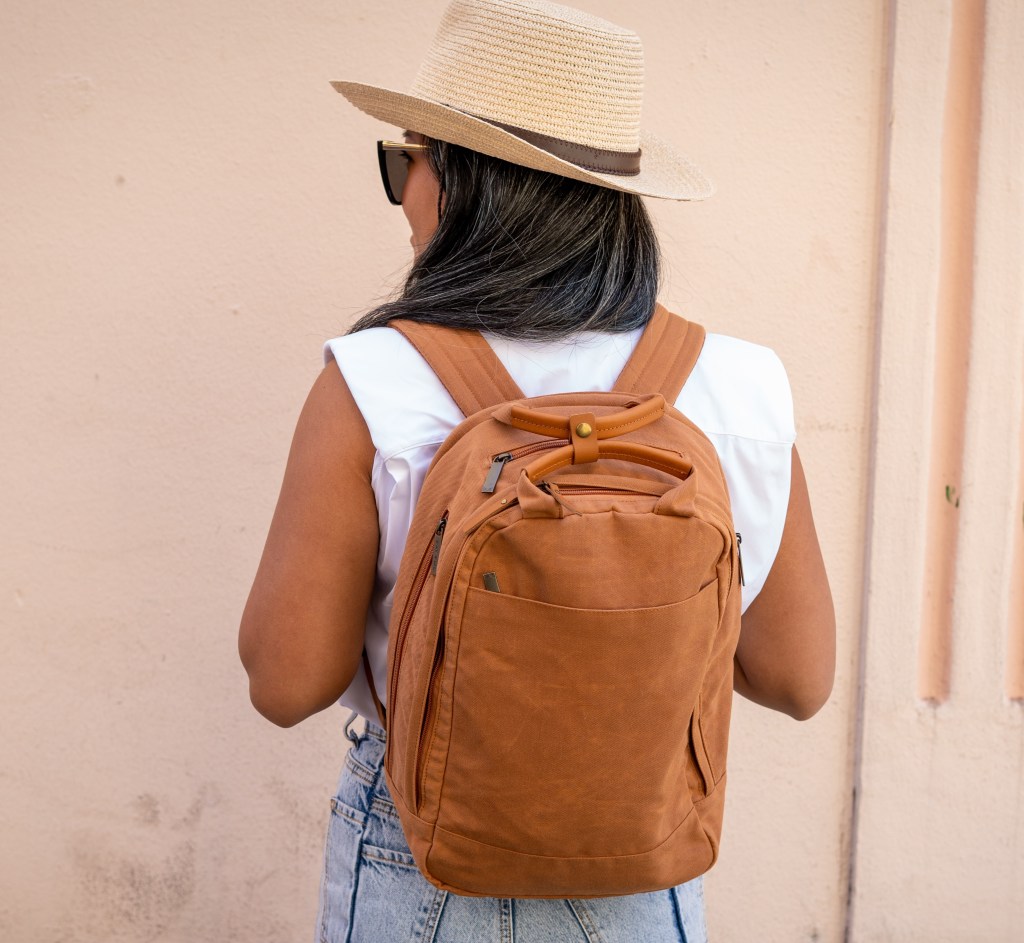
Luckily my purse is backpack-style so I didn’t need to carry it in my hands. And my office keys were on my ID badge, which hung around my neck.
On the way to the bus, I was preoccupied with things that I still needed to do and concerns about issues at home.
The bus arrived, I got on and put my belongings on the floor at my feet, burying myself in a game on my phone.
NOTHING seemed out of the ordinary, save for someone who sat down beside me and seemed to press against me a bit. But, hey, it’s the bus and there were a lot of people on so it isn’t a completely comfortable ride. That’s okay.
Besides, the guy moved to another seat as people got off on their stops.
By the time we got to my stop, I prepared to get off by collecting my items. And my heart missed a beat: my purse was not there.
I did a double-take. I looked all around my seat. Nope, no purse.
My head started to swim because it seemed obvious that someone had taken it. I rushed over to the driver and told him that I thought my purse had been stolen. He listen to my story, called the dispatch and marked the security video, explaining that I should fill out a police report and let them know the time and bus number…
My mind was a blur as I tried to remember everything that I had in my purse. (Photo by Nick Noel on Unsplash)
I dutifully wrote down his instructions but I was already thinking of the hours of work that getting my cards cancelled, obtaining a new drivers license, getting new car, apartment and mailbox keys, and everything else would require.
“And now THIS on top of everything else!” I thought to myself as I got off the bus and walked home, feeling dejected and spent.
Before calling the police department I decided to call my co-worker to check my office in case I’d somehow left my purse there.
But I knew that was hopeless. There is no way that I would have walked out of the office without putting on my backpack purse, no way that I would have not felt it on my back as I stood waiting for the bus and absolutely no way that I would not have noticed that it wasn’t there when I put all my belongings by my feet on the bus.
I was wrong.
My co-worker told me that it was on the floor under my desk.
Behold the power of mindlessness! I have no idea how I could have missed all those cues that alert me to presence or absence of my purse, especially when it’s the most important item that I carry. But I did.
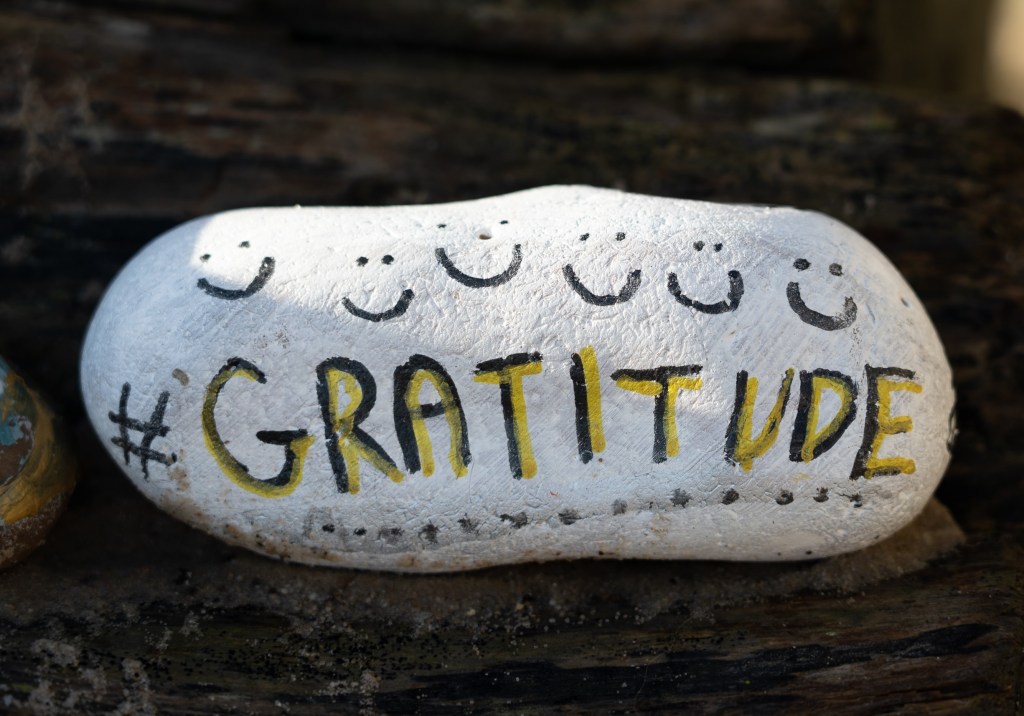
Gratitude hides out in the unlikeliest of places. (Photo by Nick Fewings on Unsplash)
However, that’s not the point of this post. The point of this post is, suddenly I did not need to call the police department, cancel my credit and debit cards, stand in line to get a new driver’s license, sit and recall everything that I had in my purse and wallet and anything else that I would have spent hours doing.
And I felt a tidal wave of gratitude wash over me, one that would have not experienced if I hadn’t spent the last 20 minutes convinced that someone had stolen one of my most important belongings.
That gratitude came out of nowhere. And it made me think.
If I could muster such a powerful feeling of thankfulness when I realized that something bad that I was sure happened actually hadn’t happened, maybe I could find a way to generate that same feeling without needing to experience the sense of doom beforehand?
In other words, I can be thankful for all the bad things that don’t happen even if there aren’t great things going on at the time.
So this Thanksgiving, my wish for you is to be able to experience sincere gratitude without having to lose your wallet and then find it.
Since we’re in the season of gratitude and mindfulness, it’s a great time to post about Dr. Jon Kabat-Zinn, Professor Emeritus of Medicine of the UMass Medical School. Among other things, he is the founder of the Mindfulness-Based Stress Reduction (MBSR) program, which I had the privilege of taking in early 2018.
For this week’s post, I’m including a short, 5-minute guided video meditation by Dr. Kabat-Zinn that was presented as part of his class on MasterClass.com (I was fortunate enough to take this class also). While the subscription to MasterClass is somewhat pricey, the meditation below is free.
The video requires little time investment and will pay back rewards in spades. I hope you enjoy!
This is a beautiful mindfulness meditation for right now.
There are a number of other meditations and talks by him available on YouTube. If you currently don’t have a mindfulness meditation practice, I encourage you to give yourself a gift by looking him up. His videos are the perfect place to start.
Apologies because this might sound like a rant but this topic has been on my mind a lot lately.
When you’re diagnosed with cancer, you learn about the many side effects of treatments.
You will be informed about the physical and even psychological effects that cancer patients deal with, but there are also considerable financial repercussions. Patients may struggle with hospital bills: some lose their insurance coverage, others might never have had any to begin with, those who have coverage may find that it’s insufficient. It’s not uncommon to hear how cancer has driven survivors and their families into bankruptcy.
On top of that, cancer can do a number on your career aspirations for years to come.
Money issues are one of the side effects of cancer that don’t get a lot of airtime…but really should. (Photo by Alexander Grey on Unsplash)
In case you think that it’s uncool to complain about one’s career in the face of having survived cancer, let me get this out of the way: being a cancer survivor is a privilege. I’ve written before about how acutely aware I am that I have lasted longer than many cancer patients.
But as the effectiveness of cancer treatments improves, the number of cancer survivors increases and long-term repercussions become a more and more serious consideration, particularly how they affect ongoing quality of life.
For people who are still working out their careers, cancer can derail progress because it plants a huge stop sign in their path.
Think of going into the chemo infusion room: the days leading up to it entail appointments, port placement, purchasing supplies (anti-emetics, anyone?) and in general prepping for being out of commission about a week.
It’s not the time to focus on stressful work deadlines (and most sincere condolences to any patient who has to do that!).
Ironically, as much as I feared infusions, they actually gave me an excuse to focus on myself instead of worrying about everyone else. I posted about that here somewhat sadly that chemo allowed me to rest without feeling guilty.
It was at that point that I’d realized I’d been pushing myself, always expecting more and not feeling like I was measuring up. Chemo gave me a break from that. Which was good…kind of…
But after chemo and radiation came endocrine therapy, so just as I was winding down from one set of side effects, up popped another.
And all those plans I’d had for myself were put off again and again. Career goals seemed more out of reach because my timeline had shifted.
Well, I’m not stupid, so I changed my career goals. Makes sense, right? Cancer provided a different perspective on things and motivated me in another direction.
But in the wake of cancer treatment, I feel like I’m walking in cement shoes…if it’s not one thing it’s another. I got off aromatase inhibitors (early) and then realized that I was having memory and focus issues. Whether Cancer Related Cognitive Impairment (CRCI) or menopause-driven brain fog, all of a sudden I’m dealing with something else.
It feels as though the train to prosperity has left the station and I was just a little too late to catch it.
Great.
Right now I’m looking at sky-rocketing costs-of-living in a part of the country that literally got expensive around me. Instead of moving up in the world, my family and I are desperately searching for less pricey housing which will put us in worse conditions and a longer commute to work.
And at age 57, when most of my friends are looking at enjoying retirement in the years to come, planning for what they’ll do in their golden years, I’m trying to reeducate myself, shifting into a career that doesn’t make much use of previous work experience.
And it feel exhausting. Sometimes I want to cry.
I want to believe this, I really do. But I don’t think that there’s a reward for surviving cancer beyond simply surviving cancer. (Photo by Nik on Unsplash)
Yes, I’m happy to be alive. But no, this was not the way I thought things would go. When initially I was told that I had a decent chance of surviving for five years, that was all I could think about. In fact, that was all that mattered.
I wasn’t thinking about the fact that if I managed to live through this, I’d still need to find a way to make a living. And the interruption that was cancer could do a number on that.
At this point, I need to stress that my intention is *not* to try to scare cancer patients into dreading survivorship. Goodness knows, there are enough things to navigate within the cancer experience as relate to the usual treatments that will take your energy and attention.
I wish nothing less for you than 100% remission and many years ahead to enjoy your “survivor” label.
At the same time, I encourage you to remain present and mindful of the fact that you might have to pivot if you’re not already well-established in your career. If things start to change in a direction that’s southward of what you expected, be patient and readjust your expectations. Nuture acceptance and keep an eye on how you can put yourself in a good position to meet the future. And be kind to yourself.