Mindfulness Apps I Love: “myNoise”

Note: Technically, this isn’t a “mindfulness app”, but it’s perfect for creating a peaceful atmosphere conducive to concentration, reflection and meditation.

These days I’m still working in my COVID-office–my bedroom–and trying to create as expansive a space as possible in a small room, and achieving this has involved modifying ambient noise.

There’s a generous selection of sounds from which you can chose. I’ve expanded my list by purchasing the entire collection.

I stumbled upon the myNoise app in an AppStore ad and found it to be perfect for this. Background noises/music have always been a favorite part of the meditation and breathing apps that I’ve used, but myNoise raises those sounds to a completely new level.

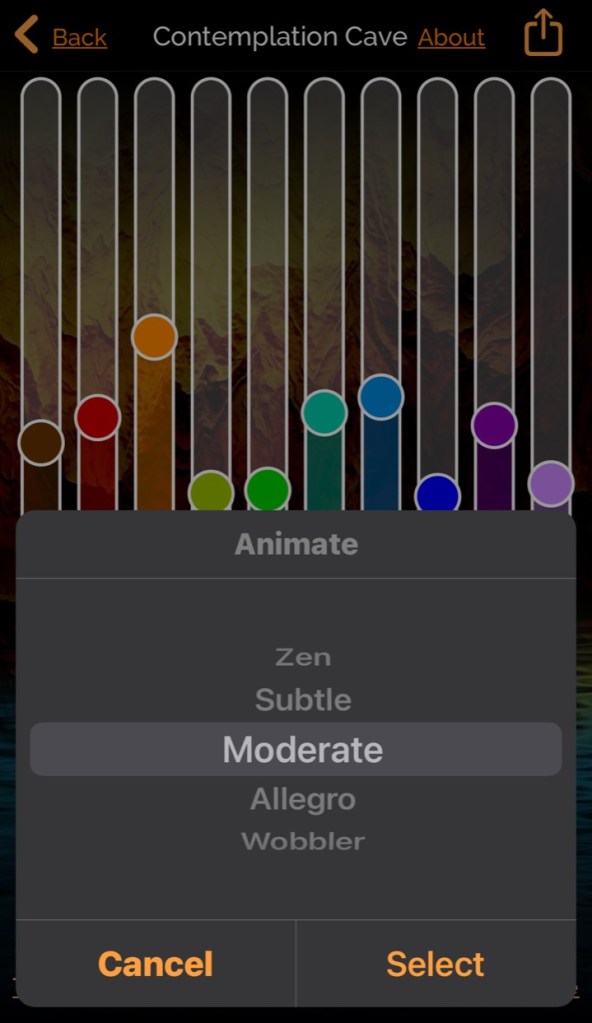
The app is well-designed and intuitive. Here’s what makes it really special: clicking on a soundscape brings you to its screen, which contains a 10-slider, equalizer-like panel. You can signficantly alter the sounds as you see fit by using the sliders. This is particularly useful when trying to mask noises (snoring, dog barking, tinnitus) by increasing the sliders that correspond to the pitch you’re masking–relatively easy to determine by experimenting with the sliders.

The equalizer-like sliders provide a lot of control over which tones are expressed and make it easy to modify them to your liking.

On top of that, there are presets that allow you to customize the slider settings according to various elements, such as Scene (aspects of the environment and how the sound emanates from it), Color (brown, pink, white, etc., as it relates to the quality of the sound) and Frequency (in Hz and kHz). In addition, you have the option of animating the sliders to create something truly unique and ever-changing, using a range of animation speeds (Zen, Subtle, Moderate, Allegro and Wobbler).

The presets allow for quick customization of the soundscape.

This means that you can create a completely new sound experience every time you use the app. Add to that, you can combine up to five of these soundscapes to play at the same time with the Super Generator, and the experience is really phenomenal. I was surprised at how beautifully the sounds melded together; I was expecting cacophany but instead I got depth and fullness.

The free version of myNoise has a generous repertoire of various soundscapes to choose from, but I jumped at the opportunity to significantly expand that list for $9.99. I appreciate flat-rate purchases where I’m not locked into monthly fees and this one has really paid off for me.

Animating the sliders means that no two listening sessions will ever be alike.

So all of this alone would make this my uber-favorite sound app, but as I was preparing info for this post, I happened to search online and I found myNoise.net. And then the clouds parted, the sun shone down and I heard choirs of angels sing out.

No seriously, this website is mind-blowingly fantastic. It is like the big brother of the app, but on steroids. The repertoire of sounds is beyond expansive–over 200 and growing!–organized in a way that makes it easy to navigate to whatever soundscape tickles your fancy. I spent several hours playing Cat Purr alone.

And most importantly, many items on the website are accessible for free, which is truly keeping in the spirit of mindfulness. The developer, a research engineer and sound designer, certainly accepts donations, so if you use myNoise.net, consider supporting him (note: donations open even more options, including the entire list of sounds). I have done so and felt that the money was well spent. But lack of funds won’t prevent you from enjoying much that he has to offer.

Since I mainly used (and loved!) the myNoise app and only recently discovered the myNoise.net website, I haven’t even begun to scratch the site’s surface, but if you enjoy ambient sounds and/or have noise in your environment that you need to mask, I encourage you to set aside some time to explore it. Given the range of incredible atmospheres available, you’ll be able to locate the perfect flavor for your taste.

Just Do It: Breast Cancer Survivors and Exercise

Following up on last week’s exercise post, I wanted to focus on two recent studies that really drive home the benefits of physical activity for breast cancer survivors. If you’re not exercising now, here’s why you should consider it.

In 2017, Hamer and Warner published a review in the Canadian Medical Association Journal (Open Access link here). They analyzed 67 existing studies in an effort to ascertain what lifestyle factors were most important in reducing the risk of breast cancer recurrence in survivors.

Whatever you can do right now is enough to start out with. Just keep moving!

The results were striking: of all the lifestyle variables that the researchers looked at, exercise came out on top. They found that engaging in moderate exercise resulted in a 40% decrease in cancer recurrence. This included easily-adoptable, low-cost programs such as brisk walking.

I want to stress: they weren’t talking about doing crazy-high amounts of exercise, but simply adhering to the current physical activity recommendations for US adults, which are as follows (summarized by the American Heart Association and taken from their website):

Sadly, only 13% of recent breast cancer survivors actually met those exercise guidelines, and that number dropped even more as time went on. Consider how that affects overall cancer rates, when we talk about our chances as survivors: if the vast majority of the population is not engaging in a beneficial habit, the reported recurrence rates will reflect that. However, if you do incorporate exercise into your life, one could argue that your chances of recurrence are significantly improved over the numbers usually cited.

In addition, an increase of at least 10% of body weight after breast cancer diagnosis, which unfortunately happens often, increased both risk of recurrence and mortality. Again, patients who exercised were able to avoid this weight gain, improving their chances for disease free survival.

Nonetheless, while it seemed relatively straightforward to achieve the percent reduction in recurrence, the researchers stressed two very important points: (1) this reduction came after finishing treatments, not in lieu of them, so one should not assume that exercise would necessarily take the place of conventional cancer treatments, and (2) sadly, some cancers will recur even if the survivor is doing everything “right” and so if there is a recurrence, it should not be taken as the individual not doing enough. That’s the cruel unfairness of cancer.

It’s never too late to start, but it’s never too early either! Pick a sport and make it yours!

The second study was original research with high-risk breast cancer patients by Cannioto et al. (2020), published in the Journal of the National Cancer Institute (Open Access link here). The study participants filled out a questionnaire about their exercise habits at four time points: (1) when they enrolled in the study after diagnosis (this question asked about pre-diagnosis exercise habits), (2) during chemotherapy, (3) one year after finishing treatment, and (4) two years after finishing treatment.

Once again, exercise was shown as having a significant impact: women who met the guidelines for physical activity (150 minutes/week of moderate exercise) before, during and after treatment had a 55% lower risk of recurrence and 68% lower risk of dying than those who didn’t meet the guidelines.

Even those who only started exercising after finishing treatment still had a significantly reduced risk of both recurrence and death compared to those who didn’t exercise at all. Additionally, benefits were also seen for those who consistently exercised, even if they didn’t fully meet the guidelines. So it seems that any exercise that these high-risk cancer survivors did was still better than not doing anything at all.

The same holds for you!

Both of these studies convey the importance of engaging in physical activity. Exercise is critical for the well-being of all humans, but even more so for breast cancer survivors. Think: when we receive a cancer diagnosis, we are ready to undergo potentially dangerous treatments, risking debilitating side effects that leave us bald, exhausted and wretched.

So why not engage in something as beneficial for body and spirit as moderate physical activity to help prevent the possibility of having to repeat the cancer treatment again?

~~~~~~~~~~~~~~~~~~~~~~~~~~~~~~

A few more bits of information:

The easy-to-read executive summary of the US Physical Activity Guidelines for Americans can be found here.

For a plain-language synopsis of the Hamer and Warner (2017) review, see this Healio interview with co-author Dr. Ellen Warner.

For a plain-language synopsis of the Cannioto et al. (2020) paper, see this article in breastcancer.org.

Tailor your exercise to your abilities…and then keep going!

Keep in mind that terms such as “moderate” and “intense” are relative to YOU. someone just starting out is not going to be able to handle the same level of intensity as a highly-trained individual, and there’s nothing wrong with that. Start where you are–it’s okay.

Finally, Dr. Robert Sallis, chairman of the American College of Sports Medicine’s Exercise Is Medicine inititative, has said, “If we had a pill that conferred the proven health benefits of exercise, physicians would prescribe it to every patient and healthcare systems would find a way to make sure every patient had access to this wonder drug.”

The two studies here show exactly why!

Three Pillars of Fitness: Consistency, Progression and Balance

Although this is a blog about cancer and mindfulness, I hardly think there is any lifestyle habit as effective as exercise at helping survive cancer. And what better time to discuss this than the start of a hopeful new year?

I’ve been certified as a personal trainer by the American College of Sports Medicine (ACSM) for well over a decade, and although I haven’t actively taken on clients, I’ve had enough time to develop my own fitness philosophy. I must stress, this is a conceptual post and not designed to guide you to specific exercises (although I mention some modalities as examples). However, if you’ve had trouble getting your head around how to maintain an active lifestyle, these ideas may help.

In my experience, there are three critical aspects to a successful exercise program: (1) consistency, (2) progression and (3) balance.

CONSISTENCY

This is the most important concept of my three and worth spending the most time on.

Consistency is the concept that seems to be most difficult for people, and it’s usually the “make-or-break” aspect of fitness. It’s quite simple to get motivated to start a new program, whether it be signing up for classes, planning out home workouts or simply deciding to go for a brisk walk every day.

The hard part is sticking with it. But I can promise you, that’s where the magic is. Be realistic about how much time you have to devote on a daily basis and what your exercise will consist of. This should not be something far out of your realm of experience or else it will be too difficult to maintain. Make it familiar.

When starting out, pick something you enjoy doing and it’ll be easier to keep doing it!

For example, if you do not already have a consistent history with a piece of exercise equipment (say, treadmill), do not purchase one under the assumption that the high price tag will surely motivate you to use it. It will not. The greatest workout you’ll get with it is carrying it to the basement or attic after you can no longer stand the guilt of watching it gather dust.

If you can’t maintain your workouts, you will have to go through the “beginner” phase every time you summon the wherewithal to restart again.

That also means going through “beginner soreness”. Honestly, there’s little pleasure in a Groundhog Day-like experience of not being able to get past the little aches and pains you might feel after getting your body into motion again. Don’t do this to yourself.

How to avoid it? Look at exercise as a lifelong habit, not something you do just to “get in shape” for a specific event like a wedding or reunion. Take smaller bites of exercise, something very doable that you won’t dread, especially if you have negative associations with workouts. Set goals like “train 5 days a week” and plan them out, not “lose 15 pounds” or even worse “look better” (what’s that?). It’s more motivating being able to tick off a specific, finite goal than never reaching one that’s vague, arbitrary and even judgemental.

And DO consider it “training”. You are training for living the rest of your life with more ease, maintaining your flexibility, balance, strength and endurance just that much longer. As in the tale of the tortoise and the hare, starting something that seems “not vigorous enough” but that you can see yourself doing, say, every day, in a year will put you miles ahead of someone who started an ambitious and complicated exercise program and burned out in a matter of weeks.

The fitness industry is banking on the fact that people will start exercising and then give up, only to start again later. And eventually give up again.

Look at it this way: the trillion-dollar exercise industry is betting on you giving up, and so it always comes up with a new shiny object to tempt you with. Often the program is unsustainable and the promised results are unrealistic. You don’t need that. You need consistency.

Again, decide what you can do and do it regularly. Realize there will be days when it won’t be possible to get it done. That’s okay – no guilt, no shame. But then get right back to it as soon as you can. Think of every workout as something positive and precious that provides you with health benefits that no one else will be able to take away. Each day you exercise is one more step towards establishing a habit that will lead to a lifetime of fitness.

Got your exercise in? MARK IT OFF!

IMPORTANT: Put up a high-visibility calendar where you can mark off your workouts and easily see how consistent you are.

But what if it gets TOO easy? That’s when the next pillar comes in…

PROGRESSION

Once you’ve established an exercise habit, your body will eventually adapt to what you’re doing. This is a very good thing. It also means that it’s time to change things up a bit, always giving yourself permission to dial back down to what you’d been doing previously if you have a harder time getting going on any given day.

Is your walking route getting too easy? Make a detour to a set of stairs and get your heart rate up!

The trick is to maintain consistency while also challenging yourself. For example, if you were doing a walking program, incorporate bodyweight exercises (squats, modified push-ups) that you can do along the way. Climb more hills. Pick up the pace.

If you want to get a PhD, you don’t keep taking freshman-level classes. Challenge is where growth happens. We get an unmistakable sense of satisfaction putting in the work and seeing results.

This is also where your self-confidence blossoms. And that’s exactly the bouyed spirit that keeps you going.

Don’t ramp everything up at once. Add a little at a time, but definitely make it count. Be realistic about whether or not you’re challenging yourself: if you need to push it even more and can do so safely, go for it. If you honestly try but can’t do as much as you expected, halve the amount and try again. Don’t beat yourself up. You will get there. But don’t short-change yourself either.

Keep writing it down! When you’re ramping up your fitness program it’s important to keep track of your progress.

Most importantly, unlike high school PhysEd class, you’re in charge. That also means you’re responsible for your own progress. Some workouts will be better than others, but always remember, doing anything is STILL better than binge-watching Netflix with a bowl of chips on your lap. Congratulate yourself for making the decision to exercise!

Hey, why not watch Netflix while marching in place? It still counts so write it down!

So let’s assume that you’re being consistent and gradually increasing the duration/intensity of your workout. That’s perfect, but there’s one more pillar to consider…

BALANCE

In this case, I don’t mean balance as in being able to hold tree pose throughout your entire lunchbreak. I mean are your workouts well-rounded? I’ve seen runners do little else but run. If this is you, incorporate some variety into your life. Your running will improve if you are also training for strength and flexibility.

Hey, your other shoulder needs massaging too!

Here’s a simple analogy for balancing out your workouts: imagine getting a massage regularly, but on only the left side of your body. That side will feel great, but you’re missing something. Your right side needs some love too. Eventually that imbalance will affect you negatively.

Exercise programs are best when they are a melange of endurance, conditioning, strength work and staying limber. It is extremely tempting, once you become adept at an exercise modality, to keep at it at the exclusion of everything else. After all, you’re an expert in it. But you’re also opening yourself up to injury and that’s something no one needs.

Treat your body to something new just to keep things interesting.

Take the time to explore different modalities. Often a type of exercise (say, yoga) can cover a number of bases, but you will still need to supplement with other exercises to stay truly well-rounded. Even strength training (which I consider critically important, btw) can have a cardio effect, but much will depend on how your workout is structured.

Do some research but don’t over think this. Just make sure that you are supporting all your body’s needs. Taking the runner’s example again, strength training will help you maintain muscle mass that you might lose from too much running, and it, along with flexibility and mobility work, will help prevent overuse injuries.

This doesn’t mean that you have to significantly increase the number of workouts you do, just that you have to be creative in what you add to your exercise session. The idea is to incorporate what else your body needs to keep it humming optimally. And then, write it down.

BOTTOM LINE

Bottom line when you’re just starting out? Move. Even if you don’t really know what exercise you “should” do, just find a way to move. Dance. Wave your arms over your head. Break up sedentary times as much as possible. If you sit for an hour, stand up and walk in place for three minutes, swinging your arms. Don’t be afraid to work up a sweat.

Then keep doing it.

When you establsh one healthy habit, it’s easier to incorporate others to support it.

Above all, make it pleasant, so that you look forward to exercise as a break from those things in our environment that keep us sedentary. The human body was meant to move. That is its natural state. Give it the opportunity to do what it’s supposed to do, then let it recouperate and nourish it with healthy food. The idea is to start now and keep going for the rest of your life.

~~~~~~~~~~~~~~~~~~~~~~~~~~~

Being an avid exerciser enable me to recover from cancer treatment much more quickly. Up until my last couple of infusions, I was rowing and lifting weights within a week after each chemo (mine were spaced three weeks apart). In an out-of-control situation like cancer, exercise was one constant that made me feel like I still had a grip something, and that made the whole experience better.

When I Think I Don’t Have Time To Meditate

This being the last week of 2020, it’s a good time to write about establishing new positive behaviors. I myself am working on biofeedback practices to increase my heart rate variability, commonly referred to as HRV, and balance my autonomic nervous system (ANS) since I have a history of being very “sympathetic”-heavy (that is, “fight-or-flight”).

This is particularly critical for me as a cancer survivor since stress is closely associated with inflammation which is linked to cancer. So bottom line, I consider getting good at calming myself a matter of life or death. Most of my life has been a runaway train as far as stress is concerned.

To achieve this, I’m using a smartphone app called Elite HRV (but I’m sure there are others). In the biofeedback section, the app recommends two daily breathwork sessions of at least 20 minutes each. Now, that got me thinking about whether I had that kind of time available. As it is, come hell or high water, I meditate at least 30 minutes a day, often using a variety of apps and a mixture of guided meditation and breathing practices, in addition to informal meditation sessions.

“I just spend three hours doing WHAT???” Sometimes, when we’re busiest, we’re also most vulnerable to completely zoning out.

But adding another 40 minutes? Seems unlikely, since I’m often going from morning to night without much of a break, especially because my bedroom is also my COVID-office.

Still, is it really unlikely? Yes, it’s true that I’m working longer hours, but I’m still making room for non-work things that are critically important to me, like exercise. So I find time for what matters.

And if I review my workday, I know I experience periods of “zoning out”, often when something on my computer or phone catches my attention. These breaks aren’t long, but it’s not uncommon for me to get caught up in focusing on something else along the way…before you know it, that can be 10 or even 20 minutes.

And sometimes it’s really long. Case in point: over the weekend, my daughter and I ended up (and I seriously don’t know how we started on this, but…) watching several hours’ worth of YouTubers streaming video games. I don’t even play a lot of video games, but I was tired and became transfixed. And we did do this for several HOURS because one YouTube video often leads to another. That’s a chunk of my life that I will never get back, and in retrospect, that time could have been spent more wisely.

Now I realize that it would have been so simple to retreat to my bedroom for less than the length of one of those videos and eke out some quiet time to turn inward. I could have returned to the videos afterwards without feeling like I’d missed anything.

Leave yourself a reminder to pause activity and simply BE.

All I need is that little reminder, the mindful awareness that meditation and breathwork are available to me at literally any time. Even if it’s not a full 20 minutes. Five or ten minutes interspersed throughout the day will still offer benefits, so they’re still worth doing–and I’m talking about in addition to my regularly scheduled sessions. And who knows? Once I begin, I may find it possible to stretch those few minutes into a few more minutes. And a few more.

This is particularly important because as lovely as it is to have a longer calming meditation, the ultimate goal for me is to seamlessly incorporate mindfulness into my everyday activities, so that I am always able to take a deep breath and pause before my ANS gets triggered into “fight or flight”. It is especially those little blips of meditative time–a minute or two here or there–that help reset my nervous system.

Taking a mini-break for mindfulness may seem so simplistically obvious but I’m willing to bet that many of us don’t even entertain that possibility. We’re convinced we can’t shoehorn another thing into our busy days. If a sticky note by our computer reminds us to take five deep breaths, for example, and we begin incorporating that into our day, we see that there is more room for pausing than we imagined. Just opening up that breathing space can not only invite more consistent practice, but also slow the hectic pace of our lives.

We could all use that.

Understanding Clinical Research

If you’ve had cancer, you know that the information presented to you following your diagnosis is like a crash course in medicine.

All of a sudden you’re hit with explanations of complex bodily processes, unpronounceable medicine names, and a deluge of statistics. You need to digest all of that and agree to a specific treatment plan, of which there may be several for your type of cancer. It can be overwhelming. But then again, what about cancer isn’t?

Okay, but what does it all mean?

Making the “right” decision for you can be difficult. Many of us gravitate to the Internet for information, but that can be a minefield of questionable value. With some luck, we eventually get to PubMed, which is Ground Zero for medical information. PubMed is the National Institutes of Health’s (NIH) database of published research on a variety of topics. These articles focus on biomedical fields, but the range is quite broad.

There, you can find the background information for the treatment decisions that your oncologist has made about your specific situation.

I would venture that bringing a relevant scientific article to your oncological appointment beats mentioning an ad for a new medicine where the announcer says, “ask your doctor if [insert med name here] is right for you”. But of course the commercial is easier to understand, while the research article is written in “science-ese”.

So, if there’s something that can serve as a true ally as you navigate through your cancer experience, it’s being science-literate. That doesn’t mean you need a PhD in some medical research field. But it does mean understanding how researchers set up experiments, what they’re actually studying, and whether those results are valid for your situation. And then being able to search through clinical studies and see whether they can inform your decisions on cancer treatments.

For digging deeper into the specifics surrounding clinical research, I highly recommend Coursera’s free class, “Understanding Medical Research: Your Facebook Friend Is Wrong.” I use PubMed at work and have studied research design in Psychology, but I realized that I needed a crash course in evaluating clinical studies if I wanted to use scientific literature to make informed decisions about my health. “Understanding Medical Research” is an excellent survey of the types of studies out there, basic research design, terminology, relevant statistics and how to judge whether the study is useful for your personal situation, not to mention warning flags to watch out for.

Dr. F. Perry Wilson teaches the Coursera class, “Understanding Medical Research: Your Facebook Friend Is Wrong.”

The course is free if you don’t need the Coursera certificate. And the instructor, nephrologist F. Perry Wilson, MD from the Yale School of Medicine, is entertaining and occasionally silly, making what could be a dry subject much more palatable.

This might not be the first online class that you’ll want to tackle right after your cancer diagnosis. For that, I would highly recommend seeking out a mindfulness meditation class. But after you’ve gotten relaxation skills under your belt, learning about how to access medical literature and decipher the results may be one of the most important things you can do for yourself.

~~~~~~~~~~~~~

If you’re not ready to commit to a course on understanding medical research, below are two informational links that can still get you on your way to figuring out what all the research means:

The National Cancer Institute (NCI) has a blog that explains findings from the latest cancer studies in lay terms, called “Cancer Currents”. The sidebar on the right allows you to zero in on more specific topics. This is the most science-based information that you can get on cancer, keeping in mind that studies can only speak to what they have specifically been designed to research.

For some general information on clinical studies, NIH’s webpage on “Understanding Clinical Studies” is a good place to start. This is a one-page easy read with a infographic that explains basic facts about clinical studies.

Yoga Is For Every Body

As my interest in and personal practice of yoga has increased, I’ve noticed something peculiar about images of yoga. They send a message that you have to be young, slender and unnaturally flexible to be a “real” yoga practitioner. That seems daunting to anyone who doesn’t fit that mold.

I noticed something similar after I became certified as a personal trainer. I myself loved the feeling of strength and freedom I got from exercise; however, many people I spoke with were reluctant to go to a gym because they felt they needed to be in a certain physical condition before they even started. At the same time, they were daunted by the idea of striking out on their own. Even worse, in personal conversations with experienced exercisers and even other trainers, I found many would poke fun at those who were just starting out.

Come on, everyone has to start somewhere. An expert is just a beginner who stuck with it.

This is unavailable to me.

I thought yoga would be different, given the emphasis on one’s inner state. But I had to get over my apprehension about trying to fit an older creaky body into the unbelievable positions modeled by the yoga teachers I saw online. It was daunting. While I still felt strong, I seemed to lack that which yoga demanded. There were many poses that my old injuries and life-long inattention to flexibility would prevent me from doing.

I mean, google Flying Dragon pose and you’ll see why. Heck, it doesn’t even have to be as exotic as that. Go to Pinterest and search for yoga images – the results seem almost outrageous, with every yogini outdoing the one before them. Is that what we’re supposed to aspire to? I don’t see anyone even close to my age. Are they all in physical therapy? Or traction?

My spine doesn’t bend like that.

This is more my level: still challenging, but quite doable.

But this is yoga, right? There are quite enough poses that most everyone can learn and use to build a regular yoga practice, no matter what the images on the Internet suggest. More importantly, there are modifications for whatever your own body will allow. Can’t put your forehead on your knees in forward-fold? Then how about a ragdoll variation. Guess what, it’s still yoga.

That doesn’t mean that what those super-bendy instructors are doing isn’t impressive. But I view them much as I view someone free-climbing Yosemite’s El Capitan. With awe and admiration for their abilities. And then I delight myself by finally being able to touch my toes again, thanks to my yoga practice.

How Mindfulness Helped Me Enjoy Cleaning

Full confession here: For years (ahem, decades), I disliked cleaning. I understood the importance of keeping things clean and tidy. But I never connected a positive feeling with it. Even as an adult, I would put it off. And off. And then someone would want to stop by and I’d be filled with dread. Never was the disheveled state of my home as apparent to me as when an outsider walked though the front door. Suddenly, I saw everything with fresh eyes, and it didn’t look great.

My approach to cleaning changed when I did one small thing: I noticed that my life was not one big overwhelming mess. It was a series of little challenges. So, too, my home. I stopped looking at everything as a whole. The whole was overwhelming. The whole meant a day spent cleaning and organizing. It didn’t have to be like that.

Just as life is in flux, so is the order in your home. Think of is as a wave, never, standing still. Things fall out of order and then are put back in order. Consistency in effort is what gives music to the dance. So you never have to “miss it”.

When I started looking at the work as distinct items, it was so much easier to take care of things. A small pile of papers. Scrubbing out the kitchen sink. Cleaning three windows.

It was that simple. I stopped thinking about “all the stuff I need to do”. Instead, I thought, “Oh, look! This is done already.” The boost of positivity that I got from taking care of the finite tasks was infinitely rewarding.

Most importantly, I made this a working meditation. My focus was on “now”. Scrubbing this spot of the bathtub. When it was done, I went to another spot. And that way traveled around the bathroom and out to other rooms until I was done for the time being. The rhythm made the day bright.

My personal strategy for cleaning mindfully:

  1. Set a timer for a reasonable amount of time, say, 10-15 minutes — you will quickly find a time that’s right for you based on how much you bristle when it’s time to start. Pick out a manageable “project” (or perhaps several) that you can get done during that time. Start when the timer starts. When the alarm rings, you’re done.
  2. Whatever you are doing, do it with a focus on the present moment. Give your full attention to what you’re working on. This is not the time to worry about what else needs to be done — stay with what you’re doing now, just as you would stay with your breath during meditation.
  3. Decide to do it again tomorrow. That stuff you did today? It’s done and no one can take that away from you, so whatever you do tomorrow only adds to the satisfaction of moving forward. Consistency is what makes this strategy work.
  4. Bring lightness and joy to the task. Play music, run an essential oil diffuser. Mark your success with staying on task by bringing in fresh flowers, even just foliage clippings in a colorful vase. Help yourself feel positive through the process. THIS IS NOT A PUNISHMENT.
  5. Pick up after yourself throughout the day. There is great power in putting things away right after you’re done with them. It feels so silly to even have to write that, but trust me, it’s a useful reminder, and one that I needed until it became a habit. (Who am I kidding? I STILL need the reminder.)
  6. The corollary to #5 is not to procrastinate on starting. If you start now and recycle five papers that you don’t need, there will be five fewer papers cluttering your desk. If you do that again tomorrow, that will be ten. Do it now. I have missed out on so many wonderful opportunities in my life because I put things off, a clean home being the least of them.
  7. Notice how good it makes you feel to invite order into your life.
I feel unsettled simply looking at this image. The disarray elicits anxiety, like I’ve lost something important, with little hope of easily getting it back.

I’ve found that the state of my surroundings is representative of my emotional state. And my emotional state likewise responds to the environment around me. When I was diagnosed with breast cancer, my world crumbled around me, physically and emotionally. Everything felt out of control and my surroundings reinforced that sense of despair. It took months for me to finally get a grip and move past the overwhelm.

Bringing order into my life was like an anchor that helped me recover, in many senses of the word. When I focused on what was good in my world, I spent less time worrying about what was wrong.

I’m betting you have 10 minutes in your day…

Mindfulness Apps I Love: “Unwind”

Disclosure: I was approached by Unwind‘s developer to review their breathing app and offered a free upgrade. I appreciated the suggestion to try Unwind because these days I’m all about breathwork. In addition, upon reading about the app in the iPhone App Store, I was impressed with both the concept and the developer’s sincere responsiveness to user comments. You can find it in there App Store here.

I’ve been using the Unwind app for a number of weeks now. It is a lovely breath-focused app with a number of unique features that I love, customizable and easy to use.

Unwind offers three breath exercises, all of which I which I recognized as science-backed for specific purposes: (1) the “Start fresh” pattern (6 counts in, 3 counts out) which brings oxygen into the body and energizes you; (2) the “Relax & unwind” pattern, great for a relaxation break during the day (4 counts in, hold for 4 counts, 4 counts out, hold for 4 counts); (3) the “Sleep better” pattern, perfect for deep relaxation before bed (4 counts in, for 7 counts, 8 counts out).

The user can pair these patterns with a specific ambiance. An ambiance is a themed background soundscape, and Unwind offers a broad range with options such as Rainforest, Rain on Umbrella, Village Backyard, Open Air Cafe, Japanese Pagoda…including unique ones that I haven’t found in similar apps such as Deep Space, Swimming with Whales, Castle and City Skyline with Ocean. At last count, there were 33, so there’s a flavor for every mood.

Breathing in, the landscape moves up.
Breathing out, the landscape moves down.

Each ambiance has a visual associated with it, and I really like the way the breath is represented in Unwind. In other apps, the breath is often shown as a ball, but in Unwind, it’s the selected ambiance’s landscape, with a foreground and background layer rising and lowering with the inhalation and exhalation. The images are uncomplicated and not distracting, but easily recognizable. There are also additional visual cues: a circle that represents time elapsed in a session and a line that represents breath “hold” time.

Sometimes I play an ambiance by itself, allowing my imagination to create my own imagery, or simply to use it as background sounds while I’m working or drifting off to sleep.

The settings give you a variety of options for customization.

You can chose between a male and female voice for inhalation/exhalation guidance: “Seth” or “Emma”. I’ve tried both and found that I’m more drawn to Emma’s voice, but I appreciate the ability to switch between the two. Also, it seems like there’s a slight change in voice inflection between some of the guidance cues, so even though the spoken words are the same, it doesn’t feel like you’re listening to a robot. That’s nice attention to detail!

This is the ultimate in making the app your own: you can stick with the pre-set breath exercises, or modify them to your liking.

Another lovely customization is the ability to adjust the breath lengths for each of the breathing exercises. While the established counts are research-supported, if, for example, the 7-count hold happens to be too long for you, you can adjust it. This means that you have the ability to completely personalize your breathing patterns, a valuable feature that I don’t usually find in apps like this. Of course, you can also choose the total length of each breathing session.

Finally, after each session, you have the opportunity to select a little emoticon that represents your mood, and there’s space to write your thoughts, should you want to jot down a few notes.

Because I feel that mindfulness, relaxation and breathwork should be accessible to all and not limited to those who are able to pay, I held off on the upgrade that I was given to me so that I could try out the free version first. My experience was not diminished at all, and that was really important to me.

Eventually, I did upgrade, which gave me access to the entire list of ambiances, which otherwise are locked. However, even in the free version, you can access some (or all — sorry, I upgraded before I found out!) additional ambiances by maintaining your practice streak, which is a lovely perk. Upgrading also enables you see all your past sessions and notes. But there is no subscription, which sets Unwind apart from other apps of its kind. There’s only a flat, one-time fee (at this writing, $5.99). I really appreciate that and would have happily paid it myself!

The bottom line is that I love this breathing app! Its obvious that the developer put a lot of thought into it, with a definite focus on the needs of the user. Unwind is the ideal complement to the other meditation apps that I use, and perfect for whatever breathwork I want to do. Because most of the features are accessible without the upgrade, I recommend trying this out to see if it works for you. If you do decide to upgrade, it’s a small investment for immediate access to all the ambiances and logged notes, and in my mind, well worth it.

Mindfulness Apps I Love: “Zen Koi 2”

Note: I do not receive compensation for writing about apps. I highlight these products because I personally use them and have found them to be helpful. Hope you do too!

Zen Koi 2 works for me like a mindfulness/meditation app.

I admit that I would have never though of calling a smartphone game a “mindfulness app”, but as far as I’m concerned, Zen Koi 2 qualifies.

The concept is simple: lead your koi through a pond as it catches prey that it uses to magically craft into gems, which in turn are used to expand the size of the pond. The koi increases in abilities (speed, agility and rarity) and has the opportunity to mate with other koi (in a stylized, family-friendly kind of way).

The egg that’s produced has the possibility of hatching into one of several different koi, which you can gather into collections. The pond increases eight times, each one marked by a certain sigil (symbol), and at the last one, your koi ascends to a beautiful dragon by jumping over the dragon gate and establishing its place in the heavens, harkening back to the Chinese legend of the hero Dayu.

The koi is supercute, swimming around the pond and gulping the prey you select for it.

That’s the gist of the game. But what makes it a mindfulness app? The way it allows you to stay in the moment. There is no competition, and while, if you prefer, you can focus on completing the collections of different koi “sub-species”, or collecting dragons, the game is not lessened if you chose not to do so.

Both koi and prey are colorful and pleasingly cute. The pond looks peaceful and inviting. Catching the prey is easy, even though they get more evasive as the pond expands. Select a prey item and the koi swims up to it and gulps it.

At the last expansion of the pond, the koi jumps over the dragon gate and transforms into a colorful dragon.

Once you hatch an egg into a koi, you can release the fish if you don’t want to keep it. The koi remains in your collection, able to be cloned and played with again, “paid for” with easily-obtainable pearls that appear in pond flowers, as rewards, or, if you prefer, by watching ads. There is no time limit and your koi is never in danger. You don’t suffer any penalties by taking it slow. This is all about living in the moment, playfully chasing the prey needed for that given sigil level and enjoying the surroundings.

You also get a personal pond outside of gameplay to showcase several koi and decorate with plants and rocks as you wish.

What was my most definitive test of whether this worked as a mindfulness app for me? I woke in the wee hours of the morning with too many worries on my mind. Usually I meditate when this happens and I can fall back asleep, but last night my thoughts raced too much to allow that sort of calm. I popped open this app and after about 15 minutes of helping my koi meander through the pond, I found distance from my worries and was able to sleep a few more hours.

Zen Koi 2 is worth looking into if you’re interested in soothing, mindful distraction.

Breast Changes, Revisted

One of the most popular posts on this site has been, “I Didn’t Expect THAT: Breast Changes“, so I thought it might be useful to revisit the subject now after a few years have passed since my initial lumpectomy for breast cancer.

Before my surgery, I had been frustrated by the lack of information about how much tissue would be removed along with my tumor. Or maybe I was just too afraid to search. In either case, I had prepared myself to lose a good chunk of my left breast. All the “after” photos of lumpectomies that I found on the internet were not pretty.

However, my tumor was only 1.6cm at its longest, and was on the outer upper quadrant of breast, and this turned out to offer me the best of all possibilities. There was amazingly little breast size lost. I was impressed. So was my surgeon.

So, fast forward to now, three and a half years down the road. The scars, one for the lumpectomy and the other for lymph node excision, remain very uninteresting in a good way. Only three sentinel lymph nodes were removed, and the scar for that sits up in my armpit. The lumpectomy scar is situated a bit further down and into the side of my breast. But it’s not obvious.

This is the original photo from my post on Nov 1, 2018, already over a year and a half since my surgery.
Three and a half years after surgery, today: the top scar is the lymph node excision, the bottom one is the lumpectomy.

The biggest issue I have had with the lumpectomy scar is that the scar tissue there feels like a biggish lump itself. Not frightening for me anymore, but when I went to a new gynecologist who, I suspect, forgot that I had had breast cancer (HOW? That’s the main thing I talked about!), she felt that area and said, “Oh, there’s something here” in that ‘I’m-going-to-say-something-scary-in-a-calm-voice’ kind of way.

Yes, it was just my scar tissue, but for a split-second I wanted to let myself freak out. Didn’t, but wanted to.

Sorry about the headlights…I just wanted to show how “normal” the shape of my breasts is. The weird thing is that it’s actually my left breast that is a bit BIGGER now. Who would have expected that? (NOTE: my left breast is also turned towards the camera slightly, accentuating its size.)

But the bottom line is, as time has gone by, the scars remain inconspicuous, and if not for the fact that my affected breast is actually a touch firmer and larger than the healthy one, something attributable to radiation treatment, there’s no obvious sign that I had breast cancer.

Not a bad deal considering what could have happened.