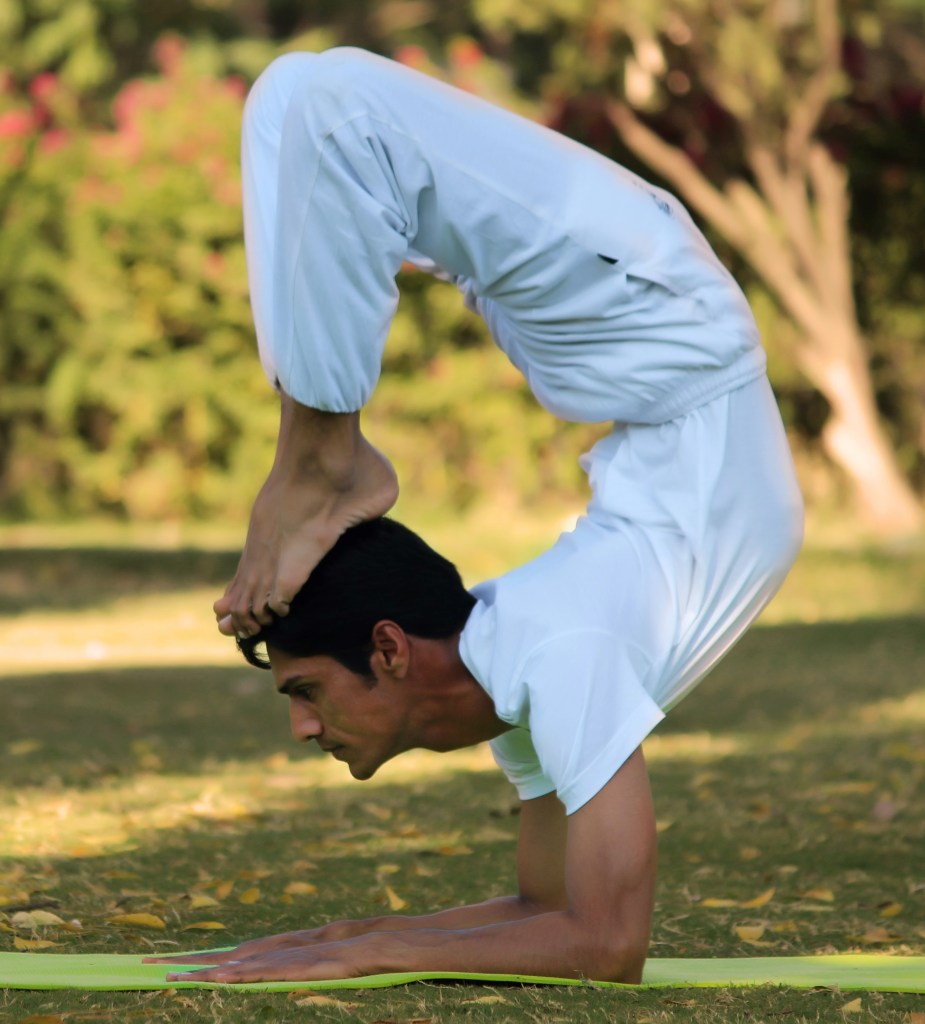
As my interest in and personal practice of yoga has increased, I’ve noticed something peculiar about images of yoga. They send a message that you have to be young, slender and unnaturally flexible to be a “real” yoga practitioner. That seems daunting to anyone who doesn’t fit that mold.
I noticed something similar after I became certified as a personal trainer. I myself loved the feeling of strength and freedom I got from exercise; however, many people I spoke with were reluctant to go to a gym because they felt they needed to be in a certain physical condition before they even started. At the same time, they were daunted by the idea of striking out on their own. Even worse, in personal conversations with experienced exercisers and even other trainers, I found many would poke fun at those who were just starting out.
Come on, everyone has to start somewhere. An expert is just a beginner who stuck with it.
This is unavailable to me.
I thought yoga would be different, given the emphasis on one’s inner state. But I had to get over my apprehension about trying to fit an older creaky body into the unbelievable positions modeled by the yoga teachers I saw online. It was daunting. While I still felt strong, I seemed to lack that which yoga demanded. There were many poses that my old injuries and life-long inattention to flexibility would prevent me from doing.
I mean, google Flying Dragon pose and you’ll see why. Heck, it doesn’t even have to be as exotic as that. Go to Pinterest and search for yoga images – the results seem almost outrageous, with every yogini outdoing the one before them. Is that what we’re supposed to aspire to? I don’t see anyone even close to my age. Are they all in physical therapy? Or traction?
My spine doesn’t bend like that.
This is more my level: still challenging, but quite doable.
But this is yoga, right? There are quite enough poses that most everyone can learn and use to build a regular yoga practice, no matter what the images on the Internet suggest. More importantly, there are modifications for whatever your own body will allow. Can’t put your forehead on your knees in forward-fold? Then how about a ragdoll variation. Guess what, it’s still yoga.
That doesn’t mean that what those super-bendy instructors are doing isn’t impressive. But I view them much as I view someone free-climbing Yosemite’s El Capitan. With awe and admiration for their abilities. And then I delight myself by finally being able to touch my toes again, thanks to my yoga practice.
Full confession here: For years (ahem, decades), I disliked cleaning. I understood the importance of keeping things clean and tidy. But I never connected a positive feeling with it. Even as an adult, I would put it off. And off. And then someone would want to stop by and I’d be filled with dread. Never was the disheveled state of my home as apparent to me as when an outsider walked though the front door. Suddenly, I saw everything with fresh eyes, and it didn’t look great.
My approach to cleaning changed when I did one small thing: I noticed that my life was not one big overwhelming mess. It was a series of little challenges. So, too, my home. I stopped looking at everything as a whole. The whole was overwhelming. The whole meant a day spent cleaning and organizing. It didn’t have to be like that.
Just as life is in flux, so is the order in your home. Think of is as a wave, never, standing still. Things fall out of order and then are put back in order. Consistency in effort is what gives music to the dance. So you never have to “miss it”.
When I started looking at the work as distinct items, it was so much easier to take care of things. A small pile of papers. Scrubbing out the kitchen sink. Cleaning three windows.
It was that simple. I stopped thinking about “all the stuff I need to do”. Instead, I thought, “Oh, look! This is done already.” The boost of positivity that I got from taking care of the finite tasks was infinitely rewarding.
Most importantly, I made this a working meditation. My focus was on “now”. Scrubbing this spot of the bathtub. When it was done, I went to another spot. And that way traveled around the bathroom and out to other rooms until I was done for the time being. The rhythm made the day bright.
My personal strategy for cleaning mindfully:
Set a timer for a reasonable amount of time, say, 10-15 minutes — you will quickly find a time that’s right for you based on how much you bristle when it’s time to start. Pick out a manageable “project” (or perhaps several) that you can get done during that time. Start when the timer starts. When the alarm rings, you’re done.
Whatever you are doing, do it with a focus on the present moment. Give your full attention to what you’re working on. This is not the time to worry about what else needs to be done — stay with what you’re doing now, just as you would stay with your breath during meditation.
Decide to do it again tomorrow. That stuff you did today? It’s done and no one can take that away from you, so whatever you do tomorrow only adds to the satisfaction of moving forward. Consistency is what makes this strategy work.
Bring lightness and joy to the task. Play music, run an essential oil diffuser. Mark your success with staying on task by bringing in fresh flowers, even just foliage clippings in a colorful vase. Help yourself feel positive through the process. THIS IS NOT A PUNISHMENT.
Pick up after yourself throughout the day. There is great power in putting things away right after you’re done with them. It feels so silly to even have to write that, but trust me, it’s a useful reminder, and one that I needed until it became a habit. (Who am I kidding? I STILL need the reminder.)
The corollary to #5 is not to procrastinate on starting. If you start now and recycle five papers that you don’t need, there will be five fewer papers cluttering your desk. If you do that again tomorrow, that will be ten. Do it now. I have missed out on so many wonderful opportunities in my life because I put things off, a clean home being the least of them.
Notice how good it makes you feel to invite order into your life.
I feel unsettled simply looking at this image. The disarray elicits anxiety, like I’ve lost something important, with little hope of easily getting it back.
I’ve found that the state of my surroundings is representative of my emotional state. And my emotional state likewise responds to the environment around me. When I was diagnosed with breast cancer, my world crumbled around me, physically and emotionally. Everything felt out of control and my surroundings reinforced that sense of despair. It took months for me to finally get a grip and move past the overwhelm.
Bringing order into my life was like an anchor that helped me recover, in many senses of the word. When I focused on what was good in my world, I spent less time worrying about what was wrong.
Disclosure: I was approached by Unwind‘s developer to review their breathing app and offered a free upgrade. I appreciated the suggestion to try Unwind because these days I’m all about breathwork. In addition, upon reading about the app in the iPhone App Store, I was impressed with both the concept and the developer’s sincere responsiveness to user comments. You can find it in there App Store here.
I’ve been using the Unwind app for a number of weeks now. It is a lovely breath-focused app with a number of unique features that I love, customizable and easy to use.
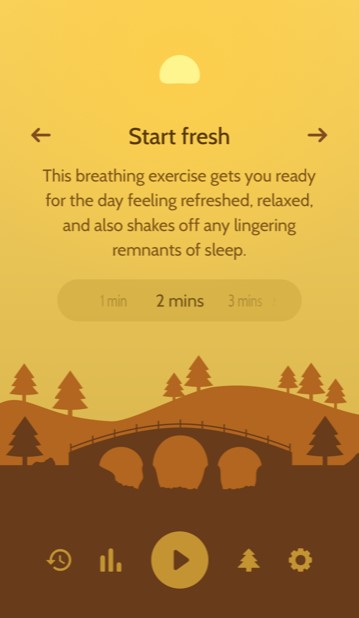
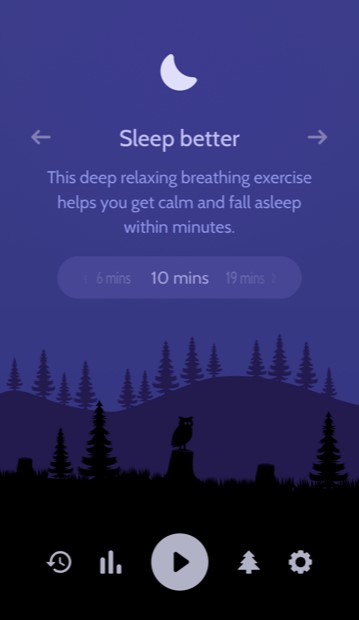
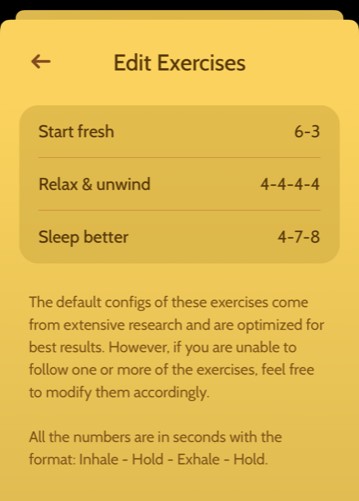
Unwind offers three breath exercises, all of which I which I recognized as science-backed for specific purposes: (1) the “Start fresh” pattern (6 counts in, 3 counts out) which brings oxygen into the body and energizes you; (2) the “Relax & unwind” pattern, great for a relaxation break during the day (4 counts in, hold for 4 counts, 4 counts out, hold for 4 counts); (3) the “Sleep better” pattern, perfect for deep relaxation before bed (4 counts in, for 7 counts, 8 counts out).
The user can pair these patterns with a specific ambiance. An ambiance is a themed background soundscape, and Unwind offers a broad range with options such as Rainforest, Rain on Umbrella, Village Backyard, Open Air Cafe, Japanese Pagoda…including unique ones that I haven’t found in similar apps such as Deep Space, Swimming with Whales, Castle and City Skyline with Ocean. At last count, there were 33, so there’s a flavor for every mood.
Breathing in, the landscape moves up.
Breathing out, the landscape moves down.
Each ambiance has a visual associated with it, and I really like the way the breath is represented in Unwind. In other apps, the breath is often shown as a ball, but in Unwind, it’s the selected ambiance’s landscape, with a foreground and background layer rising and lowering with the inhalation and exhalation. The images are uncomplicated and not distracting, but easily recognizable. There are also additional visual cues: a circle that represents time elapsed in a session and a line that represents breath “hold” time.
Sometimes I play an ambiance by itself, allowing my imagination to create my own imagery, or simply to use it as background sounds while I’m working or drifting off to sleep.
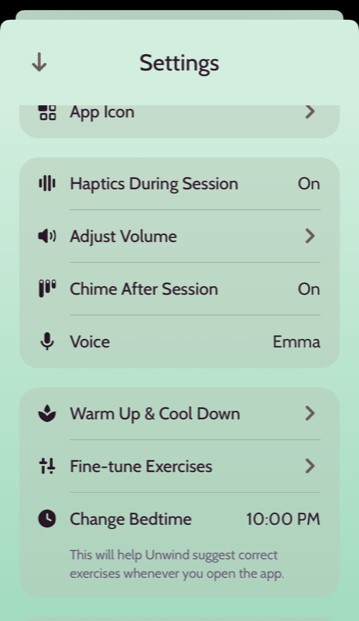
The settings give you a variety of options for customization.
You can chose between a male and female voice for inhalation/exhalation guidance: “Seth” or “Emma”. I’ve tried both and found that I’m more drawn to Emma’s voice, but I appreciate the ability to switch between the two. Also, it seems like there’s a slight change in voice inflection between some of the guidance cues, so even though the spoken words are the same, it doesn’t feel like you’re listening to a robot. That’s nice attention to detail!
This is the ultimate in making the app your own: you can stick with the pre-set breath exercises, or modify them to your liking.
Another lovely customization is the ability to adjust the breath lengths for each of the breathing exercises. While the established counts are research-supported, if, for example, the 7-count hold happens to be too long for you, you can adjust it. This means that you have the ability to completely personalize your breathing patterns, a valuable feature that I don’t usually find in apps like this. Of course, you can also choose the total length of each breathing session.
Finally, after each session, you have the opportunity to select a little emoticon that represents your mood, and there’s space to write your thoughts, should you want to jot down a few notes.
Because I feel that mindfulness, relaxation and breathwork should be accessible to all and not limited to those who are able to pay, I held off on the upgrade that I was given to me so that I could try out the free version first. My experience was not diminished at all, and that was really important to me.
Eventually, I did upgrade, which gave me access to the entire list of ambiances, which otherwise are locked. However, even in the free version, you can access some (or all — sorry, I upgraded before I found out!) additional ambiances by maintaining your practice streak, which is a lovely perk. Upgrading also enables you see all your past sessions and notes. But there is no subscription, which sets Unwind apart from other apps of its kind. There’s only a flat, one-time fee (at this writing, $5.99). I really appreciate that and would have happily paid it myself!
The bottom line is that I love this breathing app! Its obvious that the developer put a lot of thought into it, with a definite focus on the needs of the user. Unwind is the ideal complement to the other meditation apps that I use, and perfect for whatever breathwork I want to do. Because most of the features are accessible without the upgrade, I recommend trying this out to see if it works for you. If you do decide to upgrade, it’s a small investment for immediate access to all the ambiances and logged notes, and in my mind, well worth it.
Note: I do not receive compensation for writing about apps. I highlight these products because I personally use them and have found them to be helpful. Hope you do too!
Zen Koi 2 works for me like a mindfulness/meditation app.
I admit that I would have never though of calling a smartphone game a “mindfulness app”, but as far as I’m concerned, Zen Koi 2 qualifies.
The concept is simple: lead your koi through a pond as it catches prey that it uses to magically craft into gems, which in turn are used to expand the size of the pond. The koi increases in abilities (speed, agility and rarity) and has the opportunity to mate with other koi (in a stylized, family-friendly kind of way).
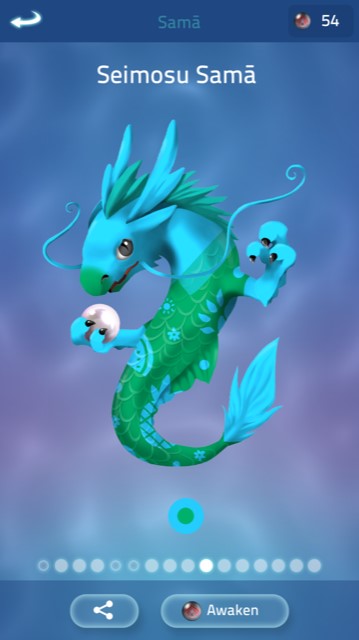
The egg that’s produced has the possibility of hatching into one of several different koi, which you can gather into collections. The pond increases eight times, each one marked by a certain sigil (symbol), and at the last one, your koi ascends to a beautiful dragon by jumping over the dragon gate and establishing its place in the heavens, harkening back to the Chinese legend of the hero Dayu.
The koi is supercute, swimming around the pond and gulping the prey you select for it.
That’s the gist of the game. But what makes it a mindfulness app? The way it allows you to stay in the moment. There is no competition, and while, if you prefer, you can focus on completing the collections of different koi “sub-species”, or collecting dragons, the game is not lessened if you chose not to do so.
Both koi and prey are colorful and pleasingly cute. The pond looks peaceful and inviting. Catching the prey is easy, even though they get more evasive as the pond expands. Select a prey item and the koi swims up to it and gulps it.
At the last expansion of the pond, the koi jumps over the dragon gate and transforms into a colorful dragon.
Once you hatch an egg into a koi, you can release the fish if you don’t want to keep it. The koi remains in your collection, able to be cloned and played with again, “paid for” with easily-obtainable pearls that appear in pond flowers, as rewards, or, if you prefer, by watching ads. There is no time limit and your koi is never in danger. You don’t suffer any penalties by taking it slow. This is all about living in the moment, playfully chasing the prey needed for that given sigil level and enjoying the surroundings.
You also get a personal pond outside of gameplay to showcase several koi and decorate with plants and rocks as you wish.
What was my most definitive test of whether this worked as a mindfulness app for me? I woke in the wee hours of the morning with too many worries on my mind. Usually I meditate when this happens and I can fall back asleep, but last night my thoughts raced too much to allow that sort of calm. I popped open this app and after about 15 minutes of helping my koi meander through the pond, I found distance from my worries and was able to sleep a few more hours.
Zen Koi 2 is worth looking into if you’re interested in soothing, mindful distraction.
One of the most popular posts on this site has been, “I Didn’t Expect THAT: Breast Changes“, so I thought it might be useful to revisit the subject now after a few years have passed since my initial lumpectomy for breast cancer.
Before my surgery, I had been frustrated by the lack of information about how much tissue would be removed along with my tumor. Or maybe I was just too afraid to search. In either case, I had prepared myself to lose a good chunk of my left breast. All the “after” photos of lumpectomies that I found on the internet were not pretty.
However, my tumor was only 1.6cm at its longest, and was on the outer upper quadrant of breast, and this turned out to offer me the best of all possibilities. There was amazingly little breast size lost. I was impressed. So was my surgeon.
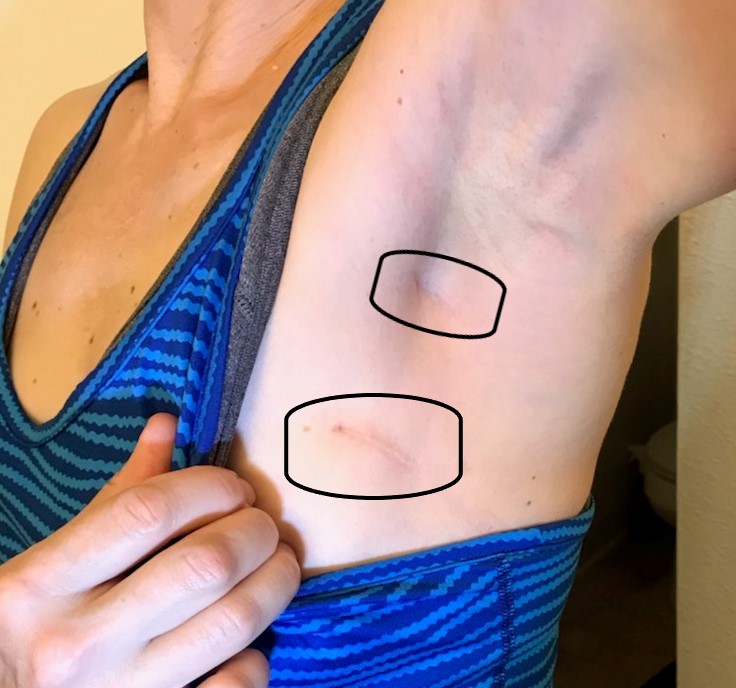
So, fast forward to now, three and a half years down the road. The scars, one for the lumpectomy and the other for lymph node excision, remain very uninteresting in a good way. Only three sentinel lymph nodes were removed, and the scar for that sits up in my armpit. The lumpectomy scar is situated a bit further down and into the side of my breast. But it’s not obvious.
This is the original photo from my post on Nov 1, 2018, already over a year and a half since my surgery.
Three and a half years after surgery, today: the top scar is the lymph node excision, the bottom one is the lumpectomy.
The biggest issue I have had with the lumpectomy scar is that the scar tissue there feels like a biggish lump itself. Not frightening for me anymore, but when I went to a new gynecologist who, I suspect, forgot that I had had breast cancer (HOW? That’s the main thing I talked about!), she felt that area and said, “Oh, there’s something here” in that ‘I’m-going-to-say-something-scary-in-a-calm-voice’ kind of way.
Yes, it was just my scar tissue, but for a split-second I wanted to let myself freak out. Didn’t, but wanted to.
Sorry about the headlights…I just wanted to show how “normal” the shape of my breasts is. The weird thing is that it’s actually my left breast that is a bit BIGGER now. Who would have expected that? (NOTE: my left breast is also turned towards the camera slightly, accentuating its size.)
But the bottom line is, as time has gone by, the scars remain inconspicuous, and if not for the fact that my affected breast is actually a touch firmer and larger than the healthy one, something attributable to radiation treatment, there’s no obvious sign that I had breast cancer.
Not a bad deal considering what could have happened.
This follows on the heels of my last post, which discussed a couple of things that doctors say to cancer patients that I wish could be handled differently. Today’s post is specific to breast cancer and deals with menopausal status.
Okay, okay, the last time I wrote about this I concluded that healthful living was important regardless of whether you were staring down breast cancer before or after menopause. But I need to back up a bit, because there’s more that needs to be said.
It is a fact that the risk factors we hear about the ones associated with postmenopausal breast cancer, as are the recommendations for decreasing your risks. It took literally months for me to fully comprehend this.
Wish I’d known that earlier! Following my diagnosis, I beat myself up trying to understand what I did “wrong”, when in fact, I was doing everything “right”. I hadn’t worried about breast cancer because according to the informational breast self-exam card hanging in my shower, my risk was super-low.
Well, yeah, it was. For postmenopausal breast cancer.
It was only later, talking to my clinical counselor, that she described younger women at informational sessions for new breast cancer patients, looking dazed and not understanding why they were there. Vegetarians, non-drinkers, non-smokers, active exercisers, lean and fit. Isn’t that the lifestyle that we’re supposed to live in order to reduce our cancer risk? You mean it might not work?
The reality is that all bets are off for premenopausal breast cancer. The average age at diagnosis is 63, which means that there are a lot more postmenopausal women with cancer who have been studied, and so there’s more that we know about them. And that’s why everyone talks about them. For them, higher bodyweight is positively correlated with development of cancer, but higher weight in premenopausal women has a mildly protective effect. What’s up with that?!
I was already a full year into this blog, which I started a year after finishing my chemo, and I was STILL ranting about those stupid risk factors that mean nothing. But the truth was that I hadn’t yet connected the dots about menopausal status and cancer risk. My medical team kept saying things like “you’re still young”, and I didn’t understand what they meant by that, until my clinical counselor mentioned that things didn’t go as anticipated for younger (read: premenopausal) women.
So my anxiety about what I did to bring cancer upon myself could have been brought down a few notches (and my early posts on this blog would have been less acrimonious) had I known that the preventative information is aimed at women in a different stage of life.
Instead, I was frantically asking, “What should I do now? What should I change?” and was perplexed by the response: “Just keep doing everything that you’re doing!” “But that’s what gave me cancer!” (Obviously, it wasn’t, but in my mind, there was some preventative measure I hadn’t taken that left a crack open for cancer to squirm through.)
So, okay, no one knows exactly what causes breast cancer in an individual, and this is not the post to attempt tackling that question. But truly, it would help if doctors would admit that the view is *even* fuzzier if you haven’t yet gone through menopause. Psychologically, I would have been able to cut myself some slack, and perhaps it would have, just a teensy bit, eased that frustrating sense of helplessness.
~~~~~~~~~~~~~~~~~~~~~
This is probably a good place to remind everyone that, even with everything we know about cancer and how it develops, there’s still so much we don’t know. Genes, environment, the alignment of the planets…who knows where the blame really lies?
From time to time, I think back on my cancer experience (who am I kidding, I think about it every single day!) and wonder how things might have gone differently. Generally, I write for the cancer patient, but this post is directed at the doctor who delivers the diagnosis.
So…dear doctors:
Think very carefully about what else you want to tell a new cancer patient right after you tell them that they have cancer. It better not be important, because they’re not going to hear it. Once you deliver the diagnosis, a cancer patient’s executive level cognitive processes freeze, making comprehension difficult. Any further speech sounds like the “wah-wah-wah” talk of the adults in Charlie Brown cartoons.
For example, I was told two things by my radiologist, when he came into the room after he looked at my diagnostic ultrasound: (1) you have cancer, and (2) you’re going to be alright. Guess which one of those points I didn’t remember. I’m sure my doctor was trying to be cheery and supportive, but I can guarantee you it didn’t work.
Let’s face it, no matter how gently a doctor tries to break it to you, being told that you have cancer is devastating. It’s perfectly normal to be blown back by the news because your life is going to change drastically for at least a while, and maybe permanently. But, geez, doc, you should be prepared to repeat the same info at least several times and cut out the unnecessary bits. Your newly-designated cancer patient is going to have to need time to process the news!
Tip to the patient: bring someone with you to your subsequent visits who’s good at taking notes and is on an even keel. I brought my husband but he barely wrote anything down. Turns out, he was just as shocked as I was and wasn’t taking the news any better.
Hey, doc, I get that this is hard on you too. So please don’t think I don’t appreciate what you do (especially these days!). But please consider some of these things before you deliver your next cancer diagnosis. Thanks. 🙂
Following up on that, doc, the next thing that I would suggest is that you not give overly specific responses to questions based on assumptions you’re making. I asked about the recovery time from surgery, since I was terrified by the thought of going under the knife. Mine was early stage breast cancer, and ultimately I had a lumpectomy, but that same radiologist had warned me that recovery would take 4-6 weeks. Up to a month and a half?!? I whimpered something along the lines of, “But I have to work,” at which point he reminded me that my health was more important than my job.
I don’t know where he pulled out such a long recovery time, but being given that sort of time frame compounded my anxiety. Maybe he also said that some people have a shorter recovery time, but of course, I wasn’t processing info well and all I could remember was “4-6 weeks”.
So I would recommend to doctors, (1) if you really don’t know specifics, don’t offer estimates–I was back to work the week after my surgery, btw–and (2) please don’t blow off a patient’s concern about the importance of other aspects of their lives, like going to work. Yes, ultimately, as the saying goes, “if you don’t have your health, you don’t have anything.” But for many of us, if you don’t have a job, you don’t have health insurance! Everything in our lives is interconnected. It’s all important. Please keep that in mind.
Hey, nobody likes to deliver bad news and I know you’re trying your best. But the only thing worse than telling someone they have cancer is being the one it’s being told to. So please, be gentle. You will go home that evening possibly bummed that another one of your patients has cancer.
The patient is going home that evening embarking on one of the most frightening journeys of their life.
As I mentioned in a previous post, I’ve really enjoyed the Coursera course, “Engineering Health: Introduction to Yoga and Physiology“, which I highly recommend. One of the recurring themes of the class that I’ve found particularly relevant is that of effecting incremental and meaningful epigenetic change through yoga and meditation.
The class lectures went through the physiological mechanisms by which this happens, and this information would be reason enough to incorporate mindfulness and breath-to-movement in one’s life. But for someone who’s experienced cancer, there’s something even more important: a sense of control.
For me, the most terrifying part of my cancer diagnosis was the lack of control over what was happening to me. First, my body had turned on me by cultivating a tumor, the ultimate goal of which was to take over my organs and kill me. Then, my doctors were giving me drugs that by design would kill certain parts of me, with the intention of taking out the tumor before it spread to really important parts of me (brain? liver? heart?).
My body was a battleground in the war between my rogue cells and modern medicine. I had to sit there and take collateral damage if I wanted a chance at survival.
Disclaimer: So I feel the need to stress here that we do not yet know how to reliably prevent the formation of cancerous tumors, but there are things that we can do to greatly lessen the risk. I’m willing to bet that managing stress would have a powerful impact on prevention.
While I did begin meditation at that time, had I started learning to deal with my anxiety and accompanying physiological responses years ago, I might have been able to sidestep the disease. There is science to this which I will cover in a later post, but my doctors *hate* it when I postulate possible causes of my tumor since if we could truly pinpoint the cause, we’d be able to cure the disease. However, given what we do know about stress and inflammation, I can guarantee that my stress response did not help in keeping me cancer-free!
In the Coursera class, Dr. Ali Seidenstein (NYU) explains, among other things, how the small positive changes that arise from learning to control the stress response by applying yoga and meditation affect your genetics. And this is key. While you’re born with a certain set of genes, the science of epigenetics describes how you can affect gene activity (think, turning a gene on or off) and thereby have a different outcome from someone else with the same gene.
Finally! Something that *I* can do that provides a rare sense of control in an uncontrollable situation! For a cancer survivor, this offers a nugget of hope to hold on to in the face of continuing medications that may or may not help your survival. Medicine is tested on a variety of individuals but there’s no guarantee that their success will translate into your own (news flash: cancer = no guarantees, period). But knowing that you can engage in behaviors that, when applied over time, will actually benefit you on a genetic level…that, my friends, is priceless.
Oak is among the simplest meditation apps that I’ve tried. While it’s not as stripped down as The Breathing App, it really covers all one would need for a meditation practice.
The home tab – simple!
I love the aesthetics — the app has a soothing watercolor-like look to it that reminds me of a quiet, overcast morning, before the rest of the world has awoken. Navigation is very simple as there are only three basic elements to choose from: meditate, breathe and sleep. However, they’re quite enough.
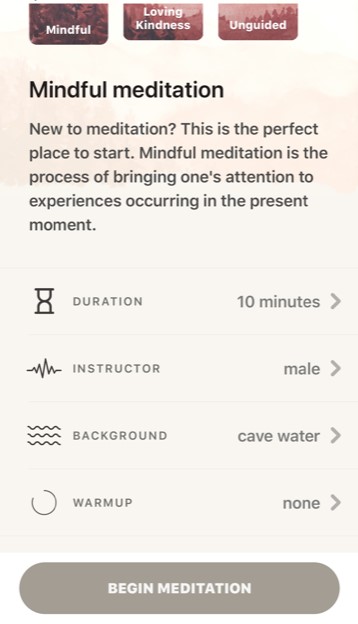
Meditate offers three meditation options, all customizable in duration, instructor voice (male/female), background sounds and warm up (for those wanting to settle in before meditating). The three types of meditations are (1) Mindful, learning to focus on the breath; (2) Loving Kindness, cultivating compassion and empathy both for yourself and others; and (3) Unguided, with the choice of interval bells instead of spoken cues.
Choose your meditation and then customize it to your liking.
Again, very uncomplicated and accessible. Both the male and female voices have that certain “something” that makes them soothing and easy on the ears. While Oak doesn’t have the expansive meditation libraries that some apps provide, for many meditators what Oak offers will be quite enough, and the ability to customize the meditations creates far more permutations than one might expect.
Breathe is the section of this app that I personally use the most. It consists of three types of breathing exercises: (1) Deep Calm, which has been advocated by Dr. Andrew Weil and has a 4-second inhale, 7-second hold and 8-second exhale; (2) Box breathing, which is a square “box” of inhale-hold-exhale-hold, each segment being 4 seconds long; and (3) Awake, which is a 6-second inhale followed by a brief 2-second exhale.
The number of breaths per “set” for each of these exercises differs, and you are limited to the number of totals sets you can do at a given time. However, this is probably a good idea because it’s important to take breaks when doing prescribed breathing in these ways. Think of it as insurance against passing out.
Not just for sleep! I can choose from a variety of sounds to fill the empty voids in my workday.
Sleep offers (1) Relaxing Sounds and (2) Guided Breath. Again, there are options for the background sounds and duration. I enjoy using the sound “elevate” at work, not for sleep (!) but to offer gentle music to even out the frustrations that may complicate my day.
There is also a 10-session course on Mantra Meditation. While I was able to unlock it for free, this may be a temporary benefit (perhaps due to COVID-19?) because the App Store makes mention of the course being available for a small fee. Keep that in mind for the future.
I had not been using a mantra for meditation, but this class helped me choose one and added another dimension to my meditation practice. The narrator’s voice was perfect for this type of lesson. The class is downloadable which leaves you no excuse not to meditate on your next plane flight. Note that I haven’t completed the entire course yet, so I cannot yet comment on its benefits as a whole.
Finally, Oak tracks your progress, including minutes meditated and number of breaths taken. It also shows the number of people meditating and breathing with you. And of course, it shows you your streaks. So, if there were something that I felt I need to gripe about with this app, it would be that it encourages me to focus on streaks. I can get pretty obsessive and competitive about these things, and unfortunately, Oak doesn’t let me turn them off.
On the other hand, tracking your progress is what allows you to gather badges while developing your meditation and breathing practice, so for anyone who’s interested in seeing visual reminders of their progress, this is a plus.
All things considered, this is a lovely app that you’re not likely to outgrow quickly. With the exception of possibly being charged for the course, everything else is absolutely FREE, which evokes the spirit of mindfulness being accessible to all. It also makes it completely risk-free to download and try for yourself. While I haven’t used Oak quite as much as I have other apps, I really do enjoy it and highly recommend it.
In my last post, I mentioned yogi Eddie Stern’s breathing app. If there were ever an app that exemplified the beautiful simplicity of mindfulness, this is is!
There are several things that make this mobile app perfect: (1) it does one thing and does it well, (2) it is uncomplicated, and (3) it’s absolutely free, with no in-app purchases.
This app is designed to help guide you in breathing. It is based on the concept of resonance frequency breathing, which is deep, slow, diaphragmatic breathing, between about 4-7 breaths a minute, depending on the individual — true resonance is considered to be six breaths a minute. Resonance breathing, “where oscillations in heart rate (HR) and breathing synchronize” (Pagaduan et al., 2019), has been shown to improve heart rate variability (HRV), which is “a key marker of health, mood, and adaptation” (Steffen et al., 2017). You may be familiar with HRV if you’re in training for a sport.
Set the timer, choose your breath intervals…
As Eddie Stern describes in his app and on his website, “by breathing at resonance, we enter into an even balance between the two branches of our autonomic nervous system, the sympathetic…and the parasympathetic…” The sympathetic is known as “fight-or-flight” and parasympathetic as “rest-and-digest”, and in our everyday lives, we tend to spend too much time with the sympathetic nervous system in charge.
…and inhale.
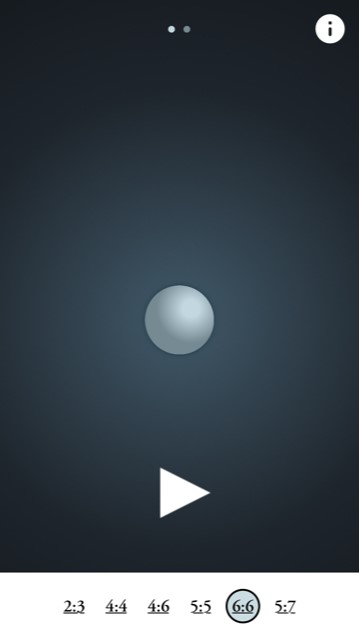
The Breathing App helps us balance out the two systems via resonance breathing. There are several elements to this app: (1) an informational page, with instructions on setting up and using the app, including info on the science and creators; (2) the breathing ball, which helps you visualize the breath; and (3) the sound breath guide, which provides a tone that guides your inhales and exhales.
You set the timer from 1 to 30 minutes, choose your inhale:exhale ratio (2:3 or 4:4 [for kids]; 4:6, 5:5, 6:6 [true resonance] or 5:7), and decide whether you’ll watch the ball or look at a starry sky, with or without the sound.
And that’s it.
There’s nothing to buy and practicing with it is simple. Of all the mindfulness/meditation apps that I use, this is one of my favorites and I use it to augment my yoga practice. Give it a try!
~~~~~~~~~~~~~~~~~~~~~~~~~~~
Fun fact: some well-known names are credited as participating in the development of this app, including Deepak Chopra and musician Moby!