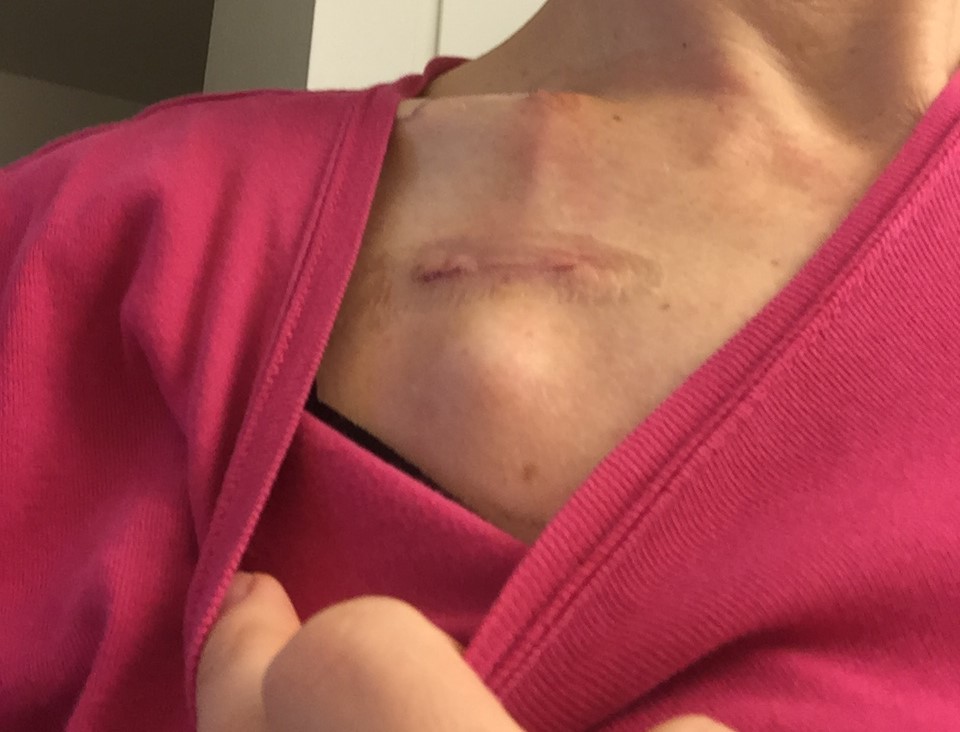
This was the situation: I finished chemo, finished radiation. I had gotten to bang the “Whoopie! I’m done!” gong in the radiation oncology patient waiting area — very satisfying. I had my “exit interview” with the cancer staff. The worst was over.
Every cancer patient looks forward to the end of treatment and a clean bill of health. As a matter of fact, I’d been so focused on finishing that even when I could see the light at the end of the tunnel, I really couldn’t see past that point. Chemo was the monster that consumed me. I had dreamed about the end of treatment for weeks and weeks, trying to hold on mentally until that final infusion, and after that, the last radiation appointment. Finally, that day had come.
However, I still parked in the familiar “cancer patient” spots in the parking garage that allowed me quicker access to the hospital buildings, a necessity on busy days when I needed to get to my appointments promptly. My chemo port was still in because I would be receiving Herceptin (monoclonal antibody) infusions for about six more months, and even though Herceptin doesn’t have noticeable side effects, it had the potential to affect my heart.
So was I well? Was I sick? The tumor was gone, the treatment was over, my scans had come back clear, but the questions remained. My sense of self had experienced a powerful upheaval during treatment and I felt lost. As much as I hated it, I’d become comfortable with the idea of being a cancer patient. That was the known. The unknown was what came after that.
Okay, where to now?
The unknown is scary and the uncertainty doesn’t simply go away. When you’re a patient, your medical team works out a plan based on your specific situation, and that’s your roadmap for the length of your treatment. When you pass into survivorship, you travel off the edge of the map. The remission rate for breast cancer is remarkably good, but it’s not guaranteed.
At some point, I left the map. I have the rest of my life to get comfortable navigating through what comes next.
After posting about missing the “downtime” of chemotherapy, I need to talk about how much of a privilege it is to be here writing that. I get to reminisce about the positives of being allowed to have no other job but to rest and recover.
Sometimes I complain about chemo brain, sometimes I wonder why *I* got cancer when those who take worse care of themselves seem to get off scott-free. I’ve left the initial fears about death behind me. Yes, my cancer may come back, but right now I’m in a good place with a good prognosis. My reality is that I will be able to enjoy this holiday season and focus on being with family, feeling physically healthy and “normal” again.
I have friends who are currently going through treatment. And you can bet that they would give anything to not have to be there, in the same way that I would have when it was happening to me. Some of my friends may eventually get to the place that I am now; for others, this may be the last stage of their lives.
“All we have to decide is what to do with the time that is given us.” ~Gandalf, The Return of the King
This is not lost on me. In fact, it’s something that I think about a lot. As we approach Thanksgiving, I am very grateful that I’m doing well, not even a full year after completing my last treatment. In addition to my gratitude, however, I carry a lot of guilt. One in eight women will be diagnosed with breast cancer during their lifetime. And many will be diagnosed with other cancers or other life-threatening illnesses. At any given time, there are so many of us going through the shock, fear and psychological and physical suffering of various treatments. How can I complain about my lingering discomforts when I have the pleasure of being here and experiencing them?
There are many things that could have been worse for me. But they weren’t. The more time that passes, the less I worry about why I got cancer and wonder more why I am one of the fortunate ones. As difficult as it is to put my cancer experience behind me and move on as if nothing happened, it’s even harder to do so knowing that I am leaving behind others who will not make it.
I’ve met a lot of fellow cancer patients in the infusion room, some with metastatic cancer. There’s one in particular I cannot forget. I’ll call her “Noel” since I met her heading into the 2017 holiday season and her mother privately told me that she wasn’t expected to survive past Christmas. Noel was a friendly and sweet woman with aggressive breast cancer. We chatted about hair regrowth as mine was just barely beginning to come back, and she shared with me Facebook photos of what her hair looked like after her first breast cancer treatments were completed. Eighteen months later, the cancer had returned with a vengeance. Noel was divorced with two pre-adolescent daughters. Her mother told me that as Noel’s situation deteriorated, it also devastated her daughters, who were witnesses to their mother’s decline. Luckily, their father was very supportive and provided as much care and love as he could.
I was heartbroken as I left the infusion room that day. I don’t know ultimately what happened to Noel, although I expect the worst. Cancer is a horrible beast that ravages the patient, but also takes the family down with it. I think, “What a blessing to not have to go through that.” But that thought catches on my conscience. I’m still here; do I deserve to be?
Recounting this story a year later, that guilt weighs even heavier now. I feel an obligation to make good use of the time remaining.
This is going to sound very strange. In fact, it seems bizarre to me as I’m writing it. But there are parts of chemotherapy that I miss.
So this deserves some clarification: chemo was absolutely miserable and by far the worst part of cancer treatment. When I entered the infusion room, I knew that I’d be out of commission for the next week. I’d feel nauseated with a burning throughout my GI tract and be laid out as if I’d been hit by a locomotive. I could.not.wait for chemo to end.
What changed my opinion? You may think this sounds crazy, but hear me out. The sad fact was, chemo was the only guaranteed way that I could get some rest.
I knew I wasn’t going to handle work issues, clean the apartment, pick up the kids or do anything else that I’m usually expected to do. It was a forced convalescence. One that I desperately needed.
When I was going through cancer treatment, I didn’t worry about the little things. And truly, when you have cancer, everything else seems inconsequential. When you’re wondering whether you’ll live to see your kids graduate from high school, nothing matters as much as survival.
It wasn’t until I finished all my treatments and my hair had grown back that the “little things” started to creep back and set up residence again. Memories of the misery of chemo lose their clarity, the fear of death passes. The overwhelm from a diagnosis is replaced by the more familiar overwhelm of daily stressors, now made worse by the additional complication of chemo brain. No, they’re not life-threatening, but they are all-absorbing.
I’m gonna lie down and close my eyes for just a sec…
So is it surprising that I wish I could close my eyes and be left alone for a week? Even more so, isn’t it sad that it took cancer for me to be allowed to rest and let others take care of things for a while?
That, I believe, was a warning that my life needed to change and is now the major driving force in my meditation practice.
~~~~~~~~~~~~~~~~~~~~~~~~~~~~~~
Consider: Because my cancer treatment lasted over a year, it became the “familiar”. The “unknown” is what follows, and that includes the threat of recurrence. That’s when things really get scary. Learning to deal with that will literally take the rest of my life.
This was one of the nicest surprises that I received throughout all of treatment.
Growing up, I always associated surgery with umpteen stitches that required removal. Then again, I also associated cancer with certain death. Luckily, neither one is a definite anymore. Since I’d never needed major surgery before, I had no idea that surgical glue is a thing. And what a thing it is! It would have probably been different if I’d had a mastectomy, but with a simple lumpectomy to remove a not-so-big tumor…all the stitches were dissolvable and internal.
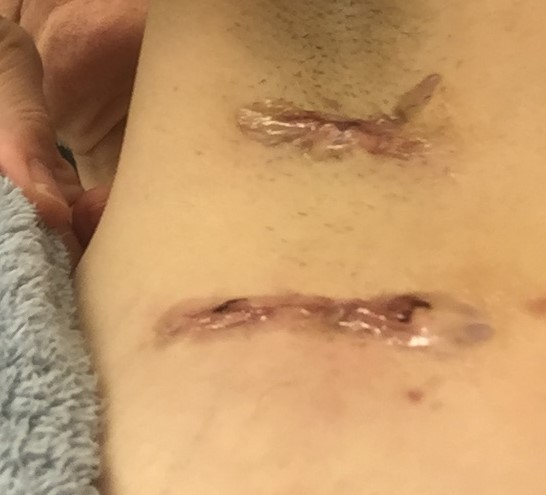
A view of my armpit after my surgery. The top scar is lymph node excision, the bottom is lumpectomy. The shiny stuff is glue. Yay, no bandages needed and no stitches to remove!
On the outside, there was glue. It was plastic-y, kind of like if someone had taken nail polish and drawn a stripe across the incision, only it was more pliable. As my incisions healed, the glue flaked off. There were no dressings to change, no bandages necessary at all. Not having external stitches was a beautiful gift from my surgeon.
If you’ve read my other posts, you’ll know that psychologically I didn’t handle the concept of cancer well. It took me on an anxiety-fueled roller-coaster ride, as I went from a healthy, active woman to a cancer patient. I have a stubborn expectation of normality in my life, and over the years I’ve put a lot of work into maintaining it. Cancer blew that to shreds. And in a funny way, that little strip of glue brought a bit of “normal” back to me.
My last post (I Didn’t Expect THAT: So.Many.Pills) was about the overwhelming number of medications associated with cancer treatment, particularly for someone not used to taking pills. But this topic deserves a closer look…
If I had to choose one of the most frightening aspects of cancer treatment, it would be side effects. This is not like popping an aspirin for a headache. These are medications that can take a heavy toll. One of my greatest sources of anxiety was deciding whether to take a pill or try to “tough it out”.
After surgery, I was given a generic form of something approximating Norco. Some people jokingly commented that this was a “perk” of treatment, but I had read the insert that came with the medication and wanted nothing to do with it. The only reason that I took it (a single half dose) was that by the evening I had a horrible headache, more painful than anything at the surgery site and probably due to a combination of the anesthesia and not being able to drink coffee that morning.
Just…no.
It was a miserable night, since the half dose didn’t do much and I tossed in bed, googling interactions between my pill and ibuprofin, which is what I really wanted to take but hadn’t due to potential bleeding issues. At about 5am, satisfied that enough time had passed from my half dose of pain reliever, I took the ibuprofin and finally got some sleep. Wish I’d taken it first instead of the “oooo-you’re-so-lucky” Norco.
Nausea from chemo was another terrifying thought. The nurses had warned me not to risk it; if I started to feel queasy, take anti-nausea meds. Once vomiting sets in, I was told, it was hard to stop. Of course, the side effects associated with the meds were rather extensive and just reading the label made me anxious. There were two different meds and the idea was this: take the first one (ondonsetron) and then if I need a booster in four hours, take the second one (prochlorperazine). And then alternate like that every four hours, if necessary.
Sounds reasonable, except that a couple of nights after my first infusion I mixed up the pills and ended up taking prochlorperazine first. Prochlorperazine is an anti-psychotic (I guess, with anti-nausea properties?) and it was responsible for one of the roughest nights of my life. It was that night that I swore I’d pierced the veil between this world and the next and decided that death was a fair alternative to what I was feeling.
Somehow, I survived those first nights, but I wasn’t keen to go through that again.
Not a perfect solution, but better than the alternatives.
I live in a state that has legalized cannabis, and was sent a shipment of CBD cookies by one of my brothers who had used them to control nausea from migraines. I was encouraged to try them since I was told CBD didn’t have side effects. Of course, as I mentioned in the previous post, it also didn’t have clear dosing guidelines. I mean, this was a crumbly cookie – how do you dose that? My brother said something like, “I take a couple when I get a migraine.” My brother is also 6’3″. I figured I’d start with one.
Shortly after that, I fell into a weird sleep from which, an hour later, I woke with a gasp because I thought I’d stopped breathing. Mmmm, probably not the right dose for me. Four hours after I’d consumed the cookie I needed to pick up my son from school. I wasn’t high, of course, but I wasn’t feeling normal either. I made it there and back alive. It was at that point that I realized having to play mom while going through cancer treatment just plain sucked, but I digress…
Eventually I worked out a dose, about 1/5 to 1/4 of a cookie, which was 20-25 mg of CBD. This was a game-changer for me and I gratefully relied on CBD for the remainder of my treatment. Yes, I truly disliked the taste, and with the lining of my GI tract gone, eating a cookie was not first on my list but being able to calm my nausea without side effects was well worth it. It probably helped my anxiety too.
What it would have been like to go through treatment without being so fearful of what the medications were doing to me? Anxiety always got the best of me. As noted in my last post, getting to the point where I could limit the number of medications I took was key in helping me get through this experience.
While the physical effects were rough, the psychological effects were what magnified the discomfort, and that had to do with feeling so far out of my element. None of this was close to normal. Of course, my normal is not needing medications. That wasn’t happening with cancer, but once I figured out what was what and how much I could handle, treatment became more manageable.
I figured that there would be a lot of medication involved with cancer treatment. I just didn’t realize it would be THIS much.
I am not a big pill-taker. Besides vitamins here and there, the only thing I’d taken with any frequency had been ibuprofin, and that was only for menstrual cramps and knee pain. But then came breast cancer.
First there was Xanax, so that anxiety from my diagnosis wouldn’t cause me to lose too much weight before starting chemo. Then there were meds post-surgery: I took half a pill of generic Vicodin before switching to ibuprofin, fearful of taking anything for too long. But with chemo, I needed steroids for before/during/after to get me through the infusion’s worst effects. Then there was the chemo itself, and additional IV drugs to prevent an immediate reaction. The day after each infusion, I went in for an injection (Neulasta) to help bring my white blood cell count back up.
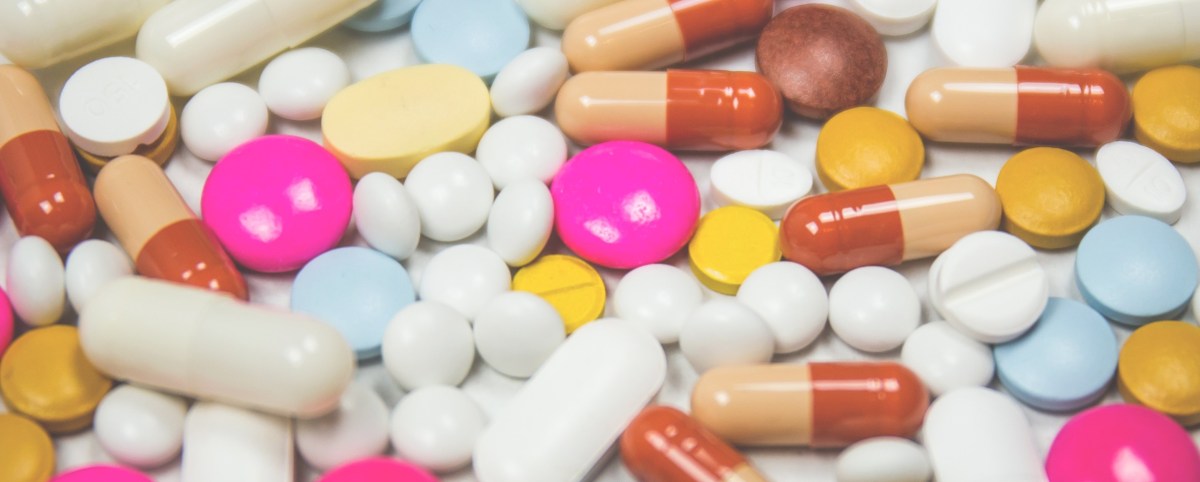
Some of my medications. Just looking at them made me feel sicker!
There were drugs to help deal with side effects. And then other drugs to handle the side effects of those drugs. I had more pills with my name on it than I’d ever had in my life. It was terrifying to me. I’d gone from being a remarkably healthy 50-something to (what felt to me like) a seriously ill patient with a life threatening disease.
In all honesty, most of these drugs I didn’t even take. While I did need the Xanax, I worked hard to reduced the dose until I parted with it completely. In its place, I meditated. After the first infusion and some unfortunate confusion regarding which anti-nausea pill to take first, resulting in one of the roughest nights of my life, I switched to CBD (cannabidiol) oil to prevent vomiting. Initially this required experimentation, as research in the area is relatively young due to an evolving legal landscape, resulting in lack of reliable dosing guidelines. But once I got that down, CBD eliminated the need for a myriad other medications because it didn’t have side effects.
Even the Claritin, which I was told to take for bone pain commonly associated with the Neulasta shots, was unnecessary. I took it for a while until I realized that I wasn’t experiencing significant pain and could do without it.
Limiting medications that weren’t completely necessary didn’t have negative physical effects and, even better, benefited me psychologically. I was constantly striving for normality, and that doesn’t come easily with cancer treatment. Pill-popping was an unfamiliar concept for me, so getting back to where I felt comfortable, taking as few medications as I could safely tolerate, was critical.
Unfortunately, I’m not quite done yet. The toughest part is over, but the last chapter of my pill-taking experience includes a decade of the estradiol-blocking drug Tamoxifen. It’s a single pill I have to take on a daily basis to reduce the chances of cancer recurrence, and I deal by looking at it as an excuse to hydrate before getting out of bed every morning. Drink a bunch of water and, oh, slip that pill in there too.
I wish I didn’t even have to take the Tamoxifen. But it is what it is. I’m looking forward to the day when I can be completely pill-free, and trying to appreciate that after everything I’ve been through, there’s only one medication left.
Okay, this one was just weird. File this under “not all cancer treatment side effects are bad.”
How shall I put this? After I finished chemo, I noticed that I didn’t smell. At all. No armpit odor, no sweaty crotch odor, nothing. I asked my husband to check; he concurred.
“You smell like…skin,” was the best description he could muster. Once again, I took to the Internet, that repository of information about anything and everything. Except that I found nothing.
Eventually, I came across a forum where women were discussing bad smells associated with their tumors. Again, not what I was looking for. But nestled within all those posts was a single comment by someone that she had lost all her body odor for about two and a half years. Finally! Someone else experiencing the same cool weirdness.
I don’t even need deodorant, but why not smell fruity?
So this probably won’t last forever, but for now, I can get away with all-natural deodorants and not worry that they won’t have staying power. To be clear, I sweat, I just don’t smell like it. My teenage daughter is jealous. My teenage son, of course, couldn’t care less, although I really wish he would. The smell of testosterone is strong with that one.
Regardless, this is one side effect that I’m going to enjoy as long as I can.
Or more accurately “Breast Changes, Lack Thereof.”
This one threw me for a loop. Prior to my lumpectomy, I scoured the internet for ideas of what partial breast removal looked like. In a word, disfigurement. Certainly, having half a breast was preferable to having no breast or dying from breast cancer, but I wondered how I would deal with losing a secondary sex characteristic that society uses as an indication of female-ness. My breasts had nursed two bouncing babies into toddlerhood and cancer was going to take one of them (breasts, not babies!). That kept me up at night.
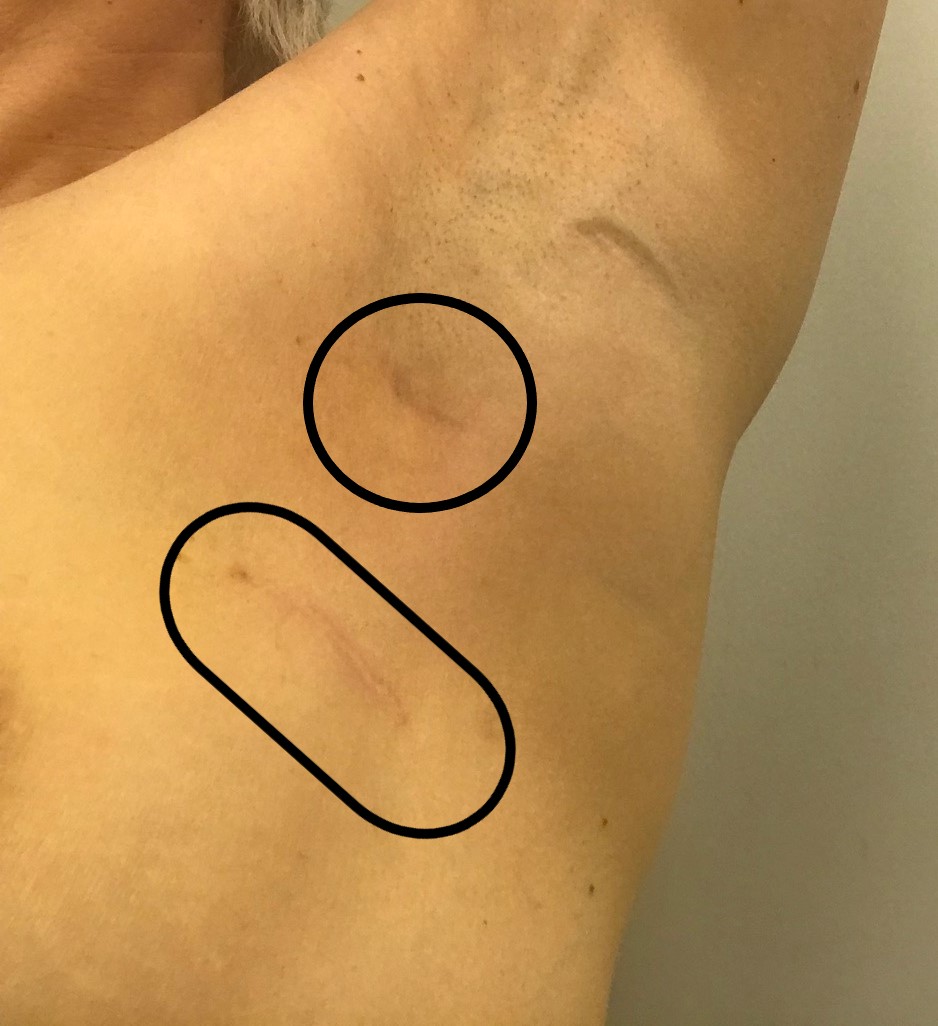
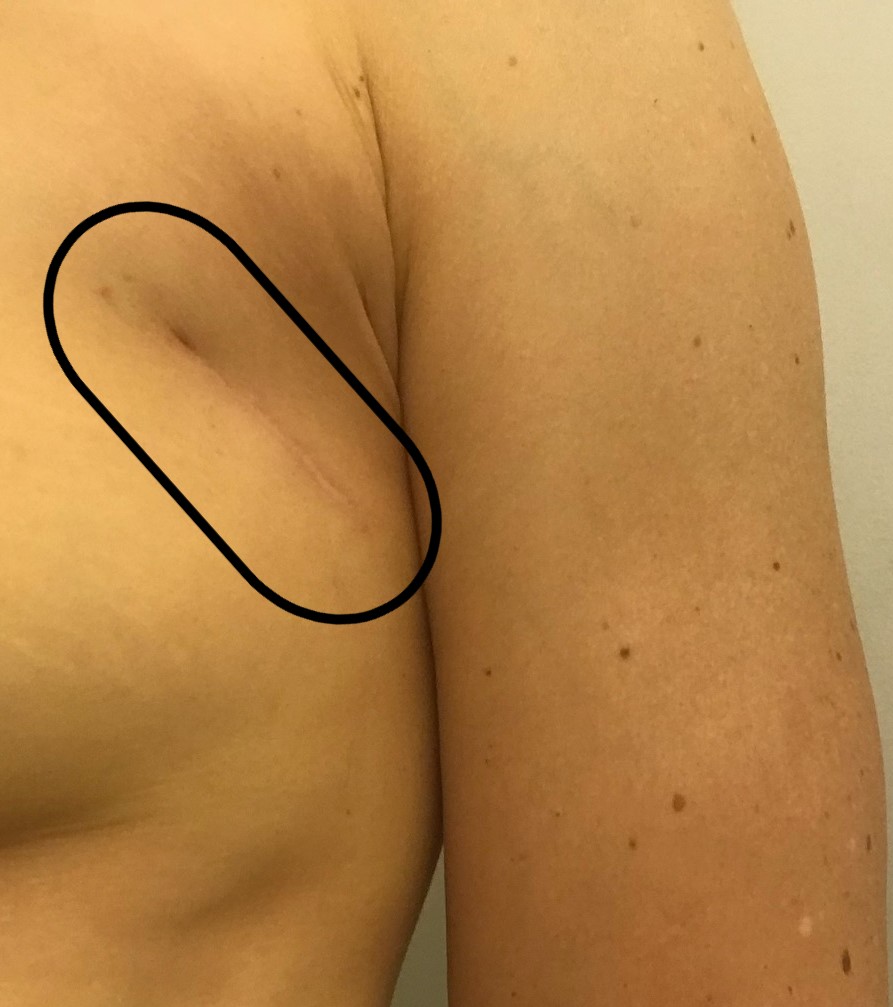
Top scar: sentinel lymph node dissection; bottom scar: lumpectomy. Teeny!
After dying a thousand deaths, I found that my reality was not nearly as frightening. My lump was small and sitting at about 2 o’clock on my left breast. That put it dangerously close to my axillary (armpit) lymph nodes, which could enable the cancer to spread faster, but also in a place where tissue removal would be less noticeable. Three sentinel lymph nodes were removed from my armpit — they were found to be unaffected. My surgeon was able to get “clear margins” (no cancer cells were seen on the edge of the tissue that was removed) on the cancerous lump, and if not for the scars, there was little indication that I’d had surgery.
View of my lumpectomy scar, arm down.
That blew my mind. With small breasts, I didn’t think I could spare the tissue. I was contemplating a prosthesis, and concerned that the size of the excision might tempt me to go with reconstructive surgery…but none of that was necessary. Even my surgeon was surprised. I told her it was because she was an excellent surgeon, but she wouldn’t accept the compliment. According to her, I was just very lucky.
After radiation treatment, that breast tightened up and even gained a bit of size. All at no extra cost.
So, whenever I do a gratitude meditation and count my blessings, I reflect upon this. There are so many things that could have been worse, and I had gotten lost in the terror of it all. But in the end, it was okay.
Note: I wanted to show how similar both breasts looked, but then there’s all this potential for getting flagged as inappropriate, so you’ll need to be content with “side boob” photos and just take my word for it.
I’ve written a lot about my chemo experiences for breast cancer, but I also underwent radiation treatment. Compared to chemo, it was a breeze, however, it came with its own surprises. I was preparing myself for potential discomfort and burns, but was caught off-guard when I realized I would get four permanent marks on my body to help align the lasers and make sure that radiation was being delivered where it was needed.
Permanent marks = tattoos. Now, I have nothing against tattoos on other people, though I admit to occasionally thinking, “You realize you’re stuck with that, don’t you?” about a particularly colorful specimen. Sorry, it’s the era I grew up in. I’ve seen absolutely gorgeous tattoos; I just never wanted any myself.
Venus de Milo illustrating where three of my four tattoos are (the 4th is hidden by the stub of her arm, but mirrors the visible one on the other side). Not actual size, obviously.
I remember being told about the tattoos and instinctively wanting to protest. It wasn’t about the dots themselves — I keep my dermatologist in business with all the moles that pepper my body. I think it was about not having a say regarding something that was going to be done to me. For me, cancer was about feeling out of control. Being forced to get tattoos was frustrating and completely unexpected. It felt like bait-and-switch, where the focus was on preventing burns and what to do about tender skin, but then ohbytheway, you’re getting tattooed too. It was one more thing to endure.
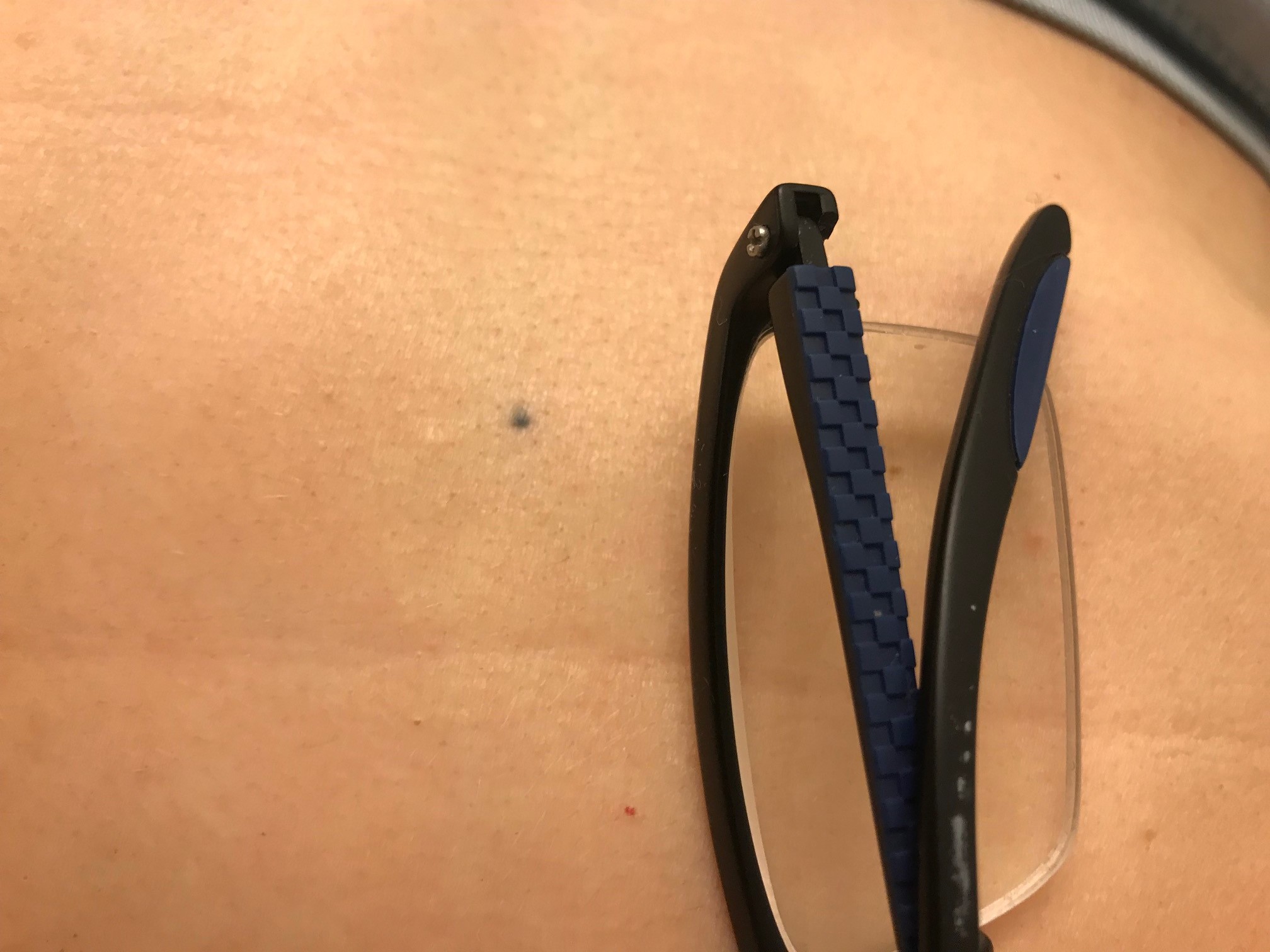
I know I was blowing this out of proportion. These are just small dots. There are four of them, one on the ribcage below each armpit and two running down the center of my chest. They’re blue, which was a necessity, given my highly mole-y skin. And they’re definitely permanent. I wrestled with the concept but eventually sighed and just accepted it.
One of my tattoos, closest to the belly, several inches below the sternum (see Venus). Glasses for reference. Yes, It’s teeny.
Maybe it was the friendships that I developed with the radiation team, maybe it was finishing all my cancer treatments, but my prejudiced view of those tattoos softened over time. Now they meant something to me. Previously, I couldn’t imagine any reason that I would submit to being marked like that. But then I started wishing that the tech had drawn teeny stars or hearts instead of plain dots. And I heard of breast cancer survivors covering mastectomy and implant scars with inked art, or foregoing the reconstruction altogether and allowing their chests to serve as a canvas, making something beautiful out of an emotionally painful situation.
When you’re told that you have cancer and will need the full complement of treatments, you focus on the concepts of surgery, chemotherapy and radiation. Chemo, for example, can be frightening to think about because of purported its side effects, so you gloss over the details. But when you get down to a practical level and start learning about exactly how the infusions will take place…
I knew I needed chemo. I assumed that it would be administered intravenously, as in, into an arm vein with the bag o’ drugs hanging from the IV pole. Ahhh, but the drugs are caustic and would cause damage to a smaller vein, so to avoid that, they go directly into a major blood vessel to allow for quicker mixing with blood, faster circulation through your body and much less discomfort. This is done through a port.
Let me be clear: a chemo port is a revolutionary device that has made administration of chemo drugs far easier on the patient. Not having the port would be absolutely miserable and likely necessitate breaks in treatment as the patient recovered.
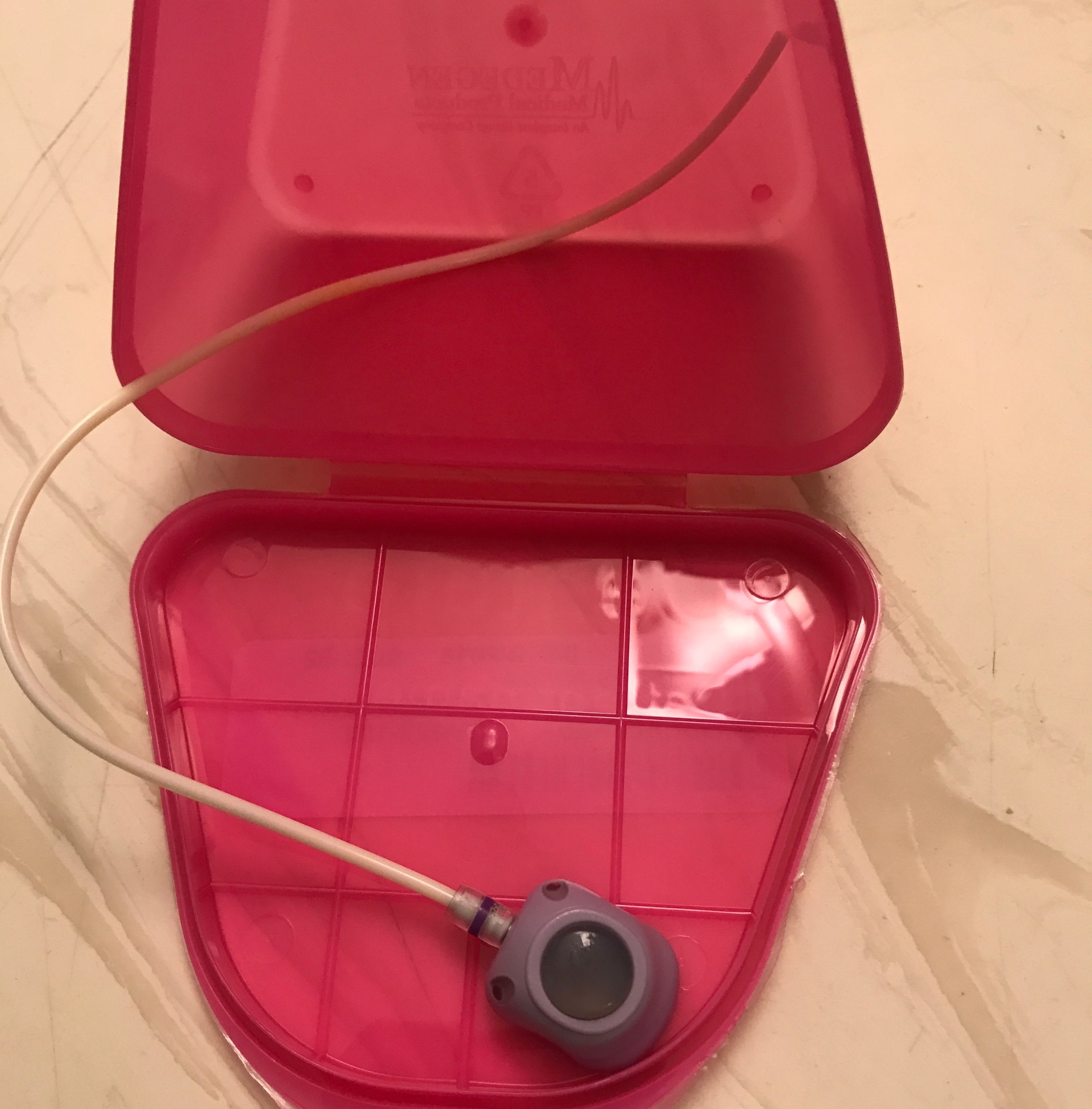
This little marvel makes chemo much easier. The dark purple circle is a soft membrane into which the needle is inserted (through the skin). The tube delivers the meds straight into a major vessel. Easy peasy!
However, it wasn’t until we were talking about setting up a port implantation appointment that I began to grasp what was actually going to happen: a small disk would be implanted onto my chest wall, just under the skin, from which a thin flexible tube would run up and over my clavicle and then down into the blood vessel (probably the superior vena cava, but I didn’t ask). Once I started infusions, the needle from the bag containing the drugs would be inserted through my skin, through a membrane on the port, and that was it for the needle prick. Simple and relatively painless.
But about that port. To me, “port placement”, as the implantation procedure was called, was surgery. And I wasn’t great at handling surgery. Usually I like a lot of info to prep me for what’s coming, but I couldn’t even handle watching a video of a placement procedure.
After port placement. I was acutely aware of a foreign body poking out of me. Alien, anyone?
I don’t have a lot of fat on my chest. There was nothing to nestle the port down into, and as a result, after implantation my skin was stretched tight. I could see the lump in my chest and I could see the tube as it ran up from the lump, over the clavicle. Turning my head pulled the skin — ow! I avoided looking at it, let alone touching it. All I could think was that I had an entire year of this.
Eventually the skin stretched to accommodate the port, but because it stuck out like a little knob, I worried about twacking it. When I hit it with a dumbbell during a workout, I cried. Seatbelts were a constant concern; I was afraid that the port would get dislodged and injure me in a car accident. Hugs hurt and I instinctively turned that side away from people. And of course, in the event of a huge catastrophe that resulted in the collapse of society and all modern services including port removal procedures, I might be stuck with that thing on my chest for the rest of my pathetic little life.
Eventually, the day came when I finished my last infusion and my oncologist gave the go-ahead for port removal. That thing was out within a week. Removal was simpler than implantation, done under local anesthesia without the need for fasting, and even all the tugging to get it loose didn’t bother me. I was so happy to have it out.
But I’d carried it inside me longer than I had carried either of my children, so I asked to take the port home. While I had hated it inside me, I was so grateful for what it had done. I mean, I couldn’t just let them throw it out! It was handed to me in a bright pink box designed for dentures (apparently, keeping your port isn’t popular enough for the creation of “used port” containers) and now sits on my desk. I prefer it there rather than in my chest.