I, like so many people, keep a lot of tension in my neck and shoulders. Some days it feels as though my neck is made of steel, but not in a good way.
The reality is that I don’t even realize how tight those muscles are until I lie down and try to relax.
So I have made a meditation of this for bedtime. Instead of focusing on the sensation of my breath, the focus is on releasing the tension in my neck and upper shoulders.
It may sound like I would not be able to squeeze an entire meditation session out of this, but oh, I can.
Complete release takes focus!
Lying down on my back I inhale, and then with the exhale, I focus on my neck and relax it, releasing the rest of my body along with it. With the following exhale, I do that again. That’s because while I may think that the initial release took care of the tension, there is still tightness there and I really have to work on it mentally to release that.
It’s as though my neck muscles are springs that I can stretch, releasing tension through the exhale, but once I let go (inhale) the “memory” in my muscles tightens them up again.
It helps to imagine my body melting, as if I’m being drawn downward into the Earth.
I can keep going like this, feeling my chin inch slightly towards my chest as the tension releases. Melting into the mattress. The more I release, the more subtle the sensation, yet very satisfying. The more I relax, the more deeply I breathe and everything lets go.
The awareness of what is going on in my body helps so much, but the tension is tenacious. This is not surprising, given how much mental weight my neck and shoulders bear. So it is a dance between releasing and returning to release again. Little by little until I eventually fall asleep.
I’ve shared that I recently completed a three-month, 200 hour Yoga Teacher Training (YTT).
My main motivation for entering YTT revolved around yoga’s role in my emotional recovery from cancer. My teaching goal is to make yoga accessible to more cancer patients and survivors. Sadly, the view that many have of yoga in the USA is that it’s mainly for young, white, flexible, affluent women.
That means that the benefits of yoga are not reaching many of the populations that need it most.
Sadly, yoga in the USA is not associated with a diverse clientele.
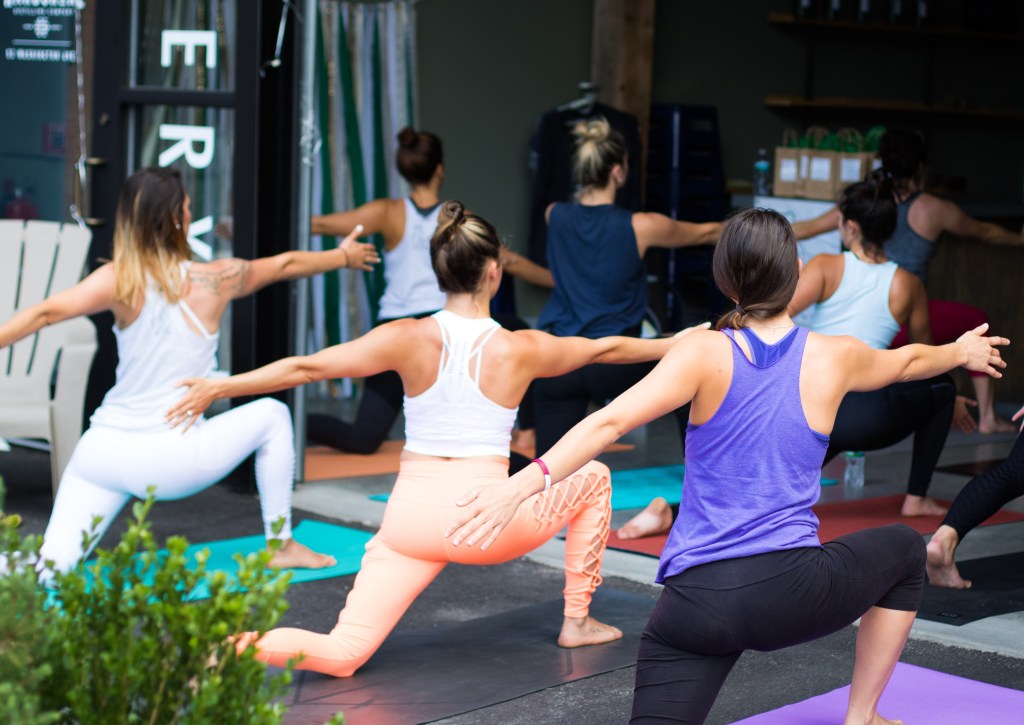
In YTT, I expected to deepen my own practice, immerse myself in the roots of yoga and gain experience in sequencing and teaching among other things. And we did that. The program was well-rounded and paid homage to yogic philosophy, in addition to covering a broad range of relevant topics such as anatomy, meditation, sound healing and creating an inclusive atmosphere.
What I didn’t expect was what I learned about myself. Now, in the course of cancer treatment I gained access to counseling at my cancer center with an excellent therapist. And prior to that, I had sought help for anxiety. I’d explored talk therapy, cognitive behavioral therapy (CBT), eye movement desensitization and reprocessing (EMDR), mindfulness-based stress reduction (MBSR) and had gone through a lot of introspection. Basically, I thought I’d covered my bases and knew what’s what when it came to my inner workings.
YTT proved me wrong. I learned that I still struggle with competitiveness, perfectionism and a host of little insecurities. Wow, that was an eye-opener, even after all the “head work” that I’d done! In addition to coursework, YTT had a requirement of attending a number of yoga classes. Due to the limitations on my time given my work and family schedule, I was forced to take the heated (~95F) Level 2 classes, which happened to be most convenient. They emphasized balance and flexibility, while my non-yoga fitness focus has been strength and endurance.
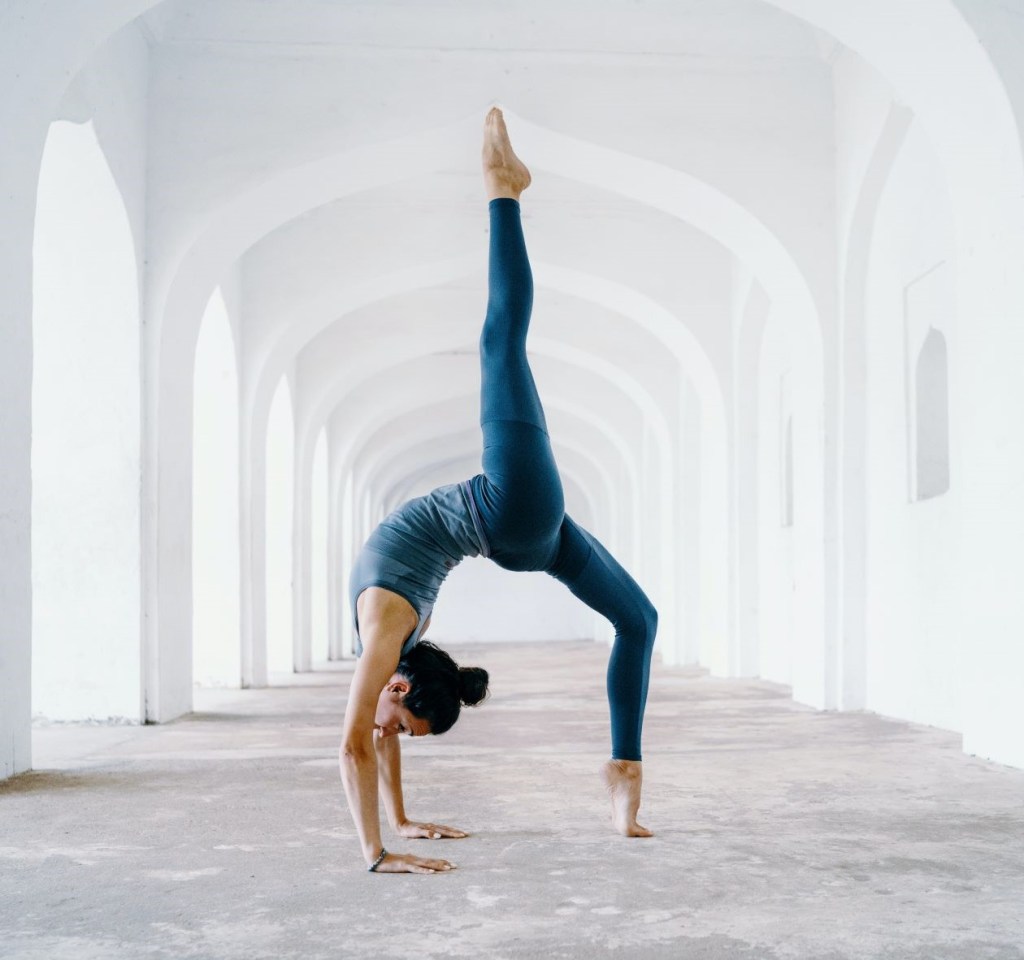
*ahem* This is NOT me.
Balance and flexibility against the backdrop of neuropathy, menopause and vestiges of cancer treatment effects did not allow me to show my “best side.”
Not a big deal, I thought, since yoga for me is a mental “work-in”, not a workout. I’ve felt that holds truer to the traditional purpose of yoga and respects its roots. But in a crowded yoga studio where I was usually the oldest class member, I struggled to maintain my composure. Many of the other students could have been my offspring. The Level 2 classes made me look, I felt, like I didn’t belong.
And that feeling got worse as the classes went on. By the last weekend, I was the only teacher trainee who showed up (others trainees had more flexible schedules that allowed them to take other classes). After weeks of taking Level 2 classes, feelings of dejection had built up.
I should be over this, right? I should have been able to hold my head high and do what I could, knowing that my fitness stemmed from other activities and yoga served a different purpose for me than for “the youngsters”.
But nope.
The YTT itself was exceptional and the teacher trainers were amazingly supportive and knowledgable. The other members of my class were (no surprise) all white, all female and all younger than me. But they were generous and sweet and each one had been through her share of hardships. I felt only love from them. I just didn’t feel it from myself.
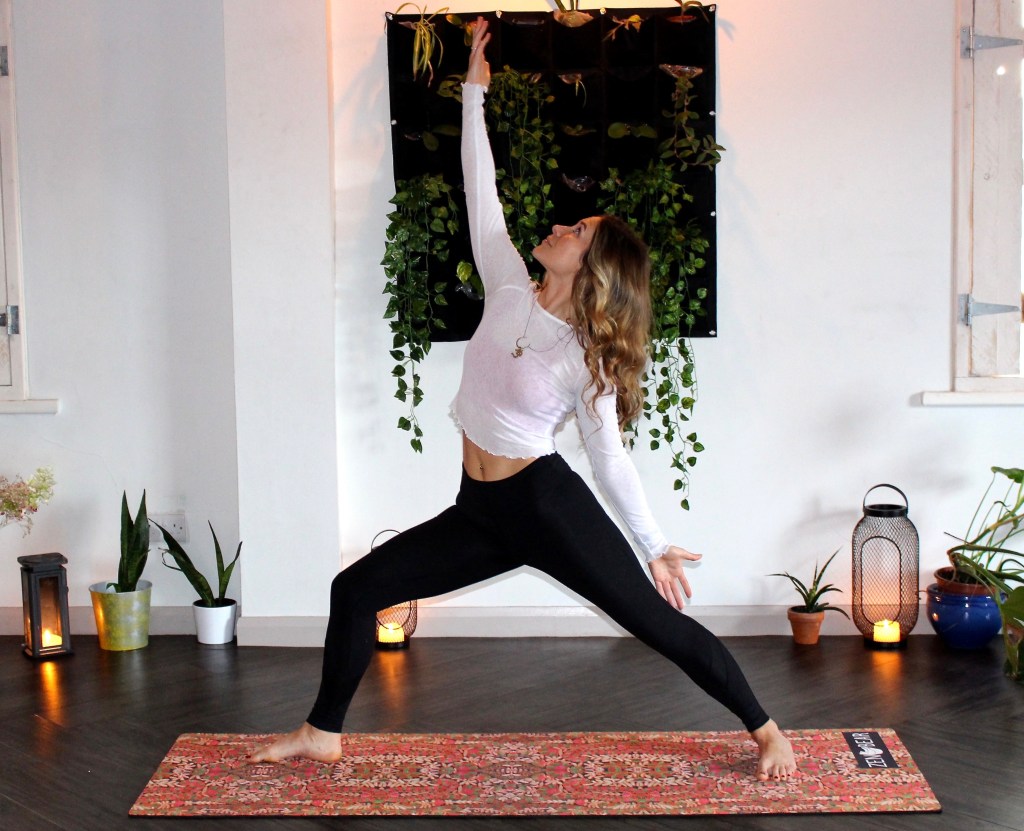
This is my preference for yoga: slow , mindful movements performed with intention. No contortions.
And with fitness being so important to me, I was frustrated that yet again I managed to find a situation where I showed myself to be “less than”. That was painful.
Yet, this peek into my current state was invaluable. Being in the midst of all those younger bodies strengthened my resolve to create classes that are more suitable for not only cancer folk, but also for other special and older populations.
YTT taught me that I don’t have it all figured out yet. However, it also gifted the awareness of what was really going on. Just as in mindfulness meditation, once I became aware of where my mind was leading me, I could take action to return to a place of peace and acceptance. That advanced my emotional evolution by lightyears!
Experiencing classes at a yoga studio also drove home the necessity of offering yoga to people who would benefit from the practice but are often forgotten when classes are planned. There are populations for whom studios are simply inaccessible financially, physically and even psychologically.
Ultimately, this next-level awareness showed me that what I had been doing on my own over the years still counted as yoga, even when I didn’t look like the other class members. It was the yoga I needed. And that was enough.
I was not in a good headspace during that time. I had started a mindfulness meditation practice five months earlier but had too little experience and not enough training for it to significantly affect my mindset, 50+ years in the making.
When I write a cancer-related post, I straddle a line. On the one hand, I want to provide an admittedly subjective and honest account of what I experienced during treatment; on the other hand, understanding that we all come from different backgrounds and may have vastly different perceptions of what cancer means to us, I don’t want to color the reader’s view of what their experience might be like.
Cancer revealed a lot more about myself than I expected to find.
There have been times that I held back on projecting too much of my own personal state. I waited five years to post my videos on Chemo Fatigue because I didn’t know whether it was appropriate to do so. They remain some of the rawest and truest representations of the despair that I felt at the time. I was still very angry and frustrated, feeling what I recognize now as a deep sense of betrayal.
It was mindfulness meditation along with deep reflection, expert counseling and simply the passage of time that ended up bringing me out of the anger. That process took a lot longer than I ever expected. It also showed me aspects of my personality that I hadn’t understood before because I’d never had to confront them.
So while I still would never say that cancer had a positive effect on me, just as with many heavy life experiences, it took me to a new level of maturity and self-awareness. I am very thankful to be on this side of treatment, although I’m acutely aware that everything may change with the next scan. That makes every moment all the more precious.
[IMPORTANT: Please be aware that at the time the videos were filmed, I was in a very negative headspace. My experience should not be considered an example of a “typical” experience because with cancer treatment, there is no such thing. Just as cancer is a disease specific to an individual, so is the treatment and, as a result, one’s response to it. If you are interested in viewing the below videos, please keep all the above in mind.]
I’ve posted quite of few photos of my cancer journey. You’d think I wouldn’t have any more pics left, but–surprise–I do!
I made some important (to me) videos after my sixth and final infusion, but to date I’ve hesitated to post them. In part, this is because I’ve tried to remain anonymous in this blog, but in the clips, you get to see my face. And it’s not a pretty sight.
I didn’t feel human.
I was the weakest that I’d been my entire adult life. My body was feeling the strain of multiple infusions of chemotherapy, I didn’t recognize myself in the mirror and my voice didn’t sound like my own. I was so sick and tired of this part of the treatment and wanted it to be DONE.
At this point, I wasn’t suffering that entire cascade of side effects that I’d experienced after my first chemo infusion, and I’d learned to better deal with what I did experience, and even what to do to avoid some of the side effects.
However, the fatigue I felt was far beyond what I imagined it would be. And it was coupled with constant background nausea, like a slow burn in my gut. This was a result of losing the rapidly-dividing cells that lined my intestinal tract; they were felled by the chemotherapy, collateral damage as the medicine killed off potential cancer cells.
Strangely, there were also times when I was actually quite hungry, but literally too tired to try to get something to eat. Even calling for a member of my family to bring me food required too much effort. Speaking took a lot of energy.
The final infusion’s side effects lasted the longest. A full week after my infusion I was still very unsteady and barely made it to work for a few hours.
It’s worth noting that this was pre-pandemic and I wasn’t properly set up for working from home. Were I experiencing chemo treatment now, I’d be able to get more work done…likely to my detriment, unfortunately, because I really needed that time away.
It took five years for me to decide that it was time to post these videos. Apologies if they get a little intense:
In my continuing quest to find ways to calm myself and soften anxious thoughts, I often resort to visualizations. They are effective in putting the breaks on distressing thought patterns, creating space and encouraging a broader perspective.
My clinical counselor offered the visualization I’m introducing here. It works similarly to “thought container“, which is a visualization in which you create a container for your stressful thoughts, put them in there, lock the container up and place it on a shelf.
You decide how you’d like your rocket to look. Serious and foreboding or cute and shiny?
However, this one goes a step further. For this visualization, imagine a shiny space capsule on a launch pad, of whatever style and era that suits you. Gather up your troubling thoughts and send them towards the capsule, marching them up the ramp and in through the door. You can wave good-bye as the thoughts enter and settle into comfy seats, safely belted in.
Your thoughts are not “bad”. They simply elicit negative reactions in your body. And right now you want to loosen their grip on you.
When all those stressful images are inside, close the airlock/door. It’s up to you how that’s going to look. Perhaps it’s a high-tech electronic door that shuts and locks remotely so you don’t have to be close by. Or maybe it looks like a massive bulkhead, with a wheel that you yourself physically crank shut and secure so that you can be sure that nothing slips out.
When the capsule is secured. Start the countdown to launch. Or just press a button and shoot it off into space immediately. You have full control here.
But here’s the thing: this is a visualization to create distance, not to completely eradicate those thoughts. Because that’s impossible. They will not simply disappear. However, you can give yourself a little break from them, which is what this lauch is about.
Your stressors are still there, but it’s easier to learn to deal with them from down here. Give yourself some space.
Where does the capsule go? To the Moon. It will rocket off the Earth and land on our satellite neighbor. Point your telescope at the Moon at night and you’ll see the capsule, knowing that those thoughts are there but far enough away that they don’t torment you. You’re not trying to forget about them completely. Instead, practice dealing with them where they’re not an in-your-face threat.
In this way, you don’t repress or avoid, you give yourself breathing space and the opportunity for calm.
~~~~~~~~~~~~~~~~~~~~~~~~~~~~~~~~~
I admit that if you’ve been particularly beleaguered by stressors, it would be very tempting to treat the rocket like a clay pigeon and blast the whole thing to bits…and maybe there’s a great idea for a video game there. But truly, it may be easiest to handle them by releasing the thoughts into the ether.
Yes, they’ll be back. And so will the chance to take a deep breath and send them off again.
At some point in a cancer patient’s life, there are certain questions that tend to come up. The most likely one of these is why we were singled out to have such a serious calamity befall us.
I went through a long period of this. I mean, loooong. The early posts of this blog are filled with agonized questions about why cancer hit me even when, by all accounts, it shouldn’t have. I posted about not having risk factors and blah blah blah. I kept going around and around and around on this, stuck on a hamster wheel that wouldn’t stop.
I clung to the same ride, unhappy but not wanting to get off.
Allow me to stress: cancer is a serious illness. That is not to be taken lightly. Most of us, regardless of lifestyle, experience profound shock with our cancer diagnosis. It may seem that life is cruel and unfair (well, it is) and that we didn’t deserve to get cancer (well, we didn’t).
I struggled with anger and frustration for years. It’s both embarrassing and freeing to admit that.
Acceptance is a process. I thought I’d accepted my situation a couple of years ago, but in retrospect, I hadn’t. Some days I felt holy and zen-like, floating on my own little cloud, but it was a sham. I’d have glimpses of acceptance and then a wave of anger and resentment would wash over me and I’d be pissed off for another week.
I thought God hated me. A purportedly loving and merciful being allowed this to happen. It was hard to not think of cancer as a blow against my value as a person because of how I interpreted my situation.
It wasn’t until I stepped outside the confines of that type of thinking that I gained a different perspective. I posted about re-writing my life (basically, viewing the same experiences through a different, more positive lens) which provided a glimpse of another way to assess what had happened. And when I heard the retelling of an ancient Buddhist tale I finally understood what it meant.
Never seen mustard seeds? Here they are. Kisa, however, came up empty-handed.
What was that tale? It was “Kisa Gotami and the Mustard Seed”. In brief, Kisa Gotami’s young son dies and she is so distraught–not understanding why she would deserve such a painful experience–that she goes to the Buddha in hopes that he can bring the son back from the dead.
The Buddha agrees to revive her son if she can bring him mustard seeds from households where no one has died. Of course, she cannot because death touches all living creatures. She is comforted by the realization that her sorrow is shared and understood by everyone in the community and she finds acceptance of her loss .
Another way of looking at this is that we all suffer. For me, it’s a reminder that while a cancer diagnosis is life-threatening, there are few (if any) humans on this Earth who have not experienced some form of loss or grief at some point in their lives. Yes, some of us bear a far greater burden than others–grave inequities exist. But they also bring profound opportunities for growth.
And while I (and I expect most cancer patients/survivors) would have preferred to experience this personal growth through means other than cancer, being able to be here in this moment, having turned the corner, is one of the most beautiful gifts I could ever receive.
~~~~~~~~~~~~~~~~~~~~~~~~~~~~~~~
Two points need to be made here:
Point #1: Burdens are distributed unequally. Socioeconomic, racial and other disparities further tip the scales, making outcomes from a disease like cancer even worse. As a society, we haven’t come close to rebalancing this. Acceptance is easier for some than for others; no one has a right to preach to anyone else.
Point #2: It’s been over five years since my initial cancer diagnosis, and even longer that I’ve been worrying about it. As I mentioned above, it took a LONG time to get to this point of acceptance. Knowing this, I would never rush a new cancer patient to get here. Acceptance must come organically, and yes, sometimes never does. Cancer breaks hearts and no one experiences it in the same way. Be patient.
I have a problem. And if you’ve been reading this blog, that statement won’t surprise you.
My thoughts take me for a ride and it’s a wild one. I’ve gone from being perfectly calm one minute…and the next minute gesturing wildly, face screwed up, whisper-arguing with a person who is not there. I can feel agitation in my belly and an increase in breathing and heartrate.
The story takes off.
I have a solo argument with an invisible adversary. Sometimes it’s someone I know, rehashing past hurts; other times it’s an imaginary situation that my brain concocted, a fear of the future. Regardless, there is always some form of negative state change involved.
When my mind starts creating stories, it’s hard not to jump on board the train and get taken for a ride.
In the past, I would have barreled along like a runaway freight train, exhausting and unnerving myself. It became a habit, like an itch I needed to scratch. It was so hard to stop those thoughts once the train started rolling along.
Mindfulness changed that, but it took time to develop awareness. I learned to ask one very simple question of myself as soon I realize that I’m being swept away by that torrent of brain activity.
Three simple words: where am I?
This works like magic for me. It’s instant grounding.
That’s because the train screeches to a halt and I shake off the mental noise and look around myself. I’m usually somewhere alone. There’s often some far away street hum or something else not very intrusive. I feel where my body makes contact with whatever surface I’m on.
As soon as I poke my head out from the noise, I realize that I’m on the train. And I get off.
I am HERE. And in this moment, I am safe. Regardless of all the thoughts that suggest otherwise, I am safe.
It doesn’t mean that there aren’t problems that will need solving or work that needs to be done. But all that noise that was panicking me just a bit ago? I am reminded that it doesn’t exist right now. And right now is the only moment that matters.
Three simple words. Man, if I’d known this years ago, I could have saved myself so much heartache. But at least I know now. And now, so do you.
One thing I’ve had trouble with is expressing self-compassion. When you’re a driven perfectionist it’s easy to believe that “giving yourself a break” is tantamount to “going soft” and “losing your edge”.
I couldn’t forgive myself when I felt that I’d failed. And guess what, getting cancer made me feel like a failure. I had tried to live the healthiest adult live I could, given the sometimes-limited resources I had, often denying myself what others called “pleasures” or “indulgences”.
I’ve lived most of my life feeling like I had to constantly push myself…and that I was never good enough.
The fact that I was convinced that I shouldn’t have gotten cancer was a recurring theme early on in this blog–I was convinced that I must have done something wrong, even when I tried so hard to do my best.
I was also ashamed. Cancer, I felt, opened my life up to judgment by others.
Getting myself out of that funk took serious work. It meant rewiring my brain and allowing in the same kindness and compassion for myself that I allowed for others. At the same time, I reminded myself of a quote by author and humor columnist Dave Barry: “A person who is nice to you, but rude to the waiter, is not a nice person.” I prefer to interpret Barry’s words in this way: I cannot be genuinely kind and non-judgmental to others until I’ve learned to be so to myself.
Cancer gave me perspective to see how much I needed compassion from myself.
But how do you do that when you’ve spent your life pushing yourself, not accepting excuses? It wasn’t until I hit the lowest low that I ever experienced that I learned to dip into unadulterated compassion for myself. I imagined who I was as a chemo patient–skinny, bald, dehydrated, vulnerable, frightened. And suddenly felt it: that overwhelming desire to wrap my arms around that version of me and protect it.
And while that was “cancer me”, I realized that same version of me was the scared person inside that I had always bullied with perfectionism and accusations of not being good enough. This was who I really was, in need of and deserving of gentle holding.
It took a life threatening illness to make me realize that I deserved kindness and compassion. I believe that you are deserving of the same. Do something today to prove it to yourself.
While this isn’t exclusively an exercise blog, if you’ve perused my posts you’ve probably noticed that I’m a huge proponent of exercise for both cancer patients and survivors (well, actually for everyone; but see my important message at the bottom of this post).
The best way to achieve this is to start exercising right now, if you are not yet, no matter what stage of the cancer experience you’re in.
There is a growing body of research that shows the benefits of exercise for cancer folk (I’ve written about it here). But the fact is that only about 17-37% of cancer survivors meet the minimum physical activity guidelines set out by the American Cancer Society (Hirschey et al., 2017, Cancer Nurs) even though doing so reduces the risk of cancer recurrence by 55%, not to mention the improvement in quality of life (Cannioto et al., 2021, J Natl Cancer Inst).
Exercise, the Cancer Fighter. In the not too distant future, your oncologist might hand you an exercise prescription as part of your cancer treatment.
Now, there is a call to include exercise as an adjuvant therapy for cancer for those who are currently undergoing chemotherapy. During the Oncology session of the 7th International Congress of the Spanish Society of Precision Health (SESAP) that took place in Spring 2022, Adrián Castillo García, a researcher at the Barcelona Biomedical Research Institute (IIBB) of the Spanish National Research Council (CSIC), reviewed recent studies regarding the benefits of exercise during cancer treatment, including the potential role that it had in “modulating the tumor microenvironment and immune function.”
You can read a synopsis of his statements here in the section entitled “Exercise as Oncological Therapy” (starting towards the bottom of page 2). Castillo states that physical exercise “has been shown to have the ability to modulate the tumor environment… . This modulating effect translates into an improvement in the efficacy of chemotherapy and other oncological treatments.”
Castillo goes on to say that “prescribing doses of physical activity at an established intensity and volume can be very decisive in combating the tumor microenvironment, but this preliminary evidence must be confirmed in trials on humans to ratify the role of exercise as a treatment capable of improving the efficacy of the main therapies.” (All quotes from the aforementioned synopsis.)
With such promising results, it’s quite possible that future cancer treatments may be a combination of medicine and physical activity.
Ok, so say that you are not an avid exerciser, but motivated by these studies you’re willing to give regular exercise a go. What do you do when you’re already feeling fatigued from treatments?
I wrote about this here, but in a nutshell, the idea is that you need to decide what the right starting point is for you, and this will depend on your previous experiences, both physical and emotional, with a physical activity program. It will also depend on what you can manage at any given time in your treatment.
Starting an exercise program? Make it something that you can do and enjoy, and it will become a life-long habit.
Ask yourself, “what is reasonable for me?” But don’t respond to that with a t-shirt slogan-type answer (“Exercise? I thought you said extra fries?!?”) that immediately shuts down the idea. Admittedly, there may be times during treatment that getting yourself to the toilet without help is a momumental achievement. But that will pass. And exercise will make you feel more in control of your health and better overall.
IMPORTANT: Find what you can do and then do it as consistently as you can.
This may mean starting very simply [always get your doctor’s okay first!]. Choose an activity, duration and frequency, say, brisk walking for 20 minutes a day, three days a week. Follow that pattern for two weeks, then add to it–perhaps another 10 minutes–not to overwhelm yourself, but simply to push the edge a bit (you can always ease off if you need to, give it a week and increase again). If possible, increase some aspect of your program every couple of weeks, as it suits your condition. In the example of walking, incorporate a flight of stairs and gradual upper body movements: first pumping the arms, then hand weights, eventually strength training for both upper and lower body.
The timing is up to you.
If a walking program feels too easy for you, train at a higher level, but remember that the same concepts still apply: (1) consistency, (2) progression, (3) balance in your activities. If you’re interested, read my post about my three “pillars” of fitness.
Most importantly, start, progress gradually and keep it up for the rest of your life.
If your starting point is a standstill, this will take patience. But I PROMISE you, no matter what you can muster, it will still be better than doing nothing.
~~~~~~~~~~~~~~~~~~~~~~~~~~~
I know I already said this, but it bears repeating, especially for cancer patients and survivors: do not start any exercise program without consulting with your medical team first. While I feel that improving your physical fitness is one of the best things you can do for yourself, every body is different and every cancer situation is different. Talk to your doctor and let them know what you’re planning to do.
Throughout my primary and middle school years, I thought I had powerful extra-sensory perception. Actually, it might have even been longer than that, although I’m embarassed to admit it.
I blame my older brother for this. We were in grade school and my grandma had just passed away. Due to the arrival of a number of relatives for the funeral, we were left alone to entertain ourselves. As we turned off the lights for sleep, he and I somehow got on the topic of extra-sensory perception and decided to test it out.
One of us would think of a number and the other would guess what it was. I guessed correctly, over and over again. I would “see” it through my closed eyes as I concentrated. I didn’t miss a single one and my brother was very impressed.
When I was young, my older brother convinced me that my mind had special powers. Well…he wasn’t exactly wrong.
I fell asleep that night believing that my dear grandmother had imparted me a special gift with her passing, and I felt that I had undisputable empirical evidence of it.
In reality, my claim was on shakey ground, but I had already convinced myself that there was something magical there. In fact, I began seeing “evidence” of it everywhere. These couldn’t have possibly been coincidences, could they? I started fearing that if I could see something as a possibility, it would actually happen. As a result, I fought to keep certain thoughts out of my mind. Avoidance, anyone?
Some years later my older brother admitted he had fibbed to me that night, that no matter what number I “saw”, he would pretend that was the number he was thinking about. He thought it would be funny.
But by then, the latent fear of my thoughts was ingrained in me, even though I knew that triggering event had been a lie. What was true, however, was that my mind had always been very powerful. In one instance, I experienced intense pain that I couldn’t explain, lasting several days. While I was vaguely aware that this pain disappeared upon the release of a stressor, I didn’t realize that it was psychosomatic –literally something my mind created that had been expressed in my body.
My mind also had the power to hijack my thoughts, amplifying negative feelings. I was anything but grounded. I managed to plow on, garnering notable academic achievements. But there was always a sense of fear in the background and since it ran unchecked, eventually it overtook me and pointed my life’s path in a direction quite different from that of my peers.
Wish I’d realized way back when that life could “magical” in its beauty without having to be supernatural and out of my control.
Lacking awareness of how my mind operated meant that I didn’t realize why I was making the decisions that I was. It took years, even decades, to understand that so many of the things I had feared originated in my mind, affecting my interpretation of whatever input I was receiving.
Now, after all these realizations and a number of painful lessons, my world is not as “magical” as it used to be, but I am better rooted and grounded. And that feels a lot better.
What about “ghosts”?
When I live in the present, I am safe and secure. Those unexplainable occurences that I attributed to otherworldly origins have become much more explainable. And I’m well-aware of how my mind has twisted meaningless common things into terrible foreboding ones.
There are quite enough frightening things in the material world (cancer, wars, having my email account hacked…) that there’s no need to search the paranormal world for their cause.
~~~~~~~~~~~~~~~~~~~~~~~~~
A 2021 survey of 1000 Americans revealed that 2 out of 5 people believe in ghosts. I am not here to contradict their beliefs, and frankly, when I talk of “ghosts” I don’t mean spooks. At the same time, I learned the hard way that my mind wasn’t always reflecting 100% truth. I was compelled to take inventory of what was bouncing around in my noggin and decided that, while I can’t neatly explain everything going on around me, it’s harmful to let my thoughts run wild.