It’s Not a Crisis, It’s an Opportunity

(Title image: Photo by Nick Fewings on Unsplash)

So I’ve been playing with another mental challenge.

For the past month, it feels like I’ve been dealing with a lot.

So many things weighing upon me: obligations, deadlines, upcoming responsibilities, health woes. At least I think there are many things.

Lately, I’ve been getting overwhelmed by what needs to be done. I manage to trudge through everything but procrasination becomes harder to resist and a good night’s rest is harder to get. I’m more susceptible to distractions, which end up resulting in more stress because now, of course, I’m getting even less done.

Life can look scarier than it actually is. Awareness illuminates reality.
(Photo by Razvan Sassu on Unsplash)

It is a self-fulfilling prophecy of sorts.

But when I pause and identify the sources of stress, there aren’t that many. The ones that are there expand around their edges, looking bigger than they really are and that creates a crisis in my brain.

If I were a purely mindful creature, I’d be able to notice this immediately and gently put a stop to it. But, alas, I am clumsy human being. Even with all my practice, mindfulness can easily evade me at times when I need it the most.

So for this round of dancing with anxiety, I’m reframing what I’m experiencing as a fortuitous learning opportunity. And it’s a very “safe” one because quite honestly nothing that I’m going through now is life-threatening.

I am not currently dealing with a cancer diagnosis. I am not about to be kicked out onto the street with my life in peril. I am not dodging bombs or searching for missing loved ones.

Instead, I only need to de-escalate what my brain is blowing out of proportion. This is in fact an ideal situation to be in because I can’t get it wrong. The only question is how long this process is going to take. Everything else is time-limited. Sooner or later it will work itself out and I know I’m going to be okay.

Every challenge is another chance to practice mindful awareness.
(Photo by Gantas Vaičiulėnas on Unsplash)

This is a chance for me to practice shortening the time it takes to notice that no true calamity has befallen me. The more I sit with the things that I’m grateful for, the more I reinforce the realization that not everything that I experience is a stressor and there are so many awesome things that perfuse my day.

And once that realization lands, once I see that my feet are planted on the ground and the din of fears in my head fades, everything feels clearer and calmer.

Why didn’t I do this earlier?

Simple Meditations: Just a Piece of the Puzzle

Over the holiday break, I indulged myself by lassoing the family into working on a couple of jigsaw puzzles that I’d been saving. It was great! And if one of your goals for 2025 is to establish a mindfulness/meditation habit, here’s a simple practice to try if you, too, enjoy jigsaw puzzles.

Putting together the puzzle itself can be a great pasttime, offering good conversation and comraderie when working with others, or proving a shift of focus when constructing solo.

However, a large multi-piece puzzle can feel overwhelming at the start, even when you’re experienced and KNOW that eventually everything will click into place.

Ah, the joy of a finished puzzle. This one is from the Ravensburger Cozy Series and is a favorite of mine. Such a great experience putting it together with family!

So here’s my suggestion. Put your puzzle together. With whatever help you need, with whomever wants to participate, no matter how long it takes. Because for this, you want to start from the end.

Now, take apart of corner of the puzzle. It’s up to you about how many pieces you will want to remove, but choose a “comfortable” amount. Twenty? Fifty? Start with fewer pieces the first time you try this.

Once you’ve deconstructed that corner, put it back together. But this time, without the “stress” of doing the whole thing. This will be easy. You know that it’s only a handful of pieces. So simply enjoy the process.

The deconstructed corner turns putting the puzzle together into an meditative exercise. The focus is on contemplation, not completion. Enjoy the satisfaction of the clicking the pieces into place.

Perhaps find the edge pieces and create the frame, or simply build out the puzzle from the “raggedly” edges of the puzzle. There is no single “right” way to do this. What is important is that you breathe through the process. Picking up a piece, focusing on its qualities, seeing where it belongs. Either clicking it in or putting it back down and picking up another piece until you find the one that will go where you want it to.

Notice the sensations: the feeling of the puzzle piece in your hand, its shape and color, the texture of the interlocking sides, even the smell of the cardboard all work together to bring you back to the present moment.

The goal is contemplation, not completion. When you’ve put all the pieces together…do it again with another corner. You get the satisfaction of clicking the pieces into place without the fleeting stress of “omg, where do I start?” In turn, this provides you the opportunity to get absorbed in the process.

What a lovely way to meditate.

What If We Re-Interpreted Anxiety?

Title image: Photo by Priscilla Du Preez 🇨🇦 on Unsplash

You may be familiar with the old story about the award-winning singer Carly Simon’s stage fright which prevented her from performing in front of an audience for 14 years.

Performance coach Tony Robbins famously compared her anxious reactions to those of superstar Bruce Springsteen (yes, I realize I’m dating myself) who would describe his physiological responses to going on stage in the same way that Carly did, but he associated them with excitement and not fear.

Anxious responses weigh heavily on us…but what if we could reassign their meaning?
(Photo by Kyle Glenn on Unsplash)

At least that’s how the story goes. And although I think some of this is an oversimplification of Carly’s experience, there is a lot of wisdom to breaking down both performers’ reactions to the point where we recognize that what we feel in our bodies can be interpreted in very different ways based on what’s going on in our heads.

I grapple with this issue myself when I am offered unexpected opportunities that can propel me forward in career and life…but which also cause me agony in terms of my fear of change.

What to do?

What has worked for me is to identify the sensations that I’m feeling. Naming them makes them less overwhelming and it’s a big plus if I can describe what my head feels like, what my chest feels like, what my belly feels like. I try to understand each sensation’s role in creating the overall experience.

Then I try to image that the emotion these individual sensations lead to is one of positivity and excitement. It’s the anticipatory “butterflies in the stomach” from doing something that seems amazing rather than an upset stomach arising from wanting to flee.

And I sit with all those things, bringing in reasoning too: thinking about the positive consequences while allowing the feelings and sensations to be there. Understanding that they are simply sensations and not dangerous on their own–they are physiological responses that evolved to help us out when we needed an extra boost of energy (think “fight or flight”).

Thinking about all the good stuff that opens up to us when we leave fear behind…
(Photo by Allef Vinicius on Unsplash)

I call this reasoning “mental calisthenics”. It takes some massaging and can even get a little metaphysical, but at some point I usually manage to get a grip of that good feeling as if I were gripping the edge of a wall and then pulling myself around to “turn a corner”.

Trying not to overthink it. Just allowing myself to feel into the sensation while giving it a positive spin. And then imagining myself “doing the thing” that I fear…and being good at it.

When particularly anxious, I may even exert myself physically to allow my responses to exercise to meet and match the fast heart rate and breathing that I’m already experiencing.

And that’s about it.

As with meditation, this is a practice and I have to keep reframing the situation in this way to remind myself that change can be unsettling but “unsettling” isn’t inherently negative. It may take a succession of days or weeks to come to grips with the new situation and that’s okay. Patience is the key that leads to progress, and every day that I reframe my sensations is another day that I improve my mental situation.

Hope this helps you too!

~~~~~~~~~~~~~~~~~~~~~~

Important: this is not about “toxic positivity”. There are some situations that are truly bad and understandably elicit an anxious response. Rather, this is realizing that our physiological reactions–the ones that evolved to protect us–may be holding us back because we associate them with fear rather than seeing them as the excitement of possibility arising from change.

Dampening the Echoes of the Past

(Title image: Photo by Anastasiya Badun on Unsplash)

The Advent season is a perfect time for introspection and mindfulness. For me, 2023 has had challenges and as a result has served as a proving ground for different calming techniques.

One of the things I’ve grappled with, usually in the wee hours of morning, is the persistence of uncomfortable memories from the past.

It reminds me of a one-panel comic that I saw some time ago: a person lying in bed, eyes wide, a theater marquis over their head that reads in bright lights: PLAYING AT 3AM! EVERYTHING YOU SAID AT THE PARTY LAST NIGHT! [A cartoon in the same general vein by Hilary Fitzgerald Campbell appeared in The New Yorker on Jan 21, 2019 (#11 of 15), but I’m not posting it here because they might be touchy about copyright infringement.]

In the middle of the night, being hit with an glaring memory of something that sends your stress levels rocketing…goodbye sleep.
(Photo by Gregory Brainard on Unsplash)

How many of us have had a similar experience? I occasionally find myself tortured by things I said or did even decades ago. DECADES! Or they could have happened yesterday. A simple image can trigger shame, embarrassment or regret that feels real and vivid and, yes, while this generally happens at night for me, it’s certainly not limited to that time.

How odd that we give the past so much power over us when it’s not even real anymore. While we’re shaped by our experiences, allowing ourselves to be haunted by them serves no purpose, especially not once we’ve learned whatever we needed to from them.

Soooo, one early morning in the darkness I found a way to add some perspective to the memories that bully me: I started thinking of them as echoes, wispy harmless reminders of what happened.

And there in bed at 3am, I am safe. My body is not in the imagined situation, it’s under the covers, lying on my mattress. Here is where mindfulness is so helpful because it brings me back to the present. The past is echoing, trying to get my attention. But the more aware I am of where I am in space currently, the easier it is to step back and simply observe the echoes, watching them fade away.

I’m making this sound simple, I know–as with all the things that bounce around inside our heads, taming a stressful memory is not necessarily easy. But identifying it as just an echo has been remarkably helpful for me. It has provided a different viewing angle that enabled my perspective to shift.

Echo…echo…echo…

Thinking of thoughts as echoes can dispell them, but simultaneously focusing on a sense helps ground us in reality.
(Photo by Mariana Rascão on Unsplash)

I’m not there now, those other people are not there now, that event is not happening now–just because I remember it so vividly doesn’t mean that anyone else does. And most of the time, I don’t remember it either. Only during the limited, wee-morning-hour viewing window during which it appears because I’m susceptible to the tickle of anxiety.

The senses can bring me back to reality. Opening the eyes, feeling where my body contacts the surface that it’s on, hearing the hum of a fan or sound machine. Anything occuring in the present anchors me to what’s going on now.

And in the present, that echo cannot hurt me because it’s just an airy thought.

Of course, this all comes back to the basic idea that the more we practice presence, the easier it will be to minimize the impact of thoughts that unsettle us. It may take some exploration to find what works best for you, but in the end, being patient and consistent will be the best way to calm your mind and bring you back to what is real at the moment.

“Am I Clenching?”; or “Wait, Where’s My Tree?”

A few days ago I realized that we were missing a tree out in front of our balcony. Not some little sapling that could be easily overlooked, but a tall, mature pine tree that offered us shade during hot summer afternoons.

It was gone, only stumps remaining. I was stunned. After I furiously texted my family for answers (WHERE IS THE TREE???), my husband texted back that it hadn’t been there for weeks, and I hadn’t noticed its disappearance even though I’d been out on the balcony numerous times.

WHO TOOK MY TREE???

That was weird.

So, you might be wondering what that has to do with this post. Well, it’s easy to cruise through life not being fully aware of what’s going on around us…or in our bodies. Just like I was imaging the tree was still there (while also wondering why the plants on the balcony were drying up much faster this summer), many times I’m also not aware that I’m holding tension in my body.

Perfect example: I had trouble falling asleep a few nights ago. After lying awake in bed for some time, it struck me that I was clenching just about every part of my body. My jaws, neck, shoulders, back, glutes…everything had tightened into knots.

I had been concerned about preparations for a party that we were to attend the next day–and I was aware of that–but all of those worries had passed into my physical being, and that I wasn’t aware of. Good luck trying to get to sleep when you’re as rigid as a board!

So I started a little dance of releasing those muscles, then drifting back to my “normal” state of what can only be described as oblivious unattention, until I noticed that I was still not sleeping and–oh look!–everything was rigid again, so I released my muscles again…

Sometimes I find myself clenching just a teensy bit too tightly…

Yes, I went through the process of relaxing my face, my jaw, my neck…blah blah blah…if you’re a meditator, you know the drill. But a few minutes later, everything had clenched up again without me realizing it.

This went on for a while. When I get caught in a “loop of oblivion” like this, one of the first things I do is stop. Just halt the dance. And take a very deep breath.

That’s the first start in resetting things. Think of it as a much kindler, gentler version of someone slapping you in the face and yelling, “Get it together!”

And that’s when my broader awareness returned and I was able to get out of autopilot mode, acknowledging my mental tension and thereby the physical one. It was a perspective shift because I wasn’t just thinking, “Will we get everything done in time?”

I realized what was actually happening: “All this concern about getting everything done in time is keeping me up.”

That slight shift enabled me to pull back and out of myself, brush off the worries about things I could do nothing about at the moment, and drift off to sleep. But it also reminded me that I need to practice awareness more than I had been. In a sense, I was now more aware of the need to stay even more aware.

Yes, even after years of understanding the importance of mindfulness, I must return to square one and refocus. I don’t think I’ll ever not be restarting, especially not as long as trees keep disappearing from under my nose. But that’s okay…the journey is soothing and the practice itself is a destination. My main task is to not stop practicing.

Navigating Anxious Moments with Breath and Muscle Release

When you can’t control your anxious thoughts, what can you use to get a foothold on stability?

This was the issue for me for years, if not decades. During panicky times, I’d close my eyes at night and see a montage of fleeting images like a rapidly changing patchwork quilt that I couldn’t stop. It was kind of like at the beginning of a Marvel movie, where images whiz by you. Except that for me there were no superheroes or rush of excited anticipation.

This is not an ad for Marvel. The first seven seconds of this 11-second clip represent what I used to “see” during middle-of-the-night panic sessions: just flashing images passing before me.

Anxiety meant being blanketed by nausea and fear that blocked my view of reality. I couldn’t see past any of it because the sensation was all-encompassing. Mindful grounding has enabled me to get a hold on the edge of that blanket and pull it up ever so slightly to let some light in.

That was accomplished by two simple things that I could control in the midst of everything else I couldn’t:
1) changing my breathing pattern
2) identifying and releasing muscle tension

I might not have been able to slow the thoughts, decrease my heartrate or relieve the nausea directly…but the combination of the breath and relaxing my muscles provided a path that led around those things and quietly affected them behind the scenes.

First, start with your breath

Bring your attention to the breath and consciously slow it down. Start by trying to make your inhales and exhales the same length, adding a second-or-two pause in between. Depending on your level of anxiety, this may take some time if your breathing has been rapid and shallow. Any slowing is helpful, especially at the beginning. Be compassionate and patient with yourself.

A hand on the belly makes it easier to focus on breathing into the abdomen.

I find it easiest to deepen the inhale first, drawing the breath into the belly. Placing a hand on the belly helps keep your focus there as the sense of touch supports grounding. Try a deep inbreath, pause, and a lengthened outbreath. Blowing out through pursed lips helps control the air flow and draw out the exhale. An exhale that is longer that an inhale helps slow your heartrate. Belly-breathing makes a big difference.

Aim for an inbreath of 4 counts, pause and hold for 2 counts, exhale for 6 counts.

Some guidance recommends that you place one hand on the chest while you have the other on your belly. However, in my experience, if you are particularly anxious it’s helpful to keep your focus off a racing heart. Keeping your hand on your belly is enough.

Next, relax muscular tension

Releasing the tension in your body will help calm you. We often don’t realize how much tension we’re holding until we mindfully scan our bodies.

Stretch in whatever way feels good. Don’t be afraid to take up some space.

First, streeeetch the way you’d stretch after waking or when you’ve been stuck in one position for a while. Imagine you’re a sleepy bear coming out of hibernation. Too often when stressed we crumple in and hunch over — opening up through a stretch may signal to the body that it’s safe to come out.

Then, roll your shoulders forwards and back. Gently roll your head in a front semicircle, ear to ear, paying attention to how it feel to move in that way. So many of us hold tension in the neck and shoulders and we squeeze muscles there without realizing it. Spend some time loosening up these areas.

Feel into your face. Raise and lower your brows several times. Relax the muscles around the eyes. Open and close your mouth and wiggle your jaw. Clenching in this area can cause headaches so try to release tightness here.

Turn your attention to the rest of your body. Are you knotted anywhere? Simply the process of noticing where your muscles are tightening can change your focus from anxious thoughts in your head to sensations in your body, keeping you present and less likely to get trapped by fears.

Aim for progress, not perfection. This is a learning process, so don’t wait for anxiety to reach a peak before starting. Practice when you’re calm so you know what a lengthened breath and relaxed state feels like in your body.

Those of us who have lived with anxiety would love to hang out in peaceful bliss all the time, but that’s not the reality of life. However, nurturing calm through techniques such as breathwork and muscle relaxation lessens the distress of anxiety-provoking situations and helps us find a sense of comfort within our discomfort.

Yogis, Find Your Own Balance

I am a newly minted registered yoga teacher (RYT-200), having passed my Yoga Teacher Trainer (YTT) final exam in mid-May 2022. When I tell people I’m a yoga teacher, they naturally assume that I am extremely flexible and have impeccable balance.

But, no.

Yes, yes, when I’m warmed up I can touch my toes with straight legs, even put my palms flat on the floor…but in yoga practice, I prefer to keep a slight bend in the knee in forward fold. My balance is a little wonkier and I’ve been known to wobble and trip my way around a corner if I’m moving quickly.

I enjoy a deep yogi squat because I’ve been practicing that pose since childhood, but neuropathy pain in my feet prevents me from holding my back heel up high in lunges. So my abilities are spotty.

The gift of yoga is that it is available to all.

When I took level 2 yoga classes, part of the prerequisite for my YTT, I would regularly lose my balance in some of the moves that the younger class participants easily nailed. It took more brain power and concentration to keep my body steady (possibly chemo brain played a part). I’m sure other students would have been surprised that I was in yoga teacher training.

I mean, WHY would I even consider becoming a yoga teacher?

Because I want people to know that yoga is for everyone. While I’ve ranted about this before here, going through YTT classes really underscored the fact that, at least in the United States, yoga practitioners tend to be very homogeneous: young, white, female, flexible, affluent.

Come as you are. Nothing special needed.

This is particularly disappointing because there are other populations that would benefit greatly from establishing a yoga practice and arguably might need it even more for their well-being. Slowly, yoga is being made available to “the rest of us”. But it’s going to take a while.

So I urge you, seek out yoga in parks and free classes at the Y. Explore YouTube for gentle beginner yoga videos so you can practice from home. You don’t need the burning sage, expensive yoga pants, organic cork blocks or trendiest mat. You just need to show up, follow along with the poses and breathe.

~~~~~~~~~~~~~~~~~~~~~~~~~~~~~~

To be fair, my balance and flexibility have improved significantly with regular yoga, and that’s my point: I didn’t need to be super flexible to begin. No one does. But if the message that yoga studios and fellow yogis are sending is that you already need to be able to strike a complicated advanced pose, think of all the people who won’t even consider starting.

And I have learned to seek out modifications for those yoga poses that throw me off center. The old self-conscious me would have thought that made me a failure. But I know better now.

Because I know I can do the most important pose very well: sit quietly and breathe.

Namaste ❤

Mindfulness 101: You Want Me To Do WHAT in the Middle of Anxiety?

Ah, anxiety. I hate it but it’s such a fixture in my life, although it’s gotten better now that I’ve become more aware of the nuances of my reactions to stress.

That awareness was key, but it took a while for me to figure it out. I had been told to “feel what the response to anxiety feels like in my body”, but lemme tell ya, when you’re in the middle of being really stressed out, the only answer you can give is: “TERRIBLE!”

I think the way this suggestion has been posed is all wrong. It wasn’t until I started mindfulness meditation that I finally understood what was really the point of feeling into body sensations.

First of all, in case you’ve been fortunate enough to never experience severe anxiety, here’s how to imagine it: (1) turn on a really large blender, (2) stick your head in it. That’s about it. Then, when someone asks you to feel what body sensations you have, you answer, “Dunno, my brain is missing.”

If serenity is a clear day, this is anxiety.

Basically, in the midst of anxiety, there is so much that feels out of control that I don’t think it’s possible to lasso down sensations without having a person hold your hands, look into your eyes and say, “Okay, focus on me and do this…”

And that, my friends, is why scratching out even the slightest bit of space for yourself in a stressful situation, just so that you are not 100% caught up in the whirlwind, is so beneficial for getting yourself through it.

Just like you don’t wait until the day of your first marathon to start training for it, you need to prepare for the next tornadic episode of anxiety before you’re in it.

Become your own Professional Stress Manager. That takes practice, primarily when things are peaceful. Just like you don’t wait until the day of your first marathon to start training for it, you need to prepare for the next tornadic episode of anxiety before you’re in it.

Job One is bringing yourself out of the swirling thoughts in your head and that can be hard to do, since they are where your anxiety originates. That’s why you have to re-direct your attention to something outside your mind, and that’s where focusing on body sensations comes into play.

First, find stability and grounding.

First, find yourself an anchor, like the oft-mentioned breath, and start with that. Focusing on the breath gives you a target for your attention when everything else feels crazy. There are a variety of sensations associated with breathing: the rush of air, expansion of the chest, expansion of the belly and whatever else is salient to you.

Pick one that makes sense. It is expected that you won’t be able to maintain your focus on it and your mind will wander off. That’s OK. In fact, the whole point of this is that you DO lose your focus. And once you realize that you have, bring your attention back to your breath.

And that’s it. That’s ALL of it. It doesn’t get more complicated than that.

And when you’ve achieved some sort of stability there, you’ve made yourself some space. Take advantage of that and bring your attention to other parts of your body, with one eye on your breath: is there a tingle in your fingertips? How about your toes? Are you clenching any muscles in your body and what happens if you try to release them?

Ask yourself, “How do I know I’m anxious?” What are the signs? Face feeling hot? Stomach bunched up? Cold feeling in the intestines? Tightness in the chest? Can I take a deeper breath and try to relieve that tightness? Can I send warmth into my gut? Try to define what anxiety means to you on a physical level. The more you do that, the more control you get on your reaction and the experience is not as frightening.

See, the idea is that you need that fingerhold in the crack between your stressor and your reaction to it so that you don’t get swept up in the lack of control. And establishing that will take some practice and time, but as with any exercise, each practice session will benefit you. And then best time to start is now.

What Would You Like to Think About? – Visualizing a Positive Headspace

Some time back, I listened to a lovely guided meditation on the Insight Timer app by Emma Polette in which she instructed the listener to “feel how you want to feel”. I wrote a post about this because I thought it was a perfect morning exercise, one that helps train you to establish a sense of awareness of how much control you yourself have in how you feel.

Well, I wanted to revisit this concept but with a focus on thoughts, since so many of us deal with overactive minds.

Take a comfortable seat and think…what would you like to fill your head up with?

Find yourself a quiet spot and turn your attention to your thoughts. Regardless of how much brain chatter you’re currently experiencing, consider what you would like to be thinking about.

That’s it. Your mind may be cluttered with worries, but IF you could think about something pleasant and calming, IF that’s where your mind’s focus could be, what you be thinking about?

Allow yourself to sink into this. Maybe your mind would be focused on potential successes in your career, troubleshooting a problem that you haven’t had time to devote attention to? Maybe you would simply focus on the task at hand, without intrusive thoughts invading your headspace? Maybe you would sit quietly without feelings of self-blame or incompetence? Or imagine yourself breezing through a situation with a difficult individual?

Ah, headspace! There’s nothing more delicious than getting a nice big helping of perspective.

The act of asking ourselves what we would like to be thinking about requires us to take a step back and make space for it. The realization that we have the ability to decide what to think about unshackles us from our thoughts. The more we do this, the more we widen the gap between what we think and our concept of ourselves, making it easier to observe the thoughts before us rather than to be sucked into the torrent of images and feelings that course through our minds.

What we fill our minds with is so powerful in terms of affecting certain wanted outcomes. It is often during periods of mindfulness meditation that things I’ve forgotten come back to me, I realize solutions to problems or come up with useful ideas. That’s what a calm mind is perfect for.

And so often, people lament that things are not they way they want them to be. So why not use that opportunity to truly feel into and savor what your mindset would be if things felt good? And then, if it’s available to you, maintain that mindset.

What would you be thinking…and how would that feel? A sense of peace and self-confidence? Perhaps space, distance from negative thoughts.

Give it a try and see how it feels.

Breathing into Limbs: A Grounding Visualization

I’m perpetually on the lookout for different ways to ground myself.

When things get tough and I feel my anxiety rising, I’ve gotten better at pausing and pulling a grounding technique out of my “mental tool bag” before the feelings become too intense.

One that I came up with recently works quiet well, especially if you can take a quick break and find a quiet corner.

As I breathe, I visualize my breath inflating my limbs, filling them with relaxation.

The idea behind this one is that you take a few deep breaths to help slow your breathing down, and then start imagining that your breath is going down into one arm, inflating it.

I’ve visualized it in two ways. The first being breathing into the arm as if it were a balloon that inflates in all directions, all the way down to the fingertips, until it’s completely full. I imagine it glowing from within.

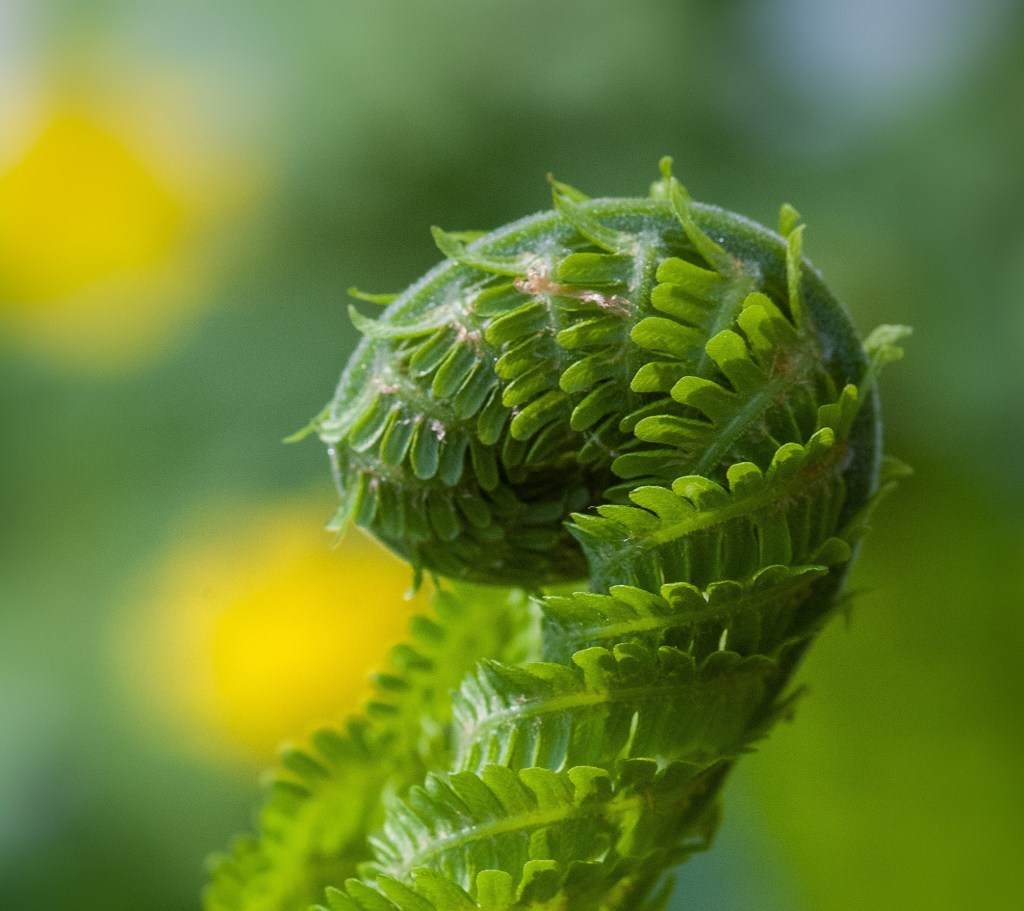
The second entails imagining the breath filling the arm in the way that a fern leaf unfolds. The expansion starts at the shoulder, then upper arm, elbow, lower arm, wrist, hand and finally fingers. As the arm fills with the inhalation, it brightens. This visualization is best when your breathing has already slowed considerably, as it may take a longer breath for your entire limb to sense the serial expansion down to your fingertips.

If my breathing has slowed enough, I imagine the breath entering my limb gradually, just like a fern leaf gently unfurls, part by part.

Either way, I wiggle my fingers at the end of the in-breath, and then as I exhale, the fingers fall still again and the breath exits my arm as it arrived.

Then I do the same with my other arm, followed by one leg and then the other.

On days that I’m really rushed, I might only have time for one limb, particularly if I’m sitting at my desk at work. But that’s okay. Even that short bit is better than letting stress run away with me. That little pause may be exactly what I need.

If this “extremity inflation” sounds too complicated in the heat of the moment, I urge you to try it when you’re lying in bed with your eyes closed. Then you can focus on the sensation of expansion and get familiar with it, so that when you need to call upon it in a stressful situation, you’ll have an easier time bringing up that imagery.

My limbs glow as the breath brings brightness into them.

What I particularly like about this visualization is that it’s a touch more complex, and therefore requires more attention from you. The inhalation all the way to the wiggling fingers makes it more difficult to be thinking about other things. So while it may demand more, I feel that it also delivers more, since everything else decreases to a dull roar in the background as you visualize the air rush in and inflate your body.

And of course, there are different variations of this that you can play with, such as expanding your entire body.

If you are able to practice with this, or even duck out to the bathroom for a few moments of eyes-closed peace, I think you’ll find it a lovely way to give your nervous system a needed break.