“Detached”: Time-Out in Third-Person

As an addendum to my post where I wrote about using third-person language in meditation to help keep distance between yourself and your thoughts, I wanted to revisit this method for everyday life.

While in that post I alluded to using third-person descriptions on stressful days, it’s really worth emphasizing the utility of creating space throughout the day.

To sum up that post, I mentioned a mindfulness technique suggested by meditation teacher Jeff Warren in which when we find ourselves being swept away in thought, we describe what’s happening in “third-person” language and play the role of an observer.

Observe…make space…gain perspective.

But as I said in that post, why limit that to meditation sessions? In fact, you could argue that it is even more important to bring that type of gentle detachment to the things that ordinarily set us off in our daily lives, whether it be with family, at work or anywhere.

I would say that so much of my anxiety has stemmed from an inability to maintain perspective about the trigger. Noticing when I’m getting carried away and then describing the situation as something that is happening to another person — similar to the way a newcaster might report on an event in a calm, informative manner — helps loosen its grip on me.

The ability to step back and detach from the situation is kind of the name of the game in terms of reducing stress levels, isn’t it?

By narrating the circumstances around your stressors, we make space: “FranticShanti felt a little ill when she saw that the letter in her mailbox was from her landlady. She expected this to be about a rent increase…and she was right. Another $200 per month.”

Third-person language gives us the space we need to tackle our stressors without getting pulled into them.

That telling offers some space. It doesn’t change the situation, simply presents what’s happening in an unemotional manner. Then following up with some trouble-shooting helps soothe my agitation: “This will require a review of her finances, but as she calculated with last year’s rent increase, she can still absorb this additional amount. Things will probably be okay. She takes some deep breaths and feels into her hands and feet.”

Not only can you calmly describe the situation, but you can describe yourself engaging in self-soothing techniques as you work out your next steps.

It is quite effective in slowing down racing thoughts, particularly if you’re in a place where you can speak out load, as hearing yourself describing things can be even more grounding.

As with other simple grounding techniques, this may seem a little contrived or simplistic, but it might be just enough to bring you out of your head and into the here and now — cool, calm and collected.

Creating Space with Third-Person Language

I’ve had some up-and-down weeks this year and have been working on making space in my head to lessen the impact of anxious thoughts.

I recently heard a wonderful suggestion by meditation teacher Jeff Warren (via his Daily Trip on the Calm app) about creating more mental room for yourself. He encourages describing what’s happening in the third person when thoughts come up during meditation.

Like many suggestions to help with mindfulness, this seems surprisingly simple, but so far I and everyone else I’ve recommended it to have found it to be very effective.

Making space is good for more than avoiding viruses…

It goes like this: I am sitting in meditation focused on my breath (or any other chosen anchor) and a thought pops into my mind. I say to myself, “There goes FranticShanti thinking about X topic again”.

Suddenly I feel a *whoosh* as I’m pulled back out of that scenario. And instead, I’m observing myself having that thought. Hearing myself describe the situation as a bystander has a calming effect and creates a sensation of safety and distance.

I’m still staying present and noticing what’s going on around me, but recognizing that this thought is happening to the person who is known as me — instead of allowing myself to get sucked into it, along with all the associated emotions — expands the amount of mental space I have.

It’s kind of like looking through a window at a situation instead of being there in the room with it. Not nearly as scary or immersive.

Looking at things through a protective buffer makes even scary situations less threatening.

Likewise, throughout the day, describing a stressful situation in third person helps us remember that there is always space around us that can serve as a buffer from unsettling thoughts. It can even help us handle anxiety-provoking situations as it also provides an opportunity to describe a potential ‘solution’, as if you were to give a friend some advice on how to deal with it.

Imagine saying, “[Your name] just realized that there’s a deadline they forgot about, so they’re reshuffling their schedule to accommodate the task.” That’s much more productive and grounding than screaming, “AAAAAAAAIIIIIIIEEEEE!!!” in your head.

So, I’ve started using this in everyday interactions when I feel myself getting swept away by worries. It’s been an effective way of bringing myself back into the present, to what is real and actually here, and it serves to reframe what is going on in my life.

This sort of method brings stressors down to a manageable level, allowing for perspective. And we can all use a bit of that.

Just One Day

If you had one day to live, how would you live it?

I pondered this question last week as I was trying to calm myself down before teaching my first official public yoga class, while also juggling emotions about certain events at home over which I had no control. Read that as: anxiety.

And in the midst of this all-too-familiar emotional turmoil I felt myself being consumed by my thoughts. And yet, if I had only one day left on this earth, I can’t image that I’d let myself get mired in everyday worries. My perspective would immediately snap into a megawide view of everything that exists in the world.

Never was I so aware of every palm tree…

It would be easier to see the beauty everywhere. Consider this: when I returned to Southern California after four bitterly cold years in a Northern climate, I noticed every.single.palm tree. I was so aware of everything that I had missed during my years away and appreciated every ray of warm sunshine. Other cares temporarily fell away as I was filled with gratitude to be back.

If I had only one day to enjoy the world, I hope that I wouldn’t spend it lamenting over little things. I would sit with my face to the sun, smell the breeze, take deep breaths and appreciate the here and now. Accepting that I had only 24 hours, I imagine that I wouldn’t be ruminating about something a co-worker said to me in passing or how I really should be cleaning the bathroom more often.

So interesting that it would take facing the end of my days to begin truly appreciating them.

So how about this (and this was what I meditated on last week in the midst of nervous feelings), why not imagine the feelings of that last precious day every single day? Stop and feel into my feet on the ground and the air in my lungs. There is so much wonder all around us and what a pity that it takes a drastic event to experience a perspective shift.

It feels so glorious to be alive.

~~~~~~~~~~~~~~~~~~~~~~

Don’t get me wrong, the shock of knowing that your end is near could be devastating. So if you’d like to use this idea as a meditation prompt, perhaps consider if you were on vacation in a paradise-like location and if your plane were leaving in a day, how would you enjoy your remaining time there?

What Is Self-Talk Telling You?

Last week we had a guest come visit. This was preceded by a flurry of preparation on my part as I caught up on all the cleaning and organizing that I’d been putting off.

And as I was planning out what I was going to tackle on which day, I berated myself for waiting this long to start, thinking that if I’d done more the previous week, I wouldn’t feel so rushed.

So as I pushed through late day fatigue, I realized that there was a soundtrack running through my head. In it, I’m explaining to our guest why there’s still clutter and dust, and what issues I have with where we live that we get a lot of road gunk coming in through the windows. Excuses, explanations…

I always imagine my home as being dirtier than it really is, and it continues that inner narrative in my head that I’m never going to be good enough.

I actually went as far as to text our guest an apology that we didn’t have a nicer place to offer them to sleep. I felt that they should know in advance.

I was getting quite stressed about the whole thing, so I took a moment to ponder what was actually going on.

Yes, keeping a very tidy apartment is difficult when I’m the only one working actively towards maintaining it. Particularly now that my plate feels even fuller as I try to incorporate teaching yoga into my current work schedule…

But that’s not the real issue.

Problem is, I was raised to believe that my home is a reflection of me. My abilities as a housekeeper were practically a moral issue, as allowing in clutter and not keeping up on scrubbing things meant that there was something wrong with me. I was shown examples of other women who seemed to have no problem giving cleaning the priority that it required.

I felt like a failure.

With a guest coming to visit, I realized that no matter what the apartment looked like, I would still fear being judged. And it is that fear of judgement that has followed me through my life, throughout all the ups and downs, cancer and anxiety.

What did I hear from my inner critic? That no matter what I do, it’s still not good enough.

In fact, I have taken a liking to getting things clean and organized, standing back and surveying the work that I’ve accomplished. But that feeling of not being good enough still haunts me, and it’s not like this is a new revelation.

Frankly, I’ve been aware of this for years, especially when I realized that deep down I had viewed getting cancer as a failing, like I had brought it on myself, even though I was doing everything imaginable to live a fit life. So it wasn’t until I turned my attention to my inner critic and listened to what it was telling me that I realized, ah, maybe I wasn’t over all of this just quite yet.

Mindfully allowing that voice in my head to express itself, but without getting sucked into the negativity, offered me insight into those old fears and worries that encrust my mind like mineral deposits on a bathroom faucet. They’re tough and really stuck on there.

Bringing awareness to that negative soundtrack takes some of its punch away, kind of like identifying the monster under the bed and making it sit on the living room couch where I can keep an eye on it.

Yes, it’s still there. But now it’s tamer and eventually I’ll be able to show it out the door.

~~~~~~~~~~~~~~~~~~~~~~

Undoubtedly, negative self-talk can be harmful, but it’s also quite difficult to stop. However, being able to allow yourself the space to examine it and understand its roots is one of the best ways to free yourself of it.

“My Eyelids Are Heavy, But My Thoughts Are Heavier” – Anxiety At Night

I have a full toolbox of techniques for handling anxiety during the day, but nighttime is a little trickier. If you’ve had the same experience, you’re not just imagining things.

A Live Science article by Louise Bond examines this issue. According to Clinical Psychologist Charissa Chamorro, PhD, at night our brains have fewer distractions, leaving us more vulnerable to worries that creep in. This makes sense as we can redirect our attention during the day to activities that are not available when we’re in bed.

Darkness can be unsettling enough, but researchers feel that the circadian rhythmn is also involved in the accentuation of nighttime fear.

And you don’t need to be suffering from horrible anxiety for this to be the case. Research (Li et al., 2015, Int J Psychophysiol) showed that even among women without anxiety, fear was enhanced at nighttime, and not simply because of darkness, suggesting the involvement of the circadian rhythm. At the same time, as diurnal beings, humans naturally evolved to have stronger fear responses at night. This is partly due to the fact that we don’t see well in the absence of light and therefore are more vulnerable to nighttime predators.

Furthermore, while there is a natural ebb and flow of cortisol throughout the circadian cycle with cortisol levels peaking in the morning and being lowest at midnight, when anxiety keeps cortisol levels high during the day, that affects nighttime hormone release and therefore your ability to rest (Hirotsu et al., 2015, Sleep Sci).

To make matters worse, once your sleep is disrupted, worrying about your inability to get a good night’s sleep can result in being unable to sleep, and a vicious cycle develops.

Establishing calming practices during the day can have a positive effect on nighttime anxiety.

You’ve probably heard the suggestions for improving sleep: turning the lights down in the evening, avoiding electronics (or using blue-light blockers), keeping your bedroom cool and dark, using a sound machine to mask noises, avoiding stressful or polarizing conversations in the evening, and the like.

To that I would add that what you do during the day itself can affect what kind of sleep you have at night. Meditation, practicing mindfulness, doing deep breathing exercises all put us into a calmer state. If you wake up in the middle of the night with a racing mind, having practiced and become adept at self-grounding techniques in daytime can help you soothe yourself at night.

While the roots of our anxiety may be complex, for those of us for whom it’s built up over time, so too will it take time to establish behaviors to help control it. Sometimes we need support of a therapist or medication, sometimes we can manage on our own, but setting aside time every day for even a short calming practice can help you improve management of anxiety no matter when it appears.

REFERENCES

Bond, Louise (2023) Can’t sleep? An expert reveals why anxiety may be worse at night. Live Science, https://www.livescience.com/anxiety-at-night

Li Y, Ma W, Kang Q, Qiao L, Tang D, Qiu J, Zhang Q, Li H (2015) Night or darkness, which intensifies the feeling of fear? Int J Psychophysiol, 97, 46-57. https://www.sciencedirect.com/science/article/abs/pii/S0167876015001713

Hirotsu, Tufik S, Anderson ML (2015) Interactions between sleep, stress, and metabolism: From physiological to pathological conditions. Sleep Sci, 8, 143-152. https://www.ncbi.nlm.nih.gov/pmc/articles/PMC4688585/pdf/main.pdf

In Memoriam: Thich Nhat Hanh, “I Have Arrived, I Am Home” [VIDEO]

Since my last post, my family and I were diagnosed with COVID. We are doing well and experiencing mild symptoms.

I’d like to devote this post to a beautiful documentary that came out on January 22, 2023, Vietnam time (January 21, 2023 in the US), a year to the day of the passing of Zen master Thich Nhat Hanh, aged 95, known as the “Father of Mindfulness”.

Entitled I Have Arrived, I Am Home (Plum Village YouTube Channel), this film covers the last few years of the life of Thich Nhat Hanh — also called Thay, or “teacher” — after he returned to the Tu Hieu Temple in Vietnam at which he was ordained a monk many decades prior.

“I Have Arrived, I Am Home” – 41:46 min

Under 3/4 of an hour long, the film beautifully illustrates how Thay, in his post-stroke years, returned to his roots in preparation for his passing (“transition”). It documents his death and funeral and the effect that his life has had on the existing monasteries of the Plum Village Tradition, which he established.

The writing of Thay greatly touched me during my cancer journey, and I Have Arrived, I Am Home is a lovely video that depicts his kindness and care for his students. This was not created to “convert” anyone but only to teach by example. I hope you take some time to view it, especially as our world continues to experience much unrest and pain.

~~~~~~~~~~~~~~~~~~~~~~~~~~~~~

If you are interested in learning more about Thich Nhat Hanh’s mindful life, I encourage you to refer to this article from Lion’s Roar magazine, published on the day of his death last year.

I had the pleasure of attenting a “Day of Mindfulness” at the Deer Park Monastery (Plum Village Tradition) in Escondido, CA in Summer 2019 and described it here.

Navigating Anxious Moments with Breath and Muscle Release

When you can’t control your anxious thoughts, what can you use to get a foothold on stability?

This was the issue for me for years, if not decades. During panicky times, I’d close my eyes at night and see a montage of fleeting images like a rapidly changing patchwork quilt that I couldn’t stop. It was kind of like at the beginning of a Marvel movie, where images whiz by you. Except that for me there were no superheroes or rush of excited anticipation.

This is not an ad for Marvel. The first seven seconds of this 11-second clip represent what I used to “see” during middle-of-the-night panic sessions: just flashing images passing before me.

Anxiety meant being blanketed by nausea and fear that blocked my view of reality. I couldn’t see past any of it because the sensation was all-encompassing. Mindful grounding has enabled me to get a hold on the edge of that blanket and pull it up ever so slightly to let some light in.

That was accomplished by two simple things that I could control in the midst of everything else I couldn’t:
1) changing my breathing pattern
2) identifying and releasing muscle tension

I might not have been able to slow the thoughts, decrease my heartrate or relieve the nausea directly…but the combination of the breath and relaxing my muscles provided a path that led around those things and quietly affected them behind the scenes.

First, start with your breath

Bring your attention to the breath and consciously slow it down. Start by trying to make your inhales and exhales the same length, adding a second-or-two pause in between. Depending on your level of anxiety, this may take some time if your breathing has been rapid and shallow. Any slowing is helpful, especially at the beginning. Be compassionate and patient with yourself.

A hand on the belly makes it easier to focus on breathing into the abdomen.

I find it easiest to deepen the inhale first, drawing the breath into the belly. Placing a hand on the belly helps keep your focus there as the sense of touch supports grounding. Try a deep inbreath, pause, and a lengthened outbreath. Blowing out through pursed lips helps control the air flow and draw out the exhale. An exhale that is longer that an inhale helps slow your heartrate. Belly-breathing makes a big difference.

Aim for an inbreath of 4 counts, pause and hold for 2 counts, exhale for 6 counts.

Some guidance recommends that you place one hand on the chest while you have the other on your belly. However, in my experience, if you are particularly anxious it’s helpful to keep your focus off a racing heart. Keeping your hand on your belly is enough.

Next, relax muscular tension

Releasing the tension in your body will help calm you. We often don’t realize how much tension we’re holding until we mindfully scan our bodies.

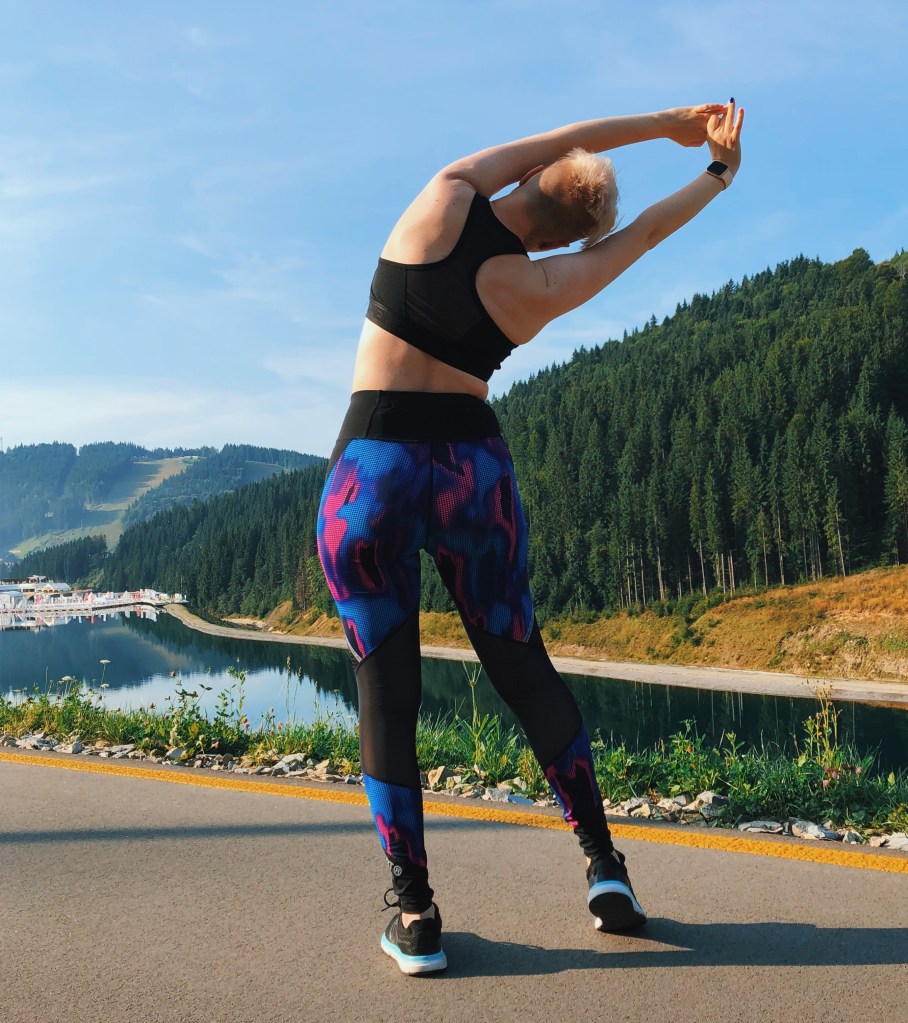
Stretch in whatever way feels good. Don’t be afraid to take up some space.

First, streeeetch the way you’d stretch after waking or when you’ve been stuck in one position for a while. Imagine you’re a sleepy bear coming out of hibernation. Too often when stressed we crumple in and hunch over — opening up through a stretch may signal to the body that it’s safe to come out.

Then, roll your shoulders forwards and back. Gently roll your head in a front semicircle, ear to ear, paying attention to how it feel to move in that way. So many of us hold tension in the neck and shoulders and we squeeze muscles there without realizing it. Spend some time loosening up these areas.

Feel into your face. Raise and lower your brows several times. Relax the muscles around the eyes. Open and close your mouth and wiggle your jaw. Clenching in this area can cause headaches so try to release tightness here.

Turn your attention to the rest of your body. Are you knotted anywhere? Simply the process of noticing where your muscles are tightening can change your focus from anxious thoughts in your head to sensations in your body, keeping you present and less likely to get trapped by fears.

Aim for progress, not perfection. This is a learning process, so don’t wait for anxiety to reach a peak before starting. Practice when you’re calm so you know what a lengthened breath and relaxed state feels like in your body.

Those of us who have lived with anxiety would love to hang out in peaceful bliss all the time, but that’s not the reality of life. However, nurturing calm through techniques such as breathwork and muscle relaxation lessens the distress of anxiety-provoking situations and helps us find a sense of comfort within our discomfort.

2023: Thriving at Last?

Some of our greatest strengths are born in our lowest moments.

Unknown

While I try not to keep returning to stories about “how far I’ve come” since my breast cancer diagnosis almost six years ago, for the start of 2023, I wanted to do a teensy bit of navel-gazing and take stock of how different everything looks compared to how it did after my 2017 diagnosis…and even from just a year ago.

My breast cancer story started the same way as it does for most of those diagnosed with cancer, with a lot of shock and disbelief. There’s nothing new or special about that.

However, for me cancer had been my ultimate health fear, the worst thing that I could image happening, particularly because I grew up during a time that cancer patients had poor prognoses and I had lost dear family to the disease. My exercise, dietary and lifestyle habits were in part driven by health concerns and that’s why my eventual diagnosis felt all the more “unfair”.

I have survived almost six years! But I had been so angry about my diagnosis that it took several years to appreciate how much of a victory that was.

The absolute worst health catastrophe that I feared could happen to me actually did happen…and I was too bitter to appreciate that I survived it.

Not only did I survive the treatment, I have slogged through lasting side effects. Trapped by fear and anger, I lost the initial positivity that I’d experienced right after completing chemo and radiation — I mean, after all that almost anything is going to feel better — and became mired in frustration.

When I finally managed to get through my head that there are many bad things that happen to people who do not deserve them, and many far worse than my own, I was able to move past my preoccupation with myself. That took longer than I’d like to admit.

But allowing that time to work through anger and fear until I got to the point of acceptance was so important for me. And the magical part of this is that acceptance was followed by an unfettering of my thoughts. Holding that bitterness had taken so much energy that little remained for other, more important things.

At the time of my diagnosis, I was fearful and bitter. A mere year ago, I was still angry. But in 2023, I have given myself the gift of freedom from that negativity and that allows so much space to breathe deeply and turn my attention towards better things. It was that release that took with it a nice chunk of anxiety that had likewise held me captive.

And now, instead of being just a survivor, I am finally feeling like I’m thriving.

New Year, New Approach to Resolutions

With the start of the new year, many of us set lofty goals with the intention of changing things that we do not like about ourselves.

But so many of those goals are not realized. You may be aware that it takes approximately 21-28 days in order to create a new behavior, but a cursory search on the internet suggests that most people don’t even last that long.

New Year’s resolutions are not known for their longevity!

There are certainly behavioral modification tricks that you could use to establish a new healthy habit, but if you haven’t had success in the past, perhaps it would be worth taking a different tack this year.

Instead of doing something to immediately “fix” yourself, try sitting with the acceptance of who you are right now.

Release the pressures of becoming that person that you think you want to be and spend some time getting to know the ins and outs of the person that you already are.

You may argue that there are things that you must change within yourself, that there are challenges you must take on and healthy behaviors that you must establish. I am certainly not telling you to give up on those.

Sit quietly with acceptance of that person that you are right now, in your current “unchanged” state.

But it’s possible that you need a little self-compassion before plunging into making big changes.

So just for today, consider what an amazing being you are. Beautiful as you are right now. A mosaic of the years that you’ve already lived, showing the marks of your experiences. Some of those might be scars, but that’s okay. They have all come together to make that unique being that is “you”.

Then consider what this “you” really needs. Not late nights and fast food meals. Not being jammed into an office chair, hunched over a desk, or crumpled on a couch trying to distract yourself with TV shows about other people, neglecting the needs of the person you are.

Through self-compassion, find your reasons to show yourself the love that you deserve.

You need the freedom to breathe deeply, be nourished and allowed to stretch out your limbs. To close your eyes and be still, to take a break from harsh lights and electronic screens. To move, whether it’s a jog-walk to the park or dancing in your living room.

Consider how you can do something supportive of yourself and the world in which you live, out of love. Those changes that you want to make, do they nuture your body? Do they lift up others or help care for your surroundings? That challenge that you wish to undertake, will it help you grow, or just mindlessly try to hammer you into something that you are not?

And once you’ve accepted where you are now, can you find a way to love and guide yourself through establishing new behaviors — because it is your choice to do so — and *not* fight the things that will contribute to your health and well-being?

Take some time to think about all of this…and proceed from there.

HAPPY NEW YEAR! ❤

But First, Self-Compassion

If you don’t love yourself, you cannot love others. You will not be able to love others. If you have no compassion for yourself, you are not capable of developing compassion for others.

Dalai Lama

As we head deeper into the holiday season, it’s easy to get lost in the hustle of preparations, gift purchases and holiday parties. So often, a time that’s supposed to be “joyous”, “merry” and “bright” becomes dark and stressful as we face the high expectations that we hold for these remaining weeks of 2022.

It’s difficult to welcome the holidays with an open heart if we’re closed off to our own needs.

I think of self-compassion as a rope. If you’re standing at the edge of a lake and see someone in distress you can only throw a rope if you have enough coils on your end. If the rope you hold is too short, it won’t reach the person you’re trying to help. 

And so it is if you’re trying to show care for someone—how can you truly care for them if you don’t care for yourself? Will you even know what sincere care and compassion are?

Self-compassion: acceptance, kindness and the understanding that what you are experiencing is part of being human.

 But the bonus of self-compassion is that the rope you throw is magical — you never give it all away. The rope is endless. Compassion doesn’t hurt, and a compassionate heart opens you up to being more compassionate more easily.

Allowing yourself to have the “less-than-Hallmark” holiday spread, to admit that you’re not feeling particularly jolly, to acknowledge that you need a break from responsibilities…

Take some time to feel into where your tension lies. Stop and listen to yourself breathe. Accept your feelings without judgment. Say “no” to taking on extra responsibilities more often…and then help others in doing the same.

Be compassionate towards yourself and it will be easier to show compassion to everyone else.

How will I show compassion to myself today? By taking stock of what else I can reasonably get done…and therefore end this post right here.

~~~~~~~~~~~~~~~~~~~~~~~

Ok, I know up there I said I was ending this self-compassion post…but before I go, consider the words of Kristin Neff, PhD, Associate Professor of Educational Psychology at the University of Texas and a research pioneer on the topic: “With self-compassion, we give ourselves the kindness and care we’d give to a good friend.”

Dr. Neff breaks self-compassion down into three elements:
1. Mindfulness
2. Self-Kindness
3. Connectedness or Common Humanity

Read more about her work at https://self-compassion.org/