I Didn’t Expect THAT: Breast Changes

Or more accurately “Breast Changes, Lack Thereof.”

This one threw me for a loop. Prior to my lumpectomy, I scoured the internet for ideas of what partial breast removal looked like. In a word, disfigurement. Certainly, having half a breast was preferable to having no breast or dying from breast cancer, but I wondered how I would deal with losing a secondary sex characteristic that society uses as an indication of female-ness. My breasts had nursed two bouncing babies into toddlerhood and cancer was going to take one of them (breasts, not babies!). That kept me up at night.

Scars
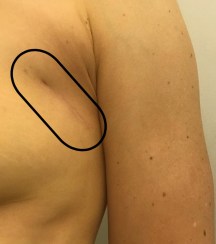
Top scar: sentinel lymph node dissection; bottom scar: lumpectomy. Teeny!

After dying a thousand deaths, I found that my reality was not nearly as frightening. My lump was small and sitting at about 2 o’clock on my left breast. That put it dangerously close to my axillary (armpit) lymph nodes, which could enable the cancer to spread faster, but also in a place where tissue removal would be less noticeable. Three sentinel lymph nodes were removed from my armpit — they were found to be unaffected. My surgeon was able to get “clear margins” (no cancer cells were seen on the edge of the tissue that was removed) on the cancerous lump, and if not for the scars, there was little indication that I’d had surgery.

Scar_arm-down
View of my lumpectomy scar, arm down.

That blew my mind. With small breasts, I didn’t think I could spare the tissue. I was contemplating a prosthesis, and concerned that the size of the excision might tempt me to go with reconstructive surgery…but none of that was necessary. Even my surgeon was surprised. I told her it was because she was an excellent surgeon, but she wouldn’t accept the compliment. According to her, I was just very lucky.

After radiation treatment, that breast tightened up and even gained a bit of size. All at no extra cost.

So, whenever I do a gratitude meditation and count my blessings, I reflect upon this. There are so many things that could have been worse, and I had gotten lost in the terror of it all. But in the end, it was okay.

~~~~~~~~~~~~~~~~~~~~~~~~~~~~~~~~~~~~~~~~~~~~~~~~~~~~~~~~~~~~~~~~~~

Note: I wanted to show how similar both breasts looked, but then there’s all this potential for getting flagged as inappropriate, so you’ll need to be content with “side boob” photos and just take my word for it.

I Didn’t Expect THAT: Radiation Tattoos

It’s not the kind of tattoo you’re thinking of.

I’ve written a lot about my chemo experiences for breast cancer, but I also underwent radiation treatment. Compared to chemo, it was a breeze, however, it came with its own surprises. I was preparing myself for potential discomfort and burns, but was caught off-guard when I realized I would get four permanent marks on my body to help align the lasers and make sure that radiation was being delivered where it was needed.

Permanent marks = tattoos. Now, I have nothing against tattoos on other people, though I admit to occasionally thinking, “You realize you’re stuck with that, don’t you?” about a particularly colorful specimen. Sorry, it’s the era I grew up in. I’ve seen absolutely gorgeous tattoos; I just never wanted any myself.

Venus_de_Milo_RAD-TATTOO
Venus de Milo illustrating where three of my four tattoos are (the 4th is hidden by the stub of her arm, but mirrors the visible one on the other side). Not actual size, obviously.

I remember being told about the tattoos and instinctively wanting to protest. It wasn’t about the dots themselves — I keep my dermatologist in business with all the moles that pepper my body. I think it was about not having a say regarding something that was going to be done to me. For me, cancer was about feeling out of control. Being forced to get tattoos was frustrating and completely unexpected. It felt like bait-and-switch, where the focus was on preventing burns and what to do about tender skin, but then ohbytheway, you’re getting tattooed too. It was one more thing to endure.

I know I was blowing this out of proportion. These are just small dots. There are four of them, one on the ribcage below each armpit and two running down the center of my chest. They’re blue, which was a necessity, given my highly mole-y skin. And they’re definitely permanent. I wrestled with the concept but eventually sighed and just accepted it.

rad_tattoo
One of my tattoos, closest to the belly, several inches below the sternum (see Venus). Glasses for reference. Yes, It’s teeny.

Maybe it was the friendships that I developed with the radiation team, maybe it was finishing all my cancer treatments, but my prejudiced view of those tattoos softened over time. Now they meant something to me. Previously, I couldn’t imagine any reason that I would submit to being marked like that. But then I started wishing that the tech had drawn teeny stars or hearts instead of plain dots. And I heard of breast cancer survivors covering mastectomy and implant scars with inked art, or foregoing the reconstruction altogether and allowing their chests to serve as a canvas, making something beautiful out of an emotionally painful situation.


I’m glad I have my little tattoos.


I Didn’t Expect THAT: Chemo Port

When you’re told that you have cancer and will need the full complement of treatments, you focus on the concepts of surgery, chemotherapy and radiation. Chemo, for example, can be frightening to think about because of purported its side effects, so you gloss over the details. But when you get down to a practical level and start learning about exactly how the infusions will take place…

I knew I needed chemo. I assumed that it would be administered intravenously, as in, into an arm vein with the bag o’ drugs hanging from the IV pole. Ahhh, but the drugs are caustic and would cause damage to a smaller vein, so to avoid that, they go directly into a major blood vessel to allow for quicker mixing with blood, faster circulation through your body and much less discomfort. This is done through a port.

Let me be clear: a chemo port is a revolutionary device that has made administration of chemo drugs far easier on the patient. Not having the port would be absolutely miserable and likely necessitate breaks in treatment as the patient recovered.

Port_in_a_box
This little marvel makes chemo much easier. The dark purple circle is a soft membrane into which the needle is inserted (through the skin). The tube delivers the meds straight into a major vessel. Easy peasy!

However, it wasn’t until we were talking about setting up a port implantation appointment that I began to grasp what was actually going to happen: a small disk would be implanted onto my chest wall, just under the skin, from which a thin flexible tube would run up and over my clavicle and then down into the blood vessel (probably the superior vena cava, but I didn’t ask). Once I started infusions, the needle from the bag containing the drugs would be inserted through my skin, through a membrane on the port, and that was it for the needle prick. Simple and relatively painless.

But about that port. To me, “port placement”, as the implantation procedure was called, was surgery. And I wasn’t great at handling surgery. Usually I like a lot of info to prep me for what’s coming, but I couldn’t even handle watching a video of a placement procedure.

Port_Placed
After port placement. I was acutely aware of a foreign body poking out of me. Alien, anyone?

I don’t have a lot of fat on my chest. There was nothing to nestle the port down into, and as a result, after implantation my skin was stretched tight. I could see the lump in my chest and I could see the tube as it ran up from the lump, over the clavicle. Turning my head pulled the skin — ow! I avoided looking at it, let alone touching it. All I could think was that I had an entire year of this.

Eventually the skin stretched to accommodate the port, but because it stuck out like a little knob, I worried about twacking it. When I hit it with a dumbbell during a workout, I cried. Seatbelts were a constant concern; I was afraid that the port would get dislodged and injure me in a car accident. Hugs hurt and I instinctively turned that side away from people. And of course, in the event of a huge catastrophe that resulted in the collapse of society and all modern services including port removal procedures, I might be stuck with that thing on my chest for the rest of my pathetic little life.

Eventually, the day came when I finished my last infusion and my oncologist gave the go-ahead for port removal. That thing was out within a week. Removal was simpler than implantation, done under local anesthesia without the need for fasting, and even all the tugging to get it loose didn’t bother me. I was so happy to have it out.

But I’d carried it inside me longer than I had carried either of my children, so I asked to take the port home. While I had hated it inside me, I was so grateful for what it had done. I mean, I couldn’t just let them throw it out! It was handed to me in a bright pink box designed for dentures (apparently, keeping your port isn’t popular enough for the creation of “used port” containers) and now sits on my desk. I prefer it there rather than in my chest.


Memories of Blood, Sweat and Tears

There are some odd memories from my chemo experience that stick in my head. It was such a jumbled, frantic time when I was struggling to get a handle on what I was dealing with. I was going through my first few courses of chemo when my daughter was diligently learning the dance steps to K-Pop group BTS’ song, Blood, Sweat and Tears. Lying on the couch in the living room as she followed the dance practice video, I became involuntarily familiar with the song and its accompanying dance moves. Because of the frequency with which I heard the music, I was convinced that either I was going to love it — or would get nauseated and anxious whenever I heard the opening bars.

I never developed an aversion to it. In fact, it remains one of my favorite music videos. Any associations that I have with the song also include knowledge of having endured the chemotherapy medications and emerged on the other side of treatment. That positive perspective gives me a feeling of accomplishment. I can watch the video without any “baggage”, which is a feat for things cancer-related. The surreal nature of the video, coupled with the fact that most of it isn’t even in English, reflects my disoriented state during treatment: colorfully dreamy, occasionally inexplicable and an escape when reality became “too real” to handle.

Peace In Puzzle Pieces

One unexpected thing that had a big influence on me in terms of feeling support from others was a jigsaw puzzle in the oncological radiology’s waiting room. It was a large puzzle with a lot of pieces. Every day for six weeks, as I received radiation treatment, I saw that puzzle in various stages of progress. Eventually, I started poking around at it, and often I would be able to add a piece or two. The next day I came, more would have been completed — seems like a lot of us were poking!

This served as a lovely metaphor for what we, as patients, were going through: cancer is a puzzle, and treatment offers pieces that we put together in hope of finding our way through. All of us were working on this jigsaw puzzle at different levels of ability. Some were stronger than others, some had better support networks, but everyone was shuffling along at their own pace, completing their treatment puzzle, piece by piece, day by day. On days when treatment seemed never-ending, there was gratification to be found in the progress of the jigsaw puzzle.

I had never realized that working on jigsaw puzzles was so soothing. Just as in mindfulness meditation where you focus on the breath, the puzzle offers an opportunity to focus on a particular pattern, color or shape of a piece. It requires concentration, but this concentration comes easily. You don’t have to make yourself focus, it simply happens as you search for a piece.

Eventually, my radiation treatment ended and I left a partially completed puzzle in that cozy waiting room for others to finish, but I longed for that familiar feeling of comfort and quiet. That waiting room had been an inviting sanctuary where my only responsibility was to practice self-care. I wanted that to continue. It wasn’t long before I’d found puzzles to work on at home. I chose the images for how they made me feel, and for quite a few months afterwards, working on puzzles was a meditation. My family played the role of other patients, and together we enjoyed the satisfaction of putting the pieces together.

~~~~~~~~~~~~~~~~~~~~~~~~~~~~~

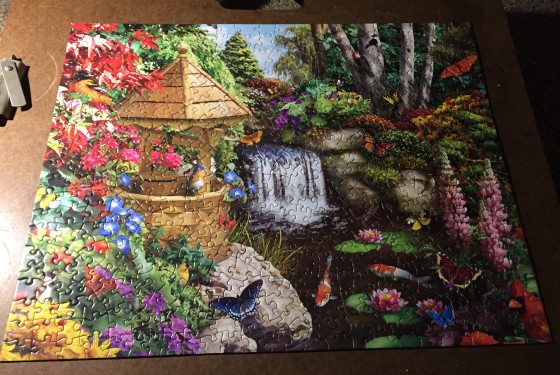
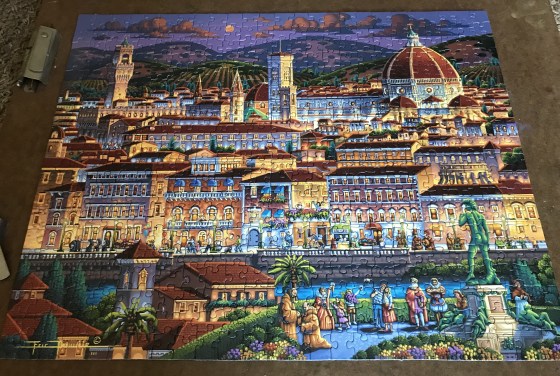
Here are several of the puzzles I/we finished at home. Apologies again: as with most other photos in this blog, I never intended to post these online, so the photo quality is lacking. I’ve added info on where these puzzles can be found in case anyone is interested, especially if you’d like to see what the pictures look like under ideal conditions.

“Secret Garden” by Alan Giana (Bits & Pieces, 500 pcs, Amazon.com): I was looking for a peaceful oasis and this image fit the bill. I loved the flowers and flying creatures, but particularly the koi, which brought a special zen to the picture. (Bad lighting – doesn’t do it justice!)

Summer_Puzzle

“Marvelous Garden” by Oleg Gavrilov (Bits & Pieces, 500 pcs, Amazon.com): I love peacock blue, the architecture smacked of Tuscanny and the flowers (yes, pink ones) completed the scene. This remains my favorite puzzle to date.

Peacock_Puzzle

“Autumn Oasis II” by Alan Giana (Bits & Pieces, 500 pcs, Amazon.com): Autumn means that Halloween/Thanksgiving/Christmas are coming up soon, and after such a miserable year of fear and cancer treatments, I was so looking forward to a joyous holiday season.

Autumn_Puzzle

“Florence” by Eric Dowdle (Dowdle Puzzles, 500 pcs, dowdlefolkart.com but purchased at Costco): I missed visiting Florence during a European trip due to scheduling conflicts, but it remains one of my most-wanted cities to tour. Seeing Michelangelo’s David in person is on my bucket list! I particularly liked that this puzzle came with a little poster of the image that made putting it together a serene pleasure. The last thing you want is to get headache trying to match up teeny windows!

Florence_Puzzle

The Problem With Pink

The breast cancer awareness movement has done a good job of bringing cancer awareness to the forefront. Especially in October, which is Breast Cancer Awareness Month, it’s hard to see pink without thinking of breast cancer. This is particularly true for someone who has gone through cancer treatment, but I expect that many who haven’t strongly equate the color with the cancer too.

Certainly, it doesn’t hurt to distribute pink “Save the Boobies”-esque stickers, t-shirts and wrist bands. It’s acceptable to say “boobies” in polite company, to broach the subject of women’s health, and this push to pink-out everything has resulted in more funding for cancer research. People probably think it’s cooler to have “boobies” on your wrist band than something like “Save the Pancreas”, the cancer of which has a much higher mortality rate. But a pancreas doesn’t look as good in a bikini top.

There is a darker side to this, and it has nothing to do with the usual arguments against pinking everything out, which tend to be about companies making profits at the expense of women. This is about what it feels like to be diagnosed with breast cancer.

At some point, awareness hits a saturation point. I’m willing to bet that many women who have been diagnosed with breast cancer dislike the color pink on some level. The diagnosis is life-disrupting if not traumatic, and the constant reminder from all the pink ribbons and other paraphernalia can get nauseating. And I do mean that in a physical sense. For me, diagnosis = anxiety; anxiety = nausea; pink = breast cancer…well, math was never my strong suit, but this all adds up to pink = nausea.

As I sat alone waiting for my surgery, feeling very nauseated, my Nurse Navigator paid me a visit. Incidentally, these nurses are the greatest thing since sliced bread (probably even better!), as they are a knowledgeable liaison between the patient and everything medical. In any case, my nurse brought me a goodie bag. Yes, it was pink and it contained various useful items relevant to my surgery and future treatments. And yes, most of these items were pink too. I guess these days it’s hard to justify using any other color if you’re talking breast.

But there was one thing that was not pink, and it’s because it wasn’t pink that I realized right then and there what sort of a visceral response I’d been having to all the pink stuff. It was a soft and springy heart-shaped pillow to be placed in the armpit to comfortably support the affected arm after surgery, and it was purple. Okay, with pink accents, but close enough. It was PURPLE!

PurpleHeart

This is a good place to mention that I make strong associations between emotions and my environment. This is a form of contextual conditioning. I’m sure I’ll write more about that in the future, but for now, I can tell you that having something not-pink that I used daily until my incisions healed, and having it be completely relevant to breast cancer treatment…but again, not-pink…actually took the edge off my anxiety. I was more likely to reach for it because at a time when I needed to relax and recover, the color didn’t remind me of my cancer.

That may sound unbelievable, but contextual conditioning is like that. I love that pillow and I love that it’s purple. And it’s really pretty amazing how my brain perceives that squishy little purple pillow as being so nice to have around. Don’t think I would have had the same response had it been pink.

A Year With Tamoxifen

One of the most distressing parts of going through cancer treatment was that I thought it would “ruin everything”, even if it saved my life. Physically, I was really enjoying my 50s and hadn’t noticed much of a drop in endurance and strength, and certainly wasn’t experiencing menopausal symptoms. But with my diagnosis came the news that, because I had an estrogen receptor positive tumor, I’d need to be taking estrogen-blocking Tamoxifen (or an aromatase inhibitor) for a decade.

A decade is a long time! Chemo was only six courses over about four months and radiation lasted only six weeks — all time-limited and psychologically doable. But Tamoxifen would be with me for ten years, and presumably, so would the troublesome side effects, according to just about every woman who was taking it. They spoke about how difficult it was to stick to the daily regimen, knowing that it was responsible for horrible hot flashes and night sweats — one woman even said that she couldn’t exercise due to the severity of her symptoms.

Not exercise?!?! My version of hell: a sedentary existence.

At this point, I was busy dying a thousand deaths. I started to question whether death by cancer was a preferable alternative to a decade of misery. Mind you, I hadn’t even begun taking Tamoxifen yet; all of this was fear-driven. I feared having no control over my own existence and the things that really mattered to me. Basically, this was an end to life as I knew it.

So, fast forward to today. I have been on Tamoxifen for a year. I’m still waiting for the misery. Please note, I do not, for a second, doubt that women struggle with Tamoxifen’s side effects and I have the utmost sympathy for them. I also realize that I’ve been very fortunate so far to not have those types of symptoms. Sometimes I feel a little warm and have to roll up my sleeves or take off a sweater. Being in stuffy rooms can feel uncomfortable. But these don’t constitute what has been described to me as a hot flash, and I cannot recall whether I had those same sensations prior to treatment. Before my diagnosis, I’d had some sweaty nights from stress; I haven’t had a single night like that since starting Tamoxifen.

I do have some memory issues, particularly distractibility and loss of focus. Sticking to one thing at a time is an absolute necessity or else I’ll get sidetracked. My libido took a hit too. But is that Tamoxifen, effects of chemo…or just the onset of menopause?

The bottom line is, I had beaten myself up over potential effects of a medication way before I’d experienced it. I’d ignored the number one rule of cancer: everyone’s experience is different. Oddly enough, that had been the mantra I repeated to everyone else, but I’m the one who needed the reminder. For me, Tamoxifen has not turned out to be the torture that I’d expected.

If there’s a take-home message from this, it’s that cancer is a complex disease and its treatment is equally complex. Just as there is personalized medicine, there are individual reactions to that medicine. I, for one, have convinced myself that I need to stay off the Internet, take a deep breath and have my own experience.

Gratitude for Community

My teenage daughter had her eyebrows threaded for the first time (her decision). The threading salon came highly recommended and it was bright and inviting with a peaceful vibe. On the wall by the entrance was a sign next to photos of the owner’s lovely children: “I am not lucky, I am blessed.”

Ok, you probably see where I’m going with this and it has nothing to do with eyebrows. As I waited for my daughter I read the sign over and over again and felt a rush of warm fuzzies. I feel the same way, not simply lucky, but blessed. And in that comfy little shop, I thought about where I was a year and a half ago, scared and disoriented after my diagnosis, feeling like my world was crashing in on me. That seems so far away now.

Later, I was less frantic and lost, but saw a future only as far out as my hand, living treatment to treatment, riding a roller coaster as I went from one new medical experience to the next. But even in the midst of treatment, when I took a moment to stop and look around, I knew that I had so much to be grateful for. Not the least of this were the people who cared for me: brilliant doctors, nurses, therapists and administrative personnel. When I pause to consider my treatment experience, the warmth of these people is what leaves me with such a positive feeling. It was the community of care that made a huge difference: the attending nurses in the infusion room, the radiation therapists that I saw daily for weeks, the other cancer patients, most of whom I never met, but with whom I shared the work of putting together a jigsaw puzzle in the waiting room as we all came for treatments throughout the day. That sense of community, of never feeling alone and always being supported, that’s what makes me feel so blessed right now.

Yes, when I finished my infusions, when I finished radiation, I jokingly told these wonderful people that I hoped I’d never see them again (they get that a lot), but every time I think of them, I am overwhelmed with gratitude.

When Deep Breaths Don’t Calm

It’s an obvious understatement to say that getting cancer is stressful.

My treatment plan involved a lumpectomy first, then chemo and radiation, but just getting to the surgery wore me out emotionally. I’ve written before that I’d never experienced anesthesia before, certainly never had major surgery…and add to that, the surgery would confirm how far my cancer had spread so I was apprehensive about the whole thing.

Suffice it to say, I didn’t handle this process well. Two weeks prior to surgery, I had begun a mindfulness meditation practice at the suggestion of my radiation oncologist. This was a life-changing step for me, but I hadn’t had enough experience with meditation for it to truly benefit me as I was sitting in the “ready room”, waiting for my surgeon. I knew I had to breathe, but it was hard to focus when I was terrified.

The “breathe deeply” mantra was repeated by a number of nurses, probably because I looked like a wreck. I can honestly say that breathing deeply, as hard as I tried, didn’t work. Months later, I came across an article (and unfortunately, I cannot recall whom to credit for this) addressing this issue. The problem with focusing on the breath during periods of extreme anxiety is that the breath is most obvious in the center of the body. You know, right where your racing heart is. I couldn’t separate out the two, and as I was trying to slow my breathing, I was acutely aware of the pounding in my chest.

So, here’s the advice that I would give now: find a comfortable position and focus on your hands. Feel into them and focus on any sensations present in them. Fingers are sensitive, so it’s likely that you’ll feel something. Is there tingling there? Are they numb?What’s the texture of the material that they’re resting against? If you feel nothing, rub your hands together and focus on those sensations.While this type of meditation (essentially a body scan) is often done with eyes closed, depending on the individual and how frightening the surroundings are, it might even work better to keep the eyes open and look at the hands. But really look, so that you draw your attention away from the beating heart, and then gradually try to slow your breathing.

The idea is to keep your attention away from parts of the body that remind you of how anxious you are.

I can’t say that I would have completely relaxed had I known to do this. I had been dealing with runaway anxiety for the past weeks that my rudimentary meditation had only begun to chip away at. But it’s possible that I would have gotten myself into a more comfortable state as I waited for surgery. Definitely worth trying the next time you find that a breath focus doesn’t help with anxiety.

Lifting My Spirits

I received an unexpected but incredibly satisfying compliment today. It was from a worker at Trader Joe’s who made a flattering comment about my arms. A little background here: I like to work out, and even obtained a personal trainer certification when I was a stay-at-home-mom. While I’ve never trained people as a profession, I have maintained my certification over the years — in addition to a vigorous training schedule. I’ve been told that this is unusual for “a woman of my age”.

When I received my cancer diagnosis, I was shocked largely because in my mind my lifestyle didn’t seem to fit the profile of someone at high risk. One of my greatest fears as far as cancer was concerned was that it would affect my ability to train regularly. While so many people engage in eye-rolling when it comes to exercise — it’s popular to equate exercise with misery — having to take time off from working out was one of the most horrible outcomes I could imagine. My version of hell involves a sedentary existence. I train hard to enjoy my life, to be able to move and lift and not feel pain. I work out to live and that energizes me like nothing else. And anything that jeopardizes that is a death sentence to me.

Okay, maybe a little dramatic? But you get my point. I.Love.Exercise.

Today’s compliment was particularly poignant. During my 2017 doctor’s appointment to check out that suspicious lump in my breast, the doctor’s assistant commented that she wished she had my arms. I remembered that as I went through diagnostic tests and oncology visits and surgery. I followed my surgeon’s orders regarding not lifting heavy things (well, mostly, because “heavy” is negotiable), but as soon as that time limit passed, I was off and running. Exercise meant normality, and I craved feeling normal, as in “not sickly and dying from cancer”. There was mention of this nasty impediment to my life called lymphedema. I didn’t really think about it much until I was discussing lifting weights with my oncologist, who said, “Exactly HOW MUCH weight are we talking about here?” and sent me to the lymphedema specialists so that I wouldn’t go full-Schwartzenegger without knowing whether I was risking having my arm blow up. (It hasn’t so far.)

But my point: the compliment I received today made me feel like I’d come full circle. While, yeah, fear of death from cancer is a biggie, drastic changes to one’s lifestyle are also anxiety-provoking.

Today, I felt, I’m back.