Staying Calm is the Best Revenge

(Title image: Image by Pexels from Pixabay)

Yes, revenge is not a nice word. But if you’re having “that kind of a day” it just might offer you the kick in the pants that you need.

Here’s an example: last week was hectic for me. There were additional work demands on top of which popped up all sorts of fires that I needed to put out. Things were not going smoothly, I missed out on exercise, wasn’t sleeping well, got a letter of rent increase, had an upset stomach—all of which were dragging me into a funk.

With all the negative things coming at me, I lost my emotional footing.

So…I decided to take revenge on the bad news, work emergencies and everything else.

And I was going to do it by not letting it affect me. I even wrote “revenge” on a sticky note and put it up on my computer monitor (NOT at work! At home, where it’s easier to explain myself).

Just say “NO” to allowing the negatives in life to run you ragged. You show ’em!
(Photo by Jon Tyson on Unsplash)

Like I mentioned at the top of the post, revenge brings with it all sorts of negative connotations. It’s kind of like giving in to the “dark side” and using your anger, frustration, despair and whatnot to overcome you. I’m NOT advocating for that.

But there is a certain fire and focus that the concept of revenge embodies…yes, we can call it passion, but I’m not in the mood for that. So I’ll stick with simple revenge with the understanding that sometimes, little rebels that we are, we will do exactly the opposite of what the situations are drawing out of us. Just because.

Freak out? No, you bully, watch me remain calm. Heart starts racing? No no no, I soothe myself with deep breaths and extended exhales. Scary thoughts fluttering wildly in my head? Nope, I bring my attention down to my feet and seat, settling down into where I am now.

No temporary wrinkles are going to ruffle me. And I know that all these things are TEMPORARY. This might be fierce defiance that I’m dipping into, like a recalcitrant toddler, but if it works, it works.

~~~~~~~~~~~~~~~~~~~~

This is probably not what the great teachers of mindfulness had in mind…but, ehh, today I’m not playing nice.

“Lightening Up”: A Breathing Visualization

(Title image: Photo by Josh Rangel on Unsplash)

Since I’ve found my stress levels higher this year, I’ve been playing with ways to quickly calm myself down.

Here’s one that I’ve been using lately. It’s very simple and involves a basic visualization, but has also been effective in grounding me fast.

And it goes like this…

Sit comfortably on a stable seat with a dignified upright posture, not too rigid, not too loose. Close the eyes or, if you prefer, soften your gaze with eyes cast downwards.

Then start slowing your breath, deepening your inhale and extending your exhale. Not focusing on a particular part of the breath cycle, but more on your entire body, noticing it rock with the breath, feeling it settle with every exhale.

Every inhale gives you a lift.
(Photo by Florian Klauer on Unsplash)

As this becomes comfortable, start visualizing the expansion and contraction of your body, as if the breath were a hollowing out of your insides. Imagine that inside you there is a space like a balloon. And the inhale is an inflation of the balloon, with the exhale a gentle relaxation of that stretch.

No need to imagine specifics about the balloon, what’s important is to notice the stretch and an opening inside as the air flows in, the expansion releasing muscles that might be tight from stress. And then, as the air flows out, notice the softening and relaxation of the body.

As you continue the inhale and exhale, feel the lightening of the body as it expands, followed by the gentle sinking as it contracts. See if you can notice yourself lift off as you breathe in, as if you were filling up with helium. But then settle into your seat as you breath out.

Continue like this, noticing yourself get progressively lighter, so that when you settle with the exhales, you still maintain some bouyancy.

This type of breathing meditation helps me “lighten up” when I feel overwhelmed, like I’m getting crushed by whatever the stressor is. Putting focus on the body keeps me out of my head and the deep breaths are soothing.

Hope this helps you too!

Rappeling Down through the Strata: A Grounding Exercise

(Title image: Photo by Outward Bound Costa Rica on Unsplash)

It’s been a very weird few weeks for me. My stress levels have been climbing, and while I can kind of, sort of point to certain anxiety-provoking events that might be responsible…there’s nothing truly significant that would elicit this type of response.

Regardless, I’ve been spending more time in the “higher strata” of myself, and I don’t mean this in a good sense. Another way of putting it is that I’m all up in my own head, bouncing around and being pummeled by all sorts of thoughts, expectations, fears, unreasonable beliefs and the like.

Oooo, there I am, stuck in my own head.
(Photo by Taylor Brandon on Unsplash)

Usually I know when this is happening, but this time I was too preoccupied with the worries of those around me that I didn’t notice myself drift up and stake a camp in the swamp of my mind.

Even my meditations tended to get stuck up there. Time to rappel down.

I get myself down this way: first by acknowledging the mess that I’m dealing with in my head, the rainstorm whipping up swirling thoughts. Not all my concerns are unreasonable, but they are pointless to get hung up on in this moment.

Next, I focus on the noise on the street outside (there is always noise on our street, but the longer I listen, the greater chance that I’ll hear a bird or other wildlife sounds). I bring my attention out to the expanse around me—getting out of the cramped space between my ears.

That’s a nice break. But I can’t ignore myself forever. So I feel into the sensations on my face: the feeling of the air (hot or cool), noticing the weight of my glasses on my nose, perhaps an itch on the scalp or cheek.

And here I go, rappeling down to a place where I can ground myself and return to the present moment.
(Photo by Ben Kitching on Unsplash)

Then I drop down to my neck and shoulders, giving them a roll as I go, and then towards my chest. Here I pause and bring focus to my breathing. Usually that results in an automatic slowing of the breath, as I notice my ribs expand and contract.

But after a brief stay I rappel down and out more quickly, into my hands and feet. Noticing how my hands feel on whatever surface they lie. And how my feet feel against the earth.

I imagine that my feet are part of the bedrock, joining the rest of the Earth’s crust. Connected and solid, forming a stable base.

And from down here, I look back up to where those clouds around my head were bringing furious rain, and they seem so far away. I’m peaceful and unruffled here on the ground. Down here is what’s really happening in the present, without being affected by the past and future. And what’s happening is just what’s happening, neither good nor bad.

Taking a deep breath, maybe a yawn, I stretch my body out the way I do when waking from a long sleep, enjoying the slight shiver of the muscles.

And then, on to the rest of my day a little bit calmer.

“The Resilience Challenge”: Research Study and Master Class Registration

(Title image: Photo by Jumpy Wizard on Unsplash)

This is a time-sensitive opportunity for US residents!

NOTE: all links are described at the bottom of this post.

I unexpectedly came across a great opportunity for those of you interested in taking a master class in stress management and also participating in a large research study.

Dr. Judith Moskowitz, a research psychologist at Northwestern University’s Feinberg School of Medicine, is recruiting 20,000 participants for an online, self-guided, positive emotions study/class. The course will teach eight science-backed stress reduction skills over 5 weeks, with the 6th week being a practice and review period (the entire length of the study will be 12 weeks). The skills being taught involve the following (from this National Public Radio (NPR) article):

  1. Positive Events
  2. Savoring
  3. Gratitude
  4. Daily Mindfulness
  5. Positive Reappraisal
  6. Self-Compassion
  7. Personal Strengths
  8. Attainable Goals

Additionally, NPR has an accompanying 5-week newsletter series called Stress Less that will help reinforce these skills. Signing up for that can be done here.

This other article from NPR talks about both the newsletter and the study/class.

More information and the registration link can be found on Dr. Moskowitz’s site where she describes what’s involved. To participate, you must be over the age of 18, living in the United States and have reliable internet connectivity as this is 100% online. There will be questionnaires to complete about your emotional states at the beginning and end of the study, and you will get nightly homework.

Consistency is the way to grow positive skills and behaviors, which is why I’m looking forward to participating in this class.
(Photo by Jane Thomson on Unsplash)

While the “nightly homework” thing might seem like too much, I can personally attest to the fact that consistency is what strengthens skills and habits. You keep yourself accountable by committing to a daily practice. For me, knowing that a course is set up for working on a little every day is actually quite reassuring—I know I’m more likely to get results.

But do these skills really work in reducing stress? Dr. Moskowitz herself said that she was initially skeptical that skills like these would make an appreciable difference, but years of positive research results changed her mind. The idea is to train your brain to experience good feelings.

I love programs like this because the only cost is a little effort on your part. If it doesn’t seem to work for you, you haven’t lost much, but if it works, the rewards can be life-changing.

As a cancer survivor with anxious tendencies, I find this to be a win-win proposition. I have signed up, as have several members of my family. If you are interested, don’t wait! The study is limited to the first 20,000 registrants and when the original NPR story came out on Monday, September 30th, the response was so overwhelming that it effectively shut the regstration site down.

Registration resumed on October 2nd and as far as I know there are still spaces available.

But the enthusiastic initial response to the invitation to join in the research was quite telling. So many of us are looking for a way to reduce our stress levels and bring more positivity into our lives. This challenge is one more way to do that.

~~~~~~~~~~~~~~~~~~~~

Links with descriptions:

NPR audio story featuring the Resilience Challenge: https://www.npr.org/sections/shots-health-news/2024/09/27/nx-s1-5082364/anxiety-stress-positive-coping-class-skills

NPR article featuring the Stress Less newsletter and Resilience Study: https://www.npr.org/sections/shots-health-news/2024/09/28/nx-s1-5084630/anxiety-stress-relief-tips-strategies

The Resilience Challenge registration information and link: https://www.moskowitzlab.com/resilience

NPR Stress Less newsletter sign up: https://www.npr.org/newsletter/stress-less?&utm_campaign=hpstory

I Saw My Oncologist…and Left Ridiculously Happy

(Title image: Photo by Nick Fewings on Unsplash)

Yep, this is another installment of “I had another oncologist appointment today”. This time I’m marking seven years since completing my chemo treatment, which I can assure you at the time was a very happy event…

…marred only by that little nail infection a few weeks later. But don’t go there unless you have a strong stomach.

Regardless, I had a great meeting with my oncologist. The concern now is about whether I’m experiencing anything cancer-related, either long-term side effects or—perish the thought—a recurrence. Today the answer was neither.

We talked about the recent death of my father…and that’s pretty much the way the appointment went–catching up on the last six months. Naturally, I forgot to tell him about a bunch of the other concerns I had, little weird things in my body. But really, they’re not unusual given what I’ve gone through.

If there’s one thing I’ve learned, it’s that I need to slow down when interpreting body sensations as health problems. Usually they’re not. (Even though once they were cancer.)
(Photo by LOGAN WEAVER | @LGNWVR on Unsplash)

We did, however, discuss how it takes a little while to get used to all those sensations in your body. After cancer, I was on high alert. My medical team was asking detailed questions about what I was feeling, and as a result, I was laser-focused on every twitch and twinge…and maybe some that I just imagined. At one point, I was sent for a brain MRI because of what I feared were serious cognitive issues. But in reality it was anxiety, not a tumor.

Seven years out, however, you kinda get expect all those funny sensations and don’t interpret them as being dangerous anymore. Even the heart palpitations that I would get from time to time…yeah, I still get those, maybe once a week, maybe a couple of times a month. But they only last a handful of seconds and I no longer think that my heart is failing (especially not when I can turn around and do a HIIT workout). I haven’t been back to the cardiologist and my oncologist agrees that it’s not necessary.

He asked if I wanted to come back in six months. Sure, I like being back in the Cancer Center as *NOT* a cancer patient. It’s nice being there and remembering doing jigsaw puzzles in the radiation oncology waiting room, or even feeling well-taken-care of after my treatments were done. There ARE positive memories in a place that you’d think would only be negative.

That can change very quickly, of course. But for the time being, I’m feeling happy.

Entering a Dimension of Calm

(Title image: Photo by Ksenia Makagonova on Unsplash)

One of the amazing “side effects” of meditation for me has been that the calm I experience while I’m on my meditation cushion has been leaking into the rest of my life.

This did not happen overnight. As a matter of fact, it took a number of years (I am currently on 7+ years of daily meditation). But through the ups and downs of my sessions, there’s been a wonderful build-up of grounding and calm.

Yes, I still get smacked with a powerful wave of anxiety from time to time. But recovery is quicker and I don’t feel like I’m being dragged under, disoriented.

The raw dimension is slippery and loud and agitated.
(Photo by Martin Adams on Unsplash)

What I have been feeling lately is that there is a dimensionality to how I experience the world. It’s like this: there is the raw world, which has lots of hard edges and bright lights–overexposed, washed out colors–and loud noises. That’s the world I used to live in exclusively and it felt like a whoosh flying at me and pulling me in, allowing no control over what was hitting me, nor much of a way to steer myself.

But now, I’ve transcended that dimension somewhat. I’ve found a much more grounded dimension, perhaps a more soothing shade–think “golden hour”. The colors are deeper, the pace is slower, the sounds are gentler, the edges are softer. In this dimension, I find my roots quickly, feeling my feet on the floor and connection to the earth, to what is stable and unchanging.

The calm dimension invites deep breaths and beckons us into the present moment.
(Photo by Jasper Boer on Unsplash)

Here, I hear my breath and feel the tingle in my hands. I notice when I’m clenching my jaw, furrowing my brow, hunching my shoulders. I am also aware of when the raw dimension starts pushing to the forefront and am able to prioritize creating a safe space so that I don’t leave myself exposed.

This may sound very woo-woo but I assure you it’s not. It’s very much down-to-earth and sensible. There is no otherworldly magic at work. Just the understanding that my nervous system needs to feel safe and stable, and that I can offer myself a protective shield not by running away, but by settling into where I am.

It is as if there is a comfy blanket that I draw around myself, and from there I sit and watch and process and, if necessary, deflect the things around me. This is the gift that consistent meditation along with mindfulness have given me, and it feels like for the first time I’m experiencing life the way it was meant to be lived. Not as something to dodge and weave around but something to grow with.

Pictures at an Exhibition: Re-framing Your Fears

(Title image: Photo by Dannie Jing on Unsplash)

I have a history of getting myself wrapped up in future fears and past regrets. It can be terrifying and difficult to shut off, especially during very stressful events.

I have to be honest, there was a time when I was afraid that if something seemed so real in my head, something I could describe in fine detail and feel the fear via physiological responses in my body, it was more likely to come true.

I don’t know how that actually started. It might have been some form of “magical thinking” that suggested that if I’m having a response, it was a premonition that accurately predicted the future. Or maybe I was so frightened by how real it felt. Regardless, it was difficult to shake.

With the help of mindfulness, meditation and expert guidance from a counselor, I found it easier to notice when this was happening. It took years to get to this point and the shift was very gradual.

It’s not a perfect shift, however. From time to time, I still get run through the wringer by fearful thoughts so I’ve developed a silly practice to help myself defang this beast. When I realize I’ve been caught, I grab the thought and run to the nearest art gallery–in my mind.

It’s the ability to step back and put space between yourself and your fears that makes this such a helpful practice.
(Photo by Xavier von Erlach on Unsplash)

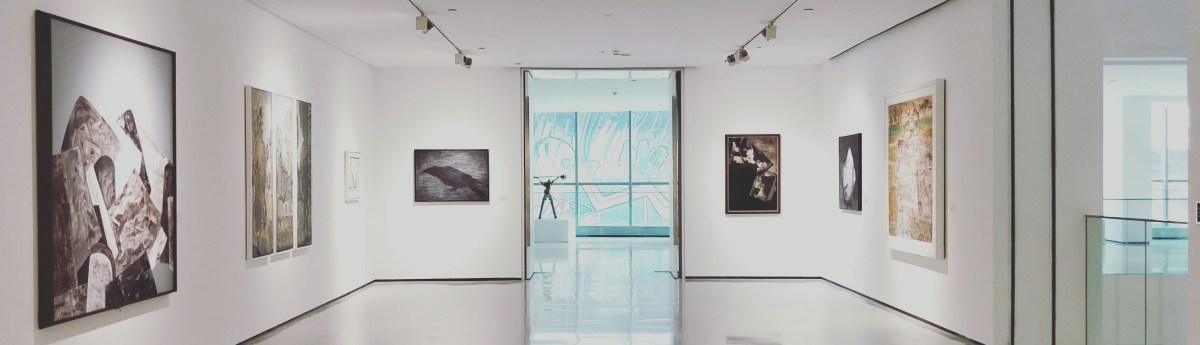
Yes, I realize this sounds strange, but hear me out: (1) I recognize that an anxious thought is particularly sticky, (2) I compress it into a two-dimensional image, and (3) place it in an imaginary frame on an imaginary wall in an imaginary environment that I define, and finally (4) I step back to give myself some space–as if I were at an art gallery evaluating a painting–and note that it is only a picture, one that I could potentially remove from the exhibition and send to storage.

Then I ground myself in the present, feeling my feet on the real floor where I actually am.

This kind of manipulation requires some imagination and, like I mentioned, this practice can seem a little silly. But it does help to recognize that the thing that elicited such a strong response in us is really just a simple thought. We can choose what to do with that thought.

IMPORTANT: I acknowledge that the physical responses are real and they might be driven by the real possibility of something bad happening. We don’t have a crystal ball to tell us with 100% certainty what will take place in the future. But what we do know is that nothing is happening now. If you can clear the foreboding images out of your mind you will realize that in this moment you are safe. And that is a very comforting place to be.

Exactly Where You’re Supposed to Be

(Title image: Photo by David Paschke on Unsplash)

Some time ago, I was thinking how I got to where I am and was seized by a sense of regret and shame. This was not where I thought I’d be by this age.

So many things that I’d worked for education-wise, health-wise, career-wise seemed to have been derailed by decisions I’d made based on life circumstances that I didn’t feel I could control…or by just plain bad luck (cancer, I’m looking at you).

As I pondered this, I became enveloped in it, slipping down a dark hole, trying to squash those negative feelings—the ones that get buried for a while only to pop back up at 3am some night.

But then I thought, “Ok, so how about another way of looking at this?”

What if how I am now was the end goal all along?

What if where you are right now is where you need to be for the rest of your life to work out according to plan?
(Photo by Jon Tyson on Unsplash)

And that shift in perspective allowed me to look at the things that I felt I hadn’t fully achieved as being “the plan” for creating me as I am now.

And what I am now is made up of the valuable experiences that I was labeling as half-done or poorly-executed or forced upon me—but no, perhaps they were all so necessary for setting up myself in this place with this knowledge. And from here, preparing me to move forward.

A master’s degree I haven’t used for a couple of decades, a job situation that falls below my career aspirations, a body that is limping back from injuries and cancer, a mind that can be my worst enemy. The experience of all of these brings with it wisdom and insight. And strength.

Where I am now is exactly where I need to be for the next chapter of my life. The foundation for future-me has been established.

So, how about you?

What if you spin the timeline around, understanding and appreciating who you are now, however “imperfect” it might seem to you, social media, whomever else serves as the judge of your life. This is now your starting point.

What’s your next step?

How can you take everything that’s come before you and allow it to support the incredible you that you will become?

I Am an Imperfect Yoga Teacher

(Title image: Photo by Cameron Raynes on Unsplash)

A couple of months ago I received an amazing invitation: to teach yoga to cancer survivors at our local Cancer Survivors Day event on June 1st.

What an amazing opportunity! The sole reason that I had gone through yoga teacher training and registered with the Yoga Alliance was to eventually teach cancer survivors. To have this invitation fall into my lap was serendipity at its very finest!

It was also terrifying.

Ever been offered an amazing opportunity and felt like you’re still a little too ‘green’ to handle it?
(Photo by Nagara Oyodo on Unsplash)

My first impulse was to run and hide under the most solid object that I could find. You know, sometimes you have great goals, but you don’t consider what you will do if you actually manage to achieve them. I didn’t feel confident that I was ready for something that had always seemed several years away.

But I still had enought time to prepare for this class. I had taken a specialty 5-hour training on teaching cancer survivors, I had 16 years of maintaining a personal trainer certification with a clinical/academic focus and, importantly, I was a cancer survivor myself. I kinda knew what’s what.

At the same time, I felt a nagging doubt. What if I created a yoga class that people hated? What if someone got injured? What if I couldn’t memorize the sequence, kept stumbling over words or blanked out in the middle of it?

The more I practiced the sequence with friends and family, the more opportunities I had to beat myself up over every time I said “right” instead of “left”. Or said “arm” instead of “hand”. Or anything else that seemed less than perfect. The possibility of looking like a bad teacher and shaming myself opened the door for anxiety to flood my mind.

Nothing quite like thinking you’re not good enough and then proving yourself wrong!
(Photo by Clay Banks on Unsplash)

Eventually, I recognized that I was driving myself nuts with unrealistic expectations. I also realized that this is a bad habit that I’ve fallen into on other occasions too. So I took some time to sit quietly and reflect on what was happening.

I am an imperfect yoga teacher. While I try to mirror movements for my students, I mess up once in a while (mirroring can be really hard!). I might not always use the right word to describe a body part. I might forget to mention a cue and then have to stick the instruction in later. I might even forget whether I forgot to say something!

But when the day came to teach to this amazing group of people, my students followed along without a problem. And you know what? After class, they clapped for me. My heart was so full!

I may be an imperfect yoga teacher but maybe that’s okay.

Kidney Stones: Errr, Maybe Not?

(Title image: Photo by 愚木混株 cdd20 on Unsplash)

So my health has taken an interesting turn.

About a week ago, I went to see a nurse practitioner (NP) for an interesting combination of symptoms: nausea and middle back pain. After listening to my complaints, she determined that the cause was most likely kidney stones.

So…I’m not the typical kidney stone sufferer…but I wasn’t the typical breast cancer getter either, so I accepted her diagnosis while we awaited lab confirmation of whether there was blood in my urine (TMI, sorry).

And then I proceeded to waste an entire weekend on the Internet, driving myself bonkers about what foods contained oxalates (a common kidney stone culprit) and how to combine foods that did with calcium, but not too much calcium.

I was treading in the Wild West of the Internet and I soon learned that kidneys are big business and everyone not only has an opinion, but is also selling something.

Kidneys = $$$ and clear and concise info was harder to find than I anticipated. More stress!
(Photo by JESHOOTS.COM on Unsplash)

At the same time, except for one relatively bad night with a lot of pain, most of my symptoms remained mild-ish. Definitely not “hurts more than childbirth” level.

However, as a result of this, I was afraid to eat, which seemed to increase the pain and I realized that it was actually kinda sorta in my stomach?

Four days after submitting the urine sample, my NP called with the results: no blood in the urine.

That made the “kidney stones” story more difficult to believe. So after more discussions with her, she settled on the possibility that I might just be experiencing particularly bad heartburn and prescribed omeprazole to reduce the levels of acid my stomach produces.

This actually made a lot of sense to me. I am one of those “stress non-eaters”: in difficult situations I lose my appetite quickly, go for longer periods without eating and tend to lose weight. That leaves a lot of time for my stomach to sit empty.

But this also brings up another point that I find personally interesting. I have consistently been doing better with handling general stress and anxious episodes. I now have a plan for stress that includes understanding my reactions and using mindfulness, meditation and exercise. As a result, I experience far fewer episodes of runaway anxiety.

Stomach, stress…it all feels like fire.
(Photo by Yaoqi on Unsplash)

However, I am not able to control everything that happens in my body. I might be able to soften my response to stress and anxiety, but over the long term my body may still show signs of wear and tear from the pressures that I face.

This may also mean that while I’m doing great with keeping my stress levels lower, I might not be doing as great as I think I am. If this is truly “heartburn” or a little ulcer or something, it’s a reminder that managing stress is a constant process that requires vigilance.

Oh, and there’s also the oxalate thing, which my NP said not to stress over since it’s probably not a kidney stone. Which is good. Except now I’ve bought a bunch of low-oxalate foods, a number of which are the ones that I learned I should avoid for stomach issues.

Health is becoming a nonstop game of whack-a-mole.