The Dangers of Elle Macpherson’s Cancer Treatment Choices

(Title image: Photo by Naser Tamimi on Unsplash)

Supermodel Elle Macpherson recently made the news with an interview with the Australian Women’s Weekly magazine when she revealed her breast cancer diagnosis.

She was diagnosed in 2017 (as I was!), so the fact that she’s here and talking about it suggests that her treatment worked.

But what was her treatment? According to the article, following diagnosis Elle consulted with 32 doctors (and experts, although it’s unclear in what) and ultimately decided to follow a holistic treatment path. In her own words, “an intuitive, heart-led, holistic approach”.

She decided to forego a mastectomy in favor of a lumpectomy (as I also did) but also dispensed with the conventional chemotherapy, radiation and hormone therapy (I went the conventional route).

So let me clarify some things here: Elle had the lump removed. If the cancer had not spread (which presumably it hadn’t) AND no rogue cancer cells had gotten out AND the surgeon confirmed “clear margins” upon excision of the tumor, it’s certainly possible that all evidence of the cancer was removed from Elle’s body with that surgery.

As we survivors know, everyone’s cancer is different. That’s why we discourage comparing tumors or offering advice. What works for one person may not for another because so much depends on the state of the individual…and probably on a lot of other factors that we are not even aware of, even with present day advances in cancer treatment.

Elle has even stated that her treatment is not for everyone. Who knows, she might have said this for legal reasons…because you can see what’s going to happen. While Elle, as a former supermodel, businesswoman, etc., might have access to whatever specialists and level of care she desires, most of us will not.

Do you feel lucky? Rejecting conventional cancer treatments in favor of clinically unproven ones can be a big gamble.
(Photo by Chris Liverani on Unsplash)

Elle asserted: “I want to help and encourage others to follow their heart and give things a go.” Sadly, when it comes to something as slippery as cancer, following our hearts is not always the best choice of action, no matter how much we want it to be.

My concern is that a newly-diagnosed breast cancer patient, fearful of the admittedly-harsh treatments that modern medicine offers, might decide to take Elle’s path (“she did it so I can too!”). But unless this person is independently wealthy or otherwise connected, they will have to cobble together a questionable plan with minimal support, and possibly fall prey to unscrupulous players looking to make a buck out of someone’s desperation.

And in these days of growing suspicion of science and the advice of doctors—brought on by pandemic-related missteps or perceived draconian measures—the chance of patients rejecting well-worn treatments is even more likely. Statistically, this would result in more lives lost to the disease.

When I made my own treatment choices, I didn’t go with the harshest stuff that my oncologist offered, opting for very effective (and, yes, cardiotoxic) Herceptin immunotherapy instead of lobbying my insurance to cover the even-more-effective (but even more toxic) Perjeta for my HER2+ cancer. I also had to cut my hormone therapy short by a number of years due to how it affected my ability to exercise, which has also been shown to have a strong effect on preventing cancer recurrence. These were measured choices, as it’s clear that Elle’s were.

At the same time, in the back of my mind I know I can’t say I did everything I could to blast my cancer into submission. But I do feel that taking everything into consideration, I did enough. My oncologist agrees.

As far as Elle’s treatment is concerned…I also did a number of things that she did, including meditation, exercise, therapy (our cancer center was very supportive of complementary therapies) and more. I cannot say how much conventional treatments vs. complementary ones contributed to my remission, but I assume each played a role. And the combination gave me peace of mind, which I would not have had, had I chosen only alternative therapies.

Ultimately, I hope we get to the point where we can eliminate the most toxic treatments and heal ourselves more gently. Ideally, we’d even prevent cancer. Huge strides have been made in cancer treatment, but we are not there yet. Every time we decline a proven treatment, we roll the dice. I’m hoping that Elle’s story does not unnecessarily put people with fewer resources at risk.

I Saw My Oncologist…and Left Ridiculously Happy

(Title image: Photo by Nick Fewings on Unsplash)

Yep, this is another installment of “I had another oncologist appointment today”. This time I’m marking seven years since completing my chemo treatment, which I can assure you at the time was a very happy event…

…marred only by that little nail infection a few weeks later. But don’t go there unless you have a strong stomach.

Regardless, I had a great meeting with my oncologist. The concern now is about whether I’m experiencing anything cancer-related, either long-term side effects or—perish the thought—a recurrence. Today the answer was neither.

We talked about the recent death of my father…and that’s pretty much the way the appointment went–catching up on the last six months. Naturally, I forgot to tell him about a bunch of the other concerns I had, little weird things in my body. But really, they’re not unusual given what I’ve gone through.

If there’s one thing I’ve learned, it’s that I need to slow down when interpreting body sensations as health problems. Usually they’re not. (Even though once they were cancer.)
(Photo by LOGAN WEAVER | @LGNWVR on Unsplash)

We did, however, discuss how it takes a little while to get used to all those sensations in your body. After cancer, I was on high alert. My medical team was asking detailed questions about what I was feeling, and as a result, I was laser-focused on every twitch and twinge…and maybe some that I just imagined. At one point, I was sent for a brain MRI because of what I feared were serious cognitive issues. But in reality it was anxiety, not a tumor.

Seven years out, however, you kinda get expect all those funny sensations and don’t interpret them as being dangerous anymore. Even the heart palpitations that I would get from time to time…yeah, I still get those, maybe once a week, maybe a couple of times a month. But they only last a handful of seconds and I no longer think that my heart is failing (especially not when I can turn around and do a HIIT workout). I haven’t been back to the cardiologist and my oncologist agrees that it’s not necessary.

He asked if I wanted to come back in six months. Sure, I like being back in the Cancer Center as *NOT* a cancer patient. It’s nice being there and remembering doing jigsaw puzzles in the radiation oncology waiting room, or even feeling well-taken-care of after my treatments were done. There ARE positive memories in a place that you’d think would only be negative.

That can change very quickly, of course. But for the time being, I’m feeling happy.

Reconsidering Yoga Adjustments

(Title image: Photo by Shashi Chaturvedula on Unsplash)

There is an expectation in the US that yoga practitioners are all young and flexible with great balance, but we know that’s not the case. Many people who might benefit the most from a yoga practice are certainly not.

When I started Yoga Teacher Training (YTT), there were two assumptions that most of us made:

“Full expression of the pose” is not accessible to every yoga practitioner.
(Photo by Carl Barcelo on Unsplash)
  1. Every yogi strives for the “full expression of the pose”, suggesting that there is one perfect way to perform a yoga asana.
  2. An important responsibility of a yoga teacher is to move students into the full expression of the pose, using hands-on adjustments if necessary.

Those two assumptions may:
(1) discourage students from yoga practice, particularly when you consider that yoga originally developed as a practice for men, and asanas do not necessarily take into consideration the female body (or diverse body shapes) even though the majority of practitioners in the US are female; and (2) may compel newly-minted yoga teachers to push students into positions that are wrong for their body shapes and can cause harm to them.

During YTT, however, we learned that the “full expression of the pose” as a concept was no longer taught and teachers were discouraged to refer to asanas in that way, no doubt in an effort to be more welcoming to a broad range of people.

My person belief is that hands-on adjustments are not necessary for yoga under most circumstances.
(Photo by Annie Spratt on Unsplash)

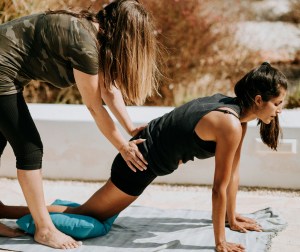
We also learned how to do hands-on adjustments. The idea was that you needed to check with the student whether they wanted to be adjusted.

However, I myself have received adjustments in classes that I hadn’t requested or agreed to. It’s never been harmful to me and generally felt good, especially in settings where I couldn’t check my form in a mirror. Futhermore, the classes tended to be higher level, so there was probably an assumption on the part of the instructor that you’re in a more intense class for a reason, otherwise you’d be in a lower level class.

But you can probably see where I’m going with this. I tended to be one of the oldest students in these classes. I’ve done yoga (and a range of other exercise modalities) for decades, but my flexibility and balance have taken a hit from cancer treatment and various injuries. Unless a teacher is sensitive to that, we can run into trouble.

Additionally, I’ve seen less-experienced students attend more difficult classes because they were coming with a friend or couldn’t get to the easier class that they wanted, and decided to just “do their best”. That should always be good enough without putting a student at harm.

Yogis come in different shapes, sizes and levels of flexibility…and that’s okay.
(Photo by LOGAN WEAVER | @LGNWVR on
Unsplash)

My personal feeling? Stick with gentle verbal adjustments to relay the spirit of the asana and cue according to the class’ level, understanding that students will have varying ranges of flexibility. I do not feel comfortable doing hands-on adjustments unless the student is requesting it AND I know the student well enough to be familiar with their limitations, if any. That means verbal adjustment for students in a general class vs. POSSIBLY hands-on adjustments for a student that I’m teaching privately, where we can talk through how the asana feels in their body. Quite often, I will forgo hands-on adjusting altogether.

Finally, I leave you with a quote from the YogaUOnline.com website. Charlotte Bell proposes a difference definition of “full expression”, in an excellent article titled, What is Full Expression in Yoga Practice?: “Full expression arises in a pose when our bodies are aligned such that the wave of the breath is free to circulate throughout the body. It also happens when we have invested our full attention into the sensations arising as we move and breathe in the pose. The full expression is not dependent on what a pose looks like.”

“I Can’t Do It…But If I Could…”

(Title image: Photo by Mick Haupt on Unsplash)

What would that feel like?

After a few weeks away for a funeral in my hometown, it’s not so simple to jump back into what I was doing before.

This has led to some ‘motivation’ issues (complicated by the grieving process, no doubt). As a result, I’ve been reviewing how I tackle difficult tasks. Before I undertake anything that I consider less palatable, it’s not unusual for me to have some sort of visceral reaction to the idea of the task. I think this is true for many of us. And we might not even be aware that this is taking place.

Encountering resistance to initating projects?
(Photo by Peyman Shojaei on Unsplash)

But if that response is strong enough and negative enough, it can shut down the possibility of accomplishing the task in front of us.

If we can’t get past that point, we don’t tackle the things we should. Unfortunately, those may be the kinds of things that help us grow personally, professionally, health-wise and the like.

So I have a suggestion for you. The next time you have that “ugh, I can’t do that” reaction, stop and consider:

* But…what if I could?
* How would I go about taking care of that? What steps would I take?
* What would it feel like to know that I was doing it?
* How great would it feel to be done?

When you start answering these questions for yourself, several things happen. You introduce the possibility of starting, making it less daunting. Sometimes that’s the hardest part. You open up a path for moving forward, breaking down what needs to be done into small steps. You may imagine yourself taking care of things and bring them into reality.

So what does this look like? Take cleaning as an example, something that I usually put off. “House cleaning” as a concept may seem like a monolithic undertaking. There are so many other things that I’d like to be doing, and many of them important. But consider, what might it be like to just, say, grab the vacuum cleaner and vacuum one area…yeah, that seems doable. And maybe after that, just empty some trash cans. How would it feel to do that? Not to get bogged down in the process but to move through it.

The “Done” List

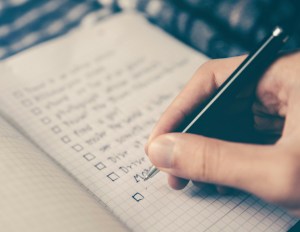
Try a different kind of list. Instead of (or in addition to) a “to-do” list, make a “done” list. Write down everything you’ve accomplished. It can feel really good to see what you’ve done and more positive than simply crossing off items on a “to-do” list since you’re adding accomplishments instead of taking away tasks.

Note your accomplishments instead of simply crossing out tasks.
(Photo by Glenn Carstens-Peters on Unsplash)

If you have a particularly difficult time getting motivated, split your already-split-up tasks up into even smaller parts: instead of waiting until you’ve “vacuumed the house” to write it down, note that you “vaccuumed the entry way”, “vacuumed the front part of the living room”, even “vaccumed the doormat”. It counts. Because no matter what you’ve done, it’s still better than not having done anything, even if it’s just one thing.

Let your own need for putting completed tasks behind you be the guide for how granular to get with this.

I do this when I clean. And, yes, my go-to is the vacuum to get started. Or sometimes the toilet. But it could also be doing the dishes, something that I’ve actually dreaded in the past but realized that it takes a surprisingly short time. Our brains are what stop us from proceeding so make the process rewarding to your gray matter.

Many of the tasks that we don’t undertake are simpler, easier and take less time than we anticipate (or fear!). The key is to not psych ourselves out, instead breaking them down into bite-sized pieces and recognizing their completion as a reality. Even if you don’t do it all, you’ve done part, bouyed by the knowledge that it doesn’t have to be perfect to count. This builds positive associations with getting things done.

No matter how much you do, it’s all good.


Staying Present in Discomfort: Being Here When You’d Rather Not

Title image: Photo by Tolga Ulkan on Unsplash

~~~~~~
Thank you everyone for your patience during this time of my father’s passing from cancer and dementia. I have appreciated the quiet visit to my childhood home, supporting my mother and being comforted by close friends and relatives.
~~~~~~

There are times that the present moment is an uncomfortable place to be in.

That’s when things are not going well and you want the current situation to be over so that you can move past it and onto healing. But one could argue that this is exactly the time you need to sink even deeper into the present moment.

And even more important to get more granular and still. To observe what is going on even more closely. To understand the important of this very point in time, how it will never come again in the same way. And even in this discomfort there is something to learn, something to lean into, something to accept.

I felt this strain while my father was still in in-home hospice, declining at a pace that was both quick and slow depending on what you’re focusing on. It evoked an axiety in me: wanting to hold on to him and save him–but knowing that this was an impossibility. The tug of time is unrelenting, taking everything with it like a glacier or a tsunami that continues onward no matter what is in its way.

But this is also an opportunity to remember that the impermanence of life does not take away from the joy and beauty of it. Dropping down into what is happening right now, taking a front seat on top of that glacier/tsunami, and allowing everything to be here is the way to appreciate all of this.

So while I would rather that the things that were happening not be happening, I couldn’t stop them. I sat here trying to understand my feelings and allowing gratitude for my father’s long life to remain in the forefront. There was peace in knowing that he was living his last days at home, in familiar surroundings with my mother there.

I could have made all sorts of stories up about what he was feeling or thinking, but the reality is that I didn’t know. So I didn’t pretend and instead noticed the sounds around me, the feeling of the air on my skin and the knowledge that my father’s imminent passing unscored all the many things about him and my own life that I have to be thankful for.

~~~~~~~~~~~~~~~~~~~~~~~

It’s easier to ignore reality and think about other things, but that doesn’t help us deal with them.

A Rock in a Bubbling Stream [Visualization]

(Photo by Hendrik Cornelissen on Unsplash)

There’s a lot going on in my family at this time, most importantly the transition of my father to in-home hospice care, signaling that a life chapter will be coming to a close. That’s one of those things that you know is going to happen but usually don’t want to think about.

It’s these kinds of changes that unsettle us the most because they’re significant shake-ups of life as we know it. In the case of my family, this change was not unexpected and yet it is still not easy.

The uncertainties associated with end-of-life issues can be unsettling.
(Photo by Pylyp Sukhenko on Unsplash)

But I can draw on my meditation practice and ability to stay present to accept things are they are now.

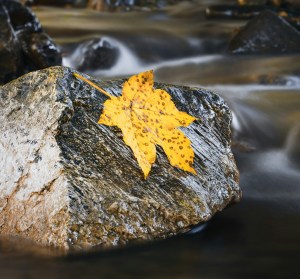
It helps to use a visualization in the midst of emotional upheaval. So I think of myself as being a rock in a rushing stream. You know, one of those rocks that sticks out about the water’s surface and might serve as a comfortable sunning place for a river turtle.

The rock sits still even thought there is a rushing tumult all about. The water parts around it and then rejoins on the opposite side, but the rock remains there, unmoving and unbothered.

The rock doesn’t hinder the flow but neither does it get carried away by it. And as it sits, so do I, observing and understanding and accepting everything that is going on around me. Not getting caught up in my head and taken away by thoughts.

Mindfulness meditation provides me with a stable rock from which I observe the tumult of life as it rushes by.
(Photo by Simon Berger on Unsplash)

There will come a time to grieve but now I focus on what is happening in the moment and how I can support my parents. There is gentle planning as I get more information about the situation. And always, taking deep breaths, feeling into my hands and feet, staying grounded. From this vantage point, I can clearly see what needs to be done today.

“This is what’s happening now. Tomorrow may be different, but at this point in time, I am here.”

So the coming weeks may bring shorter posts, perhaps a skipped one here or there. There will be much to do and it will all get done in time. Decisions will be made as they come up. Focus remains on each task at hand. Even if responsibilities come fast, I find a stable base in my practice that helps support a strong relationship with my family.

The river rushes relentlessly. But I know it’s there and expect the constant movement. Changes become familiar, fear drops away and I am comfortable where I sit, calm as I watch the waters flow past me and then continue onward.

Entering a Dimension of Calm

(Title image: Photo by Ksenia Makagonova on Unsplash)

One of the amazing “side effects” of meditation for me has been that the calm I experience while I’m on my meditation cushion has been leaking into the rest of my life.

This did not happen overnight. As a matter of fact, it took a number of years (I am currently on 7+ years of daily meditation). But through the ups and downs of my sessions, there’s been a wonderful build-up of grounding and calm.

Yes, I still get smacked with a powerful wave of anxiety from time to time. But recovery is quicker and I don’t feel like I’m being dragged under, disoriented.

The raw dimension is slippery and loud and agitated.
(Photo by Martin Adams on Unsplash)

What I have been feeling lately is that there is a dimensionality to how I experience the world. It’s like this: there is the raw world, which has lots of hard edges and bright lights–overexposed, washed out colors–and loud noises. That’s the world I used to live in exclusively and it felt like a whoosh flying at me and pulling me in, allowing no control over what was hitting me, nor much of a way to steer myself.

But now, I’ve transcended that dimension somewhat. I’ve found a much more grounded dimension, perhaps a more soothing shade–think “golden hour”. The colors are deeper, the pace is slower, the sounds are gentler, the edges are softer. In this dimension, I find my roots quickly, feeling my feet on the floor and connection to the earth, to what is stable and unchanging.

The calm dimension invites deep breaths and beckons us into the present moment.
(Photo by Jasper Boer on Unsplash)

Here, I hear my breath and feel the tingle in my hands. I notice when I’m clenching my jaw, furrowing my brow, hunching my shoulders. I am also aware of when the raw dimension starts pushing to the forefront and am able to prioritize creating a safe space so that I don’t leave myself exposed.

This may sound very woo-woo but I assure you it’s not. It’s very much down-to-earth and sensible. There is no otherworldly magic at work. Just the understanding that my nervous system needs to feel safe and stable, and that I can offer myself a protective shield not by running away, but by settling into where I am.

It is as if there is a comfy blanket that I draw around myself, and from there I sit and watch and process and, if necessary, deflect the things around me. This is the gift that consistent meditation along with mindfulness have given me, and it feels like for the first time I’m experiencing life the way it was meant to be lived. Not as something to dodge and weave around but something to grow with.

Pictures at an Exhibition: Re-framing Your Fears

(Title image: Photo by Dannie Jing on Unsplash)

I have a history of getting myself wrapped up in future fears and past regrets. It can be terrifying and difficult to shut off, especially during very stressful events.

I have to be honest, there was a time when I was afraid that if something seemed so real in my head, something I could describe in fine detail and feel the fear via physiological responses in my body, it was more likely to come true.

I don’t know how that actually started. It might have been some form of “magical thinking” that suggested that if I’m having a response, it was a premonition that accurately predicted the future. Or maybe I was so frightened by how real it felt. Regardless, it was difficult to shake.

With the help of mindfulness, meditation and expert guidance from a counselor, I found it easier to notice when this was happening. It took years to get to this point and the shift was very gradual.

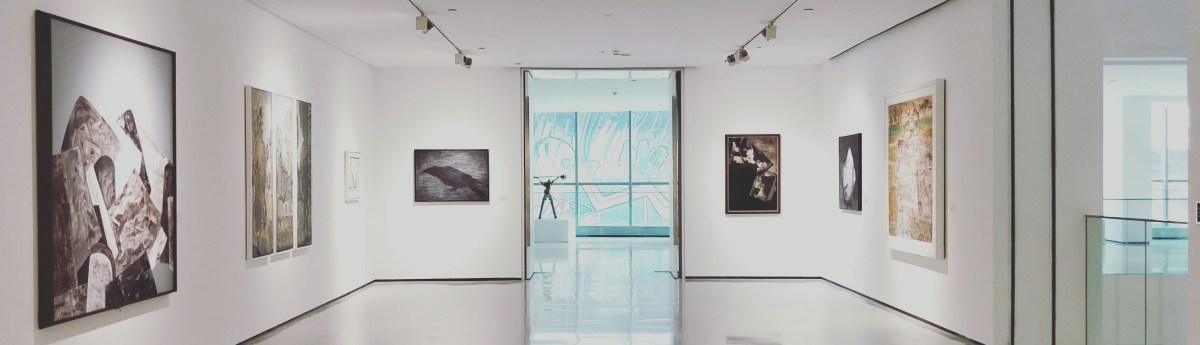
It’s not a perfect shift, however. From time to time, I still get run through the wringer by fearful thoughts so I’ve developed a silly practice to help myself defang this beast. When I realize I’ve been caught, I grab the thought and run to the nearest art gallery–in my mind.

It’s the ability to step back and put space between yourself and your fears that makes this such a helpful practice.
(Photo by Xavier von Erlach on Unsplash)

Yes, I realize this sounds strange, but hear me out: (1) I recognize that an anxious thought is particularly sticky, (2) I compress it into a two-dimensional image, and (3) place it in an imaginary frame on an imaginary wall in an imaginary environment that I define, and finally (4) I step back to give myself some space–as if I were at an art gallery evaluating a painting–and note that it is only a picture, one that I could potentially remove from the exhibition and send to storage.

Then I ground myself in the present, feeling my feet on the real floor where I actually am.

This kind of manipulation requires some imagination and, like I mentioned, this practice can seem a little silly. But it does help to recognize that the thing that elicited such a strong response in us is really just a simple thought. We can choose what to do with that thought.

IMPORTANT: I acknowledge that the physical responses are real and they might be driven by the real possibility of something bad happening. We don’t have a crystal ball to tell us with 100% certainty what will take place in the future. But what we do know is that nothing is happening now. If you can clear the foreboding images out of your mind you will realize that in this moment you are safe. And that is a very comforting place to be.

Take-a-Break Monday

(Title image: Photo by Clem Onojeghuo on Unsplash)

For anyone who’s been wondering, it is true that I did not post last Monday.

There was so much going on at home, including cleaning and prepping for out-of-town guests who were coming in for my eldest child’s university graduation that was taking place over the weekend.

I had so much to do that I knew trying to squeeze out a post would pile on even more pressure on top of what I was already feeling.

At the same time, I have a strong sense of responsibility that keeps me on track with all the things that I need to accomplish. This has been a very good thing that helped me establish a lot of healthy habits.

Can you tell when you’ve got pressure building up? And do you know when to slow down?
(Photo by Wim van ‘t Einde on Unsplash)

However, I’ve been mindfully reconsidering some of the rules that I’ve made for myself. Missing last week’s post was an opportunity to gently relax my stringent requirements for consistency, since what I really needed was a break.

It felt good to give myself permission to release at least one responsibility. And as soon as I made the decision to take a break for that one Monday, I realized how much my overworked self deserved that tiny bit of grace.

It also reminded me of going through chemo. Several infusions in, once the terror of unknown side effects had ebbed, I found myself relaxing into my chemo seat, knowing that chemo gave me an excuse to release all my “shoulds”. Don’t get me wrong, I wanted nothing to do with chemo and couldn’t wait for my treatment to finally be done. But there was also that strange relief that at least I could use the infusions as a reason for people to not expect too much of me.

It wasn’t until very recently that someone asked me whether I had been burned-out even before my cancer diagnosis. I realized that I had been under so much stress at work with responsibilities at home too, that all the anxiety associated with that was only relieved by getting cancer.

Pause. Breathe.
(Photo by Flash Dantz on Unsplash)

“Relieved by getting cancer”!!! What a ridiculous statement, and yet so true and telling. Sometimes we barrel forwards carrying so much responsibility (and, yes, guilt) that we don’t stop to question whether there’s a way to do this without driving ourselves into the ground.

And that, my friends, is why I’m forcing myself to stop pausing from time to time to reevaluate whether my expectations for myself are reasonable. No, that doesn’t mean practicing “deleterious self-care” that can be harmful–for the record, eating half a box of donuts in bed while binge-watching an entire season of a Netflix series does not qualify as true “self-care”, no matter what Instagram is trying to get you to believe.

Rather, I’m noticing where I am applying pressure on myself in a way that ultimately may have negative effects. It’s all about finding a healthy balance.

And so, there was no post last Monday. My hope for you is that you also take a break when it’s beneficial for you to do so. Have a great week!

Exactly Where You’re Supposed to Be

(Title image: Photo by David Paschke on Unsplash)

Some time ago, I was thinking how I got to where I am and was seized by a sense of regret and shame. This was not where I thought I’d be by this age.

So many things that I’d worked for education-wise, health-wise, career-wise seemed to have been derailed by decisions I’d made based on life circumstances that I didn’t feel I could control…or by just plain bad luck (cancer, I’m looking at you).

As I pondered this, I became enveloped in it, slipping down a dark hole, trying to squash those negative feelings—the ones that get buried for a while only to pop back up at 3am some night.

But then I thought, “Ok, so how about another way of looking at this?”

What if how I am now was the end goal all along?

What if where you are right now is where you need to be for the rest of your life to work out according to plan?
(Photo by Jon Tyson on Unsplash)

And that shift in perspective allowed me to look at the things that I felt I hadn’t fully achieved as being “the plan” for creating me as I am now.

And what I am now is made up of the valuable experiences that I was labeling as half-done or poorly-executed or forced upon me—but no, perhaps they were all so necessary for setting up myself in this place with this knowledge. And from here, preparing me to move forward.

A master’s degree I haven’t used for a couple of decades, a job situation that falls below my career aspirations, a body that is limping back from injuries and cancer, a mind that can be my worst enemy. The experience of all of these brings with it wisdom and insight. And strength.

Where I am now is exactly where I need to be for the next chapter of my life. The foundation for future-me has been established.

So, how about you?

What if you spin the timeline around, understanding and appreciating who you are now, however “imperfect” it might seem to you, social media, whomever else serves as the judge of your life. This is now your starting point.

What’s your next step?

How can you take everything that’s come before you and allow it to support the incredible you that you will become?