My previous post was about the side effects that I experienced from my first chemotherapy infusion for breast cancer. However, side effects are specific to the individual and depend on a variety of factors. My greatest concern was that someone about to embark on chemotherapy would read about my experience and immediately assume that it would be theirs, also.
So I’m aiming this post directly at newly-diagnosed breast cancer patients, in an effort to provide helpful (I hope!) suggestions for getting through cancer and chemotherapy. The below is not supposed to be an exhaustive list — rather it contains random things to consider (in no particular order):
You’ve got this.
You can get through this. And I don’t mean that in a “rah-rah” way like a well-meaning friend who makes it their personal crusade to make sure you “think positive” for a positive outcome. That’s BS. But please know that there are medications and suggestions available to manage chemo symptoms, with a lot of advances made in the last decades, and you should make use of all of them. Ask your oncologist.
Take it step-by-step. If there’s one thing that a cancer diagnosis is, it’s overwhelming. Once you get past the initial shock, there may be more diagnositics to run and a host of treatment options to consider. You don’t have to take on everything at once. Sit down. Breathe. Clear your head.
Know your sources. Everyone and their cousin may have some miraculous piece of advice that they claim helped someone. Great for them. Everyone’s situation is different, so stick with reliable sources. This will generally be your healthcare providers, but if you feel you need to, get a second opinion. Or a third one. It’s your right because it’s your health. And tread gingerly through the internet!
Everyone’s situation is different, as mentioned in the point above. It’s worth repeating,again and again. As a matter of fact, a number of us have made this our mantra. I have suffered more from the fear of going through what someone else did than I actually did from the thing itself. That says a lot. You have a right to your own experience so feel free to protect it.
Stay informed. Once you get reliable sources, keep on top of information related to your condition. Too stressed or tired? Ask a close friend or relative, or in the absence of those, make use of the nurses at your cancer center. There is a push in medicine today to fully support the patient, and that includes providing information.
Ask for/accept help. If someone offers to clean your kitchen or prepare a meal, take them up on it. I had a mom offer to pick my son up from school on the days after my chemo and it made a huge difference! Talk to your healthcare provider about getting assistance at home if you don’t have anyone to help you.
You didn’t do anything to deserve this. Let me be the first to absolve you of responsibility. People do not purposefully bring cancer onto themselves, nor do we know enough about what causes most cancers to make you liable for your disease. Someone suggesting that? You have my permission to kick them in the teeth. (Just kidding! Don’t do that; save your energy for recovery.)
Prepare your area. A bedside table with all the things you’ll need to ride out chemo side effects at the ready will make things easier. I used a chair without a cushion to keep necessary medications and a glass of flat ginger ale on hand.
Set your boundaries. You may not want visitors/advice/your aunt’s casserole and that’s okay. If you have a partner or friend to act as a gatekeeper, perfect, but if not, feel free to pull the cancer card and ask people to leave you alone, guilt-free.
Make use of freebies. Ask your nurses about organizations or individuals who offer services at low or no cost to cancer patients. I was told of a salon that provided free head-shaving, wigs and scarves and scarf tying lessons, and of an aesthetician who gave free facials. There is a program called “Look Good, Feel Better” that provides high-end makeup and application tutorials, including helpful things like drawing on eyebrows. See what’s available in your area.
Distract yourself. And do so with pleasant things, whether it’s watching rented movies, taking a drawing class, going for a walk. Be mindful as you’re doing so, truly enjoying each moment. Your cancer center may have various activities available for cancer patients.
Breathe. I know I said this before, but it’s worth repeating. Breathe.
IMPORTANT: The effects of chemotherapy vary from drug to drug and patient to patient. My side effects may be very different from what others experience. If you are about to start chemo, please consider not reading this post, as I do not want to cause you unnecessary anxiety. You have the right to enter into treatment without fear or preconceived notions that may be irrelevant to your situation! Instead, read THIS.
~~~~~~~~~~~~~~~~~~~~~
This is one of those “if you wanted to know but were afraid to ask” posts. It’s not meant to scare anyone. Chemotherapy has a frightening reputation, but often what really unnerves us are the unknowns. I took a lot of notes on my treatment experience and wanted to share these in case anyone was curious. This is a much longer post than usual, so kudos to anyone who gets to the end!
~~~~~~~~~~~~~~~~~~~~~
Today, April 27th, marks the two-year anniversary of my very first chemotherapy infusion for treating my triple-positive breast cancer. I was told that the first chemo was often a shock to the system and could be exceptionally hard on the body. This was true for me — sort of — because the nature of the side effects changed from one infusion to the next. My reaction to the first infusion resulted in the greatest variety of effects, a number of which didn’t significantly reoccur with subsequent infusions, even though fatigue became much worse by my sixth and final chemo session.
In addition, when I started I was not prepared to manage all the side effects effectively, whereas with later infusions, I knew better what to expect. I was most fearful of nausea as I had been warned that if I started vomiting it would be difficult to stop and might necessitate a trip to the Emergency Room. This was not a comforting thought. I was prescribed anti-nausea medications but even they had side effects, so I resisted taking them. Eventually, as mentioned in a previous post, I switched to CBD and it provided enough relief without any noticeable side effects, calming my fears. I was grateful that I lived in a state where it was freely available.
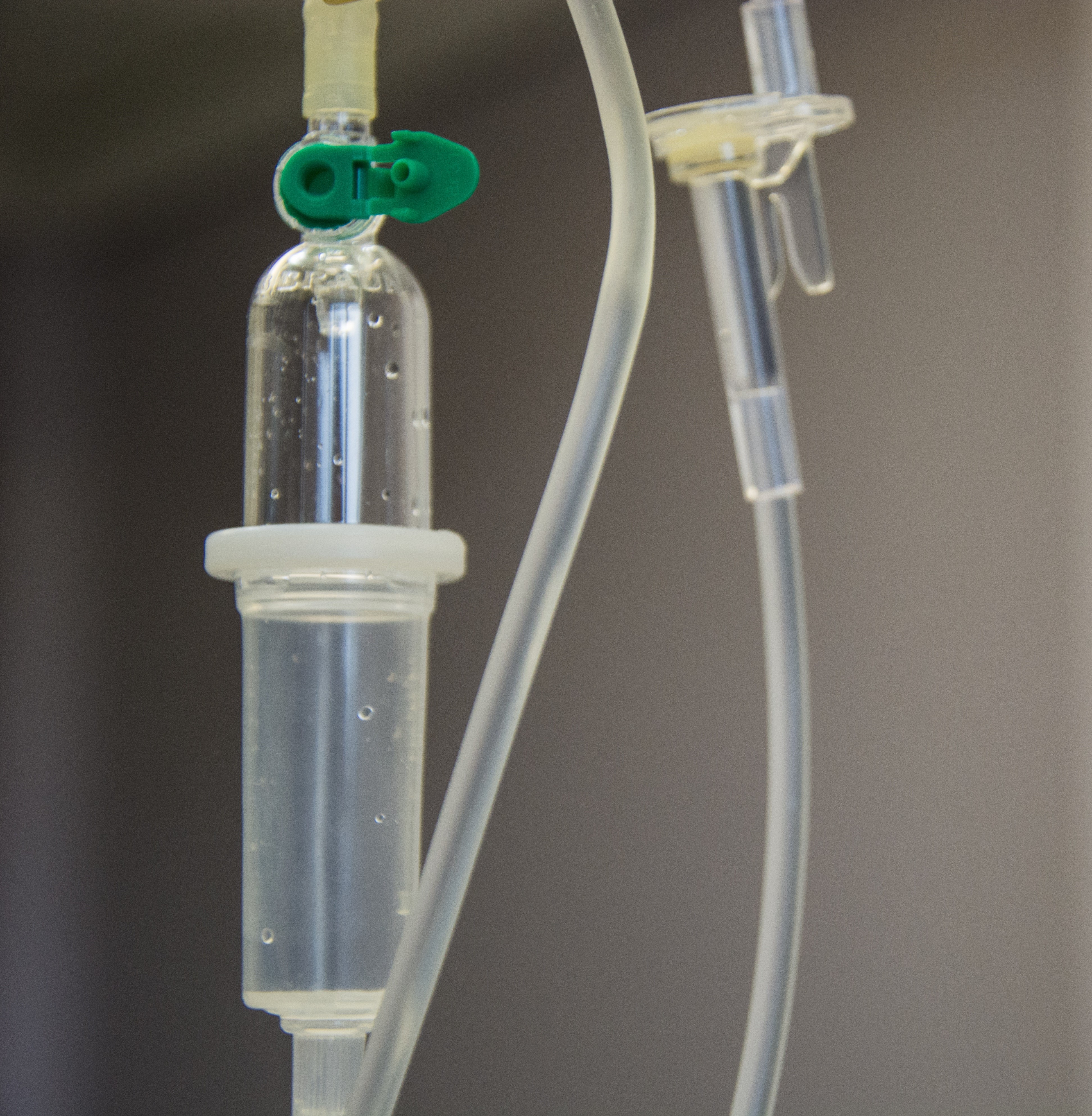
Drip, drip, drip…
My 4-hour-long chemo infusion session consisted of : 1) Herceptin 2) Benedryl & steroids 3) Taxotere 4) Carboplatin
This was in addition to steroids that I had to take starting from the day prior through the day following the infusion. That’s a LOT of medication for someone who was unaccustomed to taking drugs at all! Because of this, I can’t say my side effects were all attributable to the chemo drugs themselves, so this should be considered a run-down of the entire “chemo experience”.
4/27/2017: This was the day of my first chemo infusion at my cancer center, following check-in and bloodwork. I received my I.V. seated by the nurses’ station so they could watch for adverse reactions, but I tolerated the infusion well. There were no acute side effects except sleeplessness from the steroids. I was off to a promising start!
4/28/2017: I returned to the cancer center for a Neulasta injection (stimulated white blood cell production, which took a hit from chemo) and took Claritin (anti-histamine) prophylactically as it helped with potential bone pain from the Neulasta. No nausea, but I noticed that my stomach felt better if I ate more frequently. Finished up my last steroids but they were still affecting my sleep.
By that evening, things were looking surreal, like I wasn’t completely here.
BEWARE! Great food…but not a couple of days after chemo.
4/29/2017: My stomach started feeling funny, particularly towards the end of the day. I still wasn’t sleeping well, and I had difficulty standing in place. And that afternoon I made what ranks as one of the biggest mistakes of my life: for dinner, I ate an entire package of Palak Paneer (Trader Joe’s). It was Indian food made with spinach, paneer cheese and spices. I was hungry, yes, but it was a foolish move. I would pay for it.
Shortly after dinner, I was overtaken by a wooziness and began regretting my dinner choice. After some fearful indecision, I took an anti-nausea pill (ondansetron) and propped my head up in bed.
4/30/2017: Things started to get serious. My energy levels were dropping, and by the evening my stomach was on fire. I felt like I’d been hit by a truck. Putting my head down made me feel sick so I tried to sleep sitting up in bed.
That night was horrible. I took two different anti-nausea medications (four hours apart), but confused their order, so the pill I took first, I should have taken second (prochlorperazine, an anti-psychotic (!) drug with anti-nausea properties). Ho ho ho. Yeah, don’t do that. My dreams were colorless with a gritty texture, like someone had smeared coffee grounds on them. My nausea didn’t improve and I paced back and forth in the living room until enough time had passed so I could take the ondansetron pill that I should have taken first. Death was looking like an attractive alternative.
5/1/2017: I was deep in the “real” side effects by now. I had severe fatigue and a woozy stomach, no appetite, bone pain and headache (probably because I couldn’t get coffee down). Most of this day was spent in bed. I tried taking CBD to help with the nausea, since I was getting constipated from the chemo and anti-nausea meds. I got the dosing wrong on the CBD, fell asleep, waking with a gasp because I thought I’d stopped breathing. Disconcerting, to say the least. For the record, I figured the dosing out by my second infusion.
Chemo dries everything out!
5/2/2017: My fatigue was starting to improve and my appetite was coming back, but my stomach couldn’t handle food (fun fact: chemo made the lining of my GI tract slough off). It was a frustrating situation: I was hungry but unable to eat. My throat felt raw and my skin was getting chapped. The inside of my mouth was drying out and it felt like there was gunk on my teeth even after brushing them.
Warning, TMI! I, the multi-decade vegetarian, was officially constipated. This was a miserable feeling. It took an hour of straining on the toilet to finally produce a post-chemo bowel movement, at which point I decided that I’d rather starve than go through that again. With subsequent infusions, I was able to tweak my diet and avoid a repeat. I can’t imagine going through this on a regular basis!
5/3/2017: Finally! I got a good night’s sleep, although could have used a few hours more. My lips were severely chapped and my throat felt so swollen that swallowing was difficult. I tried eating crackers but as tender as the inside of my mouth was, it felt like I was chewing glass. Luckily, a salt-and-baking soda mouth rinse provided a little relief to the soreness. There was a lot of gunk on my teeth, probably because my GI tract was in rough shape and I was experiencing reflux.
5/4/2017: This was my first day back to work following the infusion. The intense chemo fatigue had let up, but my throat was still sore, mouth raw and lips chapped. I was getting nosebleeds. I had a huge headache in the morning, but it eased after eating, which still required very soft and bland foods.
5/5/2017: There was noticeably less mouth and throat pain. Still had a headache and chapped lips along with an itchy scalp. By evening my saliva had a strong bitter taste, making food less palatable.
5/6/2017: My tongue stuck to the roof of my mouth overnight! Overall, my mouth and throat were feeling better and it was easier to swallow, but my skin was very dry and itchy, and my scalp tingled. Still, I was feeling much more normal, except that my saliva was still unpleasantly bitter.
5/7/2017: Skin and lips were still chapped and I was having nosebleeds, but it was easier to eat crunchy foods. My saliva was still bitter but it didn’t seem as bad when I was eating. Swallowing was getting easier to do without feeling like I was taking air into my stomach, something that I realized had caused a lot of discomfort in previous days.
5/8/2017: Most of my energy had returned. My skin and lips were dry and irritated and I had a runny nose in addition to nosebleeds. Now my mouth was able to handle carbonated drinks along with a more normal diet full of crunchy veggies. This was the first day that I was able to do a workout with weights, even though I had to keep it light.
5/9/2017: Lips were still chapped and the inside of my mouth stuck to my gums at night. But finally I was able to eat spicier foods and the taste of my saliva had significantly improved. I was continuing to have sleep issues but I’m unsure if this was a leftover side effect or just a general reaction to the anxiety associated with cancer treatment.
5/10/2017: Still chapped lips and dry mouth, but now I could eat whatever I wanted to with no discomfort.
5/11/2017: My nose was bleeding much less, but — surprise, surprise — my hair started falling out. As a matter of fact, it was falling out on schedule, as I’d been told to expect hair loss about two weeks following my first chemo. So much for escaping that side effect.
5/12/2017: Hair was coming out more rapidly. It probably wouldn’t have been noticeable to a bystander, but when I ran my fingers through it, I was left with a handful. I tried not to touch it so that I could get through my workday without creating bald spots.
At this point, I had fully recovered from the chemo. In all honesty, the week after my first infusion I had no idea how I could go through it five more times. But with three weeks in between chemo sessions, I had enough of a chance to feel human again. In addition, while I would still have GI tract issues and experience severe fatigue with subsequent infusions, many of the above listed side effects didn’t return. I did, however, experience new ones: water retention, loss of taste, constant tearing of the eyes, very runny nose, loose teeth and the like.
This will pass.
My first infusion was a great lesson in being patient and taking things as they come. The side effects don’t happen all at once; it’s a cascade, with one rising up while another ebbs. When in treatment, the best you can do is to stay in the present and ride them out like waves.
The most important take-home point? Chemotherapy is doable. That doesn’t mean it’s a pleasant experience, but it’s one you can get through.
These are the most difficult mental calisthenics I’ve ever done.
The most frightening part of anxiety for me is that when scary, intrusive thoughts hit, they are right in my face. It feels as though there is no buffer zone so they come at me fast. I am highly reactive — nausea, cold bowels, rapid breathing, sweating, buzzing head. No opportunity to pause and consider a response. I am thrown into “flight” mode.
I don’t get panic attacks the way others have described them: heart beating so hard it feels like it’ll burst out of your chest, or hyperventilation to the point of getting lightheaded, even passing out. But I still feel anxiety intensely and physically.
So my practice lately has involved allowing stressful thoughts into my line of sight, but softening them, so that they appear blurred and more distant.
I establish this by immediately focusing on my body sensations as soon as I’m aware of the physical sensations of anxiety. That means feeling down to where my skin touches my clothing and focusing on the sensation of pressure on my seat and feet (if sitting) or the entire length of my back (if lying down).
Once my attention in on my body, I revisit the stressful thought, but as if squinting with my “inner eyes”, sometimes looking at it from the side instead of head on. I acknowledge its presence, but fuzz out the details, and most importantly, I keep it at a distance from me so that I have some space. Then I bring in deep breaths, slowing them down and allowing them to calm me as much as possible.
This is not even remotely easy. On some level, I’m still reacting to the thought and do experience a fear of bringing it closer to me. But the soothing nature of the breath helps temper my reaction. I think of this as exposure therapy, a form of cognitive behavioral therapy, except where everything takes place inside my head.
Establishing the breath as a self-soothing “anchor” takes time and consistency in practice.
Lately, I’ve been having more success with this, particularly when I wake in the middle of the night, which is one of the most frightening times for me to experience runaway anxiety. This self-comfort would not be possible without established meditation and relaxation techniques — I’ve used the breath to soothe myself through cancer diagnosis and treatment, but the great majority of my meditation practice takes place when I am not stressed.
That fact, along with consistency in practice, has been critically important to me. In order for the breath to serve as an effective anchor, it must be recognized as one. And that means building up “anchor-like” peaceful associations over time so that the link is not easily broken.
None of this is a quick fix. But as with many things that are not quick fixes, the process of achieving success is part of the success itself. And that is a very reassuring thought.
For better or worse, my tendency is to cling to thoughts, expectations, emotions. Letting go is difficult because change brings on uncertainty, and uncertainty doesn’t feel safe.
And yet, if there’s anything that watching the stately Notre-Dame aflame teaches us, it’s that nothing remains untouched by time and happenstance, not even the 850-year-old symbol of a country.
In our lifetimes, the cathedral has been a steady fixture. And yet, if you consider its history, Notre-Dame has undergone many changes. Modifications by French kings, damage during the Huguenot riots and French Revolution. Repurposing, re-consecration, restoration and renovation over the centuries
While it’s romantic to consider Notre-Dame de Paris as a constant through the ages, the reality is that those significant changes have enhanced its character with meaning. And when the unstoppable advance of time transforms the cathedral into rubble, perhaps something even more beautiful will arise from her remains.
Change can set free something unexpected and lovely.
I have experienced changes in my own life that I couldn’t have predicted and certainly didn’t want. They have been frightening and even painful, and I increased my suffering by fighting them even after realizing I couldn’t stop them.
But just as there is new growth after a forest fire, with the heat being necessary in some cases to release seeds and allow them to find soil, unpleasant changes in my life have led to new paths. All I have needed to do is let go of the past, accept my new reality and find something even more beautiful there.
I attended a workshop on cancer and stress given by the social workers at my cancer center. Since I like to take advantage of every opportunity to explore what’s going on inside my noggin I was looking forward to the presentation, but I didn’t realize that I would be offered a curious vantage point at the same time.
Sitting in the front row as I always do, I was joined by a woman who was awaiting the results of her second breast tumor biopsy; her first had confirmed cancer but another tumor was discovered shortly thereafter.
She told me about her racing thoughts, lack of appetite, inability to sleep — all those symptoms of intense stress that I also experienced as I awaited diagnosis. How odd it was to revisit this through her, now that I had a comfortable seat on the other side of that experience.
I commiserated with her, briefly offering up my own experience, and assured her that some of the anxiety would mellow once she had a definitive diagnosis and accompanying treatment plan. That’s the only thing I assured her of, knowing the nature of cancer, but I hope it gave her comfort seeing how far I’d already made it on the cancer journey.
And then, ironically, I realized that the woman sitting directly behind me was someone I had sat next to during one of my chemo infusions in 2017. I re-introduced myself, and while she didn’t remember me, she said she’d been through so many chemo sessions that it was hard to differentiate one from the other.
When I met her in 2017, she had hair and a good dose of energy. We talked about our kids (hers were grown) among other things. She was being treated for lung cancer but we didn’t dwell on the particulars. That’s not generally what you talk about during chemo. You gravitate towards non-cancer topics.
Things don’t always turn out the way we predict they will.
But now, she wore a ball cap to cover her bare head and walked with a cane. She seemed frail and was accompanied by a caregiver — several years of cancer treatment, not to mention the cancer itself, will do that to you. I’m not sure what her prognosis was, but given what I knew about her and the fact that she was still doing chemo, it probably wasn’t favorable.
There I sat, trying to stay present, next to my past and in front of my potential future. I had the good fortune of surviving the one and a decent chance of escaping the other.
There is no crystal ball with which we can gauge the future, deciding whether or not we like it, and if not, opting out. So here’s to making the best of the time that we have.
I wrote my last post about my not-so-mindful behavior in the jury lounge of the local Superior Court, waiting to see if I’d be called to serve as a juror on a case.
I wasn’t, but the situation ended up being stressful nonetheless, and it had nothing to do with my forgetting that I had a metal fork in my backpack and being called out by security for it. (Oops!)
No, what did it was the runaway narrative being played out in my head about potential frustration if I were selected, and whether I could manage all the facts of the case (chemo brain) and the sitting (neuropathy and back pain). While not completely inconsequential, neither chemo brain nor physical limitations were an issue for me as I was sitting in the jury lounge, waiting.
That evening, released from jury duty for another year, I came across an article by beading teacher and author Kristal Wick, who settled on beading as meditation to help her deal with her monkey mind, and in it she wrote about her realization that we are making stress up.
In stressful times, it’s not always easy to differentiate between what’s real and what’s not.
I would clarify that by noting that we don’t make up stressful events themselves, but the toll that anticipating what may happen takes on us depends in great part on our reaction to it. And whether or not we want to admit it, ultimately that’s under our control — although if we’ve established a behavior pattern of anxious reactivity (*cough, cough*), it will take practice to rein in those responses.
But the reminder that those “thousand deaths” that I was dying in advance of something that was not real or guaranteed…ahhhh, I needed that.
Next time a calmer, more realistic response, perhaps?
Do we equally offer everyone the benefit of the doubt?
In his post, Smilecalm describes how mindfulness creates a situation where justice truly prevails. Whereas it would have been easy to make a snap judgment and convict someone who seemed, on the surface, to be guilty, pausing and carefully sorting through the facts provided a different picture.
When I think of the concept of “beginner’s mind”, I think of this kind of patience and open examination of what is before you, instead of moving down well-worn paths to conclusions based on circumstances.
I am sure that the defendant in Smilecalm’s case was grateful for the care with which the jurors considered his testimony. I, for one, am grateful to Smilecalm for bringing to light not only the importance of serving on a jury, but doing so with care and compassion.
My right heel has been hurting — for the past week I contemplated claiming plantar fasciitis to get out of jury duty.
Okay, I knew that excuse wouldn’t fly, but I was stressed about getting pulled out of everyday life, with an already overfull plate, to do my civic duty. The more I thought about it, the more I worked myself up into a lather.
Mindfulness couldn’t cut through the noise in my sleep-deprived head. This agony of anticipation made several things crystal clear:
My nemesis. This monkey will pull your lungs out through your nose.
I ruminate enough to rival a massive herd of cows. Hello, monkey mind! I’d been thrashing through all the unknowns, unfettered irritation and unfounded fears in my head. This was the monkey-on-my-back, screeching madly.
My physiological reaction to even the anticipation of potential stress is out of control. Granted, this reaction was lubricated by a hefty pint of caffeinated coffee from the courthouse cafe. But when the voice over the loudspeaker called out names in alphabetical order, my heart pounded as the list approached where my name would be. I knew what was happening and that it was ridiculous, but simply couldn’t stop.
Instead of patiently waiting to see what happens, I really really really want things to be a certain way. I punished myself by clinging too tightly to expectations. I mean, tight enough to turn my knuckles white (knucklehead that I am).
All of this opened the door to a boatload of suffering. Great. So much for being mindful. My morning as a prospective juror was fraught with anxiety.
Even after several years of daily meditation and mindfulness bells and “take 5” reminders, even after trying to be all zen about it, I was still a mess. Disappointing, by my judging eyes. But also, very human.
Things didn’t improve until I started pacing at the back of the jury lounge briskly enough to feel conspicuous. The motion soothed me, like rocking a baby. It was self care, which is the first casualty of my anxiety.
It was the only mindful thing that I could manage, but it kept the monkey busy as we zigged and zagged around other people to avoid a collision.
Once I racked up a good 3000 steps and a bunch of odd stares (don’t care, don’t care, don’t care), the pressure released a bit. Okay, that and the fact that I’d made it through the first two rounds of juror calls without hearing my name and it was already time for lunch. That combo was like the “pffft” from a fizzy bottle of kombucha. I was feeling better.
I returned from a long lunch break with my reasoning mind in charge, calculating probabilities. Three sections of seats, fifteen rows each, a minimum of three people per row…not counting the folks at random round tables and working on laptops along the walls…hey, that’s a LOT! Safety in numbers! The odds were in my favor, otherwise known as, “if your group is being chased by a hungry leopard, don’t worry about outrunning the cat, just outrun your friends.”
You mean, NONE of this stuff is real???
So the reasoning mind wrestled the crazy monkey mind into a half nelson. But alas, the reasoning mind was still a slave to expectation, with its own monkey-on-the-back. It was a tenuous peace, unstable and easily shattered by the voice over the loudspeaker, but it enabled me to approach the situation with less reactivity even if temporarily.
Guess how this messy day ended: a thousand deaths later (around 2pm, to be exact) the voice from the loudspeaker released us from service, giving me a year’s reprieve and kicking the monkey to the curb. And it was at that moment that I realized how tightly worry had gripped me, and it wasn’t even real. Everything had taken place in the space between my ears.
I thought about how my agony had been self-generated. And that’s a topic for another post.
Much gratitude toSmileCalmwho brought this meditation app to my attention!
So far most of the mindfulness apps and programs that I’ve written about have reflected a more secular version of mindfulness (Insight Timer is an exception, because it encompasses a very broad range of practices).
The opening screen invites you into Plum Village…
However, Plum Village is the meditation app of Thich Nhat Hanh’s Plum Village Tradition of Buddhism. It is beautiful in its simplicity, reflecting mindfulness authentically — and appropriately so, as Thich Nhat Hanh is considered the “father of mindfulness”.
Things that ring true for me:
1. It is completely free. There are no in-app purchases or upgrades, and certainly no ads. You download it and have access to everything. It is open to everyone.
2. It is uncomplicated in design, allowing easy navigation within a simple serene tangerine-colored layout.
3. There is no competition inherent in this app: no meditation counters, no record of meditation “streaks”, no gold stars for hitting meditation milestones, nor a way to compare your progress against that of others. It focuses only on the selection that you are doing now. And when you are done with it, you are done. No clinging.
A partial view of some of the categories in the “Meditations” section.
There are five sections, buttons for which run along the bottom of the screen. “Resources” contains chants, poems, mindful movement videos, in addition to spoken and written teachings by Thich Nhat Hanh. “Practices” could be considered the ‘how-to’ section as it explains various mindfulness practices and concepts.
There is a large selection of guided meditations in the “Meditations” section. They are based on Buddhist values, and while most are lovingly presented by monks and nuns, there are some led by Thich Nhat Hanh himself. To round out the collection, there are clips of nature sounds to use as a background to meditation.
The “Ask Thay” section (Thay, or “teacher”, referring to Thich Nhat Hanh) contains a long list of questions posed to the Zen Master with audio clips of his gentle responses. While these within themselves are not meditations, I found myself mesmerized by his words.
But the section I’ve utilized the most is “Bells”. It’s possible to set up the sounding of a ‘bell of mindfulness’ for intervals ranging from every five to sixty minutes. I’ve let that run for the entirety of my workday, setting up the bell to sound every 10 minutes, as a reminder to stay present and focused. When I get lost in work, the bell declares its presence, easily cuts though the noise in my head and serves as a reminder to take several deep breaths.
I have been using this app differently from other mindfulness apps like Calm and Insight Timer. Plum Village is more instructive, and as I am interested in deepening my knowledge of Buddhist Dharma, I use it not only to calm my monkey mind, but also as a learning tool.
Of all the programs and apps I have used, Plum Village feels the most authentic, as if I’m coming home to the roots of mindfulness.
As an alumna of one of the universities involved in the recent U.S. college admissions scandal, I’ve been following the details of this story with great interest. My eldest will be completing college applications this autumn. She is a remarkable student; however, unlike many of my fellow alumni, I have not had the means to put her into every imaginable extracurricular activity.
Yet, I had impressed upon her the importance of always doing her best and getting into a “good” university to improve her choices for the future, particularly since there will not be a windfall waiting for her when I die.
But the recent events have left a sour taste in my mouth. Particularly since my cancer diagnosis, I’ve been rethinking the stressors that are placed on students in the hopes of getting them into the “best” schools.
So much anxiety and lost sleep. Pressures to compete. I can no longer say that it’s worth it. The recent admissions scandal broke open the “secret” that many of us already knew. There is great iniquity in our society and college admissions reflect that.
I do believe that education is very important. That has not changed. But the artificial ways that we twist ourselves to fit a mold, to be granted confirmation of our worthiness of being one of the chosen few, is unhealthy.
I have served as an alumna interviewer for prospective students and become increasingly frustrated by the opportunities that wealthier applicants are given, when in fact they may work no harder than their less fortunate counterparts. If anything, I’ve seen relatively poor students do so much with what they have, sometimes as they deal with complicated home situations and an inordinate amount of responsibility.
But one thing seems to hold true for all students, regardless of income: competition for college acceptance teaches them that they’re never “good enough”. Having good grades and high scores is insufficient — they must do more: sports, clubs, musical instruments, volunteer activities, other distinctions, all at nosebleed-high levels of accomplishment. Nothing less than perfection is expected.
And always planning, planning, planning. There is little time to appreciate what is taking place now.
I don’t want the exquisite beauty of now to be sacrificed for some plastic promise of tomorrow.
I have bright children, but my wish for them is not necessarily to attend my alma mater. That is not what is important. I want them to be good people. Compassionate, empathetic and not so much in a hurry to get ahead, particularly not if it means treading on others. We have the ability to define our own success and we can do so mindfully and with grace.
This is not something that money can buy, nor that a particular diploma can offer. This is something that comes from within. The greatest gift that I can give my children is to teach them mindfulness, to show them how to still their thoughts and calm their worries. That lesson will serve them for the rest of their lives.
What I would like all those students who tried so hard and still weren’t “accepted” to know:
You are enough. You don’t need an acceptance letter to prove your worth.
You are bright and resourceful, inquisitive and engaged. And no matter where you go to school, you will do well. I see the sparkling light in your eyes — don’t let the heaviness of worldly expectations douse it. You, not some musty ancient institution, are who defines yourself.
Strive for what you feel is important, but do so mindfully and with kindness. That is what will make this world a better place for all.
Although I may never be able to prove it, I’m willing to bet that stress played a role in the proliferation of my cancer.
As a result, getting my stress response under control was a high priority, so I started a meditation practice and once the toughest parts of my treatment (chemo, radiation) were done, went searching for a formal class to address anxiety.
My clinical counselor had told me about a book called “Full Catastrophe Living” by Dr. Jon Kabat-Zinn. As it turned out, Kabat-Zinn had been a long-time meditator and, drawing on both Buddhist Dharma and scientific research, developed a stress-reduction program for patients at the UMass Medical School in the 1970s called Mindfulness-Based Stress Reduction (MBSR).
So when I found a Center for Mindfulness at a local university, I jumped at the opportunity to take that same flagship MBSR course.
This is an 8-week class with an additional full-day retreat. The curriculum has been developed to introduce students to mindfulness and help them, over a two month period, develop a practice, both formal and informal to manage stress in their lives.
It is also not cheap! The non-discounted version may cost about $600, depending on where and when you sign up. If I hadn’t had cancer and therefore a powerful reason for needing in-person guidance in mindfulness meditation, I would have considered myself priced out of this course, instead opting for a self-paced, free online version, such as Palouse Mindfulness.
But I used the significant price tag to motivate myself to do each and every homework assignment. The classes themselves were 2.5 hours a week, with daily home practice lasting about 45 minutes to an hour. That’s no small commitment! I had to move around my schedule to be able to fit the practice time in, and even the Center for Mindfulness itself recommended that if you could not accommodate the home practice to wait for a time that you could before signing up for the class.
The teachers were warm and supportive. They genuinely cared about student progress and themselves had a regular practice in addition to having spent time and resources on their own teacher training. As such, the instruction was excellent.
There were a number of resources for the students, including audio and video programs, which are also available to the general public. Currently, as an MBSR alumna, I have access to all the day-long mindfulness retreats for students free of charge. This gives me an opportunity to immerse myself into silent meditation for substantial periods of time in a similarly conducive environment.
The development of a mindfulness practice has more to do with the effort of the student, rather than the expense of a class.
I was struck by how quickly the class registration filled up, and how during the first session, when asked why we were taking the course, so many of us cited the amount of stress and anxiety in our lives. It is a sign of the times that so many people are willing to pay a significant amount of money to take a class to help them get some semblance of control over their inner state.
Actually achieving this was harder than simply paying the cost of admission. This class began with about thirty of us, but fewer than half made it to the very end. A number of people admitted being unable to complete the homework. Some gave up completely. There were others that came for several sessions but then never returned. Everyone was looking for help with stress but not everyone was successful.
As a secular version of Buddhist mindfulness, the course does justice to the tradition. While the expensive registration fee may be off-putting for some (many?), there is tuition assistance available, which I feel is important. As I’ve written before, I don’t feel that it’s appropriate to make mindfulness available only to those rich enough to afford fancy classes.
But in the end, regardless of what type of mindfulness instruction you utilize, what matters is how much effort each student puts into the practice of being mindful.














 Frantic Shanti