My oncologist appointment last week marked five years since completing my final chemo infusion (and for those of you keeping track, since I had that nasty chemo nail infection).
Lately, my oncological appointments run like this: my onc asks how things are going, I air all my grievances and we spend the rest of the visit agreeing that there’s no way to determine whether what I’m experiencing is chemo-related, menopause-related, or something that I was dealing with before but hadn’t paid attention to back before cancer.
Because there’s nothing like cancer to make you acutely aware of every twinge and creak in your body.
But that’s about it. We are running out of things to talk about. In this context that’s a good thing.
I used to lament “what could have been” had I not gotten cancer, not experienced chemo, not been pushed into menopause chemically and artificially had my estrogen levels squashed. But now, I know better. What happened, happened. And “what could have been” is pointless to ponder because it simply isn’t reality.
It took me a while to get to that place and I’m finally okay with it .
But there was something else different about this oncology visit…
I walked into the cancer center for my appointment and was hit with “the smell”. There is a distinct scent in the building, possibly the cleaning solutions used to disinfect the place or maybe a fragrance that is purposefully pumped in. I had mentioned it to my clinical counselor several years ago and she admitted that a number of people have said the same thing. The smell is familiar, given that after multiple appointments and infusions and radiation sessions, I’ve experienced it a lot and have made many associations with it.
But for some reason, this time it hit me hard and a wave of sensations washed over me. Not sure why my reaction was so strong, but I’d like to think that between my last onc appointment and this one, I’ve made the most progress in distancing myself from the frustrations of getting cancer and have actually moved on with my life.
However, that rush of emotions served as a reminder of everything that I’ve been through over these past five years. I thought that chemo was going to be the hard part. Turns out, it was the most predictable part: six trying infusions, but they came with an end date. The rest of treatment brought uncertainty and unexpected difficulties. I thought I was done after radiation…but the pills continued.
Looking back at this, while I’m technically not “out of the woods” and may never be, these last six months have felt different. Yes, I still have another onc appointment half a year from now, but I’m finally turning my face forward to the future instead of constantly looking back at the past, worried that those frights will catch me again.
I was not in a good headspace during that time. I had started a mindfulness meditation practice five months earlier but had too little experience and not enough training for it to significantly affect my mindset, 50+ years in the making.
When I write a cancer-related post, I straddle a line. On the one hand, I want to provide an admittedly subjective and honest account of what I experienced during treatment; on the other hand, understanding that we all come from different backgrounds and may have vastly different perceptions of what cancer means to us, I don’t want to color the reader’s view of what their experience might be like.
Cancer revealed a lot more about myself than I expected to find.
There have been times that I held back on projecting too much of my own personal state. I waited five years to post my videos on Chemo Fatigue because I didn’t know whether it was appropriate to do so. They remain some of the rawest and truest representations of the despair that I felt at the time. I was still very angry and frustrated, feeling what I recognize now as a deep sense of betrayal.
It was mindfulness meditation along with deep reflection, expert counseling and simply the passage of time that ended up bringing me out of the anger. That process took a lot longer than I ever expected. It also showed me aspects of my personality that I hadn’t understood before because I’d never had to confront them.
So while I still would never say that cancer had a positive effect on me, just as with many heavy life experiences, it took me to a new level of maturity and self-awareness. I am very thankful to be on this side of treatment, although I’m acutely aware that everything may change with the next scan. That makes every moment all the more precious.
[IMPORTANT: Please be aware that at the time the videos were filmed, I was in a very negative headspace. My experience should not be considered an example of a “typical” experience because with cancer treatment, there is no such thing. Just as cancer is a disease specific to an individual, so is the treatment and, as a result, one’s response to it. If you are interested in viewing the below videos, please keep all the above in mind.]
I’ve posted quite of few photos of my cancer journey. You’d think I wouldn’t have any more pics left, but–surprise–I do!
I made some important (to me) videos after my sixth and final infusion, but to date I’ve hesitated to post them. In part, this is because I’ve tried to remain anonymous in this blog, but in the clips, you get to see my face. And it’s not a pretty sight.
I didn’t feel human.
I was the weakest that I’d been my entire adult life. My body was feeling the strain of multiple infusions of chemotherapy, I didn’t recognize myself in the mirror and my voice didn’t sound like my own. I was so sick and tired of this part of the treatment and wanted it to be DONE.
At this point, I wasn’t suffering that entire cascade of side effects that I’d experienced after my first chemo infusion, and I’d learned to better deal with what I did experience, and even what to do to avoid some of the side effects.
However, the fatigue I felt was far beyond what I imagined it would be. And it was coupled with constant background nausea, like a slow burn in my gut. This was a result of losing the rapidly-dividing cells that lined my intestinal tract; they were felled by the chemotherapy, collateral damage as the medicine killed off potential cancer cells.
Strangely, there were also times when I was actually quite hungry, but literally too tired to try to get something to eat. Even calling for a member of my family to bring me food required too much effort. Speaking took a lot of energy.
The final infusion’s side effects lasted the longest. A full week after my infusion I was still very unsteady and barely made it to work for a few hours.
It’s worth noting that this was pre-pandemic and I wasn’t properly set up for working from home. Were I experiencing chemo treatment now, I’d be able to get more work done…likely to my detriment, unfortunately, because I really needed that time away.
It took five years for me to decide that it was time to post these videos. Apologies if they get a little intense:
One thing I’ve had trouble with is expressing self-compassion. When you’re a driven perfectionist it’s easy to believe that “giving yourself a break” is tantamount to “going soft” and “losing your edge”.
I couldn’t forgive myself when I felt that I’d failed. And guess what, getting cancer made me feel like a failure. I had tried to live the healthiest adult live I could, given the sometimes-limited resources I had, often denying myself what others called “pleasures” or “indulgences”.
I’ve lived most of my life feeling like I had to constantly push myself…and that I was never good enough.
The fact that I was convinced that I shouldn’t have gotten cancer was a recurring theme early on in this blog–I was convinced that I must have done something wrong, even when I tried so hard to do my best.
I was also ashamed. Cancer, I felt, opened my life up to judgment by others.
Getting myself out of that funk took serious work. It meant rewiring my brain and allowing in the same kindness and compassion for myself that I allowed for others. At the same time, I reminded myself of a quote by author and humor columnist Dave Barry: “A person who is nice to you, but rude to the waiter, is not a nice person.” I prefer to interpret Barry’s words in this way: I cannot be genuinely kind and non-judgmental to others until I’ve learned to be so to myself.
Cancer gave me perspective to see how much I needed compassion from myself.
But how do you do that when you’ve spent your life pushing yourself, not accepting excuses? It wasn’t until I hit the lowest low that I ever experienced that I learned to dip into unadulterated compassion for myself. I imagined who I was as a chemo patient–skinny, bald, dehydrated, vulnerable, frightened. And suddenly felt it: that overwhelming desire to wrap my arms around that version of me and protect it.
And while that was “cancer me”, I realized that same version of me was the scared person inside that I had always bullied with perfectionism and accusations of not being good enough. This was who I really was, in need of and deserving of gentle holding.
It took a life threatening illness to make me realize that I deserved kindness and compassion. I believe that you are deserving of the same. Do something today to prove it to yourself.
So this isn’t the kind of news you want to see. But there’s still hope…
A scientific journal article from 2017 (Cupit-Link et al., 2017, ESMO Open) describes the toll that cancer treatments can take on the patients subjected to them.
After being told you have cancer and deciding to proceed with the treatments that will offer you the best chance of survival…it’s disheartening to learn that many of those same treatments can accelerate aging, causing damage to your DNA, heart disease, hearing loss, cataracts, liver and kidney diseases, brittle bones, lowered immune response and other cancers (!) among other issues, depending on the type of cancer and treatment (see WebMD article).
The treatments that can save our lives from cancer may hasten our demise from age-related factors.
This is a problem resulting, ironically, from the success of treatments and extended lifespan of cancer survivors. Back when cancer was deadly with a low survival rate, no one was too concerned about the state in which survivors were left in; simply surviving the cancer was enough. Now that people are beating their cancers at greater rates, quality of life has become a much bigger issue.
While the most striking detriments are seen in childhood cancer survivors, accelerated aging occurs in most former cancer patients.
Doctors and researchers are taking note. At the time of this scientific article’s publishing in Dec 2017, there was already discussion on how to “de-escalate” cancer treatments as a way to decrease the amount of cellular damage to patients.
On a personal level, I chose an effective drug for my HER2+ breast cancer (Herceptin) over a more effective drug (Perjeta) that carried a risk of greater cardiotoxicity. I made that decision because although I was terrified of cancer, I was also afraid of what lasting effects the drug would have on me once the treatments were over.
Cancer treatments are strong but healthy living can help mitigate their negative effects.
But even if you didn’t have the opportunity to make such a choice, there’s still something that you can do. The authors of that 2017 paper noted that cancer survivors can take back some control over their health by adopting or continuing those healthy lifestyle habits that should sound familiar by now: not smoking, limiting alcohol, exercising regularly and eating a healthful diet.
To that, I would also add, managing your stress levels, the importance of which has been demonstrated on a cellular level, and getting optimal amounts of sleep.
Improving longevity is a hot field for research as scientists work to determine what aspects of one’s lifestyle show the greatest promise in keeping the body young. This topic is complex and new data is coming in on a regular basis, so I won’t delve into details here, but it stands to reason that being sedentary and eating a high-sugar, high-processed diet is not going to do you any favors.
Just as cancer treatments may have a negative effect on overall health, you can win back some lost ground by making healthy, informed decisions on diet and exercise. No one wants to limit their cancer treatment options, so this is one form of insurance that you can give yourself. No matter what else happens, a healthy lifestyle will benefit your quality of life. And that is an improvement that is yours to keep.
After finishing chemo for breast cancer and noticing that I had no body odor, I decided to write a post about it because the Internet was silent on the topic. Apparently, I wasn’t the only one who’d come up empty. A number of you commented that you’d noticed the same thing and similarly found no explanation.
Well, five years after my initial diagnosis, maybe 4.5 years after finishing chemo, I still can’t locate info on the Internet about this.
If I do find the odd article about cancer and body odor, it’s about the exact opposite: smelling bad as a result of the disease or certain medications. Not what I’m looking for.
Hey, Internet! Is there really no one looking into this?
It is quite weird that I can’t even find anything in the US National Institutes of Health PubMed database, so I would suspect that chemo-related loss of body odor is not on the radar of researchers. Well, it’s certainly not on my oncologist’s radar because he said he’d never heard of it and didn’t think it could be attributed to chemotherapy. Personally, I can’t imagine how it could be from anything else.
I’m going to pester him about it again during my next appointment. Usually armput odors are caused by bacteria. As an article from the Cleveland Clinic explains, odor is produced “when bacteria on the skin break down acids contained in the sweat produced by apocrine glands, which are located in the armpits, breasts, and genital-anal area. The bacteria’s waste products are what produce the smell.”
And NPR ran a story on researchers looking into what the worst bacterial offenders are, noting, “When the bacteria break down the sweat they form products called thioalcohols, which have scents comparable to sulfur, onions or meat.” The greatest culprit? Staphylococcus hominis.
So then maybe the chemo stops the production of thioalcohols? Or chemo wipes out the S. hominis living on our skin? I’m surprised that no one is researching this in the context of chemo patients, because it seems like it might have some health implications. We still don’t know all the side effects of chemo drugs and it would be useful to start a conversation about this one.
If you’re experiencing this, please tell your medical team. They might simply not be aware of what’s happening.
I’m not saying that I smell like a bouquet of flowers, but according to my husband, there’s no “sweaty pit” odor.
And you might be wondering what my current experience is, almost five years later. Even though I departed the realm of the completely-odorless about two years after completing chemo, I still have very little body odor. And it’s not like I don’t give it chances to fester since I work up a good sweat when I exercise. Note that my left armpit, which was thoroughly irradiated, exudes almost no noticible odor. My right armpit doesn’t smell very much, but sweat that gets on, say, a sports bra will start making the fabric stink the next day. (Let’s just say that I’ve been testing this out.) The skin in the armpit itself? Minimally, and that’s with no deodorant, although I do wear it anyway.
Certainly, the six weeks of radiation therapy on my left side would likely have an effect, and so it would make sense that there’s a difference in odor between both armpits.
Still, the “natural” (and unfortunately overpriced – yeesh!) deodorants do a very good job of fragrancing my armpits because they don’t have to work very hard.
So the mystery remains. I’m going to keep digging into this as it’s likely there’s a disruption of our skin microbiome involved, and given the popularity of that research (see microbiome and armpit odor info at drarmpit.com), someone may be looking into the connection between chemo and body odor in the future. Until then, I’ll just remain happy and relatively unstinky with fingers crossed that it continues.
~~~~~~~~~~~~~~~~~~~~~
Many thanks to my very patient husband who played along and agreed to smell every place I pointed to. I’ll revisit the odor issue during the summer just in case…
You know how you have a picture of yourself in your mind’s eye? The way you imagine you look?
For four years, that self didn’t mesh with reality.
I still saw the long-haired fitness freak who’d never had a surgery in her life and definitely no serious illness. The one who was remarkably healthy at 50…the one whose co-worker assumed was age 35.
This is a perfect illustration of how I felt post-diagnosis.
That reality changed in an instant. The unbelievable happened, the unexplicable knocked me off my feet. There was no transition time. I went from super-healthy and super-fit to being diagnosed with one of the most dangerous diseases in our experience.
As the saying goes, “If you don’t have your health, you don’t have anything.” My health was everything to me, and suddenly I felt as though I had nothing.
And in the cruelty that is cancer treatment, off went the hair. Now there was no mistaking that I was “sick”. So when I bumped into friends who hadn’t heard about my diagnosis and tried to explain what had happened, they all said the same thing: “I know.”
Every time I walked past a mirror, I would get a shock. And this went on. Through the months of chemo, through radiation, waiting for regrowth that seemed to take forever.
My oncologist told me to be patient, the hair would come back. It was different for everyone. But I was still scared. And acceptance was a new concept that I was not comfortable with.
Yes, I felt I bounced back the year after chemo – working out hard, with the most awesome new-growth hair that random people would stop and compliment. That year, I felt strong and full of promise. I dared to say that cancer MIGHT have been the best thing to happen to me…
But as time went on, reality moved in again and I realized that there really was no going back. And that “lift” that I had gotten after my hair started growing back and I was hitting the gym hard, well, I crashed again.
Picking up the pieces has been a process…
Endocrine therapy pushed me through menopause. My hair thinned. And most devastatingly, I lost two friends who had been diagnosed with breast cancer around the same time that I had been.
I couldn’t celebrate that. And I fought it for months and months.
Four years later, I’m comfortable with calling myself a cancer survivor. But you know what? I still get a little jolt when I walk past the mirror. It’s still not the “me” that I expect to see. After several years of endocrine therapy, I do not look like I used to. My body doesn’t feel like it used to.
So I stopped beating myself up about it. I need more rest time between workouts. I get tired earlier in the evening. Yeah, I forget things. A lot. So I write more notes and declare my intentions out loud (“I’m going to have to take the next exit…”) so I remember what I’m doing.
I still don’t recognize “myself” in the mirror, but that is a previous “self” who was the right “self” for that time. The current “self” is wiser and more gentle with her body and her spirit.
More than two years after finishing chemo, after being afraid my hair would not grow back, and after being delighted with the way it did…I’m experiencing follicular drama, once again.
Once chemo was over, my sleepy follicles took their time getting roused into action. To say that I worried would be an understatement. I was still caught up in the unfairness of being smacked down by breast cancer. Confronting the possibility that after enduring the nastiness of cancer treatment, I might not get my hair back? That was too much.
Well, if you’ve read my posts on hair, you’ll know that my hair finally did come back. And there was much rejoicing.
And that’s where my hair posts stopped. But as happens with these kinds of things, that wasn’t the end of the story.
While still bald, I had been fed reassuring anecdotes by well-meaning supporters about hair coming back even better than before, lush locks that served as well-deserved rewards for undergoing the anxiety and strain of cancer diagnosis and treatment.
But as much as cancer patients feel like they don’t know what’s going on, those around them have even less of an idea. They want you to “stay positive” at all costs, so they overload you with lots of good news.
The forest isn’t as dense as it used to be.
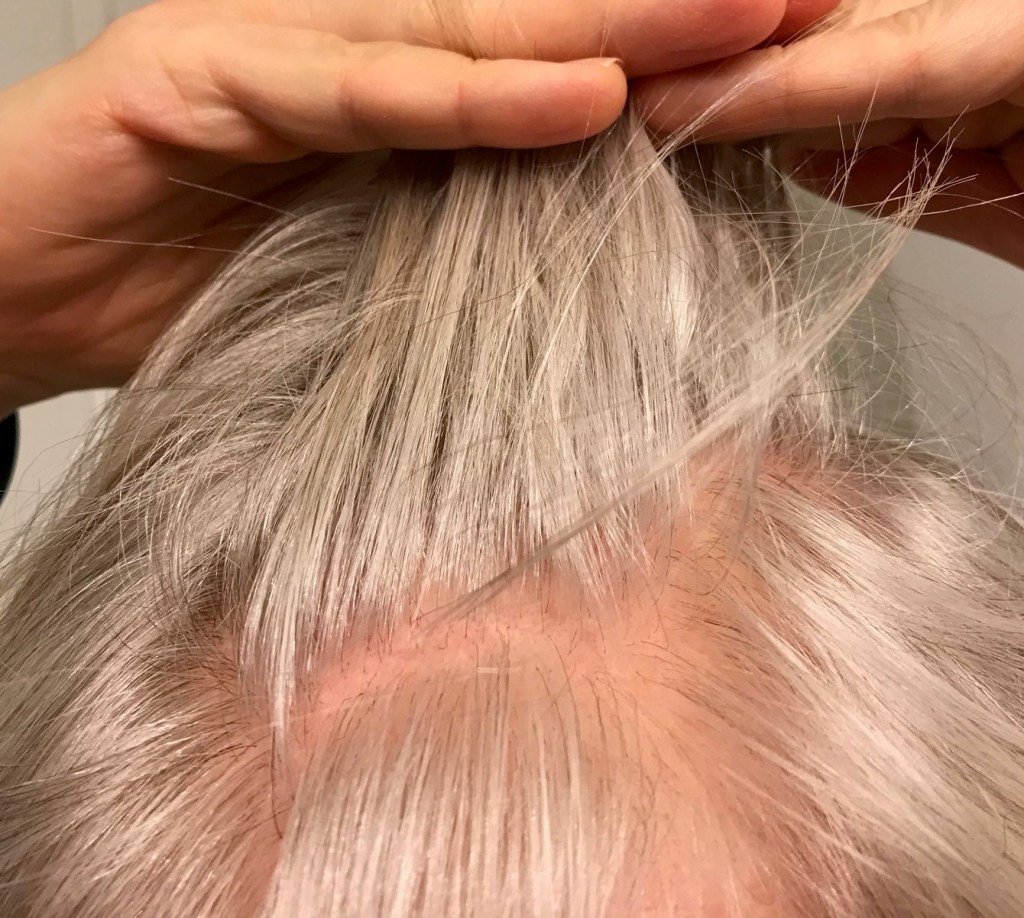
By now you can probably guess where I’m going with this. Because in Spring 2019, things started changing. Within a few months, my uber-cool spikey rockstar hair lost fullness as my strands thinned. Then, I saw “bald spots”.
So, let me explain how I define “bald spots”: these areas have hair, but due to the color (um, WHITE) and thinness, the hair seems translucent, even transparent. And along the part? You can’t see the roots well at all.
My reward for enduring cancer is invisible hair.
My hairstylist confirmed that the hair that comes back in after chemo is different from the hair that eventually settles in. And mine had settled.
Tamoxifen also played a role, since choking off estradiol and moving into menopause will age both you and your hair, particularly if you are premenopausal going into treatment, as I was. So this should have been expected, but in the hustle and bustle of all the other little things, like, oh, wondering if you’re going to survive the ordeal, no one really talks about the fact that there will be other changes that take place.
And now, I’ve been off tamoxifen for almost six weeks, but can’t tell whether there’s been any regrowth, not that I expect any. I meet with my oncologist this Tuesday and you can bet your panties he’s going to prescribe an aromatase inhibitor for me, so the pharmaceutical depression of estrogen will continue.
I am dealing. Mostly. Am I happy about this? Of course not. The last few years have felt like running a gauntlet of misery, but one where I’m only hobbled and not completely taken out. Given that, I’m ashamed of complaining, as there are many others doing so much worse. But not ashamed enough to stop writing about it, as this is my reality and it affects me. If I’m going through this, there’s a good chance that many others are too.
I’m supposed to be moving on and leaving cancer behind me, right? But like an annoyingly nosy neighbor, it keeps waving at me through my kitchen window, reminding me that it’s living next door.
My previous post was about the side effects that I experienced from my first chemotherapy infusion for breast cancer. However, side effects are specific to the individual and depend on a variety of factors. My greatest concern was that someone about to embark on chemotherapy would read about my experience and immediately assume that it would be theirs, also.
So I’m aiming this post directly at newly-diagnosed breast cancer patients, in an effort to provide helpful (I hope!) suggestions for getting through cancer and chemotherapy. The below is not supposed to be an exhaustive list — rather it contains random things to consider (in no particular order):
You’ve got this.
You can get through this. And I don’t mean that in a “rah-rah” way like a well-meaning friend who makes it their personal crusade to make sure you “think positive” for a positive outcome. That’s BS. But please know that there are medications and suggestions available to manage chemo symptoms, with a lot of advances made in the last decades, and you should make use of all of them. Ask your oncologist.
Take it step-by-step. If there’s one thing that a cancer diagnosis is, it’s overwhelming. Once you get past the initial shock, there may be more diagnositics to run and a host of treatment options to consider. You don’t have to take on everything at once. Sit down. Breathe. Clear your head.
Know your sources. Everyone and their cousin may have some miraculous piece of advice that they claim helped someone. Great for them. Everyone’s situation is different, so stick with reliable sources. This will generally be your healthcare providers, but if you feel you need to, get a second opinion. Or a third one. It’s your right because it’s your health. And tread gingerly through the internet!
Everyone’s situation is different, as mentioned in the point above. It’s worth repeating,again and again. As a matter of fact, a number of us have made this our mantra. I have suffered more from the fear of going through what someone else did than I actually did from the thing itself. That says a lot. You have a right to your own experience so feel free to protect it.
Stay informed. Once you get reliable sources, keep on top of information related to your condition. Too stressed or tired? Ask a close friend or relative, or in the absence of those, make use of the nurses at your cancer center. There is a push in medicine today to fully support the patient, and that includes providing information.
Ask for/accept help. If someone offers to clean your kitchen or prepare a meal, take them up on it. I had a mom offer to pick my son up from school on the days after my chemo and it made a huge difference! Talk to your healthcare provider about getting assistance at home if you don’t have anyone to help you.
You didn’t do anything to deserve this. Let me be the first to absolve you of responsibility. People do not purposefully bring cancer onto themselves, nor do we know enough about what causes most cancers to make you liable for your disease. Someone suggesting that? You have my permission to kick them in the teeth. (Just kidding! Don’t do that; save your energy for recovery.)
Prepare your area. A bedside table with all the things you’ll need to ride out chemo side effects at the ready will make things easier. I used a chair without a cushion to keep necessary medications and a glass of flat ginger ale on hand.
Set your boundaries. You may not want visitors/advice/your aunt’s casserole and that’s okay. If you have a partner or friend to act as a gatekeeper, perfect, but if not, feel free to pull the cancer card and ask people to leave you alone, guilt-free.
Make use of freebies. Ask your nurses about organizations or individuals who offer services at low or no cost to cancer patients. I was told of a salon that provided free head-shaving, wigs and scarves and scarf tying lessons, and of an aesthetician who gave free facials. There is a program called “Look Good, Feel Better” that provides high-end makeup and application tutorials, including helpful things like drawing on eyebrows. See what’s available in your area.
Distract yourself. And do so with pleasant things, whether it’s watching rented movies, taking a drawing class, going for a walk. Be mindful as you’re doing so, truly enjoying each moment. Your cancer center may have various activities available for cancer patients.
Breathe. I know I said this before, but it’s worth repeating. Breathe.
IMPORTANT: The effects of chemotherapy vary from drug to drug and patient to patient. My side effects may be very different from what others experience. If you are about to start chemo, please consider not reading this post, as I do not want to cause you unnecessary anxiety. You have the right to enter into treatment without fear or preconceived notions that may be irrelevant to your situation! Instead, read THIS.
~~~~~~~~~~~~~~~~~~~~~
This is one of those “if you wanted to know but were afraid to ask” posts. It’s not meant to scare anyone. Chemotherapy has a frightening reputation, but often what really unnerves us are the unknowns. I took a lot of notes on my treatment experience and wanted to share these in case anyone was curious. This is a much longer post than usual, so kudos to anyone who gets to the end!
~~~~~~~~~~~~~~~~~~~~~
Today, April 27th, marks the two-year anniversary of my very first chemotherapy infusion for treating my triple-positive breast cancer. I was told that the first chemo was often a shock to the system and could be exceptionally hard on the body. This was true for me — sort of — because the nature of the side effects changed from one infusion to the next. My reaction to the first infusion resulted in the greatest variety of effects, a number of which didn’t significantly reoccur with subsequent infusions, even though fatigue became much worse by my sixth and final chemo session.
In addition, when I started I was not prepared to manage all the side effects effectively, whereas with later infusions, I knew better what to expect. I was most fearful of nausea as I had been warned that if I started vomiting it would be difficult to stop and might necessitate a trip to the Emergency Room. This was not a comforting thought. I was prescribed anti-nausea medications but even they had side effects, so I resisted taking them. Eventually, as mentioned in a previous post, I switched to CBD and it provided enough relief without any noticeable side effects, calming my fears. I was grateful that I lived in a state where it was freely available.
Drip, drip, drip…
My 4-hour-long chemo infusion session consisted of : 1) Herceptin 2) Benedryl & steroids 3) Taxotere 4) Carboplatin
This was in addition to steroids that I had to take starting from the day prior through the day following the infusion. That’s a LOT of medication for someone who was unaccustomed to taking drugs at all! Because of this, I can’t say my side effects were all attributable to the chemo drugs themselves, so this should be considered a run-down of the entire “chemo experience”.
4/27/2017: This was the day of my first chemo infusion at my cancer center, following check-in and bloodwork. I received my I.V. seated by the nurses’ station so they could watch for adverse reactions, but I tolerated the infusion well. There were no acute side effects except sleeplessness from the steroids. I was off to a promising start!
4/28/2017: I returned to the cancer center for a Neulasta injection (stimulated white blood cell production, which took a hit from chemo) and took Claritin (anti-histamine) prophylactically as it helped with potential bone pain from the Neulasta. No nausea, but I noticed that my stomach felt better if I ate more frequently. Finished up my last steroids but they were still affecting my sleep.
By that evening, things were looking surreal, like I wasn’t completely here.
BEWARE! Great food…but not a couple of days after chemo.
4/29/2017: My stomach started feeling funny, particularly towards the end of the day. I still wasn’t sleeping well, and I had difficulty standing in place. And that afternoon I made what ranks as one of the biggest mistakes of my life: for dinner, I ate an entire package of Palak Paneer (Trader Joe’s). It was Indian food made with spinach, paneer cheese and spices. I was hungry, yes, but it was a foolish move. I would pay for it.
Shortly after dinner, I was overtaken by a wooziness and began regretting my dinner choice. After some fearful indecision, I took an anti-nausea pill (ondansetron) and propped my head up in bed.
4/30/2017: Things started to get serious. My energy levels were dropping, and by the evening my stomach was on fire. I felt like I’d been hit by a truck. Putting my head down made me feel sick so I tried to sleep sitting up in bed.
That night was horrible. I took two different anti-nausea medications (four hours apart), but confused their order, so the pill I took first, I should have taken second (prochlorperazine, an anti-psychotic (!) drug with anti-nausea properties). Ho ho ho. Yeah, don’t do that. My dreams were colorless with a gritty texture, like someone had smeared coffee grounds on them. My nausea didn’t improve and I paced back and forth in the living room until enough time had passed so I could take the ondansetron pill that I should have taken first. Death was looking like an attractive alternative.
5/1/2017: I was deep in the “real” side effects by now. I had severe fatigue and a woozy stomach, no appetite, bone pain and headache (probably because I couldn’t get coffee down). Most of this day was spent in bed. I tried taking CBD to help with the nausea, since I was getting constipated from the chemo and anti-nausea meds. I got the dosing wrong on the CBD, fell asleep, waking with a gasp because I thought I’d stopped breathing. Disconcerting, to say the least. For the record, I figured the dosing out by my second infusion.
Chemo dries everything out!
5/2/2017: My fatigue was starting to improve and my appetite was coming back, but my stomach couldn’t handle food (fun fact: chemo made the lining of my GI tract slough off). It was a frustrating situation: I was hungry but unable to eat. My throat felt raw and my skin was getting chapped. The inside of my mouth was drying out and it felt like there was gunk on my teeth even after brushing them.
Warning, TMI! I, the multi-decade vegetarian, was officially constipated. This was a miserable feeling. It took an hour of straining on the toilet to finally produce a post-chemo bowel movement, at which point I decided that I’d rather starve than go through that again. With subsequent infusions, I was able to tweak my diet and avoid a repeat. I can’t imagine going through this on a regular basis!
5/3/2017: Finally! I got a good night’s sleep, although could have used a few hours more. My lips were severely chapped and my throat felt so swollen that swallowing was difficult. I tried eating crackers but as tender as the inside of my mouth was, it felt like I was chewing glass. Luckily, a salt-and-baking soda mouth rinse provided a little relief to the soreness. There was a lot of gunk on my teeth, probably because my GI tract was in rough shape and I was experiencing reflux.
5/4/2017: This was my first day back to work following the infusion. The intense chemo fatigue had let up, but my throat was still sore, mouth raw and lips chapped. I was getting nosebleeds. I had a huge headache in the morning, but it eased after eating, which still required very soft and bland foods.
5/5/2017: There was noticeably less mouth and throat pain. Still had a headache and chapped lips along with an itchy scalp. By evening my saliva had a strong bitter taste, making food less palatable.
5/6/2017: My tongue stuck to the roof of my mouth overnight! Overall, my mouth and throat were feeling better and it was easier to swallow, but my skin was very dry and itchy, and my scalp tingled. Still, I was feeling much more normal, except that my saliva was still unpleasantly bitter.
5/7/2017: Skin and lips were still chapped and I was having nosebleeds, but it was easier to eat crunchy foods. My saliva was still bitter but it didn’t seem as bad when I was eating. Swallowing was getting easier to do without feeling like I was taking air into my stomach, something that I realized had caused a lot of discomfort in previous days.
5/8/2017: Most of my energy had returned. My skin and lips were dry and irritated and I had a runny nose in addition to nosebleeds. Now my mouth was able to handle carbonated drinks along with a more normal diet full of crunchy veggies. This was the first day that I was able to do a workout with weights, even though I had to keep it light.
5/9/2017: Lips were still chapped and the inside of my mouth stuck to my gums at night. But finally I was able to eat spicier foods and the taste of my saliva had significantly improved. I was continuing to have sleep issues but I’m unsure if this was a leftover side effect or just a general reaction to the anxiety associated with cancer treatment.
5/10/2017: Still chapped lips and dry mouth, but now I could eat whatever I wanted to with no discomfort.
5/11/2017: My nose was bleeding much less, but — surprise, surprise — my hair started falling out. As a matter of fact, it was falling out on schedule, as I’d been told to expect hair loss about two weeks following my first chemo. So much for escaping that side effect.
5/12/2017: Hair was coming out more rapidly. It probably wouldn’t have been noticeable to a bystander, but when I ran my fingers through it, I was left with a handful. I tried not to touch it so that I could get through my workday without creating bald spots.
At this point, I had fully recovered from the chemo. In all honesty, the week after my first infusion I had no idea how I could go through it five more times. But with three weeks in between chemo sessions, I had enough of a chance to feel human again. In addition, while I would still have GI tract issues and experience severe fatigue with subsequent infusions, many of the above listed side effects didn’t return. I did, however, experience new ones: water retention, loss of taste, constant tearing of the eyes, very runny nose, loose teeth and the like.
This will pass.
My first infusion was a great lesson in being patient and taking things as they come. The side effects don’t happen all at once; it’s a cascade, with one rising up while another ebbs. When in treatment, the best you can do is to stay in the present and ride them out like waves.
The most important take-home point? Chemotherapy is doable. That doesn’t mean it’s a pleasant experience, but it’s one you can get through.