Advent 2025: So What Did We Learn?

(Title image: Photo by Nick Fewings on Unsplash)

Yesterday was officially the last Sunday of Advent 2025. Today brings me closer to the end of a difficult year. Ehhh, maybe the end of a difficult eighteen months, given that my dad passed away in July of 2024 and I’ve been dodging tough stuff since then. Change is hard and there was a lot of it.

But after all that, here we are. This reminds me of those “things will turn out okay” adages. Sure, in retrospect you can look back at the maze that you picked your way through and see the clear path. But that’s not what it looks like at the start. It’s a series of twisting turns with no guarantees that you’ll get to where you hope to be by the end, and that you won’t suffer in the process.

Ahhhh, the view from the end comes with a satisfying release of stress.
(Photo by Matt Botsford on Unsplash)

No doubt, it’s much nicer being at the end point and having the luxury of saying, “yep, I survived that.” Reminds me of my last chemo infusion or radiation treatment. The hard stuff is over and now we coast to the finish line.

With the last Sunday of Advent, I finally exhale. My thrice-hourly bells (from the Plum Village app) not only remind me to take a deep breath, they make clear that in between those breaths my breathing has been shallow. The realization that I put an imaginary checkmark beside my deep breath (like, “ok, I did my duty”) but then often return to being a spaced-out mess…hmmm, that’s quite humbling.

In the context of mindfulness, we speak of “remembering” and “being awake” to this life. I spend so much time skittering around like a caffeinated squirrel on an ice rink that it seems I need to be taken by the hand and brought back to my senses. The good news is, the present is a very calming place to be because it’s uncomplicated. You only need to deal with that singular point in time that is “right now”.

So this past Advent was a reminder to myself not to get caught up in what’s coming up, not to wallow in what I should have done differently in the past but to pay attention to where I am.

Ok, What Now?

In the interest of riding the groundswell that I’ve established, I’m going to jump on a free course from Deer Park Monastery’s website called Essential Practices of Mindful Living (https://courses.deerparkmonastery.org/c/essential-practices-of-mindful-living). After pressuring myself with time-intensive certifications over the past years, this is a pleasant change. The online course is self-paced (i.e., no rush, no stress) and teaches topics with which I’m already familiar…but I’m a believer in repetition. Practice, practice, practice

So why am I talking about it now and not on New Year’s Day, as is customary? Because I’ve learned that the best time to start strengthening a habit is now. Not at some arbitrary point in the future (like a certain holiday), but right now.

Onward!

Advent 2025: Refusing Good Cheer

(Title image: Photo by Nathan Dumlao on Unsplash)

If you’re following my Advent experience, you’ll know that I had a teensy bit of trouble getting into the swing of things as far as reenergizing my mindfulness practice was concerned. But as I mentioned in my last post, the trick was regular and frequent (3x an hour) reminders to stop, take a breath and return to the present.

This strategy worked so well that these thrice-hourly breaks opened the door for gratitude to seep in. The extra-deep breath slowed everything down and made it easier to notice how “okay” things were around me.

That’s a reminder that I think we all need. So innocently, in casual conversations, I mentioned to friends how I found this Advent practice to be particularly uplifting because it allowed me some time and space, even if only a sliver, to realize there was so much good stuff going on.

And, ok, since I had such a positive experience with my deep breath and gratitude, I (gently) encouraged others to try it.

Psst! It’s that gratitude thing again.
(Photo by Thiago Rocha on Unsplash)

Well, just like unsolicited advice is wont to do, I didn’t get the greatest reaction to what I felt was simply finding light when things feel dark. Many people that I know have worries and hardships and things-to-be-angry-about, and sometimes, when difficulties abound…let’s just say that there’s not a lot of enthusiasm for making yourself feel better.

[Note: I am not suggesting “everything is 100% awesome” toxic positivity! This is about finding little things to appreciate.]

I think it’s very human to resist gratitude at times, especially when you feel you’ve been wronged and might believe that letting go of hurt and anger is like “letting the other side win”, so to speak.

But it is interesting to ponder how we can stubbornly cling to feelings of hurt and agitation if we convince ourselves that making ourselves miserable is how we further our cause. As if nurturing your discontent makes you more focused in fighting for your way. But I’m not convinced that this is beneficial; all it does is increase your stress levels, which introduces physical and emotional repercussions.

Instead, in allowing ourselves to soften and appreciate the good around us, we can lift our spirits. By calming ourselves and creating space, we think more clearly, respond more appropriately and ultimately are more productive.

There’s a lot think about this week—I am amazed at the difference that one little breath timer has made, and I’m so grateful for it.

Advent 2025: Expectation vs. Reality

(Title image: Photo by Dayne Topkin on Unsplash)

Or, “if at first you don’t succeed…”

I had planned out my Advent to incorporate a return to peace through mindfulness after a particularly difficult year. It wasn’t supposed to be overly involved or unattainable.

As a matter of fact, I figured it would be simple to slide back into staying more present, particularly since we are heading into one of my favorite times of the year. Hourly check-ins, more dedicated meditation time, a concerted effort at staying present all day long and avoiding anxious reactivity—oh, the blissful calm that would flood my life!

Hmmm, this did not go according to plan.
(Photo by Alan Rodriguez on Unsplash)

Instead, none of that happened. I was still running up until bedtime when I’d scramble to meditate. Continuously forgot to set an hourly reminder to return to mindfulness. Found myself being yanked around emotionally. And I didn’t even unpack any of the remaining moving boxes that are sitting around the new apartment.

An entire week of Advent was gone and I felt like I frittered it away. I was expecting to feel a bit more grounded by now, but I’m not even getting a decent night’s sleep.

So, I sat down to take a look at where I ran off the road. And truthfully, I was never even on one.

I stated my intention for Advent in last week’s post…and then aimlessly wandered off into the woods.

This is a good reminder that mindfulness doesn’t happen on its own, no matter how long you’ve been practicing it. By its very definition, it requires attention.

Funny, in order to practice mindfulness, you kinda need to be mindful about it.

This time, I had a brilliant idea: why not actually DO the thing that I planned to do?
(Photo: @FranticShanti)

Enough belly-aching. I brushed myself off, hiked up my pants and did the following: I set a timer. This could have been any sort of timer, but I used the Plum Village smartphone app’s “Bell of Mindfulness” timer, set to ring (well, “bong” actually) once every 20 minutes from 8am to 8am.

It’s a low, soulful tone that rumbles through whatever else I’m doing, while at the same time not sounding intrusive.

When I hear the “bong”, I take a deep breath and notice what that feels like. Quite often, that breath turns into a deep sigh and I realize that my breath before was shallower. So I take a few more deep breaths.

That type of diaphragmatic breathing, into the belly, activates the parasympathetic (“rest and digest”) nervous system, and thereby the relaxation response.

Then I go back to my work until I hear the next “bong” and this process repeats.

By mid-afternoon, I found that I was much more aware of my breath and was breathing deeper during the interval between the bonging. And that was just the first day.

Ahhhh, this was a much better plan than my previous “no-plan” plan. Yes, I was bummed that I hadn’t implemented an actual plan a week ago, but here I am now and it’s working well.

The best part is, you can’t really “fall behind” on being mindful. Unlike where I am with my Advent cheese calendar…

Advent 2025: Turning Inward

(Title image: Photo by Waldemar Brandt on Unsplash)

Sunday, November 30 marks the start of Advent. While this is a time period associated with a Christian tradition that encompasses the four Sundays and intervening weeks preceding Christmas—and is considered a season of preparation—I believe that it’s a season that can be appreciated by all, regardless of religious beliefs.

Certainly, stores are very willing to cash in on Advent calendars, some of which are extremely elaborate and quite expensive. That’s a sad reminder that where there’s a tradition, there’s a way to make money off of it.

Yep, there’s an Advent calendar for that.
(Photo: @FranticShanti)

There are more mindful ways of treating this season. While I celebrate Advent every year, as I’ve gotten older, the way that I focus on this time of the year has changed.

It used to be common to “give something up” for Advent. As a child, it was generally sweets, so that when the Christmas holiday came around, we would enjoy desserts all the more.

However, there are more meaningful ways to spend the 3+ weeks prior to end-of-year holidays.

Instead of “giving up” something that I might simply go back to once the holidays hit, I use Advent to help me form new and important habits, or to reinforce practices that I might have allowed to slip.

This year year has been a challenging one for me. I found myself pushing meditation back to evening time, right before bed…and I’d often fall asleep before I was done.

With so many changes and stressors in my life, I have spent too much of the day running, exhausted and not paying attention to what my body and mind are feeling. So for this Advent season, I’ve decided to reacquaint the rest of my day with staying mindful and present.

We can all use a reminder to remain mindful throughout our day.
(Photo by Jakob Owens on Unsplash)

Therefore, my focus has turned inward. I am paying more attention to sensations in my hands and feet, starting with the physical aspects of making my morning coffee (decaf) and tea (matcha). I have set a reminder on my phone to check in at least once an hour to see where my body is in space, no matter where I am. When I do so, I consider how long it’s been since I stretched my limbs or had a drink of water. In doing so, I anchor myself in the present moment and remember that difficulties ebb and wane like the tides.

Yes, I still have a lot of take care of, and the last month brought some painful changes that I have to fully deal with. And I can’t truly “slow down” at work the way some might suggest. But mindfulness works with my schedule.

Staying present means that I can keep pace with my responsibilities instead of allow them to run roughshod over me, since it helps me avoid a sense of overwhelm. Yes, that requires discipline as my tendency is to allow myself to get swept up in the torrent of anxiety and busyness that is my life. But I remain conscious of the fact that I get done what I can, and that is enough.

For anyone who feels that this isn’t “religious” enough, I disagree. I find that experiencing the present moment may be one of the most sacred things that you can do. You honor the nature of the season by being a participant in it, not simply a passive passenger in the whoosh of activities that mindlessly steamroll us through the holidays in the New Year.

I wish you a joyous Advent season!

Finding Balance, Literally

(Title Image: Photo by Martin Dawson on Unsplash)

One of the striking benefits of mindfulness is that it amplifies the richness of our world. On a personal level, it’s revealed to me how tightly my mind and body are connected.

I truly believe that when you calm the mind, you calm the body and vice versa. This is particularly important for me because 1) I am prone to anxiety and 2) some of the breast cancer drugs I was given were cardiotoxic. Therefore, I have an inherent interest in keeping calm and avoiding stress.

Avoiding stress. HA!

After several anxious weeks that included trying to secure a new apartment and the possibility of serving as a juror on a 4-week criminal trial (for better or worse, neither one has happened), I found myself drained and unbalanced.

So for my Advent commitment, I’m working on getting my sense of balance back. And while I realize that yoga is much more than just one aspect of the physical practice, in my case, I believe that being able to calm my body, find a point of focus (drishti) and work on my balance go hand in hand with balancing my mind .

The moves that I’m using are uncomplicated and unimpressive, but I’m getting back to basics and rebuilding my balance foundation from there, even though I’ve found that there are more advanced balance moves that I can do that don’t seem to give me as much trouble. Go figure.

My daily practice has incorporated the following poses (asanas) with the intention of holding each for a prolonged period of time:


Standing wind-release pose (Tadasana Pavanmuktasana): This is a classic beginner pose that I chose as a starting point. From Mountain Pose (Tadasana), shifting weight into supporting leg, float the other leg up forward, knee bent with options to draw it into your chest or, which I find more comfortable, have my hands in prayer or support the raised leg under the knee.

Tree pose (Vrksasana): This is the classic tree pose, weight on supporting leg, other leg bent with knee pointing to the side, but with the sole of foot on the inside of the supporting calf instead of the inner thigh, as we usually see it portrayed. I chose this because of the hip opening aspect and by keeping the foot on the lower leg, all my focus is on balance, without having flexibility become an issue, because that is also affected by stress–I found that certain muscles tighten up and throw things out of whack.

Warrior Three (Virabhadrasana III): This is an intermediate level pose in which body weight is in the supporting leg with the upper body bent forward parallel to the floor in line with the hips, and the non supporting leg stretched out back, also in line with the hips. I play around with arm positioning, alternating between arms stretched forward past my head, out to the side or behind me.

Has this been a humbling experience? Yes, it has.

My balance practice is not a competition, it is a gentle smoothing of my nervous system. I’m not trying out for Cirque du Soleil. Ever.
(Photo by GMB Fitness on Unsplash)

Balance poses are not my “thing”. They used to be no big deal, but that was in my pre-cancer life. Physical balance took a huge hit during cancer treatment and I found myself strangely off-kilter afterwards. Aromatase inhibitors’ effects on my joints certainly didn’t help either. It was exhausting to fight this deterioration when I already felt spent. Years later, I had been avoiding balance asanas in my practice, which means that what was suboptimal has become worse.

Starting out this time around I was terrible. And I mean embarrassingly terrible. When I moved into the first asana, it felt as though I’d been plugged into a light socket with nervous energy coursing through me, making it so difficult to be still. I couldn’t hold any poses for very long and Warrior Three felt like a constant struggle.

But even in the space of a week’s practice, I am getting better. These asanas were chosen with ease of progress in mind and I’ve decided to keep going with this well into the New Year. I can definitely use the work.

While it’s frustrating feeling like I’ve regressed so much, I guess that means my progress will seem even better, right?

A Different Take on Advent

(Title image: Photo by Niklas Ohlrogge on Unsplash)

For anyone here who has celebrated Advent, you know it as the period of time comprised of the four Sundays (and the weekdays in between) leading up to Christmas in preparation for the arrival of the Messiah. The 2023 season of Advent starts this coming Sunday, December 3rd. [Edit: Many consider Advent to run from Dec 1 – Dec 24, and that suits the purpose of this post also.]

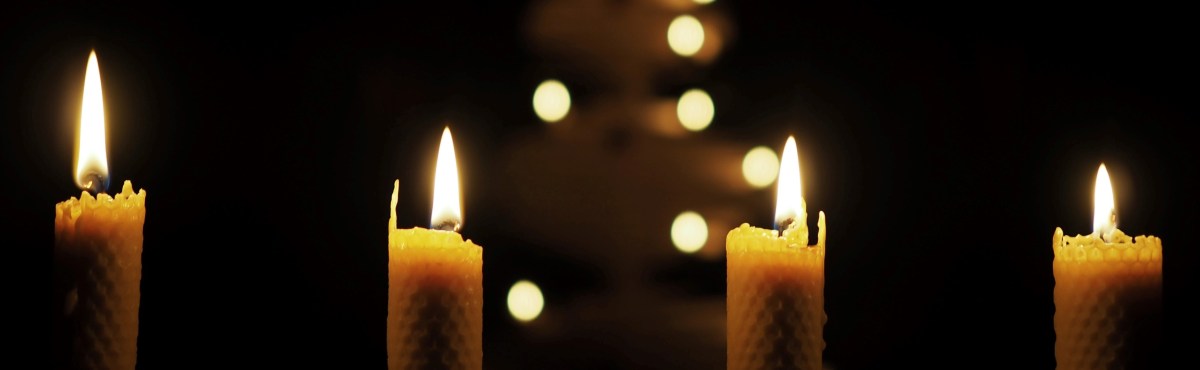
Advent has historically been observed by Christian religious dominations and is marked by the lighting of four candles, one for each Sunday. But it is most famously known by everyone as the four or so weeks before Christmas when you “give up” something.

Advent wreath with four colored candles representing hope, peace, joy and love, one lit every Sunday of Advent. The white candle can be lit on Christmas Eve or Christmas.
(Photo by KaLisa Veer on Unsplash)

Growing up, we’d usually give up sweets during this time, only being allowed a little something each Sunday, with the idea that we would appreciate the candies and cakes at Christmas all the more.

But you know what? I don’t really think it had that effect. That was something geared more towards our stomachs than our souls. Sure, we’d look forward to finally indulging in holiday goodies…but that was about it.

And as the years went on and treats played an ever-decreasing role in my life, I flailed around looking for something else to deny myself. Let’s face it, I was missing the point.

More recently, I’ve turned Advent into a different kind of spiritual opportunity.

So I’d like to offer a most positive way of observing those last weeks of the year for everyone, regardless of religious affiliation. And it has nothing to do with depriving yourself of anything.

Rather, it’s a blissful gift for yourself…and your soul, if you will.

Not everyone lives where the winter weather is warm enough to pick up trash on the beach…but I’m willing to bet that most of us live in a place where we can lend a hand to a charitable organization.
(Photo by Brian Yurasits on Unsplash)

For this Advent, I invite you to commit to several weeks of establishing a new thoughtful behavior. This can look different for everyone:

Perhaps, it’s time to set aside a few minutes in prayer and contemplation, as it suits your own spiritual tradition.

Perhaps it’s an opportunity to commit to volunteering for a charity, giving to others without expecting anything in return.

Perhaps it’s a time to establish a simple meditation practice, a few minutes a day at a specified time.

Perhaps it’s an opportunity to practice daily mindfulness, say, when you make your morning coffee or tea, truly focusing on the process and what the items feel like in your hands.

Perhaps, it’s time to think before reacting, pausing before getting angry and saying something hurtful.

This Advent might be the perfect opportunity to establish a practice of mindful contemplation.
(Photo by Ümit Bulut on Unsplash)

Perhaps this is the time to go through your belongings, a little every day, and gather up what you can give to others in need, or discard if the item is no longer of use to anyone.

Perhaps this is time to think about all the things for which you’re grateful, starting or ending your day in this way. And if there’s nothing that you can be grateful about, then consider what you’re grateful that is *not* happening.

Choosing what to focus on for Advent can be a very mindful process in itself. And after about a month of this practice, you will emerge with a beautiful new habit.

Give it a try and I wish you a beautiful Advent season!

~~~~~~~~~~~~~~~~~~~~

Please note: I realize that there is a much deeper religious meaning of Advent for Christians, and I’m not trying to minimize that. However, in this time of hyperpolarization when we’re so focused on what sets us apart from those around us, this is a thoughtful way to share the Advent tradition with everyone, with love. And isn’t that the spirit of Christmas?