Staying Calm is the Best Revenge

(Title image: Image by Pexels from Pixabay)

Yes, revenge is not a nice word. But if you’re having “that kind of a day” it just might offer you the kick in the pants that you need.

Here’s an example: last week was hectic for me. There were additional work demands on top of which popped up all sorts of fires that I needed to put out. Things were not going smoothly, I missed out on exercise, wasn’t sleeping well, got a letter of rent increase, had an upset stomach—all of which were dragging me into a funk.

With all the negative things coming at me, I lost my emotional footing.

So…I decided to take revenge on the bad news, work emergencies and everything else.

And I was going to do it by not letting it affect me. I even wrote “revenge” on a sticky note and put it up on my computer monitor (NOT at work! At home, where it’s easier to explain myself).

Just say “NO” to allowing the negatives in life to run you ragged. You show ’em!
(Photo by Jon Tyson on Unsplash)

Like I mentioned at the top of the post, revenge brings with it all sorts of negative connotations. It’s kind of like giving in to the “dark side” and using your anger, frustration, despair and whatnot to overcome you. I’m NOT advocating for that.

But there is a certain fire and focus that the concept of revenge embodies…yes, we can call it passion, but I’m not in the mood for that. So I’ll stick with simple revenge with the understanding that sometimes, little rebels that we are, we will do exactly the opposite of what the situations are drawing out of us. Just because.

Freak out? No, you bully, watch me remain calm. Heart starts racing? No no no, I soothe myself with deep breaths and extended exhales. Scary thoughts fluttering wildly in my head? Nope, I bring my attention down to my feet and seat, settling down into where I am now.

No temporary wrinkles are going to ruffle me. And I know that all these things are TEMPORARY. This might be fierce defiance that I’m dipping into, like a recalcitrant toddler, but if it works, it works.

~~~~~~~~~~~~~~~~~~~~

This is probably not what the great teachers of mindfulness had in mind…but, ehh, today I’m not playing nice.

“Lightening Up”: A Breathing Visualization

(Title image: Photo by Josh Rangel on Unsplash)

Since I’ve found my stress levels higher this year, I’ve been playing with ways to quickly calm myself down.

Here’s one that I’ve been using lately. It’s very simple and involves a basic visualization, but has also been effective in grounding me fast.

And it goes like this…

Sit comfortably on a stable seat with a dignified upright posture, not too rigid, not too loose. Close the eyes or, if you prefer, soften your gaze with eyes cast downwards.

Then start slowing your breath, deepening your inhale and extending your exhale. Not focusing on a particular part of the breath cycle, but more on your entire body, noticing it rock with the breath, feeling it settle with every exhale.

Every inhale gives you a lift.
(Photo by Florian Klauer on Unsplash)

As this becomes comfortable, start visualizing the expansion and contraction of your body, as if the breath were a hollowing out of your insides. Imagine that inside you there is a space like a balloon. And the inhale is an inflation of the balloon, with the exhale a gentle relaxation of that stretch.

No need to imagine specifics about the balloon, what’s important is to notice the stretch and an opening inside as the air flows in, the expansion releasing muscles that might be tight from stress. And then, as the air flows out, notice the softening and relaxation of the body.

As you continue the inhale and exhale, feel the lightening of the body as it expands, followed by the gentle sinking as it contracts. See if you can notice yourself lift off as you breathe in, as if you were filling up with helium. But then settle into your seat as you breath out.

Continue like this, noticing yourself get progressively lighter, so that when you settle with the exhales, you still maintain some bouyancy.

This type of breathing meditation helps me “lighten up” when I feel overwhelmed, like I’m getting crushed by whatever the stressor is. Putting focus on the body keeps me out of my head and the deep breaths are soothing.

Hope this helps you too!

A Vote for Respecting Each Other

(Title image: Photo by alpay tonga on Unsplash)

Some people may experience resistance to this concept.

But as the United States heads into a contentious election, there are a lot of electrified emotions. People are on edge, tempers short and those who think differently from us are viewed with suspicion, disdain or hostility.

It’s very easy to get sucked into that kind of thinking because “us vs. them”messaging abounds and there’s always someone who seeks to profit from continual polarization.

Perhaps someone supports the “other” candidate and we imagine that they are a certain type of person with numeous negative characteristics.

But I offer a different way of looking at them.

We open ourselves to heartbreak when we close the door to understanding.
(Photo by Kelly Sikkema on Unsplash)

Consider someone that you’ve met or read about and formed a negative opinion of based on very little information. All you know is that they disagree with you on topics that you feel strongly about.

Then think about what their motivations are. And instead of allowing yourself to follow down the path of immediate condemnation, consider that they might have motivations very similar to yours. If they seem angry, consider that the anger and hatred you perceive is stoked by fear and concern.

They may fear for what happens to their family. Perhaps they feel that their children are at risk. It’s possible that they believe their livelihood is threatened or that they themselves are in grave danger. They may feel very deeply about the same things that you feel deeply about, but their perspective is different.

What if you try to soften your views of them? That doesn’t mean you have to agree with them. But try not to vilify them for how passionately they care about the issues that they do.

Take a deep breath, it’s okay.
(Photo by freestocks on Unsplash)

Do you find yourself resisting this practice? Perhaps it seems like you don’t want to “give them an inch” because of a plethora of perceived injuries. Or that extending them some grace is somehow morally reprehensible.

But does living with that kind of anger in your heart serve you better? What are the emotions that keep you from wishing someone well: fear, suspicion, anger, pain, obstinance…all these are negative drivers. They will never bring you a sense of peace.

There is a point at which we realize that maintaining polarization takes far more energy than acknowledging that someone thinks differently because they care deeply, even though their solution is different from yours.

Showing respect to people is not the same as agreeing with them. You do not have to vote for their candidate. You don’t have to believe that their way is the only way.

But try to release animosity. Because if there is one right that we should all grant ourselves, it is to live together in an environment where we understand each other, even if we don’t agree.

Lucy in the Sky with Diamonds: And Now…My Eyes?

(Title image: Photo by Adam Gonzales on Unsplash)

So one of the hardest things for me about having cancer was losing a sense of security. Suddenly my body was out to get me, without my knowledge, while I was basking in a false sense of security that everything was okay.

Dealing with uncertainty is tough. It made me painfully aware of my own mortality before I was ready for it. It was as if cancer became my midlife crisis.

But it wasn’t just that I had to deal with not having guarantees about my own health (I mean, do we ever really have that?), about cancer not bothering me again. It also brought uncertainty about whether strange feelings in my body meant something.

I got to a point where I was afraid of anything, real or imagined, that I felt in my body. And after doing that for a while and completely exhausting myself, I called it quits and stopped running to the doctor for every little thing.

But now…I’m wondering if I’m kidding myself?

About a week ago, I had a weird thing happen. I was shopping at a market with my daughter. We were almost done when I noticed a funny change in my vision.

This wasn’t what I saw, but the colors were just as bright and vibrant.
(Photo by Randy Bayne on Unsplash)

I started seeing rings, the best way I can describe them is as if they were stained glass rings of vibrant colors, like an OLED screen, kind of like what you might see in a beautiful kaleidoscope. They were noticible, but didn’t take over all of my visual field. And YES, they were freaky. The entire show lasted about 20 minutes and primarily affected my left eye.

Then they faded away.

At that point, I recalled that I had experienced something similar, but without the vibrant colors, a few months ago. Again, I had been at a store and noticed a funny change in my vision, zigzagged lines.

That time it also didn’t last very long. Neither one of these episodes was associated with headaches.

Now we have a situation.

My oncologist always asks about visual disturbances, like seeing things that aren’t there, shadows, headaches, severe loss of balance. As a triple positive breast cancer survivor, I know this is because of possible metastases to the brain.

But instead of calling him last week to tell him what happened, I paused. I had done some research on the internet about these types of phenomena, and it’s quite possible that I’m experiencing ocular (acephalgic) migraines…again, without the headache. I’ll have to see if those rings/zigzags happen again, but at this point, with the amount of upheaval that I’ve experienced over the past few months (including the death of a parent)…and the fact that both times these visual oddities happened in stores with bright overhead lighting, well, let’s just say “brain tumor” doesn’t strike me as the most likely cause.

Yes, yes, yes, I will reach out to my oncologist this week. Probably, maybe. And if I do, I will ask to wait before being required to take another ride in the MRI tube. I’ve learned that at times like this, it is best to take a breath, stay present and wait for more information before proceeding.

“Ask Me Anything”: Streaming on Twitch

(Title image: Photo by Clay Banks on Unsplash)

Well, I tried a thing…

In honor of Breast Cancer Awareness Month, I decided to try an “Ask Me Anything” stream on a streaming platform called Twitch.

Twitch is primarily a game streaming platform although there are also art streams, animal streams, science streams and a variety of other worthwhile (and some not-so-worthwhile) streams.

I’ve streamed video games there before—because after cancer, playing horror games in virtual reality is not as scary—so I was familiar with the workings. Additionally, with progressively more younger women getting diagnosed with breast cancer, I felt that it was appropriate to reach out to a younger community.

I wanted to give people a chance to ask questions about the breast cancer experience that they might not feel comfortable asking someone they know who has the disease. This was based on my own experience decades ago; a fellow student was diagnosed, and suddenly I wasn’t sure how to talk to her. I didn’t want to say the “wrong” thing, afraid that I might upset her or otherwise “remind” her about her cancer, as if she had forgotten.

All this was, of course, ridiculous, because she herself was very open about the disease and talked about it to us freely. She’d let us know how it was going, sometimes came to class wearing only a hat on her bald head, never showing any indication that speaking about cancer made her uncomfortable.

The issue wasn’t my friend, it was me, and I honestly didn’t give her as much support as I could have. I probably looked like I was pulling away but the reality was that I just didn’t know how to speak to her for fear of hurting her.

I’m here to answer all those questions that people don’t feel comfortable asking…but want to know the answer to.
(Photo by 愚木混株 cdd20 on Unsplash)

There were questions that I could have engaged her with like, “how sick do you get from chemotherapy”, “what does your treatment plan look like”, “what type of breast cancer do you have”, “what are you looking forward to most when you’re done?”

Additionally, I wondered about things like, “what is the survival rate for your cancer”, that I would have never asked her for fear of really being inappropriate. But I was still curious (keep in mind, this was prior to widespread usage of the World Wide Web/Internet, so I couldn’t google the info).

All of those questions are the ones that I wanted to be available to answer on my stream. If you’ve been reading my blog posts, you probably know a lot about my own situation. I’m not shy about sharing.

But a person with a co-worker who was recently diagnosed, like my younger self, might not want to ask them.

So, I gave the Q&A session a try…to a whopping zero viewers. And that was okay because I wasn’t sure how it would go. I talked almost non-stop about what my breast cancer experience was like. It was cathartic to be sure and I was surprised that I was able to speak for as long as I did. Eventually, my throat started to hurt (water? I’m supposed to drink water?) and I called it a day.

It was also a touch out of my comfort zone. I feel like I need to do something useful with my life and I’m running out of time. This stream is one way to shake myself up at the age of 58 and get used to taking risks again. Ouch.

Just for kicks, I’ll be posting the unedited video that I created from the Q&A session although I admit, it took a bit for me to get going so it’s very stream-of-consciousness. I’m still in the process of uploading it, but will post it once that’s all done.

I’m tentatively planning to do this again next Saturday morning at ~9am PDT, assuming my voice recovers by then. If you’re interested it taking a look, you will be able to access the stream here: https://www.twitch.tv/franticshanti.

Rappeling Down through the Strata: A Grounding Exercise

(Title image: Photo by Outward Bound Costa Rica on Unsplash)

It’s been a very weird few weeks for me. My stress levels have been climbing, and while I can kind of, sort of point to certain anxiety-provoking events that might be responsible…there’s nothing truly significant that would elicit this type of response.

Regardless, I’ve been spending more time in the “higher strata” of myself, and I don’t mean this in a good sense. Another way of putting it is that I’m all up in my own head, bouncing around and being pummeled by all sorts of thoughts, expectations, fears, unreasonable beliefs and the like.

Oooo, there I am, stuck in my own head.
(Photo by Taylor Brandon on Unsplash)

Usually I know when this is happening, but this time I was too preoccupied with the worries of those around me that I didn’t notice myself drift up and stake a camp in the swamp of my mind.

Even my meditations tended to get stuck up there. Time to rappel down.

I get myself down this way: first by acknowledging the mess that I’m dealing with in my head, the rainstorm whipping up swirling thoughts. Not all my concerns are unreasonable, but they are pointless to get hung up on in this moment.

Next, I focus on the noise on the street outside (there is always noise on our street, but the longer I listen, the greater chance that I’ll hear a bird or other wildlife sounds). I bring my attention out to the expanse around me—getting out of the cramped space between my ears.

That’s a nice break. But I can’t ignore myself forever. So I feel into the sensations on my face: the feeling of the air (hot or cool), noticing the weight of my glasses on my nose, perhaps an itch on the scalp or cheek.

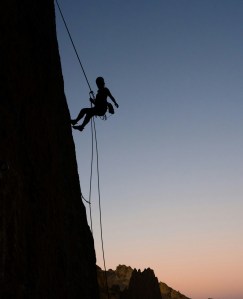
And here I go, rappeling down to a place where I can ground myself and return to the present moment.
(Photo by Ben Kitching on Unsplash)

Then I drop down to my neck and shoulders, giving them a roll as I go, and then towards my chest. Here I pause and bring focus to my breathing. Usually that results in an automatic slowing of the breath, as I notice my ribs expand and contract.

But after a brief stay I rappel down and out more quickly, into my hands and feet. Noticing how my hands feel on whatever surface they lie. And how my feet feel against the earth.

I imagine that my feet are part of the bedrock, joining the rest of the Earth’s crust. Connected and solid, forming a stable base.

And from down here, I look back up to where those clouds around my head were bringing furious rain, and they seem so far away. I’m peaceful and unruffled here on the ground. Down here is what’s really happening in the present, without being affected by the past and future. And what’s happening is just what’s happening, neither good nor bad.

Taking a deep breath, maybe a yawn, I stretch my body out the way I do when waking from a long sleep, enjoying the slight shiver of the muscles.

And then, on to the rest of my day a little bit calmer.

“The Resilience Challenge”: Research Study and Master Class Registration

(Title image: Photo by Jumpy Wizard on Unsplash)

This is a time-sensitive opportunity for US residents!

NOTE: all links are described at the bottom of this post.

I unexpectedly came across a great opportunity for those of you interested in taking a master class in stress management and also participating in a large research study.

Dr. Judith Moskowitz, a research psychologist at Northwestern University’s Feinberg School of Medicine, is recruiting 20,000 participants for an online, self-guided, positive emotions study/class. The course will teach eight science-backed stress reduction skills over 5 weeks, with the 6th week being a practice and review period (the entire length of the study will be 12 weeks). The skills being taught involve the following (from this National Public Radio (NPR) article):

  1. Positive Events
  2. Savoring
  3. Gratitude
  4. Daily Mindfulness
  5. Positive Reappraisal
  6. Self-Compassion
  7. Personal Strengths
  8. Attainable Goals

Additionally, NPR has an accompanying 5-week newsletter series called Stress Less that will help reinforce these skills. Signing up for that can be done here.

This other article from NPR talks about both the newsletter and the study/class.

More information and the registration link can be found on Dr. Moskowitz’s site where she describes what’s involved. To participate, you must be over the age of 18, living in the United States and have reliable internet connectivity as this is 100% online. There will be questionnaires to complete about your emotional states at the beginning and end of the study, and you will get nightly homework.

Consistency is the way to grow positive skills and behaviors, which is why I’m looking forward to participating in this class.
(Photo by Jane Thomson on Unsplash)

While the “nightly homework” thing might seem like too much, I can personally attest to the fact that consistency is what strengthens skills and habits. You keep yourself accountable by committing to a daily practice. For me, knowing that a course is set up for working on a little every day is actually quite reassuring—I know I’m more likely to get results.

But do these skills really work in reducing stress? Dr. Moskowitz herself said that she was initially skeptical that skills like these would make an appreciable difference, but years of positive research results changed her mind. The idea is to train your brain to experience good feelings.

I love programs like this because the only cost is a little effort on your part. If it doesn’t seem to work for you, you haven’t lost much, but if it works, the rewards can be life-changing.

As a cancer survivor with anxious tendencies, I find this to be a win-win proposition. I have signed up, as have several members of my family. If you are interested, don’t wait! The study is limited to the first 20,000 registrants and when the original NPR story came out on Monday, September 30th, the response was so overwhelming that it effectively shut the regstration site down.

Registration resumed on October 2nd and as far as I know there are still spaces available.

But the enthusiastic initial response to the invitation to join in the research was quite telling. So many of us are looking for a way to reduce our stress levels and bring more positivity into our lives. This challenge is one more way to do that.

~~~~~~~~~~~~~~~~~~~~

Links with descriptions:

NPR audio story featuring the Resilience Challenge: https://www.npr.org/sections/shots-health-news/2024/09/27/nx-s1-5082364/anxiety-stress-positive-coping-class-skills

NPR article featuring the Stress Less newsletter and Resilience Study: https://www.npr.org/sections/shots-health-news/2024/09/28/nx-s1-5084630/anxiety-stress-relief-tips-strategies

The Resilience Challenge registration information and link: https://www.moskowitzlab.com/resilience

NPR Stress Less newsletter sign up: https://www.npr.org/newsletter/stress-less?&utm_campaign=hpstory

The Pink Tsunami is Coming

(Title image: Photo by Pawel Czerwinski on Unsplash)

It’s that time of the year again.

I won’t lie, I have mixed feelings about the color pink these days, along with October’s “breast cancer awareness” paraphernalia popping up in stores, in promotions and all over social media. Some of us don’t need the reminder that breasts get cancer.

Breast cancer is probably the most popularized cancer there is, and I’m willing to bet that’s in part because there is a giddiness associated with yelling “SAVE THE BOOBIES” and not getting into trouble for it. It is also the most funded cancer (McIntosh et al., 2023, Lancet, for example) but to be fair, also one of the most common.

So you would think that by now I would be very accepting of all the pink ribbons on yogurt and fizzy drinks and whatnot. But amidst the rah-rah, October also brings with it the memories of feeling very alone with my disease. Once the chemo and radiation were done, I found myself wading through a new phase of life that I wasn’t prepared for.

This is a reminder to myself that it is a privilege to be here griping about October being so pink!
(Photo by Angiola Harry on Unsplash)

I thought I was “done”. And so did everyone else. But dealing with continued Herceptin infusions along with an uncertain future of endocrine therapy frustrated me because I felt I still had an excuse to feel crappy, but no one else thought I did.

And even with that frustration, I have a lot to be grateful for.

All the pink stuff and smiling faces have been so important in bringing so much generous funding to breast cancer research, which has resulted in great strides being made. There are other cancers that are painfully underfunded (for instance, pancreatic cancer, which also has high mortality rates), and I would be lying if I said that I didn’t feel some guilt about that. I cannot gripe about all the pink too much, because I am the beneficiary of all the money that has poured in.

Specifically, my triple-positive breast cancer was actually considered quite aggressive, but research resulted in new pharmaceuticals that have de-fanged that type of breast cancer and resulted in high survival rates. Even my oncologist remarked that he couldn’t remember the last time a HER2-positive patient of his suffered a recurrence, and he’s in his 70s. That says a lot.

So it seems disingenuous of me to lament all the screaming pink at the store. It seems equally disingenuous of me to wonder how much cancer took away from me that I would still have right now. Because one thing it didn’t take away was my life, and not everyone is that fortunate. Remembering that puts everything into perspective.

Aging Muscle: After Cancer Treatment and Menopause [PHOTOS]

(Title image: Photo by Samuel Girven on Unsplash)

This is a reality check to demonstrate how, even with the greatest of intentions and planning, coupled with a serious love of exercise, you can’t turn back time.

And that’s okay.

But first, the comparison. Taken from this previous post, here’s a photo right before I started chemotherapy for triple-positive breast cancer, April 27, 2017:

April 27, 2017: I was exercising with a vengeance

After finishing chemo, radiation and Herceptin, AND after two years of estrogen-lowering Tamoxifen and a year into Letrozole, I’d lost some muscle even though I was lifting as heavy as I could.

This photo is from December 11, 2020:

December 11, 2020: Still exercising with a vengeance, but…

While I was still working out hard, endocrine therapy and menopause took their toll on my progress. Interestingly, estrogen is not simply a “feminizing” hormone; in women, it also helps preserve both muscle and bone mass. Menopause puts the breaks on estrogen production.

This becomes worrying as we age because less estrogen means weaker muscles which can lead to a greater risk of falls and chance of bone fractures. Endocrine therapy, which is designed to decrease the estrogen in the body in order to lessen the recurrence risk of hormone-sensitive breast cancer, adds to the problem.

And more than seven years after the top photo, this was taken today before posting, September 23, 2024:

September 23, 2024: New phone, different lighting (sorry!), more wrinkles, same moles. I’m working hard just to keep what I have, but loss is inevitable.

I’m still lifting but the entire landscape of my workout routines has changed. I have to give myself more recovery time between strength training sessions. I am much more susceptible to injuries—seriously, I can tweak something by turning or stretching out in a weird way. I have neuropathy in my feet which makes getting up on my toes (such as in plank or doing lunges) painful.

We recently had an intense heat wave: for a week the temperature inside our apartment didn’t fall below 80F degrees, and during the day it climbed as high as 95F degrees (again, INSIDE our apartment). I managed to work out through a chunk of that week, but the heat eventually got to me. And recovering from that took almost another week.

So, the spirit is willing but the flesh is barely managing at times.

However, there is an upside to being 58 years old with a lifetime of fitness experience. I still love working out. Even tough training sessions are manageable because they feel like an awesome accomplishment, and I feel bouyed afterwards.

Even on the days that I don’t do a formal workout, I make sure that I’m moving as much as I can. Fitness is an integral part of my life, even though it looks different now than it did seven years ago. In the post that I reference earlier, at the very bottom I wrote about how yoga was becoming a larger part of my life.

And that’s continued. Through my yoga teacher training in 2022 and upcoming yoga4cancer advanced training starting in January 2025, this direction feels so right for me.

While I don’t plan to give up my gym sessions anytime soon, yoga has given me a path to physical and mental fitness as I age. I am gradually moving into a more meditative approach to exercise that is less about intensity and more about staying healthy by integrating mind and body.

Elle Macpherson’s Cancer Story and the Missing Tumor Info

(Title image: Photo by Pierre Bamin on Unsplash)

Following on the heels of my Elle Macpherson post last week, I wanted to fill in some missing info…

To back up, former supermodel Elle Macpherson revealed that she took the holistic route when deciding to treat her breast cancer in 2017. However, most of the news stories that reported and offered opinions on her choices left out some critical information, as noted by this article in The Guardian (“Crucial information missing in Elle Macpherson breast cancer story, experts warn“). In this case, that information makes a big difference.

While it seems that Elle’s cancer was HER2-receptor positive, which suggests a more aggressive cancer, it was considered “non-invasive”, meaning it was contained within the mammary ducts. Often, this is referred to DCIS, or Ductal Carcinoma In Situ, and at this point those of us with personal knowledge of the disease will knowingly go, “OOooooooh.”

This is basically a “precancerous” mass of cells and often the treatments are more conservative. It’s considered stage 0. Yes, it becomes more dangerous if you do nothing, but clearly Elle did something: she had it removed.

DCIS is a stage 0 cancer, which doesn’t necessitate the most aggressive treatment.
(Photo by Bernard Hermant on Unsplash)

Beyond that, there are other conventional treatments offered, depending on how aggressively you want to go. This introduces the issue of potential overtreatment, which is gaining more attention among physicians and the public. It’s easy to throw the kitchen sink at anything that looks like cancer, but that increases the chances that patients unnecessarily experience damaging side effects. Not everyone needs to be smacked that hard with treatment.

So, given that Elle’s cancer was DCIS, her holistic treatment starts looking less extreme. In perspective, for stage 0, a radical mastectomy topped off with chemotherapy and other treatments leans towards overkill with minimal benefits, potentially affecting quality of life. So this is less about the types of Elle’s holistic treatments and much more about her cancer not requiring the same level of aggressive action as stage 1+ tumors.

However, very few of the news stories mentioned this. As a matter of fact, my own blog post last week might have confused the issue—I was writing without having all the facts. This underscores the importance of learning as much about your cancer as you can and understanding that your version of the disease may be very different from that of a friend with cancer.

In light of this, the pile-on regarding Elle’s treatment seems unfair…but only as it regards her personal situation. Because all the opinion pieces that came out against her choices, including my post, did so for a critical reason: that Elle’s story (“follow your heart”) may turn a cancer patient away from much-needed and beneficial treatment that can prolong their lives.

Get the facts, talk to your team, understand what you’re up against and what your risks are—yes, meditate, pray, exercise, change your diet. But don’t try to wish your cancer away.

~~~~~~~~~~~~~~~~~~~~

To clarify, Elle did indeed decline even less radical treatments such as endocrine therapy, so one could argue that she’s still taking a risk. We don’t have a crystal ball to determine whether this was the wisest choice, Elle believed it was the right choice for her.