Is it possible to re-imagine annoying city noises?
At the least, living in an urban area with a high level of noise pollution is annoying. At worst, being subjected to car alarms and emergency vehicle sirens at any time of the day and night is very jarring and stressful. And I’m speaking from personal experience here, as following our last move, we ended up with a bedroom overlooking a very busy Southern California street.
The stretch of road outside our apartment unit is one of those that give cars enough distance between traffic lights to really accelerate as they blast by. It also leads to one of the major hospitals in the area (hello, ambulance traffic), and this being a big city with big city issues, there’s no shortage of opportunities for the police to be called out, sirens blaring.
There are many days that I wish I weren’t where I am. But wishing doesn’t change anything.
Drawing on mindfulness helps, however, and this is how:
Re-interpreting noise as different sound elements turns an “idiot street racer” into a thunder-like rumble. Much less annoying.
Much of the stress I experience from these various car noises is due in part because I know what they mean. I know that the sounds are the constant stream of cars going down the street or a high-pitched siren wail. But what if I were to accept that I’m living in a noisy city and to define the street noises as simply various sounds?
What if I were to break down the sounds into their characteristics? Would it be easier to handle the noise if I stopped judging and explored each sound as if I were hearing it for the first time?
This is far more doable than one might imagine. Yes, alarms and loud tail pipes are decidedly unpleasant, but they don’t punctuate my soundscape nearly as frequently as do the regular cars driving by. The cars speed through with whooshes of different pitches depending on the vehicle and how quickly it passes.
Sounds of passing cars transform into soothing waves – with the occasional jarring reminder that things are not entirely pleasant.
These sounds rise up and pass away like waves on the ocean – in fact, that whoosh can be soothing, just like the sounds of the ocean can lull you to sleep. Even noisier cars and motorcycles take on a rumbling quality, like thunder. Allowing oneself to re-interpret these sounds, to let go of annoyance, makes even the more jarring noises easier to handle.
When you can’t run away from the noise, make space for it, invite it in and accept that this is what’s happening now. Inevitably, it will pass, to be replaced by another noise and another opportunity to re-imagine it.
There have been times when things in my life have gotten intense and I feel the walls closing in on me (cancer, I’m looking at you). Those are the times that I need to back off and give myself space to breathe. Being a very visual person, one of the methods I’ve employed is finding an image and associating a calm mind with it.
This becomes my safe space. Whether you prefer to call it your “calm space”, “sacred space” or even the oft-ridiculed “happy place”, the idea is the same. Find the visual elements that you find soothing and comforting — perhaps a place in nature, a place from your past where you felt safe, even a fantasy land that you create for the purpose. Real, imaginary, familiar or visited only in your mind, it doesn’t matter. What matters is that it resonates with you.
When I did this most recently, in the preparatory phase for Eye Movement Desensitization and Reprocessing (EMDR) therapy sessions to help with anxiety that I’d never been able to shake, I made a new Pinterest account to collect images.
I highly recommend this for anyone going through stressful times. We all need a buffer between ourselves and this hectic, unpredictable life, and this is one way to do that. Collecting and pinning these images is relaxing in itself!
I have always been drawn to natural settings with lots of greenery, so I searched for elements such as gardens, greenhouses, water, hanging vines, flowers and fish. This is a place created exclusively for me.
It is is easy to find many images that capture the feeling I’m after: a sense of closeness and security in a place of natural beauty, where I can be alone (unless I chose to let someone else in), a space impenetrable from the outside.
The sound of running water is luxuriously soothing, and the vibrant color of koi brightens everything. The above image may have been at the side of a house, but in my mind, it could be a hidden corner that only I can access.
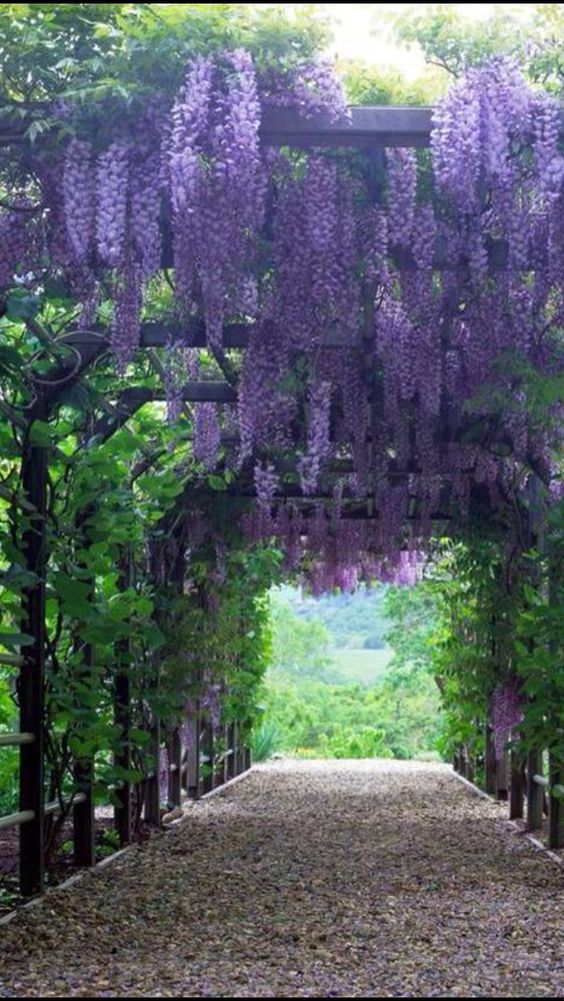
Not all spaces have to be confined, as this vine-covered path above illustrates. It provides room to wander and breathe deeply while still feeling secluded.
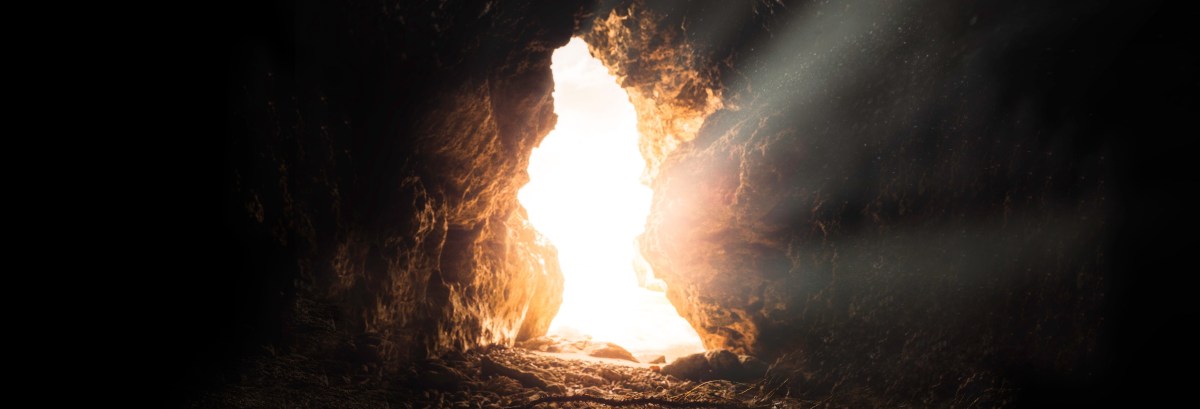
Your calm space can be made up of different images that show different elements of it. Each space needs a portal through which you enter, so why not make it magical?
Once I had gathered a variety of images that evoked the feeling of grounding and peace that I sought, it was time to name it: one word (or phrase) that enables me to conjure up my calm space. I settled on Halcyon, but realized later that it didn’t give me what I needed (I’m picky about words and their meanings). Then I came up with Elysium, as it suggested an other-worldly place in the heavens.
I thought that name fit perfectly. Except that as we continued in the preparation phase for EMDR, I had a hard time maintaining focus on one particular image. I had chosen so many! So I thought about what I really needed.
It was breathing space. A place to pause when things come at me too quickly. Ironically, after pinning so many glorious images on Pinterest, I returned to a photo that has served as the background for my two monitors at work. When I arrive in the morning and log in, this image grounds me and I find myself taking a very deep breath, like a sigh:
THIS is my sanctuary.
This image speaks to me. It combines nature with a sense of spaciousness, yet feels secluded enough to impart a feeling of security. And my name for it? Sanctuary. So simple and to the point, and yet encompassing so many different emotions and meanings for me.
The next step has been feeling into the sensations that this calm space evokes. What does that feel like in my body? And then holding onto that feeling, saying the name, imagining the setting. You can “charge” the image with meaning in this way ( à la Pavlov).
The associations that are formed in the process create a sense of calm that I can draw upon to center and ground myself during periods of high stress. It’s not a pill to end all woes, but it can be a powerful tool for dropping yourself down into a more peaceful state. I encourage you to give it a try.
I try to avoid “stream-of-consciousness”posts, but occasionally I’ll let one through.This one stings a bit…
I am tired. Physical fatigue is easy for me; getting emotionally wrung out is exhausting.
Events that have taken place over the past several years have demanded a release of expectations, a relinquishing of normality, how I think life “should” be.
Cancer was the big one. I used to wake in the morning, hoping that my diagnosis had been a bad dream. That I could laugh and shake my head, thinking, “Phew! Glad THAT wasn’t real!” And then go about my day, forgetting the fear and immersing myself in blissfully boring everyday life.
But that’s not what happened. I would wake in the pre-dawn hours after sleep had left me to the darkness, coldness spreading through my belly as I remembered that I had cancer. And in the midst of the fear of dying was that wrenching feeling of having to let go of wanting things to be different. Still desperately holding on when it was too late to do so.
Attachment leads to suffering. I know this, but I cling nonetheless, stubbornly refusing to accept change.
I was given a bit of news several days ago, too disorienting for me to even define in this post. Like cancer, it caught me off guard, and I cling to wanting things to be different. To be “normal” and uninteresting. I’m compelled by my need to fix it, make it comfortable and easy to accept.
I need to get.a.grip…
Yet another thing I wish I could control. But I can only paw at it from the outside.
Now I’m engaging in emotional calisthenics, to try to find a notch on this slick surface that I can stick my finger into and get some sort of grip.
I wish this wasn’t the case. I’m disappointed that I feel the way I do. I tell myself, I should be more tolerant of what happens. But it’s the hope that things will stay the same that makes change so difficult.
I twist my thoughts into origami, trying to find a comfortable shape. It takes a lot of massaging to smooth out the edges and make this morsel easier to swallow. Every time I mull it over, it cuts me again.
At some point it is no longer the matter itself that causes pain. It’s all the emotion layered on top of it.
So I’m tired. Letting go, yes, but so slowly. You’d think that it would get easier with practice but even the process hurts.
Cancer can turn you into a stress-ball on its own, thankyouverymuch, but there are things that healthcare workers do that may worsen matters.
While there is always room for improvement in the many subtleties of physician-patient interactions (with subtleties being the operative term here, as anxious patients may be zeroing in on the “feel” of interactions and not just the spoken words), there are two big assumptions that I wish doctors would realize that they’re making:
Eat your vegetables and you won’t get cancer? I wish it were that simple.
The first assumption I’ve experienced has been made by non-oncologist physicians. They seem to be just as likely as the rest of the population to confuse correlations with causations. One doctor had been surprised that I had gotten cancer (hey, join the club) because my lifestyle “should” have been protective.
This physician, you could argue, was justified in saying what he did, as the messages we are bombarded with suggest that we have some control over our risk for cancer. However, read the fine print and you’ll see that in a great number of cases the risk factors that a cancer patient has don’t differ from those of someone who doesn’t develop cancer. But even doctors miss the fine print…
I brought this up to my oncology team which was quick to point out that as long as we don’t definitively know what causes cancer, we can’t make assumptions about whether or not someone will get the disease. So, yeah.
The other major assumption is one that I’ve gotten from the oncological community, and that is that on some level, most patients with a given cancer have the same health profile. Ironically, this concept is often mixed in with the conflicting assertion that everyone’s cancer experience is different. Granted, when you’ve seen a gazillion cancer patients, similarities emerge, and consciously or not there’s probably a tendency to pigeonhole people. Still it’s frustrating to be treated like I fit into a slot when I really don’t.
Effective communication is a critical part of quality physician-patient interactions.
My own oncologist has realized that, thankfully, but he has done a good job of listening and I do a (*cough cough*) good job of talking. Perhaps a bit too good, since he’s mentioned that it would be best if I scheduled my appointment to be his last of the day, so that we don’t face as many time restrictions. But therein lies my point: oncologists need to ask and patients need to share, otherwise, the patient remains a two-dimensional entity and it’s more likely that assumptions will be made about them.
So if there’s a take-home message from any of this, it’s that good communication is an essential part of effective treatment. This is not an easy feat, as physicians have a limited amount of time with each patient, and patients might not think that a given aspect of their experience is relevant. Believe me, it is, and the more that we talk about this and get into the nitty gritty of it, the easier it will be for everyone involved.
Exercise has been an integral and indispensable part of my cancer recovery and my life as a whole. I’ve maintained a personal trainer certification (ACSM-CPT) for over a decade and even though I don’t train professionally, I keep abreast of new research and love a challenging workout.
Still, there are days that even I find myself dreading the session I have planned. For those times, I engage in mental calisthenics and rely on a mindful attitude. If you’re struggling to find motivation to exercise, this may help you too.
Note, motivation is something you generate yourself. It is inside you, but you have to coax it out. Be gentle. Hiring a personal trainer to beat you with a stick when you’re not up to a workout is not going to make you look forward to exercising more. But the following concepts might help:
Consider that a workout is made up of a series of movements.
Stop looking at a workout as a massive monolithic thing. Doing so can be overwhelming and make it more likely that you’ll talk yourself out of it before you even begin. Instead, consider that it’s made up of distinct parts, steps that you take one at a time.
Stay in the moment and keep each movement fresh.
Stay present and focus on the part of the movement that you’re doing at the moment, truly feeling into it. If you’re on a rowing machine, concentrate on each individual stroke making sure that you’re using proper form as you reach, push with your legs, and pull the handle. If you’re lifting weights, focus on where your body is in space, on contracting the muscle as you lift, on exhaling as you do so, keeping your body properly aligned. If your exercise is a brisk walk, be aware of how you’re stepping, pushing forward, swinging your arms. These movements become a meditation in and of themselves.
What matters is the here and now.
Release thoughts of how much longer you have until you’re done. Focus on the stroke, step or rep that you’re taking at this very moment. And then when you’ve completed it, consider the next movement with the same fresh attitude. Just as you would if you were focusing on each breath during meditation.
If you can’t finish your workout, that okay. You can try again tomorrow.
Practice self-care.
Do not force yourself to finish an entire workout if you *really* don’t have the energy to–but that means truly listening to your body’s limitations, not discouraging voices in your head. You are better off making a concerted effort at doing, say, half your distance or only one set per weight lifting exercise and doing it well, instead of making yourself so miserable that you don’t exercise again for another week and a half.
If you’re thinking, “I’m not up to doing the entire workout”, ask yourself, “Well, how much can I do?” and at least start. Consistency is key.
Let go of expectations.
Release preconceived notions of how your workout will go and how tired, miserable or sore you’ve already decided that you will feel. Look at each movement with fresh eyes. Employ a beginner’s mind. Get curious about how everything feels.
While it’s true that you’re exercising your body, your mind has a lot of influence on what will happen. The kind of exercise session you have is up to you. Decide to use your best form, draw on as much energy as you have in the moment, and exercise as much as you have planned. And if you cannot go as long you anticipated and have to stop earlier, let that be okay. No matter how much exercise you do, you are still better off than having done nothing. No one can take that accomplishment away from you.
I’m constantly working to keep anxiety under control. For me, one of the most common feelings associated with stress is that of it being “in your face”. There is no buffer and therefore no easy way to give yourself time to pause. Emotions rush at you.
I’ve developed visualizations to give me some space. I’ve already written about getting perspective and keeping anxiety at arm’s length, but sometimes I need another way of freeing myself from stressful thoughts. So I use bubbles!
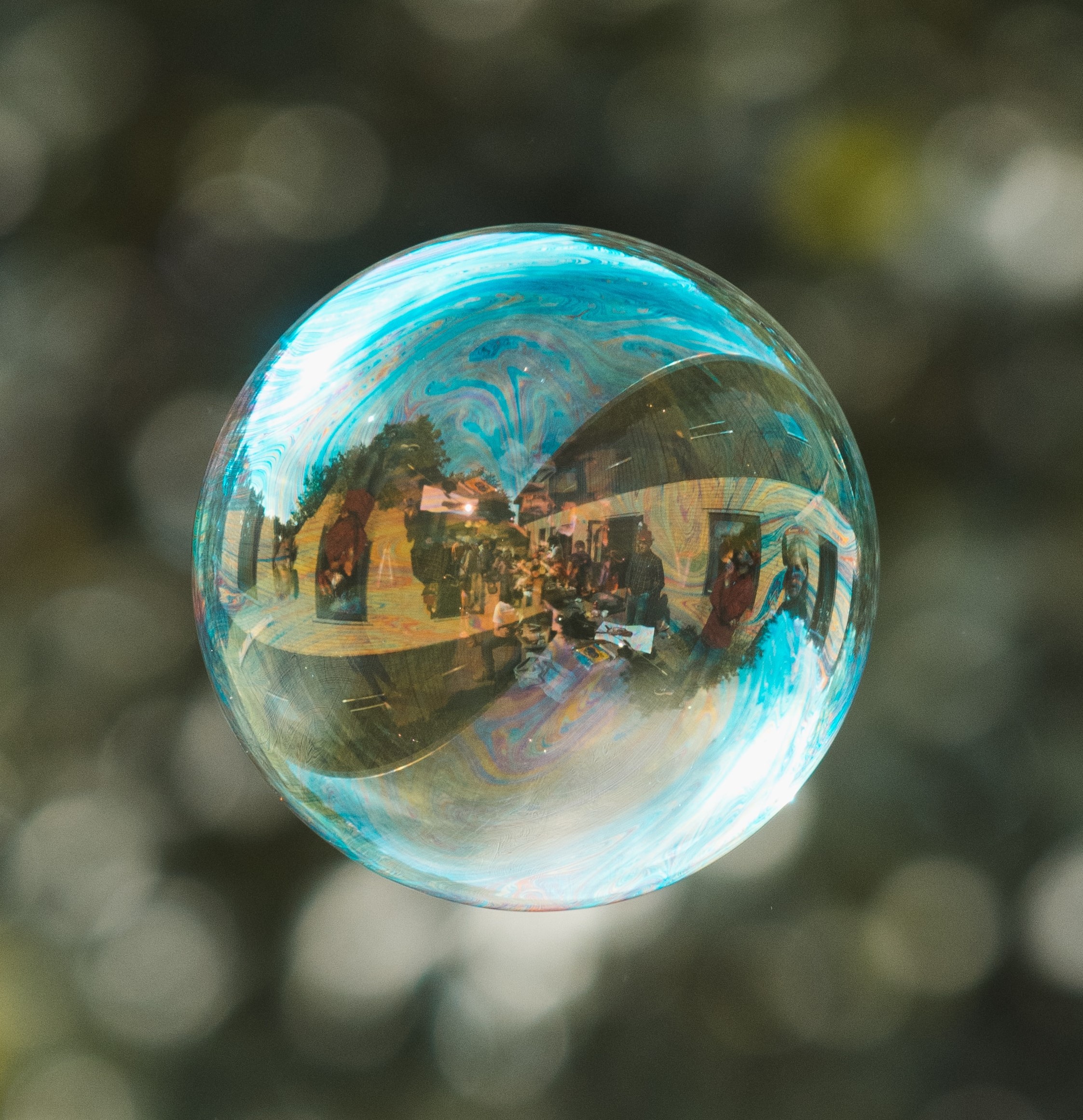
Oooo, bubbles!
When I get caught up in thoughts of a stressful situation and I feel like the images are right in front of me, I imagine pulling back from the scene. What is transpiring before me continues, but I slowly move away, and as I do, the periphery of my vision starts bending inward. As I pull back, I realize that I am inside a bubble with finite edges.
I keep moving backwards through the wall of the bubble until I’m standing outside it. The actions within are still taking place, but they’re no longer coming at me. I watch from a safe distance, feeling secure.
I may allow the bubble to float away or I can pop it if I choose. Or I may stay with it for a while, observing without getting drawn back in.
Sometimes this becomes a game, particularly if I wake in the middle of the night and find myself in the grip of fearful thoughts. It’s usually not enough for me to back out of one bubble. There may be many. Sometimes I leave a bubble and then realize that I’m standing in another, even bigger one.
When my mind is particularly active, the bubbles keep coming.
But eventually, I get to the point where I am standing outside of all the bubbles, watching them floating before me, the figures or events looking small and not menacing at all. That is the perspective that I need to create myself breathing space.
The metaphor of a bubble is a lovely one because bubbles by themselves are playful, beautiful and, of course, ephemeral. Just as the bubble does not last forever, the events in our lives, no matter how stressful, don’t last forever either. The bubble reminds me that all things pass.
I’ve even brought a little container of soapy water with a bubble wand to work. Blowing bubbles (when no one’s looking) in my office slows my breathing and requires some focus. A controlled exhalation is needed to not pop the prismatic ball of soap-water before I can send it on its way, taking my worries along with it.
A stressful event taking place inside a bubble seems less frightening.
When I cannot do this indoors, I may take a break and head outside, letting the bubbles float off into the breeze. I might make someone else smile in the the process and that gladdens my heart.
It’s silly and fun and reminds me not to take everything so seriously. And if I can send my cares off in bubbles, giving me even a temporary reprieve from anxiety, then perhaps what might have seemed like an overwhelming crisis may feel more manageable.
I first learned of Dr. Jimmie Holland’s work through her obituary in the New York Times, following her passing on December 24, 2017. As a psychiatrist at Memorial Sloan-Kettering Cancer Center, she was credited with pioneering the field of psycho-oncology, which addresses the stuff that goes on in your noggin while you’re making your way through cancer treatment.
Years ago, Dr. Holland became frustrated by the fact that cancer patients were questioned about how every inch of their bodies felt, but oncologists neglected to ask about the state of their emotions. I’m grateful for her recognition of this fact and I completely agree with her. The psychological experience of cancer is a critically important element in treatment, one that is too easily overlooked by hospitals and physicians in their rush to address physical symptoms.
The late Jimmie Holland, a psychiatrist who happened to be married to an oncologist, understood the many psychological pressures affecting cancer patients.
I highly recommend Dr. Holland’s book, The Human Side of Cancer: Living With Hope, Coping with Uncertainty, which still sits by my bedside even though I finished reading it well over a year ago. While I read it cover-to-cover, it works just as well as a reference text, set up so that you can go to the section most relevant to you.
For me, with a background in psychology, this book was exactly what I was looking for, but certainly psychology degrees are not necessary to utilize what’s on these pages. The book was written for both patients and caregivers, for those undergoing treatment and those on the path of survivorship, dealing with a poor prognosis or experiencing a recurrence. There is information appropriate for all these varied situations and all types of cancers.
The book is divided into 16 chapters, followed by a listing of resources. The chapters are as follows:
What Is the Human Side of Cancer?
The Tyranny of Positive Thinking
The Mind-Body Connections and Cancer
The Diagnosis: “I Could Die of This”
Working Together
Coping
The Human Side of Cancer Treatments
The Human Side of Specific Cancers
All Medicine Doesn’t Come in a Bottle: Psychological Treatment
Alternative and Complementary Therapies
“I’m a Survivor–Now What?”
Staying Healthy
The Goal is Control
The Last Taboo
The Family and Cancer
How Do I Go On?
At some point, I had to stop tagging pages because, honestly, I wanted to tag everything.
I enthusiastically plowed through this book because Dr. Holland was writing exactly about the things I’d been thinking about. Most of the parts that I tagged for future reference were in the center (chapters 7-11), but in its entirety, the book is invaluable. Dr. Holland provided numerous examples of situations that her patients experienced in addition to offering practical advice on a variety of topics. So many sections spoke directly to questions that I’d had, such as, “Did Stress Alter My Immune System and Cause My Cancer?, “Are All These Problems [from treatment] Worth the Long Term Gain?” and “Am I a Cancer Patient or a Cancer Survivor?”, to name several. I was surprised by how many issues that had been bothering me showed up in the pages of this book.
Cancer is never an easy topic, but thoughts about potential outcomes and treatment consequences are the reality that cancer patients live every day. This book addressed everything about that reality, and it was perfect for where my head was at the time I was reading it: having had surgery, chemo and radiation, still undergoing monoclonal antibody infusions. My hair had just begun to grow back in and I was happy that the “worst” of my treatment was over, but I was facing the uncertainty of the future.
I remember reading The Human Side of Cancer and being excited by how relevant the material was to my life, and simultaneously wondering why this wasn’t required reading for anyone receiving a cancer diagnosis. Or every oncologist on the face of this planet.
If you are a cancer survivor, current patient or caring for someone who is, I encourage you to get a copy of this book. You might not realize how much you need it.
I’m currently taking a class via Coursera.org by Prof. Laurie Santos of Yale entitled, “The Science of Well-Being“, which I expect to cover in more depth in a future post.
The purpose of the class is to present research on happiness, why we don’t have it (the things we think will make us happy, don’t) and how we can get it (what actually makes us happy may be surprising).
Of the many studies that Dr. Santos discusses, one in particular caught my interest. University of Chicago researcher Nicholas Epley investigated the impact that social connections have on our happiness (“Mistakenly seeking solitude“). Briefly, he found that individuals who made even superficial contact with someone else during their commute to work on a train not only felt happier, but the person with whom they struck up a conversation likewise felt happier that day.
Making an effort to bridge the gap between us benefits everyone.
But this can be uncomfortable to do. Quite often, people taking public transport keep to themselves. Even if we know that striking up a conversation might be pleasant – and even increase our happiness – we may feel too self-conscious to engage with a stranger.
This made me think: some of the most rewarding interactions that I’ve had with strangers have consisted of merely eliciting a smile from them. That is a very brief connection with another human that ends up bringing both of us joy.
And the best way to do that? Pay them a compliment. I have been gifted with the most beautiful and sincere smiles from others by complimenting them on something about them that was genuinely laudable, resulting in good feelings that last an unexpectedly long time. Try it and see!
This world needs more diverse people finding common connections with each other.
Furthermore, when you open yourself to finding something to compliment about another person, it is amazing how quickly you can locate it. Your eyes see things more brightly and happily, and that feeling is passed on to your recipient along with your kind words.
Then, if their smiles last long enough for their good mood to positively benefit someone else, perhaps that simple act of a compliment can send a ripple that becomes something so much bigger.
Although I don’t do so often, I can still knock out a proper cartwheel.
Since it’s a “wheel”, you only need a lot of space moving forward, not width-wise, so presumably, it should be possible to cartwheel down a hallway. After all, gymnasts manage this on a balance bean only a few inches wide.
But that’s not what happens to me. Even when there’s physically an ample amount of space for gymnastic endeavors, psychologically there is a perceived narrowness.
That lack of space exists only inside my head, but it’s powerful enough to hinder even an attempt at a cartwheel in our apartment.
I imagine limbs thwacking against walls coupled with lots of pain and regret.
This post, of course, is not about cartwheels. It’s that I often approach life events in a similar way. There is a narrowness of view and fear of pain, and these limitations take up real estate inside my head. While in reality, there’s enough space for emotions to express themselves and enough time to work out any arisen problems, those imagined walls confine my actions.
Yeah, there are moves that I will *not* be able to manage no matter what.
Were I to close my eyes and trust my abilities, cartwheeling through the little hallway from my galley kitchen to our dining area would be no big deal.
But faith in myself has been eroded away and my sight is influenced by not only things that came before but also the discomfort of what may come in the future.
Breaking through these barriers takes work, and while I’m up for it, it is a process. The trick, of course, is to generate enough confidence to cartwheel down that hallway while I still remember how.
This past Sunday, July 28, the monks and nuns of Deer Park Monastery (Tu Viện Lộc Uyển) graciously opened their grounds to the public for a Day of Mindfulness. This Buddhist monastery, in Thich Nhat Hanh’s Plum Village Tradition, is nestled in the Escondido highlands, in northeast San Diego County.
My daughter and I were delighted to join in since the monastery is within a reasonable drive from our home. It was going to be a hot day, and I figured that there might not be a big turnout, even though this seemed to be the only Day of Mindfulness offered during the summer months at the monastery.
I couldn’t have been more wrong! Apparently, many were in need of a Day of Mindfulness, and 400 of us showed up.
This was our first trip to Deer Park. Following a welcome with singing, we participated in a walking meditation. My daughter and I were clearly more focused on taking mindful steps and enjoying the beauty of our surroundings instead of exactly where on the grounds we were, and as a result, had trouble locating the small meditation hall where all the first-timers go following the walk. By the time we figured out where it was, the room was already packed with people. We managed to eke out a small space at the very back for ourselves to sit and listen.
I have never sensed such peace and spaciousness in the midst of so many bodies. The monk who spoke was gentle and funny, originally from Sweden, and it was a pleasure to listen to his introduction to the practice of mindfulness.
Following this explanation was a short break, and my daughter and I headed for tea. Cups in hand, we sipped as we sat outside in the shade behind the Tea Room, feasting on the glorious sight of the hilly terrain, serenaded by birds and wind chimes, and cooled by mountain breezes. Not what you would expect on a 90+ degree day during the summer. This felt so peaceful.
Done, we waited for our turn to wash our cups. Dharma sharing was next, but we never made it back to the small meditation hall. I admit I have a weakness for koi, and the lotus pond under the trees called to us.
At the lotus pond, I lost myself and found bliss.
We sat and watched the fish. I had had a difficult week, but those worries had not followed me to the monastery. In fact, all I felt was bliss and a lightness of being. Any thought that might have agitated me sat about six feet away, teetering precipitously on a rock surrounding the pond, ready to lose its balance, plunge into the water and be gulped up by one of the majestic koi. There, I was not bothered by anything. I don’t remember the last time I enjoyed such peace. We sat in silence for an hour and a half, breathing in, breathing out and filling up our senses.
I rarely go into the Southern California sun without my umbrella, and on this Sunday it not only saved my scalp, but also a tiny life.
The only break in the calm was a disturbance at one end of the pond. A bee was furiously treading water, looking like a teeny motorboat driving in circles. I rescued it with the end of my umbrella so it wouldn’t become fish food. The koi, I presumed, were well fed, and the world needs all the honeybees it can get.
I could have kept the fish company for the rest of the day, but lunch was upon us, so we made our way down the dining area (we were finally figuring out where everything was!). Everyone stood quietly in line as the scent of curry wafted through the air.
Four hundred visitors descended (ascended?) upon the monks and nuns diligently preparing our delicious lunch. By the time we got to the food, some platters were empty, but there was still more than enough to put on our plates and enjoy a mindful meal.
A much-needed reminder to slow down.
I had practiced mindful eating before, but this was a novel concept for my accompanying teenager, who often ate paying more attention to her phone than to her plate. We chewed silently and slowly, savoring every bite. The tastes of the curried tofu, rice, steamed carrots and salad were vivid, the colors on our plates glowed brightly. My daughter, halfway done, leaned over and whispered to me, “This is the most delicious salad I’ve ever eaten, and I’m already full!”
Ah, if only we could enjoy such preciously appreciated meals at home! At least I had one convert now.
We waited in line to wash our dishes – the sensation of soapy water followed by a cool water rise was refreshingly pleasant on such a hot day.
Our last stop before departing the monastery grounds was a visit to the bookstore. There were more people than books, and it seemed like the two nuns handling the payment transactions were a bit overwhelmed by everyone’s enthusiasm for making purchases. We indulged in coconut ice cream and visited the donation box before heading home.
Floating Cloud Stupa – we admired it from afar and look forward to visiting it the next time we are on the grounds.
We are looking forward to our next trip to Deer Park Monastery, with a visit to the Floating Cloud Stupa, which we only saw from afar this time. When we return, we won’t get “lost” again, because no matter where we are on the grounds, that’s where we want to be.