Breast Cancer: Finding Gratitude as a Cancer Patient

(Title image: Photo by Diego PH on Unsplash)

I’m not going to lie, gratitude can be difficult to navigate as a cancer patient.

When you’re mourning your diagnosis and trying to hold yourself together from the shock, the last thing you want is for some sunny person to tell you to think about everything you’re grateful for.

At such a time, it can be very difficult to think of anything. I, personally, felt a lot of anger, bitterness and even betrayal after I was told I had breast cancer. It wasn’t a great set of feelings to sink into, but that was my reality.

While I tried doing gratitude practices, in the beginning the process was miserable and felt “fake”. The whole notion of being grateful struck me as forced and required me to think about things I didn’t want to focus on.

Tough to be grateful? Make a list of what doesn’t suck.
(Photo by Hannah Olinger on Unsplash)

However, what helped me was making a list. It started out as a list of things about which I could say, “well, at least this didn’t happen” and slowly shifted to “well, this thing made my life easier”. It enabled me to find positives that I had otherwise overlooked.

I wasn’t grateful for getting cancer. But having bosses whose wives had survived breast cancer made it easier for them to understand what I was going through…and also to offer some useful advice (as did their wives).

I didn’t have the luxury of not working throughout treatment, but I was glad that a series of big projects had ended the previous year, so I didn’t have a huge workload waiting for me at the office. And while I really wished I could have had a full-time income, my part-time position meant that I had an easier time shifting my schedule to accommodate appointments and days off following infusions.

Additionally, it was fortunate that the region in which I live had a number of highly lauded cancer centers. And my cancer center offered free counseling by excellent therapists specifically trained to work with cancer patients.

It was also a plus that the summer during which I had my chemo infusions ended up being mild—luckily, since we didn’t have air conditioning—and my fear of enduring nausea through hot summer days never became a reality.

My list got longer and longer.

Opening the door to gratitude soothes the overwrought mind.
(Photo by Pedro Ramos on Unsplash)

So little by little, I started to pick through all the things that ended up better than they could have been. I didn’t call it “gratitude” at first because I was still bitter and refused to accept that there was anything to be grateful for. But the more things that came up that made me realize how much better the situation had turned out…the easier it was to finally come around to the idea that, even in the midst of the crappiest-thing-that-could-happen, there truly were things that I could l squeeze out a bit of gratitude for.

It took time. But when I loosened my grip on bitterness, I allowed in a swell of gratefulness, so much so that it was almost overwhelming how, if I had to get cancer, if it truly had to happen, there were so many things that had gone right. I started feeling so much better emotionally.

So my advice to anyone who wants to try out that “gratitude stuff” to see why it’s so great for your mental health: be gentle, start slowly and don’t tell anyone you’re doing it. This is a private practice for you. When you finally allow yourself to zero in on those little things that aren’t so bad or are kind of fortuitous given the situation, you may find that they buoy your spirits.

That’s all it takes. Not need to rush. Let the appreciation come to you.

The Stuff after Cancer Treatment: Even When It’s Over, It’s Not Over

(Title image: Photo by Leon Seibert on Unsplash)

I stumbled across an article about another celebrity who has gone through breast cancer treatment. That’s not surprising, given the relatively high percentage of women, in particular, who have been diagnosed or are at heightened risk of the disease.

But this one—about celebrity organizer Clea Shearer (of The Home Edit, a home organizing company/brand/empire)—gave me pause for the specific reason that there was so much cancer-related hardship that continued after she finished her treatment.

In 2022, Clea was diagnosed with stage 2 breast cancer (“invasive mammary carcinoma”) and underwent the familiar treatments of surgery, chemotherapy and radiation therapy. However, it’s the complications of her double mastectomy that make her story very striking. To date (that is, as of the release of this article in People magazine a few days ago), she has undergone 14 surgeries and may be running out of options for breast reconstruction.

This is not what anyone expects after they “finish” cancer treatment. In fact, Clea was declared cancer-free in November 2022. But it was clearly not the end of cancer-related effects for her.

I think it’s important for us to consider this when we try to be over-optimistic with cancer survivors. Pushing an upbeat attitude or telling survivors to “just be grateful” glosses over the reality of what they may continue to keep going through.

Yes, of course we are grateful. A cancer diagnosis is terrifying and for those of us who grew up when it was considered practically a death sentence, the idea of having it take your life is hard to get out of your head. In this day and age where social media describes the “condition” as d**th…well, cancer survivors have to meet the possibility head-on, minus the asterisks.

However long a survivor has survived is a cause for celebration and gratitude. But it’s not necessarily the end-of-story, fade-into-the-sunset ending. Clea’s experience is proof of that and I wish her strength and perseverance as she navigates the coming months.

Stories like Clea’s underscore the critical need to treat the whole patient, including offering emotional/mental health support, and not to simply stop the support when the cancer center-based treatment ends. Even when it might seem that treatment is done, it may just be the beginning of a new set of challenges.

“Dear Princess Kate, I Can Relate”

(Title image: Photo by Bence Balla-Schottner on Unsplash)

Over the last week or so, there have been a number of news articles focused on Catherine, Princess of Wales, who has been talking about life after finishing her cancer treatment.

She is officially in remission from her unspecified cancer, having completed chemotherapy. However, in a conversation on July 2 with hospital patients, staff and volunteers at Colchester Hospital in Essex (in southeast England), the princess noted that there was still more to endure once she was past her cancer treatment.

This is summed up from an article in USA Today (and numerous other outlets):

Kate described the cancer diagnosis and treatment as “life-changing” for both patients and their loved ones. “You have to find your new normal and that takes time … And it’s a roller coaster. It’s not smooth, like you expect it to be,” she said, according to the outlet. “But the reality is you go through hard times. … “You put on a sort of brave face, stoicism through treatment. Treatment’s done, then it’s like, ‘I can crack on, get back to normal,’ but actually the phase afterwards is really, really difficult.”

Wow, this is so relatable! I’m grateful that Kate is discussing life after cancer treatment, especially because she’s a highly public figure.

Many cancer survivors have experiences similar to Kate’s, particularly those, such as breast cancer survivors with hormone-positive cancers, who continue to take “maintenance” medications like tamoxifen and aromatase inhibitors. While many patients expect chemotherapy and radiation to be tough, they are often not prepared for the side effects associated with endocrine treatments that are prescribed to be taken for years after finishing everything else.

Princess Kate breaks with royal protocol in speaking frankly about the struggles following the end of cancer treatment.
(Video from TODAY)

But even without endocrine therapy, many cancer survivors are left with long-lasting side effects of varying severity. Some may be truly life-changing. Most of them will prevent a return to “normal” as we used to know it.

That normal, however, is what others may be expecting of you. Or you might expect of yourself. And that’s tough. Kate mentions the importance of reaching out for professional support if it is especially difficult to manage the phase following treatment, and I concur 100%.

Because it’s not simply the side effects…it’s the frustration that we feel with having the side effects linger. Or even the reactions of loved ones who don’t understand why things aren’t back to how they used to be. There is a grieving process associated with the loss of our previous lives that those around us may not appreciate, so I’m glad that Princess Kate is using her position to bring this out into the open.

Energy Modulation through Breath and Imagery

(Title image: Photo by Alexander Krivitskiy on Unsplash)

As my family takes some time to grieve the passing of a family member, I have been using pranayama (breathwork) to help with the broad range of emotions that such situations elicit.

I came across an excellent meditation by teacher Jeff Warren on the Calm app in which he pairs visualization with breathwork as a way of modifying your energy states.

Need to spark yourself? Or cool the sparks? There’s a breathing practice for that.
(Photo by Jez Timms on Unsplash)

It works with the natural ability of inhales to quicken your heartrate and bring up your energy levels and exhales to calm the nervous system and elicit the relaxation response. This is my version of what he instructed (his actual guidance may have been a little different):

To increase energy:
Breath ~ Extended, intentional inhales fully filling the lungs followed by shorter, sharper, quicker exhales. Five such breaths followed by natural breath, then bringing attention to your current state. Important: stop if becoming lightheaded or short of breath. This should increase your energy, not overwhelm or wear you out!
Visualization ~ Imagine sparks of energy rising up from the earth and entering your body, into the fingertips and soles of the feet, coalescing in your core, then shooting upwards towards your head and skyward from your crown. Imagine the sensation of energy coursing through your entire body, and a sense of lightness and bouyancy, as if your body is charged and driving itself.

To come into calm:
Breath ~ Four-count inhales through the nose breathing into the diaphragm followed by 6-count extended exhales through pursed lips. Five of these breaths then moving into your natural breath, noticing the stillness. If available to you, extend the exhales to eight counts. This helps elicit the “relaxation response”.
Visualization ~ Imagine heat and sparks draining down from your body, into the earth. Feel a coolness washing over you, notice a solid foundation beneath you. There is a slowing and steadiness, a pleasant grounding and a clearing of the ears. Notice the sensations of your surroundings in the present moment.

Sometimes a mind-body break is in order.
(Photo by Victoria Tronina on Unsplash)

Quite honestly, I rarely need to increase my energy levels due the the ability of my parasympathetic nervous system to get activated quickly. If I am feeling fatigued, I don’t do breathwork to rev myself up. More likely, I will exercise…or I’ll respect the fact that my body is telling me that rest is needed and will respond accordingly.

On the other hand, I make frequent and liberal use of calming breaths and find that my ability to handle difficult emotions has improved because of it. Of course, I still struggle from time to time, but that is why this type of work is called a “practice.”

I hope these help you too!

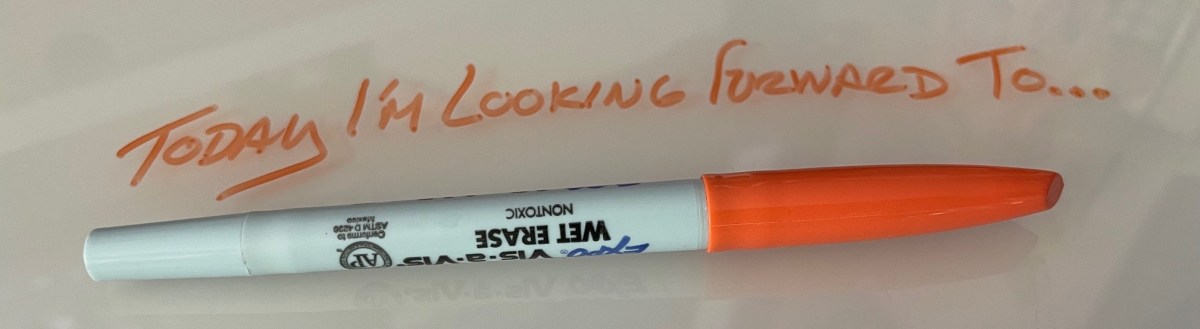
Today I’m Looking Forward To…

(Title image: FranticShanti)

Here’s a slightly different type of gratitude practice. It’s a nice little way to bring more joy into your life.

Instead of looking for things to be grateful for, try simply thinking of things that you might be looking forward to.

They don’t have to be big productions like an expensive vacation or some sort of exclusive party. This works just as well, perhaps even better, with something small.

Grab a pen and a sticky note and start looking forward to the little things.
(Photo by Ravi Palwe on Unsplash)

How small? How about receiving a new calendar you ordered that has pictures you find particularly soothing? Or maybe going to a museum that you haven’t visited in a while. Or visiting a local garden shop just to browse and take in the glorious colors.

Clean out your coffee maker and look forward to having tomorrow’s coffee brew in a clean machine.

Or look forward to getting into bed in the evening and stretching out comfortably.

Consider the things you could potentially look forward to…get granular about it…and try to see what the smallest thing might be that you could look forward to enjoying.

There’s a lot of good stuff in between those pickets.
(Photo by Brad Switzer on Unsplash)

The “grandness” of the thing doesn’t matter—what matters is how you feel about it. And perhaps, at first thought, you consider it insignificant, but when you lean into it, you realize that it truly is something that brings you joy.

The more of these little things we can find, the more we realize that little bits of joy are scattered throughout our lives. And once we become aware of one, we might start noticing them everywhere.

~~~~~~~~~~~~~~~~~~~~

Speaking from personal experience, I find it very easy to become overwhelmed with the negatives in my life. There are times when it seems like all the difficulties come crashing down at once, at the worst possible moment.

However, it is worth shifting our focus and noticing the things that aren’t going wrong. It’s as if you are looking at a picket fence. The fence itself might be the negatives and they’re hard to miss—after all, they’re right in front of you.

But if you look through the posts of the fence, into the space between, that’s where you see everything “not wrong”. And you might find that, in fact, there is more “not wrong” space than there is picket fence.

So I encourage you to take some time when things get difficult to look through the fence and find your little joys to look forward to. Focus on them, write them on a sticky note and put the note somewhere where you’ll see it in the morning.

And then smile.

I have my note ready…

I Thought I Was Doing Better

(Title image: Photo by Merch HÜSEY on Unsplash)

Last week, I met with a friend that I don’t see often. We were talking about what was going on in our lives and he related how he loved where he lived right now, and put a positive spin on everything in his life, even when talking about negative happenings.

He sounded sunny and was handling the tough stuff that came his way.

But then it was my turn to tell him about what I’d been up to. I started describing what I’d been dealing with: my father’s decline and death last year, worries about my mother’s well-being, concerns about the increasing cost-of-living…

My friend smiled at me. The last time he had talked to me, he said, I was stressed about something else. In fact, every time he calls me, there’s some new thing that I’m stressed about.

And of course he’s right. As much as I’ve improved in handling anxiety using all the tools I’ve developed to calm myself down—and, yes, I’ve found success with that—the overarching feeling that I have is that I’m playing whack-a-mole with my worries.

It’s as if I’m trying to regain my footing, but something new comes up and knocks me off balance again.

I admit it. I’m feeling worn out.
(Photo by Anca Gabriela Zosin on Unsplash)

After getting past cancer treatments like chemotherapy and radiation, you’d think that the skies would look brighter and my outlook would be more positive. And for quite some time that was completely true.

But as endocrine therapy wore on and I went through menopause, my spirit suffered. The luster of surviving cancer started wearing off. That’s embarrasing to admit, especially when I have lost friends and family to the disease and know of many others desperately fighting it.

But even being aware of that, my day-to-day seems to have become darker overall. I start the day with energy to get things done but by evening I’m exhausted and sometimes overwhelmed by what’s in front of me.

I know some of this is my own doing. In fact, one of the big, scary changes that I was faced with this year just sorted itself out. It was simpler than I expected (note my previous post). And then my son was admitted to the college he wanted to attend. All these are refreshing successes that I should have spent time basking in. But it didn’t take long for the clouds to gather again.

After hearing my friend’s assessment of me, I am trying to figure out whether what I’m going through is really getting harder? Or have I gradually been losing my ability to pull myself out of a funk? And once the uncertainties are settled, will I bounce back?

I feel disappointed in myself, which is exactly part of the problem. Lack of self-compassion simply compounds the stress. You know the carrot-and-stick analogy? Well, I’ve tossed the carrot and am just beating myself with the stick.

Back to the drawing board.

But What If Everything Goes Right?

(Title image: Photo by Aaron Burden on Unsplash)

Friends, I am a worrier. You’d be hard-pressed to find something that I wouldn’t worry about.

I know better. And I’ve actually gotten better.

But even with practicing mindful self-awareness, those foreboding thoughts of “what if everything goes wrong” creep in, particularly at night.

Because 2025 is a year of big changes for me, there have been many opportunities to awaken in the darkness, worrying about how this and that can go totally downhill.

A few days ago I was on the same train ride, hurtling through fears, when it hit me that, in the same way that I can imagine everything crashing and burning and my life being miserable and terrifying, I didn’t have to fear the worst. Things could work out.

Call that the “Schrodinger’s Box” philosophy of life. At the same time that things could be awful, they can simultaneously be fabulous—or somewhere along that spectrum. No matter what you’re anticipating, it won’t be until you finish the exam, give the speech, get the biopsy results or have the conversation that you will really know how things turn out.

Fear and avoidance are not the way to go through life.
(Photo by Alexander Grey on Unsplash)

So if you don’t know, you might as well think positively, tempered with a healthy dose of realism. Things are rarely black or white. Just as we shouldn’t be “all negative”, we shouldn’t be “all positive” either.

Ok, so right here I need to backtrack and say a word about “positivity” and “negativity”. When we practice mindfulness, we strive to release expectations, to not attach ourselves to an outcome. Yes, I get that.

That is an ideal. Our minds don’t always allow us this.

But if there is a choice between being morose or upbeat, you are still better off being upbeat. Realistic and upbeat.

I’ve heard people justify constantly being negative by saying that at least they will be “prepared for bad news” so that it’s not a shock. I used to think that too, fearing the precipitous drop in spirit when you’re expecting something good and get something bad instead. But I’m no longer convinced that doom-and-gloom saves you from anything.

Consider the “coward dies a thousand deaths” adage. Perpetual pessimism can lead to all sorts of health issues, mental and otherwise. For example, living in constant fear may result in anxiety, depression and high blood pressure,among other things. And with enough time, those can turn into something worse.

Again, the ‘ideal’ is non-attachment. But if you cannot completely disengage from imagining an outcome, your mind and body will be better served by considering that everything will work out in the end. At least you’ll be able to sleep better at night.

~~~~~~~~~~~~~~~~~~~~

And what is recognized as the optimal way of thinking? There exists the concept of “short-term realism, long-term optimism”. This means that you take care of the tough stuff in the present, facing challenges head on, but keep your chin up and not lose hope for the future.

Naptime with Animal Friends: A Calming Visualization

(Title image: Photo by Kristin Lyse on Unsplash)

I recently came up with a fun visualization for calming myself that I wanted to share with you. It’s ideal if you love animals.

The concept is quite simple. Imagine yourself in a comfortable place outdoors with an environment that is what you like best. As an example, for me, it’s a warm-ish spring or summer day and I’m sitting under an arbor covered in wisteria or another flowering vine with leaves just dense enough to allow dappled light through.

Create a detailed, colorful picture of your perfect place in your mind. And then…start settling. Bringing attention to your body, imagine what it would feel like to be there. As your breath slows, the calmness you generate travels outward and attracts friendly animals to you.

You are the Pied Piper of imaginary animals.
(Photo by Dmitry on Unsplash)

Perhaps a colorful bird alights on your shoulder or next to you. A bunny hops over and snuggles next to you. Or maybe you attract a group of sleepy cats that come, purring, and rub their faces against you before stretching out beside you and perhaps in your lap.

The animals can be whatever you desire. Maybe it’s a family of platypuses? Or perhaps you’re sitting by a natural pool, feet in the water, and koi are languidly swimming around you. Sometimes, I imagine something potentially frightening and powerful like a tiger appearing, then nuzzling my hair before he rolls onto the ground to snooze, pressed up to me.

It doesn’t have to be realistic. It just has to make you feel good. There are no rules.

All animals relax around you as long as you stay relaxed around them.
(Photo by Sandra Vasilenko on Unsplash)

The richer and more vibrant the picture, the more easily you will settle. As you develop the image in your mind, watching the butterflies circle around your head or feel the weight of the wolf’s head as she lays it on your shoulder, you nurture a sense of calm. These animals are attracted to you because you are what soothes them.

And the reason that you soothe them is because you have calmed yourself. Being calm, and tranferring that feeling to others, is your superpower.

If you lose focus and your mind drifts into worry or to-do lists, the animals will scatter, so you have to notice what’s happening and resume the visualization to show them that it’s safe to return. Allow a warm breeze against your skin or the cooing of mourning doves to transition you back to this calm space.

Understand that you have this ability to generate a sense of well-being, in yourself and others. You might not always be aware of it in the middle of a busy day…but it is there. Close your eyes, feel into your feet and call your favorite furry, feathered or scaly friend to you for a snuggle.

~~~~~~~~~~~~~~~~~~~~

If you’d rather not imagine animals, you can make flowers bloom or young children smile and nod off (which might be very satisfying if you are a preschool teacher!).

Farming ‘Likes’ on Instagram

(Title image: Photo by Chelsea Gates on Unsplash)

I am a reasonably flexible person although I’ve become less so with age and especially following cancer treatment. Yoga asanas that I used to be able to do…well, they don’t come so easily anymore, if at all.

After going through my yoga teacher training in my 50s and now in the middle of an Oncology Yoga (y4c) certification program, I spend a lot of time feeling like an imposter.

There’s an element of shame to this. I tell myself I should be more flexible, I should have better balance, I should be able to hold more advanced poses and for longer.

In my y4c training, the manual referenced a concept, versions of which I’ve seen before and have written about myself, but the message continues to hold true (see this article). The proliferation on social media of young, flexible bodies in extremely inaccessible poses for the vast majority of the population not only hurts the practice, but completely misses the point.

It seems like a lot of images that show up as “yoga” on platforms such as Instagram are part (if not wholly) acrobatics and contortions. But yoga is actually a spiritual practice and only one part of it, the one that is overemphasized in the west, is physical.

POV: You’re a cancer patient and your forward-thinking oncologist suggests that you try yoga to help alleviate some of your side effects. But this is what you think of when you hear “yoga”. What are the chances that you’ll try a yoga class? What are the chances that you’ll even find a yoga class that is appropriate for your current condition? Or will be able to afford one?
(Photo by Wesley Tingey on Unsplash)

And that physical practice is a big money maker. If you doubt that, take a look at how many yoga studios exist in affluent areas, and the dearth of studios in more moderate-to-low valued ones.

Yoga was what helped me through my cancer diagnosis, treatments and beyond. But that yoga was minus the “workout”. My workouts during cancer focused more on rowing and lifting weights rather than Sun Salutations and balance asanas. Yoga was for my mind and spirit, to maintain connection and grounding, to not get lost in my fears and to be grateful for what I had.

This is not to say that it’s not impressive when people post challenging asanas on social media. Some of the wonderful teachers that I have trained with have shared those kinds of posts. It’s natural to want to show off a physical achievement that you’ve worked so hard for. In a way, that’s the whole point of social media posts. And that’s also part of the problem with social media.

Frankly, yoga has become deeply entrenched in the United States as a physical practice and nothing is going to change that now. We can be hopeful that those who dutifully attend yoga class, rolled up mat under the arm, will take the time to understand the depth of this ancient practice. But regardless, the flow of the class still brings peace to the mind in a way that my ‘hardcore’ workouts do not.

There are a lot of people who could benefit greatly from the practice of yoga in all its forms, matching breath to movement and developing a mind-body connection. Cancer patients and survivors are some of those people. But if all they know is that yoga demands extreme flexibility, even hypermobility, and statue-like balance, they will avoid the practice as too advanced and inaccessible to them.

If you are a teacher, please keep that in mind. If you are a potential student, please don’t let social media keep you away from such a beneficial form of exercise for both your body and your mind. And if you are a current practitioner, please dig deeper to understand the roots of yoga to honor the cultural tradition from which it arose. It’s not just for likes on Instagram.

Simple Meditations: Just a Piece of the Puzzle

Over the holiday break, I indulged myself by lassoing the family into working on a couple of jigsaw puzzles that I’d been saving. It was great! And if one of your goals for 2025 is to establish a mindfulness/meditation habit, here’s a simple practice to try if you, too, enjoy jigsaw puzzles.

Putting together the puzzle itself can be a great pasttime, offering good conversation and comraderie when working with others, or proving a shift of focus when constructing solo.

However, a large multi-piece puzzle can feel overwhelming at the start, even when you’re experienced and KNOW that eventually everything will click into place.

Ah, the joy of a finished puzzle. This one is from the Ravensburger Cozy Series and is a favorite of mine. Such a great experience putting it together with family!

So here’s my suggestion. Put your puzzle together. With whatever help you need, with whomever wants to participate, no matter how long it takes. Because for this, you want to start from the end.

Now, take apart of corner of the puzzle. It’s up to you about how many pieces you will want to remove, but choose a “comfortable” amount. Twenty? Fifty? Start with fewer pieces the first time you try this.

Once you’ve deconstructed that corner, put it back together. But this time, without the “stress” of doing the whole thing. This will be easy. You know that it’s only a handful of pieces. So simply enjoy the process.

The deconstructed corner turns putting the puzzle together into an meditative exercise. The focus is on contemplation, not completion. Enjoy the satisfaction of the clicking the pieces into place.

Perhaps find the edge pieces and create the frame, or simply build out the puzzle from the “raggedly” edges of the puzzle. There is no single “right” way to do this. What is important is that you breathe through the process. Picking up a piece, focusing on its qualities, seeing where it belongs. Either clicking it in or putting it back down and picking up another piece until you find the one that will go where you want it to.

Notice the sensations: the feeling of the puzzle piece in your hand, its shape and color, the texture of the interlocking sides, even the smell of the cardboard all work together to bring you back to the present moment.

The goal is contemplation, not completion. When you’ve put all the pieces together…do it again with another corner. You get the satisfaction of clicking the pieces into place without the fleeting stress of “omg, where do I start?” In turn, this provides you the opportunity to get absorbed in the process.

What a lovely way to meditate.