I’ve taken a month or so off from posting due to our apartment move, but I should be back next week.
If there’s one thing that this move has taught me is that sometimes the things you fear the most (like change, for example) end up being what you need the most.
In our case, this move has come with so many positives…including a major purging of belongings that has created not only physical space, but also some much-needed headspace.
There is a certain lightness of being that releasing possessions we don’t need or use anymore has brought us.
This is just what I needed coming into Thanksgiving season. Granted there have been some unexpected and painful changes too, but I can be grateful for what we have had and enjoyed thus far.
So if you celebrate Thanksgiving, make sure to take time to consider all the things around you and, regardless of whether they’re good or bad, what they have taught you.
Since I’ve been writing about non-attachment, I wanted to follow up with a description of what it feels like for me.
As an example, I’m currently waiting on medical results for a family member. And I can promise you, there is a particular outcome that I really want. It’s the one where everything works out without any problems and you can look back at what transpired and wonder what you were even worried about. All good!
But that’s a best-case scenario, and wish as we might, it’s not a guaranteed outcome, even when we assume it’s a guaranteed outcome. When reality comes out worse, the let-down can feel intense. I’ve experienced that too many times.
Gently, gently. Allowing thoughts to come and go as they please without holding on or pushing away. (Photo by Dmitry on Unsplash)
So I’ve taken to holding my thoughts lightly, like you would hold a little bird in your hand. Not grasping them, just keeping my hand open and allowing them to flit in and out of it.
It feels like I’m hovering over the possibilities of what might transpire. I am aware of the potential outcomes, but not holding on to them. I don’t push them out of my mind completely. Rather, I fuzz my view of them as if with a softened gaze.
Then time stops. And coming down out of what is swirling in my head, I turn my awareness to what is going on right now. Especially what my feet are doing. How my soles feel pressed against the floor. Focusing on the sensations.
Always, when the possibilities get too intense and clear, I return to my feet on the floor. If my recalcitrant mind continues to swirl, I focus on my hands and pour my senses into what they are doing: tying shoelaces, making coffee, doing the dishes—noticing the movements and pressure, watching my fingers. Once I’m anchored in my body, my awareness reaches out again.
I know those thoughts, hopes and fears are there. I don’t try to repress them. I don’t try to analyze them. They simply come and go, and I return to the calmness of where I am.
Admittedly, some days it’s much harder than on other days. “Letting go” is a practice, not a destination. But even brief moments of respite are welcome.
~~~~~~~~~~~~~~~~~~~~
There’s also something to be said about the underlying fear of waiting for responses, the uncertainty that weighs so heavily upon us. I’ve always felt that one of the toughest times of my cancer experience was when I was waiting for scan results, biopsy results, even doctors’ appointments. That was the real test of “hovering” and it was one that I did not handle well at the time. But thankfully, relief came in the form of a treatment plan, a.k.a. a certainty of sorts. No, it didn’t make everything better, but it gave me a path to focus on.
I have a history of getting myself wrapped up in future fears and past regrets. It can be terrifying and difficult to shut off, especially during very stressful events.
I have to be honest, there was a time when I was afraid that if something seemed so real in my head, something I could describe in fine detail and feel the fear via physiological responses in my body, it was more likely to come true.
I don’t know how that actually started. It might have been some form of “magical thinking” that suggested that if I’m having a response, it was a premonition that accurately predicted the future. Or maybe I was so frightened by how real it felt. Regardless, it was difficult to shake.
With the help of mindfulness, meditation and expert guidance from a counselor, I found it easier to notice when this was happening. It took years to get to this point and the shift was very gradual.
It’s not a perfect shift, however. From time to time, I still get run through the wringer by fearful thoughts so I’ve developed a silly practice to help myself defang this beast. When I realize I’ve been caught, I grab the thought and run to the nearest art gallery–in my mind.
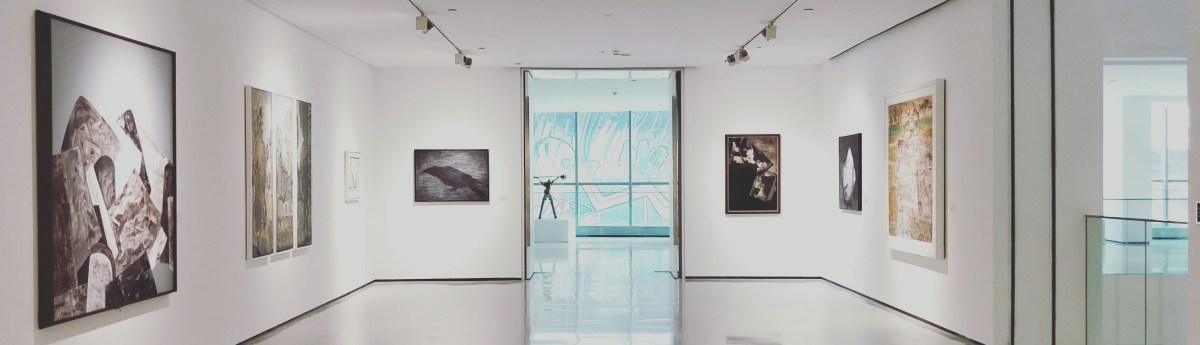
It’s the ability to step back and put space between yourself and your fears that makes this such a helpful practice. (Photo by Xavier von Erlach on Unsplash)
Yes, I realize this sounds strange, but hear me out: (1) I recognize that an anxious thought is particularly sticky, (2) I compress it into a two-dimensional image, and (3) place it in an imaginary frame on an imaginary wall in an imaginary environment that I define, and finally (4) I step back to give myself some space–as if I were at an art gallery evaluating a painting–and note that it is only a picture, one that I could potentially remove from the exhibition and send to storage.
Then I ground myself in the present, feeling my feet on the real floor where I actually am.
This kind of manipulation requires some imagination and, like I mentioned, this practice can seem a little silly. But it does help to recognize that the thing that elicited such a strong response in us is really just a simple thought. We can choose what to do with that thought.
IMPORTANT: I acknowledge that the physical responses are real and they might be driven by the real possibility of something bad happening. We don’t have a crystal ball to tell us with 100% certainty what will take place in the future. But what we do know is that nothing is happening now. If you can clear the foreboding images out of your mind you will realize that in this moment you are safe. And that is a very comforting place to be.
You may be familiar with the old story about the award-winning singer Carly Simon’s stage fright which prevented her from performing in front of an audience for 14 years.
Performance coach Tony Robbins famously compared her anxious reactions to those of superstar Bruce Springsteen (yes, I realize I’m dating myself) who would describe his physiological responses to going on stage in the same way that Carly did, but he associated them with excitement and not fear.
Anxious responses weigh heavily on us…but what if we could reassign their meaning? (Photo by Kyle Glenn on Unsplash)
At least that’s how the story goes. And although I think some of this is an oversimplification of Carly’s experience, there is a lot of wisdom to breaking down both performers’ reactions to the point where we recognize that what we feel in our bodies can be interpreted in very different ways based on what’s going on in our heads.
I grapple with this issue myself when I am offered unexpected opportunities that can propel me forward in career and life…but which also cause me agony in terms of my fear of change.
What to do?
What has worked for me is to identify the sensations that I’m feeling. Naming them makes them less overwhelming and it’s a big plus if I can describe what my head feels like, what my chest feels like, what my belly feels like. I try to understand each sensation’s role in creating the overall experience.
Then I try to image that the emotion these individual sensations lead to is one of positivity and excitement. It’s the anticipatory “butterflies in the stomach” from doing something that seems amazing rather than an upset stomach arising from wanting to flee.
And I sit with all those things, bringing in reasoning too: thinking about the positive consequences while allowing the feelings and sensations to be there. Understanding that they are simply sensations and not dangerous on their own–they are physiological responses that evolved to help us out when we needed an extra boost of energy (think “fight or flight”).
Thinking about all the good stuff that opens up to us when we leave fear behind… (Photo by Allef Vinicius on Unsplash)
I call this reasoning “mental calisthenics”. It takes some massaging and can even get a little metaphysical, but at some point I usually manage to get a grip of that good feeling as if I were gripping the edge of a wall and then pulling myself around to “turn a corner”.
Trying not to overthink it. Just allowing myself to feel into the sensation while giving it a positive spin. And then imagining myself “doing the thing” that I fear…and being good at it.
When particularly anxious, I may even exert myself physically to allow my responses to exercise to meet and match the fast heart rate and breathing that I’m already experiencing.
And that’s about it.
As with meditation, this is a practice and I have to keep reframing the situation in this way to remind myself that change can be unsettling but “unsettling” isn’t inherently negative. It may take a succession of days or weeks to come to grips with the new situation and that’s okay. Patience is the key that leads to progress, and every day that I reframe my sensations is another day that I improve my mental situation.
Hope this helps you too!
~~~~~~~~~~~~~~~~~~~~~~
Important: this is not about “toxic positivity”. There are some situations that are truly bad and understandably elicit an anxious response. Rather, this is realizing that our physiological reactions–the ones that evolved to protect us–may be holding us back because we associate them with fear rather than seeing them as the excitement of possibility arising from change.
A few days ago I had my seven-year post-diagnosis appointment with my oncologist. Seven whole years. And it was a weird conversation.
He said something that set me aback. He told me that he didn’t think I should worry about the cancer coming back. Essentially, I was cured (note: MY words, not his, but that’s the idea). [See bottom of post for disclaimer!]
He’s alluded to this before during previous appointments. But this time around felt different.
I returned home a bit confused. See, for the last seven years, I’ve been a full-on cancer survivor. Still holding on to the fear that at any moment, I would get those terrifying scan results back and–WHAM–I’m a cancer patient once more, back on that sickening rollercoaster ride through treatment.
As difficult as it was to accept that–even trying my best to live a healthy life–I had somehow been smacked down by cancer…now, I had a new problem. Reentering life as maybe not-so-much a cancer survivor anymore, but rather just a healthy, active postmenopausal woman with years ahead of her.
And that is a weird feeling.
For the first five years after my diagnosis, I was frustrated, even angry. Cancer was a devastating detour at a time when I was already struggling to find my way back into a career. Well, forget that. Derailed. I was bitter.
Eventually, I realized that while life sucked, it sucked for a lot of people and I wasn’t special in that regard. That was an important turning point in how I perceived my own role in my cancer story–it was humbling but also gratifying.
Humbling because my experience could have been so much worse. There were people whose treatment did not end well. I was incredibly fortunate, even when it felt like I’d been thrown in a sack and beaten with sticks. At least, I made it out.
Gratifying because early on I held myself responsible for getting cancer, even though I had literally done everything protective (lots of exercise, high fitness, plant-based diet, breastfeeding, not smoking, not drinking) that I could think of. I was desperate with frustration and helplessness about this. Letting go of that guilt was healing.
Feels like I’ve got the green light to hurry up and get on with the rest of my life now. (Photo by Possessed Photography on Unsplash)
So the last two years have been more about understanding my perspective and then stepping out of it to view things more objectively. Mindfulness and meditation helped with that, which is why I often write about them here. But I hadn’t been ready to get out of the breakdown lane and drive myself back into mainstream life, in part fearful of the pain of having the expectation of cancer-free “normality” smashed to smithereens by a potential diagnosis.
Gradually, that’s changed. But this last appointment felt like getting shoved out the door by someone yelling, “YOU’RE OKAY, DAMMIT!” Here I am, standing and blinking in the sunlight, trying to make sense of exactly what that means for me now. Wow, after seven years, I can actually stop being afraid.
I don’t know if I even remember what that feels like.
Yes, I’m still going to refer to myself as a survivor, because it’s a part of my natural history. I’m never going to forget that experience and I continue to be driven by a need to support others going through this disease.
And if it does return? Well, at least I will have had a brief glimpse of life completely outside the notion of cancer.
~~~~~~~~~~~~~~~~~~~~~~~~~~
Of course, because we’re talking about cancer, the statements above call for level-headness in the midst of levity. While my oncologist feels that the chances of the same cancer coming back are low, the possibility for a brand spankin’ new tumor, breast or otherwise, never goes away. It happened once, it can happen again. But that’s life. I’ll take it.
It’s hard to believe that six years ago I was a week and a half away from my final chemo infusion, in the thick of being a cancer patient with no idea of what tomorrow would bring.
Cancer survivorship used to be a whole lotta “looking over your shoulder” for the next thing to hit.
I also thought that I’d live the rest of my life, however much or little of it there was left, in fear, always looking over my shoulder to see if cancer was close behind. In fact, after my active treatment was over, I expected that my anxiety would increase because I imagined that whatever had triggered my tumor growth would again be unleashed and ready to attack my again.
And when I had to stop aromatase inhibitors early due to side effects, I envisioned even more terror because I wouldn’t have the medication’s protection anymore.
None of this suggested that I would have a very pleasant future. Either I would get cancer again…or I’d be consumed by worry over getting cancer again.
Reality turned out to be quite different.
The more (1) I practiced being present, coupled with the (2) increasing distance between my last dose and today, the easier it has become. Now, that might sound like a no-brainer, but it was news to me.
And I don’t know exactly when I turned the corner on my fear but it was probably after the worst letrozole side effects ceased and I was able to reflect on and accept that cancer happened and now I was moving past it.
It took years to get to that point, but it would have probably come sooner if I hadn’t convinced myself that I’d never get there.
And how are things different now? I don’t think of cancer every minute of every day. And when I do think about it, it doesn’t seem as daunting.
So far, so good.
I realized this after meeting a cancer survivor who works at a store that I frequent. She revealed that she’d just received her three-year “all-clear”. The relief on her face was unmistakable.
And it struck me that I used to have that incredible sense of gratitude too. And I still kind of do for a short bit, but it fades quickly as I turn my focus to the rest of my daily responsibilities.
Yes, I am still seeing my oncologist twice a year, having annual 3D mammograms AND the occasional MRI, so it’s less likely that something’s going to sneak up on me. But the concern is no longer as all-encompassing because it doesn’t feel as likely.
Of course, I could be kidding myself. Even after six-plus years I know that every set of scan results is a door to either “no evidence of disease (NED)” or “we’ll get you in to see the oncologist ASAP”. So far I keep going through the NED door…and it keeps opening onto a bright day.
In the midst of taking things for granted, it’s nice to stop and think about that.
As the saga of our building’s leaky pipes continues, this experience reminds me of some of the best advice I received for getting through my cancer treatment.
How could cancer relate to a plumbing emergency? In how I perceived the news and possible outcomes. My cancer diagnosis was terrifying because I had grown up understanding that the disease meant difficult treatment and a real possibility of death. Now that I was dealing with cancer, I was jumping to conclusions, driven by FEAR.
And the leak in our unit? That meant a huge disruption in our lives as workmen enter and our belongings are piled together. But even more so, FEAR of the future, as we didn’t know the extent of the damage and whether we’d be able to to keep living here.
Getting a first glimpse of restoration. Lost some ceiling, light fixtures and a lot of kitchen cabinets.
The thought of moving brought anxiety about higher rental rates, dealing with belongings after nine years in the same apartment, even simply fear of change and uncertainty.
But that best bit of advice that I mentioned above? I found that it applied well to this situation also. And it goes like this: don’t try to tackle everything at once; take it bit by bit.
When I was diagnosed with cancer, the experience was nothing if not overwhelming. So many new terms, treatment options, possible outcomes. It was too much to handle. Someone I worked with suggested that I deal with things on a day to day basis. Not obsessing about the future, only what I needed to get through for today.
This was not easy for me, as being FEARful came naturally to me. But I understood what he was saying, even if I struggled to actually follow this advice at the time.
As with cancer, so with plumbing. My mind had already “gone there”, struggling to afford another unit (this is an older unit with rent lower than other places around us), staying up day and night to pack. Ending up in an even worse situation with inconsiderate neighbors…
But reality was not like that.
Behold, the FORCE AIR 2000EC! This monstrosity is the heart of the asbestos abatement operation. The workmen couldn’t fit it back in their truck so we’re babysitting it for a couple of days. Also, it looks like it was built by orks, but that has nothing to do with anything.
Within a weekend we had moved much of the kitchen and dining area. And really overhauled our possessions — even something as complicated as draining our 20-gallon fishtank and relocating its inhabitants to my husband’s office was not as difficult as anticipated.
I had time. I had time to move things, I had time to reorganize, to declutter, to stop and think about what was next. I had time because it wasn’t all happening at once. Stopping and breathing and noticing all the space around gave me space inside my head.
Discussions with our landlady suggested that we would take it one day at a time. No one was throwing in the towel yet…
…and even if the worst case scenario happened and we had to move, there were other places that were available (all with air conditioning, which we don’t currently have), and the rental cost would have been similar to what we pay now. In some cases the places were newer and most allowed pets (!), which I’ve been longing for.
All of a sudden, things didn’t look that bad. The options seemed promising.
Taking it bit by bit gave back a sense of control. All those fears slowly fell away.
And now, I find myself hovering with acceptance. Not landing on an expectation that THIS or THAT will happen. I don’t know what will happen and I’m finding a comfortable place to simply hang here, not gripping or holding on or needing for anything to be different.
Quite a lot has happened here in less than a week and it deserves a bit of an introduction.
It started with a leak last Wednesday. Water dripping from a ceiling fan…which isn’t supposed to happen! I got the upstairs neighbors to check their plumbing — their carpet was wet. And it got worse from there as plumbers found several gallons of standing water contained within the studs in the floor above us, coming from cracks in our neighbors’ kitchen drain pipe, now starting to overflow those confines.
Yeah…I’m pretty sure this is not a good thing.
That water was searching for low points…which happened to be overhead electrical spaces in our unit: ceiling fan in the dining area, wires coming through our kitchen cabinets, even the overhead kitchen light. Soaking the ceiling as it traveled.
The water looked toxic.
We live in an old-ish building with old-ish pipes that are showing their age. We have had quite a bit of water damage and leaks already, some of which required strict restoration measures since there is asbestos(!) in the ceilings. The current incident is no different except that this time the repairs will be more extensive due to both the asbestos and growing mold, requiring the removal of kitchen cabinets, some carpeting and lots of ceiling.
When things like this happen, the HOA’s insurance covers all issues from the walls into the interwall spaces and the homeowners’ insurance covers everything inside the unit. As risk-averse renters we have our own insurance to protect our belongings, but we are not the owners of this unit. Regrettably, our owner did not have the unit insured. This poses uncertainties that we have yet to address.
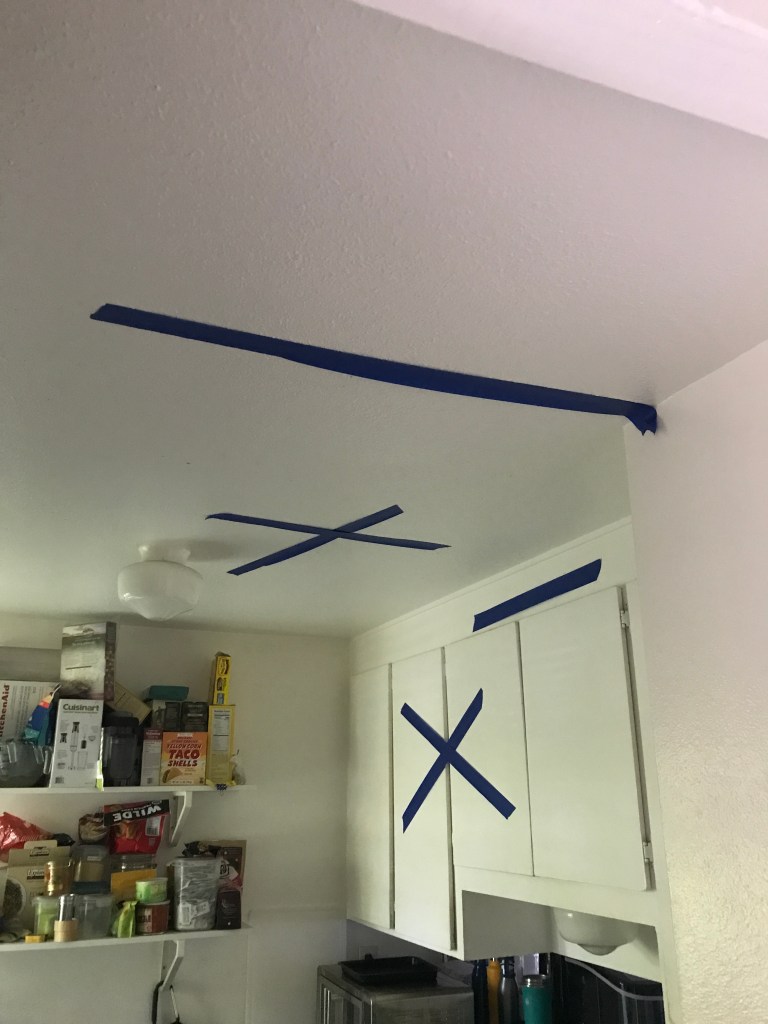
This part of the ceiling has been marked for removal…
First things first, however: a restoration company marked out the spaces that were wet and from which we needed to clean everything out. We spent all weekend doing so. And that brings me to the point of this post.
When you have a lot of stuff, it’s easy to keep holding onto it because there’s no real impetus to get rid of it. And even if you try, it’s too easy to talk yourself into not letting go. If you get rid of it and then have to repurchase, that’s like twice the cost, right?
…and this carpet has to go…
Except that I’ve come to believe that space = money. There’s so much that we have that we’re not really using. Maybe it was on sale, maybe it was something you needed one time, maybe you decided to splurge. But if these things are taking up space unnecessarily, they are costing you. I know they take an expensive toll on me in terms of headspace, making cleaning more difficult and our living area less inviting.
So this weekend was about purging. And wow did we PURGE. It felt amazing.
…as do the cabinets and ceiling in our galley kitchen.
Old glassware, shopping lists, aged spices, an extra bathroom scale (from a time long ago when we have two bathrooms), chipped plates, dollar store containers, plastic utensils, old computer cables, and the list went on. We emptied the 20-gallon fishtank, relocated its few inhabitants to the aquarium my husband has at his office, and realized that we could probably get rid of the cart that the tank sat on too.
There was so much that we’d been holding on to that simply was not necessary to have. And the more we got rid of, the lighter I felt. Buoyed by the sensation, I started going into areas not marked for restoration and getting rid of unneeded items, because I believe a big change is imminent. Something has been put into motion that will require big decisions and big action.
So in the midst of having the majority of our kitchen items and the entirety of our dining room stacked up in the living room area, I should be stressed out. But I’m floating in quiet acceptance, staying present and reveling in the lightness. I never expected to feel like this, so positive. Maybe it’s because all those things we held on to were weighing us down?
I’m not going to post the post I’d written for today.
Something else came up and it really made me think about how we are teetering on a slim ledge between “everything’s ok” and “the end is near”.
Last Wednesday, I cut the inside of the roof of my mouth in the soft palate. Or maybe it was a burn? I didn’t pay much attention to it because this happens from time to time, it’s not that big a deal and it seems to heal quickly.
Except this time it didn’t. Granted, I ignored it a tad too much and wasn’t as careful as I should have been about what I was eating. I felt loose skin rub off around that area.
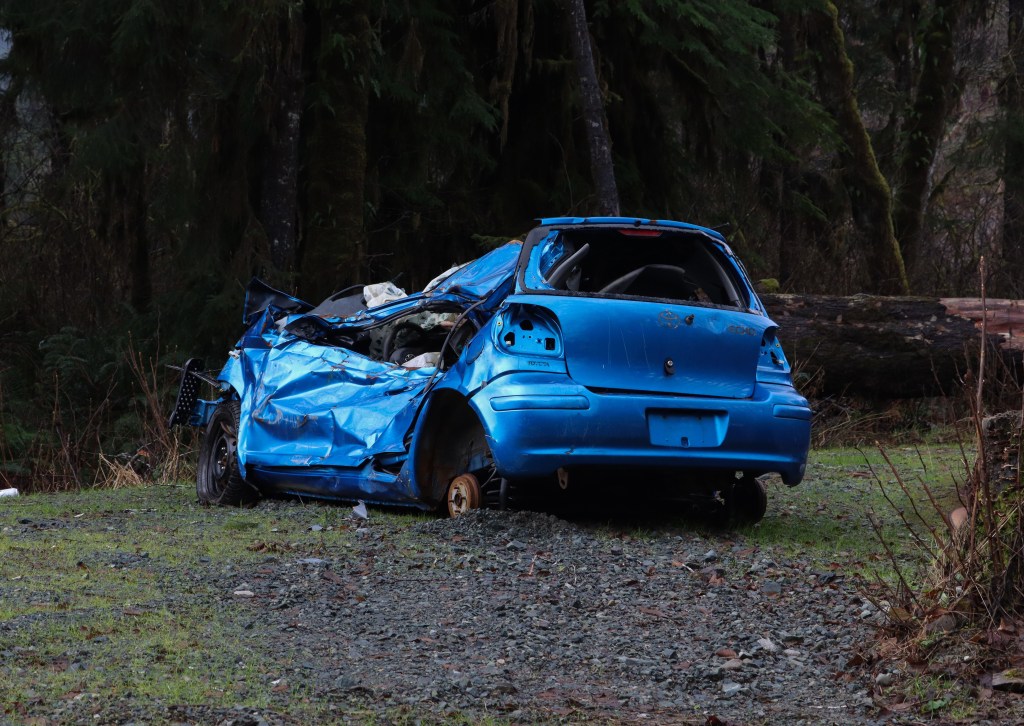
In a second, everything can change. [Note: this is not my car.]
It started hurting more and eating became more painful. At night, my mouth dries out even when I’m sleeping with closed lips. My tongue feels like sandpaper against my palate and because of where the wound was, my tongue was irritating it.
Friday, I realized that if I spoke a lot without a break, my tongue would abrade that sore area even more. Saturday, I told myself that I should be doing warm salt water rinses, but kept forgetting to do so.
Sunday, my head hurt upon waking although the area felt kind of better? But when I tried eating and drinking as normal (albeit avoiding that side of the mouth), the pain seemed worse.
Or maybe it was my perception of that pain? For me, it’s so hard to tell. I vacillate between ignoring a dangerous situation and imagining the possible worst; it feels like I could talk myself into/out of anything.
Before I was diagnosed with breast cancer, I had been aware of the lump in my breast for six months, but kept telling myself not to freak out and that it would probably go away on its own.
Maybe it’s really bad, maybe it’s not bad at all…I dunno…
Spoiler: it didn’t, and although the tumor was still Stage I-sized when I finally went to the doctor half a year later, it had already invaded the tissue outside the milk duct in which it originated. [To be fair to myself, there was more to that decision, which I won’t go into here. I wasn’t a total idiot about it.]
And then after completing all of my chemo rounds, one of my fingernails looked like it had a bubble underneath it…which I ignored for several days (actually, it became impossible to ignore because the pain was increasing), figuring I’d wait because it was probably just my nail coming off, which sometimes happens with chemo.
Except that it wasn’t. It was an infection. But instead of going to the ER immediately, I waited another night because it was the weekend and I figured I’d call my oncologist in the morning.
That night was worse than any night of my life. I barely slept because my hand was on fire and in the morning there was red line running down from my finger into my wrist.
At that point, I was probably closer to death than I had been throughout my entire cancer experience.
My point is, I was able to “reason away” any immediate responses and ignore striking red flags for fear of blowing things out of proportion. I didn’t want to look like a hypochondriac. It was hard for me to fathom that the situation was as dangerous as it ended up being.
Here for only who knows how long…
But our lives are really so fragile. After going through cancer, I realized that something could be going on inside my body, silently, that could change me irreparably — even kill me — within a very short period of time. And it could be happening right now.
What a tenuous hold we have on our existence here. How often do we forget that? And why aren’t we more careful with ourselves?
Such a short tenure on this Earth. Where do we put our energy? Too many spend so much time being horrible to each other and the world around us. And most of us don’t appreciate what we have until it’s too late. Some of us never appreciate it at all.
Take a deep breath, hug the ones you love (that should include yourself) and enjoy this moment.
I’m going to go rinse with salt water…
~~~~~~~~~~~~~~~~~~~~~~
A little update: I made a doctor’s appointment for early tomorrow morning, after which I realized — through diligent image googling — that I probably had a massive canker sore. It’s not likely to kill me but it’s doing a good job making me miserable.
And if I’m wrong and it’s something worse…then that’ll be next week’s post.
I have a full toolbox of techniques for handling anxiety during the day, but nighttime is a little trickier. If you’ve had the same experience, you’re not just imagining things.
A Live Science article by Louise Bond examines this issue. According to Clinical Psychologist Charissa Chamorro, PhD, at night our brains have fewer distractions, leaving us more vulnerable to worries that creep in. This makes sense as we can redirect our attention during the day to activities that are not available when we’re in bed.
Darkness can be unsettling enough, but researchers feel that the circadian rhythmn is also involved in the accentuation of nighttime fear.
And you don’t need to be suffering from horrible anxiety for this to be the case. Research (Li et al., 2015, Int J Psychophysiol) showed that even among women without anxiety, fear was enhanced at nighttime, and not simply because of darkness, suggesting the involvement of the circadian rhythm. At the same time, as diurnal beings, humans naturally evolved to have stronger fear responses at night. This is partly due to the fact that we don’t see well in the absence of light and therefore are more vulnerable to nighttime predators.
Furthermore, while there is a natural ebb and flow of cortisol throughout the circadian cycle with cortisol levels peaking in the morning and being lowest at midnight, when anxiety keeps cortisol levels high during the day, that affects nighttime hormone release and therefore your ability to rest (Hirotsu et al., 2015, Sleep Sci).
To make matters worse, once your sleep is disrupted, worrying about your inability to get a good night’s sleep can result in being unable to sleep, and a vicious cycle develops.
Establishing calming practices during the day can have a positive effect on nighttime anxiety.
You’ve probably heard the suggestions for improving sleep: turning the lights down in the evening, avoiding electronics (or using blue-light blockers), keeping your bedroom cool and dark, using a sound machine to mask noises, avoiding stressful or polarizing conversations in the evening, and the like.
To that I would add that what you do during the day itself can affect what kind of sleep you have at night. Meditation, practicing mindfulness, doing deep breathing exercises all put us into a calmer state. If you wake up in the middle of the night with a racing mind, having practiced and become adept at self-grounding techniques in daytime can help you soothe yourself at night.
While the roots of our anxiety may be complex, for those of us for whom it’s built up over time, so too will it take time to establish behaviors to help control it. Sometimes we need support of a therapist or medication, sometimes we can manage on our own, but setting aside time every day for even a short calming practice can help you improve management of anxiety no matter when it appears.