Although I don’t do so often, I can still knock out a proper cartwheel.
Since it’s a “wheel”, you only need a lot of space moving forward, not width-wise, so presumably, it should be possible to cartwheel down a hallway. After all, gymnasts manage this on a balance bean only a few inches wide.
But that’s not what happens to me. Even when there’s physically an ample amount of space for gymnastic endeavors, psychologically there is a perceived narrowness.
That lack of space exists only inside my head, but it’s powerful enough to hinder even an attempt at a cartwheel in our apartment.
I imagine limbs thwacking against walls coupled with lots of pain and regret.
This post, of course, is not about cartwheels. It’s that I often approach life events in a similar way. There is a narrowness of view and fear of pain, and these limitations take up real estate inside my head. While in reality, there’s enough space for emotions to express themselves and enough time to work out any arisen problems, those imagined walls confine my actions.
Yeah, there are moves that I will *not* be able to manage no matter what.
Were I to close my eyes and trust my abilities, cartwheeling through the little hallway from my galley kitchen to our dining area would be no big deal.
But faith in myself has been eroded away and my sight is influenced by not only things that came before but also the discomfort of what may come in the future.
Breaking through these barriers takes work, and while I’m up for it, it is a process. The trick, of course, is to generate enough confidence to cartwheel down that hallway while I still remember how.
This past Sunday, July 28, the monks and nuns of Deer Park Monastery (Tu Viện Lộc Uyển) graciously opened their grounds to the public for a Day of Mindfulness. This Buddhist monastery, in Thich Nhat Hanh’s Plum Village Tradition, is nestled in the Escondido highlands, in northeast San Diego County.
My daughter and I were delighted to join in since the monastery is within a reasonable drive from our home. It was going to be a hot day, and I figured that there might not be a big turnout, even though this seemed to be the only Day of Mindfulness offered during the summer months at the monastery.
I couldn’t have been more wrong! Apparently, many were in need of a Day of Mindfulness, and 400 of us showed up.
This was our first trip to Deer Park. Following a welcome with singing, we participated in a walking meditation. My daughter and I were clearly more focused on taking mindful steps and enjoying the beauty of our surroundings instead of exactly where on the grounds we were, and as a result, had trouble locating the small meditation hall where all the first-timers go following the walk. By the time we figured out where it was, the room was already packed with people. We managed to eke out a small space at the very back for ourselves to sit and listen.
I have never sensed such peace and spaciousness in the midst of so many bodies. The monk who spoke was gentle and funny, originally from Sweden, and it was a pleasure to listen to his introduction to the practice of mindfulness.
Following this explanation was a short break, and my daughter and I headed for tea. Cups in hand, we sipped as we sat outside in the shade behind the Tea Room, feasting on the glorious sight of the hilly terrain, serenaded by birds and wind chimes, and cooled by mountain breezes. Not what you would expect on a 90+ degree day during the summer. This felt so peaceful.
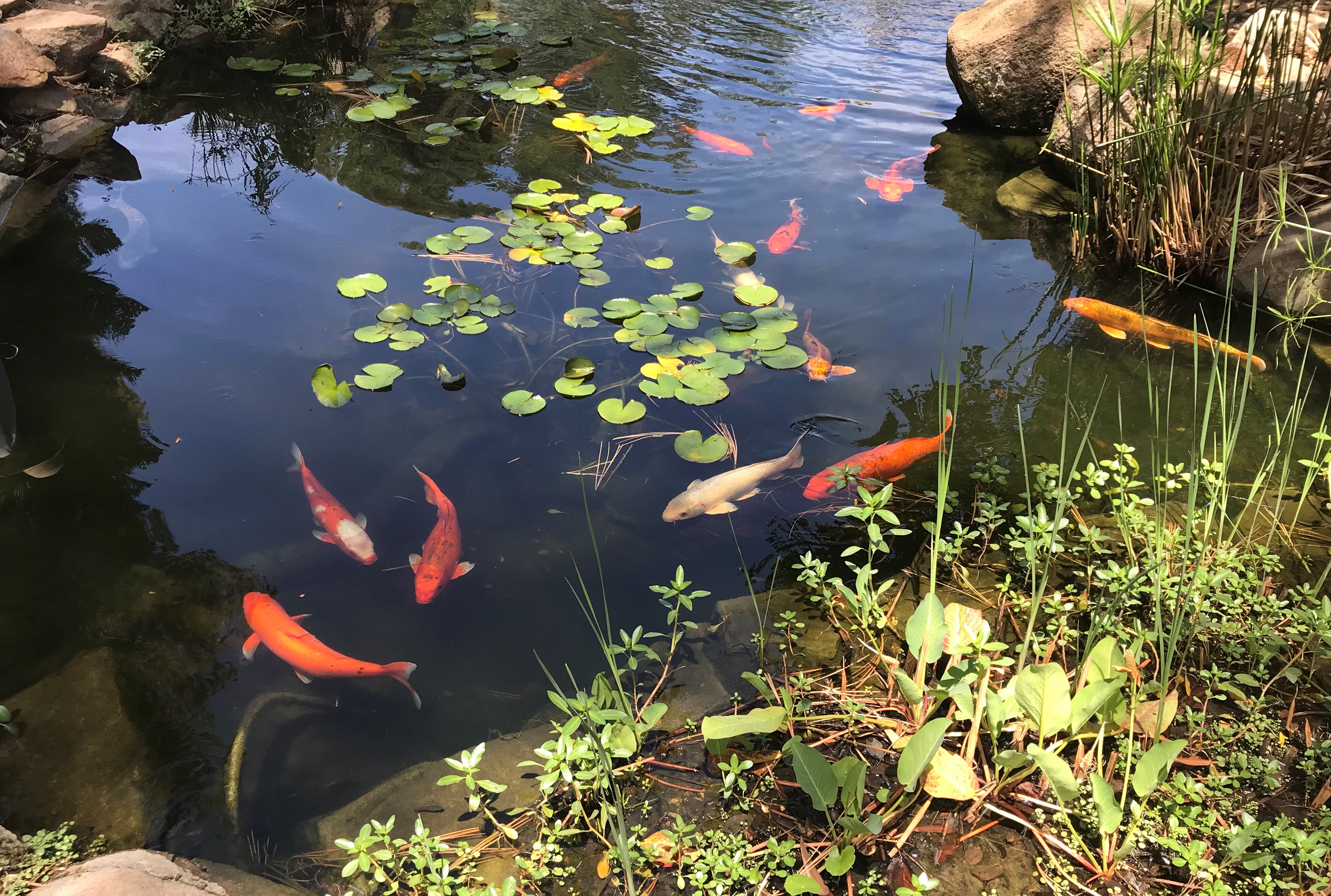
Done, we waited for our turn to wash our cups. Dharma sharing was next, but we never made it back to the small meditation hall. I admit I have a weakness for koi, and the lotus pond under the trees called to us.
At the lotus pond, I lost myself and found bliss.
We sat and watched the fish. I had had a difficult week, but those worries had not followed me to the monastery. In fact, all I felt was bliss and a lightness of being. Any thought that might have agitated me sat about six feet away, teetering precipitously on a rock surrounding the pond, ready to lose its balance, plunge into the water and be gulped up by one of the majestic koi. There, I was not bothered by anything. I don’t remember the last time I enjoyed such peace. We sat in silence for an hour and a half, breathing in, breathing out and filling up our senses.
I rarely go into the Southern California sun without my umbrella, and on this Sunday it not only saved my scalp, but also a tiny life.
The only break in the calm was a disturbance at one end of the pond. A bee was furiously treading water, looking like a teeny motorboat driving in circles. I rescued it with the end of my umbrella so it wouldn’t become fish food. The koi, I presumed, were well fed, and the world needs all the honeybees it can get.
I could have kept the fish company for the rest of the day, but lunch was upon us, so we made our way down the dining area (we were finally figuring out where everything was!). Everyone stood quietly in line as the scent of curry wafted through the air.
Four hundred visitors descended (ascended?) upon the monks and nuns diligently preparing our delicious lunch. By the time we got to the food, some platters were empty, but there was still more than enough to put on our plates and enjoy a mindful meal.
A much-needed reminder to slow down.
I had practiced mindful eating before, but this was a novel concept for my accompanying teenager, who often ate paying more attention to her phone than to her plate. We chewed silently and slowly, savoring every bite. The tastes of the curried tofu, rice, steamed carrots and salad were vivid, the colors on our plates glowed brightly. My daughter, halfway done, leaned over and whispered to me, “This is the most delicious salad I’ve ever eaten, and I’m already full!”
Ah, if only we could enjoy such preciously appreciated meals at home! At least I had one convert now.
We waited in line to wash our dishes – the sensation of soapy water followed by a cool water rise was refreshingly pleasant on such a hot day.
Our last stop before departing the monastery grounds was a visit to the bookstore. There were more people than books, and it seemed like the two nuns handling the payment transactions were a bit overwhelmed by everyone’s enthusiasm for making purchases. We indulged in coconut ice cream and visited the donation box before heading home.
Floating Cloud Stupa – we admired it from afar and look forward to visiting it the next time we are on the grounds.
We are looking forward to our next trip to Deer Park Monastery, with a visit to the Floating Cloud Stupa, which we only saw from afar this time. When we return, we won’t get “lost” again, because no matter where we are on the grounds, that’s where we want to be.
This is not the post I was originally going to write.
I was going to relate the feelings of loss that I’ve experienced. And if I feel them, cancer sufferers who are in worse situations are hit with a tenfold intensity.
However, I decided against that. As I noted earlier, attitude influences our perceptions of a situation. That’s certainly not earthshaking news, but the extent to which that happens constantly smacks me upside the head.
There are bright spots in cancer. My Nurse Navigator, herself a triple-negative breast cancer survivor, would say, “You’re gonna either laugh or cry,” and as patients we do find things to laugh about. It’s just that we want to be the ones to point those things out. Calling yourself Yoda because you have a few long hairs on your head can be done in a light-hearted way. Having your neighbor laugh at your bald pate after a strong gust of wind rips your head scarf off, not so cool.
Sitting down and plunking out a humorous piece used to be really easy. There were so many things in life to laugh about, and it was no sweat to find the funny in everything. But it’s a harder squeeze now with cancer in my rear view mirror.
Alright, who’s up for a Nerf gun battle?
Not that I want to hide behind doors in Groucho glasses ready to nail people with seltzer water. But being able to generate a little bit of lightness would be appreciated. And when you throw financial stressors, cancer, work pressures and gradually dissipating self-esteem into that environment, pulling out a sincerely funny post seems almost impossible.
This is not how I want to go out, as the grumpy old lady who sits by the window all day, watching the kids in the neighborhood and ratting them out for the smallest infraction. No, I’d rather be the fun old lady who brings out popsicles and water balloons and gets in trouble along with those kids.
Same old lady. Different attitude. Yeah, I can swing that.
Not all of us can do great things. But we can do small things with great love.
Attributed to Mother Theresa
I have disappointed myself.
Thirty years ago, I would have assumed that by now I would be doing great things, making a big difference in the lives of many beings.
I would have been well advanced in my field and a person of consequence.
But life is full of twists and turns and things don’t always go according to plan.
There are obstacles along the way, and maneuvering around them can force you onto a side path. Sometimes that path strays too far from your original purpose and you end up so far away that you cannot make it back.
You may find yourself in a place that’s unfamiliar and unexpected. For me, it was a realization that I will not get to where I thought I was going.
So I cannot make grand decisions to benefit all. But perhaps I can do little things with a kind heart that will benefit someone. I may not change the world, but in a small way with great love I can do my part.
One of the most intense emotions that I felt after being diagnosed with cancer was anger. I felt betrayed by my body and the medical community. I’d done everything that I had been told I was supposed to do to bring my breast cancer risk down to as close to zero as I could, and still cancer found me.
In reality, until we discover what causes cancer, we can never eliminate our risk of the disease. Of course, I wasn’t thinking like that. I had been completely blindsighted (as, I’ve learned, so many are) and was furious about it.
So when I read a suggestion about finding things to be grateful for, I scoffed at it. Until I actually thought about what I could potentially be grateful for.
The result was overwhelming. In the midst of what had gone wrong, there was so much that had gone right! So many things that could have been worse, so many lucky coincidences that improved my situation. So much to be grateful for! Where my way had been obstructed by brambles and thorns, now lay a welcoming path.
I sat slack-jawed, humbled by my many blessings, as if they had been planned out to benefit me. If I had to develop invasive breast cancer, then so many things were working together to make my journey easier.
I kept a gratitude list and continually added to it. Invariably when I sat down to write my mood would gently soften. Even so, I struggled. There was a perpetual tug of war between hot emotions and the soothing breeze of gratitude. Many times the heat would overtake me.
Gratitude returns the beauty that anger steals away.
Time has passed and distance offers perspective, and while I am not perfect in making space for all the frustration associated with repercussions of my treatment, I understand the importance of working on it.
Every night, therefore, right before bed, I make a list of five things that I am grateful for. They don’t need to be big and they don’t even need to have taken place that day (although often they have). If they’ve evoked gratitude, they qualify.
I can always find at least five things and that is a heartening thought.
Settling into bed, thoughts of wonderful things fill my head and put a smile on my face, shepherding me to sleep. There is no better way to end the day.
“Remember that your doctor has prescribed this medication because he or she has judged that the benefit to you is greater than the risk of side effects.”
I can’t tell you how many times I’ve read that statement on the informational leaflets from various bottles prescribed for me. When it comes to a disease like cancer, it might as well say, “You think these side effects are bad? Hohoho, just try not taking your meds!”
This does not give warm, fuzzy feelings of hope. Then again, there’s not much about cancer that’s warm and fuzzy.
It can feel like the treatment is as bad as the disease.
I, admittedly, am generally accepting of the advice given by knowledgeable professionals. When my oncologist laid out a treatment plan, I didn’t argue, although when offered a choice between an effective targeted therapy versus an even more effective but also more toxic one, I opted for lower toxicity.
For me, it was a quality of life issue. If I’m “cured” of cancer but end up with severe heart problems…well, I’d rather take my chances with a less damaging option.
Cancer still remains life-threatening, now as it did decades ago. The difference is that patients are living longer and some go completely into remission. Survivorship should be considered a factor when designing a treatment plan, as should long-lasting repercussions of side effects.
So if I had one request of oncological health teams, it would be that they look beyond simply bombarding the cancer and consider the physical and mental condition in which they leave the patient, being sensitive to the possibility of ‘overtreatment’ in their exuberance to squash as much of the disease as possible.
Should you use a sledgehammer when a rubber mallet might be sufficient? Is “just to be sure” a justification for side effects than can compromise your quality of life, however long that is?
It’s not always easy to find that sweet spot between acceptable risk and tolerable side effects.
There is no “right” answer to this as everyone’s situation and risk tolerances are different. So if I could have a second request of the medical community, family and friends of the patient, it would be that they respect the limits and decisions of the one who’s going through this.
To be able to weigh the risks and decide what’s acceptable and where to draw the line — that might offer at least a semblance of control in the crazy roller-coaster ride that is cancer.
My mind is usually abuzz with thoughts about what I have to do, what happened in the past and what the future may bring. Imaginary conversations take up space in my head, dragging me down down rabbit holes. All that unnecessary mental activity can get exhausting.
Meditation offers a reminder that I don’t have to do that.
I recently attended another mindfulness retreat. It had been a stressful week with many worries. As I took my seat, thoughts swirled in my head about everything that had been going on. It felt like I was juggling plates over my head, trying to keep everything in the air. I was tensing without even realizing.
Whoa, buddy, how about giving it a rest?
And then it hit me like a bolt from the heavens: I could choose to let go of it all. There was nothing that I had to do and nowhere to be, except sit in stillness exactly where I was.
We practiced mindful movement. I have a habit of challenging myself by trying to make poses more difficult to make my muscles work harder, and I’ve found myself doing this even during retreats.
But this time, I let go of striving and took a simpler route. No need to set personal records, hold the pose longer or deeper; I wasn’t competing against anyone.
I didn’t need to do every movement perfectly, I needed to mellow out. It took more than a few breaths to bring myself down and feel the ground beneath me.
Sometimes I need a reminder that I can simply choose to stop the noise.
Not worrying about who was watching, what they thought about me or how I looked — what a concept. I gave myself permission to set all those pressures aside, and for the first time that week, everything calmed down.
Obviously, this is not something I do enough of. If I forget that I can simply let go during a formal mindfulness practice in a supportive community setting, then it’s not surprising that I tie myself up in knots during everyday life.
And everyday life is what really matters.
I’m still not good at this. But maybe each time I stop myself, I do so just a bit earlier. With time, I will get closer and closer to stopping before I even start. And that’s something I can look forward to.
For those unfamiliar with the drug tamoxifen, its purpose is to block estradiol receptors in an effort to decrease the chances of developing hormone receptor positive breast cancer. My own tumor had been estrogen and progesterone receptor positive, so tamoxifen is pretty much standard fare for women in my situation.
The trick is, however, to make sure women keep taking the medication, and the side effects may make that a challenge. The current recommendation for pre-menopausal women with hormone receptor positive cancer is ten years of tamoxifen. When I posted after a year of taking tamoxifen, I was experiencing minor side effects but had managed to avoid the worst hot flashes and night sweats that many women complain of. And even the side effects I had I couldn’t completely pin on the drug.
After a year and a half of tamoxifen, the landscape has changed. My estradiol level, which was 36 pg/mL when I started in November 2017, has dropped to 22 pg/mL. I’m still not having a significant problem with body temperature regulation, although this may change with the summer months.
There are, however, other distressing issues that are becoming increasingly problematic:
1. Memory lapses. I’ve written about this in a number of other posts, but it deserves mention again because it’s not getting any better. I struggle with distractability and loss of focus, which compromise my ability to do my current job. There are details that I simply miss, and I have a hard time juggling things in my head. Yes, I write everything down and follow my own advice, but there are days that I want to give up and go home.
Bottom line, even with workarounds, my concentration makes me ineffective at times. That alone could be a deciding factor in how long I will last on this medication, but it’s not the only one.
2. Fatigue. This has become more noticeable and is affecting my workouts. I feel like I’m losing ground on my fitness. While I’m no stranger to working out even when I don’t feel like it, there are days that I feel beat before I begin, and like I’ve been run over by a truck by the time I’m done. Exercise is such a crucial part of recovery and good health — and a very important part of my life — that it seems ridiculous that my treatment should be getting in the way of it!
Detachment from affection feels lonely and isolating.
3. Loss of libido and emotional attachment. This would be easier to take if I were single and living alone, but dealing with this side effect in the context of a relationship is getting progressively more difficult. It is not simply romantic desire that has dwindled; feelings of affection for my husband and children have dulled. I know I love them and feel a strong sense of responsibility for them, but there’s a numbness where there used to be warm emotions. It breaks my heart because I don’t want to feel this way.
4. Depression/mood swings. On the plus side, I know what’s going on and am actively working with my counselor on dealing with these fluctuations, but these are side effects of the drug, so as long as I’m taking it, I feel like I’m trying to bail water out of a sinking boat with a spoon.
5. Argh, again with the hair! After regrowing my hair following chemo, it has been thinning from tamoxifen. This may seem insignificant in the grand scheme of things, but if you’ve ever lost your hair to cancer treatment, you know that it can be a emotional experience. Getting your hair back is a big deal, but thinning hair brings back a sense of helplessness and lack of control.
Notice that the effects above are not readily apparent — even the thinning hair might not be as noticeable to an observer as it is to me. It’s easier to understand visible health-related consequences, but we as a society have a hard time getting our head around (or expressing concern for) the importance and impact that emotional factors have on quality of life. You can’t see my concentration difficulties or depressive mood or grief over numbed affection, but they affect me as strongly as do any physical symptoms.
I’m not forgetting how lucky I am.
This is a good place to stop and mention gratitude. The fact that I write this post as a former cancer patient on a maintenance drug to help keep my cancer from re-occurring…that is a privilege. My good fortune is not lost on me, and it is something I think about every single day. We have come a long way in treating my type of breast cancer and I am the beneficiary of those advances.
But there is also an expectation that now that chemo and radiation are done and my scans are clean, I should be “back to normal”. I would like nothing more than that, but I’m not there.
This brings me to a deal I made with myself: I promise to do my utmost to last through five years of tamoxifen. However, years 6-10 remain to be seen. At some point, the scales will tip and quality of life will win out over whatever purported percentage of increased survivorship the full decade of the drug can offer me. This offers me some strength to push on and focus on the present, doing the best I can with what I have.
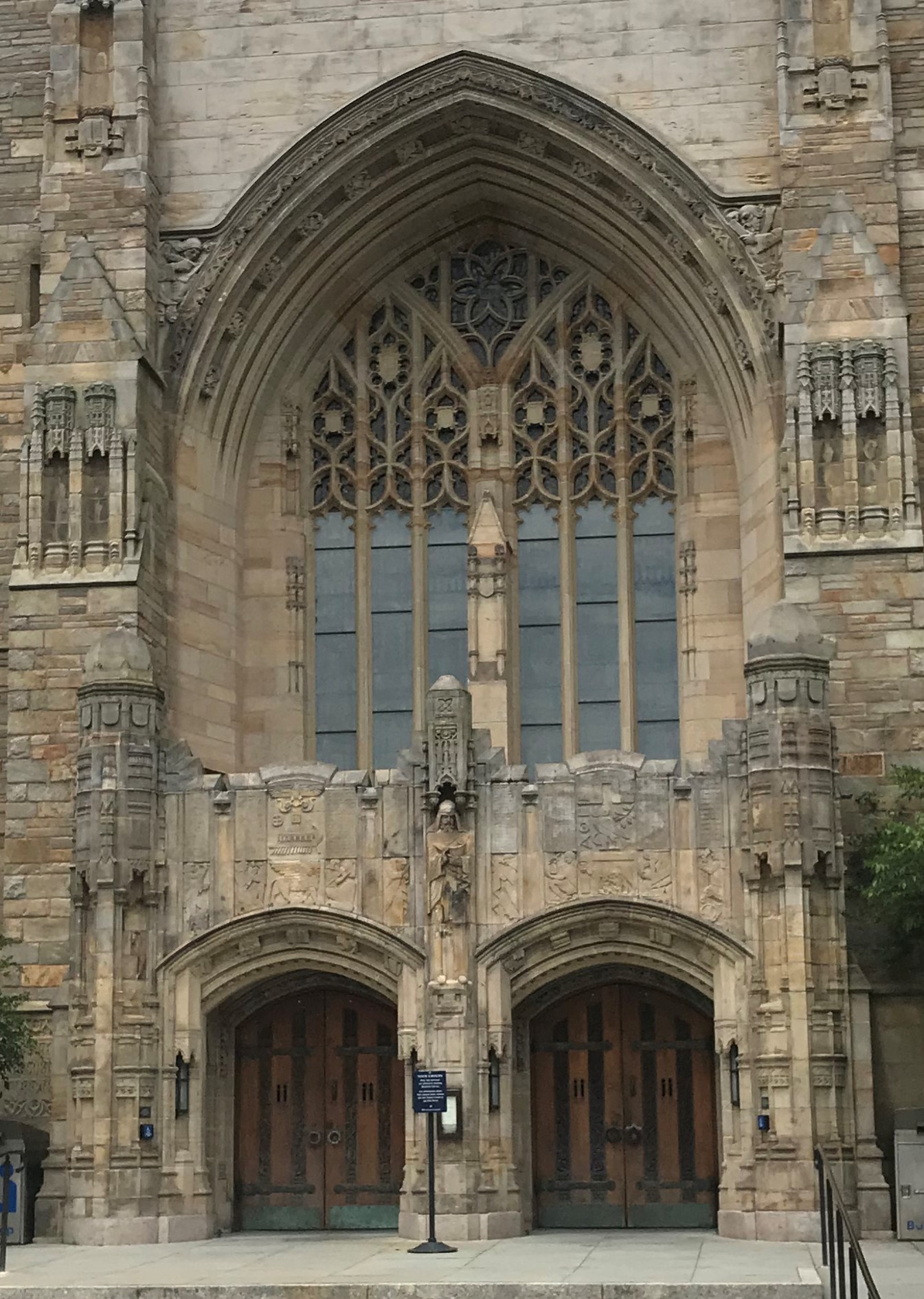
The journey back to my hometown included a trip to my alma mater, less than an hour away from my parents’ house. Just like much of the Northeastern US, the school has a lot of history that is reflected in its architecture.
A rather majestic entrance to a library…
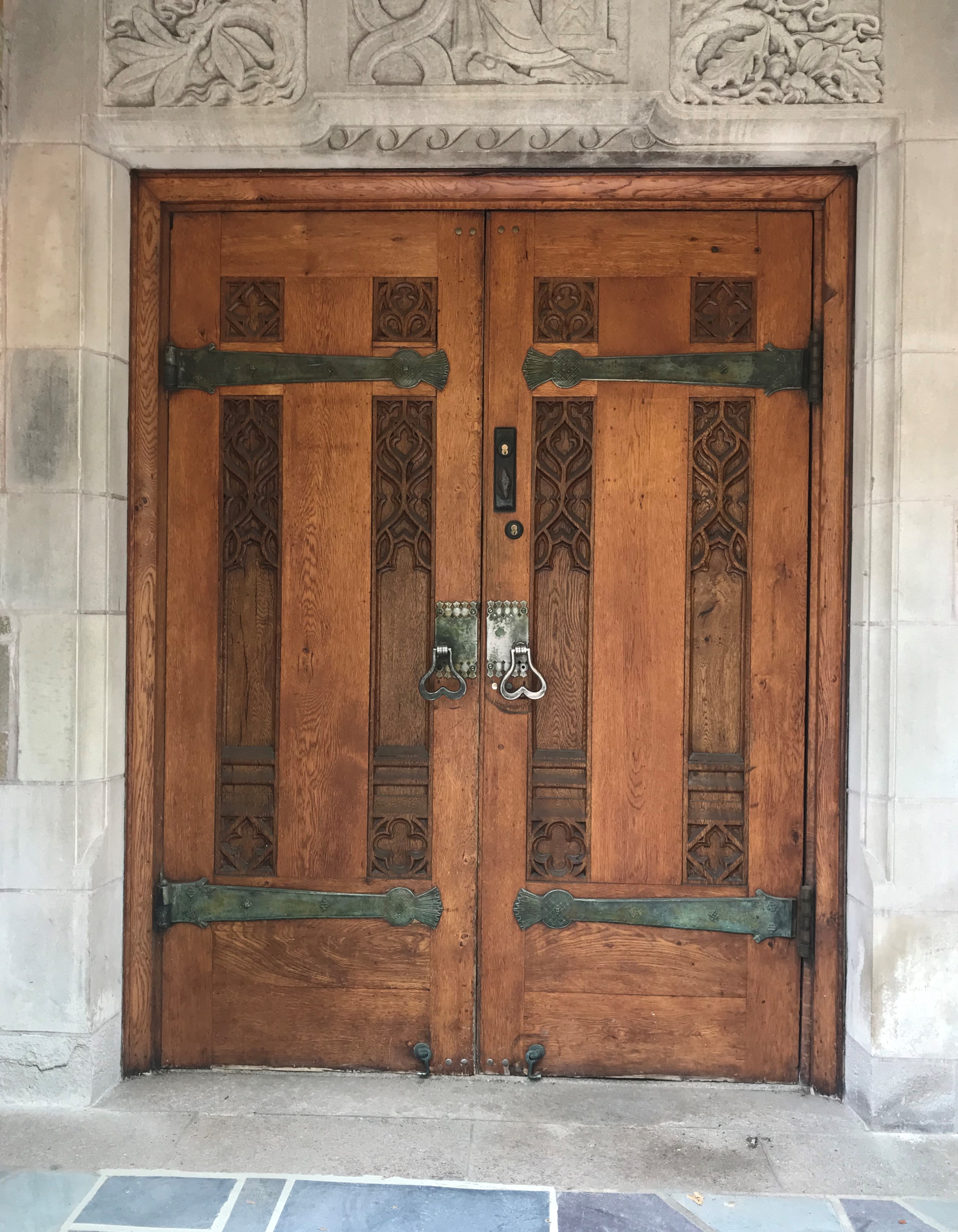
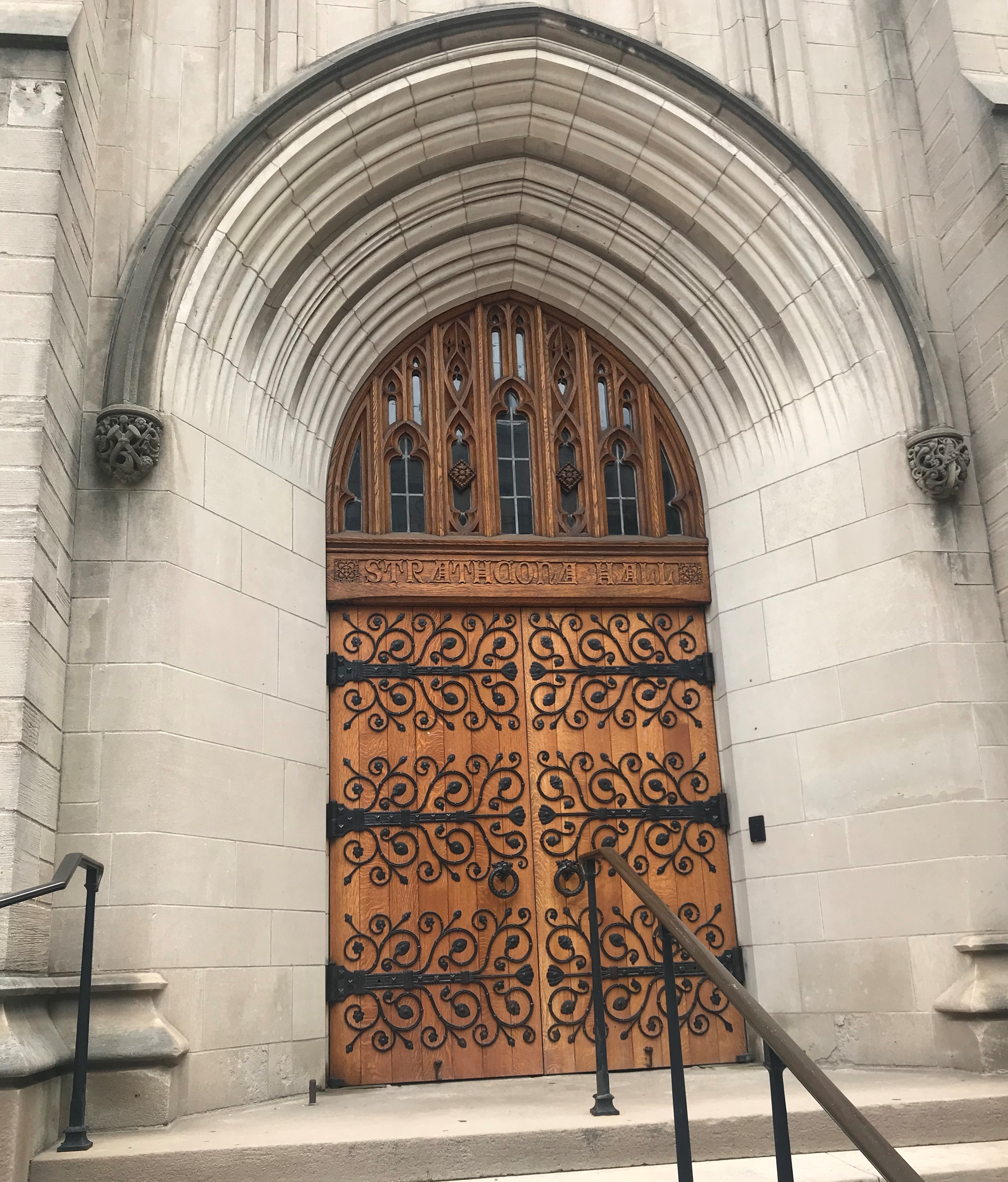
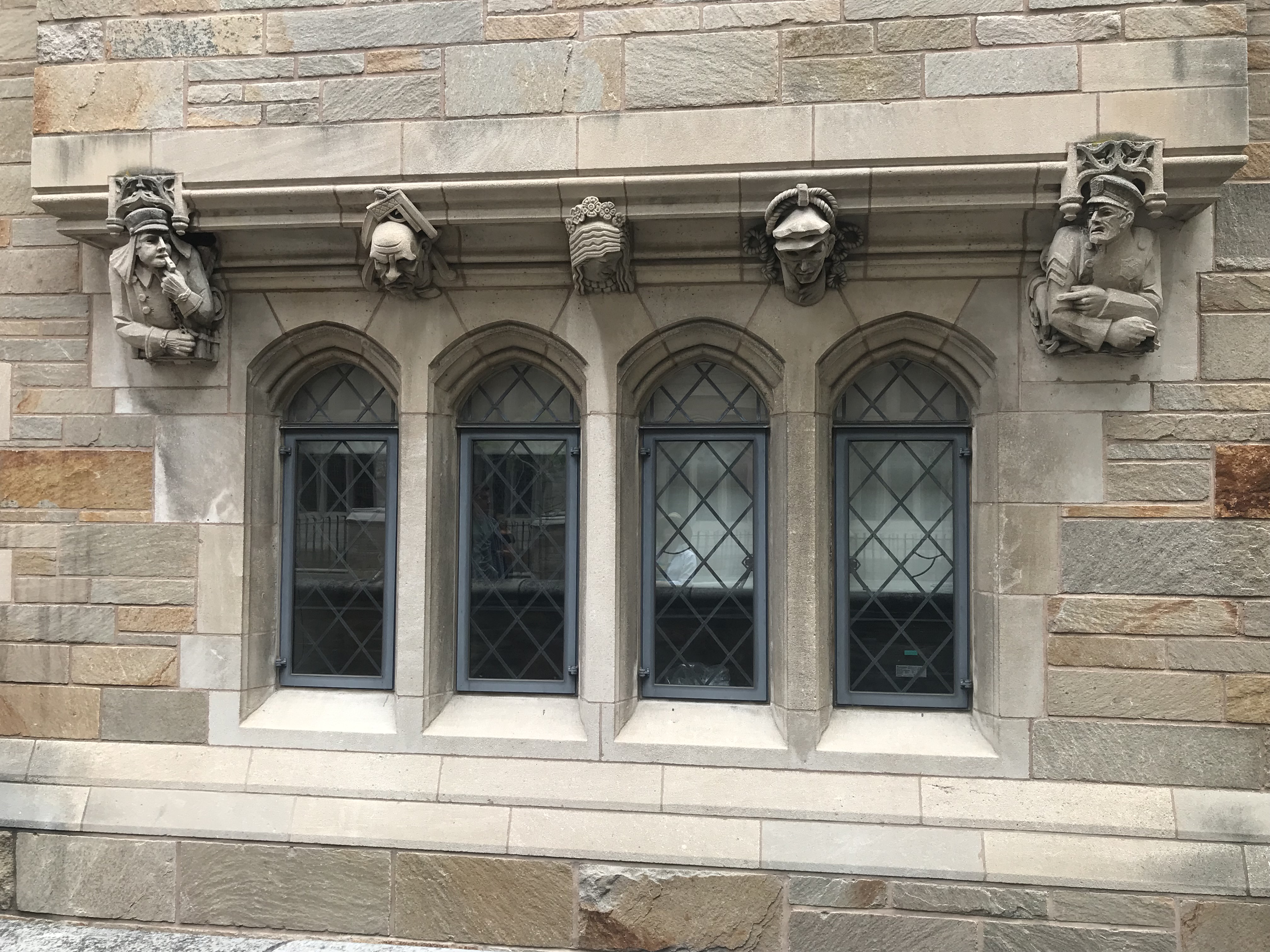
Doorways and passages hold a particular interest for me, not only because they can be works of art within themselves but also because they have a symbolism that resonates with me.
A close up of one of the library doors.
A door offers an opportunity to pass through and see what’s on the other side. It may improve our situation or worsen it, but even if it’s the latter, there’s always another door in the not-too-distant future that we can open.
What’s on the other side?
I don’t believe that we ever truly run out of portals to open and thresholds to cross.
Here’s an invitation to enter…Doors can be deceiving. They may look foreboding, but lead to glorious things.Some doors you want to stand and admire before opening. And in lieu of a proper door, windows serve as adequate portals in a pinch.
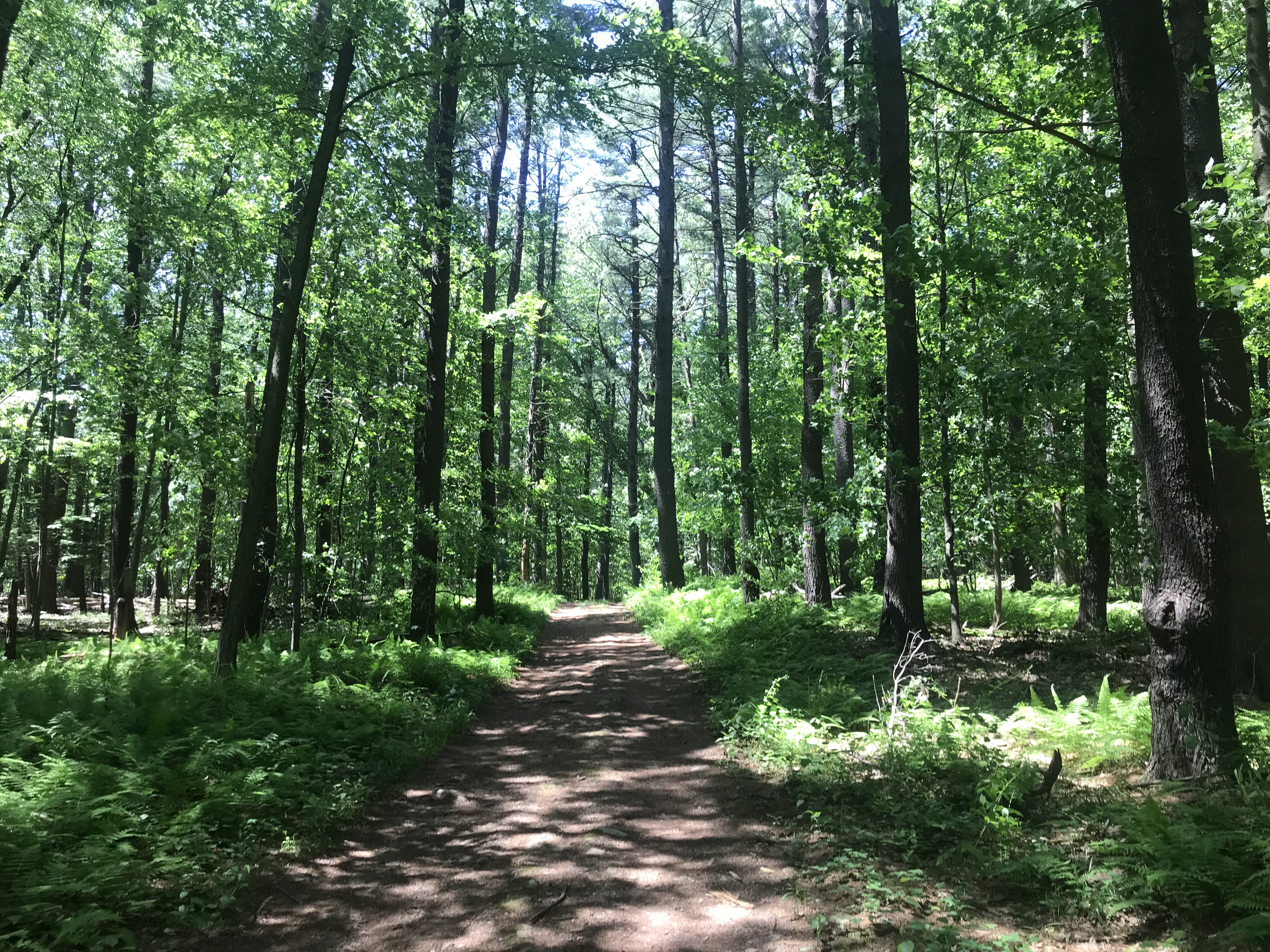
I had the pleasure of returning to my hometown in the Northeast of the United States for a long-overdue visit. Flying into the airport, the difference between the landscape there and the sparser chaparral of my current home in Southern California was striking. The abundance of greenery in the form of old growth trees reminded me of what I missed so much about living in Connecticut – walking through forests, real forests, and reveling in being surrounded by the lushness of nature, awash with feelings of serenity and renewal.
Accept the invitation to slow down and appreciate the beauty around you.
Shinrin-yoku is a Japanese term that means “forest bathing”, a form of nature therapy or ecotherapy, the benefits of which have been studied extensively beginning in Japan and South Korea, but now being practiced throughout the world. The concept is simple: slowly walk through a forest and experience it with all your senses.
Walking slowly, breathing deeply, there’s so much to experience..
While the practice is uncomplicated, in our busy world it is easy to forget the importance of spending time in nature and truly being present as we do so, connecting with an ancestral part of us that we usually ignore. There is much to be gained by doing so. Taken from the site Shinrin-Yoku.org,
I can personally attest to this. Simply being in the presence of the trees, walking down a forest path under a majestic green canopy, listening to the wind in the leaves and songs of birds, it is unlike anything that I have experienced in the urban hustle-and-bustle of the Southern California lifestyle. Even in the higher elevations, I do not find what I found during my trip home.
While I cannot easily return to that experience several thousands of miles away, I can make an effort to find the “green” in my everyday life, to pause, reflect on and appreciate the nature around me. And taking a deep breath, I am calm.

















 Frantic Shanti