On the first day of my Yoga Teacher Training program, we did a curious exercise. Students were instucted to pair up and take turns speaking for about 15 minutes. During that time the speaker was to tell the other about their life. In turn, the listener was to say nothing. In fact, they were to make no facial expressions or give any response to the speaker. They were there simply to be present and witness to what the speaker was saying.
This was incredibly difficult for me to do. My partner was an amazing woman with a backstory that I was so driven to respond to. My usual MO in situations like this is to make little noises like “oh!” and “uh-huh”, and to nod along, raising my eyebrows, smiling…all actions to encourage the speaker. Containing that urge made me feel like I was sending a message to her that I didn’t care. I didn’t want her to think that she was boring me.
Sometimes, the greatest give we can give is our presence and undivided attention.
But the idea behind this exercise made a lot of sense. Too often, we can derail the thoughts of others by interjecting comments. Even when we are encouraging the speaker, we may inadvertantly be sending them off in a different direction than they had planned to go. Additionally, I realized that my need to show that I was interested about what they were describing was actually moving the focus on myself, rather than allowing the other to speak their truth.
This spoke to my own insecurities. In particular when speaking with people in positions of power, I will often watch for body signals and verbal cues that inform me as to what direction I should take my story. I recognize that I lack self-confidence, lost over the years by interacting with people who, in fact, did not value me or my thoughts.
Afterwards, my new friend and I blurted out how much we had enjoyed the other’s story and how difficult it had been to not show appreciation. But we also understood the value of this exercise.
I would not be quite so stone-like with a speaker in a future situation, but I will definitely be more reserved with the interjected “wow”s and allow the speaker to wind their own way through their story, allowing them to fully express themselves, giving them them gift of holding space for what they want to say.
Another stressful night left me wide awake at 3am again. Not fun when you’ve got a long day of work ahead of you.
I went to my tried-and-true tactic: several guided meditations which usually work to take the place of the worries swirling in my noggin. But this time it wasn’t enough. The voices were soothing but I wasn’t close to falling asleep.
So I came up with a simple impromptu meditation that kinda-sorta breaks the mindfulness “rules”.
So many numbers out there for me to count while I’m not sleeping…
I’ve been taught that one can count the breaths to help deal with the chattering “Monkey Mind”, and this can be done in various ways. For example, count each inhale as one and each exhale as two, repeating with the next inhale as one and exhale as two, and so on, never progressing further.
Or counting each breath cycle up to 10 (or any other preset number) and then start again at one. If your focus is lost at any point, start at one again, working your way back to 10, restarting at one if your mind wanders off again.
These types of counting techniques aren’t meant to get you anywhere. The number you reach doesn’t matter. What matters is that you make the breath counts your point of focus, giving the Monkey Mind something to do and keeping anxious thoughts at bay.
But for this particular 3am waking, I decided to try something else: count breaths without a stopping point. Instead of observing the breath without changing it, as is usually done during other mindfulness meditation practices, I counted during the exhale, consciously extending the breath as I thought the number. And as I focused on my breath, I kept track of the ascending numbers. This required a touch more concentration and yet was simple and boring enough to not excite my mind.
Somewhere in the 70s and 80s the numbers started jumbling in my head and I repeated several, not being sure exactly where I was. By the 90s, my monkey brain was muttering. I remember getting to 100 and going past it, but my memory is foggy. Consciousness faded in the one hundred teens, I think.
As far as back-to-sleep methods go, this was not a quick fix, but I was too awake to try anything else. I counted for a good 20-30 minutes. I manipulated the breath, so as I mentioned, this practice didn’t follow the mindfulness meditation “rules”, although it did offer me meditation practice in lieu of spinning my worry wheels.
But in the wee hours of the morning when nothing else seemed to be working, it got me to where I needed to be: asleep.
~~~~~~~~~~~~~~~~~~~~~
When the going gets tough, I’ve found counting to be one of the most effective last-ditch back-to-sleep methods, for me preferable to getting out of bed and going out to the couch to read or something. If nothing else, I get in some effective meditation practice. Additionally, this was not a night with a totally hyperactive Monkey Mind. My monkey was awake for distractible.
Note that as I was doing this, I lay on my side, bolster between my knees, white noise playing through my earbuds (yes, I’ve taken to sleeping with earbuds in!). I was in “sleep position” and keeping still, so the only “moving parts” were my brain and the expansion and contraction of my chest and belly.
When I first started my mindfulness meditation journey, I was taught to use the breath as the point of focus. It is a reliable anchor, always there to return to when you inevitably drift off into thought. It is a stable grounding force that keeps us present.
But there are times when it’s hard to focus on the breath. Perhaps when the mind is especially busy. At those times, I switch to other bodily sensations, such as tingling in my hands or pressure from contact with the surface that I’m sitting on. I wrote a post about moving between two points of focus to help the mind maintain concentration without wandering off. That helps too.
Some days my monkey mind is particularly loud and attention-seeking.
And sometimes my chattering “monkey mind” calls for a switch to an auditory focal point such as gentle music, singing bowls, nature sounds or even simply street noises. Those will keep me present as long as I don’t fall into the trap of making stories about the sounds.
But some days are extra tough.
I tend to avoid meditating with my eyes open. Doing so only reminds me that I need to clean my desk or vacuum the carpet (“guilt-guilt, blame-blame”). However, I am a very visual person with a vivid imagination, and opening my eyes immediately grounds me if my thoughts get too pervasive when my eyes are closed.
Sometimes a thought will trigger an uncomfortable and anxiety-provoking feeling simply because a seemingly-innocuous scene has been associated with a disturbing event. The scene flashes before my eyes andbefore I know it I’m down a rabbit hole. Monkey mind is activated.
While staying with bodily sensations would be preferable, some days there are too many opportunities for my monkey mind to run away with me. It can get exhausting and counterproductive to “dodge” these visuals. Yes, we are “supposed to” let the thoughts pass by us without getting caught up in them. But there are days when they agitate me too much and throw me off track.
Tree!
So I’m cutting myself some slack and turning the “problem” into the solution. On those difficult days, I focus on an image of my own choosing. Something that I can visualize clearly so that it keeps the monkey occupied while at the same time keeping me away from troubling scenes. You could argue that I’m “avoiding” the thoughts. But I see this differently–I’m giving myself a little break from them.
What works best for me? An image unencumbered by potent associations–this is different for each person. A tree, for example, works for me. It might be a thin white birch tree or as majestic and meaningful as Yggdrasil. The tree itself doesn’t matter as much as that I choose it according to what suits me and what soothes me. I can focus on its rough bark, veiny leaves and thick canopy and the sensations that these things evoke to keep away from creating stories.
And if this results in greater concentration, I have the option of hopping back to the breath. Or not.
This might not seem like an earth-shattering revelation. There are relatively popular mountain and lake meditations, so this concept is not new. But with all the emphasis on feeling into your breath in an effort to calm the thinking mind, sometimes it’s simpler to not worry about the “shoulds” and instead see what your own self needs to help it let go and settle into peace.
After finishing chemo for breast cancer and noticing that I had no body odor, I decided to write a post about it because the Internet was silent on the topic. Apparently, I wasn’t the only one who’d come up empty. A number of you commented that you’d noticed the same thing and similarly found no explanation.
Well, five years after my initial diagnosis, maybe 4.5 years after finishing chemo, I still can’t locate info on the Internet about this.
If I do find the odd article about cancer and body odor, it’s about the exact opposite: smelling bad as a result of the disease or certain medications. Not what I’m looking for.
Hey, Internet! Is there really no one looking into this?
It is quite weird that I can’t even find anything in the US National Institutes of Health PubMed database, so I would suspect that chemo-related loss of body odor is not on the radar of researchers. Well, it’s certainly not on my oncologist’s radar because he said he’d never heard of it and didn’t think it could be attributed to chemotherapy. Personally, I can’t imagine how it could be from anything else.
I’m going to pester him about it again during my next appointment. Usually armput odors are caused by bacteria. As an article from the Cleveland Clinic explains, odor is produced “when bacteria on the skin break down acids contained in the sweat produced by apocrine glands, which are located in the armpits, breasts, and genital-anal area. The bacteria’s waste products are what produce the smell.”
And NPR ran a story on researchers looking into what the worst bacterial offenders are, noting, “When the bacteria break down the sweat they form products called thioalcohols, which have scents comparable to sulfur, onions or meat.” The greatest culprit? Staphylococcus hominis.
So then maybe the chemo stops the production of thioalcohols? Or chemo wipes out the S. hominis living on our skin? I’m surprised that no one is researching this in the context of chemo patients, because it seems like it might have some health implications. We still don’t know all the side effects of chemo drugs and it would be useful to start a conversation about this one.
If you’re experiencing this, please tell your medical team. They might simply not be aware of what’s happening.
I’m not saying that I smell like a bouquet of flowers, but according to my husband, there’s no “sweaty pit” odor.
And you might be wondering what my current experience is, almost five years later. Even though I departed the realm of the completely-odorless about two years after completing chemo, I still have very little body odor. And it’s not like I don’t give it chances to fester since I work up a good sweat when I exercise. Note that my left armpit, which was thoroughly irradiated, exudes almost no noticible odor. My right armpit doesn’t smell very much, but sweat that gets on, say, a sports bra will start making the fabric stink the next day. (Let’s just say that I’ve been testing this out.) The skin in the armpit itself? Minimally, and that’s with no deodorant, although I do wear it anyway.
Certainly, the six weeks of radiation therapy on my left side would likely have an effect, and so it would make sense that there’s a difference in odor between both armpits.
Still, the “natural” (and unfortunately overpriced – yeesh!) deodorants do a very good job of fragrancing my armpits because they don’t have to work very hard.
So the mystery remains. I’m going to keep digging into this as it’s likely there’s a disruption of our skin microbiome involved, and given the popularity of that research (see microbiome and armpit odor info at drarmpit.com), someone may be looking into the connection between chemo and body odor in the future. Until then, I’ll just remain happy and relatively unstinky with fingers crossed that it continues.
~~~~~~~~~~~~~~~~~~~~~
Many thanks to my very patient husband who played along and agreed to smell every place I pointed to. I’ll revisit the odor issue during the summer just in case…
This is the time of the year that many people make resolutions they hope will catapult their life into a new and positive direction.
So it’s also a good time to encourage people to slow down and consider what they hope to achieve and how they plan to get there.
And they’re off! The New Year fills us with energy to make big changes, but most of that impetus fizzles out as we realize that our plans are not sustainable.
The New Year’s buzz drives us to dream big and leap high, but with all that emotional energy expenditure, we run the risk of overwhelming ourselves, burning out quickly and falling far short of our lofty expectations. And that may make us feel worse about ourselves.
This year, take a step back and consider: it’s the small changes that you make on a daily basis that determine where you ultimately end up. Consider an ocean liner that turns very slowly. It makes little adjustments in its course, but depending on which adjustments it makes, it can end up in very different places.
The real name of the game is consistency. While the big goal may be the shining light you strive for, consistency paves the way. And mindfulness helps you get there.
Maintain awareness of the present so that you have perspective on what choices you’re making today and their effect on tomorrow.
Focus on what you can do today. Even this hour. Want to increase your activity level? Get up and take some steps right now. That doesn’t mean sprinting around the parking lot for 10 minutes. It means doing something you wouldn’t have done otherwise. Something that won’t give you side stitches and result in wanting to throw in the towel.
Make little decisions to change something. Make them doable. And then make them consistently.
Maintain your awareness, every day, of what you’re doing and why.
And when those changes have become comfortable, do a little more. Keep your eye on consistency, not quantity.
Establish positive little habits the way you’d spread the seeds for a lovely cottage garden. Because here’s the thing: this is not a race. This is your life. You don’t live your life a month at a time–you live it moment by moment. And that’s the way you make changes.
Be like the big ship whose many little changes, made consistently, take it to fantastic places.
Any decision that positively affects you remains yours to keep, like a little jewel in a box. Did you go for a walk among trees after lunch instead of hanging out in your office perusing social media? No one can take that experience away from you. Tomorrow, if you have a meeting after lunch and must stay at your desk, the positive effect of that walk will still have taken place.
It’s like a little brick that you can use to build a palace. You collect one each time you’re consistent with a behavior. Play the long game.
And when you remain mindful of your behavior every day, you can also step back and see where you, the human ocean liner, are headed. This makes it easier to correct your course. A short diversion does not need to take you in an unwanted direction. One small correction and you’re back on track.
And that thing that you might have called a “failure” in past years and just given up because you’d figure you’d “blown it anyway”? It would be a temporary side trip. Because you are mindful of where you are and where you’re going.
And that’s how you know you’re going to get there.
A number of years ago, when my kids were still very small, we lived in an area with brutal winters. That meant sub-freezing temperatures for weeks at a time. Money was tight so we had to keep the thermostat in the 50s overnight and in the low 60s during the day. To make matters worse, our bedroom was in a part of the house that the radiator pipes wouldn’t warm properly, so it was always cold there at that time of the year.
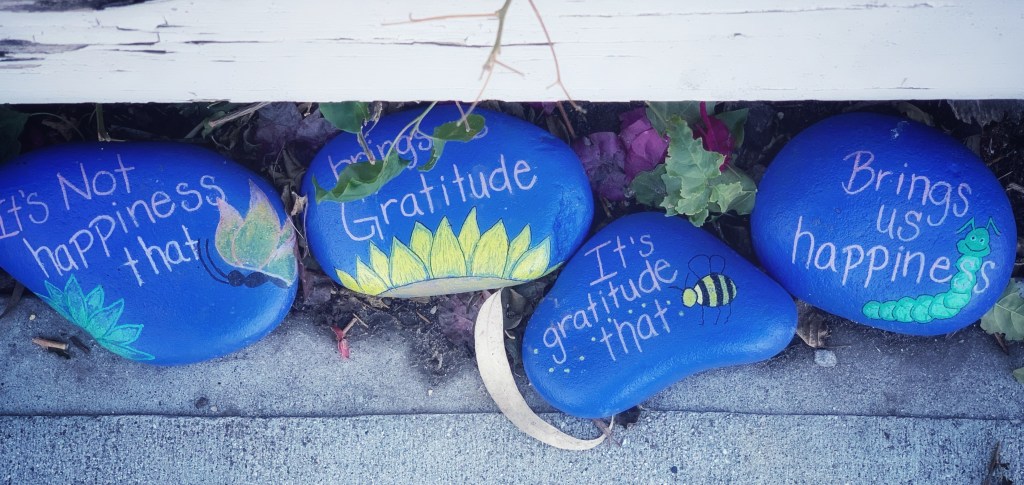
Gratitude for a cup of tea and a quiet moment to write – that is enough.
And by “cold” I mean, the bedsheets would be literally frigid when it was time for bed. So much so, that my joints would ache and I’d be miserable until my body heat could warm them up.
This continued for a year or two until I found an electric mattress pad. The first night that I crawled under the sheets with the heat turned on, I thought I’d won the lottery.
There were so many negative parts to the years we lived there, but going to bed with warmed sheets overwhelmed me with gratitude for the simple pleasure of removing the pain of the cold.
The reason that I’m telling you this is that it’s so obvious to be grateful for the stark changes in our situation. It’s a no-brainer.
But there is no need to wait for something like that. There are simple things that we take for granted that it would be so easy to be grateful for.
Turn your attention to little pleasures and acknowledge their importance in your life. Take some time to sit and bring them to your awareness. Feel into how they lighten your existence. Maybe thinking about them makes you smile. Or maybe the fact that something is simply working properly can be enough to help us realize how fortunate we are to have it at all.
Whatever it is, open up and invite gratitude in.
~~~~~~~~~~~~~~~~~~~~~~~
Maybe generating gratitude during bad times is exactly what we need.
Those of us who have recently gotten a cancer diagnosis may feel a touch bitter about this concept. Understandably, it may be easier to be grateful when you’re not dealing with a serious disease. And no one would blame you for having a hard time generating a mood of gratitude.
But perhaps that’s exactly when you should look for things that elicit a sense of gratefulness, no matter how small. It may be one of the most important things you can do to maintain a sense of well-being in a difficult time.
As 2022 approaches and we face the prospect of having another twelve months speed by us again, I’ve found it useful to sit down and take stock of where I was last January, what changed over the past year, and with what attitude I will enter into the next 12 months.
One thing that has caused a great deal of anxiety for me has been work, even with having one of the greatest bosses in the world and a flexible work situation.
My work situation is quite positive, but anxiety has left me with emotional claustrophobia.
Why? Because my job has also been associated with some of the most wrenching anxiety that I have ever experienced, including being diagnosed with cancer.
What’s resulted is that even in a supportive and stimulating environment (although not my passion, admittedly), I’ve felt trapped, like an animal trying to scratch my way out of my cage.
This past year, I came up with a tactic to at least partially relieve this feeling.
Now, I actually look forward to Mondays, because I’ve set up a beautiful association for the first day of the workweek with something very indulgent.
First, I work from home on Monday. This softens the dread that I’ve historically felt on Sunday nights, knowing that the weekend is over. The transition to the office is gentler.
Second, with some changes in my kids’ school schedules (one in college living at home and the other in high school), I start my workday an hour later. This has given the entire family reprieve from the stress of waking very early and starting the week sleep-deprived.
It also gives me to time to enjoy a cup or two of decaf in the morning.
Third, when the rest of the family leaves for school and work, I have 45 minutes before my own workday starts. I set up my rower for a 30-minute row, facing the tv/computer monitor in the living room…
Great exercise + fun videos = an amazing start to Monday!
…and put on a half-hour YouTube video of something I really enjoy that I might not have time to watch otherwise. For me now? It’s an episode of “BuzzFeed Unsolved–Supernatural”. Pure 100% indulgent entertainment.
Because it’s a timed row, when the 30 minutes are over, I stop. No pressure to hit a certain speed or distance. No matter what, it ends up being a decent workout because I enjoy the exercise.
That leaves 15 minutes before I start work. Chemo left me with short hair that allows for a five-minute shower.
By the time my workday begins, I am completely refreshed and the day’s workout is done. I feel like I’ve been given a huge treat–almost like I’m cheating, but I know I’m not. That 30 minutes of physical activity tied with watching a fun video re-sets my attitude and I’m ready to take on the week.
I love Mondays!
~~~~~~~~~~~~~~~~~
Can you create your own positive association with the toughest day of the week or anything else that causes you grief?
Since it’s winter in the US and we’re starting to get the first blankets of white around the country, I thought it’d be fun to use snow as a visualization.
While it doesn’t snow where I live now, I grew up in New England and remember the peacefulness of calm, snowy nights when I stood out on the second floor balcony in the midst of snowfall, listening to the gentle “pat-pat” of snowflakes as they landed on the ground.
When we’re at our busiest, life can feel like a blur.
I draw on those memories when I think of snow globes. Yes, they’ve often been associated with chintzy souvenirs, but there’s really something quite magical about that little underwater world.
They are also quite beautiful representations of the process of settling down.
Shake a snow globe and watch the glitter spin furiously about, swirling like mad with little sense of a pattern. Those are the thoughts of a busy pre-occupied mind, overwhelmed with responsibities and expectations. For some of us this may be what our current life is like. Or perhaps we’re going through a particularly stressful time and feel as though we’re unable to slow down and catch our breath.
Perhaps we ourselves are adding to the chaos by unintentionally shaking things even more, allowing our monkey minds to run with stressful thoughts. With so much “noise” we can’t see through the water. Everything is a blur. We have a hard time collecting our thoughts.
When we stop shaking the globe and put it down…it will continue to swirl for a while and we may feel like we’re getting “nowhere” by trying to relax. But if we trust in ourselves, trust in impermanence–nothing lasts forever–slowly things will start calming down. The agitation will diminish.
Just as the “snow” will begin to settle down, so too will our busy thoughts and our busy lives. The glitter will float through the water more slowly, and the view will become clearer. A few more breaths, a few more moments of patience. The currents inside the globe lose momentum and the snow will gently blanket the bottom until, eventually, everything is still.
No sign of the tempest that once took place. Just silent peace and quiet breaths.
Until the moment the globe is shaken again.
~~~~~~~~~~~~~~~~~~~~~~~~~~~~~~~~~
The trick, of course, is to learn how to find peace as the glitter water swirls madly about. Once we can do that, the storm may rage, but we will enjoy bliss.
You cannot say that there is a “good” cancer to have. Because the only thing that would make the cancer that you have “good” is not having it in the first place.
But if that’s not the case, the next best thing is having a cancer with characteristics that serve as targets for drugs, enabling the use of “targeted therapy”. As described by the American Cancer Society, “Targeted therapy is a type of cancer treatment that uses drugs designed to ‘target’ cancer cells without affecting normal cells. …Targeted drugs can block or turn off signals that make cancer cells grow, or can signal the cancer cells to destroy themselves.”
Cancer treatment often means chemotherapy, but there are some targeted therapies available that are highly effective.
When talking about breast cancer, currently there are several targets possible: estrogen receptor, progesterone receptor and human epidermal growth factor receptor 2 (or HER2 [also HER-2/neu or ErbB2]). These three are the ones that your oncologist will use to characterize your tumor.
The estrogen and progesterone receptor positive (ER+ and PR+, respectively) tumors are the most common ones. According to WebMD, about 80% of breast cancer tumors are ER+ and 65% are PR+, and these tumors are treated with hormone therapy, generally tamoxifen and aromatase inhibitors (depending on the patient’s menopausal status).
HER2+ is an interesting case. HER2+ tumors contain extra copies of the gene that makes the HER2, which is thought to make cancer cells grow faster. Historically, the prognosis for HER2+ tumors has been worse than for HER2- tumors, with a greater chance of recurrence and metastasis.
At least, that was the case before the development of targeted drugs specifically for HER2, such as trastuzumab (Herceptin), pertuzumab (Perjeta) and others. These drugs don’t come without risks and are known for being potentially cardiotoxic, but they are very effective.
This is the irony. Triple-positive breast cancer went from being one of the more aggressive breast cancers to being almost “curable”. All due to targets.
This is also what makes triple-negative breast cancer (TNBC) more complex. Without specific targets to aim for, treatment of TNBC relies on aggressive chemotherapy, which can be quite effective. But without targeted therapies, TNBC still has the highest rate of recurrence and worst prognosis of all breast cancers. Researchers are furiously searching for new ways to characterize TNBC tumors for this very reason.
~~~~~~~~~~~~~~~~~~~~~~~~~~~~~~~
We are all looking forward to the day when we can say there is a definitive cure for cancer.
But what brought on this post? I was searching on the internet for breast cancer info on HER2+ tumors and came across a provocative headline from MedicineNet.com that read, “Can HER2-Positive Breast Cancer Be Cured?” The answer to this, I assumed, would be “no” because we’re not at the point where we can say that we’re definitively “curing” breast cancer.
In addition, I’d been conditioned by my oncologist to think of cancer in terms of years of survival rather than cure.
But according to this MedicineNet article, “With recent advances in medicine, it is considered that HER2-positive breast cancer is curable.” A bold statement indeed. And one that I hope we will be making more and more.
For an article from the American Cancer Society describing available targeted therapies for breast cancer, go here.
It’s hard to imagine a cancer diagnosis that doesn’t provoke some level of anxiety.
When I was told that I had breast cancer, it didn’t take long before I got a prescription for Xanax because my anxiety was going through the roof — I clearly couldn’t handle everything I was feeling. It wasn’t until my radiation oncologist suggested that I try meditation that my view of the best way to handle my anxious feelings changed, and eventually I dropped the Xanax altogether.
But one thing that I kept on doing was exercising, at least as much as I could manage on a given day. So after reading a recent study about exercise, I had to wonder how much worse my experience might have been if I hadn’t kept to my workouts.
Henriksson et al. (2022, Journal of Affective Disorders; see link below) found that engaging in moderate or strenuous exercise was very effective in relieving the symptoms of anxiety. What I found so interesting was that half of the study participants had actually lived with anxiety for at least a decade, and they still got relief!
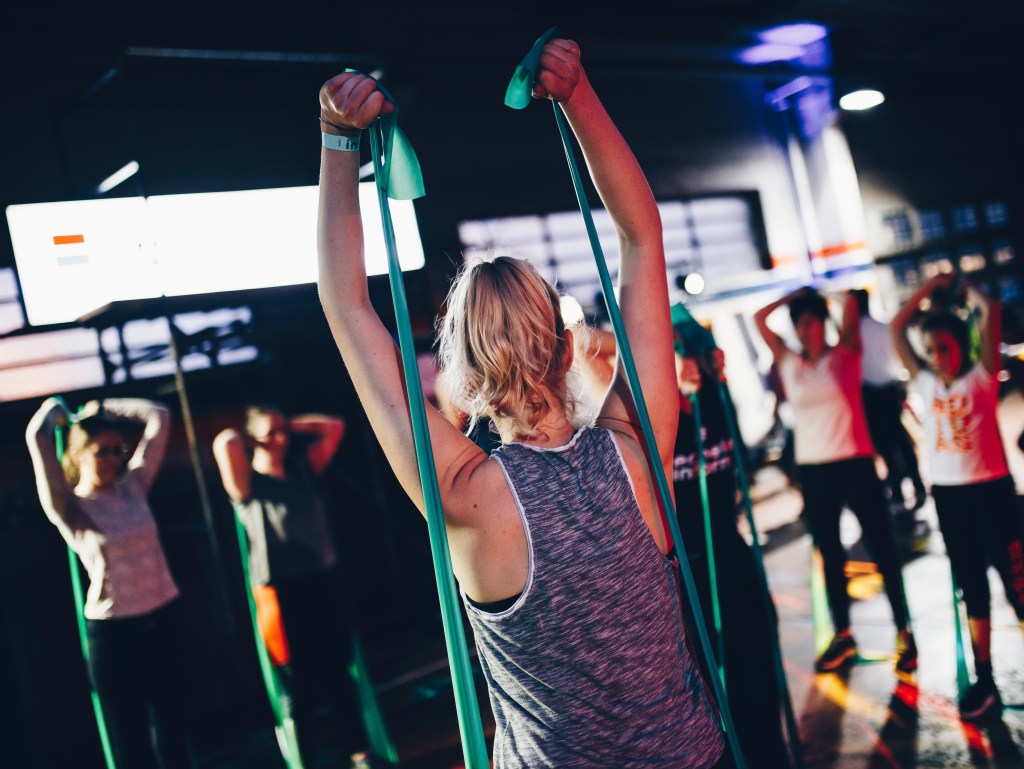
The subjects in the exercise groups did a combination of both strength and cardio training.
The subjects in the experimental groups were assigned to one of two groups: low-to-moderate intensity group exercise or high intensity group exercise. The exercise was timed circuit training that combined both cardiovascular and strength moves and subjects maintained heartrates at levels appropriate for their assigned intensity levels. At the end of the 12-week program, everyone’s anxiety had significantly decreased, as compared to a control group that was not participating in group exercise.
What is striking is that there was a tendency for the improvement to follow the level of intensity; the harder the subjects exercised, the more anxiety relief they experienced. Talk about motivation!
My own experience echoes this, but in a subtractive sense. At times of intense stress, my anxiety skyrockets when I’m prevented from engaging in my regular workouts. This may happen, for example, when I’m dealing with an unreasonable workload that ties me to my desk and preempts my exercise sessions.
I used to wonder why I felt so much worse when I was getting more work done. This study answers that question for me.
Couple these results with what we’ve learned about the beneficial effects of exercise in decreasing the risk of recurrence of breast cancer and it is incredible why physicians don’t write exercise prescriptions for their patients, and why personal trainer sessions are not covered by health insurance.
~~~~~~~~~~~~~~~~~~~~~~~~
There are several things that I feel are important to underscore here if you’re interested in trying this out yourself.
The social aspect of the exercise sessions may have also played a role in alleviating the anxiety that the study participants had initially complained of, and there was the added benefit of a pre-planned, supervised program.
First, this was a group session. That means that there was also social support involved as no one was exercising alone. The subjects were supervised by a physiotherapist; they didn’t have to come up with their own program, as it had been created for them.
Also, the exercise included both cardio and strength exercises and included warm-up, cool-down and stretching, so it covered all the bases, so to speak. And the subjects got fitter as the study progressed, so there was also a sense of self-efficacy at work here.
Does this mean that the exercise didn’t matter? Not at all! The emotional benefits of exercise have been documented in previous studies. If you consider the mind-body as a single system, as your physical fitness improves, your mental health will generally follow.
If you’d like to see the original article, it is available free online: Malin Henriksson, Alexander Wall, Jenny Nyberg, Martin Adiels, Karin Lundin, Ylva Bergh, Robert Eggertsen, Louise Danielsson, H. Georg Kuhn, Maria Westerlund, N. David Åberg, Margda Waern, Maria Åberg. Effects of exercise on symptoms of anxiety in primary care patients: A randomized controlled trial. Journal of Affective Disorders, 2022; 297: 26 DOI: 10.1016/j.jad.2021.10.006
For a reader-friendly version, see the write-up in Science Daily: University of Gothenburg. “Anxiety effectively treated with exercise.” ScienceDaily. ScienceDaily, 9 November 2021. www.sciencedaily.com/releases/2021/11/211109095348.htm