Emergency Preparedness, Inside-Out

We have spent the last couple of weeks in various hunting-gathering trips in preparation for a possible coronavirus lockdown. Yes, we got enough toilet paper, but not multiple mega packs, as there is no place to store them. We bought a little extra frozen food, but space is limited in the freezer, just as it is in the fridge.
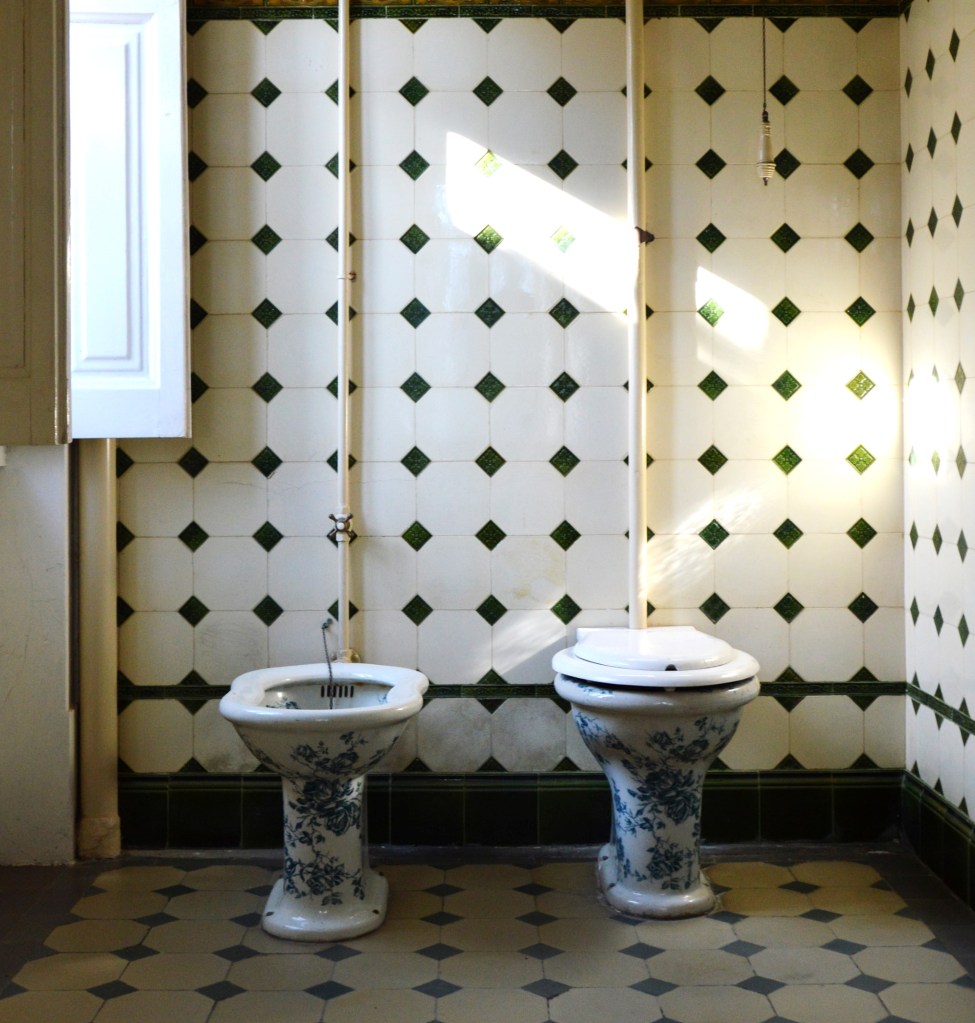
When in doubt, bidet!

Being a mainly vegetarian family, we consume a lot of fresh fruits and vegetables, and those have to be procured on a frequent basis. Hoarding is not a real possibility at our place: we have no garage, basement or pantry. And I don’t consider a 30-roll pack of TP to be proper living room furniture.

Luckily, we have ample soap and I have the large bottle of hand sanitizer that I kept at work when I was going through chemo (think: it’s been a few years). Also thanks to cancer: a generously-sized box of surgical face masks that we will be dipping into, should one of us start feeling ill.

Finally, in a “clouds parted and a ray of light shone down”-type of serendipitous luck, we found a bag of N95 respirators in the back of our coat closet. Usually one finds old tennis rackets or worn shoes. We find items that someone might strangle us for.

One of my brothers had stocked up on the respirators during the devastating fires in Northern California, only to unload them on us during a visit here. I always complain when he leaves stuff at our place, but I’m feeling much more accepting of it now. My kids are planning to sell them to finance their college educations. (kidding!)

So we’ve prepped as much as we can, for the amount of space that we have. And while it’s not a lot, I believe it’s enough for several weeks.

But where I’m engaging in some serious “hoarding” is greedily protecting my daily meditation time. If there were ever a time to practice mindfulness, it’s now.

This is not the end.

Consider this: during a trip to Costco a week ago, people were going nuts with toilet paper, as if it were a finite commodity and if we didn’t get it now, we’d be wiping our butts with tree leaves and old homework assignments for the rest of our lives.

It’s easy to laugh, but I myself felt a sudden bolt of urgency watching people squeeze nine months’ worth of toilet paper into their cars. It was difficult to resist.

Many people were operating as if with blinders on. At that same Costco, the check-out line for one cashier stretched all the way back to the bakery section. If you’re familiar with these enormous warehouse stores, you know that baked goods are way in the back. That is a crazy-long line!

What those shoppers didn’t realize was that the lines for the other cashiers were only one or two people long. But few people looked through the aisles enough to realize that. They simply saw a line and got in it, assuming that everyone else knew what they were doing.

Clearly, they didn’t

This is a perfect example of the need to slow down, take a deep breath and spend the time to understand what’s going on. In the face of unprecedented events, panic seems like a decent option. But just doing something–ANYTHING–isn’t the same as doing something useful.
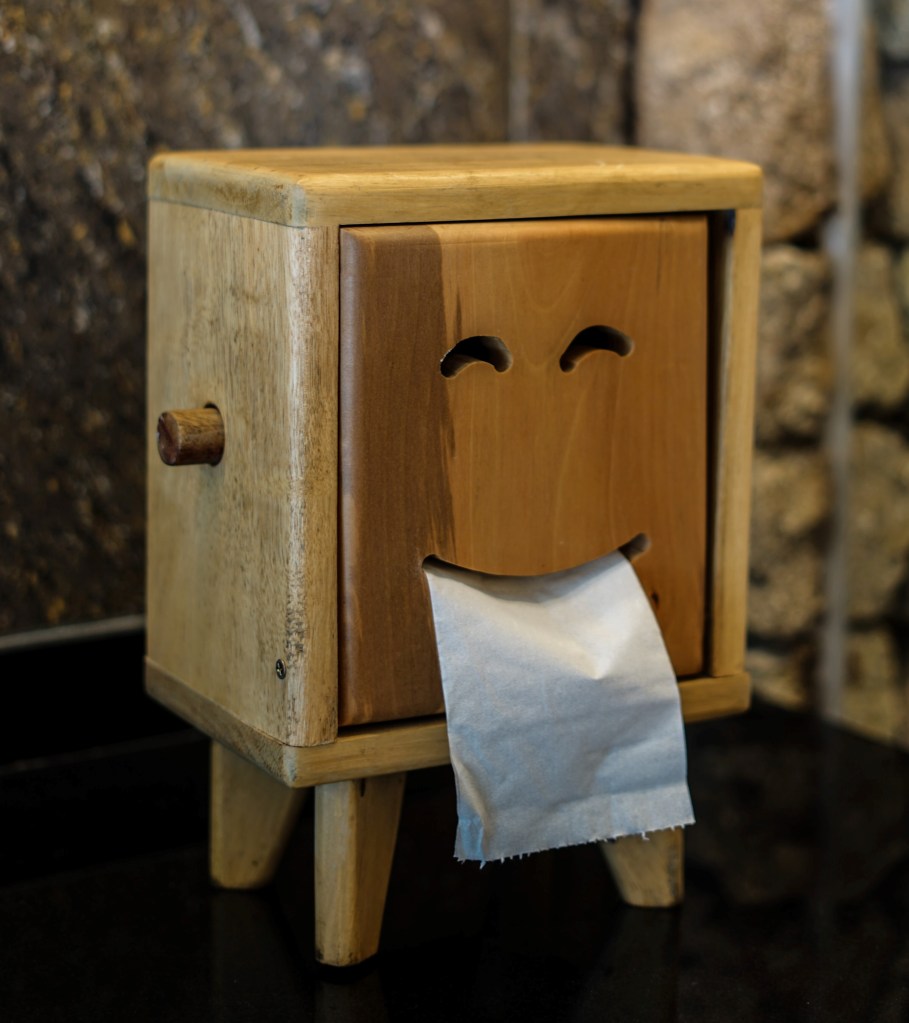
Relax. You’ll use less toilet paper that way.

Look, I get it. This is scary. As a cancer survivor, my white blood cell count remains depressed, and although my oncologist doesn’t think I’m in danger of dying from COVID-19, that doesn’t mean I can’t contract it. If I did, maybe it would tax my system more and send me to the hospital. There are so many uncertainties that I have to live with. The best thing I can do is to be mindful of what’s going on, accepting of what I can’t change, and rational about the rest.

So my wish for all of us going through surreal times for which we have no operating instructions is to listen to reputable sources, drop the conspiracy theories, pause and think. Don’t rush simply because everyone else is. Breathe. When this pandemic has subsided, there will be more toilet paper. I promise.

A Funny Thing Happened on the Way to My Mammogram

Of course, maybe not funny at the time. File this under, even the best laid plans can be undone.

I had been preparing mentally for my mammogram over the past weeks, and everything was going smoothly. I had a nice mammographer, not overly chatty, very matter of fact. There were video screens on the walls of the mammography room projecting peaceful nature scenes for me to watch as I got squooshed, as if ocean waves would make me forget that my breasts were being clamped in a mechanical vice.

Then, finally, I was done and back in the intimate waiting room. There were only two of us women there (along with my husband, who, since my breast cancer diagnosis, no longer lets me get scans alone). The other woman’s mammographer came out and told her that everything looked good and she was free to go; they’d see her in a year. She happily left.

Several minutes later, my mammographer came out and said something along the lines of, “The doctor is looking at your scans. I’ll bring you to the consultation room so that we don’t have to talk out here.”

Had I not just heard the exchange between the other woman and her technician, I would have been fine. But since I’d heard it, my heart started to pound. My husband and I were led to a cozy little room…with an array of informational pamphlets about biopsies and breast surgeries on a side table, and you can imagine where my mind went.

Forget mindfulness, forget non-attachment, forget letting go of expectations. Forget three years of daily meditation. I was terrified. I tried slowing down my breathing, but it only made me feel like I was being starved of oxygen.

I unloaded all my fears on my husband, who up to that time, was not experiencing the same level of concern.

“I don’t feel good about this. Why did they bring us into this room?”

“They always bring us into a separate room.” He was right, we always went to a consultation room for the results. But the other woman hadn’t.

“Why are all those pamphlets there?” I motioned to the biopsy pamphlets on the table.

“They’re always there.”

“Why did they tell the other woman out in the hall?”

“Maybe because you’re having a 3-D mammogram so there’s more to look at, or maybe because you’re a cancer survivor, and they probably bring all the former cancer patients in…”

Yup, I was having flashbacks.

Yes, he was giving me solid, rational explanations, but I would have none of it. I was in the middle of a “fight or flight” moment and struggling to regain composure, but it was too much.

I simply could not let go of intense feelings. They were too much like what I’d experienced three years earlier, at a time when I so desperately feared bad news. And then got it. It’s difficult to articulate what that feels like to someone who hasn’t experienced it, but if you’ve been there, you know exactly what I mean.

Throughout all of this, however, there was a small, reasonable piece of my brain that was collecting data. I had noted the time when the other woman had received her news (1:20pm), so I would have a better idea of how long this was taking. I sensed the tightening in my muscles and attempted, with difficulty, to release them. I’d been frozen into a block of ice and was trying to chip my way out with a butter knife.

Then at 1:27pm, the radiologist knocked and came in.

In that first fraction of a second that I saw her face, my brain ran a scan of it, and it told me…nothing. I’m betting that doctors are honing their “stone-face” look, so as not to give a clue one way or the other. My radiologist said hi and stretched out her hand, I shook it, and she told me everything looked good.

Just like that.

The rational part of my brain exhaled, but it took hours for my body to shake off the hype. By the evening, I felt like I’d gotten a year’s-long extension on a tenuous lease. So, I thought, I have another twelve months do something useful with my life. Go!

A week later, when I told my oncologist about this mammogram episode, he explained that as a cancer survivor, I get diagnostic mammograms from now on, and those always involve a consultation with the radiologist afterwards.

Oh. I’ll try to remember that for next time.

So Far, So Good

I had a mammogram last Thursday to ascertain whether or not I was still in remission from breast cancer.

For the record, I still am, although it’s easy to say that like it’s no big deal. Not only is it a huge deal, but getting through last week was more difficult that I anticipated.

One of the basic tenets of mindfulness that I practice, with varying degrees of success, is non-attachment. This is particularly useful when dealing with cancer because the disease involves so many scary things, and as a result, so much wishing that things were different. Of course, the more you agonize over the fact that you’re going through something you desperately don’t want to be going through, the more suffering you experience.

I can personally attest to this.

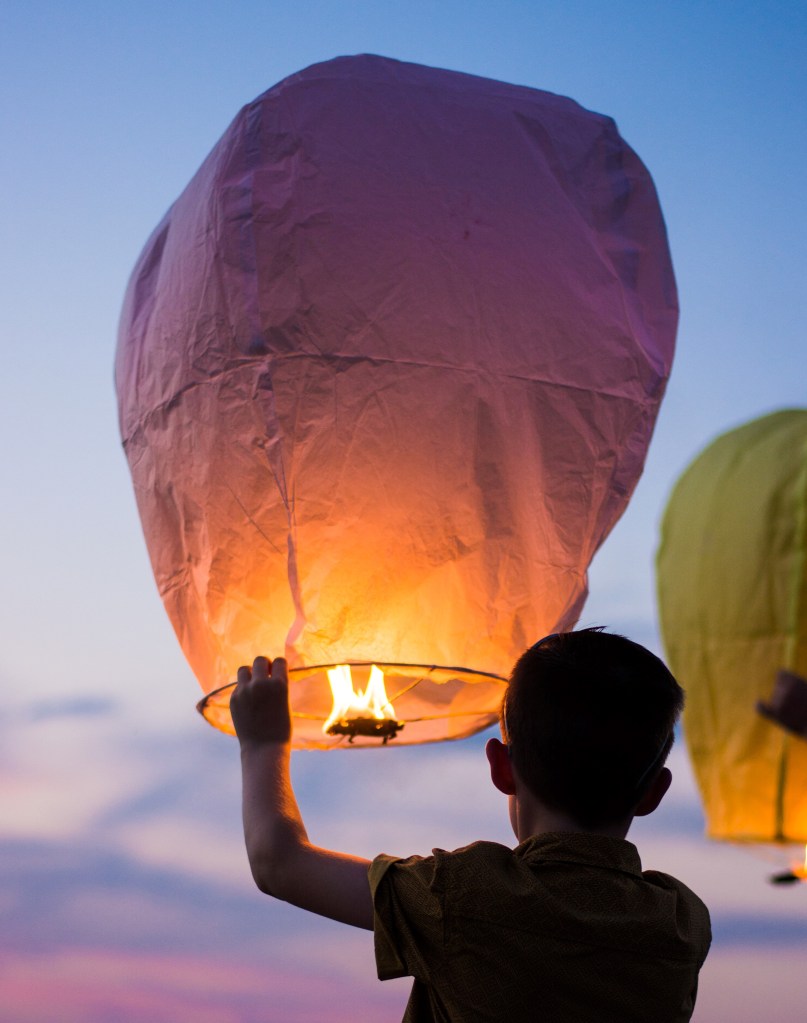
It would be great if letting go of expectations would be as simple as releasing a paper lantern, but it’s not that easy.

To counter this, I do my best to release expectations of specific outcomes. When it come to scans, every cancer patient wants to hear that tumors are shrinking and every cancer survivor wants to be told that the tumor hasn’t returned. It’s REALLY, REALLY, REALLY hard not to cling to those wants, but the harder you cling, the more painful the separation if things don’t turn out the way you hope, and even if they ultimately do, there’s fear that they might not.

So for the past several weeks, I’ve been practicing letting go. It’s funny that “letting go” is so easy to type out, but so incredibly difficult to accomplish. I’m not good at it when it comes to the things I desperately fear.

To counter my clinginess, I’ve adopted a concept I call, “so far, so good”. That means that up to this point, I’ve been able to handle everything that’s happened to me. This doesn’t mean that it’s been easy or pleasant — in fact, at times it’s been horrible — but somehow I’ve made it through to this point. And tomorrow? I cannot predict what will happen then, but right now I’m still here.

This way, I can feel positive without the burden of hopeful expectations — and the fearful possibility that those expectations will be dashed to smithereens. Of course, all of this sounds great because I’m speaking theoretically. But as we know, that ain’t real life, as I’ll illustrate in my next post…

Who Knew a Grapefruit Could Create So Much Confusion?

A few days ago, I decided to eat a grapefruit. We had gone to a Korean market earlier that day, and the citrus fruits beckoned to me with an enticing fragrance. I couldn’t resist.

So as I was finishing up one of the most delicious grapefruits that I’d had in a long time, I started thinking. Back when I was taking tamoxifen, I’d come across an admonishment not to eat grapefruit because it could interfere with absorption of the medication. But I wasn’t taking tamoxifen anymore, I was taking letrozole. Could the same be true?

I started googling, first on my phone. And as the search results came in, I had to switch to my computer because things were looking confusing. Many sites said “NO” in no uncertain terms. Grapefruit can prevent the letrozole from breaking down in the body completely, leading to higher levels remaining than could be safe.

It wasn’t that the grapefruit was hindering the efficacy of the letrozole, it was that grapefruit could set up a dangerous situation of “overdose”.

Of course, googling often results in messages that are big on warnings and short on details. So I dug further and happened upon forum posts where other women were asking the same questions.

I read the following exchange: one woman said she’d spoken to two different hospital pharmacists, both of whom had given her the okay to eat grapefruit. A number of other women (like, everyone else) chimed in on how they had unequivocably been warned to stay away from grapefruit (for the above mentioned reasons). The first woman reiterated that she had been told by HOSPITAL PHARMACISTS that she could each grapefruit with impunity…and so it went.

Do I LOOK like I know what I’m doing?

What really bothers me about this is that so many websites suggest that, it really it best to avoid grapefruit due to possible interactions with letrozole. But I slogged through the entire bloody informational insert from the manufacturer of my drug and NOWHERE did it mention that I shouldn’t eat grapefruit. There was also nothing on the bottle itself, nor did my oncologist say anything about that.

However, WebMD’s grapefruit interactions webpage, while not mentioning letrozole by name, did suggest issues with estrogen and also Cytochrome P450 substrates (of which letrozole is one, but I just happen to know that; others wouldn’t necessarily). WebMD’s letrozole info pages made no mention an issue with grapefruit. I mention WebMD mainly because many people consider it a reputable site and may go there for information.

If it truly is that dangerous to eat grapefruit while taking letrozole, why is that not explicitly stated on the container? Why would any woman think to google a random fruit or vegetable, like, “I think I’ll eat an artichoke and shiitake mushrooms today, but first I’ll do an internet search to make sure they don’t affect my medication.” Who plans their meals like that?

The bottom line is, the effect the grapefruit has depends on a variety of factors. It depends on when you’re eating and how much you’re eating, and how many days in a row. But all of that is so unsatisfying to me, who wants a concrete answer. Cancer is not about answers, however, it’s about getting comfortable with living with the unknown.

So, back to the grapefruit. Spooked, I skipped the medication that evening, although I’m sure I could have taken it and still lived through the night. I’ll ask my oncologist about it during my next visit, but I expect that his answer will be, “just don’t overdo it.”

And there’s another fragrant grapefruit sitting on the counter, which I will eat at sometime in the future, maybe half at a time. Here’s to living with uncertainty!

A Month of Fear-Driven Memories

Here we go again…

Around this time of the year, I get uneasy. It’s February, which means it’s time for my mammogram and the determination of whether I’m still in remission from breast cancer. It’s also the month when, in 2017, my life was slammed in a different direction and the best I could do was try to hang on.

February 8, 2017: Doctor’s appointment. After feeling a lump in my breast for six months (SIX MONTHS!!!), I finally met with my general practitioner to have her tell me it was nothing. Except that’s not what she said. Instead, she gave me a referral for a diagnostic mammogram and warned me not to put it off.

My own mammogram is on February 27, 2020. I don’t think I’m going to get bad news, but I just want it over.

February 23, 2017: My mammogram and diagnostic ultrasound. I had not expected that waiting two weeks for a screening would be so horrible, but my anxiety worsened with every day. I also had not expected the radiologist to come in and tell me that I had cancer. Technically, he wasn’t supposed to do that without biopsy results, but he knew what he was looking at. One in eight women is diagnosed with breast cancer at some point in her life, so he’d seen his share. Things spiraled downhill after that.

February 28, 2017: Biopsy. This procedure was anticlimactic in the sense that I knew I had cancer (see above). What I didn’t yet know was how aggressive it was. The procedure itself wasn’t bad but the mammography technicians were unable to get a clear picture of the titanium markers that the radiologist who biopsied me had inserted as surgical guides, so they took over eleven mammogram images on that left breast. The physical squeezing was miserable, but I was being squeezed mentally too. I think they eventually got the image they wanted…or maybe they didn’t. It was all a blur. I didn’t want to remember.

But now it’s three years later and I remember everything too clearly. Every February, I lose my footing on the Earth and hover for a few weeks in limbo, starting from when I make my mammogram appointment.

I’ll have an uneasy feeling until I get the “all clear” from the radiologist, or “I’m so sorry, but…”. On one end of the continuum, there’s glorious relief, on the other, mind-numbing anxiety, and I’m standing here in the middle. Most of my life now is lived in this middle ground and it’s a struggle to release expectations and attachments to how I want things to be. I’m not great at it, but I have the rest of my life to learn to deal. I hope that’s enough time.

Starting 2020 with Compassion: A Valentine for Maj. Bill White

Given that there’s a lot of divisiveness and polarization in the United States right now, I’m looking for the humanity in my country. Most of the time I feel rather ineffectual, and I have wanted to make small difference in the life of a stranger.

My opportunity came in the form of a news story (mine, Time online, but this has been posted by a wide variety of sources): Maj. Bill White is a 104-year-old veteran of the Battle of Iwo Jima who spends much of his time scrapbooking. He mentioned to the interviewer that he’d enjoy getting Valentine’s Day cards, which he promises to keep on his bookshelves, the same ones where his Purple Heart sits.

Now, while I’m decidedly not a fan of war and wish that we lived in a world where the military was not necessary, I have respect for people who are willing to give of themselves, no matter what the venue. But what moved me the most was the spark that this elderly man had. When he sang the Marines’ Hymn (see video), his voice was clear and unwavering. He still had so much life in him at age 104.

And his secret for living so long? “Just keep breathing.”

Indeed.

I will be sending him a Valentine’s Day card. If you would like to do the same, here’s the address:

Operation Valentine
ATTN: Hold for Maj Bill White, USMC (Ret)
The Oaks at Inglewood
6725 Inglewood Ave.
Stockton, CA 95207

And if not to Maj. White, perhaps there’s another deserving individual whom you could surprise this Valentine’s Day with a cheery greeting? I encourage you to do so. There’s still enough time.

And just keep breathing.

Addendum to “Chemo Nails”: Healing

I can’t write about discolored and infected fingernails as a side effect of chemotherapy without throwing in some good news too. Not only did I document the sad state of my nails in photos, I kept taking pictures even after the ER visit. I wanted to see what the healing process looked like, something that can be difficult if you don’t have photographs to compare against. So what’s the good news? That which was nasty didn’t stay nasty.

(About the photos…I never intended to post these so they aren’t the greatest images, and I’m still a dork when it comes to working with WordPress, so I apologize for the weird sizing. Eventually I’ll figure it out.)

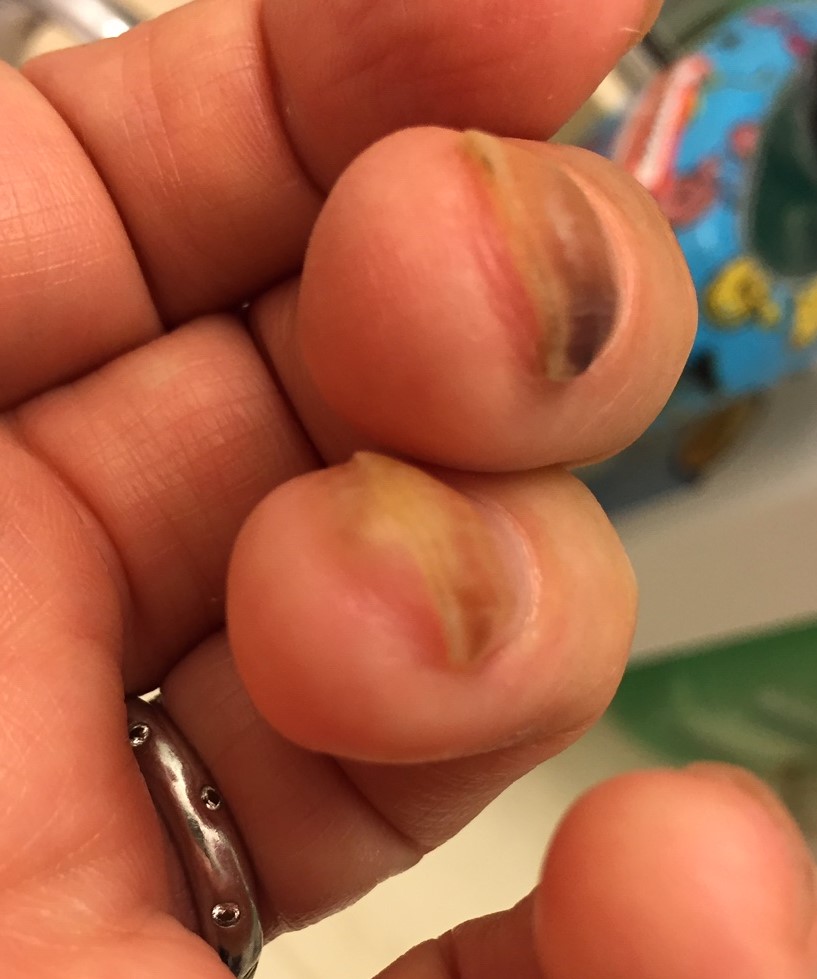
September 6, 2017: the left hand again with bruising visible on the side of the ring finger. Its nail looked like it was about to drop off, but it was actually holding on quite well, not that I was about to fiddle with it to find out. From this angle the middle finger looked black with an uncertain future. The left hand looked like it had been on the losing side of a bar flight. Nonetheless, my poor body, still recovering from the shock of chemo, was hard at work getting everything back in order.

September 6, 2017: just over a week after my ER visit, the left ring finger was normal-sized again but clearly showing the damage from the infection in the form of a significant bruise. The middle finger wasn’t looking that hot either.
September 6, 2017: in the meantime, the right hand was shaking off the chemo infusions. While it seemed like the nail beds had shrunk, the growing nails were doing well.

A week had passed since my infection had been treated (see previous post), I was still alive (a good thing!) and my nails hadn’t fallen off. My right hand, ignoring the battles of the left, was marching onward and away from chemo memories.

As I mentioned in my last post, I was wondering how much influence the vinegar and water solution that I soaked all my raw veggies in to clean them (per doctor’s orders!) had on the state of my right hand. It had spent much more time in that solution, at least several times a day, and didn’t show nearly the same amount of damage that the left hand had.

A week later, instead of nails dropping off one by one, the healing continued.

September 13, 2017: this photo offers a better view of how much the left ring finger had healed over the course of two weeks. Even after having a seriously suppressed immune system, recovery from the infection progressed remarkably quickly.
September 13, 2017: still hanging on. While the nails looked horrible, there was actually considerable improvement.
October 19, 2017: the right hand was looking almost completely normal!
October 19, 2017: a month after the photos above, healing is well on its way. I didn’t lose a single nail, the dark discoloration disappeared and everything was growing.

While nails do take a while to get rid of the damage they sustained, almost two months after the infection and about two and a half months following my last chemo infusion, they no longer screamed, “chemo patient!”

October 24, 2017: …and the right hand looked normal enough that you wouldn’t have thought anything had happened…if you hadn’t seen my scalp, the hair on which took its sweet time coming in. But that’s another post altogether.
October 24, 2017: a week later, after a good nail clipping, the left hand was no longer scaring children and small animals. I felt human again!

My nails served an important function, because I could use them as a visible indicator that things were, in fact, changing and recovery was truly taking place. That meant a lot to me as I awaited the return of my hair, a process that did not come as quickly as I’d been led to believe from the stories of others. But my nail journey was also something else: a reminder that everything awful, even the fear and pain and bruises from cancer, would eventually fade.

I Didn’t Expect THAT: Chemo Nails

I’ll be honest, I’ve been putting off writing about what chemotherapy did to my fingernails. While I’ve wanted to provide frank accounts of my cancer treatment experience, this particular side effect was nasty, miserable and completely unexpected.

Given that I ultimately decided to post this, there are three points I need to make: (1) be forewarned, there are a number of ugly images on this page; (2) just because it happened to me doesn’t mean that it’s going to happen to you; and (3) I suspect that I could have avoided ending up in the ER, and I’ll explain how at the end.

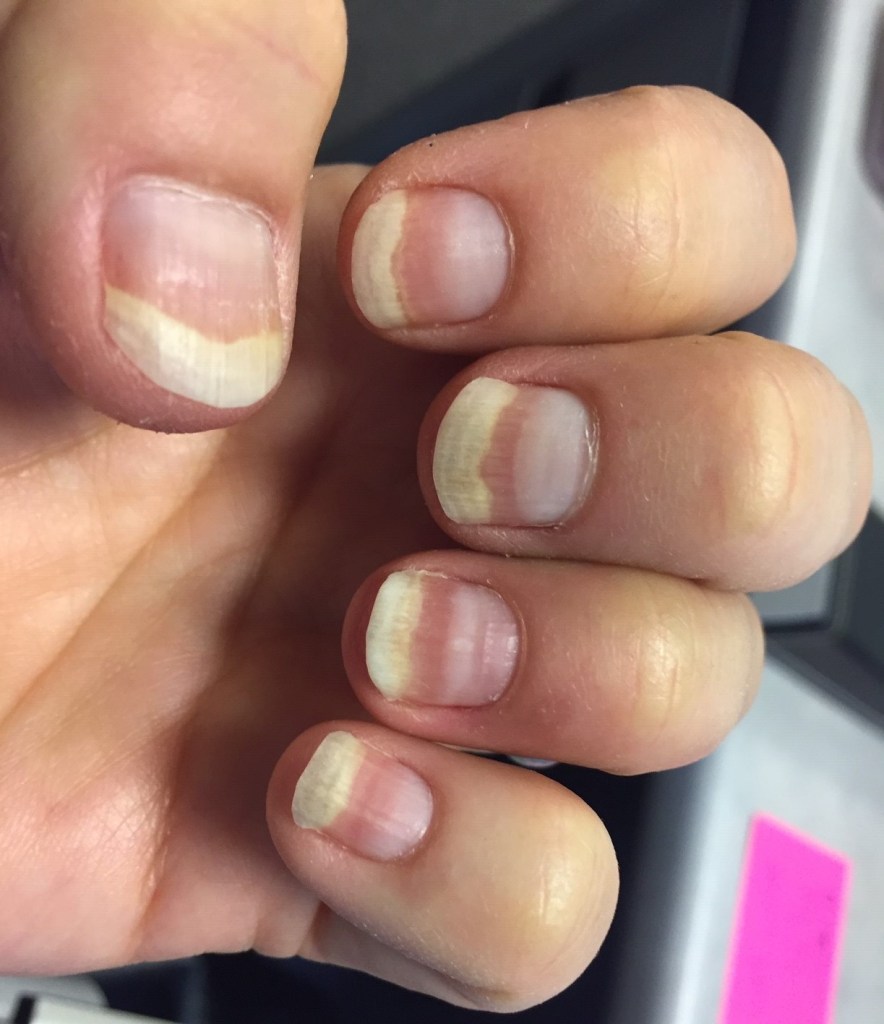
So here it is: the most painful experience associated with my chemotherapy actually came after I was done with chemo, and it deserves a bit of an introduction. You may be aware that how chemo works is by killing off rapidly dividing cells, which is why people lose their hair and the lining of their GI tract. Fingernails are also affected, often turning black, and for some patients, falling off altogether.

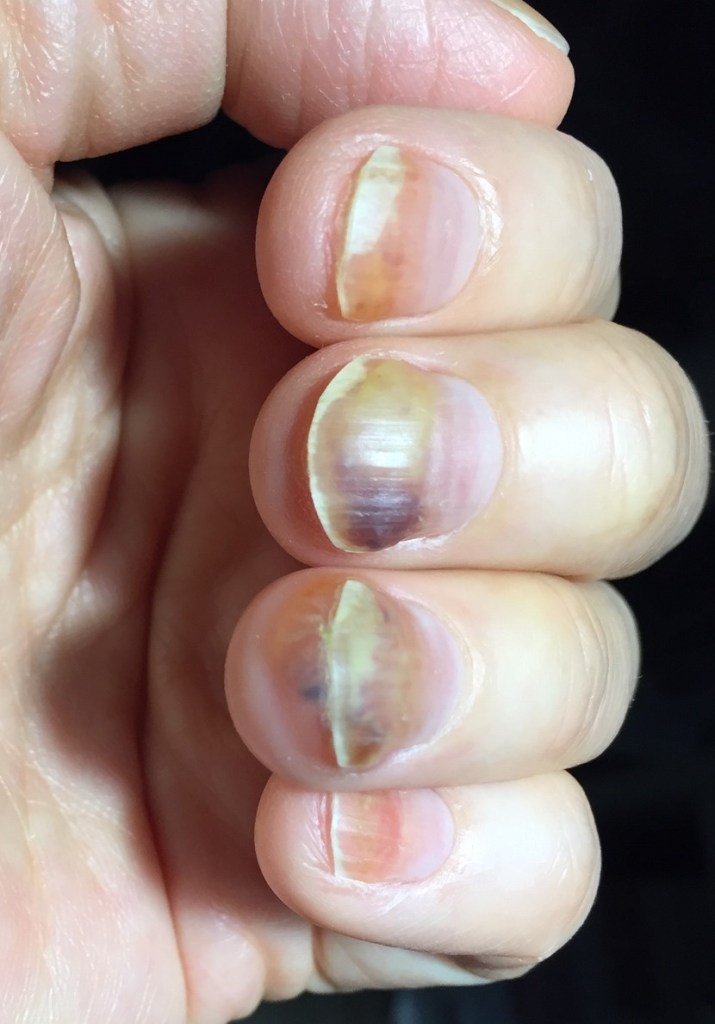
July 30, 2017: My left hand’s fingernails at the time of my fourth infusion.
Same day, right hand. The chemo drugs were beginning to leave their mark on my nails.
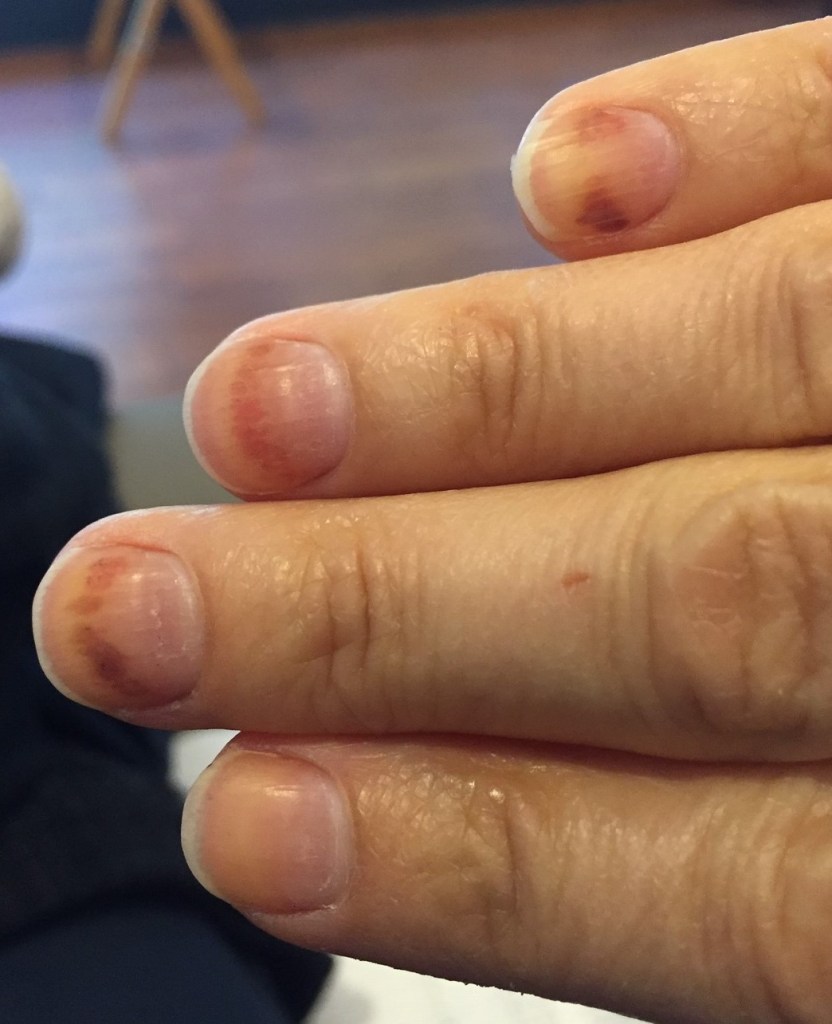
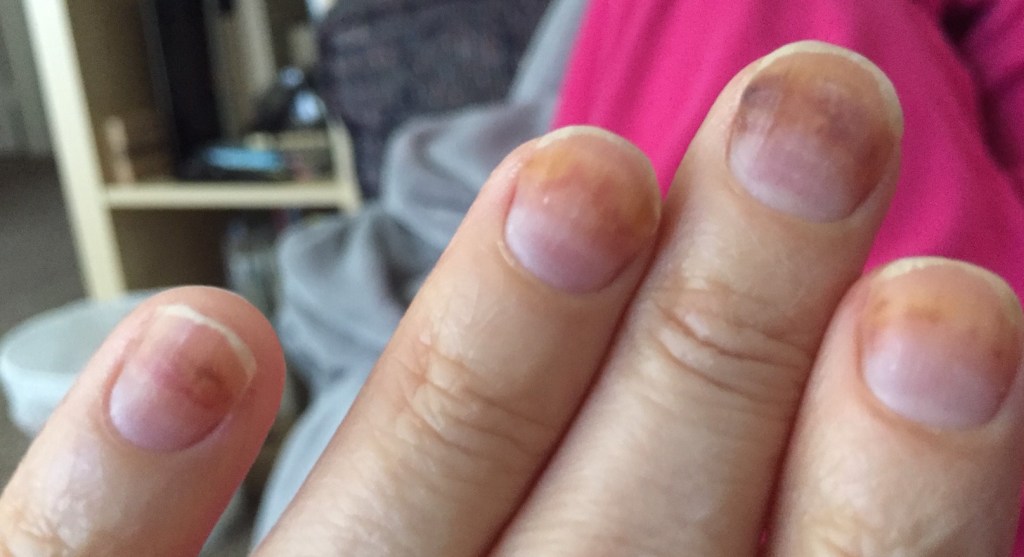
August 13, 2017: a few days after my sixth and final course of chemo, the nails were looking worse.

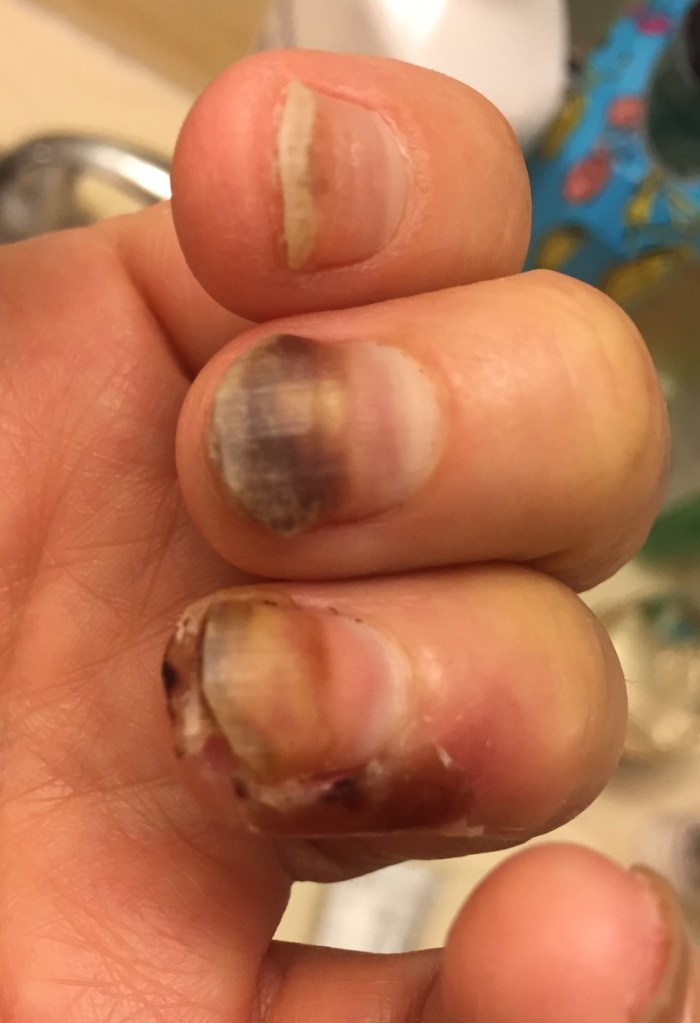
My nails didn’t fall off but they really took a beating and ached a lot, almost as if they’d been slammed in a door (not the actual “slam” experience, but the aftermath). Many of them, particularly on the left hand looked like they were starting to detach, retreating into the nail bed.

August 23, 2017: the nails are looking progressively worse.
Same day, right hand.

Several weeks after my last infusion I noticed a little something under the nail of my left ring finger, like a bit of swelling. It didn’t look like much of anything to me, nor to my oncologist during a Friday, August 25 appointment, although he lamented that I might lose that nail.

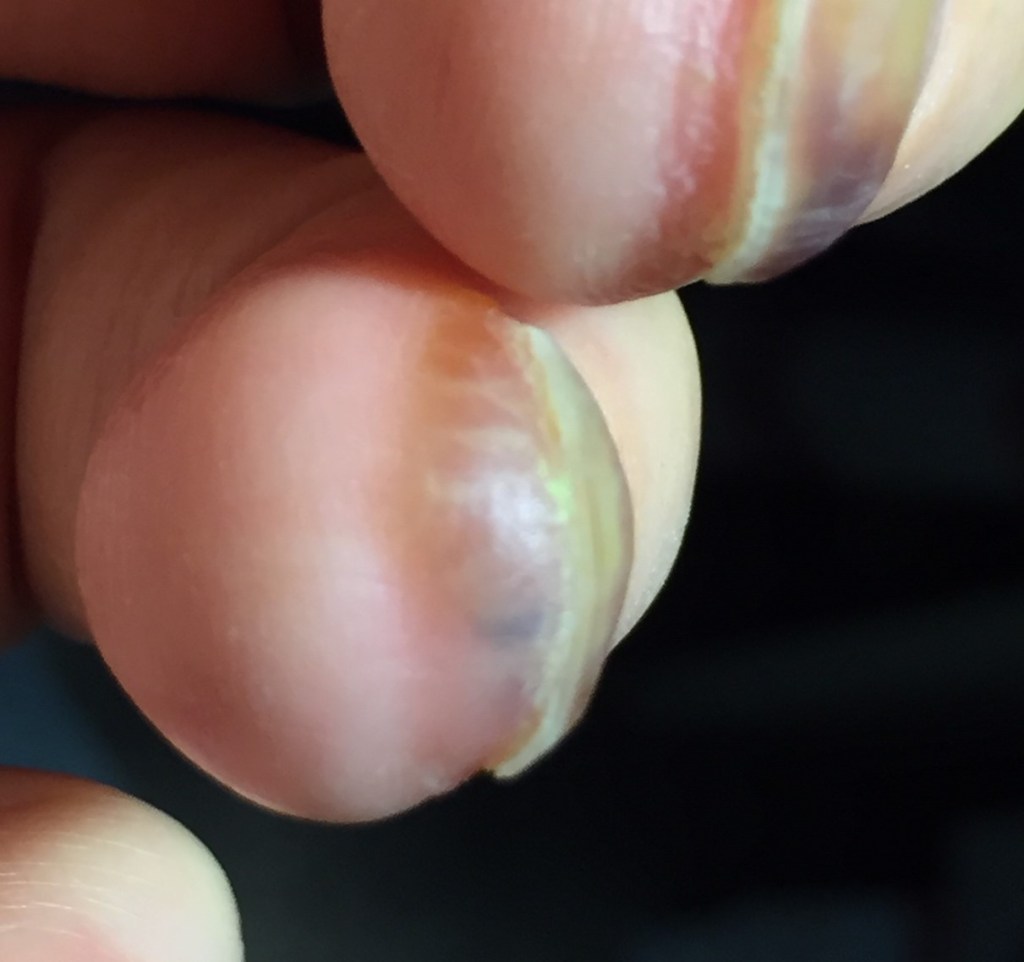
August 23, 2017: I noticed some swelling under my left ring finger’s nail and figured that it was starting to lift off and that I’d eventually lose it.
Another view of that “bubble” under the nail.
August 25, 2017: HOW could I have possibly NOT been worried about this?
These photos were taken in the evening after my August 25th oncologist’s appointment, and because he hadn’t been immediately alarmed, neither was I. Just my luck, the 25th was a Friday, and good old “I-don’t-want-to-be-a-bother” me figured this type of thing was normal and I’d wait to see how things looked on Monday.

Saturday, August 26, the increased swelling looked like a good-sized bubble under that nail. Sunday was worse, with far more pain. By that night I was in serious agony and even though I had already dubbed one of the nights after my first chemo infusion as the worst of my life, Sunday night definitively stole that title.

By early Monday morning I was in excruciating pain and paging my oncologist who exclaimed, “Hie thee to the ER!” I had a full-blown infected finger and there was a red line traveling down my hand and into my arm, meaning it was on its way to becoming systemic. I have no idea what I was thinking, not contacting my oncologist over the weekend, but the infection evolved very quickly. Had I known…

August 28, 2017: need I say more? In the space of a couple of days, everything turned nasty. And I do mean, nasty. My nails may have looked ugly before, but nothing compared to this. This was a bad situation getting worse. The pace of deterioration was accelerating and waiting in the ER was excruciatingly painful.

At the ER, healthcare workers winced when they saw my finger. I was miserable by the time they took me in, gave me IV antibiotics and (against my better judgment) morphine, the latter of which did nothing other than make me nauseated by the end of the day. I don’t understand how people get addicted to that stuff.

True relief arrived in the form of three lidocaine shots to the affected area. With the pain gone and the antibiotics at work, the ER doc lanced my poor finger and drained all the pus (no, I did not watch).

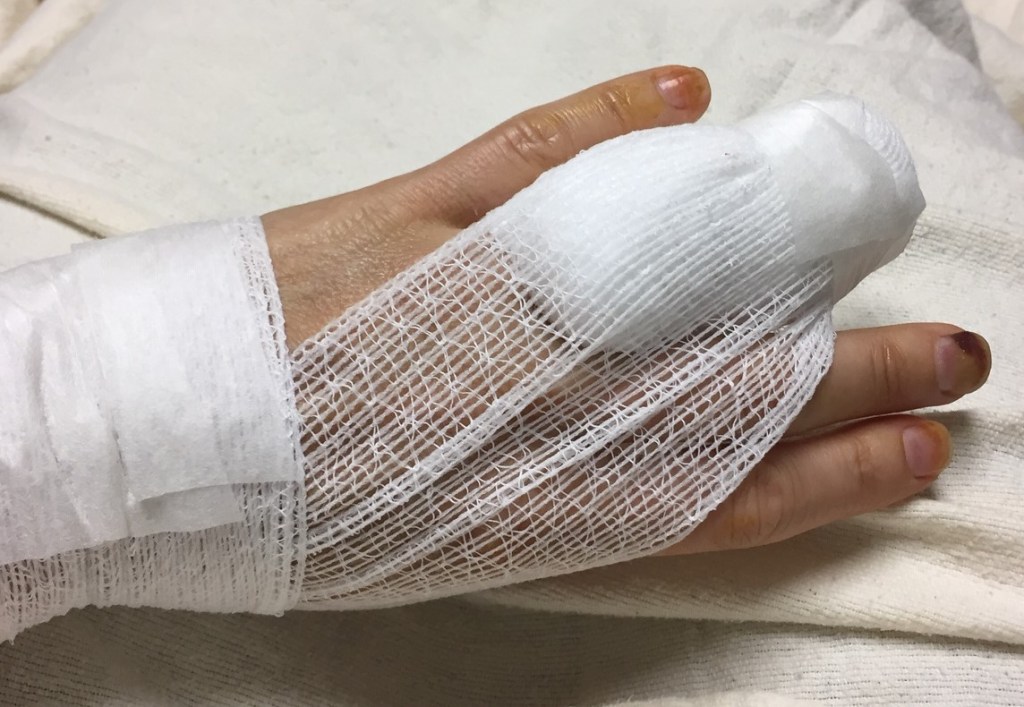
August 28, 2017: the worst part is over. And I’m not dead!
This is one week’s worth of antibiotics. Since the doc didn’t know whether the bacteria were gram+ or gram- he decided to err on the side of caution. I was popping pills every few hours.

Once that was done, I was bandaged up, got a couple of prescriptions for 7 days of heavy duty antibiotics and sent on my way.

With all this going on, my right hand wasn’t experiencing the same agony. It was a classic case of “one hand didn’t know what the other hand was doing”. My right was living in blissful ignorance.

So here are two interesting points: (1) even after all this, I did not lose that nail; (2) of my ten fingers, only one nail became infected. For this second point, I have a theory: since I’m mainly vegetarian and was eating copious amounts of veggies during chemo, I had been instructed to clean all the raw stuff with a vinegar and water solution. I did that mainly with my right hand.

Interestingly, the fingernails on my right hand hurt less and had fewer issues than the ones on my left.

I wouldn’t be surprised if the acidity of the vinegar and its antimicrobial properties were the reasons for this. Obviously, I can’t guarantee that this made a difference, but were I to go through chemo again, I’d be spending more time dipping both hands into vinegar and water.

While being diagnosed with cancer was terrifying and going through chemo was miserable, the strange reality is that this fingernail episode probably posed the most immediate risk to my life. My husband recently admitted to me that he was afraid that after enduring six rounds of chemo, I’d fall victim to sepsis. So ironic that a cancer patient would almost be done in by an infected nail!

Most amazing is how my body healed all those insults to my hands, and within a number of weeks, the signs of that infection had faded. See photos of the healing process here.

Starting 2020 with Compassion: Random Acts

On this Martin Luther King, Jr. Day in the United States, I thought it would be appropriate to highlight the idea of service to others. The possibilities are endless, as are the rewards.

The need is great all over the world so it’s not difficult to find a place to begin. Having said that, I’d like to bring “Random Acts” to your attention.

Random Acts is a non-profit started by actor Misha Collins (of “Supernatural” fame) and it operates as a clearing house of goodness. The organization raises funds and then distributes money to a broad range of causes. What sets this organization apart from others is that it enables individuals to apply for small (>US$500) grants that can be used to support a kind act, perhaps too small to attract the interest of major charities. (Larger Random Acts are also a possibility.)

Engage in random acts of kindness, no matter how small. Even if no one is looking.

I really like this idea, because kindness doesn’t have to be large-scale to make a meaningful difference in someone else’s life. We often overlook the “little things” that we can do in favor of making a huge impact. And that usually means that many of us will do nothing because, we tell ourselves, one person will not make a significant change.

Kindness doesn’t have to attract news cameras or go viral on the Internet in order to be a beautiful act of charity.

Starting 2020 with Compassion: The Dogs of Chernobyl

(Featured Image Photo: Jorge Franganillo from Barcelona, Spain [CC BY (https://creativecommons.org/licenses/by/2.0)] – cropped image)

My kids and I got hit with the flu right New Year’s Day, which meant mandatory rest and time to browse the Internet. After randomly clicking through websites, I landed on a story about the stray dogs of Chernobyl.

This touched me deeply because I hadn’t realized that animals were abandoned during the nuclear disaster in Chernobyl, Ukraine in 1986. When people evacuated the area, they were told to leave their pets, that they’d be able to soon return. Obviously, that didn’t happen, so animals that had been used to being fed, watered and otherwise cared for were suddenly left alone. To make matters worse, the Soviet government sent soldiers into the disaster area to kill the homeless animals in an effort to contain the radioactive contamination.

Amazingly, some dogs and other pets survived in the exclusion area, even through harsh winters, lack of food, threat of predation and possibility of rabies. Given that it’s been over 30 years since the accident, the current “dogs of Chernobyl” are several generations away from the original dogs, but their circumstances are still dire.

As I’ve gotten older, gone through cancer treatment and now menopause, I find that stories like cause me to disintegrate into a mushy mess. It breaks my heart that these animals were serving as companions to humans, and then were left to suffer from a human-made disaster when it was deemed too dangerous for the humans to stay there. These cruel twists of fate seem too much.

However, this post is not about agony or anger against humans, it’s about hope and compassion. A charitable group called Clean Futures Fund was established, as their mission statements reads, “to raise awareness and provide international support for communities affected by industrial accidents and long-term remedial activities”. Among other projects, they sponsor the ogs of Chernobyl effort: veterinarians and other experienced personnel who care for the descendants of abandoned pets by spaying, neutering, vaccinating, providing first aid and whatever else needs to be done to keep the animals as healthy as possible.

The Clean Futures Fund provides people an opportunity to virtually adopt the dogs and cats of Chernobyl, thereby using those funds to support their rescue program. But there’s also a sense of satisfaction to be found in simply supporting them through their GoFundMe page.

And the best news is, after years of people being told that all the animals were radioactive and therefore unadoptable, that presumption has been shown to be a myth. How? Because the radiation found on the animals can be washed off – it comes from the environment, not from the animals themselves. Finally, puppies are being removed from the exclusion area and sent to loving homes.

There are many more animals still left, but there are also many dedicated and courageous volunteers who are determined to make sure that these furries are not forgotten. While this story isn’t over yet, it promises a happy ending.