That shouldn’t be surprising, given that it was my “scan-week” of the year, but even I was taken aback by how I’d felt.
For at least two weeks prior, I’d had that low grade, persistent anxiety simmering, the kind that you can *mostly* ignore during the day, but wow, does it rear its ugly head at night. I’d fall asleep, only to wake several hours later and then the mental battle of focusing on my breath vs. intrusive thoughts would begin. You’d think that by now I’d be better at shifting my focus, but meditation is always a work in progress.
Another year of cancer remission! Normally, this would mean I’d relax. But not this year…
Tuesday was my 3-D mammogram. That’s the one that verifies that I’m still in remission from breast cancer. Oooo, just a tad bit anxiety-provoking, but since I had seen my oncologist not even two weeks before and he’d already checked me out, I wasn’t overly frightened. I admit, it didn’t help that I couldn’t bring my husband for support (hello, COVID), but I felt positive going in.
And everything looked good. For that day it calmed my scanxiety.
But by Tuesday evening, I was frightened again.
This had ceased to be about breast cancer. Now it was all about my heart. I mentioned in a previous post that I’d been having little “heart episodes”. My blood pressure monitor kept signaling “irregular heartbeat detected” and my heart rate monitor would show funny spikes when I was working out. The app I was using for measuring heart rate variability (HRV) would show heartrates up to crazy numbers like 262bpm, and from time to time I’d get heart palpitations.
To complicate matters, the Herceptin I had been given for my triple-positive breast cancer is known for its cardiotoxicity and there are heart-related side effects associated with the endocrine therapy that I’d been taking for the past three years.
But on top of that, my heart would pound when I got anxious. No matter what I did, I couldn’t ignore it–I could hear it. And that pounding made me even more anxious.
That sounds like a never-ending loop right there.
Somehow I made it to Thursday and my cardiology appointment. The mere thought of having a scan that focused on my heart was anxiety-provoking but the medical assistant engaged me in conversation and kept my mind occupied. Even my blood pressure came out as in the 120s/80s (can’t remember the exact number), which was quite normal. She ran the EKG and went to get the doc.
So is there something wrong with my heart, or isn’t there? I bounce between those two possibilities.
So right now this story is running long, but the bottom line is that my EKG was perfectly normal. The cardiologist, an older man with a gentle voice and pleasant and calm demeanor, asked a lot of questions…and ultimately told me that he didn’t think my heart had issues.
But he suggested that we run a couple more tests: echocardiogram and 14-day monitoring. That way we could rule out anything serious.
And I, the one who hates scans and the anxiety they bring, felt so much relief that he was willing to humor me, so that I would definitely know if those “episodes” I’d experienced were real or not.
I have everything scheduled now. And wouldn’t you know it: I didn’t experience any weirdness all weekend. No perceived skips, no palpitations. I am rarely aware of my heart beating and no longer hear it in my ears.
So I had several days’ reprieve.
Sunday night I felt it again. Let’s see where this goes.
~~~~~~~~~~~~~~~~~~~~~~~~~~~~~~~~~
I had mentioned to my cardiologist all those technological gadgets that I had, my blood pressure monitor with irregular heartbeat detection, my heart rate strap that can measure R-R intervals, my watch that has optical heart rate monitoring capabilities. And he said, the new tech has its benefits but it can be inaccurate.
This time of the year is stressful for me because it’s the anniversary of my breast cancer diagnosis. That means it’s time for the scans that determine whether I can continue to consider myself “cancer-free”. Scanxiety, anyone?
This week is going to be a doozie, since I have my diagnostic mammogram on Tuesday followed by a cardiologist appointment on Thursday, the latter of which has become, ironically, the major stressor as I try to determine whether I’m suffering from “cardiac anxiety” or an actual arrhythmia (one of the possible side effects of aromatase inhibitors). To top it off, I get my first COVID immunization Friday, which brings its own stressors since I’m a bit “side effects-shy” these days.
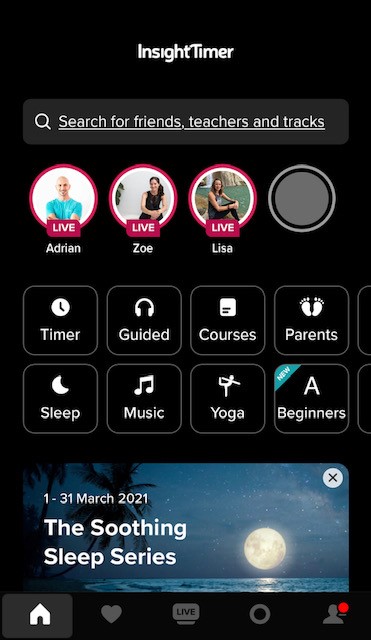
Given all this, it’s a good time to talk about what apps I use the most to help calm my anxious mind. I’ve written about quite of few of them in my “Mindfulness Apps I Love” series, but here are the one I keep coming back to (all have generous free offerings; both Calm and Insight Timer have had major upgrades since I originally posted about them):
The app I started my meditation practice with. I use it at least once a day, every day.
Calm This was the first mindfulness app I downloaded and it’s the one I’ve used every.single.day since March 13, 2017. I find the voice behind the app, that of Tamara Leavitt, very soothing. Since I started with it, Calm has added a number of elements featuring voices of celebrities, music, movement, classes, sleep stories, background sounds and other features that I haven’t even used.
What I use most: The curated “Daily Calm” meditations are my do-to first thing in the morning or if I wake up in the middle of the night with troubling thoughts swirling in my head — Tamara’s voice gives me something to focus on and shoos out the scary negative self-talk.
Why I like it: Because all the material is created specifically for the app, I always know what I’m going to get. It’s predictably high quality using a consistent format, and for me, it works. Also, once the meditation is done, the background sound continues and provides a soundtrack for drifting back to sleep or continuing meditation on my own, if that’s what I need. Finally, since this one was my first app and I ended up investing in a lifetime membership, I get access to everything it has to offer. If you’re not ready for such a loyal commitment to this app, you might not have quite as much to choose from.
By far the largest selection of meditations, classes, music and more that I’ve ever seen anywhere. You’ll need time to look through the offerings, but relax, there’s a search function. 🙂
Insight Timer This app offers a large collection of many meditations, music, classes and whatnot by a huge array of teachers. You need to search around because you don’t always know what you’re going to get, but if it’s out there, it’s in this app. I’ve played around with meditations that I might not otherwise just because they were available to try out. And now new, there are live events that include meditations, concerts, even yoga classes that you can join to help maintain a sense of community–so important at a time when so many in-person venues are closed.
What I use the most: I’ve settled on a handful of teachers with voices and styles that I prefer. Often, I use this app at the end of the day, when I’m trying to clear my head and settle into sleep, but it’s also great for any time when I want some guidance for settling down and am looking for variety.
Why I like it: OMG, the selection! Not only is there just about every type of meditation available (secular, sacred, shamanic and so much more–and now the app allows you to filter out the ones that make you, shall we say, “uncomfortable”), but there is a vast array of languages in which to listen. I speak a specific European language from a small Baltic nation, and yep, Insight Timer has a meditation in it. This is really worth looking into and most of everything is available for free–but donations in support of the app and teachers are very welcome.
Unwind has lulled me back to sleep after nighttime wakings with too much swirling in my head. It’s prevented me from throwing myself headlong into anxiety, as I’m reminded that breathwork is a tool to put the breaks on runaway fear.
Unwind This is an app that I recently reviewed here, and as I’ve gotten more into breathwork and vagus nerve relaxation, it has become invaluable to me. The combination of ambiances that you can select from paired with a gentle guiding voices that cues breath inhales, exhales and holds has made this perfect when I don’t want a guided meditation but I do want something to focus on.
What I use the most: Lately I’ve been opting for the “box breathing” pattern (inhale, hold, exhale, hold). It is perfect for calming my mind without straining my breath. I pair that with the “River Under Bridge” background ambiance that is a nice combo of gentle bird sounds with soothing running water.
Why I like it: Unwind has gotten me out of some anxious moments, specifically too-early wakings brought on by a racing heart. Instead of throwing in the towel and deciding that I’m just going to have to start my day at 4:27am, I’ve been able to lull myself back to sleep; again, the spoken breath cues provide guidance but are unobtrusive enough to allow drowsiness to set it. Additionally, Unwind is ideal for those times of my day that I need to eke out some head space and take a break from work pressure. Even a few minutes is enough to get my breath under control.
MyNoise helps me put distance between myself and my fears. It generates the mental space that enables me to step back and observe what’s going on without being pulled into it. And of course, the wide selection of sounds will mask just about anything.
MyNoise I posted about this app in late January. It’s the most recent one that I added, but it is amazing! MyNoise consists of sound generators that you can manipulate to your liking, to create unique and changing background sounds for literally just about any mood or need that you can imagine! In addition to the app, there is a website (mynoise.net) that provides similar generators. Both the app and the site offer so much, but when I’m working on my computer, I’ll usually listen through the website since my eyes do better with the large screen.
What I use the most: I tend to prefer nature sounds with running water or else drones and more meditative music. My daughter, who is also a MyNoise afficionado uses the sound of medieval scribes to create an atmosphere conducive to doing college work remotely.
Why I like it: S P A C E. MyNoise creates space by masking unwanted ambient noises (busy street, noisy neighbors, etc.) and thereby provides breathing room and headspace. I have used this for mental breaks throughout the day, or for times when I feeled overwhelmed and need help staying present. There are no discernable loops in the sounds and because each sound generator is made up of different elements that can be manipulated by sliders, you literally can create a totally custom sound environment. It has to be experienced to be believed and it’s well worth experimenting with.
So, these are the four apps that I’ll be working with a lot this week as I make my way through scans, tests and immunizations. Each app has their own little something to contribute to maintaining my peace and I appreciate the portability of having such effective soothers in my hand, on my phone.
It was just few days short of four years from my diagnostic mammogram, the one after which I was told I had triple-positive breast cancer.
If you or someone you love has been through this experience, you know the drill: surgery, chemotherapy, radiation, maybe monoclonal antibodies, endocrine therapy. Yours may come in a different flavor, but the dish is the same, give or take.
Last Thursday, following three years of endocrine therapy (two of tamoxifen and one of letrozole [aromatase inhibitor]), I called it quits, with my oncologist’s permission. The side effects of the letrozole became too much for my joints, my brain, my intimate relationship, and possibly even my heart. My doc said he knew it when he saw me and agreed that enough was enough.
Yes, this should be me right now, since I’ve eagerly awaited this day for a long time. But it’s complicated…
Keep in mind the song that all of us cancer folk sing: “everyone’s experience is different.” Based on my personal situation, and after a medical consult, this was the right decision for me.
I wanted to know what to watch out for, so my doc said:
1. Unexplained weight loss 2. Persistent cough 3. Neurological issues (i.e., seeing things that aren’t there, blurred vision, etc.)
Obviously, there are other signs of cancer recurrence, but those are what my oncologist wanted me to be particularly wary of. And then he noted that he couldn’t remember the last time one of his HER2+ patients had a relapse, so effective is the Herceptin that we’re given. But it has heart risks.
Since I’ve been off letrozole only a few days, I’m still experiencing most of the side effects–it will take several weeks to shake them.
I almost don’t know what to do with myself, and I’d be beside myself with joy if it weren’t for a possible heart arrhythmia (!) that I am experiencing. I’ve already scheduled an appointment with a cardiologist.
‘Round and ’round and ’round we go…
Yeah, I’m miffed that there’s always something with cancer. A week prior to my onc appointment I’d been in my car at a traffic light when I felt heart palpitations, sort of–and then I started seeing dark spots, like you do before you faint. The episode passed, but I had been having those brief palpitations for months, minus the spots. Maybe once a day? Maybe less.
And over a year ago, I went in for a regular health check-up, during which time the nurse practitioner checked my vitals and noted that there was some irregularity in my heartrate.
Just like with my cancerous lump, I waited, thinking would go away. But chemo and especially Herceptin are cardiotoxic, and aromatase inhibitors have been associated with heart arrhythmias. So just as soon as I got off the cancer carousel, I’m getting on the cardiac one–until I’m able to rule out problems.
I have both a 3-D mammogram and an EKG next week, and I’m way more worried about the EKG. Who would have expected that from a breast cancer survivor?
In case you’re wondering why there’s all this mindfulness stuff on a cancer blog, here’s a reason: a recently published article in Science – Translational Medicine (Perego et al., 2020) provides laboratory evidence for the benefits of reducing stress levels for cancer survivors. It has to do with the effects of stress hormones on cancer recurrence.
In this study researchers looked at the cancer cells that are sometimes pushed into dormancy by treatments like chemotherapy. Cancer recurrence may be a result of such cells being activated again at some point in the future.
Findings in the lab may explain what’s going on in the human body–and ultimately lead to treatments that prevent cancer recurrence.
Perego and colleagues were able to recreate such dormant cancer cells in the lab, then found that they could awaken them again using neutrophils, a type of white blood cell that, under certain circumstances, can be harnessed by tumor cells to aid in their proliferation.
Those “certain circumstances” turn out to involve stress hormones. The researchers found that stress hormone + neutrophils = woken cancer cells. The process is a cascade of events: the stress hormones caused the neutrophils to produce S100 proteins, which in turn created lipids, and it was those lipids that caused hibernating cancer cells to stretch and rub the sleep out of their eyes.
Keep in mind that these studies were conducted in petri dishes (for “proof of concept”) and then in mice, which does not equate to eliciting the same response in humans. In fact, the connection between stress and cancer is still inconclusive in human studies, partly because in the past researchers have noted that some of the coping mechanisms that humans use to deal with stress (smoking, drinking, overeating, etc.) may be the more important culprits that lead to cancer.
Learning how to keep stress under control may be one of the most important things that cancer survivors can do to help prevent canver recurrence.
Nonetheless, Perego and colleagues were able to show that stress and neutrophils may form a path by which dormant cancer cells awaken in humans, leading to cancer recurrence, and this opens the door to more directed future research. Note, this is certainly not the only way that cancer can recur, but it provides an opportunity to develop drugs that can break the cascade and thereby prevent recurrence in some cancer survivors.
To be clear, this doesn’t mean that if a cancer survivor is stressed out their cancer will definitely come back, because there are a number of intermediate steps that need to take place within that cascade, but this is still a good reason to practice stress-reduction techniques. It might help you remain cancer-free.
If you have access to a university or hospital library, you can look up the original research article using the following PubMed citation (links to abstracts below; once the free full-text PMC version is available, I will link to it here):
Perego M, Tyurin VA, Tyurina YY, Yellets J, Nacarelli T, Lin C, Nefedova Y, Kossenkov A, Liu Q, Sreedhar S, Pass H, Roth J, Vogl T, Feldser D, Zhang R, Kagan VE, Gabrilovich DI. Reactivation of dormant tumor cells by modified lipids derived from stress-activated neutrophils. Sci Transl Med. 2020 Dec 2;12(572):eabb5817. doi: 10.1126/scitranslmed.abb5817. PMID: 33268511.
ZenViewis a sweet little app that has been around for a number of years–I downloaded mine way before I even considered breast cancer as a possibility in my life. Note: I use the iPhone app and cannot recommend an Android version.
This is the default “theme” that comes up. It’s been my favorite for a number of years. The menu is accessed via the cross at the bottom right.
The menu is intuitive and easy to navigate. Here, you can select from a number of themes on the left.
ZenView is designed to offer you a respite from a hectic day and it accomplishes this very simply. It provides you with a soothing nature image and the ability to create raindrops in it, as if you were looking into a puddle.
The interface is easy to figure out. Click on the little cross at the bottom right of the screen to bring up a minimalist menu. You can chose from a variety of “themes”, which are basically background images (8 free and 8 with a paid upgrade). Then select the type of rain you’d like: “soft sprinkle”, “light shower”, “heavy storm” and even a “clear sky”, so you can place raindrops on the image with a fingertip and watch the ripples fan out.
Here, raindrops fall on the bamboo theme. The photo doesn’t do it justice, as it does appear as if you’re looking into a puddle as the rain comes down. The movement of the ripples is soothing and calming.
If the provided images don’t suit your fancy, you can use your phone’s camera and get a calmer, rainy-er view of your world through its lens. I’ve found that this is a great way to quickly put some space between myself and a real-life stressor.
The raindrop sounds feel immersive, perfect for taking me away from the stress du jour, no matter what rain intensity I choose. And the sounds can be turned off completely if that’s what you need at the time.
I used the free version of ZenView for years and only recently unlocked the premium themes–I was completely satisfied without them, which is one of the loveliest things about this app: the free version is quite enough.
Ultimately, I upgraded to support the developers, particularly since the cost was only $0.99. Given how much I’ve used this little app over the years, I felt that it was time.
I would encourage you to try this out. It’s not a complex app, but it delivers what it promises: a zen view of the world.
Okay, this is going to sound weird, but I’ve found that this really works.
A little background: in the midst of a stressful situation, I struggle with staying present and grounded. While I try to focus on and slow my breathing, that can be ineffective, since my heart is often beating quickly and, you guessed it, focusing on my breath brings me to close to my heart. It’s hard to ignore the pounding.
I’ve written before about turning attention to the extremities, in particular the hands and feet, feeling into the sensations there, since they are as far as you can get from your heart and still be in your body.
But most of us are very aware of our hands and even our feet since we get signals from them all day long as we manipulate objects and walk around. It’s not a new sensation. Even digging your nails into the palm of your hands may end up as a stressor of its own (ow!).
Granted, we’re not hippos. But IF we were, we would have a whole lotta palate to explore!
However, one place in our body that can still elicit novel sensations is the roof of the mouth. Even for someone like me, who often scratches my palate with hard veggie stems and uses my tongue to feel around up there, the ridges and other surfaces still seem new and unexplored.
Imagine that you’re drawing a topographical map of the inside of the mouth: feel where the teeth sit in the gums, and the hard area to the inside of the teeth traveling deeper in, how that hard ridge drops off into the concave part of the hard palate, curving up and then softening into the soft palate.
One of the supposed benefits of stroking the roof of the mouth with the tongue is that doing so can purportedly stimulate the vagus nerve, and thereby the parasympathetic nervous system, because the vagus nerve rests close to the surface of the inside of the mouth. All of this may have a calming effect, which is exactly what you’re looking for.
Just thinking about the sourness of biting into a lemon makes my salivary glands go bonkers!
It’s also worth noting that in the throes of stressful situations, our mouths tend to dry out. Something to try the next time you’re anxious and cotton-mouthed: elicit salivation by simply thinking about something extremely sour–imagine biting into a slice of lemon. Try that now, visualize it as realistically as you can, and chances are your salivary glands will respond. Mine are just writing about this!
When you are able to focus on bodily sensations you bring yourself back to the reality of the here and now. It removes you from the fear of what may be, and gives you the opportunity to come back to Earth, take a deep breath and carry on.
So next time you are feeling overwhelmed, see if you can allow the novelty of the roof of your mouth to buy you some breathing room.
Note: Technically, this isn’t a “mindfulness app”, but it’s perfect for creating a peaceful atmosphere conducive to concentration, reflection and meditation.
These days I’m still working in my COVID-office–my bedroom–and trying to create as expansive a space as possible in a small room, and achieving this has involved modifying ambient noise.
There’s a generous selection of sounds from which you can chose. I’ve expanded my list by purchasing the entire collection.
I stumbled upon the myNoise app in an AppStore ad and found it to be perfect for this. Background noises/music have always been a favorite part of the meditation and breathing apps that I’ve used, but myNoise raises those sounds to a completely new level.
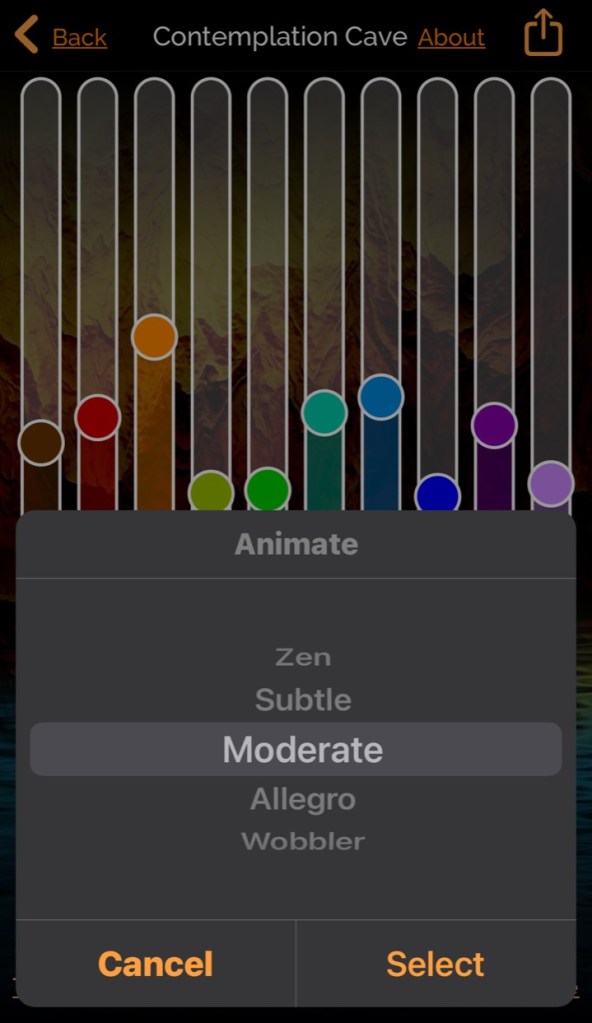
The app is well-designed and intuitive. Here’s what makes it really special: clicking on a soundscape brings you to its screen, which contains a 10-slider, equalizer-like panel. You can signficantly alter the sounds as you see fit by using the sliders. This is particularly useful when trying to mask noises (snoring, dog barking, tinnitus) by increasing the sliders that correspond to the pitch you’re masking–relatively easy to determine by experimenting with the sliders.
The equalizer-like sliders provide a lot of control over which tones are expressed and make it easy to modify them to your liking.
On top of that, there are presets that allow you to customize the slider settings according to various elements, such as Scene (aspects of the environment and how the sound emanates from it), Color (brown, pink, white, etc., as it relates to the quality of the sound) and Frequency (in Hz and kHz). In addition, you have the option of animating the sliders to create something truly unique and ever-changing, using a range of animation speeds (Zen, Subtle, Moderate, Allegro and Wobbler).
The presets allow for quick customization of the soundscape.
This means that you can create a completely new sound experience every time you use the app. Add to that, you can combine up to five of these soundscapes to play at the same time with the Super Generator, and the experience is really phenomenal. I was surprised at how beautifully the sounds melded together; I was expecting cacophany but instead I got depth and fullness.
The free version of myNoise has a generous repertoire of various soundscapes to choose from, but I jumped at the opportunity to significantly expand that list for $9.99. I appreciate flat-rate purchases where I’m not locked into monthly fees and this one has really paid off for me.
Animating the sliders means that no two listening sessions will ever be alike.
So all of this alone would make this my uber-favorite sound app, but as I was preparing info for this post, I happened to search online and I found myNoise.net. And then the clouds parted, the sun shone down and I heard choirs of angels sing out.
No seriously, this website is mind-blowingly fantastic. It is like the big brother of the app, but on steroids. The repertoire of sounds is beyond expansive–over 200 and growing!–organized in a way that makes it easy to navigate to whatever soundscape tickles your fancy. I spent several hours playing Cat Purr alone.
And most importantly, many items on the website are accessible for free, which is truly keeping in the spirit of mindfulness. The developer, a research engineer and sound designer, certainly accepts donations, so if you use myNoise.net, consider supporting him (note: donations open even more options, including the entire list of sounds). I have done so and felt that the money was well spent. But lack of funds won’t prevent you from enjoying much that he has to offer.
Since I mainly used (and loved!) the myNoise app and only recently discovered the myNoise.net website, I haven’t even begun to scratch the site’s surface, but if you enjoy ambient sounds and/or have noise in your environment that you need to mask, I encourage you to set aside some time to explore it. Given the range of incredible atmospheres available, you’ll be able to locate the perfect flavor for your taste.
The drive to conquer my fears is why I insist on playing Phasmaphobia even when I dread the thought of it.
Phasmaphobia is marketed as a “horror” video game, the kind that I actively avoid. The concept is simple: you and up-to-three other networked players enter a haunted building, set up equipment and collect evidence of a ghostly presence. There are different tasks to complete but the ultimate goal is to gather enough data to be able to determine what type of ghost is haunting the premises.
Oh, yeah. And also to get out alive.
Because depending on how long everything takes you to do, sooner or later, the ghost is going to hunt you.
Sure, I’m fine as long as I’m sitting in the ghost-hunting van.
Now, there’s a lot more that I could say about this game, specifically about how it’s set up quite intelligently to be unnervingly terrifying. And there’s Articifial Intelligence involved, which means that the ghost can recognize some of the words that you say (hint: don’t cuss!) that will get it angry and on the hunt faster.
But this post is not a review of the game.
This is an observation that this silly game picked me up and threw me to the ground. It was a reflection of real life, because it perfectly reproduced ME, under acute stress.
By that I mean, tight chest, rapid breathing, elevated heartrate, shaking hands, the whole shebang. I get that gamers go through that, but for me, this meant more. These reactions were exactly the kinds of physiological responses to anxiety that have increasingly plagued me through the years.
People who can handle high levels of stress with cool distance have always impressed me. In fact, I’ve come to see that as a superpower. Being able to maintain mental space around you so that the walls don’t come closing in, squeezing breath out of your chest. That ability to think clearly when things are falling apart around you.
I have often thought, what would my experience be like if I could just dampen that physiological response. Well, Phasmaphobia has given me a chance to practice that.
I don’t do so well when I’m in a dark haunted house, getting threatening messages from the resident ghost.
I imagine myself going into that onscreen home, doing what I need to do, seeing the signal that the ghost is on the hunt (flashlight starts flashing and the front door closes and locks), and very calmly moving to a hiding place and waiting out the event. Declaring to the ghost, “You don’t scare me! I had cancer!” This is, after all, just a game. I’ve been through far worse things in my life.
But, no. Really, I’m kind of a mess. I can’t breathe, I can’t maneuver through a doorway, I drop things and do stupid stuff.
But I’m also stubborn. And playing this game with others like my husband who is unimpressed by the potential terror and shrugs off my disbelief that he’s not unnerved at all (note: he’s also played way more video games) makes me all the more determined to use Phasmaphobia as a “safe space” to practice my calming skills. I can remind myself that the fear is not real, that I’m only looking at a screen and that I walk away from the computer at any time. I don’t have to feel this way.
I am currently a work in progress. But I’ll get there. And once I do, my self-confidence will open the way to conquer other terrifying situations.
Following up on last week’s exercise post, I wanted to focus on two recent studies that really drive home the benefits of physical activity for breast cancer survivors. If you’re not exercising now, here’s why you should consider it.
In 2017, Hamer and Warner published a review in the Canadian Medical Association Journal (Open Access link here). They analyzed 67 existing studies in an effort to ascertain what lifestyle factors were most important in reducing the risk of breast cancer recurrence in survivors.
Whatever you can do right now is enough to start out with. Just keep moving!
The results were striking: of all the lifestyle variables that the researchers looked at, exercise came out on top. They found that engaging in moderate exercise resulted in a 40% decrease in cancer recurrence. This included easily-adoptable, low-cost programs such as brisk walking.
I want to stress: they weren’t talking about doing crazy-high amounts of exercise, but simply adhering to the current physical activity recommendations for US adults, which are as follows (summarized by the American Heart Association and taken from their website):
Sadly, only 13% of recent breast cancer survivors actually met those exercise guidelines, and that number dropped even more as time went on. Consider how that affects overall cancer rates, when we talk about our chances as survivors: if the vast majority of the population is not engaging in a beneficial habit, the reported recurrence rates will reflect that. However, if you do incorporate exercise into your life, one could argue that your chances of recurrence are significantly improved over the numbers usually cited.
In addition, an increase of at least 10% of body weight after breast cancer diagnosis, which unfortunately happens often, increased both risk of recurrence and mortality. Again, patients who exercised were able to avoid this weight gain, improving their chances for disease free survival.
Nonetheless, while it seemed relatively straightforward to achieve the percent reduction in recurrence, the researchers stressed two very important points: (1) this reduction came after finishing treatments, not in lieu of them, so one should not assume that exercise would necessarily take the place of conventional cancer treatments, and (2) sadly, some cancers will recur even if the survivor is doing everything “right” and so if there is a recurrence, it should not be taken as the individual not doing enough. That’s the cruel unfairness of cancer.
It’s never too late to start, but it’s never too early either! Pick a sport and make it yours!
The second study was original research with high-risk breast cancer patients by Cannioto et al. (2020), published in the Journal of the National Cancer Institute (Open Access link here). The study participants filled out a questionnaire about their exercise habits at four time points: (1) when they enrolled in the study after diagnosis (this question asked about pre-diagnosis exercise habits), (2) during chemotherapy, (3) one year after finishing treatment, and (4) two years after finishing treatment.
Once again, exercise was shown as having a significant impact: women who met the guidelines for physical activity (150 minutes/week of moderate exercise) before, during and after treatment had a 55% lower risk of recurrence and 68% lower risk of dying than those who didn’t meet the guidelines.
Even those who only started exercising after finishing treatment still had a significantly reduced risk of both recurrence and death compared to those who didn’t exercise at all. Additionally, benefits were also seen for those who consistently exercised, even if they didn’t fully meet the guidelines. So it seems that any exercise that these high-risk cancer survivors did was still better than not doing anything at all.
The same holds for you!
Both of these studies convey the importance of engaging in physical activity. Exercise is critical for the well-being of all humans, but even more so for breast cancer survivors. Think: when we receive a cancer diagnosis, we are ready to undergo potentially dangerous treatments, risking debilitating side effects that leave us bald, exhausted and wretched.
So why not engage in something as beneficial for body and spirit as moderate physical activity to help prevent the possibility of having to repeat the cancer treatment again?
~~~~~~~~~~~~~~~~~~~~~~~~~~~~~~
A few more bits of information:
The easy-to-read executive summary of the US Physical Activity Guidelines for Americans can be found here.
For a plain-language synopsis of the Hamer and Warner (2017) review, see this Healio interview with co-author Dr. Ellen Warner.
Tailor your exercise to your abilities…and then keep going!
Keep in mind that terms such as “moderate” and “intense” are relative to YOU. someone just starting out is not going to be able to handle the same level of intensity as a highly-trained individual, and there’s nothing wrong with that. Start where you are–it’s okay.
Finally, Dr. Robert Sallis, chairman of the American College of Sports Medicine’s Exercise Is Medicine inititative, has said, “If we had a pill that conferred the proven health benefits of exercise, physicians would prescribe it to every patient and healthcare systems would find a way to make sure every patient had access to this wonder drug.”
Although this is a blog about cancer and mindfulness, I hardly think there is any lifestyle habit as effective as exercise at helping survive cancer. And what better time to discuss this than the start of a hopeful new year?
I’ve been certified as a personal trainer by the American College of Sports Medicine (ACSM) for well over a decade, and although I haven’t actively taken on clients, I’ve had enough time to develop my own fitness philosophy. I must stress, this is a conceptual post and not designed to guide you to specific exercises (although I mention some modalities as examples). However, if you’ve had trouble getting your head around how to maintain an active lifestyle, these ideas may help.
In my experience, there are three critical aspects to a successful exercise program: (1) consistency, (2) progression and (3) balance.
CONSISTENCY
This is the most important concept of my three and worth spending the most time on.
Consistency is the concept that seems to be most difficult for people, and it’s usually the “make-or-break” aspect of fitness. It’s quite simple to get motivated to start a new program, whether it be signing up for classes, planning out home workouts or simply deciding to go for a brisk walk every day.
The hard part is sticking with it. But I can promise you, that’s where the magic is. Be realistic about how much time you have to devote on a daily basis and what your exercise will consist of. This should not be something far out of your realm of experience or else it will be too difficult to maintain. Make it familiar.
When starting out, pick something you enjoy doing and it’ll be easier to keep doing it!
For example, if you do not already have a consistent history with a piece of exercise equipment (say, treadmill), do not purchase one under the assumption that the high price tag will surely motivate you to use it. It will not. The greatest workout you’ll get with it is carrying it to the basement or attic after you can no longer stand the guilt of watching it gather dust.
If you can’t maintain your workouts, you will have to go through the “beginner” phase every time you summon the wherewithal to restart again.
That also means going through “beginner soreness”. Honestly, there’s little pleasure in a Groundhog Day-like experience of not being able to get past the little aches and pains you might feel after getting your body into motion again. Don’t do this to yourself.
How to avoid it? Look at exercise as a lifelong habit, not something you do just to “get in shape” for a specific event like a wedding or reunion. Take smaller bites of exercise, something very doable that you won’t dread, especially if you have negative associations with workouts. Set goals like “train 5 days a week” and plan them out, not “lose 15 pounds” or even worse “look better” (what’s that?). It’s more motivating being able to tick off a specific, finite goal than never reaching one that’s vague, arbitrary and even judgemental.
And DO consider it “training”. You are training for living the rest of your life with more ease, maintaining your flexibility, balance, strength and endurance just that much longer. As in the tale of the tortoise and the hare, starting something that seems “not vigorous enough” but that you can see yourself doing, say, every day, in a year will put you miles ahead of someone who started an ambitious and complicated exercise program and burned out in a matter of weeks.
The fitness industry is banking on the fact that people will start exercising and then give up, only to start again later. And eventually give up again.
Look at it this way: the trillion-dollar exercise industry is betting on you giving up, and so it always comes up with a new shiny object to tempt you with. Often the program is unsustainable and the promised results are unrealistic. You don’t need that. You need consistency.
Again, decide what you can do and do it regularly. Realize there will be days when it won’t be possible to get it done. That’s okay – no guilt, no shame. But then get right back to it as soon as you can. Think of every workout as something positive and precious that provides you with health benefits that no one else will be able to take away. Each day you exercise is one more step towards establishing a habit that will lead to a lifetime of fitness.
Got your exercise in? MARK IT OFF!
IMPORTANT: Put up a high-visibility calendar where you can mark off your workouts and easily see how consistent you are.
But what if it gets TOO easy? That’s when the next pillar comes in…
PROGRESSION
Once you’ve established an exercise habit, your body will eventually adapt to what you’re doing. This is a very good thing. It also means that it’s time to change things up a bit, always giving yourself permission to dial back down to what you’d been doing previously if you have a harder time getting going on any given day.
Is your walking route getting too easy? Make a detour to a set of stairs and get your heart rate up!
The trick is to maintain consistency while also challenging yourself. For example, if you were doing a walking program, incorporate bodyweight exercises (squats, modified push-ups) that you can do along the way. Climb more hills. Pick up the pace.
If you want to get a PhD, you don’t keep taking freshman-level classes. Challenge is where growth happens. We get an unmistakable sense of satisfaction putting in the work and seeing results.
This is also where your self-confidence blossoms. And that’s exactly the bouyed spirit that keeps you going.
Don’t ramp everything up at once. Add a little at a time, but definitely make it count. Be realistic about whether or not you’re challenging yourself: if you need to push it even more and can do so safely, go for it. If you honestly try but can’t do as much as you expected, halve the amount and try again. Don’t beat yourself up. You will get there. But don’t short-change yourself either.
Keep writing it down! When you’re ramping up your fitness program it’s important to keep track of your progress.
Most importantly, unlike high school PhysEd class, you’re in charge. That also means you’re responsible for your own progress. Some workouts will be better than others, but always remember, doing anything is STILL better than binge-watching Netflix with a bowl of chips on your lap. Congratulate yourself for making the decision to exercise!
Hey, why not watch Netflix while marching in place? It still counts so write it down!
So let’s assume that you’re being consistent and gradually increasing the duration/intensity of your workout. That’s perfect, but there’s one more pillar to consider…
BALANCE
In this case, I don’t mean balance as in being able to hold tree pose throughout your entire lunchbreak. I mean are your workouts well-rounded? I’ve seen runners do little else but run. If this is you, incorporate some variety into your life. Your running will improve if you are also training for strength and flexibility.
Hey, your other shoulder needs massaging too!
Here’s a simple analogy for balancing out your workouts: imagine getting a massage regularly, but on only the left side of your body. That side will feel great, but you’re missing something. Your right side needs some love too. Eventually that imbalance will affect you negatively.
Exercise programs are best when they are a melange of endurance, conditioning, strength work and staying limber. It is extremely tempting, once you become adept at an exercise modality, to keep at it at the exclusion of everything else. After all, you’re an expert in it. But you’re also opening yourself up to injury and that’s something no one needs.
Treat your body to something new just to keep things interesting.
Take the time to explore different modalities. Often a type of exercise (say, yoga) can cover a number of bases, but you will still need to supplement with other exercises to stay truly well-rounded. Even strength training (which I consider critically important, btw) can have a cardio effect, but much will depend on how your workout is structured.
Do some research but don’t over think this. Just make sure that you are supporting all your body’s needs. Taking the runner’s example again, strength training will help you maintain muscle mass that you might lose from too much running, and it, along with flexibility and mobility work, will help prevent overuse injuries.
This doesn’t mean that you have to significantly increase the number of workouts you do, just that you have to be creative in what you add to your exercise session. The idea is to incorporate what else your body needs to keep it humming optimally. And then, write it down.
BOTTOM LINE
Bottom line when you’re just starting out? Move. Even if you don’t really know what exercise you “should” do, just find a way to move. Dance. Wave your arms over your head. Break up sedentary times as much as possible. If you sit for an hour, stand up and walk in place for three minutes, swinging your arms. Don’t be afraid to work up a sweat.
Then keep doing it.
When you establsh one healthy habit, it’s easier to incorporate others to support it.
Above all, make it pleasant, so that you look forward to exercise as a break from those things in our environment that keep us sedentary. The human body was meant to move. That is its natural state. Give it the opportunity to do what it’s supposed to do, then let it recouperate and nourish it with healthy food. The idea is to start now and keep going for the rest of your life.
~~~~~~~~~~~~~~~~~~~~~~~~~~~
Being an avid exerciser enable me to recover from cancer treatment much more quickly. Up until my last couple of infusions, I was rowing and lifting weights within a week after each chemo (mine were spaced three weeks apart). In an out-of-control situation like cancer, exercise was one constant that made me feel like I still had a grip something, and that made the whole experience better.













 Frantic Shanti