“Dear Princess Kate, I Can Relate”

(Title image: Photo by Bence Balla-Schottner on Unsplash)

Over the last week or so, there have been a number of news articles focused on Catherine, Princess of Wales, who has been talking about life after finishing her cancer treatment.

She is officially in remission from her unspecified cancer, having completed chemotherapy. However, in a conversation on July 2 with hospital patients, staff and volunteers at Colchester Hospital in Essex (in southeast England), the princess noted that there was still more to endure once she was past her cancer treatment.

This is summed up from an article in USA Today (and numerous other outlets):

Kate described the cancer diagnosis and treatment as “life-changing” for both patients and their loved ones. “You have to find your new normal and that takes time … And it’s a roller coaster. It’s not smooth, like you expect it to be,” she said, according to the outlet. “But the reality is you go through hard times. … “You put on a sort of brave face, stoicism through treatment. Treatment’s done, then it’s like, ‘I can crack on, get back to normal,’ but actually the phase afterwards is really, really difficult.”

Wow, this is so relatable! I’m grateful that Kate is discussing life after cancer treatment, especially because she’s a highly public figure.

Many cancer survivors have experiences similar to Kate’s, particularly those, such as breast cancer survivors with hormone-positive cancers, who continue to take “maintenance” medications like tamoxifen and aromatase inhibitors. While many patients expect chemotherapy and radiation to be tough, they are often not prepared for the side effects associated with endocrine treatments that are prescribed to be taken for years after finishing everything else.

Princess Kate breaks with royal protocol in speaking frankly about the struggles following the end of cancer treatment.
(Video from TODAY)

But even without endocrine therapy, many cancer survivors are left with long-lasting side effects of varying severity. Some may be truly life-changing. Most of them will prevent a return to “normal” as we used to know it.

That normal, however, is what others may be expecting of you. Or you might expect of yourself. And that’s tough. Kate mentions the importance of reaching out for professional support if it is especially difficult to manage the phase following treatment, and I concur 100%.

Because it’s not simply the side effects…it’s the frustration that we feel with having the side effects linger. Or even the reactions of loved ones who don’t understand why things aren’t back to how they used to be. There is a grieving process associated with the loss of our previous lives that those around us may not appreciate, so I’m glad that Princess Kate is using her position to bring this out into the open.


Cancer Survivorship Ain’t For Sissies

With all the focus on breast cancer during October, pushing us to be warriors and fight our way through this, the concept of survivorship can get lost in the fray.

We talk about cancer treatment and get very granular about the procedures, whether surgery, chemotherapy or radiation therapy. And those do deserve a lot of discussion as they can be difficult to endure. Some, like chemo, have an almost legendary reputation and it’s important to be able to separate fact from fiction.

After all the noise and attention associated with cancer treatment, survivorship can leave some of us feeling alone.
Photo by Atharva Tulsi on Unsplash

Consider: how many of us, upon hearing that we have breast cancer, preoccupy ourselves with worrying about what life will be like five years down the road? More likely, we’re thinking about what treatment will be like and are hoping that we’ll be around when it’s done!

But with so many women surviving breast cancer, it’s important to talk about what happens after the dust settles and you realize you’re on the other side of the treatment that you had so feared. Is it really the “other” side?

So much of my blog has been devoted to the life after cancer. After I documented my treatment journey, I turned around to get hit in the face with all the stuff that I wasn’t expecting.

One of those was endocrine therapy. Women with hormone receptor positive cancers aren’t done when the “tough stuff” is over. Tamoxifen and aromatase inhibitors are a whole new round of treatment that can affect your hair, your libido, your joints and more. Some women get hot flashes and night sweats. Some experience weight gain. And these are medications intended to be taken for a number of years.

There may be body image issues. Breast cancer surgery can leave women looking very different from their pre-cancer days. Like it or not, breasts are associated with womanhood. Whether lumpectomy or mastectomy, with or without reconstruction, there is a new normal that needs to be dealt with.

By seeking support and relating your story, you help not only others who are dealing with something similar in addition to yourself.
Photo by Ivana Cajina on Unsplash

And then cognitive issues like distractibility, loss of memory and difficulty processing concepts may come up. To make things more complicated, these may appear after treatment is in our rear view mirror and our loved ones may simply not appreciate what we’re dealing with. The bodies and minds of survivors may change in a way that they are not prepared for. Because, how do you anticipate something like this?

Survivorship does not mean that you never again have to think about cancer or its repercussions. There will be adjustments to your expectations as to how your life will be from now on. It’s important that those around you understand that just because you are done with the major cancer treatments, things might not feel familiar or normal.

So we need to be having this conversation with those around us and making opportunities for affected women to seek help and support. There is no shame in being a survivor who is also struggling. While it’s true that we are “lucky to be alive”, it does not mean that we have no right to seek a higher quality of life.

Don’t be afraid to talk about it. ❤

Finally, This Is My Real 5-Year Anniversary

I was going to write about something else for this week’s post until I realized that I had another five-year breast cancer anniversary to share: the end of my radiation treatment.

It had run for six weeks, five days a week — going to the cancer center became a daily habit. But on October 23, 2017, I rang the gong signifying the end of treatment, said my good-byes to the radiation oncology staff and left them with baked goodies.

Cancer treatment felt like a never-ending vortex of scary experiences…but it did finally end.

With 2022 being five years since my cancer diagnosis, I’ve had a number of anniversaries to share this year. What makes Oct. 23 significant is that it marked the end of all the “tough stuff” that people scare you with about cancer. By that date, I’d put the diagnosis, surgery, chemo and then radiation behind me.

Because 2017 had been a miserable year, when radiation was done I thought I could finally take a deep breath. I’d waited for this point in my treatment for a long time and decided that I would lose myself in the spirit of the holiday season.

The problem was, you never really get rid of all your concerns. You release some, but others show up to take their place. I finished radiation…but wait, there’s more! Now I was going on tamoxifen and that brought a whole new set of issues, and yes, fears, with it.

So I spent Christmas season doing my best to enjoy myself but the holidays passed by and left me feeling a little empty. I’d expected a lot out of them and they didn’t deliver.

I had wanted to be free of all my worries but that’s not how cancer works. In fact, that’s not how life works either. It took me five years to figure out that I couldn’t get what I wanted, but what I could make of it was beautiful in its own way.

Admittedly, it was a tall order. After cancer, I tought the world would shine with joy, but that wasn’t realistic. Cancer isn’t the kind of disease you say to, “done!”, brush your hands off and walk out the door. It tags along behind you, if not as the disease, then as its shadow.

Fast forward five years to now…ok, ok, I know what I got wrong back then.

I had felt like life owed me something amazing because it had put me through cancer. I thought I deserved a post-cancer life that was perfect. Of course, it wasn’t. And it still isn’t.

So if there’s something to celebrate, it’s that I learned a few things over the past five years.

This holiday season I’m not going to be expecting things to wow me. But I am going to be enjoying the fact that I am still physically active and working the same university job, expanding my horizons as a new yoga teacher and finding fun ways to spend my time. And mostly, that I have moved past the feeling of anger that I felt about cancer and found some gratitude to fill its space.

~~~~~~~~~~~~~~~~~~~~~~~~~~~~~~~~~~~

I know I keep going on and on about how much better life is when you’re not carrying the burden of anger, but honestly, if I’d known that acceptance would lighten me up this much, I would have done it sooner!

“The Gun Show”: Assessing Biceps Muscle Loss Due To Endocrine Therapy [PHOTOS]

In my last post, I whined about the repercussions of taking aromatase inhibitors (in my case, letrozole) as a way to diminish the amount of estrogen in my body, for the purpose of reducing the risk of breast cancer recurrence.

While I also mentioned letrozole’s effects on my exercise habits, in this post I wanted to drill down on one aspect in particular: muscle loss.

Before I go further, I need to add a disclaimer. Since the time the first photo was taken (the morning before my first chemo infusion), three and a half years passed and I went through menopause. Notably, the menopause was pharmaceutically-driven, starting with tamoxifen and then, after my hormone levels were low enough, continuing with letrozole. However, my body now is dealing with the same aging effects as someone who had transitioned naturally.

Except that my transition came before its time.

The below photo is from April 27, 2017, before I headed to the infusion center for my first dose of chemo. I had been training as normally as I could, under the conditions of lumpectomy and port placement that I wrote about here, and finding work-arounds for exercises that I’d been told not to do.

This is my 51-year-old biceps muscle, before I started the pharmaceutical portion of my breast cancer treatment.

While I lost some size and strength throughout my chemo infusions (here are all the photos), I was able to bounce back and had a particularly strong 2018 (sorry, don’t have good photos of that). But as the endocrine therapy with tamoxifen continued in 2019, to be replaced by letrozole in 2020, I could feel the effects of low estrogen.

On December 11, 2020, I struck the same pose again for sake of comparison.

Is something missing? This is my 54-year-old biceps muscle, struggling to keep up. Note: I am still working out as hard as I can!

As far as muscle appearance is concerned, I have experienced a slow downhill slide. My shoulder is not as peak-y, the biceps itself has decreased in size and I even find it more difficult to hold this muscular contraction. In addition, there’s more looseness in my skin, particularly at the back of my arm, which in part may be due to loss of collagen, also affected by estrogen levels (nice dermatological review by Shah & Maibach, 2001, Am J Clin Dermatol).

I’m busting my butt trying to increase the amount that I’m lifting, but I’m not making progress. Not surprisingly, the decrease in estrogen plays a role in this. As stated by Chidi-Ogbolu & Baar (2019, Front Physiol), “estrogen improves muscle mass and strength, and increases the collagen content of connective tissues”.

It makes sense then that lack of estrogen is going to be detrimental to maintaining muscle. To that point, Kitajima & Ono (2016, J Endocrinol), working with animal models, have found that “estrogen insufficiency leads to muscle atrophy and decreased muscle strength of female mice.”

Not just mice, obviously.

This information comes as no surprise to any woman who’s gone through menopause, I’m sure. But the experience of being slammed through menopause instead of having the opportunity to transition more gradually is yet another frustrating way that having cancer pulls the rug out from under you and reminds you that you are not in control of your life.

~~~~~~~~~~~~~~~~~~~~~~~~~

Slowly, yoga is becoming more important in my life and my view of fitness is changing. Good thing too, since I can’t keep beating myself up like this.

There Goes Another Cancer Milestone…Big Deal

On October 23, 2017, I finished radiation therapy for my stage 1, triple-positive breast cancer. That was three years ago. At that point, I imagined myself being through all the “tough stuff”. I’d already had surgery that March, spent the summer enduring chemo infusions, and then six weeks of radiation in autumn.

October 23rd seemed like a “marker” day. I rang the gong in the radiology waiting room, with all the staff present and smiling. It was a day that I knew I’d remember.

Except that it didn’t end up being a very important milestone. At that point, I didn’t fully realize that the treatment doesn’t really end. I can only say that it’s been three years since I finished chemo and radiation. But the truth is that a few weeks after that I started tamoxifen (surprise!), which came with its own worries. And I still had more than half of my infusions of Herceptin (trastuzumab, a monoclonal antibody) left, which stretched into April of 2018.

I guess next April, I’ll mark THAT as another milestone.

This coming December I can mark a full year of taking letrozole (aromatase inhibitor), which came after two years on tamoxifen. But I’m still supposed to be on that stuff for “a few more” years – it’s funny that my oncologist has not been specific about that. And I’m not very interested in asking, unusual for me.

I really thought I’d have said “goodbye” to all things cancer by now, but its spectre still seems to follow me around.

What once seemed like a very clear treatment plan, a definite path through the cancer jungle, now seems fuzzy and gray. In one of my first posts here, I talked about being able to put everything behind me, with the more time that passed after “finishing” chemo and radiation. Who was I kidding?

When mammogram time comes up, there’s that familiar rush of anxiety, knowing that I’ll be sitting in that comfy robe in the quiet waiting room, pretending to enjoy a cup of tea, but my tummy will be floating and I’ll try to not to think of much. That’s the work of cancer.

When I wake up in the middle of the night with my hand aching and fingers painfully stiff, medication side effects that are deemed, by the medical community, to be “worth it”. That’s the work of cancer.

When I wonder whether my 18-year-old daughter should be doing breast self-exams now. And whether she’s be hurt by whatever “mistake” my body made in not cleaning up some tumorigenic genetic defect. That’s the work of cancer.

So it makes all those “milestones” a little less fun and exciting.

~~~~~~~~~~~~~~~~~

But I have to be honest — I still note the time that’s passed by. For my breast cancer, the two-year mark is most important, followed by the five-year mark and then the 10-year one. Each year cancer-free makes me more cocky. But the truth is, one “bad” scan, and I’m back to square one: cancer patient. And then I’ll regret not having appreciated those milestones more.

Hi-Ho, Hi-Ho, On Letrozole We Go

Starting up again…

After giving me a six-week respite from tamoxifen and then running bloodwork that revealed I was postmenopausal, my oncologist made good on his threat to put me on letrozole, an aromatase inhibitor. This breast cancer medication is supposed to block “the enzyme aromatase, which turns the hormone androgen into small amounts of estrogen in the body. This means that less estrogen is available to stimulate the growth of hormone-receptor-positive breast cancer cells” (breastcancer.org). It’s also better suited for postmenopausal women.

Perhaps it’s more correct to say that the journey is BACK on. I enjoyed my time off tamoxifen, but I really didn’t notice much of a difference in myself whether I was taking it or not, suggesting that maybe what I thought were side effects, weren’t. So I’m willing to humor my oncologist and try an aromatase inhibitor.

Not gonna lie, I really did not want to go on yet another medication, but for this appointment, I left all the journal articles at home and put away the boxing gloves. I promised my oncologist that I would stay off the forums, stay off PubMed, quit overthinking things and give letrozole a chance.

The reason? My oncologist thinks that my earlier frustration with tamoxifen was, to put it bluntly, in my head. And my clinical counselor suggested that what I complained of could be explained by anxiety. But I swore that my memory and focus issues started with tamoxifen.

You know what? I’m not so sure now.

The fact is, everything that I was experiencing could have been caused by anxiety (or menopause). And even more striking were the things that I didn’t experience. Not only did I not have significant hot flashes (maybe a “warm flush” here or there, easily countered by taking off a sweater), I never had night sweats. Heck, I had more night sweats before my cancer.

No weight gain, either, which had been another big concern of mine. I’ve been disciplined in maintaining healthy fitness habits throughout my adult life, probably to the point that most people wouldn’t tolerate. Tamoxifen didn’t manage to mess with that, which was extremely gratifying.

While I really want to peg the concentration problems, distractability, flagging libido and other negatives on estrogen-blockers, a retrospective look at my emotional history suggests that (1) I’m highly suggestible (I need to stay off the internet!), (2) there have been loads of anxiety-amplifying events in my life, even before cancer, that I haven’t handled well, and (3) I would be better off shutting up, taking the pill and working on getting my mental state in order.

I mean, I already knew most of this. But some things need to hit me between the eyes a number of times before they actually register.

Wow, dizziness and impaired ability to drive are bad enough to merit a prominent place on the label? Yay! I’m going to pretend that this is a sleep inducer that will leave me better rested. I’ll let you know if that works.

So, while my oncologist warned me about “a little joint pain” (eek!), I’ve avoided anything but a cursory glance at what I might experience on letrozole, besides what reactions would necessitate calling the doctors.

We’ll see how bad these side effects really are.

~~~~~~~~~~~~~~~~~~

A FINAL NOTE – According to what was written on the bottle, this stuff can cause dizziness and impair my ability to operate a vehicle. Seriously? I didn’t expect that, but here’s what I’m going to do with that tidbit of information: I’m going to view letrozole as a reason to get to bed earlier, since I’ll obviously have to take it in the evening. And I’m going to tell myself that this is going to help me sleep. Who knows, maybe it will?

What No One Told Me About Cancer and Hair Regrowth

More than two years after finishing chemo, after being afraid my hair would not grow back, and after being delighted with the way it did…I’m experiencing follicular drama, once again.

Once chemo was over, my sleepy follicles took their time getting roused into action. To say that I worried would be an understatement. I was still caught up in the unfairness of being smacked down by breast cancer. Confronting the possibility that after enduring the nastiness of cancer treatment, I might not get my hair back? That was too much.

Well, if you’ve read my posts on hair, you’ll know that my hair finally did come back. And there was much rejoicing.

And that’s where my hair posts stopped. But as happens with these kinds of things, that wasn’t the end of the story.

While still bald, I had been fed reassuring anecdotes by well-meaning supporters about hair coming back even better than before, lush locks that served as well-deserved rewards for undergoing the anxiety and strain of cancer diagnosis and treatment.

But as much as cancer patients feel like they don’t know what’s going on, those around them have even less of an idea. They want you to “stay positive” at all costs, so they overload you with lots of good news.

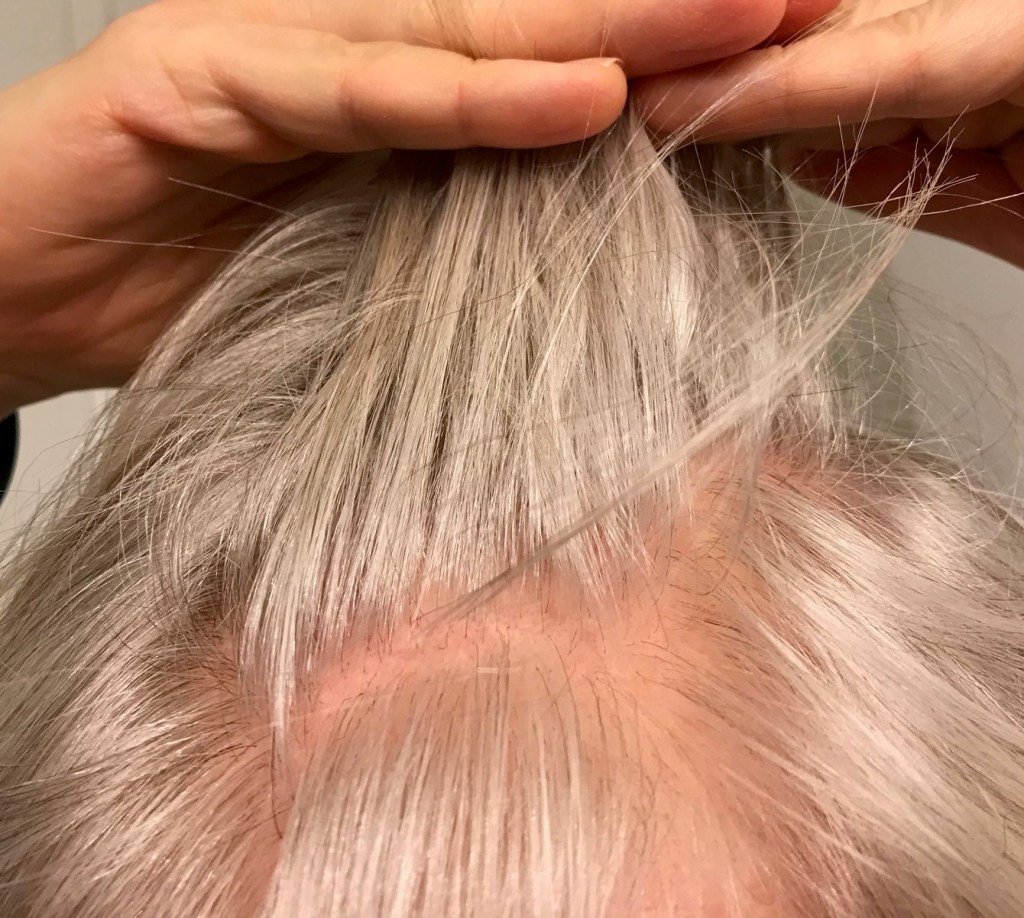
The forest isn’t as dense as it used to be.

By now you can probably guess where I’m going with this. Because in Spring 2019, things started changing. Within a few months, my uber-cool spikey rockstar hair lost fullness as my strands thinned. Then, I saw “bald spots”.

So, let me explain how I define “bald spots”: these areas have hair, but due to the color (um, WHITE) and thinness, the hair seems translucent, even transparent. And along the part? You can’t see the roots well at all.

My reward for enduring cancer is invisible hair.

My hairstylist confirmed that the hair that comes back in after chemo is different from the hair that eventually settles in. And mine had settled.

Tamoxifen also played a role, since choking off estradiol and moving into menopause will age both you and your hair, particularly if you are premenopausal going into treatment, as I was. So this should have been expected, but in the hustle and bustle of all the other little things, like, oh, wondering if you’re going to survive the ordeal, no one really talks about the fact that there will be other changes that take place.

And now, I’ve been off tamoxifen for almost six weeks, but can’t tell whether there’s been any regrowth, not that I expect any. I meet with my oncologist this Tuesday and you can bet your panties he’s going to prescribe an aromatase inhibitor for me, so the pharmaceutical depression of estrogen will continue.

I am dealing. Mostly. Am I happy about this? Of course not. The last few years have felt like running a gauntlet of misery, but one where I’m only hobbled and not completely taken out. Given that, I’m ashamed of complaining, as there are many others doing so much worse. But not ashamed enough to stop writing about it, as this is my reality and it affects me. If I’m going through this, there’s a good chance that many others are too.

I’m supposed to be moving on and leaving cancer behind me, right? But like an annoyingly nosy neighbor, it keeps waving at me through my kitchen window, reminding me that it’s living next door.

(Almost) Two Years on Tamoxifen: A Change in Plans

This weekend would have marked two years of taking tamoxifen, the estradiol-blocking medication that is supposed to keep my hormone-positive breast cancer from recurring.

As it turns out, there will be no such commemoration. Several weeks ago, I started noticing a funny cramping feeling in the general area of my uterus. It was light and under any other circumstances, I would have ignored it, but use of tamoxifen is associated with an increased risk of endometrial/uterine cancer, so it kept me on edge.

It’s worth noting that the increased risk is actually for postmenopausal women, and to the best of my knowledge, I was not yet postmenopausal. That’s why pre- and perimenopausal women are started on tamoxifen but taken off of it as soon as they go through menopause. Still the sensation, although intermittent, didn’t go away.

I finally called my oncologist. As it was, I was wary of tamoxifen – I already blamed it for a number of other negative things that I experienced: fatigue, hair thinning, low libido, cognitive issues, mood swings, general misery…all of those and more were listed as possible side effects.

I complained about the light cramping to an oncological nurse, who was surprised that I didn’t have a recent pap smear on record, because according to her, the oncologist wanted me to have one yearly. Mind you, pap smears are for cervical cancer, and I wasn’t at an increased risk for that. But whatever. The nurse gave me her blessing to stay off tamoxifen until I next saw the oncologist.

Conveniently, my oncologist appointment was in three days.

I was stressed, because if there’s one thing that being a cancer survivor made me good at, it was stressing. So much so, that my blood pressure hit 165/95 at my appointment. I couldn’t get over how ridiculous that was and how my thoughts had generated that sort of a reaction. I don’t think my pressure was even that high before my cancer surgery, at a time when my anxiety was raging and everything felt out of control.

I had a prolonged discussion (negotiation?) with my oncologist. In the end, we decided the following: I could take a month off tamoxifen and meet with him again in six weeks. In the meantime, I would go to my gynecologist to rule out endometrial cancer. (Incidentally, a week later at the gynecologist’s office my blood pressure was back down to a very reasonable 102/64.)

No more tamoxifen? Yeah, I feel like celebrating.

My oncologist and my clinical counselor (who I discovered had spoken to him about me) thought that some of the worst side effects that I was experiencing were not due to tamoxifen, but anxiety. My onc suggested that if nothing improved after a month off tamoxifen, I should consider anti-anxiety meds.

But he also checked my hormone levels to see where I was in my journey into menopause. A few days later, I got the news: I was officially postmenopausal and was told to not restart tamoxifen.

So, okay, no more tamoxifen. I was also quite happy that I managed to transition through menopause without any significant hot flashes. The downside of this was, however, that I would be put on an aromatase inhibitor, which came with its own set of side effects, not the least of which was significant bone pain and bone density loss.

Or at least those were some of the effects that I remembered from the last time that I read about them, which was a while ago. This time, I’ve decided, I won’t go back and research all the negatives of the medication. Anxiety does hit me hard, I have to admit, and I want to be sure that I’m really experiencing what I’m experiencing and not simply being influenced by what I’ve read.

So I’ll give the new medication a fair shake and give myself a break by not getting worked up by what *might* happen. As the gynecologist said, looking over my bloodwork, “Actually, you’re really healthy, except for having had breast cancer.” I’m going to go with that and see where it takes me.

A Year and a 1/2 with Tamoxifen: Collateral Damage

For those unfamiliar with the drug tamoxifen, its purpose is to block estradiol receptors in an effort to decrease the chances of developing hormone receptor positive breast cancer. My own tumor had been estrogen and progesterone receptor positive, so tamoxifen is pretty much standard fare for women in my situation.

The trick is, however, to make sure women keep taking the medication, and the side effects may make that a challenge. The current recommendation for pre-menopausal women with hormone receptor positive cancer is ten years of tamoxifen. When I posted after a year of taking tamoxifen, I was experiencing minor side effects but had managed to avoid the worst hot flashes and night sweats that many women complain of. And even the side effects I had I couldn’t completely pin on the drug.

After a year and a half of tamoxifen, the landscape has changed. My estradiol level, which was 36 pg/mL when I started in November 2017, has dropped to 22 pg/mL. I’m still not having a significant problem with body temperature regulation, although this may change with the summer months.

There are, however, other distressing issues that are becoming increasingly problematic:

1. Memory lapses. I’ve written about this in a number of other posts, but it deserves mention again because it’s not getting any better. I struggle with distractability and loss of focus, which compromise my ability to do my current job. There are details that I simply miss, and I have a hard time juggling things in my head. Yes, I write everything down and follow my own advice, but there are days that I want to give up and go home.

Bottom line, even with workarounds, my concentration makes me ineffective at times. That alone could be a deciding factor in how long I will last on this medication, but it’s not the only one.

2. Fatigue. This has become more noticeable and is affecting my workouts. I feel like I’m losing ground on my fitness. While I’m no stranger to working out even when I don’t feel like it, there are days that I feel beat before I begin, and like I’ve been run over by a truck by the time I’m done. Exercise is such a crucial part of recovery and good health — and a very important part of my life — that it seems ridiculous that my treatment should be getting in the way of it!

Detachment from affection feels lonely and isolating.

3. Loss of libido and emotional attachment. This would be easier to take if I were single and living alone, but dealing with this side effect in the context of a relationship is getting progressively more difficult. It is not simply romantic desire that has dwindled; feelings of affection for my husband and children have dulled. I know I love them and feel a strong sense of responsibility for them, but there’s a numbness where there used to be warm emotions. It breaks my heart because I don’t want to feel this way.

4. Depression/mood swings. On the plus side, I know what’s going on and am actively working with my counselor on dealing with these fluctuations, but these are side effects of the drug, so as long as I’m taking it, I feel like I’m trying to bail water out of a sinking boat with a spoon.

5. Argh, again with the hair! After regrowing my hair following chemo, it has been thinning from tamoxifen. This may seem insignificant in the grand scheme of things, but if you’ve ever lost your hair to cancer treatment, you know that it can be a emotional experience. Getting your hair back is a big deal, but thinning hair brings back a sense of helplessness and lack of control.

Notice that the effects above are not readily apparent — even the thinning hair might not be as noticeable to an observer as it is to me. It’s easier to understand visible health-related consequences, but we as a society have a hard time getting our head around (or expressing concern for) the importance and impact that emotional factors have on quality of life. You can’t see my concentration difficulties or depressive mood or grief over numbed affection, but they affect me as strongly as do any physical symptoms.

I’m not forgetting how lucky I am.

This is a good place to stop and mention gratitude. The fact that I write this post as a former cancer patient on a maintenance drug to help keep my cancer from re-occurring…that is a privilege. My good fortune is not lost on me, and it is something I think about every single day. We have come a long way in treating my type of breast cancer and I am the beneficiary of those advances.

But there is also an expectation that now that chemo and radiation are done and my scans are clean, I should be “back to normal”. I would like nothing more than that, but I’m not there.

This brings me to a deal I made with myself: I promise to do my utmost to last through five years of tamoxifen. However, years 6-10 remain to be seen. At some point, the scales will tip and quality of life will win out over whatever purported percentage of increased survivorship the full decade of the drug can offer me. This offers me some strength to push on and focus on the present, doing the best I can with what I have.

Sleep, the Ultimate Good

I hold sleep as one of the most critical elements of self-care in our lives. Get enough sleep and the whole world looks brighter. But ignore the call of the mattress and dire consequences await.

This is especially true for me, as I slog through the ever-changing side effects of my current anti-cancer therapy (Tamoxifen). The amount and quality of sleep I get sets the tone of my day and determines my resilience to work and life stress. In addition, sufficient sleep has a significant positive effect on my cognitive functioning, which took a hit from cancer treatment.

But this is not limited to my personal experience. The more we learn about the science of sleep, the more we understand how our electronics-driven lifestyles disrupt sleep patterns and affect us as a society.

Dr. Matt Walker (UC Berkeley) is a strong proponent of sleep, and for good reason. He outlines in his TED talk (19:19) below some of the latest research on the repercussions of not getting enough shut-eye, and it’s not pretty. As a cancer survivor, I find this information particularly sobering. While I’ve written about the downside of placing superhuman expectations on ourselves, having THIS kind of superpower, getting sufficient sleep, is literally life-preserving.

Let’s start with “testicles”…

Dr. Walker’s two main suggestions for good sleep? (14:16 in the video)
1) Keeping a regular sleep schedule, retiring and rising at the same time regardless of day of the week.
2) Keeping your bedroom temperature at about 65°F (no mean feat without A/C in the summer months!).

For many of us, improving the amount and quality of our sleep will take concerted planning and possibly sacrifices. We live in a 24-hour-a-day world and sometimes we try to keep up with that ’round-the-clock pace; ultimately, however, we pay the price for it. There should be no question that sleep is critical to our well-being and it’s time that we give it the priority that it deserves.