Tell Me a Story: Suppressing Anxious Thoughts

(Title image: Photo by Jonas Jacobsson on Unsplash)

Nine years ago this month when I found out that I had breast cancer, the news hit me hard and felt so raw that I had nowhere to seek emotional shelter. The information was so in-my-face. There was no way to escape it, no way to “un-know” it.

While there were things I needed to deal with immediately, the sense of dread was overwhelming at times and I wished I could push it away. Even after going through surgery, chemo, radiation, there was a constant foreboding that lingered, a trauma that continued to terrify as I learned to deal with the uncertainty of the future. The anxiety was worst in the early morning hours.

At that point, I couldn’t even repress the feelings I was having, they were so strong. Mindfulness taught that I should allow all the feelings to pass through me. I struggled with that but kept at it. After all, I thought, isn’t that sort of suppression cautioned against, with the concern that feelings and thoughts that were pushed away would resurface in some other detrimental way?

That belief has been challenged by research on the experiences of those affected by the November 2015 terrorist attacks in Paris. Tracking survivors using MRI technology and psychological assessments, the researchers discovered that part of recovery from such a traumatic experience included the ability to suppress intrusive thoughts. The memories can still be accessed but do not overwhelm the patient, easing the burden of PTSD. (A National Public Radio story on the event and research is available here.)

My solution to intrusive thoughts is to create a story-based “safe space”.
(Photo by Kourosh Qaffari on Unsplash)

I found this reassuring. Part of the way that I have dealt with stressful situations that might have otherwise overwhelmed me is by creating mental distance between them and myself. While I have found meditation to be ideal, of course, sitting and allowing all the feelings to pass through me at a time that those feelings might still be very intense is not, for me, a winning strategy.

I have had success, however, in creating a story-like safe space for myself to retreat into, as if I’m writing a novel complete with a variety of characters. The theme is pleasant, perhaps romantic, even humorous. The scenes that play out are of my own choosing and if I find myself shifting into something more “realistic” (i.e., stress-inducing) I remember that this is my creation and that the story can be whatever I want it to be.

It doesn’t have to reflect real life. It can be as improbable as I want. This is one place where I have complete autonomy in determining what movie plays out in front of me.

This serves as a needed break from my stressors. Technically, I am not “repressing” anxious thoughts, I am dealing with them in the same way that someone might read a delightful story before bedtime, except that I decide what the story is about. And if I wake in the middle of the night, I can sink back into my self-spun tale, knowing that when I need to deal with all the tough stuff in my life, it’ll be there waiting for me.

But not right now.

The Voice of Reason: Why I Love Guided Meditations

If you’ve read my posts, you’re aware that I really like guided meditations. There are a number of mindfulness apps that I use everyday, and if it’s not a meditation, it may just be ambient noise that I have in the background that helps keep me grounded.

The fact is that guided meditations have been a game-changer for me. During those times when I am trying to fall back to sleep and shake off anxiousness, having someone else’s voice in my head makes a huge difference.

When I’m groggy, I’m vulnerable. My thoughts can run away with me and take me to places that will keep me awake.

What do I mean by that? I’ve found that I’m a very visual person and for better or worse, I have a vivid imagination (this seems to be the case for many anxious people). During the day, it’s much easier for me to ground myself with the techniques that I often write about here — and it’s even better if I can find a quiet corner to do so. But nighttime is different. Sometimes I wake up stressed and clearing my head of all the noise feels like a Sisyphean task.

When I am groggy, I am vulnerable. But I certainly don’t want to do anything to make me more alert since my goal is to fall back to sleep, not to practice improving my concentration. That is the perfect time allow someone else to guide me in meditation.

The guidance does this: it allows me to focus on someone else’s voice. That’s enough. I do not want to have to exert effort beyond that required to listen.

The exact topic of the meditation is far less important than the delivery. A gentle voice at a low volume draws my attention just enough that it keeps my anxious “Monkey Mind” occupied and quiet.

The Monkey Mind running loose is a good way to visualize what your thoughts might be doing inside your head, swinging from branch to branch, chattering, jumping and constantly changing directions. It can be a jumbled mess in there. The meditation helps sort it out.

I have tried this on a number of occasions and have been very impressed with how effective a guided meditation is in dulling the clarity of what my mind has cooked up and clings to. It provides space between my worries and my self. And then I drift off to sleep.

As I mentioned, the meditation doesn’t have to be anything specific. While body scans work particularly well, any calming meditation will do as long as its purpose is to relax the listener. Breathing cues can also be highly effective, as can novel ambient noise that pulls you away from your worries.

No need to overthink it. Just indulge in a lulling guided practice and get some rest.

Peace In Puzzle Pieces

One unexpected thing that had a big influence on me in terms of feeling support from others was a jigsaw puzzle in the oncological radiology’s waiting room. It was a large puzzle with a lot of pieces. Every day for six weeks, as I received radiation treatment, I saw that puzzle in various stages of progress. Eventually, I started poking around at it, and often I would be able to add a piece or two. The next day I came, more would have been completed — seems like a lot of us were poking!

This served as a lovely metaphor for what we, as patients, were going through: cancer is a puzzle, and treatment offers pieces that we put together in hope of finding our way through. All of us were working on this jigsaw puzzle at different levels of ability. Some were stronger than others, some had better support networks, but everyone was shuffling along at their own pace, completing their treatment puzzle, piece by piece, day by day. On days when treatment seemed never-ending, there was gratification to be found in the progress of the jigsaw puzzle.

I had never realized that working on jigsaw puzzles was so soothing. Just as in mindfulness meditation where you focus on the breath, the puzzle offers an opportunity to focus on a particular pattern, color or shape of a piece. It requires concentration, but this concentration comes easily. You don’t have to make yourself focus, it simply happens as you search for a piece.

Eventually, my radiation treatment ended and I left a partially completed puzzle in that cozy waiting room for others to finish, but I longed for that familiar feeling of comfort and quiet. That waiting room had been an inviting sanctuary where my only responsibility was to practice self-care. I wanted that to continue. It wasn’t long before I’d found puzzles to work on at home. I chose the images for how they made me feel, and for quite a few months afterwards, working on puzzles was a meditation. My family played the role of other patients, and together we enjoyed the satisfaction of putting the pieces together.

~~~~~~~~~~~~~~~~~~~~~~~~~~~~~

Here are several of the puzzles I/we finished at home. Apologies again: as with most other photos in this blog, I never intended to post these online, so the photo quality is lacking. I’ve added info on where these puzzles can be found in case anyone is interested, especially if you’d like to see what the pictures look like under ideal conditions.

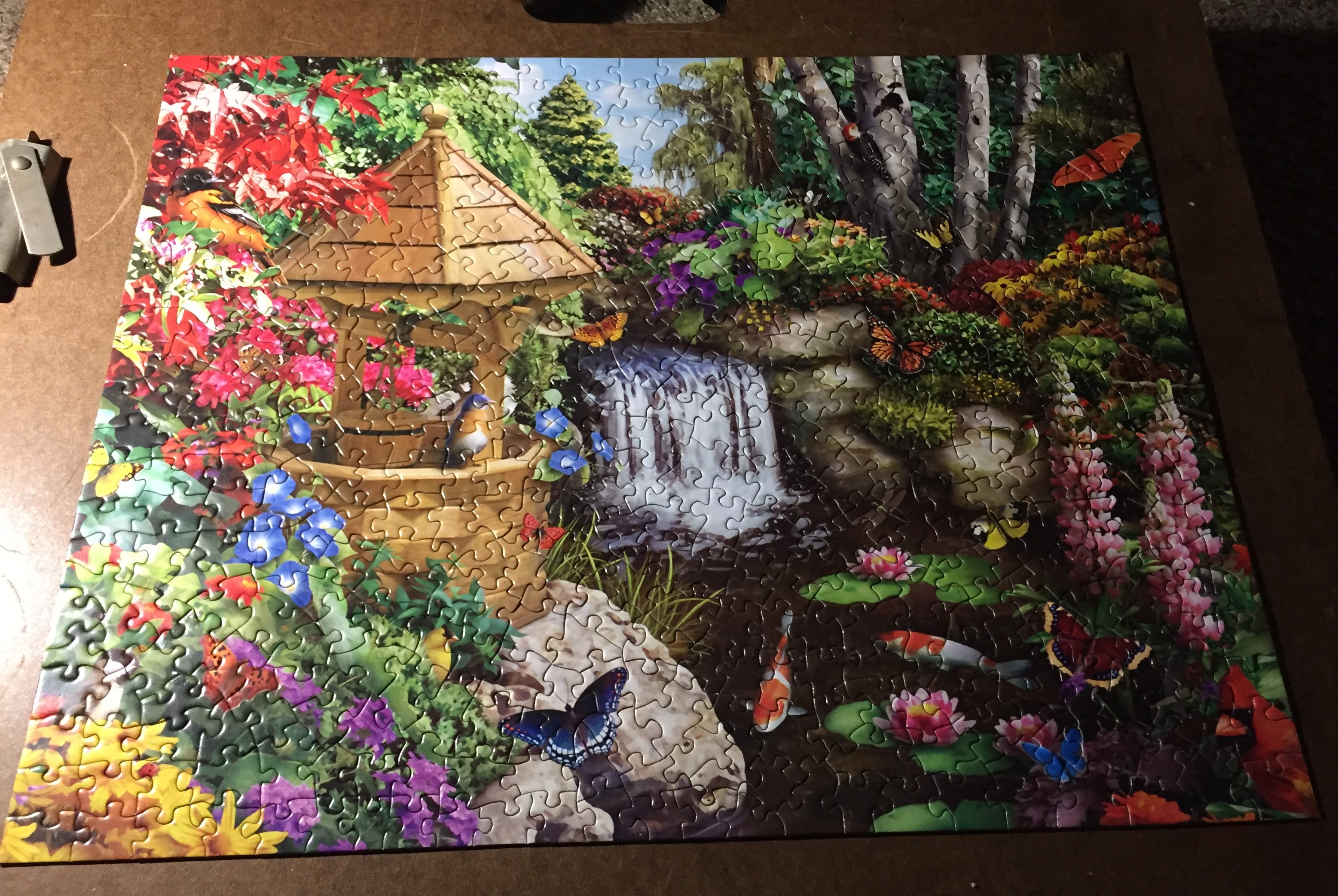
“Secret Garden” by Alan Giana (Bits & Pieces, 500 pcs, Amazon.com): I was looking for a peaceful oasis and this image fit the bill. I loved the flowers and flying creatures, but particularly the koi, which brought a special zen to the picture. (Bad lighting – doesn’t do it justice!)

Summer_Puzzle

“Marvelous Garden” by Oleg Gavrilov (Bits & Pieces, 500 pcs, Amazon.com): I love peacock blue, the architecture smacked of Tuscanny and the flowers (yes, pink ones) completed the scene. This remains my favorite puzzle to date.

Peacock_Puzzle

“Autumn Oasis II” by Alan Giana (Bits & Pieces, 500 pcs, Amazon.com): Autumn means that Halloween/Thanksgiving/Christmas are coming up soon, and after such a miserable year of fear and cancer treatments, I was so looking forward to a joyous holiday season.

Autumn_Puzzle

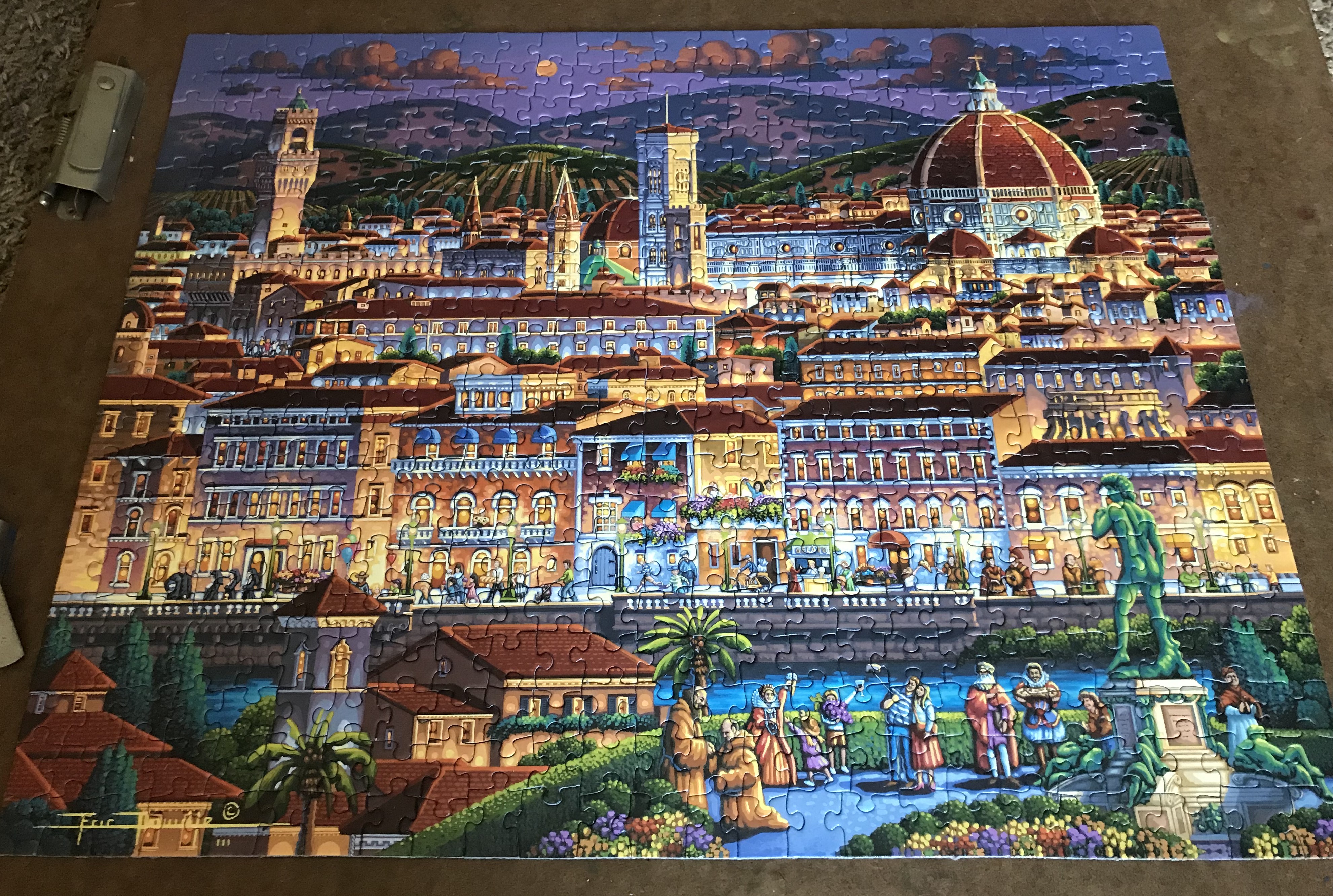
“Florence” by Eric Dowdle (Dowdle Puzzles, 500 pcs, dowdlefolkart.com but purchased at Costco): I missed visiting Florence during a European trip due to scheduling conflicts, but it remains one of my most-wanted cities to tour. Seeing Michelangelo’s David in person is on my bucket list! I particularly liked that this puzzle came with a little poster of the image that made putting it together a serene pleasure. The last thing you want is to get headache trying to match up teeny windows!

Florence_Puzzle