Another Oncology Visit and “Not Being Good Enough”

(Title image: Photo by Nik on Unsplash)

“I see pharmacological interventions in your future” is a paraphrasing of what my oncologist told me at my last doctor’s visit.

So let me back up a bit. I had my “eight-years-since-finishing-chemo” appointment with my oncologist last week. Things went the way they’ve been going for a while. He was very pleased with how things have been going and that made me feel very positive.

Certainly, I have my share of stressors churning at the moment, but most of them are not health-related. Most.

When my oncologist reviewed my bone density reports, however, he made the same prediction that he has during my previous two visits with him (see his quote above). The issue is that my bone scan in 2019 showed osteopenia, which I have to say is pretty weird given my lifestyle, which includes a lot of strength training. We both thought that perhaps it was an issue with the way the numbers were calculated.

Unfortunately, my 2024 bone scan showed a significant loss of bone compared to 2019. Enough to really concern my oncologist and befuddle us both.

So despite my living the lifestyle that medical guidelines say I’m “supposed to” live in order to stay healthy and strong, it’s still not good enough.

Tried as hard as you could? Well, too bad, try harder.
(Photo by Mads Schmidt Rasmussen on Unsplash)

This harkens back to what I experienced after being diagnosed with breast cancer. It seemed like I had done everything I could to lessen my chances of getting cancer, including things that should have been protective, but there I was, a breast cancer patient, and a young one at that (which, I later learned, what one of the reasons the risk factors didn’t necessarily apply to me, but I didn’t know that at the time).

It drove my perfectionistic mind haywire.

It brought on feelings of helplessness and even despair.

The only thing that gave me a bit of a lift was learning to meditate. Meditation imparted a sense that I had a teensy bit of control, if not on the situation, at least in the way that I reacted to it.

I got through that period of my life, brushed myself off and went on. And for a while, I was feeling blessed.

But cancer treatments have long-term effects. And the repercussions of being pushed through menopause and being on endocrine therapy eventually caught up to me. Physical movements that used to be easy started to hurt. I lost muscle mass…and apparently, I lost bone too. I felt like I was treading water with a weight tied around me.

Never good enough.

So I am bearing down and reworking my diet and exercise program even more. And to be honest, this is also an opportunity to shed some of my perfectionistic tendencies. While I want to feel like I am doing everything I can to help stop my bone loss and avoid taking medication for it, I need to learn to give myself grace. Sometimes even doing everything “right” will not be 100% successful, and I have to be okay with that.

“Dear Princess Kate, I Can Relate”

(Title image: Photo by Bence Balla-Schottner on Unsplash)

Over the last week or so, there have been a number of news articles focused on Catherine, Princess of Wales, who has been talking about life after finishing her cancer treatment.

She is officially in remission from her unspecified cancer, having completed chemotherapy. However, in a conversation on July 2 with hospital patients, staff and volunteers at Colchester Hospital in Essex (in southeast England), the princess noted that there was still more to endure once she was past her cancer treatment.

This is summed up from an article in USA Today (and numerous other outlets):

Kate described the cancer diagnosis and treatment as “life-changing” for both patients and their loved ones. “You have to find your new normal and that takes time … And it’s a roller coaster. It’s not smooth, like you expect it to be,” she said, according to the outlet. “But the reality is you go through hard times. … “You put on a sort of brave face, stoicism through treatment. Treatment’s done, then it’s like, ‘I can crack on, get back to normal,’ but actually the phase afterwards is really, really difficult.”

Wow, this is so relatable! I’m grateful that Kate is discussing life after cancer treatment, especially because she’s a highly public figure.

Many cancer survivors have experiences similar to Kate’s, particularly those, such as breast cancer survivors with hormone-positive cancers, who continue to take “maintenance” medications like tamoxifen and aromatase inhibitors. While many patients expect chemotherapy and radiation to be tough, they are often not prepared for the side effects associated with endocrine treatments that are prescribed to be taken for years after finishing everything else.

Princess Kate breaks with royal protocol in speaking frankly about the struggles following the end of cancer treatment.
(Video from TODAY)

But even without endocrine therapy, many cancer survivors are left with long-lasting side effects of varying severity. Some may be truly life-changing. Most of them will prevent a return to “normal” as we used to know it.

That normal, however, is what others may be expecting of you. Or you might expect of yourself. And that’s tough. Kate mentions the importance of reaching out for professional support if it is especially difficult to manage the phase following treatment, and I concur 100%.

Because it’s not simply the side effects…it’s the frustration that we feel with having the side effects linger. Or even the reactions of loved ones who don’t understand why things aren’t back to how they used to be. There is a grieving process associated with the loss of our previous lives that those around us may not appreciate, so I’m glad that Princess Kate is using her position to bring this out into the open.

Aging Muscle: After Cancer Treatment and Menopause [PHOTOS]

(Title image: Photo by Samuel Girven on Unsplash)

This is a reality check to demonstrate how, even with the greatest of intentions and planning, coupled with a serious love of exercise, you can’t turn back time.

And that’s okay.

But first, the comparison. Taken from this previous post, here’s a photo right before I started chemotherapy for triple-positive breast cancer, April 27, 2017:

April 27, 2017: I was exercising with a vengeance

After finishing chemo, radiation and Herceptin, AND after two years of estrogen-lowering Tamoxifen and a year into Letrozole, I’d lost some muscle even though I was lifting as heavy as I could.

This photo is from December 11, 2020:

December 11, 2020: Still exercising with a vengeance, but…

While I was still working out hard, endocrine therapy and menopause took their toll on my progress. Interestingly, estrogen is not simply a “feminizing” hormone; in women, it also helps preserve both muscle and bone mass. Menopause puts the breaks on estrogen production.

This becomes worrying as we age because less estrogen means weaker muscles which can lead to a greater risk of falls and chance of bone fractures. Endocrine therapy, which is designed to decrease the estrogen in the body in order to lessen the recurrence risk of hormone-sensitive breast cancer, adds to the problem.

And more than seven years after the top photo, this was taken today before posting, September 23, 2024:

September 23, 2024: New phone, different lighting (sorry!), more wrinkles, same moles. I’m working hard just to keep what I have, but loss is inevitable.

I’m still lifting but the entire landscape of my workout routines has changed. I have to give myself more recovery time between strength training sessions. I am much more susceptible to injuries—seriously, I can tweak something by turning or stretching out in a weird way. I have neuropathy in my feet which makes getting up on my toes (such as in plank or doing lunges) painful.

We recently had an intense heat wave: for a week the temperature inside our apartment didn’t fall below 80F degrees, and during the day it climbed as high as 95F degrees (again, INSIDE our apartment). I managed to work out through a chunk of that week, but the heat eventually got to me. And recovering from that took almost another week.

So, the spirit is willing but the flesh is barely managing at times.

However, there is an upside to being 58 years old with a lifetime of fitness experience. I still love working out. Even tough training sessions are manageable because they feel like an awesome accomplishment, and I feel bouyed afterwards.

Even on the days that I don’t do a formal workout, I make sure that I’m moving as much as I can. Fitness is an integral part of my life, even though it looks different now than it did seven years ago. In the post that I reference earlier, at the very bottom I wrote about how yoga was becoming a larger part of my life.

And that’s continued. Through my yoga teacher training in 2022 and upcoming yoga4cancer advanced training starting in January 2025, this direction feels so right for me.

While I don’t plan to give up my gym sessions anytime soon, yoga has given me a path to physical and mental fitness as I age. I am gradually moving into a more meditative approach to exercise that is less about intensity and more about staying healthy by integrating mind and body.

Cancer Survivorship Ain’t For Sissies

With all the focus on breast cancer during October, pushing us to be warriors and fight our way through this, the concept of survivorship can get lost in the fray.

We talk about cancer treatment and get very granular about the procedures, whether surgery, chemotherapy or radiation therapy. And those do deserve a lot of discussion as they can be difficult to endure. Some, like chemo, have an almost legendary reputation and it’s important to be able to separate fact from fiction.

After all the noise and attention associated with cancer treatment, survivorship can leave some of us feeling alone.
Photo by Atharva Tulsi on Unsplash

Consider: how many of us, upon hearing that we have breast cancer, preoccupy ourselves with worrying about what life will be like five years down the road? More likely, we’re thinking about what treatment will be like and are hoping that we’ll be around when it’s done!

But with so many women surviving breast cancer, it’s important to talk about what happens after the dust settles and you realize you’re on the other side of the treatment that you had so feared. Is it really the “other” side?

So much of my blog has been devoted to the life after cancer. After I documented my treatment journey, I turned around to get hit in the face with all the stuff that I wasn’t expecting.

One of those was endocrine therapy. Women with hormone receptor positive cancers aren’t done when the “tough stuff” is over. Tamoxifen and aromatase inhibitors are a whole new round of treatment that can affect your hair, your libido, your joints and more. Some women get hot flashes and night sweats. Some experience weight gain. And these are medications intended to be taken for a number of years.

There may be body image issues. Breast cancer surgery can leave women looking very different from their pre-cancer days. Like it or not, breasts are associated with womanhood. Whether lumpectomy or mastectomy, with or without reconstruction, there is a new normal that needs to be dealt with.

By seeking support and relating your story, you help not only others who are dealing with something similar in addition to yourself.
Photo by Ivana Cajina on Unsplash

And then cognitive issues like distractibility, loss of memory and difficulty processing concepts may come up. To make things more complicated, these may appear after treatment is in our rear view mirror and our loved ones may simply not appreciate what we’re dealing with. The bodies and minds of survivors may change in a way that they are not prepared for. Because, how do you anticipate something like this?

Survivorship does not mean that you never again have to think about cancer or its repercussions. There will be adjustments to your expectations as to how your life will be from now on. It’s important that those around you understand that just because you are done with the major cancer treatments, things might not feel familiar or normal.

So we need to be having this conversation with those around us and making opportunities for affected women to seek help and support. There is no shame in being a survivor who is also struggling. While it’s true that we are “lucky to be alive”, it does not mean that we have no right to seek a higher quality of life.

Don’t be afraid to talk about it. ❤

No More Sticky Fingers!

Running late with this post as I’m furiously cleaning our apartment in advance of the Christmas holiday!

I noticed a few mornings ago that when I made a fist and then straightened the fingers of my right hand, the joints didn’t stick at all.

It took over 300 days…but I’m happy to celebrate the end of the side effects!

While this may seem like an odd thing to celebrate, it marked a milestone for me. This was the last side effect attributable to letrozole that I had been experiencing, and it was finally gone. Letrozole is an aromatase inhibitor that blocks production of estrogen and is used as endocrine therapy for breast cancer patients who have estrogen receptor-positive tumors. I’d been on it for about 14 months after switching to it from tamoxifen.

For reference, as of today, I am at Day 307 since stopping the medication, so it’s taken quite a while for this joint side effect to subside. Yes, there are other things still plaguing me, such as memory issues, low libido and difficulty maintaining muscle (even with strength training), but those are more difficult to separate out from the garden-variety effects of menopause.

The sticking fingers began in August 2020 (about 8 months after starting letrozole) and were getting progressively worse. By March 2021, when I called it quits with the endocrine therapy, a number of finger joints were sticking and painful, particularly in the morning.

At that point, I was having trouble getting up off the floor, as I was having issues with joints throughout my entire body. The medication was affecting various aspects of my life, making it difficult to exercise and, as I like to put it, lowering the quality of my existence. Following discussions with my oncologist, we both agreed that my risk of breast cancer recurrence was low enough to stop the meds.

It’s been quite a journey to get to the point where I am now.

Shaking this last side effect of letrozole reminded me how far on this cancer journey I’ve traveled. There have been so many ups and downs, friends made and friends lost to the disease, that it was easy to forget that nothing in life is permanent. Time passes and situations change, sometimes for better, sometimes for worse.

The concept of “CANCER” used to terrify me, and after I was diagnosed, I hit a low so deep I thought I’d never be able to crawl out of it.

Gradually, as my experience with the disease played itself out, I came to accept the uncertainty about the future. As the end of 2021 draws near, I inch closer to the 5-year survival mark. The fact that I can straighten my fingers in the morning without any pain or sticking is a perfect example of how while I cannot know what the future will bring, I can deal with the “now”. And this “now” is not so bad.

~~~~~~~~~~~~~~~~~~~~~~~~~~~~~

Best wishes to everyone for a very Joyous Holiday Season and much promise for 2022!

After My Last Oncologist Visit, I Fell Off A Cliff

I had an oncologist appointment last Thursday that marked four years of being done with chemo for breast cancer.

During my previous onc visit in February, I had been a mess: depressed, stressed and miserable with joint pain and a feeling that my endocrine therapy was taking away from me more than it was giving me. At that point, he let me stop the aromatase inhibitors.

Now, half a year later, I felt so different. My blood pressure was 118/83, much lower than the 130s and 140s systolic numbers I was hitting after stepping into the exam room on previous visits. I was peaceful and more hopeful.

We discussed all sorts of “survivor” things. The joint pain had mostly resolved itself and was no longer a hindrance to exercise, one of the things most important to me. My libido could have been higher and my short-term memory was often lacking, but he felt that could also be attributable to working and sleeping in the same room for the past year and a half, coupled with menopause.

Finally, my doctor noted that it was time for another chest MRI. Not the most comfortable of scans, but I’d done it once, I could do it again.

I would love a pet, even if it means having to clean fur out of my keyboard.

It was not until around noon of the next day that I suddenly plunged off a cliff. I was talking to my daughter and randomly mentioned my willingness to look after any pets she might have in the future when she’s living on her own, were she to travel for work, because where we lived now we weren’t allowed to have pets…

…and I was slammed by a massive wave of sadness and regret.

My thoughts zoomed back to my first chest MRI, stripped to the waist, lying on my belly, arms stretched over my head, frightened and painfully vulnerable. All my focus was on breast cancer and what other horrible realities the MRI would reveal. All I could think of was surviving my upcoming treatments.

That MRI meant that my life was on hold. There would be no progress in my career for the foreseeable future, and no chance of moving into a bigger place, one that would allow us to get a cat (note: I’m a dog person, but I would have been happy with a cat!). Animals have always been a part of my life, but our apartment rules prohibited them. I yearned for the chance to have a pet again. It seemed such a small thing to ask, but even that wasn’t available to us now.

That brief discussion with my daughter underscored a profound feeling of loss and despair. Cancer had robbed me of a lot of things in my life that others took for granted.

This was my view before I realized I didn’t have to sit there.

And as I sat there in the depths, I forgot that time does not stand still, things are always changing, nothing is permanent…and I have inside me everything I need to climb out.

Curiously enough, I had recently attended a talk on managing anxiety aimed at cancer patients and survivors. The counselor who presented the information was herself a breast cancer survivor and she told us a story of doing a follow-up chest MRI, which she found very stressful. Afterwards, she was asked by one of the cancer nurses what sorts of mental tools she had used while in the MRI tube to calm herself down. At that point, she realized that even though she taught these techniques to her patients on a daily basis, she had completely forgotten to use them herself!

I had been sitting in the darkness for a few minutes when I remembered her story. Most importantly, I remembered that I didn’t have to feel this way, that it served no practical purpose and that I wanted be happier. The only reason I felt like this was because these emotional plunges had been a habit of mine.

So I twisted a rope out of all those grounding techiques that I’ve posted about and pulled myself up.

~~~~~~~~~~~~~~~~~~~~~~~~~~

True, I still didn’t have a cat. But I was able to take a deep breath and realize that at least I had a future. And that future might contain a cat.

“The Gun Show”: Assessing Biceps Muscle Loss Due To Endocrine Therapy [PHOTOS]

In my last post, I whined about the repercussions of taking aromatase inhibitors (in my case, letrozole) as a way to diminish the amount of estrogen in my body, for the purpose of reducing the risk of breast cancer recurrence.

While I also mentioned letrozole’s effects on my exercise habits, in this post I wanted to drill down on one aspect in particular: muscle loss.

Before I go further, I need to add a disclaimer. Since the time the first photo was taken (the morning before my first chemo infusion), three and a half years passed and I went through menopause. Notably, the menopause was pharmaceutically-driven, starting with tamoxifen and then, after my hormone levels were low enough, continuing with letrozole. However, my body now is dealing with the same aging effects as someone who had transitioned naturally.

Except that my transition came before its time.

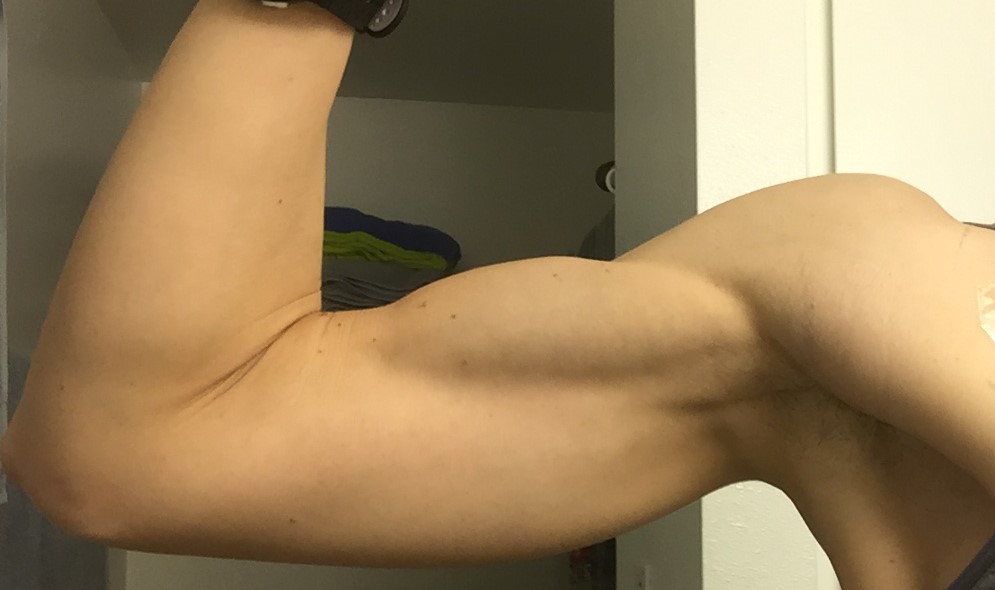
The below photo is from April 27, 2017, before I headed to the infusion center for my first dose of chemo. I had been training as normally as I could, under the conditions of lumpectomy and port placement that I wrote about here, and finding work-arounds for exercises that I’d been told not to do.

This is my 51-year-old biceps muscle, before I started the pharmaceutical portion of my breast cancer treatment.

While I lost some size and strength throughout my chemo infusions (here are all the photos), I was able to bounce back and had a particularly strong 2018 (sorry, don’t have good photos of that). But as the endocrine therapy with tamoxifen continued in 2019, to be replaced by letrozole in 2020, I could feel the effects of low estrogen.

On December 11, 2020, I struck the same pose again for sake of comparison.

Is something missing? This is my 54-year-old biceps muscle, struggling to keep up. Note: I am still working out as hard as I can!

As far as muscle appearance is concerned, I have experienced a slow downhill slide. My shoulder is not as peak-y, the biceps itself has decreased in size and I even find it more difficult to hold this muscular contraction. In addition, there’s more looseness in my skin, particularly at the back of my arm, which in part may be due to loss of collagen, also affected by estrogen levels (nice dermatological review by Shah & Maibach, 2001, Am J Clin Dermatol).

I’m busting my butt trying to increase the amount that I’m lifting, but I’m not making progress. Not surprisingly, the decrease in estrogen plays a role in this. As stated by Chidi-Ogbolu & Baar (2019, Front Physiol), “estrogen improves muscle mass and strength, and increases the collagen content of connective tissues”.

It makes sense then that lack of estrogen is going to be detrimental to maintaining muscle. To that point, Kitajima & Ono (2016, J Endocrinol), working with animal models, have found that “estrogen insufficiency leads to muscle atrophy and decreased muscle strength of female mice.”

Not just mice, obviously.

This information comes as no surprise to any woman who’s gone through menopause, I’m sure. But the experience of being slammed through menopause instead of having the opportunity to transition more gradually is yet another frustrating way that having cancer pulls the rug out from under you and reminds you that you are not in control of your life.

~~~~~~~~~~~~~~~~~~~~~~~~~

Slowly, yoga is becoming more important in my life and my view of fitness is changing. Good thing too, since I can’t keep beating myself up like this.

Hanging Tough With Letrozole — Or Not

There seems to be so much back-and-forth in the life of a breast cancer survivor. I really thought things would settle down eventually, but it seems like they refuse to.

The ultimate goal, of course, is to squash the risk of cancer returning, but the way medicine goes about it is not always kind to the patient.

Let’s back up. First, there’s the shock and anxiety of being told you have breast cancer. Because the average age at diagnosis for women is 62, most of these women grew up at a time when cancer was strongly linked to death. While treatment, and therefore survivability, has greatly improved in recent decades, a cancer diagnosis is still frightening.

That life-saving treatment comes with a reputation for nastiness. Surgery seems like the easy part; it’s the chemotherapy and radiation that we’ve heard horrible things about. I myself had six infusions, each three weeks apart. I assure you, I memorized the calendar, knew the dates of the infusions and the order of my drugs. Even about what time each one would begin on the infusion day. I counted the minutes to the end. Then came radiation, but that seemed like a cake walk in comparison.

Once through ALL of that, you figure that the treatment portion of your cancer is over and you have the rest of your life to ride into the sunset, basking in the warm glow along the way.

But for those of us with hormone receptor positive (HR+) cancer, there’s this little thing called endocrine therapy that seems like an afterthought when you’re going through the “tough stuff”.

Yeah, you think you’re done, but then you realize, there’s more…

Yet it does feel like a slap in the face when you’re “done”, because you’re not really done. And that’s where we find out that while chemo and radiation were the “running the gauntlet” phase of cancer — abusive, but time-limited — for many, the hormone therapy afterwards is like doing the Ironman triathlon. Except the water, bike and road are on fire. Because it’s hell.

Okay, about here is where I have to stress, my experiences with tamoxifen and the aromatase inhibitor letrozole (Femara) have not been as brutal as for other women. At the same time, they’ve not come without complications. Currently, I’m dealing with painfully stiff joints, weird bone pain, loss of libido (hubby’s fave), hair thinning (grrrr, I thought I was done with this when I finished chemo!), memory issues (wait, what?) and other side effects that I’m pretending I can ignore.

On the bright side, it is gratifying to know that what I’m experiencing is not all in my head, nor is it as bad as it could be. In fact, I found a valuable post (one of many!) on the blog Nancy’s Point, entitled “The Dark Side of Aromatase Inhibitors“. Not only is the post a great read, but what makes it so eye-opening is the comments section. Nancy invites readers to share their experiences, and wow, do they!

If you choose to venture there, keep in mind that everyone reacts differently to these medications. People with negative reactions may be quicker to share than those with less extreme reactions.

So if you’ve been told that you need adjuvant endocrine therapy following the “main” cancer treatments, do your homework. PLEASE know that not everyone has miserable side effects from them, and I strongly urge you to give the medications a try to see how well you tolerate them. You may surprise yourself. Note what side effects you’re experiencing and the date of onset so that you verify that the reaction is related to the drug.

Then, if you truly cannot handle the discomfort (no shame there!), you will be able to show why. Discuss other options with your medical team. Whatever amount you were able to tolerate will offer you that much more protection, and that will still benefit you.

For everyone else, hang in there!