As I’m stumbling through a bad cold, I got a reminder that you can find good stuff in bad situations.
Let me see if I can string this together somewhat coherently…
The cold I have came with an eye infection (relax, not posting pics!) that makes me light-sensitive enough that I need to be chauffeured around. Went to the doc last week, got a prescription for eye drops, then swung by to do some shopping, which I needed to wear sunglasses for.
And as I’m picking my way through a busy Costco, I’m holding onto a phone that I just bought–has a case but no screen protector yet–and I’m really worried that I’m going to drop it or lose it if I get distracted.
And why do I get distracted? Because anxiety and a touch of chemo brain (aka Cancer-Related Cognitive Impairment (CRCI)) have a summative effect that makes me loopy. Not a “scare-your-children” kind of loopy, but a constant “what-was-I-just-doing” kind of loopy. Over and over and over again.
I’ve been dealing with this over the past couple of months while juggling stressors. My eye infection introduced a new wrinkle–I am very much a visual person and use visual cues to manage the anxiety/CRCI problem.
But the good news? The Memory and Attention Adaptation Training (MAAT) classes I took for managing CRCI focused on mindfulness as a way of dealing with the lapses in memory.
And when I was in a Costco bathroom stall, I realized that I was acutely aware of where all my things were–purse on the door hook, phone on top of the toilet paper dispenser. I was ALL THERE and 100% present. I couldn’t afford not to be.
Not an earth-shaking revelation, but it was another reminder that there are all sorts ways to ground ourselves in the present. If I hadn’t taken the MAAT class I don’t think I would have felt so confident that what I was doing (being mindful) would work so well to help me stay focused and aware.
So, yes, I can be grateful for chemo brain for that.
~~~~~~~~~~~~~~~~~~~~~~~~~~~~
Today my vision has improved to the point where I can tell that the kitchen floor is really dirty, and that is most unfortunate indeed.
Apologies because this might sound like a rant but this topic has been on my mind a lot lately.
When you’re diagnosed with cancer, you learn about the many side effects of treatments.
You will be informed about the physical and even psychological effects that cancer patients deal with, but there are also considerable financial repercussions. Patients may struggle with hospital bills: some lose their insurance coverage, others might never have had any to begin with, those who have coverage may find that it’s insufficient. It’s not uncommon to hear how cancer has driven survivors and their families into bankruptcy.
On top of that, cancer can do a number on your career aspirations for years to come.
Money issues are one of the side effects of cancer that don’t get a lot of airtime…but really should. (Photo by Alexander Grey on Unsplash)
In case you think that it’s uncool to complain about one’s career in the face of having survived cancer, let me get this out of the way: being a cancer survivor is a privilege. I’ve written before about how acutely aware I am that I have lasted longer than many cancer patients.
But as the effectiveness of cancer treatments improves, the number of cancer survivors increases and long-term repercussions become a more and more serious consideration, particularly how they affect ongoing quality of life.
For people who are still working out their careers, cancer can derail progress because it plants a huge stop sign in their path.
Think of going into the chemo infusion room: the days leading up to it entail appointments, port placement, purchasing supplies (anti-emetics, anyone?) and in general prepping for being out of commission about a week.
It’s not the time to focus on stressful work deadlines (and most sincere condolences to any patient who has to do that!).
Ironically, as much as I feared infusions, they actually gave me an excuse to focus on myself instead of worrying about everyone else. I posted about that here somewhat sadly that chemo allowed me to rest without feeling guilty.
It was at that point that I’d realized I’d been pushing myself, always expecting more and not feeling like I was measuring up. Chemo gave me a break from that. Which was good…kind of…
But after chemo and radiation came endocrine therapy, so just as I was winding down from one set of side effects, up popped another.
And all those plans I’d had for myself were put off again and again. Career goals seemed more out of reach because my timeline had shifted.
Well, I’m not stupid, so I changed my career goals. Makes sense, right? Cancer provided a different perspective on things and motivated me in another direction.
But in the wake of cancer treatment, I feel like I’m walking in cement shoes…if it’s not one thing it’s another. I got off aromatase inhibitors (early) and then realized that I was having memory and focus issues. Whether Cancer Related Cognitive Impairment (CRCI) or menopause-driven brain fog, all of a sudden I’m dealing with something else.
It feels as though the train to prosperity has left the station and I was just a little too late to catch it.
Great.
Right now I’m looking at sky-rocketing costs-of-living in a part of the country that literally got expensive around me. Instead of moving up in the world, my family and I are desperately searching for less pricey housing which will put us in worse conditions and a longer commute to work.
And at age 57, when most of my friends are looking at enjoying retirement in the years to come, planning for what they’ll do in their golden years, I’m trying to reeducate myself, shifting into a career that doesn’t make much use of previous work experience.
And it feel exhausting. Sometimes I want to cry.
I want to believe this, I really do. But I don’t think that there’s a reward for surviving cancer beyond simply surviving cancer. (Photo by Nik on Unsplash)
Yes, I’m happy to be alive. But no, this was not the way I thought things would go. When initially I was told that I had a decent chance of surviving for five years, that was all I could think about. In fact, that was all that mattered.
I wasn’t thinking about the fact that if I managed to live through this, I’d still need to find a way to make a living. And the interruption that was cancer could do a number on that.
At this point, I need to stress that my intention is *not* to try to scare cancer patients into dreading survivorship. Goodness knows, there are enough things to navigate within the cancer experience as relate to the usual treatments that will take your energy and attention.
I wish nothing less for you than 100% remission and many years ahead to enjoy your “survivor” label.
At the same time, I encourage you to remain present and mindful of the fact that you might have to pivot if you’re not already well-established in your career. If things start to change in a direction that’s southward of what you expected, be patient and readjust your expectations. Nuture acceptance and keep an eye on how you can put yourself in a good position to meet the future. And be kind to yourself.
With all the focus on breast cancer during October, pushing us to be warriors and fight our way through this, the concept of survivorship can get lost in the fray.
We talk about cancer treatment and get very granular about the procedures, whether surgery, chemotherapy or radiation therapy. And those do deserve a lot of discussion as they can be difficult to endure. Some, like chemo, have an almost legendary reputation and it’s important to be able to separate fact from fiction.
After all the noise and attention associated with cancer treatment, survivorship can leave some of us feeling alone. Photo by Atharva Tulsi on Unsplash
Consider: how many of us, upon hearing that we have breast cancer, preoccupy ourselves with worrying about what life will be like five years down the road? More likely, we’re thinking about what treatment will be like and are hoping that we’ll be around when it’s done!
But with so many women surviving breast cancer, it’s important to talk about what happens after the dust settles and you realize you’re on the other side of the treatment that you had so feared. Is it really the “other” side?
So much of my blog has been devoted to the life after cancer. After I documented my treatment journey, I turned around to get hit in the face with all the stuff that I wasn’t expecting.
One of those was endocrine therapy. Women with hormone receptor positive cancers aren’t done when the “tough stuff” is over. Tamoxifen and aromatase inhibitors are a whole new round of treatment that can affect your hair, your libido, your joints and more. Some women get hot flashes and night sweats. Some experience weight gain. And these are medications intended to be taken for a number of years.
There may be body image issues. Breast cancer surgery can leave women looking very different from their pre-cancer days. Like it or not, breasts are associated with womanhood. Whether lumpectomy or mastectomy, with or without reconstruction, there is a new normal that needs to be dealt with.
By seeking support and relating your story, you help not only others who are dealing with something similar in addition to yourself. Photo by Ivana Cajina on Unsplash
And then cognitive issues like distractibility, loss of memory and difficulty processing concepts may come up. To make things more complicated, these may appear after treatment is in our rear view mirror and our loved ones may simply not appreciate what we’re dealing with. The bodies and minds of survivors may change in a way that they are not prepared for. Because, how do you anticipate something like this?
Survivorship does not mean that you never again have to think about cancer or its repercussions. There will be adjustments to your expectations as to how your life will be from now on. It’s important that those around you understand that just because you are done with the major cancer treatments, things might not feel familiar or normal.
So we need to be having this conversation with those around us and making opportunities for affected women to seek help and support. There is no shame in being a survivor who is also struggling. While it’s true that we are “lucky to be alive”, it does not mean that we have no right to seek a higher quality of life.
So, as I’ve written about in previous posts (here and here) there’s this thing called ‘chemo brain’, and contrary to what you might find when you google it, it doesn’t necessarily go away after you finish cancer treatment. It also has a longer name: Cancer-Related Cognitive Impairment (CRCI).
This can be particularly frustrating for those of us who are expected to perform “as before” (meaning, prior to getting cancer) and yet increasingly fall victim to distractions, searching for words, forgetting things as soon as we’re told them, and in general, wondering whether we’ve now come down with a mix of dementia and ADHD.
You’ll need more than a bouquet of forget-me-nots to navigate post-cancer issues like CRCI. Classes like MAAT can help.
There is help, however, and it’s arrived in the form of a class called Memory and Attention Adaptation Training (MAAT). I had the opportunity to take this 8-week class in Fall 2022 and it recently concluded.
The class is intelligently put together, first showing students the science about what they are experiencing (and that it’s not early-onset dementia!), and then over the next two months, teaching tricks and techniques for helping navigate the new landscape of CRCI.
This includes learning stress management techniques, improving sleep and pacing oneself, making self-care a high priority. But the majority of the class was devoted to learning how to use methods such as rehearsal/repetition, situational awareness, scheduling, distraction reduction, active listening and imagery. These help us maintain focus and retain information while reducing overwhelm.
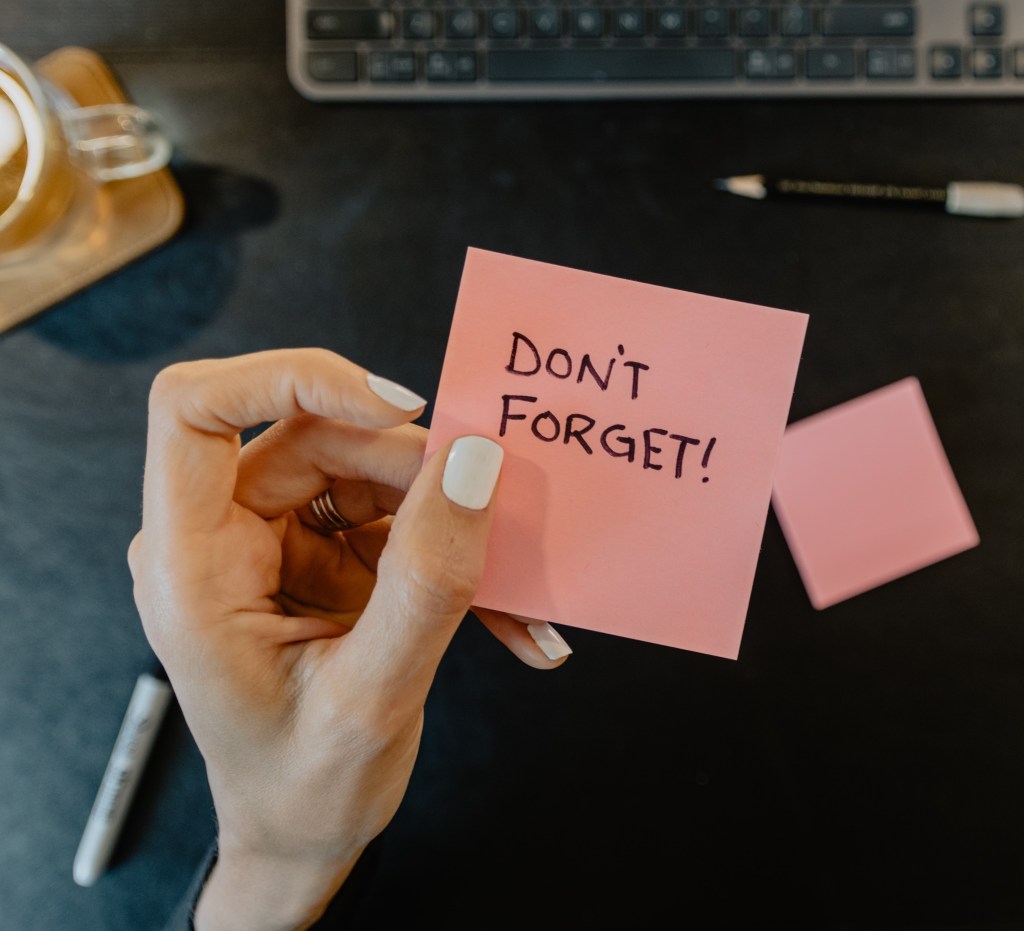
It takes more than littering your desk with post-it notes. We need to create an environment that supports memory storage and distraction reduction.
I took the class through SHARP Hospital in the San Diego, CA area as part of their second cohort. It was taught by a clinical oncology social worker (herself a breast cancer survivor) and a speech pathologist, and their expertise made the class even more worthwhile. While the first cohort was in person, we in the second cohort had the benefit of taking the class via Zoom, which helped with accessibility, especially for those of us who are still working.
And a number of us there were already about 3-5 years out of treatment, which dispells the notion that chemo brain only lasts during treatment. Our cohort members’ ages ran the gamut from early 30s to well into retirement, illustrating that CRCI can show up in any cancer survivors regardless of age.
Realizing that this is affecting many more people that have been reporting symptoms, the SHARP Health Care system has opened the classes to individuals in other health systems in the San Diego area.
No matter where you live, if you are a cancer survivor experiencing some form of cognitive impairment, I urge you to 1) tell your oncological team (They need to know this is happening!) and 2) ask them about the availability of MAAT classes in your region. MAAT is not currently being offered widely, so please make your needs known so that this service can be expanded to those who need it.
~~~~~~~~~~~~~~~~~~~~~~~~~~~~~~~~~~~~
Curiously enough, one of the first assignments we had in the MAAT class was to work with gratitude – yes, it really does help! Such a perfect practice to begin at this time of the year! Happy Holidays to all! ❤










 Frantic Shanti