I have beside my bed a 7-day pillbox. Since I avoid taking pills whenever possible, opting for alternatives to medication, there is only one lonely but mandatory pill in each little box corresponding to the day of the week.
That’s tamoxifen, a final remnant of breast cancer treatment that I’ll be taking for years to come.
I observe the passage of time by the disappearance of the daily pills. They mark the days that I work and the days that I don’t (weekends and Wednesdays). Sunday mornings the pillbox is full. The work week looms before us bringing early mornings and sleepy heads. Wednesday provides a brief respite with an extra hour of sleep and a day crammed with personal errands at home rather than office work. When Thursday rolls around and I return to my job, only the Friday and Saturday pills are left until it’s time to refill the box again.
Days melt into weeks, weeks into months. Make them count.
The weeks seem to go by more quickly as I get older. Time feels slippery and days fuzz into the background. Weeks pass into months as pills are consumed. I’m unsettled by the possibility that when my decade of tamoxifen ends, I’ll realize that I spent ten years waiting the pills to finish and missing what was going on in the moment. It frightens me into wanting to distinguish this week’s row of pills from the next, to make next week different from the last.
I pause as I plop a fresh row of pills into their designated boxes. Could I be kinder to those around me? React more calmly? Sleep better? Support the needs of others more? View my shortfalls with compassion?
Every morning I am able to get out of bed and place my feet flat on the Earth. That is something to be very grateful for, no matter how difficult my week. I represent the fortunate ones who have been given the opportunity to remain alive and present in “now” and appreciate every precious day more than the one before.
Setting time aside for formal meditation is important to me, but what about the hours of the day that I spend off my cushion? As dedicated as I am to my meditation practice, it took a while to find a way to consistently bring mindfulness into the rest of my day.
My workplace was offering an informal program through a Canadian company called MindWell-U, and since I’m always up for trying out anything mindfulness-related, I signed up.
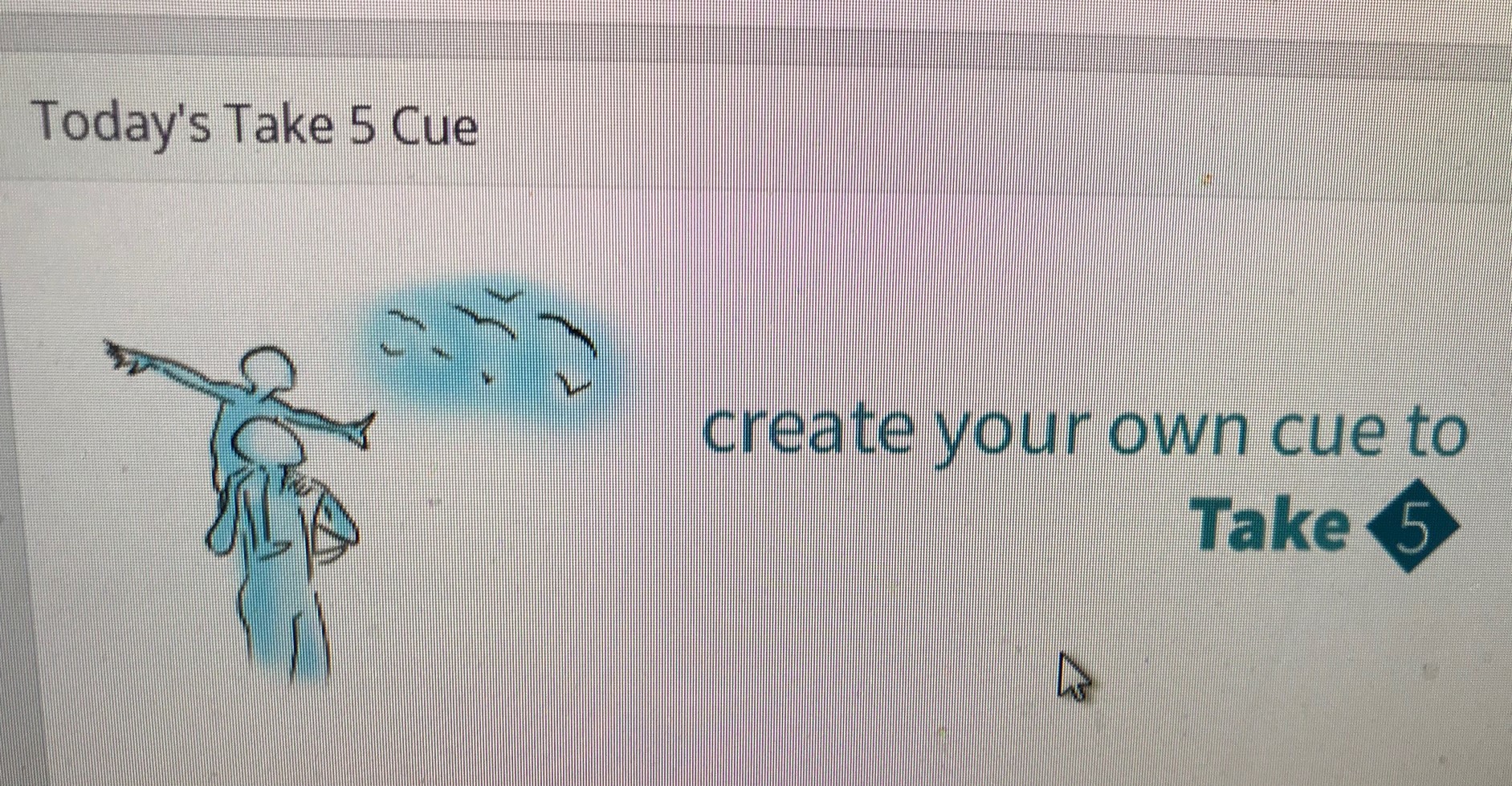
The loading screen of my MindWell-U account. This provided an opportunity to set an intention for the session.
The concept is called “Take 5”. Over a period of 30 days, you are provided a daily computer-based lesson that illustrates different aspects of mindfulness. More importantly, every day you also receive cues to remind yourself to “Take 5” – that is, to take a time-out, settle and focus on five deep breaths. You are provided “Take 5” guidance via a sound clip. As the days progress, the types of cues change. The idea is to notice the present and stay as mindful as possible, establishing space between yourself and emotional reactions.
During every lesson, the program suggested cues for the day (for instance, brushing your teeth) to use to stop and notice where your thoughts are. These changed as the days passed, and by the end, we were encouraged to create our own cues.
Aspects that made a huge difference to me:
1) Incorporating mindfulness into everyday life: When I wasn’t meditating formally, I would often get lost in day-to-day stressors. The cues provided by the “Take 5” protocol, simple as they were, were what I needed to bring mindfulness into the rest of my life. It also made me more aware of where I already was being mindful, even when I didn’t identify it as such.
For example, when I exercise I have no problem staying present during difficult workouts, and this makes them easier to complete. One benefit of this awareness is that I am more compassionate towards those who are not able to maintain the same focus and I appreciate why they may “psych themselves out” before they’ve even begun exercising. This kind of understanding makes me less judgmental.
An example of one video that provided easy-to-follow messages which reinforced the benefit of being mindful.
2) Daily video clips: These were minimalistic illustrations, using the color red to signify getting swept up in thought and emotions, and a cool blue to signify being mindfully present. Topics were relevant, the videos were entertaining and short, and were in small enough bites to provide something to work on for the day without feeling like an obligation. Examples of daily lesson topics: “Thoughts Are Not Facts”, “Reversing The Stress Response”, “Turning Off Autopilot” and “Fight, Flight or Take 5”. I found myself looking forward to each session, which I completed in the morning at my desk, prior to the start of my workday.
A sticky note on my computer monitor reminding me to be present by pausing, taking some breaths and feeling into the moment.
3) Time frame: 30 days is the perfect length of time for creating a new behavior. Again, I already had a solid meditation practice in place; the trick was to take that mindful attitude with me and apply it to the rest of my life.
Important (and sobering) note: it bears mentioning that mindfulness has taken off and is currently being applied to all aspects of our lives, often being a huge money-maker for providers. I myself have invested in programs and classes in the name of getting solid guidance to develop my practice. Ironically, this seems to go against the concept of mindfulness itself, which truly should be available to all, regardless of ability to pay for shiny apps and expensive sessions.
Furthermore, isn’t it antithetical to the Buddhist tradition for companies to encourage their employees to take such classes with the expectation that a more mindful workforce will ultimately result in higher profits?
While I am grateful for any opportunity to expand my mindfulness meditation practice, the above gives me pause. My intention, then, is to use tools like these that further my growth in a way that will also benefit those around me.
The glorious part of meditation is the opportunity to still my swirling thoughts and focus on breathing. At those times when my mind is still and the brain noise settles, my creative voice speaks most clearly.
This would be wonderful if not for the fact that, whether due to chemotherapy or my daily tamoxifen, my memory has been affected, rendering fleeting thoughts truly ephemeral. I can have a brilliant inspiration…and then *poof* it disappears. There is no guarantee that it will circle back around, and if it does, it may take a long while.
I try not to focus on these thoughts while meditating, but unlike other people who may easily remember their ideas once the session is over, I will not. This is problematic, as there are things that I must recall (like relaying important information or completing a task that I’d forgotten).
I can still seeeee yoooooou, little fly…
This can be distressing. In an unconscious effort to not forget, I find myself gently rolling the thought around in the back of my head during the session. I become like a spider, with the thought being a fly that I’ve caught. As I sit, I spin silk around my prize, gently holding it with spindly legs, trying to keep the thought away and yet not forget about it. Breathing is my focus, but that little fly is in my periphery and I keep glancing at it.
Obviously, this still interferes with my meditation. I don’t want to let my morsel go, and yet keeping it in sight is disruptive. I hold on too tightly.
So I have decided that given my current situation, I will make the best of it. If a critically important thought comes up, I will honor it and stop the meditation briefly…and write it down. This way it is secure and I can release the stress of possibly forgetting what it is and go back to meditating fully. In the event that my “great ideas” keep coming, perhaps that’s an indication that completely releasing focus on my thoughts is not the best idea at that time. And I honor that, too. This way, my meditation sessions remain about being in the present rather than losing parts of my future.
I’ve accepted that flexibility is necessary to respect both my individual needs and my meditation practice.
In my last post, I sang the praises of the Calm phone app. However, I admitted that a number of the features are only available to users who subscribe. This was an investment I chose to make because I was dealing with a cancer diagnosis and needed quality meditation support to help with my anxiety.
The opening screen has a peaceful minimalist look.
I also didn’t know about Insight Timer at the time.
For those who are looking for more free options, you’d be hard-pressed to find a better mindfulness phone app than Insight Timer, which I have grown to value highly and use daily. While the app does have a subscription option, I’ve been thoroughly impressed with what it offers to unpaid users.
These are the features that I adore:
1) 15,000+ Meditations! That’s gotta be some sort of record. And there are new meditations being added all the time, which means that you could do a different meditation every day. I constantly keep finding new favorite meditations…
This is just a partial view of the most popular meditation selections. There are so many more to choose from!
2) Variety, variety, variety! The number of options is mind-boggling. Choose from different teachers, lengths, recording types (meditation, music, lecture), and of course, a gazillion categories that encompass any imaginable meditation benefit, origin and practice, not to mention an increasing number of languages — I speak a rather esoteric language from a small country and was still able to find a couple of meditations in the lingo. Truly, it’s worth searching through the app to see what a broad selection is available. If you’re interested in meditating to it or about it or because of it, chances are Insight Timer has it.
The meditation timer function lets you create the perfect session for yourself.
3) The Timer: This is a fully customizable meditation timer that includes a variety of background sounds and meditation bells to choose from, with the ability to set the session length and bell intervals. It’s ideal for those times when you want to meditate without voice guidance. I particularly appreciate that once your session ends, the background sound continues to play in case you want to extend your time.
4) And most importantly, most of the features are FREE! Quite frankly, meditation really should be accessible by all. It doesn’t seem right to limit people’s access to something like this based on their ability to pay for it. Insight Timer does have a “supporter” option, but as the developers explain, the fees support the umpteen teachers and composers who provide content, in addition to keeping the site free for most of us. Read more about Insight Timer‘s philosophy here.
For those who decide to subscribe and support the app, there are a number of benefits available, such as a selection of 10- and 30-day courses, a curated Daily Insight meditation every day, high-quality audio, offline listening and the like.
The only downside to such an overwhelming amount of meditations to choose from is that it can become, well, overwhelming. Additionally, you don’t always know what you’re getting due to the variety of teachers posting material, so you might need to do a little searching around. It’s almost guaranteed, however, that you will find something to suit your needs.
Following my cancer diagnosis, my General Practitioner wrote me a prescription for Xanax because anxiety resulted in a steep drop in my weight (not a great way to prepare for chemo!). I’m not a pill popper and didn’t like the idea of treating my runaway anxiety with drugs; nonetheless, I relented because my situation seemed out of control. When my radiation oncologist suggested that I try meditation for long term stress relief, I jumped at the idea, but wasn’t sure where to start.
The opening screen of the app reminds you to breathe. I’ve conditioned myself to take an extra deep breath here.
The Calm phone app was enthusiastically recommended by a co-worker, so I tried it. It remains the only phone app to which I’ve ever gotten a lifetime subscription. I used the free version for several weeks but got so hooked I decided to spring for it — since my first meditation with Calm almost exactly two years ago, I have not missed a single day. I also shamelessly plug it to anyone who’ll listen (*ahem*) like I’m doing here.
Features that are worth the price of admission~
Tamara Levitt’s voice: Perfection! Tamara is officially the Head of Content for the Calm app and her voice is so soothing it could cool sunburns. I’ve tried a lot of guided meditations hosted by a variety of speakers and have heard few voices that can compare to hers. Try one of her meditations and you’ll immediately know what I mean.
This little bubble provides a lot of relief!
Breathe bubble: This is a circle that expands and contracts, enabling you to follow along and breathe as it does so. It has “inhale” and “exhale” tones so you can close your eyes if you wish, and you can adjust the pace and pattern (with or without pauses) of breath, albeit minimally. I wish there were a way to personalize it more fully, but I make do with the available options. I used the bubble feature at times when I was too anxious to effectively listen to a guided meditation and I credit it with getting me through some very tough times.
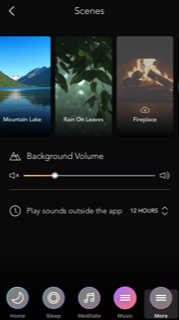
Just a few of the scenes available to play in the background. Love this!
Scenes: I adore this feature! You can select from (at last count) 35 dynamic background visuals with nature sounds or airy musical motifs to play alone or along with the meditations. All these scenes are available in the free version and suit a broad spectrum of moods. I open the web version of the app on my work computer and play this feature in the background all day long. It’s magical!
As an extra bonus, you can set up the background sounds to continue playing after the meditation is over, so that if you fall asleep during your practice, you’re not jarred awake by sudden silence.
And of course, Meditations: Take your pick! There are a vast variety of meditations to choose from, most guided but some with only bells, and there are a number of lengths (in minutes) available. Since I subscribe to the app, I enjoy the Daily Calm, which has a different topic everyday, always led by Tamara, so you can expect a consistent level of quality from them (kind of like a cup o’ java from a favorite coffee chain, but without the caffeine).
Beginners should try the free “7 Days of Calm” learn-to-meditate series that offers a week’s worth of daily 10-minute sessions to ease you into a mindfulness meditation practice.
Be aware: the free version does offer some meditations, but the majority are available only to subscribers, and you’ll soon find yourself craving for more. At that point, you’ll have to decide whether it’s in your budget to commit to the paid version.
The “more” screen showing additional features available. Loads of great stuff here!
There are other features that I use less often but are worth mentioning. A friend of mine swears by the Sleep Stories, which are high quality tales designed to help you nod off, and a number of them are voiced by celebrities like Bob Ross (yes, the ‘happy clouds’ painter — what could be better?), Matthew McConaughey, Stephen Fry and even Peter Jefferson, who used to do the UK shipping forecast which so many in that part of the world found so soothing. Most, although not all, require the paid version of the app.
There are also Masterclass courses offered that I’ve found useful enough to make my family listen to them during long car trips. Topics are broad-ranging and presented by experts in their fields and new courses are added from time to time. Some courses are free, but most require the subscription to progress further than the first class session.
The Music feature offers a generous variety of specially curated musical pieces that are perfect for creating space in your day, like a life vest in stormy seas. I haven’t even come close to making full use of this feature! Many of these are free and worth exploring.
Calm Bodies is a new feature which brings mindful movement into your repertoire of calming tools. I prefer to do yoga on my own, so I haven’t made use of this feature, which unfortunately is limited to subscribers.
There are other perks for subscribers (even a special relaxation room available at select airports!) not available to those using the free version. For me, investing in a well-curated library of meditation and mindfulness options was worth the cost.
Want to stick with the free version? There are still enough great elements available to merit downloading and playing around with the app.
If you are interested in incorporating mindfulness and meditation into your life, the Calm phone app is a great place to begin.
The original “me” is the Frantic part. This was the side that fed on anxiety and didn’t learn to rein in my runaway emotions. While Frantic didn’t interfere with academic success as I was growing up, it did stifle my future prospects as I let fear drive career decisions.
Frantic is the “me” that struggles with where I am and how I got here. It’s the competitive “me”, the perfectionist “me”, the self-critical “me”. It’s the one that’s never satisfied and always trying to improve. It’s frightened and frustrated. And it’s still angry about getting cancer.
Frantic hobbled me during the times I should have run free. It followed me home from work, woke me up in the night, poked at me on the weekends. And as long a shadow as it cast on me, I was oblivious to its effects.
But there is another side. The evolving “me” is the Shanti part. It holds the world in a single breath…and then easily lets it go. It stays present and grounded. There is a sense of calm about it, and ample space to hold emotions and observe them without being overtaken by them.
When I make a mistake, it asks gently, “Might it be okay that you did what you did based on the information you had?”
It reminds me to be compassionate, that everyone is worthy of love, including me. When things feel bleak, it holds me until the darkness passes.
When these two “me”s appear, Frantic has often been first, rushing in breathless and disheveled. Shanti arrives after and gently takes over. But on those occasions when Shanti is first, Frantic stays away and things feel a little more peaceful.
I’ve been “Frantic” and I’ve been “Shanti”. The latter is a more pleasant houseguest.
Lately, Shanti has been present more often. I’ve been able to scoot Frantic into a corner where it passes time aimlessly twisting itself in knots, allowing Shanti to spread out inside my head.
Frantic is still welcome, as long as it behaves, which isn’t often. It does keep me moving forward, never resting on laurels. But Shanti tempers its blustering when it threatens to get out of control.
Nervous energy, even anxiety, has been a driving force for most of my life. It kept me productive and lean. But as much as it propelled me forward, ultimately it held me back. It wasn’t until my cancer diagnosis that I realized how detrimental it had been. I was spent. It was time to stop.
Peace arrived with my meditation practice. Cancer forced me to slow down and be mindful of the present, to sit with uncertainty. It is a beautiful change that has brought a new dimension into my life. I only wish I’d discovered it sooner, or that it were stronger, but that will come with time.
I have not completely shaken that Frantic side of me, but Shanti has brought emotional space and a sense of gentle control. Getting that balance to shift has taken work. It is, however, the most fruitful work imaginable.
It wasn’t until almost a year and a half after my last chemo that I finally got a professional, high-caliber haircut. After an adult life filled with boring medium-to-long hair in a ponytail, this was an about-face: a short and very stylish ‘do.
I don’t think I would have ventured to try this if I hadn’t been pushed into it by chemo. Then again, cancer pushed all my boundaries further than I would have gone on my own. I’ve always played it safe, but with cancer, there was no “safe”.
When chemo took my hair, I had no say in it. As the hair grew back, it did so slowly and in a pattern that was not attractive. Nothing I could do about it but be patient.
Front shot of my awesome new pixie cut! The hair on top is full and feels thick. I love the look!
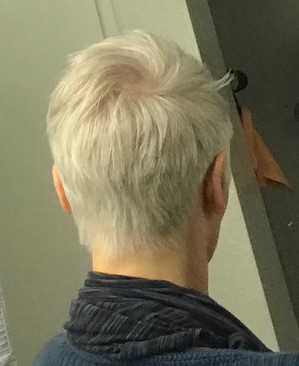
Back view. This was the part of my head that unnerved me in the middle of the night. It felt so bare and brought back all sorts of scary feelings.
But in 2019,I was in charge and could decide at what length I wanted to keep my hair. I’d been surprised by how much I liked the new “me” with a short style, so I thought I’d be adventurous and go even shorter. My hairstylist happily obliged and this past week I got a full-on pixie cut that was absolutely adorable. It felt great to be calling the shots and reclaiming myself and my look.
But something unexpected happened that night. I woke in the darkness, unsettled with a touch of panic. My head felt bare, like my hair had crossed the threshold between short and “omigodthatisTOOshort”. For a split second, everything felt out of control again.
It took a bit to calm myself down in the pre-dawn hours of the day. I had wanted to be brave and cut my hair shorter, but it elicited those old feelings of the unknown. Wait, I reminded myself, all of this was “known” now. I knew my hair would grow back again. Add to that, several days before, I’d had a mammogram that confirmed I was in remission. So there was no need for the fears.
Be that as it may, it wasn’t so simple to let the feelings go. My hair carried powerful associations that had been seared into my unconscious mind. Losing locks to chemo meant relinquishing a part of me. While I thought I already understood its importance — I’ve written about it in a number of posts — it wasn’t until that night that I realized how tightly my hair was wound up in all those memories and sensations.
You’d think that once the hair grew in, everything would return to normal and there’d be nothing more to say about it. Not so, I’m finding, as I get hit in the face by these unexpected reminders of exactly what having cancer meant to me. Sorting everything out seems to get more complicated the further away I get from treatment. Who knew survivorship could be such a head trip?
Today is my 3-D mammogram, the one that will either confirm that I’m in breast cancer remission or that I’m going to have another rotten year (or more). Two years ago, around this time, I was completely racked with anxiety in preparation for the diagnostic mammogram and ultrasound that would detect my cancer.
I feel placid. Granted, I do self-exams on an almost-weekly basis (it’s a survivor thing) and was checked out by my oncologist early last month, so I know there’s nothing palpable there, although the 3-D mammogram could pick something smaller up. But I’ve also matured in my ability to let go of thoughts that drag my mind away to wild extremes, and instead accept what is happening in the moment.
I admit that I’m holding off on travel and hair expenses until after my mammogram, because if my cancer comes back, the money spent on them would be better put towards treatment. Neither a cross-country flight nor an edgy new haircut would be in the cards for me.
If I could have one superpower, it would be to remain calm in every situation.
Another reason for waiting on making plans? It’s because the agony associated with desperately clinging to the desire to be cancer-free and then having those hopes dashed is excruciating. So for the moment, hanging around in limbo with less emotion invested in an outcome provides more comfort.
I started meditating in an effort to free myself of expectations. Today I am able to make space within myself to hold the possibility of both remission and recurrence, and then to think about neither.
So I sit in a comfy robe as I wait for the radiologist’s assessment, feeling the warmth of the cup of tea in my hand. I am here now, focused on the present instead of potential outcomes. And this is the most peaceful place to be.
Shortly after I wrote the above, the radiologist came in to confirm the good news. Another year, another clean bill of health.
Last year when I got the “all-clear” I was still finishing up treatments. And the news felt like a huge release.
This year, I felt much calmer. Not gonna lie — somewhere inside, try as I might to release all expectations, I still expected to be okay. But I was able to not focus on the outcome of the mammogram and instead go with the flow of the day. This is a first for me, so my ability to maintain that level of calm may be more significant than being cancer-free.
Oh, who am I kidding? Being cancer-free kicks ass!
Several nights ago I woke at 3am, my brain abuzz with images of what had taken place that day. In an effort to divert my attention and fall back to sleep I focused on my breath, but I was so groggy that I couldn’t concentrate effectively.
So instead I imagined a beautiful sunny field with chirping birds and various animals coming by to snuggle with me. It was the epitome of placidity and contentment. A darling fawn nuzzled me. Then a purring lion tenderly rubbed up against me. And attacked me.
Seriously??? This is my self-created fantasy and I can’t manage to keep it positive???
But perhaps I shouldn’t be surprised. I’m a few days out from a 3-D mammogram that I’ve managed not to think about because I’ve had such a busy week at work. It will be the first mammogram since completing all my cancer treatments, so it’s kind of a big deal. Somewhere in the back of my mind fears and what-ifs are simmering. It’s scanxiety rearing its ugly head.
People tell me that everything is going to be okay. But how can they say that? This is cancer. There is never a guarantee that everything will be okay. For others to say that to someone who’s been through the full spate of treatments sounds like a brush off. Even when everything is “okay”, it may still not be okay! And sometimes it’s worse.
Sure, Mr. Expectations, you look so cute and peaceful, but if I get too close, you’ll take my head off.
I wrote a letter to myself the evening before my original diagnostic mammogram way back in early 2017, trying to calm myself down because I was an anxious mess. And in that letter I told myself that I’d be able to go back and re-read it after the mammogram and chuckle about how worried I’d been and how everything actually worked out. I tried to reason myself into calm, noting how unlikely it was that I had cancer. That tenuous serenity was blown the next morning by the radiologist who read my scan.
I remember that crushing feeling — it’s what colors my experience right now. I want to believe that everything will be okay, and yet the spectre of possibilities hovers over me ready to potentially ruin my day (and life!). I don’t think that the cancer is back, but I’ve put off making summer travel plan. Just in case.
Gah, is this what the rest of my life will be like? Being fearful of making plans? That’s not a good use of the time I have left on this planet.
Mindfulness as espoused by Jon Kabat-Zinn (drawing heavily on the Buddhist wisdom of Thich Nhat Hanh) speaks of non-attachment. Having expectations and being attached to their outcome causes suffering. I can attest to that.
Trying to reason through to an “answer” only increases agony. So I will take deep breaths and stop thinking.
Throughout my cancer treatment, it was the smiles, gentle hugs, kind words and unexpected “going-out-of-their-way” little extras from those around me that made a huge difference and left a lasting impression on me.
Now, as I gradually wind my way through survivorship, memories of those acts smooth over the physical and emotional pain associated with cancer. Those soothing feelings are too powerful to keep to myself. Given the general vibe in the world today, the hyperpolarization of people’s opinions and the resistance to leaning over and trying to empathize with others, we need more kindness everywhere.
“But what if the person doesn’t deserve it?”
Then that is a person truly in need of it.
It won’t hurt a bit, I promise.
There is no limit on how many smiles you can dispense, doors you can open and kind deeds you can do. It doesn’t have to cost anything. And if there’s one thing that I’ve found, it’s that random acts of kindness have a two-fold benefit: for the person receiving the kindness and for the person giving it. It’s the ultimate win-win.
There are only so many hours left in this day of kindness. Take advantage of them. And then make every day a “Random Acts of Kindness” Day.




















 Frantic Shanti