When I Can’t Keep Images Out of My Head

When I first started my mindfulness meditation journey, I was taught to use the breath as the point of focus. It is a reliable anchor, always there to return to when you inevitably drift off into thought. It is a stable grounding force that keeps us present.

But there are times when it’s hard to focus on the breath. Perhaps when the mind is especially busy. At those times, I switch to other bodily sensations, such as tingling in my hands or pressure from contact with the surface that I’m sitting on. I wrote a post about moving between two points of focus to help the mind maintain concentration without wandering off. That helps too.

Some days my monkey mind is particularly loud and attention-seeking.

And sometimes my chattering “monkey mind” calls for a switch to an auditory focal point such as gentle music, singing bowls, nature sounds or even simply street noises. Those will keep me present as long as I don’t fall into the trap of making stories about the sounds.

But some days are extra tough.

I tend to avoid meditating with my eyes open. Doing so only reminds me that I need to clean my desk or vacuum the carpet (“guilt-guilt, blame-blame”). However, I am a very visual person with a vivid imagination, and opening my eyes immediately grounds me if my thoughts get too pervasive when my eyes are closed.

Sometimes a thought will trigger an uncomfortable and anxiety-provoking feeling simply because a seemingly-innocuous scene has been associated with a disturbing event. The scene flashes before my eyes andbefore I know it I’m down a rabbit hole. Monkey mind is activated.

While staying with bodily sensations would be preferable, some days there are too many opportunities for my monkey mind to run away with me. It can get exhausting and counterproductive to “dodge” these visuals. Yes, we are “supposed to” let the thoughts pass by us without getting caught up in them. But there are days when they agitate me too much and throw me off track.

Tree!

So I’m cutting myself some slack and turning the “problem” into the solution. On those difficult days, I focus on an image of my own choosing. Something that I can visualize clearly so that it keeps the monkey occupied while at the same time keeping me away from troubling scenes. You could argue that I’m “avoiding” the thoughts. But I see this differently–I’m giving myself a little break from them.

What works best for me? An image unencumbered by potent associations–this is different for each person. A tree, for example, works for me. It might be a thin white birch tree or as majestic and meaningful as Yggdrasil. The tree itself doesn’t matter as much as that I choose it according to what suits me and what soothes me. I can focus on its rough bark, veiny leaves and thick canopy and the sensations that these things evoke to keep away from creating stories.

And if this results in greater concentration, I have the option of hopping back to the breath. Or not.

This might not seem like an earth-shattering revelation. There are relatively popular mountain and lake meditations, so this concept is not new. But with all the emphasis on feeling into your breath in an effort to calm the thinking mind, sometimes it’s simpler to not worry about the “shoulds” and instead see what your own self needs to help it let go and settle into peace.

Still Not Stinky: Chemo & Body Odor 5 Years Later

After finishing chemo for breast cancer and noticing that I had no body odor, I decided to write a post about it because the Internet was silent on the topic. Apparently, I wasn’t the only one who’d come up empty. A number of you commented that you’d noticed the same thing and similarly found no explanation.

Well, five years after my initial diagnosis, maybe 4.5 years after finishing chemo, I still can’t locate info on the Internet about this.

If I do find the odd article about cancer and body odor, it’s about the exact opposite: smelling bad as a result of the disease or certain medications. Not what I’m looking for.

Hey, Internet! Is there really no one looking into this?

It is quite weird that I can’t even find anything in the US National Institutes of Health PubMed database, so I would suspect that chemo-related loss of body odor is not on the radar of researchers. Well, it’s certainly not on my oncologist’s radar because he said he’d never heard of it and didn’t think it could be attributed to chemotherapy. Personally, I can’t imagine how it could be from anything else.

I’m going to pester him about it again during my next appointment. Usually armput odors are caused by bacteria. As an article from the Cleveland Clinic explains, odor is produced “when bacteria on the skin break down acids contained in the sweat produced by apocrine glands, which are located in the armpits, breasts, and genital-anal area. The bacteria’s waste products are what produce the smell.”

And NPR ran a story on researchers looking into what the worst bacterial offenders are, noting, “When the bacteria break down the sweat they form products called thioalcohols, which have scents comparable to sulfur, onions or meat.” The greatest culprit? Staphylococcus hominis.

So then maybe the chemo stops the production of thioalcohols? Or chemo wipes out the S. hominis living on our skin? I’m surprised that no one is researching this in the context of chemo patients, because it seems like it might have some health implications. We still don’t know all the side effects of chemo drugs and it would be useful to start a conversation about this one.

If you’re experiencing this, please tell your medical team. They might simply not be aware of what’s happening.

I’m not saying that I smell like a bouquet of flowers, but according to my husband, there’s no “sweaty pit” odor.

And you might be wondering what my current experience is, almost five years later. Even though I departed the realm of the completely-odorless about two years after completing chemo, I still have very little body odor. And it’s not like I don’t give it chances to fester since I work up a good sweat when I exercise. Note that my left armpit, which was thoroughly irradiated, exudes almost no noticible odor. My right armpit doesn’t smell very much, but sweat that gets on, say, a sports bra will start making the fabric stink the next day. (Let’s just say that I’ve been testing this out.) The skin in the armpit itself? Minimally, and that’s with no deodorant, although I do wear it anyway.

Certainly, the six weeks of radiation therapy on my left side would likely have an effect, and so it would make sense that there’s a difference in odor between both armpits.

Still, the “natural” (and unfortunately overpriced – yeesh!) deodorants do a very good job of fragrancing my armpits because they don’t have to work very hard.

So the mystery remains. I’m going to keep digging into this as it’s likely there’s a disruption of our skin microbiome involved, and given the popularity of that research (see microbiome and armpit odor info at drarmpit.com), someone may be looking into the connection between chemo and body odor in the future. Until then, I’ll just remain happy and relatively unstinky with fingers crossed that it continues.

~~~~~~~~~~~~~~~~~~~~~

Many thanks to my very patient husband who played along and agreed to smell every place I pointed to. I’ll revisit the odor issue during the summer just in case…

Lovingkindness When It’s Hard

Lovingkindness (n.): a tenderness and consideration towards others (Oxford Languages)

Sonder (n.): the realization that each random passerby is living a life as vivid and complex as your own (Dictionary of Obscure Sorrows)

~~~~~~~~~~~~~~~~~~~~~~~~~~~~~~~~

One of my goals for 2022 is softening my views of difficult people.

This takes some mental calisthenics. There have been individuals in my life that have impacted me in negative ways, and trying to see around that is usually met with a great deal of internal resistance on my part.

But when we hold onto hurt, we sully ourselves, not to mention completely (and possibly unfairly) writing off the person whom we view as the cause of our pain.

There have been people in my life who seem to go out of their way to be cruel.

I need to stress that giving difficult individuals a second look to examine their internal motivations does not mean absolving them of all responsibility for their actions. What they did or said remains that and their role in your pain is not diminished. But in letting go and softening our own reactions, we heal ourselves and decrease the impact that the individual’s actions have on us.

What has been working for me is one simple thing: to pause and imagine what pushes people to be uncharitable. In my experience one of the main motivators seems to be fear. We all have our own ways of dealing with this emotional state, some of us may retreat and tremble (this would be me), others may lash out and attempt to control the situation that way.

I’ll go out on a limb and say that many of those in our lives that we perceive as “evil” may be running away from something. And their inability to deal with their fears and shortcomings makes them very pitiful indeed. The more thoughtless and controlling and misery-inducing an individual seems to be, the more fear they may well have bubbling under the surface.

If we can step back a bit, we can mitigate their power to upset us, because that’s when we see their behavior in a different context.

Let me offer an example: One of the most toxic bosses I ever had would go into “tyrant” mode, judging immediately and harshly, seemingly unable to manage her employees without bullying them. There was intense tension when she was around and I felt like I was never good enough, something that affected me deeply.

Difficult people may be fighting their own inner demons.

But I soon learned that she made everyone feel that way…and also that she was locked in an unhappy marriage and had little control over her personal life. So she established (and overestablished) control where she could. She hired young employees who would work for lower wages and greatly increased her profits, although it also resulted in a significant turnover because the conditions were psychologically distressing.

I dreaded work so much that it was only a matter of months before I resigned my position. I got myself out of there, a decision I never regretted. And I stress this because if a situation is bad, even if you can find some sympathy for the perpetrator, it never means you should stay there and take the abuse.

But understanding what a difficult person is going through can offer some balm for your soul as you shake off the effects of the negativity. Naturally, this is far easier to do from a distance, but it can also help create some emotional space for you if you cannot put physical space between the two of you just yet.

And in the context of a lovingkindness meditation, this makes it much easier to bring that individual into focus and offer them kindness and compassion for what they are experiencing.

It may help to consider this: true power comes not from expressing your dominion over others; it comes from understanding the reality of the situation and making the choice to respond with compassion.

~~~~~~~~~~~~~~~~~~~~~~~~~~~

In the case of my former boss, upon searching for her recently, I was shocked to learn that she had founded a charitable organization to help children in need. All those profits that she had amassed had gone to a very good cause, as she now worked exclusively on a volunteer basis.

I’m so happy to have seen this giving, caring side of her. Wish she’d been able to show it to us.

And I sat there, staring at her photograph on my computer screen. That was her, certainly decades older, but different from the way that I had remembered her. So much more complex a human being. And instead of scoffing at the “old person trying to get into heaven”, I was filled with joy. Inside that being that I had only known as a tyrannical boss was a genuine caring person who was finally able to express her true loving nature.

Nothing could have made me happier.

Nothing to Fear but Fear…Sort of

About five years ago around this time of the year, I had an uneasy feeling.

So, let me back up. The previous August 2016 I had felt a small lump in my left breast. It wasn’t all that different from another lump that I had gone to see my Nurse Practitioner about in late June 2016, and she had put my fears to rest.

Still, she noted that I hadn’t had a mammogram since 2013, so she wrote me an order for one so that I could keep on track with my screenings.

But I dragged my feet on the mammogram. And when the August lump appeared, I decided to wait until it disappeared–you know, like they always did–before setting up the appointment. Because going into a screening knowing that I had a lump seemed terrifying.

You can’t hide from your fears, but that didn’t stop me from trying.

It didn’t disappear. I kept feeling it, pressing it to see how squishy it was, did it move about, was it getting bigger. And all the time, wondering how long it would last. It was hanging around longer than I expected.

But I still waited because I was afraid. I didn’t want to go to the mammogram and have the technician look concerned. Maybe she’d call the doctor in and the doctor would look concerned. Maybe they’d suggest more tests.

I *knew* it was nothing because it had to be nothing, but I didn’t want to risk having the medical professionals think it was something because that would be terrifying to me when I really knew that it was nothing. I didn’t want to experience that fear needlessly. I was afraid of being afraid.

So I waited until around this time of the year in 2017, when, after talking with my mom, we both agreed that getting the lump checked out would relieve my building anxiety. I imagined a pleasant conversation with the Nurse Practitioner as she would say, “Don’t worry, it’s nothing.”

Except that’s not what my NP said. Her expression went from friendly-smiley to concern, and she told me that I needed to get that mammogram done as soon as possible. All that fear that I’d tried to avoid by not getting the screening suddenly hit me at once. As the NP left the examination room, she admonished me to not put the mammogram off.

The order that I got read, “Mammography and Diagnostic Screening”. The left breast on the picture on the sheet was circled. I think. To be honest, I don’t remember much more than that. To an outsider, I was just going to have a suspicious lump checked out. But inside me, there was a tornado of anxiety whipping around unchecked.

I know I know I know…but at that time, the fear of what might be overpowered common sense. So I waited.

I had waited six months simply to avoid fear. I was so afraid of the fear that I was willing to risk my life–even though I hadn’t see it that way. The overwhelming need to not experience fear trumped everything else because it was so horrible that I couldn’t seen past it. Nothing else mattered.

Believe it or not, I didn’t realize that I had been suffering from severe anxiety for a number of years. It was always bubbling right by the surface, occasionally boiling over, but never sufficiently dealt with. It had built up throughout my life through an unfortunate series of events and I had become worse and worse at shaking it, but the two years prior to my diagnosis brought some of the longest bouts of chronic anxiety and feelings of worthlessness.

And all that fear that I had, that reason for not getting the lump checked out, that fear that almost cost me my life? Cancer was what forced me to face it. The most feared disease that I could have imagined ironically put me on the path to finally dealing with one of the most crippling issues of my adult life.

No, I’m not going to say that I’m thankful for cancer. Because that would be ridiculous. But I can now step back and see the worth of fearful experiences and understand that sometimes it’s the horrible things that push you into the most meaningful personal growth.

Little Decisions Build Beautiful Things

This is the time of the year that many people make resolutions they hope will catapult their life into a new and positive direction.

So it’s also a good time to encourage people to slow down and consider what they hope to achieve and how they plan to get there.

And they’re off! The New Year fills us with energy to make big changes, but most of that impetus fizzles out as we realize that our plans are not sustainable.

The New Year’s buzz drives us to dream big and leap high, but with all that emotional energy expenditure, we run the risk of overwhelming ourselves, burning out quickly and falling far short of our lofty expectations. And that may make us feel worse about ourselves.

This year, take a step back and consider: it’s the small changes that you make on a daily basis that determine where you ultimately end up. Consider an ocean liner that turns very slowly. It makes little adjustments in its course, but depending on which adjustments it makes, it can end up in very different places.

The real name of the game is consistency. While the big goal may be the shining light you strive for, consistency paves the way. And mindfulness helps you get there.

Maintain awareness of the present so that you have perspective on what choices you’re making today and their effect on tomorrow.

Focus on what you can do today. Even this hour. Want to increase your activity level? Get up and take some steps right now. That doesn’t mean sprinting around the parking lot for 10 minutes. It means doing something you wouldn’t have done otherwise. Something that won’t give you side stitches and result in wanting to throw in the towel.

Make little decisions to change something. Make them doable. And then make them consistently.

Maintain your awareness, every day, of what you’re doing and why.

And when those changes have become comfortable, do a little more. Keep your eye on consistency, not quantity.

Establish positive little habits the way you’d spread the seeds for a lovely cottage garden. Because here’s the thing: this is not a race. This is your life. You don’t live your life a month at a time–you live it moment by moment. And that’s the way you make changes.

Be like the big ship whose many little changes, made consistently, take it to fantastic places.

Any decision that positively affects you remains yours to keep, like a little jewel in a box. Did you go for a walk among trees after lunch instead of hanging out in your office perusing social media? No one can take that experience away from you. Tomorrow, if you have a meeting after lunch and must stay at your desk, the positive effect of that walk will still have taken place.

It’s like a little brick that you can use to build a palace. You collect one each time you’re consistent with a behavior. Play the long game.

And when you remain mindful of your behavior every day, you can also step back and see where you, the human ocean liner, are headed. This makes it easier to correct your course. A short diversion does not need to take you in an unwanted direction. One small correction and you’re back on track.

And that thing that you might have called a “failure” in past years and just given up because you’d figure you’d “blown it anyway”? It would be a temporary side trip. Because you are mindful of where you are and where you’re going.

And that’s how you know you’re going to get there.

Happy New Year!

Gratitude: It’s Not Just for Big Things

A number of years ago, when my kids were still very small, we lived in an area with brutal winters. That meant sub-freezing temperatures for weeks at a time. Money was tight so we had to keep the thermostat in the 50s overnight and in the low 60s during the day. To make matters worse, our bedroom was in a part of the house that the radiator pipes wouldn’t warm properly, so it was always cold there at that time of the year.

Gratitude for a cup of tea and a quiet moment to write – that is enough.

And by “cold” I mean, the bedsheets would be literally frigid when it was time for bed. So much so, that my joints would ache and I’d be miserable until my body heat could warm them up.

This continued for a year or two until I found an electric mattress pad. The first night that I crawled under the sheets with the heat turned on, I thought I’d won the lottery.

There were so many negative parts to the years we lived there, but going to bed with warmed sheets overwhelmed me with gratitude for the simple pleasure of removing the pain of the cold.

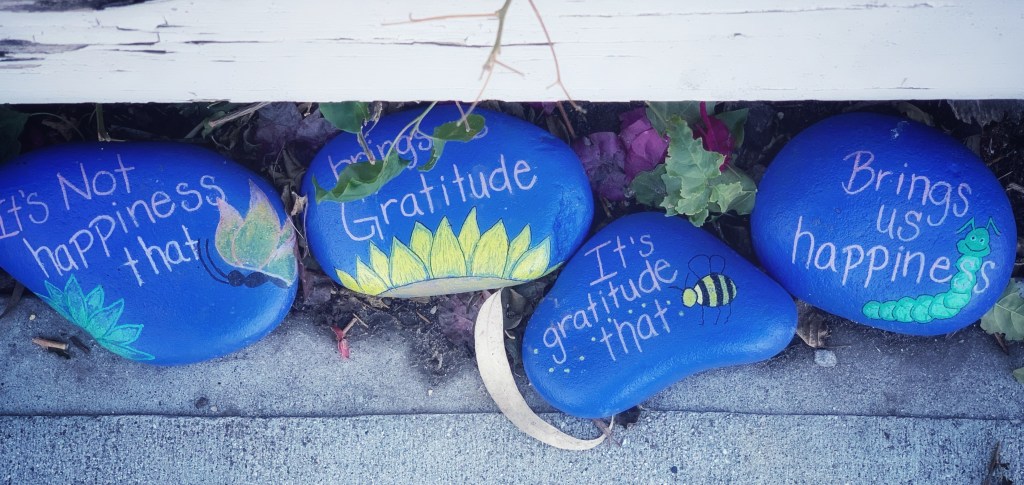
The reason that I’m telling you this is that it’s so obvious to be grateful for the stark changes in our situation. It’s a no-brainer.

But there is no need to wait for something like that. There are simple things that we take for granted that it would be so easy to be grateful for.

Turn your attention to little pleasures and acknowledge their importance in your life. Take some time to sit and bring them to your awareness. Feel into how they lighten your existence. Maybe thinking about them makes you smile. Or maybe the fact that something is simply working properly can be enough to help us realize how fortunate we are to have it at all.

Whatever it is, open up and invite gratitude in.

~~~~~~~~~~~~~~~~~~~~~~~

Maybe generating gratitude during bad times is exactly what we need.

Those of us who have recently gotten a cancer diagnosis may feel a touch bitter about this concept. Understandably, it may be easier to be grateful when you’re not dealing with a serious disease. And no one would blame you for having a hard time generating a mood of gratitude.

But perhaps that’s exactly when you should look for things that elicit a sense of gratefulness, no matter how small. It may be one of the most important things you can do to maintain a sense of well-being in a difficult time.

Making Mondays Bearable

As 2022 approaches and we face the prospect of having another twelve months speed by us again, I’ve found it useful to sit down and take stock of where I was last January, what changed over the past year, and with what attitude I will enter into the next 12 months.

One thing that has caused a great deal of anxiety for me has been work, even with having one of the greatest bosses in the world and a flexible work situation.

My work situation is quite positive, but anxiety has left me with emotional claustrophobia.

Why? Because my job has also been associated with some of the most wrenching anxiety that I have ever experienced, including being diagnosed with cancer.

What’s resulted is that even in a supportive and stimulating environment (although not my passion, admittedly), I’ve felt trapped, like an animal trying to scratch my way out of my cage.

This past year, I came up with a tactic to at least partially relieve this feeling.

Now, I actually look forward to Mondays, because I’ve set up a beautiful association for the first day of the workweek with something very indulgent.

First, I work from home on Monday. This softens the dread that I’ve historically felt on Sunday nights, knowing that the weekend is over. The transition to the office is gentler.

Second, with some changes in my kids’ school schedules (one in college living at home and the other in high school), I start my workday an hour later. This has given the entire family reprieve from the stress of waking very early and starting the week sleep-deprived.

It also gives me to time to enjoy a cup or two of decaf in the morning.

Third, when the rest of the family leaves for school and work, I have 45 minutes before my own workday starts. I set up my rower for a 30-minute row, facing the tv/computer monitor in the living room…

Great exercise + fun videos = an amazing start to Monday!

…and put on a half-hour YouTube video of something I really enjoy that I might not have time to watch otherwise. For me now? It’s an episode of “BuzzFeed Unsolved–Supernatural”. Pure 100% indulgent entertainment.

Because it’s a timed row, when the 30 minutes are over, I stop. No pressure to hit a certain speed or distance. No matter what, it ends up being a decent workout because I enjoy the exercise.

That leaves 15 minutes before I start work. Chemo left me with short hair that allows for a five-minute shower.

By the time my workday begins, I am completely refreshed and the day’s workout is done. I feel like I’ve been given a huge treat–almost like I’m cheating, but I know I’m not. That 30 minutes of physical activity tied with watching a fun video re-sets my attitude and I’m ready to take on the week.

I love Mondays!

~~~~~~~~~~~~~~~~~

Can you create your own positive association with the toughest day of the week or anything else that causes you grief?

No More Sticky Fingers!

Running late with this post as I’m furiously cleaning our apartment in advance of the Christmas holiday!

I noticed a few mornings ago that when I made a fist and then straightened the fingers of my right hand, the joints didn’t stick at all.

It took over 300 days…but I’m happy to celebrate the end of the side effects!

While this may seem like an odd thing to celebrate, it marked a milestone for me. This was the last side effect attributable to letrozole that I had been experiencing, and it was finally gone. Letrozole is an aromatase inhibitor that blocks production of estrogen and is used as endocrine therapy for breast cancer patients who have estrogen receptor-positive tumors. I’d been on it for about 14 months after switching to it from tamoxifen.

For reference, as of today, I am at Day 307 since stopping the medication, so it’s taken quite a while for this joint side effect to subside. Yes, there are other things still plaguing me, such as memory issues, low libido and difficulty maintaining muscle (even with strength training), but those are more difficult to separate out from the garden-variety effects of menopause.

The sticking fingers began in August 2020 (about 8 months after starting letrozole) and were getting progressively worse. By March 2021, when I called it quits with the endocrine therapy, a number of finger joints were sticking and painful, particularly in the morning.

At that point, I was having trouble getting up off the floor, as I was having issues with joints throughout my entire body. The medication was affecting various aspects of my life, making it difficult to exercise and, as I like to put it, lowering the quality of my existence. Following discussions with my oncologist, we both agreed that my risk of breast cancer recurrence was low enough to stop the meds.

It’s been quite a journey to get to the point where I am now.

Shaking this last side effect of letrozole reminded me how far on this cancer journey I’ve traveled. There have been so many ups and downs, friends made and friends lost to the disease, that it was easy to forget that nothing in life is permanent. Time passes and situations change, sometimes for better, sometimes for worse.

The concept of “CANCER” used to terrify me, and after I was diagnosed, I hit a low so deep I thought I’d never be able to crawl out of it.

Gradually, as my experience with the disease played itself out, I came to accept the uncertainty about the future. As the end of 2021 draws near, I inch closer to the 5-year survival mark. The fact that I can straighten my fingers in the morning without any pain or sticking is a perfect example of how while I cannot know what the future will bring, I can deal with the “now”. And this “now” is not so bad.

~~~~~~~~~~~~~~~~~~~~~~~~~~~~~

Best wishes to everyone for a very Joyous Holiday Season and much promise for 2022!

The Snow Globe: A Mindful Visualization

Since it’s winter in the US and we’re starting to get the first blankets of white around the country, I thought it’d be fun to use snow as a visualization.

While it doesn’t snow where I live now, I grew up in New England and remember the peacefulness of calm, snowy nights when I stood out on the second floor balcony in the midst of snowfall, listening to the gentle “pat-pat” of snowflakes as they landed on the ground.

When we’re at our busiest, life can feel like a blur.

I draw on those memories when I think of snow globes. Yes, they’ve often been associated with chintzy souvenirs, but there’s really something quite magical about that little underwater world.

They are also quite beautiful representations of the process of settling down.

Shake a snow globe and watch the glitter spin furiously about, swirling like mad with little sense of a pattern. Those are the thoughts of a busy pre-occupied mind, overwhelmed with responsibities and expectations. For some of us this may be what our current life is like. Or perhaps we’re going through a particularly stressful time and feel as though we’re unable to slow down and catch our breath.

Perhaps we ourselves are adding to the chaos by unintentionally shaking things even more, allowing our monkey minds to run with stressful thoughts. With so much “noise” we can’t see through the water. Everything is a blur. We have a hard time collecting our thoughts.

When we stop shaking the globe and put it down…it will continue to swirl for a while and we may feel like we’re getting “nowhere” by trying to relax. But if we trust in ourselves, trust in impermanence–nothing lasts forever–slowly things will start calming down. The agitation will diminish.

Just as the “snow” will begin to settle down, so too will our busy thoughts and our busy lives. The glitter will float through the water more slowly, and the view will become clearer. A few more breaths, a few more moments of patience. The currents inside the globe lose momentum and the snow will gently blanket the bottom until, eventually, everything is still.

No sign of the tempest that once took place. Just silent peace and quiet breaths.

Until the moment the globe is shaken again.

~~~~~~~~~~~~~~~~~~~~~~~~~~~~~~~~~

The trick, of course, is to learn how to find peace as the glitter water swirls madly about. Once we can do that, the storm may rage, but we will enjoy bliss.

Targeted Therapy? Yes, Please!

You cannot say that there is a “good” cancer to have. Because the only thing that would make the cancer that you have “good” is not having it in the first place.

But if that’s not the case, the next best thing is having a cancer with characteristics that serve as targets for drugs, enabling the use of “targeted therapy”. As described by the American Cancer Society, “Targeted therapy is a type of cancer treatment that uses drugs designed to ‘target’ cancer cells without affecting normal cells. …Targeted drugs can block or turn off signals that make cancer cells grow, or can signal the cancer cells to destroy themselves.”

Cancer treatment often means chemotherapy, but there are some targeted therapies available that are highly effective.

When talking about breast cancer, currently there are several targets possible: estrogen receptor, progesterone receptor and human epidermal growth factor receptor 2 (or HER2 [also HER-2/neu or ErbB2]). These three are the ones that your oncologist will use to characterize your tumor.

The estrogen and progesterone receptor positive (ER+ and PR+, respectively) tumors are the most common ones. According to WebMD, about 80% of breast cancer tumors are ER+ and 65% are PR+, and these tumors are treated with hormone therapy, generally tamoxifen and aromatase inhibitors (depending on the patient’s menopausal status).

HER2+ is an interesting case. HER2+ tumors contain extra copies of the gene that makes the HER2, which is thought to make cancer cells grow faster. Historically, the prognosis for HER2+ tumors has been worse than for HER2- tumors, with a greater chance of recurrence and metastasis.

At least, that was the case before the development of targeted drugs specifically for HER2, such as trastuzumab (Herceptin), pertuzumab (Perjeta) and others. These drugs don’t come without risks and are known for being potentially cardiotoxic, but they are very effective.

This is the irony. Triple-positive breast cancer went from being one of the more aggressive breast cancers to being almost “curable”. All due to targets.

This is also what makes triple-negative breast cancer (TNBC) more complex. Without specific targets to aim for, treatment of TNBC relies on aggressive chemotherapy, which can be quite effective. But without targeted therapies, TNBC still has the highest rate of recurrence and worst prognosis of all breast cancers. Researchers are furiously searching for new ways to characterize TNBC tumors for this very reason.

~~~~~~~~~~~~~~~~~~~~~~~~~~~~~~~

We are all looking forward to the day when we can say there is a definitive cure for cancer.

But what brought on this post? I was searching on the internet for breast cancer info on HER2+ tumors and came across a provocative headline from MedicineNet.com that read, “Can HER2-Positive Breast Cancer Be Cured?” The answer to this, I assumed, would be “no” because we’re not at the point where we can say that we’re definitively “curing” breast cancer.

In addition, I’d been conditioned by my oncologist to think of cancer in terms of years of survival rather than cure.

But according to this MedicineNet article, “With recent advances in medicine, it is considered that HER2-positive breast cancer is curable.” A bold statement indeed. And one that I hope we will be making more and more.

For an article from the American Cancer Society describing available targeted therapies for breast cancer, go here.