It’s 2026 and We’re Safe

(Title image: Photo by BoliviaInteligente on Unsplash)

Not going to lie, the world may seem like an unstable place. While I am happy to say that I remain cancer-free, I am facing some unexpected threats that could drastically shift my everyday life. And I know that there are readers out there with similar experiences.

Therefore, this is a great time to remind ourselves of one calming truth: at this very moment, as you are reading this post, you are safe.

You might not feel safe. There may be news you’ve received that threatens your safety. There might be thoughts in your head that make you feel unsafe. But the reality is that you are safe…right now. And…right now.

At these finite points in time, as we notice them.

Here, where you are in this moment, is safe…even when your brain says otherwise.
(Photo by Artem Beliaikin on Unsplash)

What do I mean by safe? For me personally, “I am safe” has to do with the calm reality of the present moment as contrasted with past traumas and future fears. Where you are right now, even if you don’t “feel” safe, is physically safe.

Obviously, your mileage may vary, and if you’re currently falling off a cliff then you can claim that you are not safe. But 99.999999999% of us will not be reading a blog in mid-air.

Feel into where you are in space. Notice the weight of your body and how it makes contact with the surface on which you’re resting. Objectively, where are you? Can you hear the buzzing of kitchen appliances, the chirping of birds, the people speaking outside? Reaching outward with your senses, leave the brain noise behind.

“I am safe” works as a soothing affirmation. Pair it with diaphagmatic breaths, nice deep ones into the belly (“belly breathing”) to reinforce the action of the vagus nerve in activating the parasympathetic (“rest and digest”) nervous system.

As you do this, slow everything down. I often employ the imagery of forming a “pearl” around myself and establishing a safe zone inside. Imagine that you’re blowing a bubble that surrounds you, with a slightly frosted appearance. As it forms, you can still see what taking is place outside it, but there is space between you and the rest of the world. Gone is the “in your face” feeling of rawness.
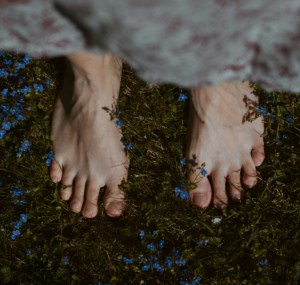
Feeling into your body is a quick way to ground yourself in what’s happening now.
(Photo by Merri J on Unsplash)

Rub your hands together and notice the sensations in your palms. Scrunch your toes and then stretch them out.

In or out, you decide. You have the option of reaching outward with your senses, or if you prefer, bringing your attention inward into your body. Or alternate between the two. Always noticing what is happening now.

The important thing here is that I’m not suggesting that nothing bad will ever happen or that what took place in the past doesn’t matter and can’t hold sway over you. Those are rose-colored views that are unrealistic and dismissive. What I *am* saying, and again, this is how I interpret this concept, is that you can check in at any given moment and notice that you are currently not in the maws of death, even if your brain is trying to convince you that you are.

Here. Grounded in this seat. You are safe.

Happy 2026!

Naptime with Animal Friends: A Calming Visualization

(Title image: Photo by Kristin Lyse on Unsplash)

I recently came up with a fun visualization for calming myself that I wanted to share with you. It’s ideal if you love animals.

The concept is quite simple. Imagine yourself in a comfortable place outdoors with an environment that is what you like best. As an example, for me, it’s a warm-ish spring or summer day and I’m sitting under an arbor covered in wisteria or another flowering vine with leaves just dense enough to allow dappled light through.

Create a detailed, colorful picture of your perfect place in your mind. And then…start settling. Bringing attention to your body, imagine what it would feel like to be there. As your breath slows, the calmness you generate travels outward and attracts friendly animals to you.

You are the Pied Piper of imaginary animals.
(Photo by Dmitry on Unsplash)

Perhaps a colorful bird alights on your shoulder or next to you. A bunny hops over and snuggles next to you. Or maybe you attract a group of sleepy cats that come, purring, and rub their faces against you before stretching out beside you and perhaps in your lap.

The animals can be whatever you desire. Maybe it’s a family of platypuses? Or perhaps you’re sitting by a natural pool, feet in the water, and koi are languidly swimming around you. Sometimes, I imagine something potentially frightening and powerful like a tiger appearing, then nuzzling my hair before he rolls onto the ground to snooze, pressed up to me.

It doesn’t have to be realistic. It just has to make you feel good. There are no rules.

All animals relax around you as long as you stay relaxed around them.
(Photo by Sandra Vasilenko on Unsplash)

The richer and more vibrant the picture, the more easily you will settle. As you develop the image in your mind, watching the butterflies circle around your head or feel the weight of the wolf’s head as she lays it on your shoulder, you nurture a sense of calm. These animals are attracted to you because you are what soothes them.

And the reason that you soothe them is because you have calmed yourself. Being calm, and tranferring that feeling to others, is your superpower.

If you lose focus and your mind drifts into worry or to-do lists, the animals will scatter, so you have to notice what’s happening and resume the visualization to show them that it’s safe to return. Allow a warm breeze against your skin or the cooing of mourning doves to transition you back to this calm space.

Understand that you have this ability to generate a sense of well-being, in yourself and others. You might not always be aware of it in the middle of a busy day…but it is there. Close your eyes, feel into your feet and call your favorite furry, feathered or scaly friend to you for a snuggle.

~~~~~~~~~~~~~~~~~~~~

If you’d rather not imagine animals, you can make flowers bloom or young children smile and nod off (which might be very satisfying if you are a preschool teacher!).

What If We Re-Interpreted Anxiety?

Title image: Photo by Priscilla Du Preez 🇨🇦 on Unsplash

You may be familiar with the old story about the award-winning singer Carly Simon’s stage fright which prevented her from performing in front of an audience for 14 years.

Performance coach Tony Robbins famously compared her anxious reactions to those of superstar Bruce Springsteen (yes, I realize I’m dating myself) who would describe his physiological responses to going on stage in the same way that Carly did, but he associated them with excitement and not fear.

Anxious responses weigh heavily on us…but what if we could reassign their meaning?
(Photo by Kyle Glenn on Unsplash)

At least that’s how the story goes. And although I think some of this is an oversimplification of Carly’s experience, there is a lot of wisdom to breaking down both performers’ reactions to the point where we recognize that what we feel in our bodies can be interpreted in very different ways based on what’s going on in our heads.

I grapple with this issue myself when I am offered unexpected opportunities that can propel me forward in career and life…but which also cause me agony in terms of my fear of change.

What to do?

What has worked for me is to identify the sensations that I’m feeling. Naming them makes them less overwhelming and it’s a big plus if I can describe what my head feels like, what my chest feels like, what my belly feels like. I try to understand each sensation’s role in creating the overall experience.

Then I try to image that the emotion these individual sensations lead to is one of positivity and excitement. It’s the anticipatory “butterflies in the stomach” from doing something that seems amazing rather than an upset stomach arising from wanting to flee.

And I sit with all those things, bringing in reasoning too: thinking about the positive consequences while allowing the feelings and sensations to be there. Understanding that they are simply sensations and not dangerous on their own–they are physiological responses that evolved to help us out when we needed an extra boost of energy (think “fight or flight”).

Thinking about all the good stuff that opens up to us when we leave fear behind…
(Photo by Allef Vinicius on Unsplash)

I call this reasoning “mental calisthenics”. It takes some massaging and can even get a little metaphysical, but at some point I usually manage to get a grip of that good feeling as if I were gripping the edge of a wall and then pulling myself around to “turn a corner”.

Trying not to overthink it. Just allowing myself to feel into the sensation while giving it a positive spin. And then imagining myself “doing the thing” that I fear…and being good at it.

When particularly anxious, I may even exert myself physically to allow my responses to exercise to meet and match the fast heart rate and breathing that I’m already experiencing.

And that’s about it.

As with meditation, this is a practice and I have to keep reframing the situation in this way to remind myself that change can be unsettling but “unsettling” isn’t inherently negative. It may take a succession of days or weeks to come to grips with the new situation and that’s okay. Patience is the key that leads to progress, and every day that I reframe my sensations is another day that I improve my mental situation.

Hope this helps you too!

~~~~~~~~~~~~~~~~~~~~~~

Important: this is not about “toxic positivity”. There are some situations that are truly bad and understandably elicit an anxious response. Rather, this is realizing that our physiological reactions–the ones that evolved to protect us–may be holding us back because we associate them with fear rather than seeing them as the excitement of possibility arising from change.