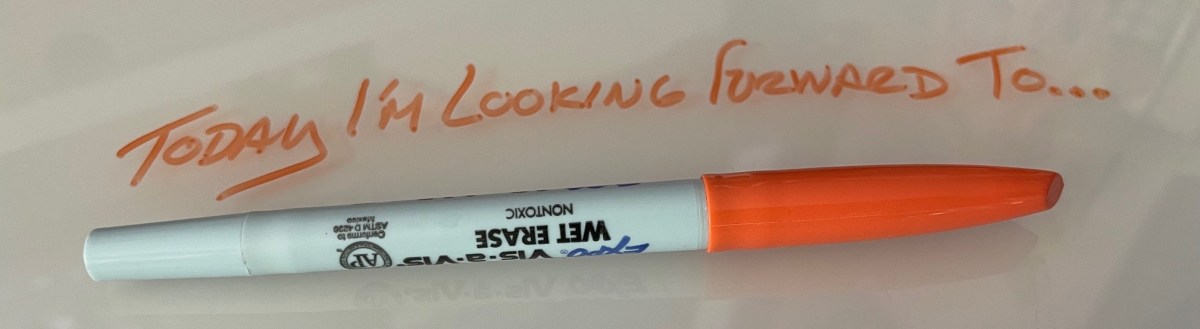
Today I’m Looking Forward To…

(Title image: FranticShanti)

Here’s a slightly different type of gratitude practice. It’s a nice little way to bring more joy into your life.

Instead of looking for things to be grateful for, try simply thinking of things that you might be looking forward to.

They don’t have to be big productions like an expensive vacation or some sort of exclusive party. This works just as well, perhaps even better, with something small.

Grab a pen and a sticky note and start looking forward to the little things.
(Photo by Ravi Palwe on Unsplash)

How small? How about receiving a new calendar you ordered that has pictures you find particularly soothing? Or maybe going to a museum that you haven’t visited in a while. Or visiting a local garden shop just to browse and take in the glorious colors.

Clean out your coffee maker and look forward to having tomorrow’s coffee brew in a clean machine.

Or look forward to getting into bed in the evening and stretching out comfortably.

Consider the things you could potentially look forward to…get granular about it…and try to see what the smallest thing might be that you could look forward to enjoying.

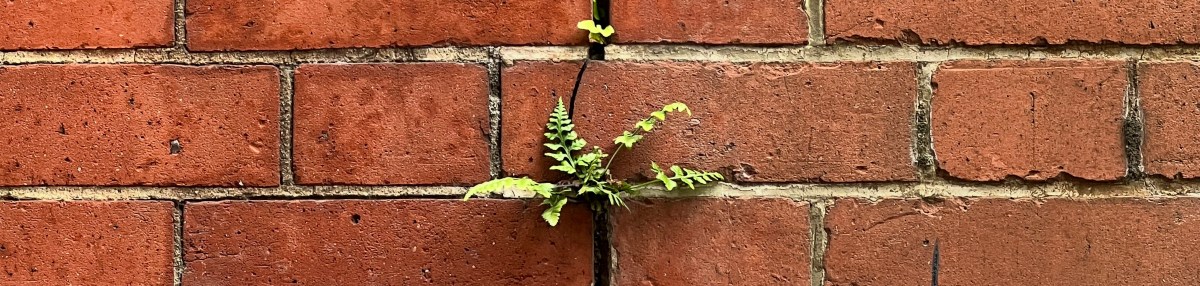
There’s a lot of good stuff in between those pickets.
(Photo by Brad Switzer on Unsplash)

The “grandness” of the thing doesn’t matter—what matters is how you feel about it. And perhaps, at first thought, you consider it insignificant, but when you lean into it, you realize that it truly is something that brings you joy.

The more of these little things we can find, the more we realize that little bits of joy are scattered throughout our lives. And once we become aware of one, we might start noticing them everywhere.

~~~~~~~~~~~~~~~~~~~~

Speaking from personal experience, I find it very easy to become overwhelmed with the negatives in my life. There are times when it seems like all the difficulties come crashing down at once, at the worst possible moment.

However, it is worth shifting our focus and noticing the things that aren’t going wrong. It’s as if you are looking at a picket fence. The fence itself might be the negatives and they’re hard to miss—after all, they’re right in front of you.

But if you look through the posts of the fence, into the space between, that’s where you see everything “not wrong”. And you might find that, in fact, there is more “not wrong” space than there is picket fence.

So I encourage you to take some time when things get difficult to look through the fence and find your little joys to look forward to. Focus on them, write them on a sticky note and put the note somewhere where you’ll see it in the morning.

And then smile.

I have my note ready…

I Thought I Was Doing Better

(Title image: Photo by Merch HÜSEY on Unsplash)

Last week, I met with a friend that I don’t see often. We were talking about what was going on in our lives and he related how he loved where he lived right now, and put a positive spin on everything in his life, even when talking about negative happenings.

He sounded sunny and was handling the tough stuff that came his way.

But then it was my turn to tell him about what I’d been up to. I started describing what I’d been dealing with: my father’s decline and death last year, worries about my mother’s well-being, concerns about the increasing cost-of-living…

My friend smiled at me. The last time he had talked to me, he said, I was stressed about something else. In fact, every time he calls me, there’s some new thing that I’m stressed about.

And of course he’s right. As much as I’ve improved in handling anxiety using all the tools I’ve developed to calm myself down—and, yes, I’ve found success with that—the overarching feeling that I have is that I’m playing whack-a-mole with my worries.

It’s as if I’m trying to regain my footing, but something new comes up and knocks me off balance again.

I admit it. I’m feeling worn out.
(Photo by Anca Gabriela Zosin on Unsplash)

After getting past cancer treatments like chemotherapy and radiation, you’d think that the skies would look brighter and my outlook would be more positive. And for quite some time that was completely true.

But as endocrine therapy wore on and I went through menopause, my spirit suffered. The luster of surviving cancer started wearing off. That’s embarrasing to admit, especially when I have lost friends and family to the disease and know of many others desperately fighting it.

But even being aware of that, my day-to-day seems to have become darker overall. I start the day with energy to get things done but by evening I’m exhausted and sometimes overwhelmed by what’s in front of me.

I know some of this is my own doing. In fact, one of the big, scary changes that I was faced with this year just sorted itself out. It was simpler than I expected (note my previous post). And then my son was admitted to the college he wanted to attend. All these are refreshing successes that I should have spent time basking in. But it didn’t take long for the clouds to gather again.

After hearing my friend’s assessment of me, I am trying to figure out whether what I’m going through is really getting harder? Or have I gradually been losing my ability to pull myself out of a funk? And once the uncertainties are settled, will I bounce back?

I feel disappointed in myself, which is exactly part of the problem. Lack of self-compassion simply compounds the stress. You know the carrot-and-stick analogy? Well, I’ve tossed the carrot and am just beating myself with the stick.

Back to the drawing board.

But What If Everything Goes Right?

(Title image: Photo by Aaron Burden on Unsplash)

Friends, I am a worrier. You’d be hard-pressed to find something that I wouldn’t worry about.

I know better. And I’ve actually gotten better.

But even with practicing mindful self-awareness, those foreboding thoughts of “what if everything goes wrong” creep in, particularly at night.

Because 2025 is a year of big changes for me, there have been many opportunities to awaken in the darkness, worrying about how this and that can go totally downhill.

A few days ago I was on the same train ride, hurtling through fears, when it hit me that, in the same way that I can imagine everything crashing and burning and my life being miserable and terrifying, I didn’t have to fear the worst. Things could work out.

Call that the “Schrodinger’s Box” philosophy of life. At the same time that things could be awful, they can simultaneously be fabulous—or somewhere along that spectrum. No matter what you’re anticipating, it won’t be until you finish the exam, give the speech, get the biopsy results or have the conversation that you will really know how things turn out.

Fear and avoidance are not the way to go through life.
(Photo by Alexander Grey on Unsplash)

So if you don’t know, you might as well think positively, tempered with a healthy dose of realism. Things are rarely black or white. Just as we shouldn’t be “all negative”, we shouldn’t be “all positive” either.

Ok, so right here I need to backtrack and say a word about “positivity” and “negativity”. When we practice mindfulness, we strive to release expectations, to not attach ourselves to an outcome. Yes, I get that.

That is an ideal. Our minds don’t always allow us this.

But if there is a choice between being morose or upbeat, you are still better off being upbeat. Realistic and upbeat.

I’ve heard people justify constantly being negative by saying that at least they will be “prepared for bad news” so that it’s not a shock. I used to think that too, fearing the precipitous drop in spirit when you’re expecting something good and get something bad instead. But I’m no longer convinced that doom-and-gloom saves you from anything.

Consider the “coward dies a thousand deaths” adage. Perpetual pessimism can lead to all sorts of health issues, mental and otherwise. For example, living in constant fear may result in anxiety, depression and high blood pressure,among other things. And with enough time, those can turn into something worse.

Again, the ‘ideal’ is non-attachment. But if you cannot completely disengage from imagining an outcome, your mind and body will be better served by considering that everything will work out in the end. At least you’ll be able to sleep better at night.

~~~~~~~~~~~~~~~~~~~~

And what is recognized as the optimal way of thinking? There exists the concept of “short-term realism, long-term optimism”. This means that you take care of the tough stuff in the present, facing challenges head on, but keep your chin up and not lose hope for the future.

“The Resilience Challenge”: Research Study and Master Class Registration

(Title image: Photo by Jumpy Wizard on Unsplash)

This is a time-sensitive opportunity for US residents!

NOTE: all links are described at the bottom of this post.

I unexpectedly came across a great opportunity for those of you interested in taking a master class in stress management and also participating in a large research study.

Dr. Judith Moskowitz, a research psychologist at Northwestern University’s Feinberg School of Medicine, is recruiting 20,000 participants for an online, self-guided, positive emotions study/class. The course will teach eight science-backed stress reduction skills over 5 weeks, with the 6th week being a practice and review period (the entire length of the study will be 12 weeks). The skills being taught involve the following (from this National Public Radio (NPR) article):

  1. Positive Events
  2. Savoring
  3. Gratitude
  4. Daily Mindfulness
  5. Positive Reappraisal
  6. Self-Compassion
  7. Personal Strengths
  8. Attainable Goals

Additionally, NPR has an accompanying 5-week newsletter series called Stress Less that will help reinforce these skills. Signing up for that can be done here.

This other article from NPR talks about both the newsletter and the study/class.

More information and the registration link can be found on Dr. Moskowitz’s site where she describes what’s involved. To participate, you must be over the age of 18, living in the United States and have reliable internet connectivity as this is 100% online. There will be questionnaires to complete about your emotional states at the beginning and end of the study, and you will get nightly homework.

Consistency is the way to grow positive skills and behaviors, which is why I’m looking forward to participating in this class.
(Photo by Jane Thomson on Unsplash)

While the “nightly homework” thing might seem like too much, I can personally attest to the fact that consistency is what strengthens skills and habits. You keep yourself accountable by committing to a daily practice. For me, knowing that a course is set up for working on a little every day is actually quite reassuring—I know I’m more likely to get results.

But do these skills really work in reducing stress? Dr. Moskowitz herself said that she was initially skeptical that skills like these would make an appreciable difference, but years of positive research results changed her mind. The idea is to train your brain to experience good feelings.

I love programs like this because the only cost is a little effort on your part. If it doesn’t seem to work for you, you haven’t lost much, but if it works, the rewards can be life-changing.

As a cancer survivor with anxious tendencies, I find this to be a win-win proposition. I have signed up, as have several members of my family. If you are interested, don’t wait! The study is limited to the first 20,000 registrants and when the original NPR story came out on Monday, September 30th, the response was so overwhelming that it effectively shut the regstration site down.

Registration resumed on October 2nd and as far as I know there are still spaces available.

But the enthusiastic initial response to the invitation to join in the research was quite telling. So many of us are looking for a way to reduce our stress levels and bring more positivity into our lives. This challenge is one more way to do that.

~~~~~~~~~~~~~~~~~~~~

Links with descriptions:

NPR audio story featuring the Resilience Challenge: https://www.npr.org/sections/shots-health-news/2024/09/27/nx-s1-5082364/anxiety-stress-positive-coping-class-skills

NPR article featuring the Stress Less newsletter and Resilience Study: https://www.npr.org/sections/shots-health-news/2024/09/28/nx-s1-5084630/anxiety-stress-relief-tips-strategies

The Resilience Challenge registration information and link: https://www.moskowitzlab.com/resilience

NPR Stress Less newsletter sign up: https://www.npr.org/newsletter/stress-less?&utm_campaign=hpstory

What If We Re-Interpreted Anxiety?

Title image: Photo by Priscilla Du Preez 🇨🇦 on Unsplash

You may be familiar with the old story about the award-winning singer Carly Simon’s stage fright which prevented her from performing in front of an audience for 14 years.

Performance coach Tony Robbins famously compared her anxious reactions to those of superstar Bruce Springsteen (yes, I realize I’m dating myself) who would describe his physiological responses to going on stage in the same way that Carly did, but he associated them with excitement and not fear.

Anxious responses weigh heavily on us…but what if we could reassign their meaning?
(Photo by Kyle Glenn on Unsplash)

At least that’s how the story goes. And although I think some of this is an oversimplification of Carly’s experience, there is a lot of wisdom to breaking down both performers’ reactions to the point where we recognize that what we feel in our bodies can be interpreted in very different ways based on what’s going on in our heads.

I grapple with this issue myself when I am offered unexpected opportunities that can propel me forward in career and life…but which also cause me agony in terms of my fear of change.

What to do?

What has worked for me is to identify the sensations that I’m feeling. Naming them makes them less overwhelming and it’s a big plus if I can describe what my head feels like, what my chest feels like, what my belly feels like. I try to understand each sensation’s role in creating the overall experience.

Then I try to image that the emotion these individual sensations lead to is one of positivity and excitement. It’s the anticipatory “butterflies in the stomach” from doing something that seems amazing rather than an upset stomach arising from wanting to flee.

And I sit with all those things, bringing in reasoning too: thinking about the positive consequences while allowing the feelings and sensations to be there. Understanding that they are simply sensations and not dangerous on their own–they are physiological responses that evolved to help us out when we needed an extra boost of energy (think “fight or flight”).

Thinking about all the good stuff that opens up to us when we leave fear behind…
(Photo by Allef Vinicius on Unsplash)

I call this reasoning “mental calisthenics”. It takes some massaging and can even get a little metaphysical, but at some point I usually manage to get a grip of that good feeling as if I were gripping the edge of a wall and then pulling myself around to “turn a corner”.

Trying not to overthink it. Just allowing myself to feel into the sensation while giving it a positive spin. And then imagining myself “doing the thing” that I fear…and being good at it.

When particularly anxious, I may even exert myself physically to allow my responses to exercise to meet and match the fast heart rate and breathing that I’m already experiencing.

And that’s about it.

As with meditation, this is a practice and I have to keep reframing the situation in this way to remind myself that change can be unsettling but “unsettling” isn’t inherently negative. It may take a succession of days or weeks to come to grips with the new situation and that’s okay. Patience is the key that leads to progress, and every day that I reframe my sensations is another day that I improve my mental situation.

Hope this helps you too!

~~~~~~~~~~~~~~~~~~~~~~

Important: this is not about “toxic positivity”. There are some situations that are truly bad and understandably elicit an anxious response. Rather, this is realizing that our physiological reactions–the ones that evolved to protect us–may be holding us back because we associate them with fear rather than seeing them as the excitement of possibility arising from change.

Reflections on 2023; or “Focusing on What Doesn’t Suck”

(Title image: Photo by Kelly Sikkema on Unsplash)

Warmest wishes to everyone for a joyous start to 2024! I hope you had a wonderful holiday season with your loved ones and are ready to launch into the new year!

I…learned a few things about myself in 2023.

My family and I had our share of misfortunes, bumps and hiccups and stumbles that started piling on. An apartment flood, two sizable rent increases, physical pains, emotional turmoils, family illnesses.

It’s easy to focus on the negatives (and *ahem* trust me, I did many times). But there were also some significant positives this year, not the least of which is that my cancer has not returned and I am still alive. Those are two biggies.

But I also found myself somehow managing, even in the midst of the worst stressors. I didn’t respond the way I had in the past, which would have been with a bought of nausea, racing thoughts and tortured nights.

So I know that something has changed: there is actual space between me and the things that suck. Now, there’s not always a lot of space–occasionally it’s a teeny gap that you could only slide a credit card through. And at those times, I might not even remember to take three deep breaths. But when I come to my senses I can breathe more space into that gap.

You need to stop and reflect on how far you’ve come to understand the benefits of what you’ve been doing.
(Photo by Alexander Milo on Unsplash)

That, my friends, is called progress.

And as frustrating as it is that anxiety sometimes gets the best of me, my reaction is still so much better than it used to be and that provides motivation to stay consistent with a meditation practice.

So, if I learned anything, it’s that you don’t know how far you’ve come until you look back at the road you’ve been on and reflect on where you started.

But I also learned something else this year: sometimes you need to back off in order to go forward. I dealt with body pains that affected both my strength and conditioning exercise and yoga practice. I fought against taking it easy because I was so afraid of “falling behind”.

Well, nothing good comes of that. If anything, it prolongs recovery.

I was pushing myself to train harder and not respecting my changing limits. At the same time, I was juggling several online classes because I was also afraid of falling behind career-wise, on top of which I was concerned about finding a new apartment.

This was a classic case of spreading myself thin.

Constant striving made it impossible to my body to heal and rest and for my mind to assimilate information and construct useful goals and plans.

It was not until late December that I was forced to prioritize my well being because it hurt too much not to. Stressful events that came in the last quarter of the year gave me no choice. But in doing so, pain in my hip improved significantly and in backing off my expectations, I opted to focus on a single class, while at the same time continuing to sort through our belongings and get rid of things that we no longer need.

I slowed down and made more progress than if I had continued beating myself silly.

Look at all the beautiful positives that show themselves when you focus on the good stuff.
(Photo by Kim Stewart on Unsplash)

All in all, as frightening as 2023 was at times, I can see all the good that took place, and that’s the third thing that was a major revelation for me. I’d describe my view of the world as being like a picket fence. Sure, if I only look at the pickets I see the negatives that have taken place. But adjusting my focus on the the world that is visible between the pickets, it becomes clear that there’s so much more that hasn’t gone wrong.

Even when it seems that you’ve suffered so many setbacks–and it felt like I really stumbled during the second half of the year–when you review what DID work out, the sense of gratitude and relief is uplifting.

So even in the midst of everything that stressed me out, 2023 doesn’t seem so bad afterall. And that little burst of positivity is what I’m taking into 2024 with me.

Happy New Year!

Paying a Compliment, the Happiest Transaction

~There are precious things that cost nothing.~

I’m currently taking a class via Coursera.org by Prof. Laurie Santos of Yale entitled, “The Science of Well-Being“, which I expect to cover in more depth in a future post.

The purpose of the class is to present research on happiness, why we don’t have it (the things we think will make us happy, don’t) and how we can get it (what actually makes us happy may be surprising).

Of the many studies that Dr. Santos discusses, one in particular caught my interest. University of Chicago researcher Nicholas Epley investigated the impact that social connections have on our happiness (“Mistakenly seeking solitude“). Briefly, he found that individuals who made even superficial contact with someone else during their commute to work on a train not only felt happier, but the person with whom they struck up a conversation likewise felt happier that day.

Making an effort to bridge the gap between us benefits everyone.

But this can be uncomfortable to do. Quite often, people taking public transport keep to themselves. Even if we know that striking up a conversation might be pleasant – and even increase our happiness – we may feel too self-conscious to engage with a stranger.

This made me think: some of the most rewarding interactions that I’ve had with strangers have consisted of merely eliciting a smile from them. That is a very brief connection with another human that ends up bringing both of us joy.

And the best way to do that? Pay them a compliment. I have been gifted with the most beautiful and sincere smiles from others by complimenting them on something about them that was genuinely laudable, resulting in good feelings that last an unexpectedly long time. Try it and see!

This world needs more diverse people finding common connections with each other.

Furthermore, when you open yourself to finding something to compliment about another person, it is amazing how quickly you can locate it. Your eyes see things more brightly and happily, and that feeling is passed on to your recipient along with your kind words.

Then, if their smiles last long enough for their good mood to positively benefit someone else, perhaps that simple act of a compliment can send a ripple that becomes something so much bigger.

What a lovely gift to the world.