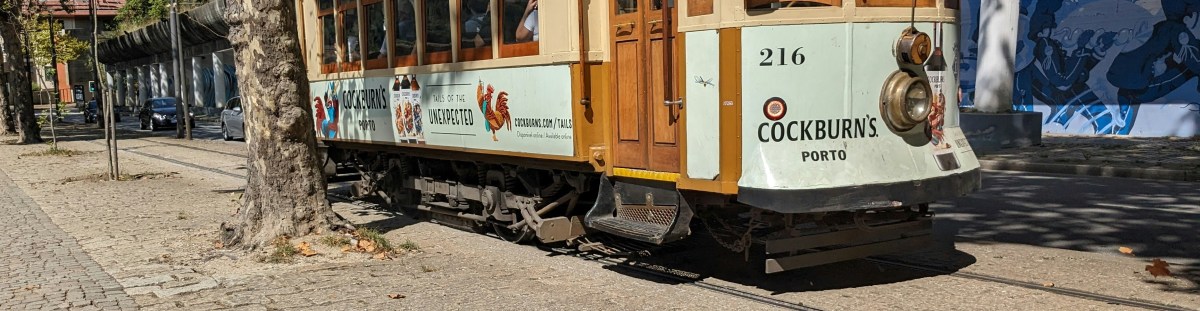
To be clear, this doesn’t have to be a mediation specifically for a trolley ride. It would work on a train, bus, car or any other moving vehicle. I take the trolley regularly and love how meditative the ride can be, so that’s where I use it.
While I work remotely for the majority of the week, some days I commute to my office, now further away due to our recent move. I get a ride in, but coming home means an hour on trolleys in addition to a long walk from the station.
At the time that I leave for home, the afternoon commute is in full swing. I often don’t get a seat on the first leg of my trip, so I stand, holding on to the bars interspersed throughout the car.
My height gives me a good view of the window. Now, if I allow my gaze to fuzz a bit, staring straight out into the distance, the passing landscape becomes a blur.
But this view can also serve as a beautiful way to drop into the ‘here and now’, and also train yourself to let go of the past. As the landscape passes before me, I mentally drop a “plumb line” into it, fixing my gaze every second or so on an object in the passing view, so that for a blink of an eye, my focus is maintained and follows it. Then I let it go, dropping another imaginary plumb, and I fix my gaze onto another spot on the fleeting landscape, again staying with it for about a second before releasing it and focusing on yet another point.
In the blur of constant movement, focus on the present moment. (Photo by hannah cauhepe on Unsplash)
If the scenery very close to the trolley moves too quickly and I tire of the rapid changes, I can cast my gaze a little further away from the trolley where things are passing less frenetically.
Sometimes I switch between points closer by and those further away.
The idea is to allow yourself to let go of the point that you’re looking at, to not get captured by it. The moving vehicle, certainly, prevents that from happening to a great extent, but we also train ourselves to break the gaze and move on.
Why Is This Important?
Imagine that your day is like this: lots of stress, perhaps a lot of work, frustrating interactions with others, so much brain clutter. Can you take a big step back to observe the flow of life, understanding that annoyances comes and go, allowing them to pass by? Just as on the moving vehicle, everything passes and new views appear, so do our emotions and situations. This simple practice reminds us that when times are difficult, we can find solance in knowing that it won’t be forever.
I love this meditation. It combines a return to the present moment with letting go and moving on. What could be better?
It’s been quite a week. And that means another post with some of my favorite ways to bring calm into my life…
This time around I’m posting about a video instead of a livestream. It’s a 12-hour long YouTube video of the central tank at the Osaka Aquarium Kaiyukan in Osaka, Japan, and it is glorious.
The central tank is a massively huge aquarium, showcasing marine animals from the Pacific Rim. According to the Kaiyukan Aquarium Wikipedia page, the tank is 34 meters (112 feet) long, 9 meters (30 feet) deep and has a staggering capacity of 5,400 cubic meters (190,699 cubic feet) of water. Its enormous size enables it to house an impressive range of animals, including whale sharks!
The central tank at Kaiyukan Aquarium in Osaka, Japan.
As long as you don’t have a fear of ocean scenes, the blueness of the water is very soothing. It feels nurturing and safe.
The soundtrack itself of the video is a little surprising: it’s disarmingly upbeat and I would not have expected it to have a calming effect…but give it a listen. I turn the volume down a bit while still allowing the tune to fill the space around me—excellent for focus as I’m working. Not distracting or sleep-inducing, just an effective noise blocker that helps with concentration.
Since I’ve been writing about non-attachment, I wanted to follow up with a description of what it feels like for me.
As an example, I’m currently waiting on medical results for a family member. And I can promise you, there is a particular outcome that I really want. It’s the one where everything works out without any problems and you can look back at what transpired and wonder what you were even worried about. All good!
But that’s a best-case scenario, and wish as we might, it’s not a guaranteed outcome, even when we assume it’s a guaranteed outcome. When reality comes out worse, the let-down can feel intense. I’ve experienced that too many times.
Gently, gently. Allowing thoughts to come and go as they please without holding on or pushing away. (Photo by Dmitry on Unsplash)
So I’ve taken to holding my thoughts lightly, like you would hold a little bird in your hand. Not grasping them, just keeping my hand open and allowing them to flit in and out of it.
It feels like I’m hovering over the possibilities of what might transpire. I am aware of the potential outcomes, but not holding on to them. I don’t push them out of my mind completely. Rather, I fuzz my view of them as if with a softened gaze.
Then time stops. And coming down out of what is swirling in my head, I turn my awareness to what is going on right now. Especially what my feet are doing. How my soles feel pressed against the floor. Focusing on the sensations.
Always, when the possibilities get too intense and clear, I return to my feet on the floor. If my recalcitrant mind continues to swirl, I focus on my hands and pour my senses into what they are doing: tying shoelaces, making coffee, doing the dishes—noticing the movements and pressure, watching my fingers. Once I’m anchored in my body, my awareness reaches out again.
I know those thoughts, hopes and fears are there. I don’t try to repress them. I don’t try to analyze them. They simply come and go, and I return to the calmness of where I am.
Admittedly, some days it’s much harder than on other days. “Letting go” is a practice, not a destination. But even brief moments of respite are welcome.
~~~~~~~~~~~~~~~~~~~~
There’s also something to be said about the underlying fear of waiting for responses, the uncertainty that weighs so heavily upon us. I’ve always felt that one of the toughest times of my cancer experience was when I was waiting for scan results, biopsy results, even doctors’ appointments. That was the real test of “hovering” and it was one that I did not handle well at the time. But thankfully, relief came in the form of a treatment plan, a.k.a. a certainty of sorts. No, it didn’t make everything better, but it gave me a path to focus on.
Here’s a slightly different type of gratitude practice. It’s a nice little way to bring more joy into your life.
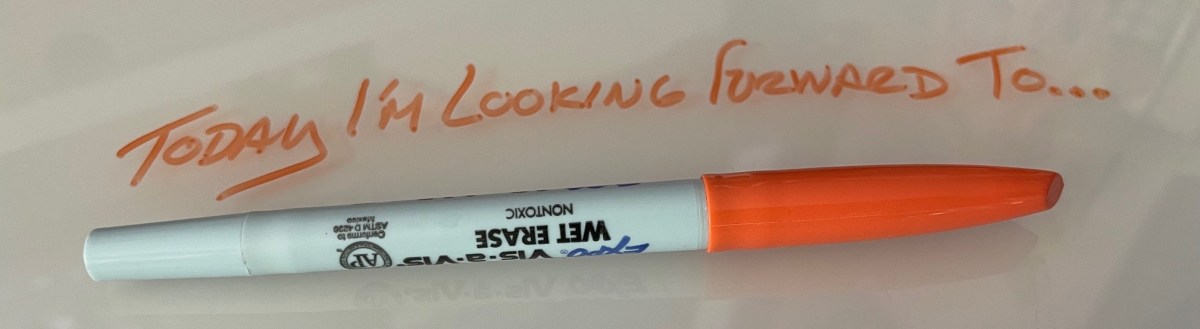
Instead of looking for things to be grateful for, try simply thinking of things that you might be looking forward to.
They don’t have to be big productions like an expensive vacation or some sort of exclusive party. This works just as well, perhaps even better, with something small.
Grab a pen and a sticky note and start looking forward to the little things. (Photo by Ravi Palwe on Unsplash)
How small? How about receiving a new calendar you ordered that has pictures you find particularly soothing? Or maybe going to a museum that you haven’t visited in a while. Or visiting a local garden shop just to browse and take in the glorious colors.
Clean out your coffee maker and look forward to having tomorrow’s coffee brew in a clean machine.
Or look forward to getting into bed in the evening and stretching out comfortably.
Consider the things you could potentially look forward to…get granular about it…and try to see what the smallest thing might be that you could look forward to enjoying.
There’s a lot of good stuff in between those pickets. (Photo by Brad Switzer on Unsplash)
The “grandness” of the thing doesn’t matter—what matters is how you feel about it. And perhaps, at first thought, you consider it insignificant, but when you lean into it, you realize that it truly is something that brings you joy.
The more of these little things we can find, the more we realize that little bits of joy are scattered throughout our lives. And once we become aware of one, we might start noticing them everywhere.
~~~~~~~~~~~~~~~~~~~~
Speaking from personal experience, I find it very easy to become overwhelmed with the negatives in my life. There are times when it seems like all the difficulties come crashing down at once, at the worst possible moment.
However, it is worth shifting our focus and noticing the things that aren’t going wrong. It’s as if you are looking at a picket fence. The fence itself might be the negatives and they’re hard to miss—after all, they’re right in front of you.
But if you look through the posts of the fence, into the space between, that’s where you see everything “not wrong”. And you might find that, in fact, there is more “not wrong” space than there is picket fence.
So I encourage you to take some time when things get difficult to look through the fence and find your little joys to look forward to. Focus on them, write them on a sticky note and put the note somewhere where you’ll see it in the morning.
Wow, 2024 is going by fast! We are now a quarter of the way done with the year and it feels like we just started.
In the midst of the whoosh of weeks flying by, here’s a way to slow things down and get intimate with the present moment. This is a simple little meditation but one that I find to be gloriously soothing.
I often do this in the morning when I awake, still stretched out comfortably in bed. Bringing attention to the weight of my body as it rests on the surface of the mattress. Sinking in.
We usually consider street traffic an annoyance, but it can translate into perfect sounds for a meditation. (Photo by Derek Lee on Unsplash)
And for this meditation, instead of using the breath as a point of focus, I bring attention to the sounds around me. In my room, outside on the street.
There is a lot happening in this soundscape. We have a sound machine going, an air purifier whirring, cars are driving up and down the street below. The sound envelops me and I absorb myself in it. It feels comforting.
Initially, my attention is open, getting settled and taking everything in. Then I shift my focus from the various indoor sounds to the outdoor sounds, traveling around them one at a time, noticing each different one.
Gradually, I select one sound that I can distinguish and move my attention towards it. I get in close. And the closer I get to it, the more my focus turns to a certain aspect of that sound, a certain pitch or rhythm. And then I zoom in even more and try to stay there.
Inevitably, I’ll notice that my attention has been pulled away by thoughts or other sensations, and when I become aware of this, I gently return to that one aspect of that one sound. Exploration continues in this way until I decide to shift my focus to another sound and do the same thing.
It’s a little dance between my thoughts and any given sound. Always returning to the sound.
There are no hard and fast rules to this. The option always exists to pull back from that one sound and open my awareness to everything audible around me. And perhaps instead of finding a specific sound to pour my attention into, I allow the soundscape as a whole to come to me and listen to it as if it were one unit, like a symphony.
This is meant to be uncomplicated and unforced. The idea is to stay present with the sounds around me and notice new textures and dimensions of noises.
I hope you give this a try the next time you find yourself in a perfect spot for it (whether in bed or outside under a tree in the park), and if you do, please let me know how it went!
So, now that we’re a week into 2024, what a great time to set an intention for the New Year.
For me, it’s going to be “stress less and move forward”. At least I’ve got the “moving forward” part planned out, as there will be a lot of changes in my life this year.
It’s the “stress less” part that trips me up. So I’m redoubling my efforts to make sure that mindfulness takes priority in my daily activities, and one of the best ways to do this is to see how I can make everyday tasks into moving meditations.
I present to you, the coffee break. Tea works as well, even better, it could be argued. Regardless of your preference, this is how the break works (and obviously, this should be adapted to your own situation):
Wow, I can literally smell this image and the aroma is glorious! (Photo by Mae Mu on Unsplash)
When you arrive in the kitchen (or wherever you keep your coffee, I’m not judging), bring your attention to your hands. Look at them. Notice the temperature of the air on them. Flex and straighten your fingers…and then observe your hands open the cupboard and remove the container in which you keep your coffee–mine is a metal cannister–along with a stack of paper coffee filters.
My cannister is has a pretty blue and green pattern on it and it feels cool to the touch, nice and smooth. As I open the top, the scent of coffee fills the air. I savor that for a moment.
Set the container down by the coffee maker and pick up a coffee filter. Mine is cone-shaped. Notice if the paper feels coarse against your fingertips and how it sounds as you handle it. Nestle it into place inside the coffee maker.
What does your running water look like, sound like, feel like? (Photo by Nathan Dumlao on Unsplash)
Then, back to the coffee…and fish out the scoop (mine invariably gets buried under the grounds), spooning out however-much coffee you want. Listen to the “crunch” of the grounds as you do so.
Transferring the coffee into the filter may elicit more aroma during the process. What does it sound like as it falls onto the filter? When done, replace the scoop and then the top of the coffee container.
Whatever water container you user–mine is a plastic water jug, perhaps yours is the coffee carafe itself– bring that to the sink, place under the faucet, and turn on the cold water.
Does the faucet handle feel cool to the touch? As the water runs, notice whether light shines through the stream or if it’s aerated and fizzy. Listen to the sounds of water flowing through the plumbing and into your water container. Perhaps there’s a cool splash.
Such a peaceful start to the day. Inhale… (Photo by Clay Banks on Unsplash)
When filled, turn off the water, noticing whether the handle makes a sound as you turn it. Bring the water container to the coffee maker and as you pour the liquid, listen to how it runs in, watching the waterline rise.
Close the coffee maker’s top, press the requisite buttons and savor the sights, sounds and smells of the coffee as it brews.
So as I mentioned above, depending on your own situation, your experience may vary, but the main idea remains the same: when you are in the process of making morning coffee or tea, be IN IT. Invite your senses to this event and, perhaps most importantly, keep unrelated thoughts out of it.
Start your day with a mindful ritual like this and it will help carry that attitude of staying present into the rest of your day. Give it a try and enjoy the calm!
There is, unfortunately, a trap that some people may fall into when practicing mindfulness meditation.
In the context of selecting a point of focus that anchors you into the present, there is that teensy possibility that someone just starting out with meditation might focus without equanimity.
Equanimity is the ability to maintain balance and a sense of calm in both good and bad situations. It is the acceptance that impermanence and suffering are a part of life, and it is the state of allowing all feelings to pass through you, observing them without judgement or expectations brought on by previous experiences.
Equanimity is being able to allow in both the good and the bad without getting dragged through it.
Allowing emotions in when you’re trying to stay calm and collected might seem a little counter-intuitive, but in fact, I consider it to be to goal of mindfulness meditation. That’s because the most important time to maintain a sense of inner peace is exactly when the proverbial sh!t hits the proverbial fan. Mindfulness meditation provides us with a safe space within which to practice just that.
The tendency, however, is to try to keep difficult emotions out. I myself encounter a lot of resistance when doing guided meditations that focus on bringing up uncomfortable thoughts, particularly in the evening, when I’m most susceptible to anything that might perturb my sleep.
However, not allowing those thoughts in can set up a pattern of avoidance, depriving us of the opportunity to learn to deal with them. And this avoidance can imbue difficult thoughts with even more power, as if they become the boogeyman lurking behind a door that we’re terrified to open. That’s not a good thing.
So how do we get around this?
Pick a good time to explore the stickier side of things; I would caution against the evening, when, as I mentioned above, bringing up tough feelings can agitate you and make it more difficult to fall asleep. Keep the environment quiet, comforting and safe, with gentle music in the background, if that suits you. I like mid-morning time and natural light, with a cup of tea or cacao or anything else that feels soothing.
Choose your anchor: your breath, a bodily sensation like tingling in your hands, a constant sound in the the background…even lofi music from YouTube.
If you feel too drifty, keep your eyes open to help ground you. Perhaps focus them on an object that brings you peace, such as the photograph of a loved one or an image of a peaceful place.
Give yourself a calm opportunity to explore complicated emotions.
Breathe deeply and pay attention to gripping or tightness in your body, especially forehead, jaw, neck, shoulders and belly. Consciously release any areas that seem to clench as you go along.
And then allow whatever comes up to come up. Observe them…and then let them go. No need to analyze or justify. Imagine that you’re made of Teflon and those uncomfortable images slide off you.
If needed, sit further away from them. When the intensity gets too high, you might need space, so imagine that they are flowing past as if you’re on the bank of a river and they are the leaves that float by on the surface of the water. They come and they go and you breathe deeply through it all.
As you practice, maintain your focus the best that you can. The point of your focus is not the thoughts, it’s the breath or whatever other anchor you might have chosen. This way, the thoughts move independently and subside as smoothly as they appeared. If you find yourself getting stuck, return to your anchor and remind yourself that in this moment, you are safe.
IMPORTANT: If your thoughts are tied to trauma or the intensity seems unbearable, please seek out the help of someone professionally qualified to help you deal with them. Mindfulness meditation is a wonderful tool, but sometimes it’s not enough.
A few days ago I realized that we were missing a tree out in front of our balcony. Not some little sapling that could be easily overlooked, but a tall, mature pine tree that offered us shade during hot summer afternoons.
It was gone, only stumps remaining. I was stunned. After I furiously texted my family for answers (WHERE IS THE TREE???), my husband texted back that it hadn’t been there for weeks, and I hadn’t noticed its disappearance even though I’d been out on the balcony numerous times.
WHO TOOK MY TREE???
That was weird.
So, you might be wondering what that has to do with this post. Well, it’s easy to cruise through life not being fully aware of what’s going on around us…or in our bodies. Just like I was imaging the tree was still there (while also wondering why the plants on the balcony were drying up much faster this summer), many times I’m also not aware that I’m holding tension in my body.
Perfect example: I had trouble falling asleep a few nights ago. After lying awake in bed for some time, it struck me that I was clenching just about every part of my body. My jaws, neck, shoulders, back, glutes…everything had tightened into knots.
I had been concerned about preparations for a party that we were to attend the next day–and I was aware of that–but all of those worries had passed into my physical being, and that I wasn’t aware of. Good luck trying to get to sleep when you’re as rigid as a board!
So I started a little dance of releasing those muscles, then drifting back to my “normal” state of what can only be described as oblivious unattention, until I noticed that I was still not sleeping and–oh look!–everything was rigid again, so I released my muscles again…
Sometimes I find myself clenching just a teensy bit too tightly…
Yes, I went through the process of relaxing my face, my jaw, my neck…blah blah blah…if you’re a meditator, you know the drill. But a few minutes later, everything had clenched up again without me realizing it.
This went on for a while. When I get caught in a “loop of oblivion” like this, one of the first things I do is stop. Just halt the dance. And take a very deep breath.
That’s the first start in resetting things. Think of it as a much kindler, gentler version of someone slapping you in the face and yelling, “Get it together!”
And that’s when my broader awareness returned and I was able to get out of autopilot mode, acknowledging my mental tension and thereby the physical one. It was a perspective shift because I wasn’t just thinking, “Will we get everything done in time?”
I realized what was actually happening: “All this concern about getting everything done in time is keeping me up.”
That slight shift enabled me to pull back and out of myself, brush off the worries about things I could do nothing about at the moment, and drift off to sleep. But it also reminded me that I need to practice awareness more than I had been. In a sense, I was now more aware of the need to stay even more aware.
Yes, even after years of understanding the importance of mindfulness, I must return to square one and refocus. I don’t think I’ll ever not be restarting, especially not as long as trees keep disappearing from under my nose. But that’s okay…the journey is soothing and the practice itself is a destination. My main task is to not stop practicing.
For a number of months now, my meditations have been “sub-par”.
I know I’m not supposed to judge, but objectively I’m aware that I’ve veered off course somewhere. In the past, I’d have good days and bad days, transcendent meditation sessions and really distracted, “no-way-I’m-gonna-focus” ones. But that was okay, because a large part of mindfulness meditation is coming back to the breath AFTER losing focus.
Rabbit holes are very enticing places to disappear into.
This has been a little different.
It started with a few weeks of distractibility as I was navigating stressors in the early months of this year. But gradually, things went downhill until I seemed to make it my job to use meditation time to go down rabbit holes.
Maybe I was too tired, meditating in the evening before bed or when I woke in the middle of the night and couldn’t sleep, so I didn’t check my wandering mind because I was dozing off.
If I had music in the background, my mind would dance off in a tangent and I wasn’t meditating anymore, forgetting that this was a time for calm and presence.
I’d get lost during my meditation with little hope of finding my way back on the path that I was on.
So I’d start a guided meditation — listening to someone’s voice would keep me on track, right? Nope. My ability to allow that voice to fade into the background was nothing short of impressive.
Day after day, I had dutifully taken on the task of wandering way off my meditation path until I realized that I was going nowhere and it was time to quit the restlessness and stay still for a while.
Even after years of daily meditations, I had to re-learn the habit of staying… because over the past few months, I’ve established a new habit of not coming back to my center regularly enough. And this new habit of spending my session mindlessly had managed to supplant my previous meditation flow.
So here we go again: setting aside some quiet time when I’m not particularly sleepy, finding an anchor like the breath to focus on in a patient, non-gripping manner, maintaining a gentle awareness of where my mind is, and when it inevitably wanders away from my point of focus (which it always will), calmly guiding it back.
Going back and consciously setting an anchor again. And enjoying that comfortable feeling of being present and aware of this very second.
When the breath seems like a boring place to drop my anchor, I turn to the sensations in my hands and feet (particulary useful when I’m stressed) or the sounds of automobile traffic outside ebbing and flowing or opening my awareness to all my senses and accepting whatever shows up. My focus is on the present and that’s where I aim to keep it.
So it’s true, that old “muscle memory” is bringing back my meditation practice and strengthening it as it does so. This serves as a good reminder to not get complacent, calling myself a “meditator” and throwing around stats like how many days in a row I’ve been meditating. In the end, the important thing is not my meditation streak, it’s the fact that today I will choose to meditate again.
As a visual person, I have days when my “mind’s eye” has difficulty focusing during meditations. For those times, listening to guided visualizations is my best option for a calming tool.
Additionally, body scans are excellent pre-bedtime wind-downs. So when I recently heard of a great visualization that includes a body scan, I wanted to share it here.
Your private pool can be anywhere you want, even indoors. Source: https://pin.it/4UeEa1U
This one is based on a “healing bath” visualization that was presented by an MSW/Oncological Therapist who leads Friday morning meditation at my cancer center. Putting the focus on vivid visuals and including your other senses fills your awareness with rich imagery that works so well to soothe an overworked nervous system. While this will not be an auditory experience, use your imagination as you read this to paint yourself a picture of a safe, soothing space that you will remember.
Here’s the basic imagery (add details that resonate with you): you arrive at a beautiful natural location, walking down a path surrounded by lush greenery, wearing a luxurious fluffy robe and cushy slippers. As you follow the path, flowery fragrances waft on a gentle breeze that carries bird songs to you. The sun is at a height most soothing for you; for me, it is early morning with a mist in the air. Bright enough to see everything, but imparting a feeling of safety and privacy.
As you continue down the path, it opens up into a small secluded beach with a round pool of water, clear and sparkling; part natural pond and part constructed, with beautiful white stone steps leading into it. Surrounded by flowering plants, it invites you in.
You feel the sensation of the fluffy robe and slippers sliding off of you as you leave these items by the entrance to the steps. Then, you dip the toes of one foot into the water and find that the temperature is perfect for you. Notice the sensation of the warm water as you step onto the stone stairs with both feet, holding onto a sturdy railing. You stand up to your ankles in the pool and sense the difference in the temperature between the misty air and inviting water.
Take two more steps down and the water slides up to your calves, soothing your lower leg muscles. Then step further in as the water line slowly travels up past your knees and halfway up your thighs, so that most of your legs are submerged in the placid, warm pool, now feeling more like a bath.
The bottom of the pool is easily visible through the clear water. Unhurriedly, take a few more steps down as your toes reach the white sandy pool floor and the water rises up to your waist, enveloping your lower body in warmth.
Feel the gentle support of the water.
By one side of the pool is a smooth sculpted stone bench to which you glide, feeling the slip of the water against your skin as you move, drawing the tips of your fingers across the pool’s surface, leaving gentle streaks as you go.
As you lower yourself onto the seat, sense the warmth rise up your torso and arms, traveling up as you settle down. The bench is deep enough for your body to submerge but comfortably keep your head out of the water.
The soothing water supports you as the seat cradles your body. Rest your head on the side of the pool – the edge is sloped and comfortable. Then listen. What do you hear? Sweet songs of birds? The meditative buzz of gentle honeybees that flit among the flowers? Waves on a faraway beach?
Can you smell the fragrances of the flowering plants that surround you? As you breathe, as your chest rises and falls, feel the water glide around you. Warm, secure, safe, secluded. This pool is whatever you need it to be for you to feel nurtured and loved.
Stay here for as long as you like, watching light sparkle on the surface of the water. If you stay until evening, warm lighting illuminates the pool and surrounding plants, dispersing dark shadows and bringing a sleepy tranquility into the area.
Finally, when it’s time to return to present world, lift yourself out of your seat and glide back to the stairs, keeping yourself submerged to your shoulders until you take a hold of the handrail. Slowly, slowly release yourself from the pool, noticing the sensation of air on your skin as you emerge, feeling the waterline move down your body as you climb the steps.
With the final step, you leave the pool and take up the fluffy, soft robe waiting for you, wrapping yourself in it. Slip your feet into the cozy slippers. Your body dries quickly. Make your way up the path. And although you leave this magical space behind, it is always available for you whenever you want to return.
~~~~~~~~~~~~~~~~~~~~~~~~~~~~~~~~~~~
If you are uncomfortable with water or if the visualization keeps bringing in disturbing images such as a very deep pool, dark water or something foreboding lurking underneath the surface, or it feels constrictive or claustrophobic, substitute a sparkling mist or a golden light for the water. You can still feel the body sensations as you enter into the pool. There are no rules here, it is your safe space and you can set it up as you please.
Finally, to bring this from a visualization into reality, create a real-life pool for yourself in your bath, with ample tealights, a soundtrack of nature sounds or gentle music and water temperature that is right for you. Feel your arms and legs float, prop up your head with a towel on the side of the tub. Breathe deeply. This is a perfect way to end the day and prepare yourself for a restful slumber.



















 Frantic Shanti