I’m popping in here with a little reminder to practice self-care over the remainder of this holiday season and springboard that care into the new year.
“I have had no time for self-care with everything going on!”, you may protest, but then, what do you imagine self-care to be?
If you believe commercials, it’s drinking red wine in the bathtub, eating ice cream from the container, using a face mask and getting your nails done at a salon. All while chanting, “BECAUSE I’M WORTH IT!”
In general, anyone who is perpetuating that type of “self-care” is trying to sell you something.
Journaling is an effective form of self-care and doesn’t require an expensive journal or pen, no matter what someone tries to sell you. (Photo by Sixteen Miles Out on Unsplash)
Here are less expensive options that I feel align more closely with the true meaning of self-care: * pausing during the day to take a few mindful breaths; * noticing where you are (“Right now, I am in the kitchen doing the dishes, feeling the warm water and slipperiness of the soap on my hands”) to help calm racing thoughts; * making a decision to choose a more nourishing food, eating slowly, savoring each bite; * decreasing/eliminating alcohol — substitute a drink that looks festive (sprig of rosemary or a skewered piece of fruit added to sparkling water); * staying consistent with exercise, or if time is squeezed, sticking in extra movement whereever you can (like doing 5 squats every time you go to the bathroom or a short yoga session right before bed); *practicing gratitude, and if that’s hard, just finding something to appreciate.
And of course, taking time for a brief meditation whenever you can.
I think you get the idea.
Holiday self-care is not about buying things. It’s not about practicing an Instagram or TikTok version of indulgence. There are no photos to post and you don’t need a manual for it to be beneficial.
It is taking a break to drop down out of your thoughts and into the present moment. Be kind to your body and mind, get enough sleep and exercise to make yourself feel good. And importantly: release expectations of what you think the holiday should look like, how people should act, what you should be able to accomplish, even how you should feel about it. Find appreciation for whatever is going well.
This is a time-sensitive opportunity for US residents!
NOTE: all links are described at the bottom of this post.
I unexpectedly came across a great opportunity for those of you interested in taking a master class in stress management and also participating in a large research study.
Dr. Judith Moskowitz, a research psychologist at Northwestern University’s Feinberg School of Medicine, is recruiting 20,000 participants for an online, self-guided, positive emotions study/class. The course will teach eight science-backed stress reduction skills over 5 weeks, with the 6th week being a practice and review period (the entire length of the study will be 12 weeks). The skills being taught involve the following (from this National Public Radio (NPR) article):
Positive Events
Savoring
Gratitude
Daily Mindfulness
Positive Reappraisal
Self-Compassion
Personal Strengths
Attainable Goals
Additionally, NPR has an accompanying 5-week newsletter series called Stress Less that will help reinforce these skills. Signing up for that can be done here.
More information and the registration link can be found on Dr. Moskowitz’s site where she describes what’s involved. To participate, you must be over the age of 18, living in the United States and have reliable internet connectivity as this is 100% online. There will be questionnaires to complete about your emotional states at the beginning and end of the study, and you will get nightly homework.
Consistency is the way to grow positive skills and behaviors, which is why I’m looking forward to participating in this class. (Photo by Jane Thomson on Unsplash)
While the “nightly homework” thing might seem like too much, I can personally attest to the fact that consistency is what strengthens skills and habits. You keep yourself accountable by committing to a daily practice. For me, knowing that a course is set up for working on a little every day is actually quite reassuring—I know I’m more likely to get results.
But do these skills really work in reducing stress? Dr. Moskowitz herself said that she was initially skeptical that skills like these would make an appreciable difference, but years of positive research results changed her mind. The idea is to train your brain to experience good feelings.
I love programs like this because the only cost is a little effort on your part. If it doesn’t seem to work for you, you haven’t lost much, but if it works, the rewards can be life-changing.
As a cancer survivor with anxious tendencies, I find this to be a win-win proposition. I have signed up, as have several members of my family. If you are interested, don’t wait! The study is limited to the first 20,000 registrants and when the original NPR story came out on Monday, September 30th, the response was so overwhelming that it effectively shut the regstration site down.
Registration resumed on October 2nd and as far as I know there are still spaces available.
But the enthusiastic initial response to the invitation to join in the research was quite telling. So many of us are looking for a way to reduce our stress levels and bring more positivity into our lives. This challenge is one more way to do that.
Warmest wishes to everyone for a joyous start to 2024! I hope you had a wonderful holiday season with your loved ones and are ready to launch into the new year!
I…learned a few things about myself in 2023.
My family and I had our share of misfortunes, bumps and hiccups and stumbles that started piling on. An apartment flood, two sizable rent increases, physical pains, emotional turmoils, family illnesses.
It’s easy to focus on the negatives (and *ahem* trust me, I did many times). But there were also some significant positives this year, not the least of which is that my cancer has not returned and I am still alive. Those are two biggies.
But I also found myself somehow managing, even in the midst of the worst stressors. I didn’t respond the way I had in the past, which would have been with a bought of nausea, racing thoughts and tortured nights.
So I know that something has changed: there is actual space between me and the things that suck. Now, there’s not always a lot of space–occasionally it’s a teeny gap that you could only slide a credit card through. And at those times, I might not even remember to take three deep breaths. But when I come to my senses I can breathe more space into that gap.
You need to stop and reflect on how far you’ve come to understand the benefits of what you’ve been doing. (Photo by Alexander Milo on Unsplash)
That, my friends, is called progress.
And as frustrating as it is that anxiety sometimes gets the best of me, my reaction is still so much better than it used to be and that provides motivation to stay consistent with a meditation practice.
So, if I learned anything, it’s that you don’t know how far you’ve come until you look back at the road you’ve been on and reflect on where you started.
But I also learned something else this year: sometimes you need to back off in order to go forward. I dealt with body pains that affected both my strength and conditioning exercise and yoga practice. I fought against taking it easy because I was so afraid of “falling behind”.
Well, nothing good comes of that. If anything, it prolongs recovery.
I was pushing myself to train harder and not respecting my changing limits. At the same time, I was juggling several online classes because I was also afraid of falling behind career-wise, on top of which I was concerned about finding a new apartment.
This was a classic case of spreading myself thin.
Constant striving made it impossible to my body to heal and rest and for my mind to assimilate information and construct useful goals and plans.
It was not until late December that I was forced to prioritize my well being because it hurt too much not to. Stressful events that came in the last quarter of the year gave me no choice. But in doing so, pain in my hip improved significantly and in backing off my expectations, I opted to focus on a single class, while at the same time continuing to sort through our belongings and get rid of things that we no longer need.
I slowed down and made more progress than if I had continued beating myself silly.
Look at all the beautiful positives that show themselves when you focus on the good stuff. (Photo by Kim Stewart on Unsplash)
All in all, as frightening as 2023 was at times, I can see all the good that took place, and that’s the third thing that was a major revelation for me. I’d describe my view of the world as being like a picket fence. Sure, if I only look at the pickets I see the negatives that have taken place. But adjusting my focus on the the world that is visible between the pickets, it becomes clear that there’s so much more that hasn’t gone wrong.
Even when it seems that you’ve suffered so many setbacks–and it felt like I really stumbled during the second half of the year–when you review what DID work out, the sense of gratitude and relief is uplifting.
So even in the midst of everything that stressed me out, 2023 doesn’t seem so bad afterall. And that little burst of positivity is what I’m taking into 2024 with me.
While this isn’t exclusively an exercise blog, if you’ve perused my posts you’ve probably noticed that I’m a huge proponent of exercise for both cancer patients and survivors (well, actually for everyone; but see my important message at the bottom of this post).
The best way to achieve this is to start exercising right now, if you are not yet, no matter what stage of the cancer experience you’re in.
There is a growing body of research that shows the benefits of exercise for cancer folk (I’ve written about it here). But the fact is that only about 17-37% of cancer survivors meet the minimum physical activity guidelines set out by the American Cancer Society (Hirschey et al., 2017, Cancer Nurs) even though doing so reduces the risk of cancer recurrence by 55%, not to mention the improvement in quality of life (Cannioto et al., 2021, J Natl Cancer Inst).
Exercise, the Cancer Fighter. In the not too distant future, your oncologist might hand you an exercise prescription as part of your cancer treatment.
Now, there is a call to include exercise as an adjuvant therapy for cancer for those who are currently undergoing chemotherapy. During the Oncology session of the 7th International Congress of the Spanish Society of Precision Health (SESAP) that took place in Spring 2022, Adrián Castillo García, a researcher at the Barcelona Biomedical Research Institute (IIBB) of the Spanish National Research Council (CSIC), reviewed recent studies regarding the benefits of exercise during cancer treatment, including the potential role that it had in “modulating the tumor microenvironment and immune function.”
You can read a synopsis of his statements here in the section entitled “Exercise as Oncological Therapy” (starting towards the bottom of page 2). Castillo states that physical exercise “has been shown to have the ability to modulate the tumor environment… . This modulating effect translates into an improvement in the efficacy of chemotherapy and other oncological treatments.”
Castillo goes on to say that “prescribing doses of physical activity at an established intensity and volume can be very decisive in combating the tumor microenvironment, but this preliminary evidence must be confirmed in trials on humans to ratify the role of exercise as a treatment capable of improving the efficacy of the main therapies.” (All quotes from the aforementioned synopsis.)
With such promising results, it’s quite possible that future cancer treatments may be a combination of medicine and physical activity.
Ok, so say that you are not an avid exerciser, but motivated by these studies you’re willing to give regular exercise a go. What do you do when you’re already feeling fatigued from treatments?
I wrote about this here, but in a nutshell, the idea is that you need to decide what the right starting point is for you, and this will depend on your previous experiences, both physical and emotional, with a physical activity program. It will also depend on what you can manage at any given time in your treatment.
Starting an exercise program? Make it something that you can do and enjoy, and it will become a life-long habit.
Ask yourself, “what is reasonable for me?” But don’t respond to that with a t-shirt slogan-type answer (“Exercise? I thought you said extra fries?!?”) that immediately shuts down the idea. Admittedly, there may be times during treatment that getting yourself to the toilet without help is a momumental achievement. But that will pass. And exercise will make you feel more in control of your health and better overall.
IMPORTANT: Find what you can do and then do it as consistently as you can.
This may mean starting very simply [always get your doctor’s okay first!]. Choose an activity, duration and frequency, say, brisk walking for 20 minutes a day, three days a week. Follow that pattern for two weeks, then add to it–perhaps another 10 minutes–not to overwhelm yourself, but simply to push the edge a bit (you can always ease off if you need to, give it a week and increase again). If possible, increase some aspect of your program every couple of weeks, as it suits your condition. In the example of walking, incorporate a flight of stairs and gradual upper body movements: first pumping the arms, then hand weights, eventually strength training for both upper and lower body.
The timing is up to you.
If a walking program feels too easy for you, train at a higher level, but remember that the same concepts still apply: (1) consistency, (2) progression, (3) balance in your activities. If you’re interested, read my post about my three “pillars” of fitness.
Most importantly, start, progress gradually and keep it up for the rest of your life.
If your starting point is a standstill, this will take patience. But I PROMISE you, no matter what you can muster, it will still be better than doing nothing.
~~~~~~~~~~~~~~~~~~~~~~~~~~~
I know I already said this, but it bears repeating, especially for cancer patients and survivors: do not start any exercise program without consulting with your medical team first. While I feel that improving your physical fitness is one of the best things you can do for yourself, every body is different and every cancer situation is different. Talk to your doctor and let them know what you’re planning to do.
So this isn’t the kind of news you want to see. But there’s still hope…
A scientific journal article from 2017 (Cupit-Link et al., 2017, ESMO Open) describes the toll that cancer treatments can take on the patients subjected to them.
After being told you have cancer and deciding to proceed with the treatments that will offer you the best chance of survival…it’s disheartening to learn that many of those same treatments can accelerate aging, causing damage to your DNA, heart disease, hearing loss, cataracts, liver and kidney diseases, brittle bones, lowered immune response and other cancers (!) among other issues, depending on the type of cancer and treatment (see WebMD article).
The treatments that can save our lives from cancer may hasten our demise from age-related factors.
This is a problem resulting, ironically, from the success of treatments and extended lifespan of cancer survivors. Back when cancer was deadly with a low survival rate, no one was too concerned about the state in which survivors were left in; simply surviving the cancer was enough. Now that people are beating their cancers at greater rates, quality of life has become a much bigger issue.
While the most striking detriments are seen in childhood cancer survivors, accelerated aging occurs in most former cancer patients.
Doctors and researchers are taking note. At the time of this scientific article’s publishing in Dec 2017, there was already discussion on how to “de-escalate” cancer treatments as a way to decrease the amount of cellular damage to patients.
On a personal level, I chose an effective drug for my HER2+ breast cancer (Herceptin) over a more effective drug (Perjeta) that carried a risk of greater cardiotoxicity. I made that decision because although I was terrified of cancer, I was also afraid of what lasting effects the drug would have on me once the treatments were over.
Cancer treatments are strong but healthy living can help mitigate their negative effects.
But even if you didn’t have the opportunity to make such a choice, there’s still something that you can do. The authors of that 2017 paper noted that cancer survivors can take back some control over their health by adopting or continuing those healthy lifestyle habits that should sound familiar by now: not smoking, limiting alcohol, exercising regularly and eating a healthful diet.
To that, I would also add, managing your stress levels, the importance of which has been demonstrated on a cellular level, and getting optimal amounts of sleep.
Improving longevity is a hot field for research as scientists work to determine what aspects of one’s lifestyle show the greatest promise in keeping the body young. This topic is complex and new data is coming in on a regular basis, so I won’t delve into details here, but it stands to reason that being sedentary and eating a high-sugar, high-processed diet is not going to do you any favors.
Just as cancer treatments may have a negative effect on overall health, you can win back some lost ground by making healthy, informed decisions on diet and exercise. No one wants to limit their cancer treatment options, so this is one form of insurance that you can give yourself. No matter what else happens, a healthy lifestyle will benefit your quality of life. And that is an improvement that is yours to keep.
This is the time of the year that many people make resolutions they hope will catapult their life into a new and positive direction.
So it’s also a good time to encourage people to slow down and consider what they hope to achieve and how they plan to get there.
And they’re off! The New Year fills us with energy to make big changes, but most of that impetus fizzles out as we realize that our plans are not sustainable.
The New Year’s buzz drives us to dream big and leap high, but with all that emotional energy expenditure, we run the risk of overwhelming ourselves, burning out quickly and falling far short of our lofty expectations. And that may make us feel worse about ourselves.
This year, take a step back and consider: it’s the small changes that you make on a daily basis that determine where you ultimately end up. Consider an ocean liner that turns very slowly. It makes little adjustments in its course, but depending on which adjustments it makes, it can end up in very different places.
The real name of the game is consistency. While the big goal may be the shining light you strive for, consistency paves the way. And mindfulness helps you get there.
Maintain awareness of the present so that you have perspective on what choices you’re making today and their effect on tomorrow.
Focus on what you can do today. Even this hour. Want to increase your activity level? Get up and take some steps right now. That doesn’t mean sprinting around the parking lot for 10 minutes. It means doing something you wouldn’t have done otherwise. Something that won’t give you side stitches and result in wanting to throw in the towel.
Make little decisions to change something. Make them doable. And then make them consistently.
Maintain your awareness, every day, of what you’re doing and why.
And when those changes have become comfortable, do a little more. Keep your eye on consistency, not quantity.
Establish positive little habits the way you’d spread the seeds for a lovely cottage garden. Because here’s the thing: this is not a race. This is your life. You don’t live your life a month at a time–you live it moment by moment. And that’s the way you make changes.
Be like the big ship whose many little changes, made consistently, take it to fantastic places.
Any decision that positively affects you remains yours to keep, like a little jewel in a box. Did you go for a walk among trees after lunch instead of hanging out in your office perusing social media? No one can take that experience away from you. Tomorrow, if you have a meeting after lunch and must stay at your desk, the positive effect of that walk will still have taken place.
It’s like a little brick that you can use to build a palace. You collect one each time you’re consistent with a behavior. Play the long game.
And when you remain mindful of your behavior every day, you can also step back and see where you, the human ocean liner, are headed. This makes it easier to correct your course. A short diversion does not need to take you in an unwanted direction. One small correction and you’re back on track.
And that thing that you might have called a “failure” in past years and just given up because you’d figure you’d “blown it anyway”? It would be a temporary side trip. Because you are mindful of where you are and where you’re going.
And that’s how you know you’re going to get there.
I am a believer in the idea that, for developing proficiency in an undertaking, consistency is more importat than what you do on any given day. It is true for workouts and it certainly holds true with meditation too. Exercises, whether physical or mental, need time to show beneficial effects and that requires patience and persistence on the part of the practitioner.
However, there comes a point where maybe what you’re doing, consistently, might need to increase in order to enable you to progress.
Consistency is key when it comes to exercise, both physical and mental.
When I started out with meditation, I had very little guidance outside that from the Calm app on my phone. The curated daily meditations there lasted about 10 minutes, so that’s how long I meditated. I did so ever single day, true to my perfectionist nature. I earned a gold star for consistency.
At that time, my life was in turmoil–I was only a few weeks out from a cancer diagnosis. Meditation helped me breathe through the early sleepless hours of the morning, when I would wake, feeling frightened, alone and angry.
But it wasn’t until almost a year later, when I started the Mindfulness-Based Stress Management (MBSR) course originally developed at the UMass Medical Center, that I learned how much meditation could do for me. Our “homework” was 45-60 minutes of meditation a day, no joke when you’re used to 10-minute stints.
But during that time, something unexpected happened. As I meditated, somewhere around the 20-30 minute mark, I felt myself settling in and releasing. This, for a bundle of nerves like me, was a novel experience. I don’t think I could have gotten that with 10 minutes a day. But a glorious hour? It was transformative.
Any meditation will do you good, but take advantage of those times that you can engage in a longer session.
Giving myself permission to simply BE for the entire length of time was not easy. There was guilt involved in being “unproductive” for so long, not to mention the difficulty of dealing with intrusive thoughts. But once my monkey mind accepted the fact that all I was going to do for the entire hour was feel into my breath or pay attention to bodily sensations, it started settling down, gifting me with a stillness that I hadn’t experienced during the shorter meditations.
It was the most soothing act of self-care that I had ever allowed myself to do.
So right now I want to clear the air of the “never good enough” idea, by which I mean the concept of, “Oh, you’re only meditating for 10 minutes? You should be doing it longer.” That is a total motivation killer and goes completely against the acceptance that mindfulness teaches. And that’s not what I’m suggesting at all.
There are great benefits to short meditation stints, one of which being that when you “drop and give 2 minutes” of deep breathing, or however else you choose to express your mindful self, you are actually doing a great job of integrating mindfulness into your everyday experience. Remembering to ground yourself in the middle of a hectic moment allows for a respite from the busyness of the day and helps build a mindful life.
But if you find yourself with extra time, such as a day of travel (where you’re the passenger!) or a prolonged sit in a waiting room–jury duty, anyone?–or even the decision to turn off the electronics and retire to bed early, it is well worth giving yourself a nice chunk of extended time to engage in the self-care of turning inward and being still.
~~~~~~~~~~~~~~~~~~~~~~~~~~~~~
Tip: If you’re not used to prolonged meditation sessions, start with an extended guided body scan meditation, readily available free online through YouTube, MBSR websites and apps such as Insight Timer, for a few examples. It will give your monkey mind enough to do so that your thoughts don’t completely wander off, and yet little enough so that you can feel completely into each body part.
Lately I’ve been speaking with people who are having a hard time dealing with anxiety, so I thought it would be worthwhile to dive deeper into grounding methods.
For me, hands down, strong neutral physical sensations (with “neutral” being the operative term here) are by far the best ways to pull my head out of swirling thoughts and get back to where I am now on the Earth.
Buttocks and feet are great focal points for drawing attention away from rapid breathing or heartrate.
Currently, I’m focusing on touch points: those places on your body where you are making contact with any surface. This is highly effective because it is well-suited for any situation. You don’t necessarily need to be in a particular position, nor do you need a quiet space. So if you’re in the middle of an exam, sitting in your boss’ office, standing at a podium or walking down the hallway of a hospital, this grounding method can shift you back to the present moment.
The idea is to focus on the sensation of pressure. My suggestion would be to bring your attention to whereever on your body you can sense that contact with a surface, giving preference to places further from areas that might be reinforcing anxiety, such as the chest region and a rapidly beating heart. So, hands, feet and buttocks would be good candidates. If you’re walking, then pay attention to the change in pressure of your steps as you put your foot down and lift it again.
Feel into these body parts, sensing how the pressure feels against them. You can also bring in sensations such as tingling and temperature. Like an investigator, experiencing these sensations as if for the first time, get curious about their quality. If needed, squeeze the muscles, but then make sure to relax them too, so that you’re not clenching. Then see if you notice a difference in sensation.
Try it right now. Go ahead, I’ll wait…
You don’t need a special place to practice grounding yourself. Where you are right now is perfect.
Did you try it? And did you feel anything? The type of sensation doesn’t matter here. The main goal is to get out of your head, which may be in overdrive. Paying attention to what your body is doing RIGHT NOW helps move you away from thoughts of dread and gives you a handle on your reactions.
Important: as with all calming techniques, this takes practice. It is not a one-time thing that you try, nor is it a pill that you pop and everything settles down. The more you practice this, especially when you’re in a peaceful surroundings, the better you will get at shifting your focus during times of anxiety. Just as with a formal meditation practice, it is consistency that will improve your focus and thereby your abilities.
The added benefit to practice is that you will realize you *can* do it, that it *does* work, and you will build confidence in yourself that you can handle it. So in an anxious moment, you’ll be able to say, “I got this” and bring yourself to a more manageable place.
I didn’t think I needed a video game to help me mediate.
In the description for “Playne” (on the Steam platform), the developer states that the game is designed to help you establish a meditation habit. While, I thought it would be uninteresting for someone who already had a solid habit, the reviews of the game were very positive and the concept seemed inviting, so I decided to give it a try.
After a week of meditation, saplings have emerged.
I had no idea that it would have such an impact on the quality of my meditation. While I often listen to ambiances (such as through the “MyNoise” app and website) and use guided meditations (“Calm”, “Insight Timer”) or similar auditory cues (“Unwind”), what I didn’t have was a visual representation of my meditation practice as it progresses over time. “Playne” supplies that.
“Playne” has three modes: Story, Sandbox and Evolve. This post is about the Story mode, as that’s the one most people start out with and the one I’m currently working on. Sandbox allows to you build your own meditation spaces and Evolve can only be unlocked after 100 days of meditation (I’m still in the 50s).
You have a small selection of meditations to choose from with the emphasis being on learning to sit with yourself.
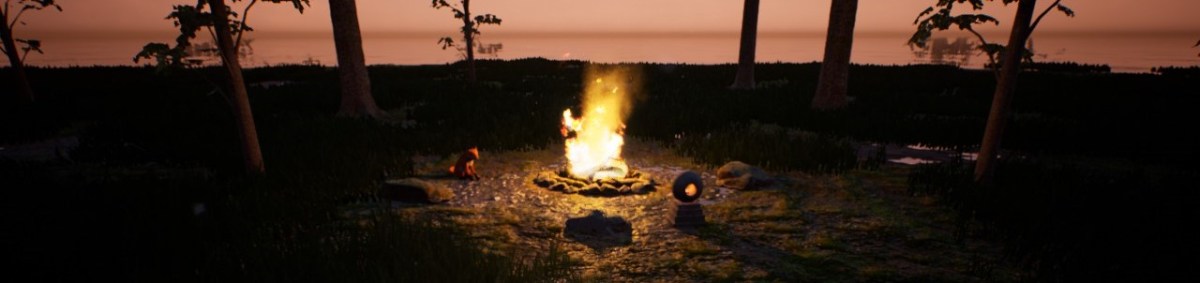
The game starts out on a semi-barren island with only a tiny flame in a campfire, a stone lantern, several rocks and Sensei Fox to keep you company. There are both guided and unguided meditations to choose from and as you meditate everyday, the fire grows taller and seedlings sprout and grow. With consistency, you unlock different story chapters, which wise Fox relates, gain the ability to change the weather, and most importantly, grow the island into a beautiful meditation retreat. All it takes is patience.
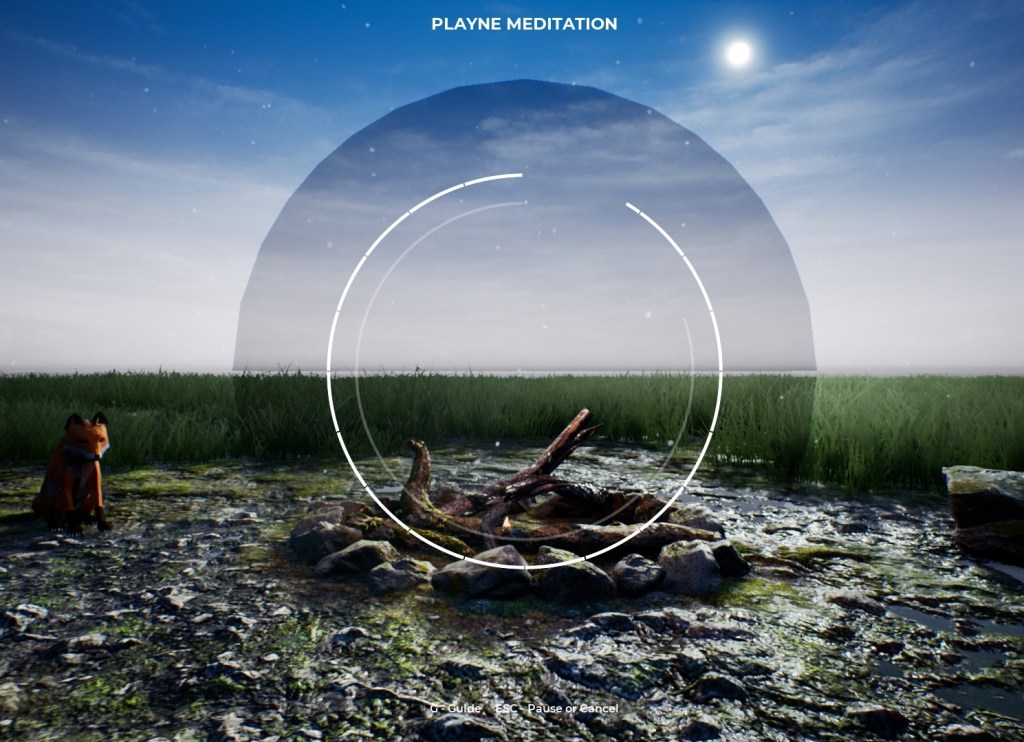
There is a breath bubble to guide your breathing if you wish, and also a ring that serves as a countdown timer. Both can be turned off if they are distracting or unnecessary.
You are given the ability to chose the length and type of your meditation. In addition, you can regulate inhales and exhales (the length of which you can designate) with a breath bubble, keep track of your meditation time with a minute-ring, enable a journaling option (known as “thought pages”, which you can either keep or burn in the fire if preferred), and mark each instance that you become aware that your mind has wandered (as I enthusiastically wrote about here). There are different places on the island to meditate, and as you accumulate more days, you not only get more weather options to chose from, but also access to elements such as birds, fireflies, Aurora Borealis and butterflies. These are quite lovely and make your “Playne” even more inviting.
Be forewarned that there is the temptation to mark your progress and count achievements. I understand why, from the viewpoint of a game, this is necessary but it does go against the concept of mindfulness. On the other hand, I’m really looking forward to flowers and butterflies!
Now for the potential downside: As much as I enjoy all the offerings, there are a few parts of the game that seem antithetical to mindfulness meditation. The game keeps track of “effort”, you gain “achievements” and note your “progress”. As do other meditation apps/games, “Playne” maintains a record of your streak, and depending on your settings, if you don’t log in to meditate with “Playne” on a given day, you run the risk of having the flame in the campfire go out. While I know that this is done to encourage daily meditation, it is also somewhat problematic, as the whole idea of mindfulness is non-striving. I feel that too much emphasis on achievement in the context of a meditation practice goes against being mindful of the present.
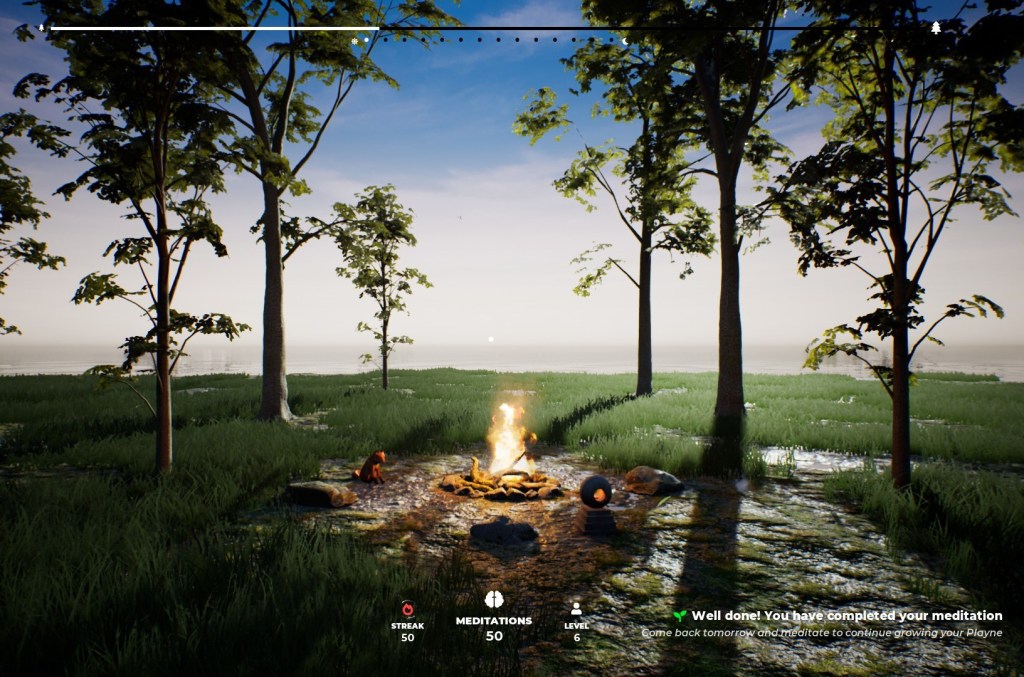
Over 50 days into this, my Playne has grown significantly.
Being of a naturally competitive nature, I was reluctant to turn my practice into one where I would be clinging to achievements. Nonetheless, there are enough positives to this game, and it has benefited my practice so much, that I have been learning to let go. That in itself is a significant improvement!
Yes, it’s unlikely that I will risk breaking my streak, but that’s pressure I can live with.
Reservations aside, I am really impressed with the game. I will write about the Sandbox and Evolve modes when I get to them, and post more images as my “Playne” grows. Additionally, there is a virtual reality (VR) option that I am looking forward to playing with. For anyone starting out with meditation, “Playne” offers a solid platform from which to develop and maintain a consistent meditation habit.
~~~~~~~~~~~~~~~~~~~~~~~~~~~~~~~~~
In addition to “Playne”, I am also using other mindfulness media on a regular basis (my favorite ones are here). That makes for a lot of checking in with electronics, unfortunately. I’ve gotten to the point where I meditate about a half-hour to an hour-plus every day. While it’s a priority in my life, there are days that it’s a struggle to find time for it all. Introducing “Playne” has added to this, and the last thing I need more of in my life is stress.
Sometimes I combine “Playne” with other apps to take advantage of the “Playne” ambiance while doing my favorite guided meditations. More recently, however, I’ve also used “Playne” as a way to emphasize unguided meditation, and that has allowed my meditation practice to mature and expand beyond the confines of a computer program and into the rest of my day. That is one of the greatest benefits of this program and the main reason why I have found it so valuable.
Although this is a blog about cancer and mindfulness, I hardly think there is any lifestyle habit as effective as exercise at helping survive cancer. And what better time to discuss this than the start of a hopeful new year?
I’ve been certified as a personal trainer by the American College of Sports Medicine (ACSM) for well over a decade, and although I haven’t actively taken on clients, I’ve had enough time to develop my own fitness philosophy. I must stress, this is a conceptual post and not designed to guide you to specific exercises (although I mention some modalities as examples). However, if you’ve had trouble getting your head around how to maintain an active lifestyle, these ideas may help.
In my experience, there are three critical aspects to a successful exercise program: (1) consistency, (2) progression and (3) balance.
CONSISTENCY
This is the most important concept of my three and worth spending the most time on.
Consistency is the concept that seems to be most difficult for people, and it’s usually the “make-or-break” aspect of fitness. It’s quite simple to get motivated to start a new program, whether it be signing up for classes, planning out home workouts or simply deciding to go for a brisk walk every day.
The hard part is sticking with it. But I can promise you, that’s where the magic is. Be realistic about how much time you have to devote on a daily basis and what your exercise will consist of. This should not be something far out of your realm of experience or else it will be too difficult to maintain. Make it familiar.
When starting out, pick something you enjoy doing and it’ll be easier to keep doing it!
For example, if you do not already have a consistent history with a piece of exercise equipment (say, treadmill), do not purchase one under the assumption that the high price tag will surely motivate you to use it. It will not. The greatest workout you’ll get with it is carrying it to the basement or attic after you can no longer stand the guilt of watching it gather dust.
If you can’t maintain your workouts, you will have to go through the “beginner” phase every time you summon the wherewithal to restart again.
That also means going through “beginner soreness”. Honestly, there’s little pleasure in a Groundhog Day-like experience of not being able to get past the little aches and pains you might feel after getting your body into motion again. Don’t do this to yourself.
How to avoid it? Look at exercise as a lifelong habit, not something you do just to “get in shape” for a specific event like a wedding or reunion. Take smaller bites of exercise, something very doable that you won’t dread, especially if you have negative associations with workouts. Set goals like “train 5 days a week” and plan them out, not “lose 15 pounds” or even worse “look better” (what’s that?). It’s more motivating being able to tick off a specific, finite goal than never reaching one that’s vague, arbitrary and even judgemental.
And DO consider it “training”. You are training for living the rest of your life with more ease, maintaining your flexibility, balance, strength and endurance just that much longer. As in the tale of the tortoise and the hare, starting something that seems “not vigorous enough” but that you can see yourself doing, say, every day, in a year will put you miles ahead of someone who started an ambitious and complicated exercise program and burned out in a matter of weeks.
The fitness industry is banking on the fact that people will start exercising and then give up, only to start again later. And eventually give up again.
Look at it this way: the trillion-dollar exercise industry is betting on you giving up, and so it always comes up with a new shiny object to tempt you with. Often the program is unsustainable and the promised results are unrealistic. You don’t need that. You need consistency.
Again, decide what you can do and do it regularly. Realize there will be days when it won’t be possible to get it done. That’s okay – no guilt, no shame. But then get right back to it as soon as you can. Think of every workout as something positive and precious that provides you with health benefits that no one else will be able to take away. Each day you exercise is one more step towards establishing a habit that will lead to a lifetime of fitness.
Got your exercise in? MARK IT OFF!
IMPORTANT: Put up a high-visibility calendar where you can mark off your workouts and easily see how consistent you are.
But what if it gets TOO easy? That’s when the next pillar comes in…
PROGRESSION
Once you’ve established an exercise habit, your body will eventually adapt to what you’re doing. This is a very good thing. It also means that it’s time to change things up a bit, always giving yourself permission to dial back down to what you’d been doing previously if you have a harder time getting going on any given day.
Is your walking route getting too easy? Make a detour to a set of stairs and get your heart rate up!
The trick is to maintain consistency while also challenging yourself. For example, if you were doing a walking program, incorporate bodyweight exercises (squats, modified push-ups) that you can do along the way. Climb more hills. Pick up the pace.
If you want to get a PhD, you don’t keep taking freshman-level classes. Challenge is where growth happens. We get an unmistakable sense of satisfaction putting in the work and seeing results.
This is also where your self-confidence blossoms. And that’s exactly the bouyed spirit that keeps you going.
Don’t ramp everything up at once. Add a little at a time, but definitely make it count. Be realistic about whether or not you’re challenging yourself: if you need to push it even more and can do so safely, go for it. If you honestly try but can’t do as much as you expected, halve the amount and try again. Don’t beat yourself up. You will get there. But don’t short-change yourself either.
Keep writing it down! When you’re ramping up your fitness program it’s important to keep track of your progress.
Most importantly, unlike high school PhysEd class, you’re in charge. That also means you’re responsible for your own progress. Some workouts will be better than others, but always remember, doing anything is STILL better than binge-watching Netflix with a bowl of chips on your lap. Congratulate yourself for making the decision to exercise!
Hey, why not watch Netflix while marching in place? It still counts so write it down!
So let’s assume that you’re being consistent and gradually increasing the duration/intensity of your workout. That’s perfect, but there’s one more pillar to consider…
BALANCE
In this case, I don’t mean balance as in being able to hold tree pose throughout your entire lunchbreak. I mean are your workouts well-rounded? I’ve seen runners do little else but run. If this is you, incorporate some variety into your life. Your running will improve if you are also training for strength and flexibility.
Hey, your other shoulder needs massaging too!
Here’s a simple analogy for balancing out your workouts: imagine getting a massage regularly, but on only the left side of your body. That side will feel great, but you’re missing something. Your right side needs some love too. Eventually that imbalance will affect you negatively.
Exercise programs are best when they are a melange of endurance, conditioning, strength work and staying limber. It is extremely tempting, once you become adept at an exercise modality, to keep at it at the exclusion of everything else. After all, you’re an expert in it. But you’re also opening yourself up to injury and that’s something no one needs.
Treat your body to something new just to keep things interesting.
Take the time to explore different modalities. Often a type of exercise (say, yoga) can cover a number of bases, but you will still need to supplement with other exercises to stay truly well-rounded. Even strength training (which I consider critically important, btw) can have a cardio effect, but much will depend on how your workout is structured.
Do some research but don’t over think this. Just make sure that you are supporting all your body’s needs. Taking the runner’s example again, strength training will help you maintain muscle mass that you might lose from too much running, and it, along with flexibility and mobility work, will help prevent overuse injuries.
This doesn’t mean that you have to significantly increase the number of workouts you do, just that you have to be creative in what you add to your exercise session. The idea is to incorporate what else your body needs to keep it humming optimally. And then, write it down.
BOTTOM LINE
Bottom line when you’re just starting out? Move. Even if you don’t really know what exercise you “should” do, just find a way to move. Dance. Wave your arms over your head. Break up sedentary times as much as possible. If you sit for an hour, stand up and walk in place for three minutes, swinging your arms. Don’t be afraid to work up a sweat.
Then keep doing it.
When you establsh one healthy habit, it’s easier to incorporate others to support it.
Above all, make it pleasant, so that you look forward to exercise as a break from those things in our environment that keep us sedentary. The human body was meant to move. That is its natural state. Give it the opportunity to do what it’s supposed to do, then let it recouperate and nourish it with healthy food. The idea is to start now and keep going for the rest of your life.
~~~~~~~~~~~~~~~~~~~~~~~~~~~
Being an avid exerciser enable me to recover from cancer treatment much more quickly. Up until my last couple of infusions, I was rowing and lifting weights within a week after each chemo (mine were spaced three weeks apart). In an out-of-control situation like cancer, exercise was one constant that made me feel like I still had a grip something, and that made the whole experience better.















 Frantic Shanti