Energy Modulation through Breath and Imagery

(Title image: Photo by Alexander Krivitskiy on Unsplash)

As my family takes some time to grieve the passing of a family member, I have been using pranayama (breathwork) to help with the broad range of emotions that such situations elicit.

I came across an excellent meditation by teacher Jeff Warren on the Calm app in which he pairs visualization with breathwork as a way of modifying your energy states.
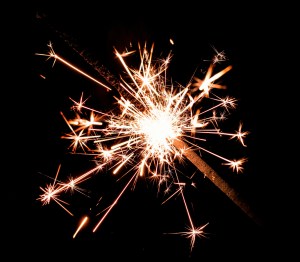
Need to spark yourself? Or cool the sparks? There’s a breathing practice for that.
(Photo by Jez Timms on Unsplash)

It works with the natural ability of inhales to quicken your heartrate and bring up your energy levels and exhales to calm the nervous system and elicit the relaxation response. This is my version of what he instructed (his actual guidance may have been a little different):

To increase energy:
Breath ~ Extended, intentional inhales fully filling the lungs followed by shorter, sharper, quicker exhales. Five such breaths followed by natural breath, then bringing attention to your current state. Important: stop if becoming lightheaded or short of breath. This should increase your energy, not overwhelm or wear you out!
Visualization ~ Imagine sparks of energy rising up from the earth and entering your body, into the fingertips and soles of the feet, coalescing in your core, then shooting upwards towards your head and skyward from your crown. Imagine the sensation of energy coursing through your entire body, and a sense of lightness and bouyancy, as if your body is charged and driving itself.

To come into calm:
Breath ~ Four-count inhales through the nose breathing into the diaphragm followed by 6-count extended exhales through pursed lips. Five of these breaths then moving into your natural breath, noticing the stillness. If available to you, extend the exhales to eight counts. This helps elicit the “relaxation response”.
Visualization ~ Imagine heat and sparks draining down from your body, into the earth. Feel a coolness washing over you, notice a solid foundation beneath you. There is a slowing and steadiness, a pleasant grounding and a clearing of the ears. Notice the sensations of your surroundings in the present moment.
Sometimes a mind-body break is in order.
(Photo by Victoria Tronina on Unsplash)

Quite honestly, I rarely need to increase my energy levels due the the ability of my parasympathetic nervous system to get activated quickly. If I am feeling fatigued, I don’t do breathwork to rev myself up. More likely, I will exercise…or I’ll respect the fact that my body is telling me that rest is needed and will respond accordingly.

On the other hand, I make frequent and liberal use of calming breaths and find that my ability to handle difficult emotions has improved because of it. Of course, I still struggle from time to time, but that is why this type of work is called a “practice.”

I hope these help you too!
“It’s Not a Toomah”: My Aura Theory

(Title image: Photo by Daniele Levis Pelusi on Unsplash)

I’ve written in my blog that I was experiencing strange visual disturbances, most likely visual migraine auras. Note: I’ve never experienced migraine pain.

This is particularly worrisome for me as a survivor of triple-positive breast cancer, as there is a greater chance of that type of cancer metastasizing to the brain. Presumably, a growing tumor could restrict blood flow to areas of the brain that could result in me seeing strange things.

This was of great concern to my ophthalmologist. However, there was no pain associated with the auras, and pain would have been expected (but not necessarily required) if the auras were caused by a tumor.

There were other confounding variables, too. Since the summer of 2024, shortly before my father’s death, I had noticed that I was doing a lot of involuntary “sighing”. I’d experienced this type of sighing before, but this time it kept going for months, sometimes occurring a number of times an hour.

Naturally I googled it, and Dr. Google pointed out that excessive sighing was potentially associated with undiagnosed anxiety and depression. When I finally started writing out all my stressors, it because obvious to me that I had been far more deeply affected by what was going on in my life than I imagined.

So, after my appointments on Nov 22, I took time to grieve my father’s death, which I hadn’t done up to then. I thought I had accepted his passing and moved on, but clearly I hadn’t. I sought hugs and solace from family members and expressed what I was feeling.

My last aura was on Nov 29th. After that, along with allowing space for grief, I expanded my time in meditation, added up to an hour of breathwork a day and even included a daily cup of ceremonial-grade cacao (for the theobromine).

Mindfulness took a front seat. I paused at various points of the day to simply take deep breaths. I paid attention to what my body was doing and what thoughts were running through my mind. I made a concerted effort to show compassion to myself, more than I had in a long time.

The auras did not come back. As of this writing, it has been 45 days since the last aura. I had been having them once a week, and at their worst, a couple a week and even two on one evening.

I am well aware of the power of the mind. My educational background is in graduate-level psychology and I myself have experienced psychosomatic pain before. But honestly, I never expected to have such a striking response to anxiety/depression/grief.

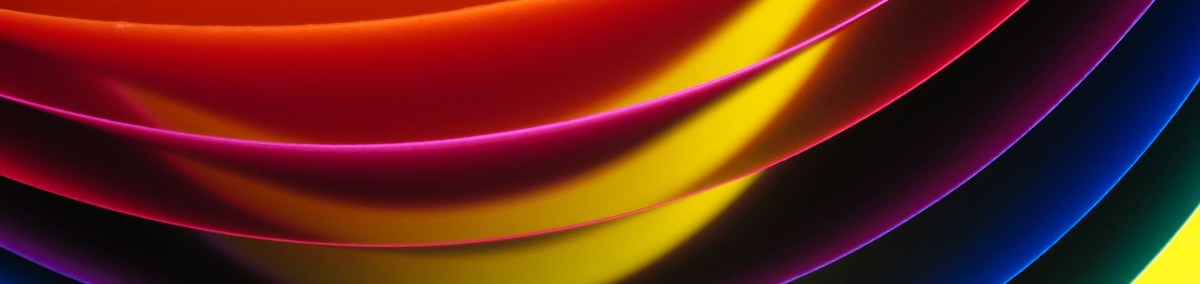
I have searched for a good visual representation of an aura and it’s hard to find one that actually reflects what I was experiencing. It was something like this:

This is not exactly what it looks like for me, as some of my auras have been “thicker” and more “stained glass-like” in color, looking more zigzagged (as if the entire half-circle is made up of triangular pieces of vividly bright LED-like colors). Also, mine were gone within about 20 minutes.

That’s not an insignificant reaction to something that is going on in my head. My brain created those auras. That is amazing.

I should mention, I never had an MRI so technically a tumor cannot be ruled out. And neither can some other cause that I have not considered. However, the fact that my auras stopped after I put concerted effort into exploring my anxiety, acknowledging depression and recognizing that I was not okay with the pressures I was under suggests that it’s probably not a tumor.

“Lightening Up”: A Breathing Visualization

(Title image: Photo by Josh Rangel on Unsplash)

Since I’ve found my stress levels higher this year, I’ve been playing with ways to quickly calm myself down.

Here’s one that I’ve been using lately. It’s very simple and involves a basic visualization, but has also been effective in grounding me fast.

And it goes like this…

Sit comfortably on a stable seat with a dignified upright posture, not too rigid, not too loose. Close the eyes or, if you prefer, soften your gaze with eyes cast downwards.

Then start slowing your breath, deepening your inhale and extending your exhale. Not focusing on a particular part of the breath cycle, but more on your entire body, noticing it rock with the breath, feeling it settle with every exhale.

Every inhale gives you a lift.
(Photo by Florian Klauer on Unsplash)

As this becomes comfortable, start visualizing the expansion and contraction of your body, as if the breath were a hollowing out of your insides. Imagine that inside you there is a space like a balloon. And the inhale is an inflation of the balloon, with the exhale a gentle relaxation of that stretch.

No need to imagine specifics about the balloon, what’s important is to notice the stretch and an opening inside as the air flows in, the expansion releasing muscles that might be tight from stress. And then, as the air flows out, notice the softening and relaxation of the body.

As you continue the inhale and exhale, feel the lightening of the body as it expands, followed by the gentle sinking as it contracts. See if you can notice yourself lift off as you breathe in, as if you were filling up with helium. But then settle into your seat as you breath out.

Continue like this, noticing yourself get progressively lighter, so that when you settle with the exhales, you still maintain some bouyancy.

This type of breathing meditation helps me “lighten up” when I feel overwhelmed, like I’m getting crushed by whatever the stressor is. Putting focus on the body keeps me out of my head and the deep breaths are soothing.

Hope this helps you too!

The Magic of the Exhale

If there is one thing that I can point to that has had the most profound effect on my reaction to anxiety-provoking stimuli, and also brought more calm into my entire day, it is deep, diaphragmatic breathing.

Diaphragmatic breathing (sometimes referred to as “belly breathing”) is an effective way to bring air into the lungs than simply inhaling into the chest. As the belly pushes outward, it pulls the diaphragm down, allowing the lungs to fully inflate.

This deep breath, in conjunction with my favorite breathing pattern — Dr. Andrew Weil’s 4-count inhale, 7-count hold, 8-count exhale — is what I call my magic pill. I have found this type of breathing to be very soothing. Dr. Weil based the 4-7-8 pattern on pranayama, an ancient yogic breathing technique, but the benefits are well-supported by modern science (Gerritsen & Band, 2018, Front Hum Neurosci, for example).

Neuroscientifically Challenged presents a short video introduction to the vagus nerve: “2-Minute Neuroscience: Vagus Nerve (Cranial Nerve X)“. It’s everything you never knew you really needed to know about the vagus nerve.

For me, it is the extended exhalation that is key. When the length of the exhale equals or particularly exceeds that of the inhale, a signal is sent to the vagus nerve. The vagus nerve is the 10th cranial nerve, and the longest one, running from the brain down to the abdomen, innervating a number of major organs along the way. The vagus nerve is also a major part of the parasympathetic nervous system (think: “rest and digest”) (Breit et al., 2017, Front Psychiatry).

The extended exhale has been shown to increase heart rate variability (HRV), slow down the heart rate itself and relax the body. HRV “represents the healthy fluctuation in beat-to-beat intervals of a human or animal’s heart rate. … Higher HRV is associated with stronger vagus nerve function, lower chronic stress levels, better overall health, and improved cognition” (Bergland, 2019, Psychology Today).

When I notice that I’m rushing through my day or experience wakefulness in the middle of the night, I have learned to turn my attention to my breath. Regardless of whether or not I’m feeling anxious, I often find myself breathing more rapidly and shallowly (chest breathing). As soon as I become aware of this, I take a deep, diaphragmatic breath and deliberately extend the exhale.

That first deep breath makes me realize how much I needed to slow things down.

That first deep breath is like putting the breaks on a runaway locomotive. It make take several more breaths to fall into that full pattern. I don’t force it — I simply allow each breath to be slower and deeper than the previous one. The sense of grounding feels amazing. I keep a lot of tension in my neck and shoulders, so I take care to release those muscles with each exhale. The result is that I feel a gentle sinking and relaxing.

One of the ways that I’ve benefitted most significantly by taking a “breath break” like this is that it has linked my formal, “on-the-cushion” meditation to the rest of my life. Even after I had established a daily meditation practice, I struggled to bring that same sense of calm into the rest of my day. Breathwork was the missing piece of the puzzle.

This deep breathing slows the overwhelming rush of sensations and provides an immediate connection to “now”, inviting stillness and spaciousness. Noticing my breathing in the midst of chaos exercises mindfulness. All this results in a sense of contentment and well-being.

Who wouldn’t want that?

Mindfulness Apps I Love: “The Breathing App”

In my last post, I mentioned yogi Eddie Stern’s breathing app. If there were ever an app that exemplified the beautiful simplicity of mindfulness, this is is!

There are several things that make this mobile app perfect: (1) it does one thing and does it well, (2) it is uncomplicated, and (3) it’s absolutely free, with no in-app purchases.

This app is designed to help guide you in breathing. It is based on the concept of resonance frequency breathing, which is deep, slow, diaphragmatic breathing, between about 4-7 breaths a minute, depending on the individual — true resonance is considered to be six breaths a minute. Resonance breathing, “where oscillations in heart rate (HR) and breathing synchronize” (Pagaduan et al., 2019), has been shown to improve heart rate variability (HRV), which is “a key marker of health, mood, and adaptation” (Steffen et al., 2017). You may be familiar with HRV if you’re in training for a sport.

Set the timer, choose your breath intervals…

As Eddie Stern describes in his app and on his website, “by breathing at resonance, we enter into an even balance between the two branches of our autonomic nervous system, the sympathetic…and the parasympathetic…” The sympathetic is known as “fight-or-flight” and parasympathetic as “rest-and-digest”, and in our everyday lives, we tend to spend too much time with the sympathetic nervous system in charge.

…and inhale.

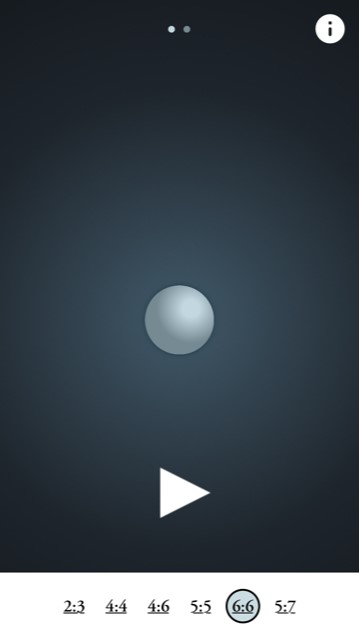
The Breathing App helps us balance out the two systems via resonance breathing. There are several elements to this app: (1) an informational page, with instructions on setting up and using the app, including info on the science and creators; (2) the breathing ball, which helps you visualize the breath; and (3) the sound breath guide, which provides a tone that guides your inhales and exhales.

You set the timer from 1 to 30 minutes, choose your inhale:exhale ratio (2:3 or 4:4 [for kids]; 4:6, 5:5, 6:6 [true resonance] or 5:7), and decide whether you’ll watch the ball or look at a starry sky, with or without the sound.

And that’s it.

There’s nothing to buy and practicing with it is simple. Of all the mindfulness/meditation apps that I use, this is one of my favorites and I use it to augment my yoga practice. Give it a try!

~~~~~~~~~~~~~~~~~~~~~~~~~~~

Fun fact: some well-known names are credited as participating in the development of this app, including Deepak Chopra and musician Moby!