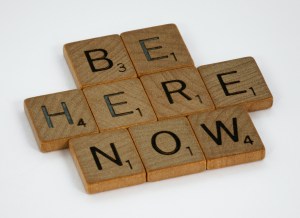
Remembering to Do Nothing

(Title image: Photo by Ken Cheung on Unsplash)

I remembered something last night about mindfulness meditation that I’d realized I had somehow forgotten.

I don’t have to do anything when I meditate.

Not strain, nor grip, nor furrow my brow.

The only thing I need to do when I meditate is to exist, and to be aware that I am existing.

I was thankful that I remembered this because I’d been struggling with the concept of sitting and being present for the past few months. I had slipped into the belief that I needed to work at it.

But last night I asked myself, “What would it feel like if I didn’t try so hard? Or at all?”

Simply exist.
(Photo by Jeppe H. Jensen on Unsplash)

If you’ve practiced mindfulness meditation, you know that the guidance is simple and straightforward.

It goes something like this:

“Sit comfortably with a tall spine, alert but relaxed. Take a few deep breaths, stretching upward on the inhale and settling down on the exhale. Soften the muscles of your body starting from your face, moving down the neck, shoulders, torso, arms to the fingers, hips and seat, down the legs to your toes. Then allow your awareness to settle onto a focal point like the breath, tingling in the hands, the hum of an appliance or sounds of traffic in the distance.”

Does that sound familiar? There are of course numerous variations of this. You select an anchor to come back to whenever you realize that you’ve drifted away from the present moment and into the thoughts in your head.

And that’s it. It’s quite basic and yet we find ways to complicate it and make it a strenuous exercise.

You don’t necessarily have to sit, you can lie down or even stand if that works for you (or you’re practicing while queuing up for something).

There are no rules for mindfulness meditation. Yes, there are principles and/or steps to take, but no real way to do it “wrong”. The only thing that would be considered “incorrect meditation” would be going to meditate, but then spending all that time doing something else.

Last night, when I remembered that my meditation didn’t have to be a certain way and all I needed to do was simply to be and to be aware of myself being, it felt like a release. The last year has been difficult and there have been tough things that I have been required to do.

This felt like a gift, that I could rest and think, “Oh, yeah…I don’t have to do anything.” And I was so grateful for that moment.

Why do I make these things so much harder than they should be?

Favorite Calm Things: Snail’s House Ferret Rescue

(Title image: Photo by Steve Tsang on Unsplash)

[NOTE: I am not associated with nor do I get any kickbacks from writing about Snail’s House, Pirate Software or Heartbound (except for a sense of well-being) 🙂 ]

Continuing with my “Favorite Calm Things” series, I have found great pleasure in watching ferrets sleep.

Yes, Snail’s House Ferret Rescue stream (https://www.twitch.tv/ferretsoftware or ferrets.live) has a playtime about once a day where you can watch an amazing bunch of curious ferrets racing about, charging through tubes, sneaking off with little toys, play-fighting and pausing the chaos to indulge in a yummy snack. But in between these playtimes, I find great comfort in watching a large cage of about 15 or so ferrets (just a fraction of the actual ferret population there) cuddle together in hammocks and under mats and snooze away the 18-20 or so hours that they spend sleeping during a 24-hour period.

The cameras are always on. Full color overhead view during playtime and front nightvision as they sleep the rest of the time.

Photos of a selection of resident ferrets (more have already been added)

This ferret rescue is the forever home for these wiggly noodles, as the facility accepts ailing animals, rescues from bad situations, ferrets who can no longer be cared for by their owners and the like. These ferrets are provided with high quality food, nurturing environment, medical care and proper stimulation…but are never adopted out. Snail’s House is the loving home from which they will ultimately cross the rainbow bridge, comfortable until the end.

Faces like this are difficult to resist (this is not one of Snail’s House’s ferrets, but cute nonetheless).
(Photo by Nikolett Emmert on Unsplash)

This ferret rescue is the pet project of game developer PirateSoftware (https://www.twitch.tv/piratesoftware) led by Jason Thor Hall and exotic vet assistant (and artist) Shaye Rehmel. Due to Thor’s diligent planning and recent explosive success on both Twitch and YouTube, the rescue is ever-expanding, as of this writing home to about 42 ferrets. Ingeniously, Snail’s House is funded by ad revenue from the FerretSoftware stream on Twitch. If you want to support them, all you have to do is tune in to the stream.

This is the only stream where the viewers get excited when ads come on because they know the benefit that advertising funds bring to the furry noodles.

We, the viewers, are the beneficiaries of the ’round-the-clock video because we get to watch the wigglers at any time, day or night. These snoozing ferrets are an anchor that I use to ground myself in the middle of a hectic workday.

For me, watching this stream is a meditation. While there is a varied soundtrack in the background (musical pieces from the Heartbound video game by PirateSoftware), sometimes I find it more peaceful to sit in silence as I watching the little guys sleep, piled up on top of each other. It feels like a perfect pause.

~~~~~~~~~~~~~~~~~~~

The rescue is expanding! Snail’s House has moved to a new and larger location and is still in the process of securing fiber internet; until that time, the stream may occasionally be pixelated.

Mindfulness 101: You’ve Got Options!

It’s been a long work day so this post has a simple message: you have options in practicing mindfulness meditation. And then for good measure, at the end I toss in an article about other meditation practices you can try.

In a nutshell, mindfulness meditation is the process of noticing your thoughts (“awareness”) and observing them without judgment (“acceptance”). It often involves an anchor, such as the sensation of the breath or a constant sound in the background, that the meditator focuses on for the purpose of grounding and staying present. The anchor is what we return to after we realize we’ve been pulled away by thoughts.

The anchor to presence is what we return to after we find ourselves carried away by thoughts.

This way we explore the concept of impermanence as it relates to life and our own situation. Everything is in flux. Negative experiences pass, positive experiences pass and we move through it all. The more we practice, the more we are able to notice the ups and downs without being as affected by them.

In the same way, I consider mindfulness meditation to be fluid without rigid rules. For example, you do *not* have to be seated in Lotus pose with your hand on your heart. You do not need a special cushion, outfit or music. There are no specific words to recite or candles to light. However, you are welcome to do all of these.

Lying down, seated on a chair, leaning against a tree or riding a crowded bus holding on to a strap are all viable positions. Eyes open, closed or half-shut. Paying attention to bird songs, a light rain, a washing machine or cars whooshing down the road, all good. In the early morning, during a work break, when the kids are napping or when you’re settling in for the evening are all ideal opportunites.

You don’t have to be in a specific location in order to practice mindfulness meditation, although admittedly some places come with a better view than others.

Even carelessly sprawled out on your bed, noticing how it feels to do that, no matter how dorky you think you look. Mindfulness doesn’t judge.

All of these are good conditions under which to practice mindfulness meditation and that is one of the things that I feel makes it an ideal meditation starting point.

As you continue to practice, you develop a tool with which to nurture a sense of peace and calm down a busy mind. It is a tool that you can take with you no matter where you go, like a little gift for yourself that you keep in your pocket, bringing it out whenever there is a need.

And since we’re talking “meditation options”…

I’ll finish up by noting that just as there are different ways to engage in mindfulness meditation, there are a number of other meditations that you can try if you want some variety.

For that, I’m going to punt you over to an article on the website Healthline, written by Holly J. Bertone, CNHP, PMP, and Crystal Hoshaw, entitled, “Which Type of Meditation Is Right for Me?” I really liked the information mentioned here, including the nine types of meditation that they describe:

  • mindfulness meditation
  • spiritual meditation
  • focused meditation
  • movement meditation
  • mantra meditation
  • transcendental meditation
  • progressive relaxation
  • loving-kindness meditation
  • visualization meditation

See the Healthline article for more information.

I do not believe that the above is an exhaustive list by any means, although it is a wonderful place to start if you want to explore other meditative practices. While I feel that mindfulness is one of the most accessible meditations for beginners, if you feel inspired to try something new, there are many options to choose from.

The only thing you “should” do is begin. 🙂

Mindfulness 101: Avoiding Avoidance

There is, unfortunately, a trap that some people may fall into when practicing mindfulness meditation.

In the context of selecting a point of focus that anchors you into the present, there is that teensy possibility that someone just starting out with meditation might focus without equanimity.

Equanimity is the ability to maintain balance and a sense of calm in both good and bad situations. It is the acceptance that impermanence and suffering are a part of life, and it is the state of allowing all feelings to pass through you, observing them without judgement or expectations brought on by previous experiences.

Equanimity is being able to allow in both the good and the bad without getting dragged through it.

Allowing emotions in when you’re trying to stay calm and collected might seem a little counter-intuitive, but in fact, I consider it to be to goal of mindfulness meditation. That’s because the most important time to maintain a sense of inner peace is exactly when the proverbial sh!t hits the proverbial fan. Mindfulness meditation provides us with a safe space within which to practice just that.

The tendency, however, is to try to keep difficult emotions out. I myself encounter a lot of resistance when doing guided meditations that focus on bringing up uncomfortable thoughts, particularly in the evening, when I’m most susceptible to anything that might perturb my sleep.

However, not allowing those thoughts in can set up a pattern of avoidance, depriving us of the opportunity to learn to deal with them. And this avoidance can imbue difficult thoughts with even more power, as if they become the boogeyman lurking behind a door that we’re terrified to open. That’s not a good thing.

So how do we get around this?

Pick a good time to explore the stickier side of things; I would caution against the evening, when, as I mentioned above, bringing up tough feelings can agitate you and make it more difficult to fall asleep. Keep the environment quiet, comforting and safe, with gentle music in the background, if that suits you. I like mid-morning time and natural light, with a cup of tea or cacao or anything else that feels soothing.

Choose your anchor: your breath, a bodily sensation like tingling in your hands, a constant sound in the the background…even lofi music from YouTube.

If you feel too drifty, keep your eyes open to help ground you. Perhaps focus them on an object that brings you peace, such as the photograph of a loved one or an image of a peaceful place.

Give yourself a calm opportunity to explore complicated emotions.

Breathe deeply and pay attention to gripping or tightness in your body, especially forehead, jaw, neck, shoulders and belly. Consciously release any areas that seem to clench as you go along.

And then allow whatever comes up to come up. Observe them…and then let them go. No need to analyze or justify. Imagine that you’re made of Teflon and those uncomfortable images slide off you.

If needed, sit further away from them. When the intensity gets too high, you might need space, so imagine that they are flowing past as if you’re on the bank of a river and they are the leaves that float by on the surface of the water. They come and they go and you breathe deeply through it all.

As you practice, maintain your focus the best that you can. The point of your focus is not the thoughts, it’s the breath or whatever other anchor you might have chosen. This way, the thoughts move independently and subside as smoothly as they appeared. If you find yourself getting stuck, return to your anchor and remind yourself that in this moment, you are safe.

IMPORTANT: If your thoughts are tied to trauma or the intensity seems unbearable, please seek out the help of someone professionally qualified to help you deal with them. Mindfulness meditation is a wonderful tool, but sometimes it’s not enough.

Quitting This Stupid Job…and Going Back to Training

For a number of months now, my meditations have been “sub-par”.

I know I’m not supposed to judge, but objectively I’m aware that I’ve veered off course somewhere. In the past, I’d have good days and bad days, transcendent meditation sessions and really distracted, “no-way-I’m-gonna-focus” ones. But that was okay, because a large part of mindfulness meditation is coming back to the breath AFTER losing focus.

Rabbit holes are very enticing places to disappear into.

This has been a little different.

It started with a few weeks of distractibility as I was navigating stressors in the early months of this year. But gradually, things went downhill until I seemed to make it my job to use meditation time to go down rabbit holes.

Maybe I was too tired, meditating in the evening before bed or when I woke in the middle of the night and couldn’t sleep, so I didn’t check my wandering mind because I was dozing off.

If I had music in the background, my mind would dance off in a tangent and I wasn’t meditating anymore, forgetting that this was a time for calm and presence.

I’d get lost during my meditation with little hope of finding my way back on the path that I was on.

So I’d start a guided meditation — listening to someone’s voice would keep me on track, right? Nope. My ability to allow that voice to fade into the background was nothing short of impressive.

Day after day, I had dutifully taken on the task of wandering way off my meditation path until I realized that I was going nowhere and it was time to quit the restlessness and stay still for a while.

Even after years of daily meditations, I had to re-learn the habit of staying… because over the past few months, I’ve established a new habit of not coming back to my center regularly enough. And this new habit of spending my session mindlessly had managed to supplant my previous meditation flow.

So here we go again: setting aside some quiet time when I’m not particularly sleepy, finding an anchor like the breath to focus on in a patient, non-gripping manner, maintaining a gentle awareness of where my mind is, and when it inevitably wanders away from my point of focus (which it always will), calmly guiding it back.

Going back and consciously setting an anchor again. And enjoying that comfortable feeling of being present and aware of this very second.

When the breath seems like a boring place to drop my anchor, I turn to the sensations in my hands and feet (particulary useful when I’m stressed) or the sounds of automobile traffic outside ebbing and flowing or opening my awareness to all my senses and accepting whatever shows up. My focus is on the present and that’s where I aim to keep it.

So it’s true, that old “muscle memory” is bringing back my meditation practice and strengthening it as it does so. This serves as a good reminder to not get complacent, calling myself a “meditator” and throwing around stats like how many days in a row I’ve been meditating. In the end, the important thing is not my meditation streak, it’s the fact that today I will choose to meditate again.

Mindfulness 101: You Want Me To Do WHAT in the Middle of Anxiety?

Ah, anxiety. I hate it but it’s such a fixture in my life, although it’s gotten better now that I’ve become more aware of the nuances of my reactions to stress.

That awareness was key, but it took a while for me to figure it out. I had been told to “feel what the response to anxiety feels like in my body”, but lemme tell ya, when you’re in the middle of being really stressed out, the only answer you can give is: “TERRIBLE!”

I think the way this suggestion has been posed is all wrong. It wasn’t until I started mindfulness meditation that I finally understood what was really the point of feeling into body sensations.

First of all, in case you’ve been fortunate enough to never experience severe anxiety, here’s how to imagine it: (1) turn on a really large blender, (2) stick your head in it. That’s about it. Then, when someone asks you to feel what body sensations you have, you answer, “Dunno, my brain is missing.”

If serenity is a clear day, this is anxiety.

Basically, in the midst of anxiety, there is so much that feels out of control that I don’t think it’s possible to lasso down sensations without having a person hold your hands, look into your eyes and say, “Okay, focus on me and do this…”

And that, my friends, is why scratching out even the slightest bit of space for yourself in a stressful situation, just so that you are not 100% caught up in the whirlwind, is so beneficial for getting yourself through it.

Just like you don’t wait until the day of your first marathon to start training for it, you need to prepare for the next tornadic episode of anxiety before you’re in it.

Become your own Professional Stress Manager. That takes practice, primarily when things are peaceful. Just like you don’t wait until the day of your first marathon to start training for it, you need to prepare for the next tornadic episode of anxiety before you’re in it.

Job One is bringing yourself out of the swirling thoughts in your head and that can be hard to do, since they are where your anxiety originates. That’s why you have to re-direct your attention to something outside your mind, and that’s where focusing on body sensations comes into play.

First, find stability and grounding.

First, find yourself an anchor, like the oft-mentioned breath, and start with that. Focusing on the breath gives you a target for your attention when everything else feels crazy. There are a variety of sensations associated with breathing: the rush of air, expansion of the chest, expansion of the belly and whatever else is salient to you.

Pick one that makes sense. It is expected that you won’t be able to maintain your focus on it and your mind will wander off. That’s OK. In fact, the whole point of this is that you DO lose your focus. And once you realize that you have, bring your attention back to your breath.

And that’s it. That’s ALL of it. It doesn’t get more complicated than that.

And when you’ve achieved some sort of stability there, you’ve made yourself some space. Take advantage of that and bring your attention to other parts of your body, with one eye on your breath: is there a tingle in your fingertips? How about your toes? Are you clenching any muscles in your body and what happens if you try to release them?

Ask yourself, “How do I know I’m anxious?” What are the signs? Face feeling hot? Stomach bunched up? Cold feeling in the intestines? Tightness in the chest? Can I take a deeper breath and try to relieve that tightness? Can I send warmth into my gut? Try to define what anxiety means to you on a physical level. The more you do that, the more control you get on your reaction and the experience is not as frightening.

See, the idea is that you need that fingerhold in the crack between your stressor and your reaction to it so that you don’t get swept up in the lack of control. And establishing that will take some practice and time, but as with any exercise, each practice session will benefit you. And then best time to start is now.

Making Meditation Easier

So the recurring theme in my posts about meditation is the struggle that I have with maintaining focus. This has been complicated by breast cancer medications that are associated with cognitive effects, not to mention the eventual menopause and “brain fog” that has resulted from them.

And while I’ve taken all sorts of classes and scoured meditation how-tos, I used to wonder, am I even doing this “right”? Shouldn’t I have an easier time with this by now?

A recent “Daily Trip” contemplation on the Calm smartphone app, narrated by meditation teacher Jeff Warren, reminded me that it’s important not to overthink what we’re doing.

The breath is a wonderful point of focus because it moves through our body and elicits sensations in a number of places.

Often in mindfulness meditation, we’re taught to use different aspects of our breath as an “anchor” or point of focus. The breath is a nice anchor to use because it helps us move inward while still staying present. It’s also a moving target, so to speak, so it might be more interesting to watch (and therefore focus on) than a static sensation.

But people are different, and if it’s really not working for you, or if focusing on your breathing actually makes you feel more anxious, you can switch to another focal point. How about the sensation in the hands, the feeling of your body’s weight against the surface on which it rests, or the distant sounds around you?

Maybe you even use several anchors within a single meditation (consider dual focus). The idea is to remain present and aware of what is happening now, even if you have open all your senses in order to do so. What anchor(s) work(s) best for YOU? It is, after all, YOUR meditation.

What really matters is just that you make it back to the present.

And then, instead of worrying about maintaining focus, what if we let go of that? It’s okay, even expected, for your mind to drift off. I would argue that losing focus is an integral part of mindfulness meditation. Because it gives us the opportunity to be aware that we are no longer focused. And once you realize this, you have returned to the present. Nice job!

The more you practice this back-and-forth, like tossing a beach ball between your anchor and your errant thoughts, the more adept you will become at realizing that your thoughts have carried you away. The more you do that, the easier it will become to return to your anchor, and that’s the whole idea.

It doesn’t have to be more complicated than that.

Grounding Through the Fingertips: Hand Steepling

Note: this is another grounding technique, by which I mean a way to retain focus on what is happening in the “now” rather than getting lost in memories of the past, which we cannot change, or succumbing to fears about what may happen in the future. It’s not a woo-woo magical technique. It’s merely being mindful about what is currently taking place so that you can respond appropriately and maintain your composure.

During acute stress, we need to bring ourselves back to the present quickly. By doing so, we are able to clear our heads of the “what-ifs” and “you shouldas” that cloud our thoughts at those times.

But what’s the fastest way to do that? For me, it’s definitely focusing on the fingertips. Each fingertip has approximately 3,000 nerve endings, more than any other part of the body (except the most intimate). When you touch something, all those nerves start firing.

You can take advantage of this sensitivity to ground yourself.

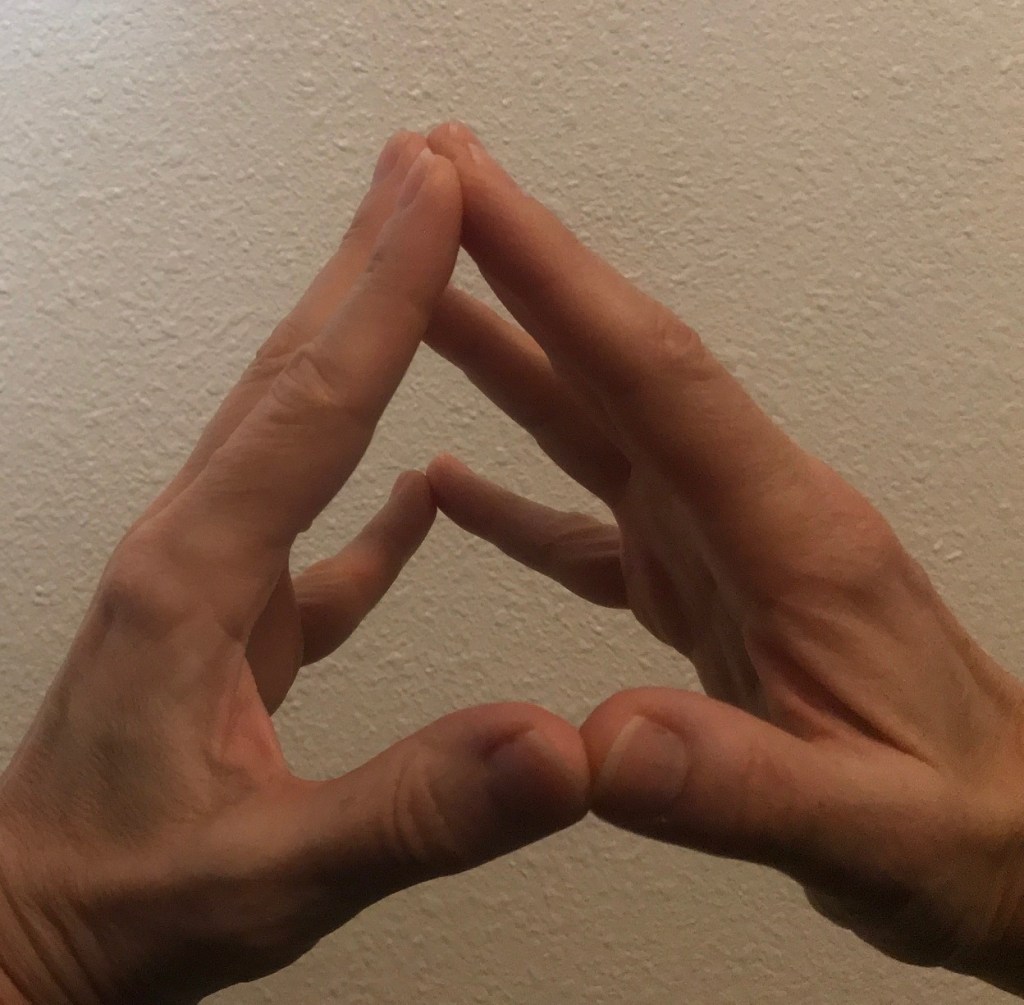
Channel Benedict Cumberbatch’s Sherlock and put your fingertips together.

This is what I do: I “steeple” my fingers (thumb against thumb, index finger against index finger, etc.) as if I were Star Trek‘s Mr. Spock contemplating a complex situation. The fingertip pressure immediately commands attention from my fearful mind in the same way that a boss displaying that hand gesture would command an employee’s attention. Taking deeper breaths, I rub my fingertips against each other in a circular motion. The movement enables the nerve endings on the fingertips to keep firing as the sensation continues. Or I can bounce my fingertips off each other, or keep them together but flex the fingers to create a pulsing motion.

Closing my eyes accentuates the emphasis on sensation and makes maintaining focus on it easier.

Yes, this seems so simple, but it’s also quite effective. By placing our focus on the fingertips, we take our attention away from more reactive parts of the body like the chest area, where the heart might be beating fast and ribcage expanding and contracting with rapid breathing. Feeling into those areas might only serve to reinforce the heightened emotions that we’re experiencing.

The hands lie further away from that commotion, and that distance between the chest and our fingertip sensations enables us, if even for a short while, to get some perspective. Think of it as the anxiety not being “in your face”.

We can use body sensations as anchors to help stabilize us through anxious times.

Sometimes, when I close my eyes, all I “see” is that sensation of fingertip to fingertip, as if it’s the only thing that exists. I can play with this, imagining that I’m holding something between my hands, and that the sensation I feel is actually the feeling of that object against my fingers. It can be a pane of glass or even a beach ball. It all depends on what my brain is willing to accept at the moment. It’s a relaxing mental exercise.

As with many things related to mindfulness, it’s helpful to practice this fingertip pose when we’re in a relaxed and meditative state to connect the sensation to a feeling of calm, enabling it to serve as an anchor when our emotional seas are rough. The more we practice, the stronger that association, and the more effective the grounding response when we use this technique in the midst of anxiety.

~~~~~~~~~~~~~~~~~~~~~~~~~~~

Fun fact: body language experts consider steepled fingers to be an expression of confidence. That might be the little boost you need when you’re navigating a stressful event!