Regaining Control Through Mindful Living

As I mentioned in a previous post, I’ve really enjoyed the Coursera course, “Engineering Health: Introduction to Yoga and Physiology“, which I highly recommend. One of the recurring themes of the class that I’ve found particularly relevant is that of effecting incremental and meaningful epigenetic change through yoga and meditation.

The class lectures went through the physiological mechanisms by which this happens, and this information would be reason enough to incorporate mindfulness and breath-to-movement in one’s life. But for someone who’s experienced cancer, there’s something even more important: a sense of control.

For me, the most terrifying part of my cancer diagnosis was the lack of control over what was happening to me. First, my body had turned on me by cultivating a tumor, the ultimate goal of which was to take over my organs and kill me. Then, my doctors were giving me drugs that by design would kill certain parts of me, with the intention of taking out the tumor before it spread to really important parts of me (brain? liver? heart?).

My body was a battleground in the war between my rogue cells and modern medicine. I had to sit there and take collateral damage if I wanted a chance at survival.

Disclaimer: So I feel the need to stress here that we do not yet know how to reliably prevent the formation of cancerous tumors, but there are things that we can do to greatly lessen the risk. I’m willing to bet that managing stress would have a powerful impact on prevention.

While I did begin meditation at that time, had I started learning to deal with my anxiety and accompanying physiological responses years ago, I might have been able to sidestep the disease. There is science to this which I will cover in a later post, but my doctors *hate* it when I postulate possible causes of my tumor since if we could truly pinpoint the cause, we’d be able to cure the disease. However, given what we do know about stress and inflammation, I can guarantee that my stress response did not help in keeping me cancer-free!

In the Coursera class, Dr. Ali Seidenstein (NYU) explains, among other things, how the small positive changes that arise from learning to control the stress response by applying yoga and meditation affect your genetics. And this is key. While you’re born with a certain set of genes, the science of epigenetics describes how you can affect gene activity (think, turning a gene on or off) and thereby have a different outcome from someone else with the same gene.

Finally! Something that *I* can do that provides a rare sense of control in an uncontrollable situation! For a cancer survivor, this offers a nugget of hope to hold on to in the face of continuing medications that may or may not help your survival. Medicine is tested on a variety of individuals but there’s no guarantee that their success will translate into your own (news flash: cancer = no guarantees, period). But knowing that you can engage in behaviors that, when applied over time, will actually benefit you on a genetic level…that, my friends, is priceless.

Making Space for Cancer Emotions

While I myself am celebrating three years since the summer of my chemo for breast cancer, I was shocked to hear of actor Kelly Preston’s death from the disease. It’s a reminder that in an egalitarian way, cancer doesn’t care how famous you are.

I’ve been reading about those who are dealing with late-stage cancer. Most notable for me is actor Shannen Doherty, whom those of my generation remember from “Beverly Hills 90210” (although, admittedly, I didn’t watch the series).

Shannen, along with well-known names like Alex Trebek, Olivia Newton-John, Congressman John Lewis and others have been interviewed by the press. We hear about daunting odds and their strength of character. Anyone battling the late-stages of cancer shows a lot of bravery.

They speak of gratitude, perseverance, patience, a forward-thinking mentality. But as anyone with cancer can tell you, they would rather not be fighting this fight. Yes, there are “bright moments” (and I use that term loosely) that come with learning you have a “serious” cancer diagnosis, but that’s because you find those breaks in the darkness.

Cancer brings powerful emotions, often negative ones. And that’s perfectly okay.

However, I think it’s critical that cancer patients be given the uninterrupted space to talk about the fear and anxiety associated with this situation. It’s not all happy trips to the infusion room as everyone cheers you on. Shannen is quoted as saying, “The unknown is always the scariest part…Is the chemo going to work? Is the radiation going to work? You know, am I going to have to go through this again, or am I going to get secondary cancer? Everything else is manageable. Pain is manageable, you know living without a breast is manageable, it’s the worry of your future and how your future is going to affect the people that you love.”

This is something that must be addressed. When others call you a warrior, they need to understand that you’ve not been given a choice in the matter. And you yourself have a right to feel all the emotions that you feel, whether it’s anger, fear, helplessness or numbness. That must be allowed because it’s real.

Most importantly, no one should tell a patient that they need to only think positive. That is telling them that they shouldn’t feel what they feel. And that’s never a good thing.

So just as Shannen has done and others continue to do, we must accept the weight of the emotions felt by cancer patients, not diminish it. We should hold space for them to express everything they’re feeling. And then actively offer all the support and love that they need.

Mindfulness Apps I Love: “Oak”

Oak is among the simplest meditation apps that I’ve tried. While it’s not as stripped down as The Breathing App, it really covers all one would need for a meditation practice.

The home tab – simple!

I love the aesthetics — the app has a soothing watercolor-like look to it that reminds me of a quiet, overcast morning, before the rest of the world has awoken. Navigation is very simple as there are only three basic elements to choose from: meditate, breathe and sleep. However, they’re quite enough.

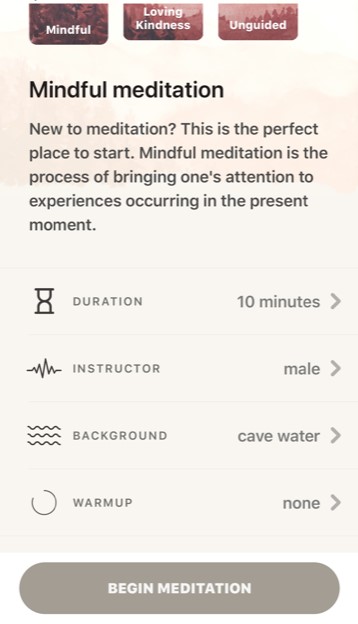
Meditate offers three meditation options, all customizable in duration, instructor voice (male/female), background sounds and warm up (for those wanting to settle in before meditating). The three types of meditations are (1) Mindful, learning to focus on the breath; (2) Loving Kindness, cultivating compassion and empathy both for yourself and others; and (3) Unguided, with the choice of interval bells instead of spoken cues.

Choose your meditation and then customize it to your liking.

Again, very uncomplicated and accessible. Both the male and female voices have that certain “something” that makes them soothing and easy on the ears. While Oak doesn’t have the expansive meditation libraries that some apps provide, for many meditators what Oak offers will be quite enough, and the ability to customize the meditations creates far more permutations than one might expect.

Breathe is the section of this app that I personally use the most. It consists of three types of breathing exercises: (1) Deep Calm, which has been advocated by Dr. Andrew Weil and has a 4-second inhale, 7-second hold and 8-second exhale; (2) Box breathing, which is a square “box” of inhale-hold-exhale-hold, each segment being 4 seconds long; and (3) Awake, which is a 6-second inhale followed by a brief 2-second exhale.

The number of breaths per “set” for each of these exercises differs, and you are limited to the number of totals sets you can do at a given time. However, this is probably a good idea because it’s important to take breaks when doing prescribed breathing in these ways. Think of it as insurance against passing out.

Not just for sleep! I can choose from a variety of sounds to fill the empty voids in my workday.

Sleep offers (1) Relaxing Sounds and (2) Guided Breath. Again, there are options for the background sounds and duration. I enjoy using the sound “elevate” at work, not for sleep (!) but to offer gentle music to even out the frustrations that may complicate my day.

There is also a 10-session course on Mantra Meditation. While I was able to unlock it for free, this may be a temporary benefit (perhaps due to COVID-19?) because the App Store makes mention of the course being available for a small fee. Keep that in mind for the future.

I had not been using a mantra for meditation, but this class helped me choose one and added another dimension to my meditation practice. The narrator’s voice was perfect for this type of lesson. The class is downloadable which leaves you no excuse not to meditate on your next plane flight. Note that I haven’t completed the entire course yet, so I cannot yet comment on its benefits as a whole.

Finally, Oak tracks your progress, including minutes meditated and number of breaths taken. It also shows the number of people meditating and breathing with you. And of course, it shows you your streaks. So, if there were something that I felt I need to gripe about with this app, it would be that it encourages me to focus on streaks. I can get pretty obsessive and competitive about these things, and unfortunately, Oak doesn’t let me turn them off.

On the other hand, tracking your progress is what allows you to gather badges while developing your meditation and breathing practice, so for anyone who’s interested in seeing visual reminders of their progress, this is a plus.

All things considered, this is a lovely app that you’re not likely to outgrow quickly. With the exception of possibly being charged for the course, everything else is absolutely FREE, which evokes the spirit of mindfulness being accessible to all. It also makes it completely risk-free to download and try for yourself. While I haven’t used Oak quite as much as I have other apps, I really do enjoy it and highly recommend it.

Revisiting Yoga After Cancer: Finally Coming Around

Decades ago, my introduction to yoga took place in my parents’ library, a small paneled room with wall-to-wall, floor-to-ceiling books. There I found an illustrated guide, replete with black and white photographs of odd contortions and strange nasal flossing. It seemed weird.

Oh, the moves I could do!

I had barely begun elementary school, and at that age was a natural-born yogi, as many young children are. Lotus pose? I could get my legs into position without using my hands. King Pigeon was no big deal, and nothing hurt when I folded myself up. I didn’t have a regular yoga practice at that age, but I would get occasional exposure to yoga moves at school, and I imagined all yogis wore diaper-like pants and lived on mountaintops.

High school provided an opportunity to do more. One of our French teachers practiced yoga, and I took a season of classes with her. Really, I remember little from that time. At that point, I was still limber but not as lanky, and yoga wasn’t particularly exciting. Volleyball was my game and I had no appreciation for how yoga could improve my playing. Had I practiced it properly, yoga could have helped immeasurably and prevented many a lost serve. But I lacked introspection and so barreled on as before.

Yoga resurfaced in my life now and again, but obsessed with more active ways of sweating, I steered away from it. I swam, ran and eventually strength-trained my body into shape. Yoga didn’t have a place in my view of what fitness should be.

Holding poses for a prolonged time? Not for me. Sweating through hot yoga? You’ve got to be kidding. A friend sustained a serious back injury from a yoga teacher who tried to force her into a pose. That was it; I was done with the idea of incorporating yoga into my already packed fitness routine.

Then I got cancer.

And I realized that my mind was victim to free-ranging anxiety. Desperate, I immersed myself in learning to meditate. I know they say that you need to find calm in the midst of chaos, but being thrown into chaos is not the best place to learn to be calm. I limped through cancer treatment and clung to the hope of peace. The only relief came from my love of fitness and drive to exercise as soon as the worst side effects of each infusion had passed.

Still, I pushed yoga away. Not interested. I needed to get my body back to where I’d been pre-cancer, not do slow movements that might tweak something and burned too few calories.

But the more meditation I did, the more mindfully I moved, yoga kept coming up, like a refrain in a song. Movements paired with breath.

I have made space in my life for yoga.

And then, it hit me. Movements paired with breath. I was all about the breath by then. Yoga provided the movements. And I found bliss.

When I opened myself up to yoga and invited it into my workout routine, something magical happened: my body started stretching out. All that tension that I’d carried for decades that had gradually tightened me up started releasing. My fingers found the floor in a forward bend again, and gently brought my palms with them. My heels easily pressed against the ground in a downward dog, with little peddling required. Moves that I could once do became available to me again.

So here’s the thing about breast cancer: after surgery, you lose some mobility in the affected side. Even now, side bends stretching my left side “pull” uncomfortably compared to my right side. Anyone who’s had lymph nodes plucked out of their armpits knows that that area stays tender for a good long time. Often, this brings an imbalance to the body.

My workouts had consisted of pounding myself through rowing, conditioning intervals, strength training with heavy weights and swinging kettlebells around. But without yoga, something critical was missing. Initially, I was afraid that “sacrificing” exercise sessions to yoga would result in faster decline of my physical ability and a push towards a more sedentary existence. Oh, how wrong I was! If anything, yoga has moved me towards vitality, flexibility and a sense of youthfulness that straight strength training had never allowed. Yoga opened up my whole body and allowed it to breathe freely.

What this has offered me is another way to look at how my cancer journey is progressing. After the aches and pains associated with never-ending adjuvant therapies, I admit I felt it was all going to be downhill, and that all I could do was desperately cling to my workout routines as my abilities gradually slipped away. Yoga brought back an element of fitness that I’d forgotten, and now, even though I know that I will be lifting less and rowing slower as time goes on, there is a new, perhaps more gentle world of fitness that I have yet to fully discover.

Mindfulness Apps I Love: “The Breathing App”

In my last post, I mentioned yogi Eddie Stern’s breathing app. If there were ever an app that exemplified the beautiful simplicity of mindfulness, this is is!

There are several things that make this mobile app perfect: (1) it does one thing and does it well, (2) it is uncomplicated, and (3) it’s absolutely free, with no in-app purchases.

This app is designed to help guide you in breathing. It is based on the concept of resonance frequency breathing, which is deep, slow, diaphragmatic breathing, between about 4-7 breaths a minute, depending on the individual — true resonance is considered to be six breaths a minute. Resonance breathing, “where oscillations in heart rate (HR) and breathing synchronize” (Pagaduan et al., 2019), has been shown to improve heart rate variability (HRV), which is “a key marker of health, mood, and adaptation” (Steffen et al., 2017). You may be familiar with HRV if you’re in training for a sport.

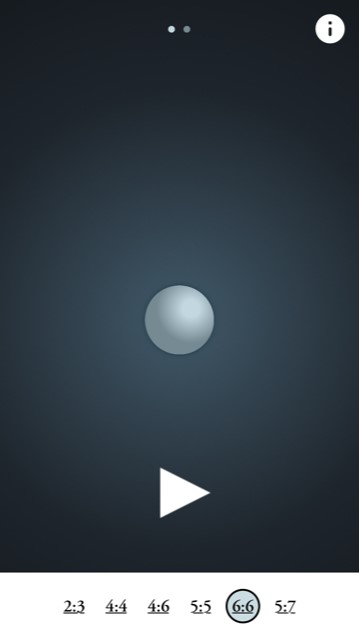
Set the timer, choose your breath intervals…

As Eddie Stern describes in his app and on his website, “by breathing at resonance, we enter into an even balance between the two branches of our autonomic nervous system, the sympathetic…and the parasympathetic…” The sympathetic is known as “fight-or-flight” and parasympathetic as “rest-and-digest”, and in our everyday lives, we tend to spend too much time with the sympathetic nervous system in charge.

…and inhale.

The Breathing App helps us balance out the two systems via resonance breathing. There are several elements to this app: (1) an informational page, with instructions on setting up and using the app, including info on the science and creators; (2) the breathing ball, which helps you visualize the breath; and (3) the sound breath guide, which provides a tone that guides your inhales and exhales.

You set the timer from 1 to 30 minutes, choose your inhale:exhale ratio (2:3 or 4:4 [for kids]; 4:6, 5:5, 6:6 [true resonance] or 5:7), and decide whether you’ll watch the ball or look at a starry sky, with or without the sound.

And that’s it.

There’s nothing to buy and practicing with it is simple. Of all the mindfulness/meditation apps that I use, this is one of my favorites and I use it to augment my yoga practice. Give it a try!

~~~~~~~~~~~~~~~~~~~~~~~~~~~

Fun fact: some well-known names are credited as participating in the development of this app, including Deepak Chopra and musician Moby!

Online Classes: Yoga and Science – Putting It All Together

Please note: I’ve included links to various items below, none of which I’m compensated for. If I’m writing about them, it’s because I think they’re excellent and worth recommending to others.

In my never-ending quest to bring more peace into my life, and with the extra time I’ve found in COVID-19 lockdown, I’ve been taking advantage of online class on platforms such as edX and Coursera, and have been impressed with the breadth of courses that are available.

Currently, I’m mid-way through a class on Coursera from New York University (NYU) connecting yoga and science, called “Engineering Health: An Introduction to Yoga and Physiology,” and I am thoroughly enjoying it. This class can be audited for free, or $49 gets you access to the quizzes, a certificate once you’re done (that can be posted on LinkedIn) and no time limit on access to the materials.

The course is taught mainly by three individuals: (1) Prof. Alexandra (Ali) Seidenstein, lecturer and research scientist in the Chemical and Biomolecular Engineering Department at NYU, who is also a yoga teacher; (2) Eddie Stern, NYC-area yoga teacher and author, co-founder of the international Yoga and Science Conference and creator (along with Deepak Chopra, Sergey Varichev and musician Moby) of the highly-rated Breathing App for mobile devices; and (3) Prof. Tommy Lee, senior lecturer in the Chemical and Biomolecular Engineering Department at NYU. In addition, there are interviews with other scientists who have studied or made use of yoga in their research. For me, as someone who’s always looking for scientific validation, this combination of yoga and physiology is very gratifying.

First and foremost, the class teaches basic physiology. If you took survey classes in high school and college, the material will be familiar, and it’s presented in a clear manner with lots of visuals. Topics include physiological systems such as nervous, respiratory, cardiovascular, immune, digestive and much more. Additionally, there are discussions of homeostasis, epigenetics, and the effect of stress on human physiology.

As a cancer survivor, I find it so empowering to see the science behind how yoga affects my physiology, especially strengthening my immune system!

But woven in between all of these topics are instructions on breathwork and yoga movements for beginners, and this is what really ties the course together for me. The yoga is expertly taught by Eddie and Ali, both of whom make the experience very positive and not intimidating. With each lesson, they take the time to connect the physiology topics with what is being taught in the yoga class. This is a novel approach that I have found very empowering: there is a direct link between the work being done in the yoga lessons with functioning of the body.

For me, making that connection leads to a sense of self-efficacy and patience with myself, as it is with consistency of practice that we make change. Even more than that is the feeling that I can affect my immunity against disease (and cancer?) by keeping my stress levels in check. I have always felt that stress played a role in the development of my cancer, and although I cannot prove this, knowing that there is good science behind using such relaxation techniques as yoga and meditation in prevention of inflammation and subsequent disease gives me a sense of control in a situation that has often felt completely outside my control.

As mentioned, I am only at the midpoint of this class. I look forward to the second half and will report back about my overall impression once I am finished. In the meantime, if this post has piqued your interest, I highly encourage you to check the class out!

When You’re The “Default”, You Don’t See The Problem

While it might not seem like a cancer/meditation/mindfulness blog is the place to bring up the issue of racial disparities, I feel this is exactly the right place for it. Because we should all be talking about this in every situation.

I am white. I grew up with people on television who looked just like me. I had dolls that looked just like me. Companies marketed their products to people who looked like me, using advertisements with actors who looked like me. Even the crayon color called “flesh” looked like my skin, and I didn’t question it. I had school friends who were black, but I didn’t understand their experience. So I really understood nothing. As a child, I didn’t see the problem.

But the problem is massive and we haven’t made much progress since the days of the 20th Century civil rights movement. The main thing that’s changed is that we now have video phones so we’re bearing witness to events that have been going on all along, but unseen by the white community.

You cannot turn 400 years of oppression around with non-discrimination laws, congratulate yourself and proclaim everyone “equal” (read: shouldn’t be complaining), because the inequality has been in our system for so long that it’s what the country runs on. It lubricates the gears of society. And there are people in power who like it that way.

This needs to change and it needs to change now.

If you don’t think that being white infers an automatic privilege, try being a black teen in a hoodie, walking through an affluent white neighborhood.

After All Those Bad Things I Said About Letrozole…

I feel that I need to revisit the whole letrozole thingie, just to be fair.

In my last post I expressed my frustration with the continued side effects of the estrogen-supressing aromatase inhibitors designed to reduce the risk of cancer recurrence. Cancer survivors face a considerable amount of pressure from our oncologists to stay on these medications, but everyone agrees that their use does not come without health risks or hits to one’s quality of life. The latter is a squishy concept that is not easily quantifiable.

Deciding whether to take medications for the length of time prescribed, or stop them early, comes down to an individual’s tolerance of both the side effects and risk.

So after all the complaining in my last post, the big question I have in front of me is that, given that I’m already postmenopausal — regardless of the fact that it was the medication that pushed me into menopause — if I were to stop letrozole, would I experience a significant improvement of my complaints? And if I could reverse the side effects how long would it take? None of that is clear.

Granted, there remains additional risk in taking an aromatase inhibitor, particularly long-term, as the cessation of estrogen production contributes to aging and age-related maladies, including heart issues, bone loss and broken bones. And certainly, there is gradual collagen and hair loss, not to mention suppression of the libido.

There are some bright spots in this.

But if we ignore that for now, I have to admit that not all days are as bad as how I described them. I don’t lie in bed staring at the ceiling while every single side effect hits me all at once. I experience them here and there. And most of them are tolerable.

My fear is about the future. If I’m feeling this now, what will it be like in another six months or a year? What if things go downhill gradually and I don’t realize it until later when I’ve slid so far down that nothing is salvageable. That’s completely ignoring the realities of the “now” for the imagined troubles of tomorrow. That is not being mindful!

But unfortunately, with medications such as these, the future is a factor that must be taken into account, and with that comes anxiety. Of course, anxiety always makes things worse. For me, it’s one of the most difficult side effects of cancer, because it magnifies all the negatives, both real and imagined.

I realized after I submitted the last post, after I complained about all the things I was experiencing, that not everything was as horrible as I thought. Things are not “normal”, and the situation is still applying a frustrating pressure on my quality of life. But maybe, for now, can I hold on and get the most out of the benefits of letrozole, and then re-evaluate tomorrow?

Yes, I can.

(Almost) Six Months on Letrozole

WARNING: IF YOU ARE STARTING ON AN AROMATASE INHIBITOR, I highly recommend that you not read this and instead give yourself the chance to gauge the medication’s effects without being influenced by someone else’s experiences. Note that I started letrozole just out of menopause, so my side effects from this drug have been more dramatic than they might be for a women who’s been postmenopausal for longer.

First a bit about aromatase inhibitors: according to breastcancer.org, “Aromatase inhibitors work by blocking the enzyme aromatase, which turns the hormone androgen into small amounts of estrogen in the body. This means that less estrogen is available to stimulate the growth of hormone-receptor-positive breast cancer cells.” Think of this as starving a hormone-positive cancer of its food.

Aromatase inhibitors have been shown to be more effective than tamoxifen, with fewer serious side effects, although they are certainly not risk-free as they can cause “more heart problems, more bone loss (osteoporosis), and more broken bones than tamoxifen.” (breastcancer.org)

When it was time to start letrozole, I took a different tack than when I began tamoxifen. For the latter drug, I did all the research I could, researching relevant studies, digging into possible side effects and visiting lots of forums to learn about what other women were experiencing.

I wish I hadn’t. I think all the negatives affected my perception and made me anxious about taking the medication.

The letrozole pill looks so teeny and cute – how bad could the side effects be?

So after two years of tamoxifen, when my hormone levels suggested that I was postmenopausal and it was time to switch to an aromatase inhibitor, I stayed away from clinical literature about letrozole. I decided to give it a chance, since my oncologist felt that I had confused the effects of anxiety about taking tamoxifen with the actual effects of tamoxifen.

Okay, then. As I was leaving my oncologist’s office, letrozole prescription in hand, he added that some women complain of “joint pain”. I think he felt it was his duty to warn me.

My experience? I’m finding it harder to recover from workouts. I train with free weights and am a rower (currently, indoor) and the change in my resilience and stamina is striking. In 2018, a year after finishing up chemo, I was able to power through tough workouts and felt like I’d gotten most of my pre-cancer strength back.

Fast-forward to now, just two years later, I feel old. My joints are creakier and I’m having increased muscle pain and overall stiffness. I’m experiencing bone pain in the leg that I broke skateboarding when I was 12. Yeah, I push through workouts, but they’re taking their toll on me.

I’m fortunate to have a full complement of gym equipment at home, so the COVID-19 lockdown didn’t hinder my workouts. To get some fresh air, I incorporated more hiking into my routine, in addition to my regular workouts.

It was too much and left me with hip pain that made it difficult to fall asleep. So I took a rare break from vigorous workouts and for two weeks incorporated more gentle movements and focused on yoga, which I had been doing intermittently.

When I started ramping back up, I didn’t feel rested, I felt weak! Weights that had been easy to lift a couple of weeks before felt challenging. I had to restart the process of building my strength. You could pass it off as simply “age”, but I’m only 54, and the drop in strength and energy has felt precipitous, even demoralizing. While it’s true that I went through menopause during the last two years, it was a medication-induced menopause and I was literally shoved through the change.

Letrozole has been shown to be very effective in preventing cancer recurrence, presumably because it works to keep estrogen levels low. However, most women on letrozole are in their 60s and have been postmenopausal for a number of years. For a woman in her 50s, the aging effect of estrogen suppression has felt dramatic.

My libido dipped even lower than I’d experienced with tamoxifen, something I was warned about by my GP and gynocologist (both females). My male oncologist didn’t talk about it. I believe this is a seriously underreported side effect of aromatase inhibitors and one that many women suffer from in silence, because they don’t feel comfortable bringing it up.

Likewise, I feel my appearance changed. Now, this may simply be my perception of myself, as my post-chemo hair transitioned from super-cool and spikey to thin and limp (and, now, untrimmed!), and my eyebrows never recovered. But it’s not just in my head: A bus driver recently tried to offer me a senior citizen discount, whereas four years ago someone had told me they thought I was in my late 30s! That’s a big difference. The fact that the lack of estrogen is making me look like I’m older than I really am has become distressing:

And that difference is felt in my relationship with my family. There have been times that I’ve looked at my husband (four years my junior) and my high school-aged kids, and I feel like don’t belong with them. I feel like a stranger, an old lady that’s just hanging around. That hurts a lot.

And on my worst days, I feel dark clouds rolling in, bringing with them frustration and hopelessness. Is it letrozole or menopause? Does it even matter? Take a woman, throw her in a bag, tie it to a tree branch and then beat it with a stick. That is how I feel when I have to take a pill that does these things to me. No control, no future, lots of pain. The longer that I continue with medications like this, the more I feel that they are pointless, since I’m starting to not care whether or not the cancer comes back. And that’s the worst side effect of all.

~~~~~~~~~~~~~~~~~~~~~~~~~~~

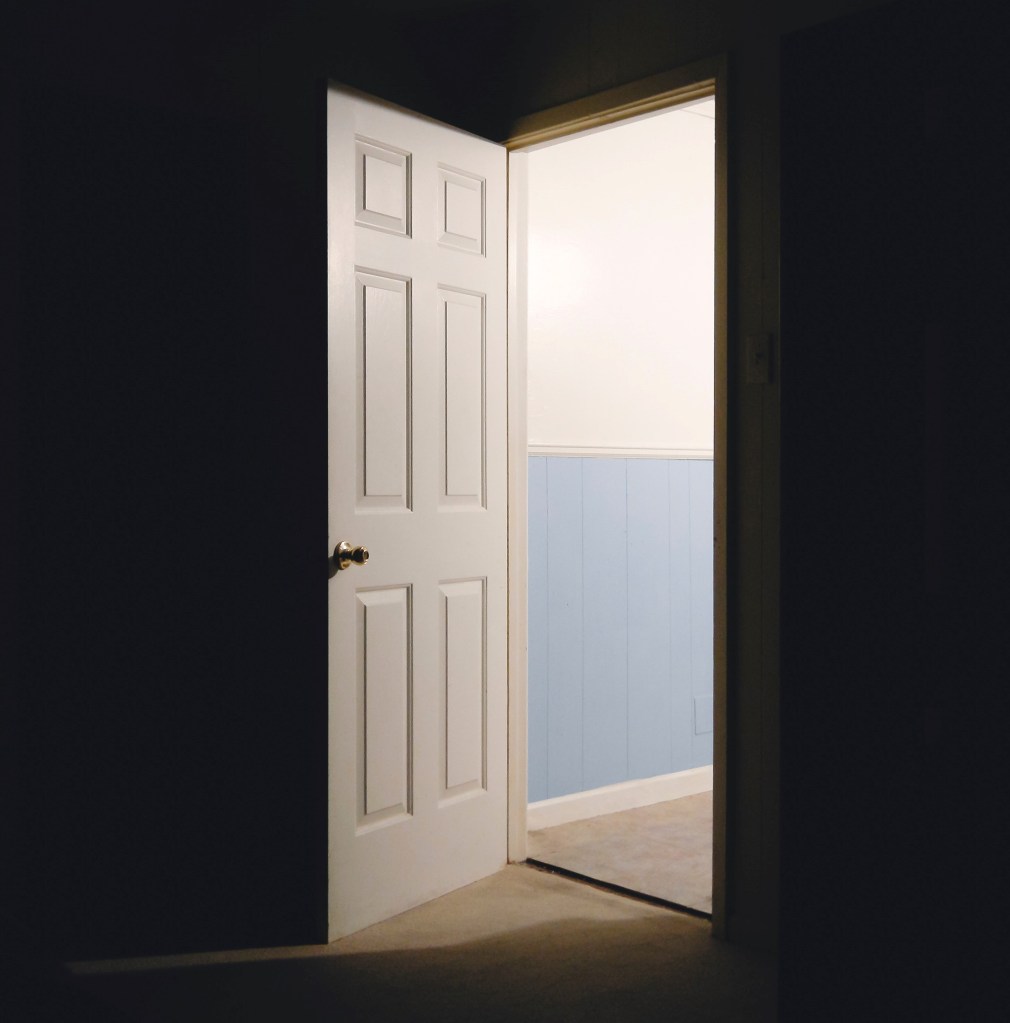
So, this blog is about being honest about the cancer experience. But it’s also about mindfulness. I have to open the door and let the negative feelings into the room so that I can offer them compassion and a kind ear. I sit with them for a while, and eventually, I feel better.

Floating Above It: A Visualization

Sometimes, you really need to get away.

I’ve written about pulling back to get perspective, but this isn’t about that. There are times that you can’t handle looking at a situation, and even less getting close and curious about it. Once in a while, you need to cut your losses and allow yourself to check out for a bit.

From time to time, I have dreams in which I’m fighting an adversary (like a monster), and I leap up into the air and float over the baddie’s head. Not all the way up into the sky, but just-just-just out of reach of their clawing hands, where I’m safe.

That’s what it feels like to release my hold on the earth and allow myself to imagine floating upwards. It is a freeing and positive feeling, often helped by music containing binaural beats and a gentle relaxing drone, as if I were being softly cradled and rocked by the sounds.

Be a bird, just for a little while.

And then I travel. In my mind, the most pleasant view is that over the water, as if a camera had been set free to follow a broad river, meandering along its twists and turns. Or head across the sea towards the shimmering horizon, as the sun descends to kiss the earth in the late afternoon.

Or letting go of gravity and rising upwards into bright, puffy clouds, so far up that the landscape below blurs into purples and blues as you float high above.

This is not about being present and grounded. There will be other opportunities to sit with difficult emotions and create space for them. This is about being able to give yourself what you need during the more difficult times and escape for a short while, breathing into the spaciousness of being somewhere else.

Take a deep breath and enjoy your flight.

~~~~~~~~~~~~~~~~~~~~~~~~~~~~

While it is true that avoiding difficult emotions is not a recommended practice, consider this your glass of wine. Just for today, just to catch your breath.