Oncology Yoga: It’s Not Just for Relieving Stress

(Title image: Photo by Raghu Nath on Unsplash)

Last week I finished up my 75-hour yoga4cancer (y4c) Oncology Yoga teacher training (wow, that’s a mouthful!).

It was about five months of some pretty hefty lessons that spanned the cancer experience, the science of cancer, the science of yoga, the y4c methodology and lots of practice, introspection and critique. And more!

What drew me to this particular specialized yoga training was that it uses yoga as an exercise modality for true mind-body fitness, not simply to help practitioners deal with the stress and anxiety related to a cancer diagnosis, but to tap into the physical benefits of exercise in helping manage treatment-related side effects and prevent cancer recurrence.

Oncology Yoga offers a safe and effective yoga practice keeping the needs of those touched by cancer paramount.
(Photo by Junseong Lee on Unsplash)

I recently spoke with someone who represented another cancer yoga certification. She felt that cancer patients and survivors were not looking for yoga that emphasizes exercise, they wanted the stress-relieving, nurturing aspects of a yoga practice.

And there is some truth to that. I myself made the most use of the Pranayama (breath work) and Dhyana (meditation) aspects of Patanjali’s Eight Limbs of Yoga, of which Asanas (poses) are only one limb, when I was going through my own cancer experience.

But on top of that, I continued to row and lift weights throughout treatment, exercising as soon as I got over the worst days of my chemo. Same thing throughout radiation treatment. Exercise made me feel strong and “normal”, and gave me a sense of control when everything else in my life seemed out of control. This was something *I* could do for myself. It gave me agency over my life.

There is a growing body of evidence that staying physically active before, during and after cancer treatment is incredibly beneficial for survival. The evidence-based y4c Oncology Yoga methodology offers sequences that are appropriate for cancer patients and survivors, taking into account cancer-related side effects. There is ample propping to support the needs of practitioners, while still allowing them to participate in many asanas that you would find in a yoga class that isn’t cancer-oriented, taking care to avoid those that could be harmful.

The y4c methodology incorporates generous propping to allow cancer survivors to participate fully in class while keeping themselves safe.
(Photo by Samantha Sheppard on Unsplash)

No doubt, the stress-relieving aspect of yoga is immensely critical also, at a time when a cancer patient/survivor may be dealing with existential fears. There are studies being run on the impact of mindfulness and meditation as they relate to cancer and results of this research are very promising on a variety of levels.

Oncology Yoga combines the two, mind and body. Breath connects with movement in this specialized vinyasa class. The sequences help with lymphatic drainage, bone and muscle building, relieving constipation, regaining range of motion and more, all the while slowing the breath, calming the mind, lifting the spirit, bringing in a sense of grounding and self-efficacy.

I am very excited about the y4c training and am working on integrating Oncology Yoga principles into classes that I offer. My intent is to use my franticshanti.com platform to post sequences and meditations in the future. Watch this space!

Farming ‘Likes’ on Instagram

(Title image: Photo by Chelsea Gates on Unsplash)

I am a reasonably flexible person although I’ve become less so with age and especially following cancer treatment. Yoga asanas that I used to be able to do…well, they don’t come so easily anymore, if at all.

After going through my yoga teacher training in my 50s and now in the middle of an Oncology Yoga (y4c) certification program, I spend a lot of time feeling like an imposter.

There’s an element of shame to this. I tell myself I should be more flexible, I should have better balance, I should be able to hold more advanced poses and for longer.

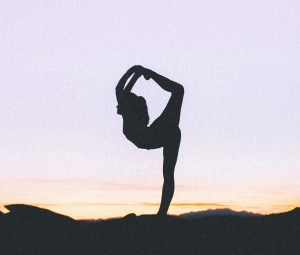
In my y4c training, the manual referenced a concept, versions of which I’ve seen before and have written about myself, but the message continues to hold true (see this article). The proliferation on social media of young, flexible bodies in extremely inaccessible poses for the vast majority of the population not only hurts the practice, but completely misses the point.

It seems like a lot of images that show up as “yoga” on platforms such as Instagram are part (if not wholly) acrobatics and contortions. But yoga is actually a spiritual practice and only one part of it, the one that is overemphasized in the west, is physical.

POV: You’re a cancer patient and your forward-thinking oncologist suggests that you try yoga to help alleviate some of your side effects. But this is what you think of when you hear “yoga”. What are the chances that you’ll try a yoga class? What are the chances that you’ll even find a yoga class that is appropriate for your current condition? Or will be able to afford one?
(Photo by Wesley Tingey on Unsplash)

And that physical practice is a big money maker. If you doubt that, take a look at how many yoga studios exist in affluent areas, and the dearth of studios in more moderate-to-low valued ones.

Yoga was what helped me through my cancer diagnosis, treatments and beyond. But that yoga was minus the “workout”. My workouts during cancer focused more on rowing and lifting weights rather than Sun Salutations and balance asanas. Yoga was for my mind and spirit, to maintain connection and grounding, to not get lost in my fears and to be grateful for what I had.

This is not to say that it’s not impressive when people post challenging asanas on social media. Some of the wonderful teachers that I have trained with have shared those kinds of posts. It’s natural to want to show off a physical achievement that you’ve worked so hard for. In a way, that’s the whole point of social media posts. And that’s also part of the problem with social media.

Frankly, yoga has become deeply entrenched in the United States as a physical practice and nothing is going to change that now. We can be hopeful that those who dutifully attend yoga class, rolled up mat under the arm, will take the time to understand the depth of this ancient practice. But regardless, the flow of the class still brings peace to the mind in a way that my ‘hardcore’ workouts do not.

There are a lot of people who could benefit greatly from the practice of yoga in all its forms, matching breath to movement and developing a mind-body connection. Cancer patients and survivors are some of those people. But if all they know is that yoga demands extreme flexibility, even hypermobility, and statue-like balance, they will avoid the practice as too advanced and inaccessible to them.

If you are a teacher, please keep that in mind. If you are a potential student, please don’t let social media keep you away from such a beneficial form of exercise for both your body and your mind. And if you are a current practitioner, please dig deeper to understand the roots of yoga to honor the cultural tradition from which it arose. It’s not just for likes on Instagram.

“Them’s Fightin’ Words!”: Discussing Cancer Language

(Photo by Thao LEE on Unsplash)

Here’s something that I want to share from my Yoga4Cancer teacher training class. It’s an episode from a BBC podcast on the language that we use to talk about cancer, and it is excellent.

The podcast features a group of people touched by cancer: survivors who have finished their treatment and those who are still undergoing it. In one case, there is a woman who will never finish treatment because she needs to stay on it for the rest of her life.

Their topic of conversation circles around how they describe their situations and how they feel about the words that others use. I don’t want to give too much away because the discussion is engaging and even humorous, so I do encourage you to listen for yourselves.

BBC Radio 4 “Fighting Talk: How Language Can Make Us Better” (https://www.bbc.co.uk/programmes/m0001g8w).

I’d be really interested in knowing what your opinion on this is. Many of us might start with more aggressive talk concerning our cancer diagnoses: fight, beat, battle, etc. And yet as you’ll see, those terms can become problematic. We may get worn down by them as the treatment progresses.

How about “toxic positivity” from others? This is the tendency to push a narrative of upbeat positivity no matter what, even when it’s not appropriate to the situation. Such encouragement often ignores the tumultuous inner state of the cancer patient and can lead to a feeling of isolation

Open discussions about cancer help maintain an active support network for the diagnosed individual.
(Photo by Helena Lopes on Unsplash)

Everyone is different and as cancer survivors, we don’t expect well-meaning friends and family to know what personally irks us: for instance, there are differences between men and women in how they react to “fighting” metaphors. But it’s useful to bring a conversation like this into the open because cancer is one of those diseases that may make people around us feel uncomfortable.

A lot of people may not know what to say in response to your diagnosis, so they’ll say something vague and positive, or even nothing at all…and some may avoid you altogether. That can be unfortunate at a time where community support is especially important.

If you are currently undergoing treatment, understand that many around you might not have the vocabulary for talking about cancer in a way that resonates with you.

And if you are one of those friends who doesn’t know what to say, it can be best to admit that. Trying, “I don’t know what to say because I don’t want to say anything wrong,” can be more heartfelt and helpful than an awkwardly-cheery, “You got this!” or “Don’t give up the fight!”

I hope you enjoy the podcast episode!