Reconsidering Yoga Adjustments

(Title image: Photo by Shashi Chaturvedula on Unsplash)

There is an expectation in the US that yoga practitioners are all young and flexible with great balance, but we know that’s not the case. Many people who might benefit the most from a yoga practice are certainly not.

When I started Yoga Teacher Training (YTT), there were two assumptions that most of us made:

“Full expression of the pose” is not accessible to every yoga practitioner.
(Photo by Carl Barcelo on Unsplash)
  1. Every yogi strives for the “full expression of the pose”, suggesting that there is one perfect way to perform a yoga asana.
  2. An important responsibility of a yoga teacher is to move students into the full expression of the pose, using hands-on adjustments if necessary.

Those two assumptions may:
(1) discourage students from yoga practice, particularly when you consider that yoga originally developed as a practice for men, and asanas do not necessarily take into consideration the female body (or diverse body shapes) even though the majority of practitioners in the US are female; and (2) may compel newly-minted yoga teachers to push students into positions that are wrong for their body shapes and can cause harm to them.

During YTT, however, we learned that the “full expression of the pose” as a concept was no longer taught and teachers were discouraged to refer to asanas in that way, no doubt in an effort to be more welcoming to a broad range of people.
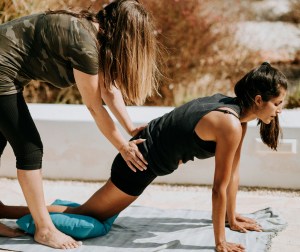
My person belief is that hands-on adjustments are not necessary for yoga under most circumstances.
(Photo by Annie Spratt on Unsplash)

We also learned how to do hands-on adjustments. The idea was that you needed to check with the student whether they wanted to be adjusted.

However, I myself have received adjustments in classes that I hadn’t requested or agreed to. It’s never been harmful to me and generally felt good, especially in settings where I couldn’t check my form in a mirror. Futhermore, the classes tended to be higher level, so there was probably an assumption on the part of the instructor that you’re in a more intense class for a reason, otherwise you’d be in a lower level class.

But you can probably see where I’m going with this. I tended to be one of the oldest students in these classes. I’ve done yoga (and a range of other exercise modalities) for decades, but my flexibility and balance have taken a hit from cancer treatment and various injuries. Unless a teacher is sensitive to that, we can run into trouble.

Additionally, I’ve seen less-experienced students attend more difficult classes because they were coming with a friend or couldn’t get to the easier class that they wanted, and decided to just “do their best”. That should always be good enough without putting a student at harm.

Yogis come in different shapes, sizes and levels of flexibility…and that’s okay.
(Photo by LOGAN WEAVER | @LGNWVR on
Unsplash)

My personal feeling? Stick with gentle verbal adjustments to relay the spirit of the asana and cue according to the class’ level, understanding that students will have varying ranges of flexibility. I do not feel comfortable doing hands-on adjustments unless the student is requesting it AND I know the student well enough to be familiar with their limitations, if any. That means verbal adjustment for students in a general class vs. POSSIBLY hands-on adjustments for a student that I’m teaching privately, where we can talk through how the asana feels in their body. Quite often, I will forgo hands-on adjusting altogether.

Finally, I leave you with a quote from the YogaUOnline.com website. Charlotte Bell proposes a difference definition of “full expression”, in an excellent article titled, What is Full Expression in Yoga Practice?: “Full expression arises in a pose when our bodies are aligned such that the wave of the breath is free to circulate throughout the body. It also happens when we have invested our full attention into the sensations arising as we move and breathe in the pose. The full expression is not dependent on what a pose looks like.”

Why I Get Irritated Searching for Yoga Photos

(Title image: Photo by Katie Bush on Unsplash)

This is getting annoying.

I’ve been posting a lot about yoga, specifically about yoga for cancer populations.

Yoga programming for such populations is *not* your garden variety beginner/intermediate yoga. With the possible exception of well-practiced, life-long yogis who experience a cancer diagnosis, most of the people taking these yoga classes will have limitations to their movement and will need thoughtfully-designed sequences that offer appropriate modifications.

In a number of cases, these individuals may be older (for example, the average age at diagnosis for a woman in the US with breast cancer is 62). Many of them will not have an established yoga practice but may be attracted to yoga due to its reputation as being a mind-body activity: people with cancer not only have to deal with the disease and physical side effects of treatments, but also the emotional repercussions of being diagnosed with a life-threatening illness. Yoga can help.

So why am I irritated? Because the photo databank I use for my blog is replete with photographs of bodies in yoga poses. However, the poses shown are nothing that I would ever consider twisting a cancer patient into.

Make no mistake: the photographs are lovely, the yogis are impressively advanced, but what kind of a message does seeing mainly *these* kinds of yoga photos send to those cancer patients considering trying out yoga?
(Photo by Oksana Taran on Unsplash)

The yogis shown almost without exception are young and flexible. And when I’ve searched for “senior yoga” etc. to increase the diversity of the images…sure, I can find some but they’re locked behind a paywall (mine is a free blog without a budget for such niceities). Apparently, an older individual doing yoga is considered “exotic”.

This type of exclusivity feeds the narrative that yoga is for youthful, injury-free people who have the funds to attend studio classes. Someone who might be older, recovering from surgery, limited in range of motion and conscious about their budget due to treatment costs…well, I wouldn’t be surprised if they felt that yoga wasn’t welcoming of them and their needs.

This is, of course, so ironic, because of all the different exercise modalities, yoga is one of the most perfect for cancer patients. These are the people who need yoga the most!

Yes, I’ve written (griped?) about this topic before. Yes, we’re becoming more accepting of diverse bodies in diverse situations. But good luck trying to illustrate a blog post on yoga for cancer patients with actual photos of cancer patients doing yoga!

~~~~~~~~~~~~~~~~~~~~~~~~~

I’m not expecting to easily find every type of person depicted doing yoga in a given (free) photobank. But in the US we have a problem with making yoga accessible, and the more images that we run of only a certain kind of human doing yoga, the more we inadvertently push the idea that yoga is only for that certain kind of human.

yoga4cancer: Bringing the Benefits of Yoga to Cancer Patients and Survivors [VIDEOS]

(Title image: Photo by Zoltan Tasi on Unsplash)

In February 2022, I started a yoga teacher training program with a singular goal: to eventually teach yoga to cancer patients and survivors.

With its mix of physical postures (asanas), breathwork (pranayama) and meditation, yoga is ideal for someone going through the traumatic experience that cancer can be. Yoga can provide enough physical exertion to count as moderate exercise and the ability to help the practioner calm their mind, things that are so important for improving cancer treatment outcomes. However, classes must be designed carefully and taught thoughtfully.

Yoga4Cancer Q&A for Cancer Patients and Survivors (Yoga Alliance on YouTube)

Keep in mind, yoga teachers were yoga practitioners first. Many of them got really good at the practice, developed great flexibility and balance and gained respect for the tradition of yoga. But that doesn’t automatically make them appropriate yoga teachers for cancer patients, who need an instructor that understands the nuances of what cancer is and how treatment affects us.

A yoga teacher and breast cancer survivor by the name of Tari Prinster addressed that need by creating yoga4cancer (y4c), “an evidence-informed Oncology Yoga method tailored to address the specific physical and emotional needs left by the cancer and cancer treatments. The approach matches breath and movement to stimulate the immune system, improve flexibility & strength, reduce anxiety and boost overall well-being” (from the y4c website).

I’m planning to begin the y4c advanced 75-hour certification program (see informational video here) either later this year or early next. I’ve been so impressed by y4c’s emphasis on understanding the unique situation that cancer patients and survivors are in–it’s not just your garden variety beginner yoga class with “also for cancer patients” dressing. The program is well-thought out and comprehensive, and I’m so excited to embark on this next leg of moving closer to my teaching goal.

In the meantime, here is a selection of videos created by Tari and her instructors that are specifically geared for the mental and physical needs of cancer patients and survivors:

Yoga4Cancer Oncology Yoga for Cancer Related Fatigue (Yoga Alliance on YouTube)
Yoga4Cancer Yoga for Bone Loss (Yoga Alliance on YouTube)
Yoga4Cancer Yoga for Range of Motion (Yoga Alliance on YouTube)
Yoga4Cancer.com Yoga for Anxiety (Yoga Alliance on YouTube
yoga4cancer.com Yoga for Lymphedema (Yoga Alliance on YouTube)
yoga4cancer.com Yoga for Constipation (Yoga Alliance on YouTube)

Enjoy!