Farming ‘Likes’ on Instagram

(Title image: Photo by Chelsea Gates on Unsplash)

I am a reasonably flexible person although I’ve become less so with age and especially following cancer treatment. Yoga asanas that I used to be able to do…well, they don’t come so easily anymore, if at all.

After going through my yoga teacher training in my 50s and now in the middle of an Oncology Yoga (y4c) certification program, I spend a lot of time feeling like an imposter.

There’s an element of shame to this. I tell myself I should be more flexible, I should have better balance, I should be able to hold more advanced poses and for longer.

In my y4c training, the manual referenced a concept, versions of which I’ve seen before and have written about myself, but the message continues to hold true (see this article). The proliferation on social media of young, flexible bodies in extremely inaccessible poses for the vast majority of the population not only hurts the practice, but completely misses the point.

It seems like a lot of images that show up as “yoga” on platforms such as Instagram are part (if not wholly) acrobatics and contortions. But yoga is actually a spiritual practice and only one part of it, the one that is overemphasized in the west, is physical.
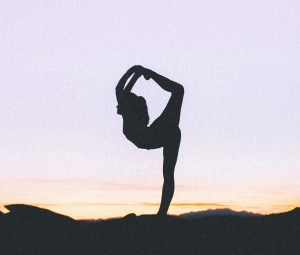
POV: You’re a cancer patient and your forward-thinking oncologist suggests that you try yoga to help alleviate some of your side effects. But this is what you think of when you hear “yoga”. What are the chances that you’ll try a yoga class? What are the chances that you’ll even find a yoga class that is appropriate for your current condition? Or will be able to afford one?
(Photo by Wesley Tingey on Unsplash)

And that physical practice is a big money maker. If you doubt that, take a look at how many yoga studios exist in affluent areas, and the dearth of studios in more moderate-to-low valued ones.

Yoga was what helped me through my cancer diagnosis, treatments and beyond. But that yoga was minus the “workout”. My workouts during cancer focused more on rowing and lifting weights rather than Sun Salutations and balance asanas. Yoga was for my mind and spirit, to maintain connection and grounding, to not get lost in my fears and to be grateful for what I had.

This is not to say that it’s not impressive when people post challenging asanas on social media. Some of the wonderful teachers that I have trained with have shared those kinds of posts. It’s natural to want to show off a physical achievement that you’ve worked so hard for. In a way, that’s the whole point of social media posts. And that’s also part of the problem with social media.

Frankly, yoga has become deeply entrenched in the United States as a physical practice and nothing is going to change that now. We can be hopeful that those who dutifully attend yoga class, rolled up mat under the arm, will take the time to understand the depth of this ancient practice. But regardless, the flow of the class still brings peace to the mind in a way that my ‘hardcore’ workouts do not.

There are a lot of people who could benefit greatly from the practice of yoga in all its forms, matching breath to movement and developing a mind-body connection. Cancer patients and survivors are some of those people. But if all they know is that yoga demands extreme flexibility, even hypermobility, and statue-like balance, they will avoid the practice as too advanced and inaccessible to them.

If you are a teacher, please keep that in mind. If you are a potential student, please don’t let social media keep you away from such a beneficial form of exercise for both your body and your mind. And if you are a current practitioner, please dig deeper to understand the roots of yoga to honor the cultural tradition from which it arose. It’s not just for likes on Instagram.

Why I Get Irritated Searching for Yoga Photos

(Title image: Photo by Katie Bush on Unsplash)

This is getting annoying.

I’ve been posting a lot about yoga, specifically about yoga for cancer populations.

Yoga programming for such populations is *not* your garden variety beginner/intermediate yoga. With the possible exception of well-practiced, life-long yogis who experience a cancer diagnosis, most of the people taking these yoga classes will have limitations to their movement and will need thoughtfully-designed sequences that offer appropriate modifications.

In a number of cases, these individuals may be older (for example, the average age at diagnosis for a woman in the US with breast cancer is 62). Many of them will not have an established yoga practice but may be attracted to yoga due to its reputation as being a mind-body activity: people with cancer not only have to deal with the disease and physical side effects of treatments, but also the emotional repercussions of being diagnosed with a life-threatening illness. Yoga can help.

So why am I irritated? Because the photo databank I use for my blog is replete with photographs of bodies in yoga poses. However, the poses shown are nothing that I would ever consider twisting a cancer patient into.

Make no mistake: the photographs are lovely, the yogis are impressively advanced, but what kind of a message does seeing mainly *these* kinds of yoga photos send to those cancer patients considering trying out yoga?
(Photo by Oksana Taran on Unsplash)

The yogis shown almost without exception are young and flexible. And when I’ve searched for “senior yoga” etc. to increase the diversity of the images…sure, I can find some but they’re locked behind a paywall (mine is a free blog without a budget for such niceities). Apparently, an older individual doing yoga is considered “exotic”.

This type of exclusivity feeds the narrative that yoga is for youthful, injury-free people who have the funds to attend studio classes. Someone who might be older, recovering from surgery, limited in range of motion and conscious about their budget due to treatment costs…well, I wouldn’t be surprised if they felt that yoga wasn’t welcoming of them and their needs.

This is, of course, so ironic, because of all the different exercise modalities, yoga is one of the most perfect for cancer patients. These are the people who need yoga the most!

Yes, I’ve written (griped?) about this topic before. Yes, we’re becoming more accepting of diverse bodies in diverse situations. But good luck trying to illustrate a blog post on yoga for cancer patients with actual photos of cancer patients doing yoga!

~~~~~~~~~~~~~~~~~~~~~~~~~

I’m not expecting to easily find every type of person depicted doing yoga in a given (free) photobank. But in the US we have a problem with making yoga accessible, and the more images that we run of only a certain kind of human doing yoga, the more we inadvertently push the idea that yoga is only for that certain kind of human.

Benefits of Mind-Body Fitness Classes for Cancer Patients: A Preliminary Research Study

If you needed yet another reason to turn to meditative exercise practices in the course of cancer treatment, here it is.

A recent, unpublished study that was presented at the 2023 ASCO (American Society of Clinical Oncology) Quality Care Symposium, entitled “Virtual Mind–Body Fitness Classes Show Unexpected Benefit in People with Cancer” (Mao et al., 2023), examined the effects of virtual mind-body fitness classes on visits to urgent care or unplanned hospitalizations for cancer patients who were in active treatment and were dealing with moderate or greater fatigue.

While mind-body practices are already recommended for cancer patients to help deal with the symptoms of treatment and its emotional fallout, the results of this study illuminated specific benefits. Those patients who had been assigned to the group given access to virtual live mind-body and fitness classes (called Intergrative Medicine at Home, or IM@Home) had fewer hospitalizations and shorter hospital stays, in addition to fewer visits to urgent care, compared to those subjects who were only given access to pre-recorded online meditation resources (Enhanced Usual Care, or EUC).

It’s not surprising that mindfulness benefits cancer patients, although it’s striking how those benefits manifest themselves.

This study was run at the renown Memorial Sloan Kettering Cancer Center (MSKCC) with 200 cancer patients randomized into the two groups (IM@Home and the stan, which makes the design more solid and increases confidence in the results. Nonetheless, as the lead author Dr. Jun Mao (Chief of Integrative Medicine at MSKCC) stated in the National Cancer Institute’s Cancer Currents blog, “I do want to caution that the current trial was designed as an early-phase trial, so we would like to do a larger study with longer follow-up to confirm our results before we are completely confident in the findings.

A larger study is currently in the works. Dr. Mao would like to explore whether these classes help patients follow through on their treatment plans, and if so, whether these patients also live longer.

The IM@Home group’s classes included a variety of classes (again, quoted from Cancer Currents blog): “Some of the classes taught participants movement-based activities such as yoga, tai chi, and dance therapy; other classes taught meditation-based practices, such as music therapy and mindfulness.” It is already known that exercise during cancer treatment can reduce fatigue, but the researchers felt that part of the success of this study was due to the participants’ ability to choose the level of exertion based on how they were feeling at the time of the class.

Looking forward to further research on the ways that we can support cancer patients physically, emotionally and spiritually!

As Dr. Mao pointed out, more directed research on this must be done before drawing specific conclusion, but this was a very valuable pilot program, the results of which would not surprise those of us who have made use of various exercise modalities, particularly those with a mind-body angle, for calming ourselves during our cancer journeys.

The more this subject is studied, the greater the chance that cancer centers focusing on whole-patient treatment will be offering such classes to their patients. COVID taught us that there are ways to make classes accessible to people with limited mobility or conditions that may prevent physical travel to classes.

While I believe that attending mind-body oriented classes in person is ideal, this study illustrated that even virtual opportunities can have significant benefits for the patient.

It’s worth pointing out that of the 200 study participants, 91% were female and 77% were white. That is not a diverse spread and reflects the typical clientele at your average yoga studio (based mainly on my personal observations), with the exception being that the average age of these study participants was 60 years. I would be willing to bet that less-represented groups would benefit greatly from the stress relievers offered here and I hope that the researchers expand their subject pool to balance out the participants in their future study.

Regardless, these are intriguing results that underscore the important of mind-body focused classes, and exercise in general, in the well-being and improvement of cancer patients. This study joins a growing list of research that is changing the way that we look at managing cancer treatment side effects.

~~~~~~~~~~~~~~~~~~~~~~~~~~

REFERENCES:

Reader-Friendly
Windstead, E, Virtual Mind–Body Fitness Classes Show Unexpected Benefit in People with Cancer, Cancer Currents, December 15, 2023:
https://www.cancer.gov/news-events/cancer-currents-blog/2023/mind-body-fitness-cancer-side-effects

Research Study Abstract
Mao, JJ et al., Effect of virtual mind-body fitness program on reduction in unplanned hospitalizations among patients undergoing active cancer treatments: A pragmatic randomized clinical trial, presented at 2023 ASCO Quality Care Symposium, October 28, 2023:
https://meetings.asco.org/2023-asco-quality-care-symposium/15514?presentation=227485#227485 (note: click on “Abstract 473” on right side panel for abstract text)