A Date with the Oncologist…and the Office Scale

This past week I had my “9-years-since-biopsy” oncology appointment. I have sat in that same exam room numerous times since March 2017.

It still smells the same—I think it’s the cleaning solution the Cancer Center uses, but I’ll never forget that scent. On the other hand, numerous improvements in treatments have taken place since my first time there.

One thing that hasn’t changed is that I still get weighed before every doctor’s visit, just like I do for a lot of other health appointments. It’s also been my least favorite part of getting a check up. No, I am not overweight, but as a child I was taller than all my classmates; basically a lean kid with perfectionistic tendancies who was occasionally teased about having a higher number on the scale, which I can assure you is a shortcut to disordered eating. As a result, even now I am sensitive about how much my healthcare team reads into my weight numbers, even though my weight fluctuations tend to be only a few pounds up & down that are not reflected on my frame.

Yes, you would be correct if I seem to get a bit touchy about this.

I weigh myself twice a week at home with a pricey, high-quality scale that provides all sorts of other metrics. The bodyfat percentage is not accurate and tends to report a lower-than-truthful value, so I don’t swear by it. But I have a great deal of confidence in the weight measurement, especially because I control for as many variables (time of day, clothing, etc.) as possible when I weigh myself.
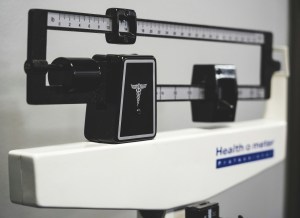
The scale in the exam room isn’t even one of the “good” ones!
(Photo by Samuel Ramos on Unsplash)

The scale in my oncologist’s exam room literally looks like a bathroom scale. It’s not even the typical mechanical doctor’s scale with the weights that you move across that “T” thing that stands in front of you, if you know what I mean. It’s just a basic electronic scale. I’m sure it’s relatively accurate but not what I’d consider a gold standard.

Why am I making such a big deal out of this? Because my weight at my appointment was about 5 pounds heavier than it had been when I weighed myself at home a few days before and about 3-4 pounds heavier than the last time I was at the oncologist’s office.

And my oncologist pointed it out. It struck a chord. Maybe I sensed concern on his part, maybe I interpreted it as disapproval, maybe I just imagined his reaction. But I immediately felt defensive. This was not a 20-pound difference. This was, for all intents and purposes, a few pounds higher than last time.

I work out 4-6 times a week. I lift weights. I do high intensity interval training. I row on an erg. I take the stairs two at a time. And I cannot shake the feeling that it’s never good enough.

I have been a pescetarian for the past 42 years. I eat mainly vegetables and protein. I don’t put sugar in my coffee. I rarely indulge in alcohol or rich desserts. I have been told that I’m TOO disciplined. And it doesn’t seem to matter.

So, yes, I’m sensitive about this because I’ve spent my entire adult life being very careful about diet and exercise. I have been big on avoiding the things that the general public may consider indispensible treats, even though they’re not healthy. And, quite frankly, I prefer it that way and regret nothing.

Eat healthy, exercise, get cancer—but will people believe you did your best?
(Photo by Nadine Primeau on Unsplash)

But still I feel pressure.

Now, if I were decades younger, this might have sent me into an “I-must-be-even-more-disciplined” state and triggered a clamp-down on myself. But I take a deep breath because I know what I look like naked. I can’t change how people think. I can’t change the healthcare system. The scale is here to stay.

But I can say that as judge-y as people get around weight, the negatives extend way beyond those who might be struggling with weight loss or seem not to care. The effects of perceived judgment touch everyone else too, no matter what shape or size you are. And numbers without context can ruin your day.

As cancer survivors we may already have a difficult relationship with our bodies: changes experienced through surgery, not being able to recognize ourselves after chemo, dealing with unexpected effects of endocrine therapy, even the beliefs of others that we did something to bring cancer upon ourselves. That’s a lot to handle when you’re worried about recurrence or a degraded quality of life.

Hey, it’s okay. I get why we get weighed. But sometimes I hate how it makes me feel.

Effects of Diet and Exercise on Chemotherapy Tolerance and Efficacy: Research

(Title image: Photo by Hermes Rivera on Unsplash)

Many cancer patients complain of feelings of helplessness after their diagnosis, and I can certainly relate to that. As a result, I’m particularly interested in research that explores whether patients can gain control over the success of their treatments.

The most recent study I’ve come across includes breast cancer patients undergoing treatment at Yale and Dana Farber Cancer Centers.

This study appeared in the Journal of Clinical Oncology (Sanft et al., 2023). Researchers examined the effect of diet and exercise on “relative dose intensity” (RDI), which is the relationship between the amount of chemotherapy delivered to the patient compared to the standard amount prescribed. Low RDI means that there was a reduction in the chemotherapy the patient received and is generally associated with a poorer outcome. Dose reductions result from the patient’s difficulty in tolerating the drug.

The researchers also looked for “pathologic complete response” (pCR), which is “the lack of all signs of cancer in tissue samples removed during surgery or biopsy after treatment with radiation or chemotherapy” (definition from cancer.gov). This was for women receiving neoadjuvant chemotherapy, which is chemotherapy administered prior to surgery.

Yep, once again we come back to diet and exercise, even during chemo.
(Photo by Yulissa Tagle on Unsplash)

The subjects of this study were women recently diagnosed with stage I-III breast cancer, who either received the “usual care” or a diet and exercise intervention. Those in the intervention group received nutritional counseling with a focus on a plant-based diet. The physical activity included counseling and support for maintaining a home-based exercise program that included strength training (2x/week) and brisk walking (150 min/week of moderate intensity or 75 min/week of vigorous intensity).

What the research confirmed first was that the subjects in the intervention group were able to increase their exercise and diet quality, which showed that it was feasible to make lifestyle improvements even in the midst of chemotherapy.

However, in this study, the RDI for both groups (“usual care” and diet & exercise intervention) ended up being similar, but also quite high, which meant that women in both groups completed most of their treatment. The researchers noted that the study should be re-run with patients who were at greater risk of not being able to complete all their chemo to see how much of an effect improved diet and exercise would have, especially since exercise has been shown in other studies to have a positive effect on patient outcomes.

But a striking difference was seen for women receiving neoadjuvant (prior to surgery) chemotherapy in that the rates of pCR (disappearance of cancer in the tissues) were 53% for women in the intervention group versus 28% for women receiving usual care. That suggests that the intervention enabled the chemotherapy to be more effective.

There are many physical activities you can choose from–clifftop not required.
(Photo by Sigmund on Unsplash)

The researchers stated the following in summarizing their study: “Given that pCR is an accepted predictor of recurrence and mortality, our findings could provide oncologists with a supportive care intervention that affects the ability to potentially improve survival outcomes” (Sanft et al., 2023, J Clin Oncol). And this is very good news indeed.

The take-home message here is not surprising, and it’s good advice for life in general: no matter what your current lifestyle, prioritizing a healthier diet (emphasis on whole foods, plant-based, less processing, etc.) and engaging in regular cardiovascular and strength training exercise will improve your quality of life. It is always worth the effort.

~~~~~~~~~~~~~~~~~~~~~~~~~~

REFERENCE:
Sanft et al. (2023) Randomized Trial of Exercise and Nutrition on Chemotherapy Completion and Pathologic Complete Response in Women With Breast Cancer: The Lifestyle, Exercise, and Nutrition Early After Diagnosis Study. J Clin Oncol, 41: 5285–5295. https://doi.org/10.1200%2FJCO.23.00871. [This paper is Open Access and can also be found in PubMed Central: https://www.ncbi.nlm.nih.gov/pmc/articles/PMC10691793/]